Gods and Goddesses – Overview of the Olympian Gods and Goddesses

I am using just one website greek-gods.org for this overview of Greek Olympian Gods and Goddesses so, if I missed any please let me know in the comments section. Thank you!

If you studied Greek mythology in school these would be the deities you might be most familiar with. There are other names mentioned in books on Greek mythology which I will list tomorrow but will probably not be doing individual posts on in the future.

The Olympian gods, main Greek gods

The Olympian gods or Olympians are younger gods who got the name after their mythical place Mount Olympus. They had gained rank as the rulers of the world after dethroning the elder gods, known also as the Titans, in a ten-year war called Titanomachy. The Olympians, as they called themselves, were the main gods of Ancient Greece and were representing civilization of the world.

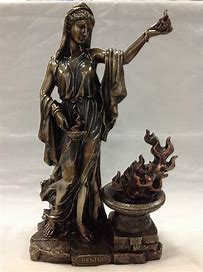
The first generation Olympians were descendants of a titan couple Cronus and Rhea. Together they gave birth to six children, three sons and three daughters. The sons were PoseidonHadesZeus and daughters HeraHestia and Demeter. Zeus, Poseidon, Hera and Demeter are always considered as Olympian gods while Hestia and Hades are only included at some point of their existence. Hades was supposed to live on Mount Olympus and had every honour and right to but was given the realm of death under his control, when the three brothers had to split the cosmos after the victory over titans. And Hestia lived there just for a short period. After being granted a place on Mount Olympus by Zeus she eventually, because of her modesty, gave away her place to keep peace among gods because there were only twelve places on Mount Olympus, and the desire for these was huge among gods. The second generation Olympians were AthenaAresHermesDionysusApolloArtemis and HephaestusAphrodite is also sometimes considered as the second generation goddess but is in general referred to be from the titans generation. Anyway, all of these gods are referred as Olympian gods and together they presided over every aspect of human life.

The Olympian Gods

Titans generation

First generation

Click on the hyperlink for each God or Goddess for more information about them. I will post on each individually in the days and weeks to come.

Gods and Goddesses – An Overview of Greek Titans Gods

I am using just one website greek-gods.org for this overview of Greek Titans Gods and Goddesses so, if I missed any please let me know in the comments section. Thank you!

The Titans, elder Greek gods and first divine rulers

The mighty Titans were a powerful race that ruled the world before Olympians, in a time of the Golden Age of men. They were immortal giants of incredible strength and knowledge of old religion rituals and magic. They are also known as the Elder Gods and their dwelling place was at Mount Othrys. In Greek culture they were interpreted as personifications of the earth (Gaea) and the sky or heavens (Uranus).

The first generation of Titans were descendants of Gaea and Uranus who originally gave birth to Twelve Titans, six males and six females. Males were CoeusCronusCriusHyperionIapetus and Oceanus and females were MnemosynePhoebeRheaTheiaThemis and Tethys. They arose to power when Cronus, in a plot with his mother and his brothers, castrated his father Uranus and took the rulership of Cosmos from him. More details about this conflict can be found in the Genesis

During this reign, the titans and other primeval gods decided to pass on the godly genes and gave birth to the second generation of Titans. Hyperion and Theia gave birth to EosHelios and Selene, while Coeus and Phoebe brought forth Leto and Asteria. Oceanus and Tethys gave birth to Oceanids and Potamoi who are in general not referred as Titans. However, an Oceanid Clymene, a daughter of Oceanus and Tethys, helped Iapetus to continue the next generation and bore him AtlasPrometheusEpimetheus and Menoetius. Crius and his half-sister Eurybia, a daughter of Gaea and Pontus, brought forth AstraeusPallas and Perses and, eventually, Cronus and Rhea gave birth to younger gods, ZeusHadesPoseidonHeraHestia and Demeter who rebelled against Cronus and his followers and later defeated them in a ten-year war, known as Titanomachy. They called themselves the Olympian Gods, after Mount Olympus which was their main dwelling place, and became the new rulers of Cosmos.

The Titans

Click on the hyperlink for each God or Goddess for more information about them. I will post on each individually in the days and weeks to come.

First generation

Crius

Cronus

Hyperion

Iapetus

Mnemosyne

Oceanus

Phoebe

Rhea

Tethys

Theia

Second generation

Eos

Epimetheus

Helios

Leto

Prometheus

Goddesses – Nephthys

Egyptian goddess Nephthys

Nephthys was an ancient goddess, who was referenced in texts dating back to the Old Kingdom. She was a member of the Ennead of Heliopolis as the daughter of Geb and Nut and the sister of OsirisIsis, and Horus, as well as the sister and wife of Set. When the Ennead and Ogdoad merged, Nephthys was given a place on Ra’s boat so that she could accompany him on his journey through the underworld.

Nephthys is the Greek pronunciation of her name. To the Ancient Egyptians she was Nebthwt (Nebhhwt or Nebthet) meaning “the Mistress of the House”. The word “hwt” (“house”) may refer to the sky (as in Hwt-hor, the “House of Horus” – the name of Hathor), but it also refers to either the royal family or Egypt as a whole. The latter makes a great deal of sense as she was described as the head of the household of the gods and was thought to extend her protection to the head female of every household. She was sometimes associated with Ptah-Tanen in representing Lower Egypt, while Khnum and Isis represented Upper Egypt.

It seems that Nephthys was originally conceived of as the female counterpart of Set. He represented the desert, while she represented the air. Set was infertile (like the desert that he represented) and was frequently described as either bisexual or gay, and so Nephthys was often considered to be barren.

As a goddess of the air, she could take the form of a bird, and because she was barren she was associated with the vulture – a bird which the Egyptians believed did not bear children. The Egyptians thought that all vultures were female (because there is very little difference in the appearance of a male vulture), and that they were spontaneously created from the air. While the care shown by a mother vulture for her child was highly respected, the Egyptians also recognised that vultures fed on carrion and associated them with death and decay. As a result, Nephthys became a goddess of death and mourning.

Professional mourners were known as the “Hawks of Nephthys”, in recognition of her role as a goddess of mourning. It was also believed that she protected Hapi in his role as of the Four sons of Horus (who guarded the organs stored in the four canopic jars). Hapi protected the lungs, and as a goddes of the air Nephthys was his guardian.

She was also one of the four goddesses who guarded the shrine buried with the pharaoh. She appears with IsisSelkit (Serqet), and Neith on the gilded shrine of Tutankhamun, but was often depicted with IsisBast, and Hathor in this role. Yet, she was also said to be the source of both rain and the Nile river (associating her with Anuket) and was thought to protect women in childbirth (with the assistance of her sister, Isis). Thus she was closely associated with both death and life.

Although she was technically infertile, later myths claimed that Nephthys was the mother of Anubis by either Osiris or Set (depending on the myth). This came about because Anubis’ position as the god of the dead was usurped by Osiris when the theologies of the Ennead and the Ogdoad merged.

According to one myth Nephthys disguised herself as Isis to get the attention of her neglectful husband Set, but instead seduced Osiris (who apparently did not realise that it was Nephthys). An alternative myth made it clear that Nephthys intended to seduce Osiris from the beginning and drugged his wine to make her task easier, while a less common myth held that she tricked her husband into a brief dalliance in order to conceive Anubis. It is suggested that this tale also explained the flowering of a plant in a normally barren area because Set apparently discovered the adultery when he found a flower left by his brother Osiris.

Isis and Nephthys were very close despite Nephthys’ alleged infidelity with Osiris (the husband of Isis) and her marriage to Set (the murderer of Osiris). Nephthys protected the body of Osiris and supported Isis as she tried to resurrect him. The goddesses are so similar in appearance that only their headdresses can distinguish them and they always appear together in funerary scenes.

Together Isis and Nephthys could be said to represent day and night, life and death, growth and decay. In Heliopolis, Isis and Nephthys were represented by two virginal priestesses who shaved off all of their body hair and were ritually pure.

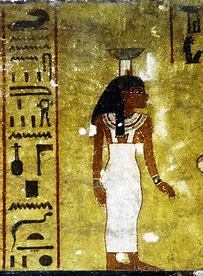
Nephthys was usually depicted as a woman with the hieroglyphs of her name (a basket on top of the glyph representing the plan of an estate) on her head. She could also be depicted as a mourning woman, and her hair was compared to the strips of cloth used in mummification.

Nephthys also occasionally appears as a hawk, a kite, or a winged goddess in her role as a protector of the dead. Her major centers of worship were Heliopolis (Iunu, in the 13th Nome of Lower Egypt), Senu, Hebet, (Behbit), Per-mert, Re-nefert, Het-sekhem, Het-Khas, Ta-kehset, and Diospolites.

Goddesses – Vesta

Roman Goddess Vesta from gods-and-goddesses.com

Vesta is the Roman goddess of the hearth. The hearth is the stone floor surrounding a furnace or fireplace. This was important to the Romans, because sources of fire for cooking, lighting, and heating homes were not easy to acquire. Therefore, once a fire was started, it had to be fueled and maintained so that it could keep burning and other fires could be lit from it. This was done at both public hearths and in those of private homes. The hearth also represented family life, and therefore the community life of the Roman State.

Vesta Facts

Name(s): Vesta
Rules over: Home, Hearth
Gender: Female
Symbols: Hearth and Fire, Flame
Sacred animals: Donkey
Parents: Saturn (Father) and Ops (Mother)
Siblings: Jupiter, Ceres, Juno, Pluto, Neptune
Greek Similar: Hestia
Norse Similar: Frigg

Origins

Vesta is one of the original gods of Rome, born to her parents, Saturn and Ops. Saturn became concerned when an ancient prophecy was revealed and told about his children becoming his undoing. He worried about the prophecy and decided to eat his children as they were born, in order to keep his position as king of the Roman gods.

The first-born child of Saturn was Vesta. She was the first to be eaten by the Titan. Saturn would then eat four of her siblings. Eventually, a stone was given to Saturn by Ops in place of the last child, Jupiter, which made him vomit the five children out of his body.

Vesta was the oldest of the children of Saturn and Rhea, but she was the last to return from his stomach, making her both the youngest and the oldest of the children of the Titans.

Appearance

Vesta is a goddess living in a state of eternal innocence and virginity, based on the stories of her life. Vesta’s innocence is shown in artworks, with her always being fully-clothed and appearing in a homely setting. The myths associated with Vesta are based on her life, with Jupiter choosing to keep the peace between Apollo and Neptune over the destiny of the goddess.

Family

The most interesting part of the family life of Vesta was her birth story. The siblings of Vesta include JupiterNeptune, Pluto, Venus and Juno. There are no children associated with Vesta because she decided to ask Jupiter to allow her to remain untouched, and maintain her virginity forever. The myth of the virginity of Vesta explains that a war would have broken out between Neptune and Apollo for the hand of the goddess, had Jupiter not decided Vesta would remain pure forever.

Symbols

Vesta is often seen accompanied by a donkey. This was her animal of choice in her role as patroness to the bakers. Her fire was needed to bake the bread, as was the the donkey’s strength to turn the mill stone, making flour. The braying of the donkey was also said to ward off the lustful advances of other gods.

The symbol of Vesta is the kettle, which was used on the hearth of every Roman home to heat water. Vesta is depicted in a homely setting in most of the images of the goddess, with Vesta often linked directly with a flame lit beside her.

Powers & Duties

Vesta chose to take up the role of the protector of the home fires of Rome, which led to her followers becoming responsible for tending the fires of the Senate. The Vestal Virgins remained untouched and locked away from human view apart from one day per year. Vesta was responsible for the health of the people of Rome and protected the work of bakers reliant on the fire Vesta created.

Myths & Stories

Few myths of Vesta exist today. Roman poet Ovid relates a story in which the fertility god Priapus attempted to seduce Vesta. He was foiled by the loud braying of her donkey. It is thought that her worship was introduced by Numa Pompilius, second king of Rome, between 715 and 673 B.C.

Worship

Each sanctuary or temple of Vesta was usually a circular building that mirrored the round huts formerly used as dwellings in Italy. The shape was also symbolic of the hearth. One such Temple of Vesta was located in the Roman Forum, on the Pallatine Hill, built in the third century B.C. A fire was kept burning there continually by a group of six priestesses called the Vestal Virgins. These priestesses were selected for service by the pontifex maximus, or chief priest, between the ages of six and ten, and served in the temple for at least 30 years. During that time, they tended the fire, prepared ritual food offerings, drew water from a spring outside Rome, lived in the House of the Vestals near the temple, and had to maintain their virginity. If one of the Virgins broke her vow of chastity, the punishment was to be buried alive. After the 30 years had passed, they were free to marry. The Vestals enjoyed a high social status in Rome.

Each year on the Roman New Year, March 1, the perpetual fire in the temple was ritually extinguished and re-lit. If the fire went out at any other time, it was seen as a bad omen for Rome. The festival to Vesta, called the Vestalia, was held on June 7 to 15. Rituals included sweeping out the temple and ritually disposing of the sweepings. The festival was considered a time of bad luck until the sweeping was completed. Normally, the inner sanctuary of the temple, called the penus Vestae, was not open to the public, but on the first day of the festival, women bearing gifts could visit if they entered barefoot. The sacred fire of Vesta was maintained until 394 A.D., when most Roman religious cults were banned.

Because of the need for fire in everyday life, Vesta was worshiped in nearly every Roman home as well. Many homes had a household shrine that included an image of Vesta. She was often worshiped alongside household deities called Penates.

Art

Statues and other artwork depicting Vesta typically show her draped in long, full robes, wearing a stern expression and with her head covered. She often holds a scepter in one hand. Interestingly, a statue of the goddess was not included at any of her temples. However, the penus Vestae housed the Palladium, a statue of the Trojan Athena. This object was considered too sacred for a man too look upon. When it was rescued from a fire that destroyed the temple in 241 B.C., the rescuer – Roman Consul L. Caecilius Metellus, was then blinded for having seen the sacred statue. However, he was also afforded great honor for the daring rescue.

Today

As with many ancient deities, Vesta’s legacy continues in the naming of interstellar objects. In 1807, the asteroid now called Vesta was discovered by Wilhelm Olbers. It is the brightest and second largest asteroid in our solar system’s asteroid belt.

Facts about Vesta

  • Vesta is the Roman goddess of the hearth.
  • Hestia is the Greek goddess who is equivalent to Vesta.
  • Vesta is commonly associated with the donkey and fire.
  • Vesta is the protector of home fires of Rome.
  • She was the oldest of Saturn’s six children.
  • In mythology, she and four of her siblings were eaten by her father, Saturn.
  • A Roman festival called Vestalia was dedicated to her and held from June 7 to 15.
  • The words “Vesta” and “vestibule” are likely derived from similar roots, as vestibule means “a dwelling or front area of a house”.
  • Few ancient statues of the goddess exist.

Goddesses – Ammit

Ammit Egyptian Goddess of Divine Retribution from ancientegyptonline.co.uk

The ancient Egyptian goddess Ammit (also known as Ammut and Ahemait) was the personification of divine retribution. She sat beside the scales of Ma’at ready to devour the souls of those deemed unworthy. Those unfortunate enough to fail the judgement of the dead would suffer the feared second death, and have no chance of the blissful life of the field of reeds, instead roaming restlessly for eternity.

Thankfully, the judges (Osiris or Anubis) were not too harsh, and the prosecutor (Thoth) was a pretty enlightened guy. The deceased made a negative confession (i.e. they listed the large number of evil things they had never been guilty of) and then their heart was weighted against the feather of Ma´at (justice or balance). It was not necessary to be totally good, just reasonably well balanced. There were also a number of spells and amulets the deceased could use to increase their chance of success.

Her name, is generally translated as “Devourer”, but could also be the chilling “Bone Eater”, and she was known as “Devourer of Millions” leading to the suggestion that the god Am-heh was one of her aspects. Some scholars have linked Ammit with the Hippopotamus goddess Tawaret, because of the similarities in their appearance and their role in fighting evil. According to some traditions, she lived by the scales of justice, but other sources suggested that she (like Am-heh) lived by a lake of fire into which the souls of the guilty were thrown. According to these traditions, she did not devour the souls, but protected the lake. This has led some to suggested that she may be linked to Sekhmet due to her lionine characteristics and her role in protecting a lake of fire.

She was generally depicted as a demon with the head of a crocodile, the torso of a wild cat, and the hindquarters of a hippopotamus. However, she also took human form.

Ammit was never worshipped, and was not strictly a goddess, but her image was thought to ward off evil. She was the personification of all that the ancient Egyptians feared and a reminder to live by the principles of Maat. Although she was referred to as a demon, she was in reality a force for order. Moreover, each person was at least given the chance to defend their actions before being consigned to eternal damnation. The heart scarab was used to encourage the person’s heart not to speak out against them and the negative confession allowed a person to defend themselves by pointing out all of the evil actions they had NOT taken.

Ammut in Moon Knight

Recently Ammut (or Ammit) has given a bit of a makeover by Marvel. As a servant of Maat she is given a more active role in judging the dead. She is described as a riddle asking sphinx in the comics (a role ascribed to the sphinx by Greek, not Egyptian mythology).

In the series “Moon Knight” her character is further developed and she is said to want to judge the living for crimes they have yet to commit. She is given power over the scales (as opposed to being restricted to acting upon their judgement). This is a bit of departure for her, but makes for an interesting premise. The series places her in opposition to the god Khonshu. It is suggested that she has been trapped to prevent her from taking vengeance on the living (presumably by Khonshu) and that a winged scarab can lead the way to her tomb.

  • Bard, Kathryn (2008) An introduction to the Archaeology of Ancient Egypt
  • Lesko, Barbara S (1999) The great goddesses of Egypt
  • Pinch, Geraldine (2002) Handbook Egyptian Mythology
  • Redford Donald B (2002) Ancient Gods Speak
  • Wilkinson, Richard H. (2003) The Complete Gods and Goddesses of Ancient Egypt

Goddesses – The Morrigan

The Morrigan – Celtic Goddess of War, Fertility and Sovereignty

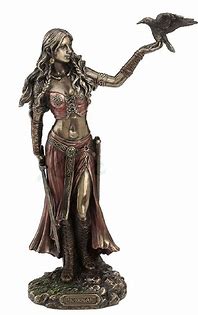
The Morrigan goddess is usually thought of as the Celtic goddess of war and sometimes the Celtic goddess of death, but she has strong association with fertility and sovereignty as well. Gifted with the ability to shapeshift, she has the capacity to take many forms, but commonly takes the form of a crow.

She is a complex deity known as the Phantom Queen, who is both a single goddess and also a triple goddess. The triple goddess is composed of the goddesses BadbMacha and Nemain.

The crow symbol is thought to connect with Badb (meaning crow in Irish). As a crow, she would fly over the battlefield and either encourage or instill fear in the warriors below. She is also said to have the ability to foretell the outcome of battles and predict violent deaths.

Macha is more usually connected with the land and its fertility and is seen as a protector. There is a strong link between Macha and horses, as well as other livestock. It has been suggested that the origin of her name possibly stems from an area used to graze cattle.

The frenzy of battle is connected with the aspect of Nemian. She is said to be responsible for the rage and fury of a battle and her terrifying scream can kill or paralyze a man.

Badb and Nemain were the wives of Neit, the Irish god of war.

According to some versions, the war goddess Morrigan is the wife of the Dagda and they have a special coupling around the feast of Samhain.

She also set her sights on Cú Chulainn and tried unsuccessfully to seduce him. After a series of failed attempts to seek revenge on him, she ultimately correctly prophesied his death in battle.

Goddess – Heqet

Egyptian Goddess Heqet from symbolsage.com

Heqet, also known as the ‘Frog Goddess’ was the Ancient Egyptian goddess of fertility and childbirth. She was one of the most important goddess of the Egyptian pantheon and was often identified with Hathor, goddess of the sky, of fertility and women. Heqet was usually depicted as a frog, an ancient fertility symbol and was much revered by mortals. Here’s her story.

Heqet’s Origins

Heqet is first attested to in the so-called Pyramid Texts from the Old Kingdom, where she helps the pharaoh along his journey through the Underworld. She was said to be the daughter of the sun god, Ra, the most important god in the Egyptian pantheon at the time. However, her mother’s identity remains unknown. Heqet was also considered the female counterpart of Khnum, the god of creation and she was the wife of Her-ur, Haroeris, or Horus the Elder, the Egyptian the god of kingship and the sky.

Heqet’s name was said to have the same roots as the name of the Greek goddess of witchcraft, ‘Hecate. While the actual meaning of her name isn’t clear, some believe that it was derived from the Egyptian word ‘heqa’, meaning ‘scepter’, ‘ruler’, and ‘magic’.  

Depictions and Symbols of Heqet

One of the oldest cults in Ancient Egypt was the worship of the frog. All frog deities were believed to have had an important role in the formation and creation of the world. Before the inundation (the annual flooding of the River Nile), frogs would begin to appear in large numbers due to which they later became associated with fertility and the beginning of life on earth. Heqet was often portrayed in the form of a frog but was also portrayed as a woman with a frog’s head, holding knives in her hand.

In the story of the Triplets, Heqet appears as a frog with ivory wands that looked more like boomerangs rather than like the batons magicians use today. The wands were to be used as throwing sticks. It was believed that if these ivory wands were used in rituals, they would draw protective energy around the user during dangerous or difficult times.

Heqet’s symbols include the frog and the Ankh, which she is sometimes depicted with. The Ankh signifies life and is also considered as one of Heqet’s symbols since giving people new life was one of her main roles. The goddess herself, is regarded as a symbol of fertility and abundance.

Heqet’s Role in Egyptian Mythology

Aside from being the goddess of fertility, Heqet was also associated with pregnancy and childbirth. She and her male counterpart often worked together to bring life into the world. Khnum would use the mud from the River Nile to sculpt and form human bodies on his potter’s wheel and Heqet would breathe life into the body, after which she would place the child in a female’s womb. Therefore, Heqet had the power to bring the body and spirit into existence. Together, Heqet and Khnum were said to be responsible for the creation, formation and birth of all living beings.

Another of Heqet’s roles was the role of a midwife in Egyptian mythology. In one story, the great god Ra sent Heqet, Meskhenet (the goddess of childbirth), and Isis (the Mother goddess) to the royal birthing chamber of Ruddedet, the royal mother. Ruddedet was about to deliver triplets and each of her children were destined to become pharaohs in the future. The goddesses disguised themselves as dancing  girls and entered the birthing chamber to help Ruddedet deliver her babies safely and quickly. Heqet quickened the delivery, while Isis give the triplets names and Meskhenet predicted their future. After this story, Heqet was given the title ‘She who hastens the birth’.

In the myth of Osiris, Heqet was regarded as a goddess of the final moments of birth. She breathed life into Horus as he was born and later on, this episode became associated with Osiris’ ressurection. Since then, Heqet was regarded as a goddess of resurrection as well and she was often depicted on sarcophagi as a protectress.

Cult and Worship of Heqet

Heqet’s cult probably began back in the early dynastic periods as frog statuettes created in that time were found that may be depictions of the goddess.

Midwives in ancient Egypt were known as ‘servants of Heqet’, as they helped deliver babies into the world. By the New Kingdom, amulets of Heqet were common among mothers-to-be. Since she was associated with resurrection, people began to make amulets of Heqet with the Christian cross and with the words ‘I am the resurrection’ on them during the Christian era. Pregnant women wore amulets of Heqet in the form of a frog, sitting on a lotus leaf, since they believed that the goddess would keep them and their babies safe all throughout their pregnancy. They continued to wear them right through the delivery as well, in hope of a quick and safe delivery.

In Brief

The goddess Heqet was an important deity in Egyptian mythology, especially for pregnant women, mothers, midwives, commoners and even queens. Her association with fertility and childbirth made her an important deity during the ancient Egyptian civilization.

Goddess Of The Day is Blodeuwedd c. 2011

Blodeuwedd

by Karen Davis
Blodeuwedd was created out of flowers by Gwydion to wed Llew Llaw Gyffes. She betrayed Llew, either because she had no soul, being non-human, or because she resented being his chattel, or because the triplet of one woman and two men must play itself out in Welsh myth, and Llew Llaw Gyffes must die. At any rate, she fell in love with Goronwy and, wishing to be rid of Llew, she tricked out of him the clearly supernatural and ritual manner in which only he could be killed: neither by day nor night, indoors nor out of doors, riding nor walking, clothed nor naked, nor by any weapon lawfully made. She asked him to explain this, and he did: he could be killed only if it were twilight, wrapped in a fish net, with one foot on a cauldron and the other on a goat, and if the weapon had been forged during sacred hours when such work was forbidden. Blodeuwedd convinced him to demonstrate how impossible such a position was to achieve by chance, and when he was in it, het lover Goronwy leapt out and struck. Llew was transformed into an eagle and eventually restored to human form, after which he killed Goronwy. Blodeuwedd was transformed into an owl, to haunt the night in loneliness and sorrow, shunned by all other birds.

Goddesses – Skadi

Norse Goddess Skadi from gods-and-goddesses.com

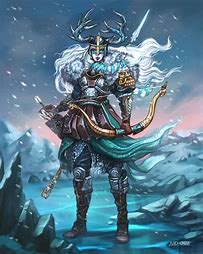
Skadi is the Norse giant goddess of winter, hunting, and skiing. Known as the snowshoe goddess, she rules over mountains, wildernesses, winter, revenge, knowledge, damage, justice, and independence. Passionate in her pursuits, especially in the pursuit of justice, Skadi is determined to live how she wants and not be told by the gods of Asgard.

Skadi lives in the highest part of the mountain where the snow never melts in her father’s grand hall, Thrymheim. Odin once described her home as the “ancient court” and described her as the shining bride of the Gods. Skadi, a giant, is the enemy of the gods of Asgard. Being a giant, she is associated with darkness, cold, and death, just like winter. However, Skadi is seen to be more benevolent than the rest of her giant kin.

Skadi Facts

Name(s): Skadi
Rules over: Winter, Hunting
Gender: Female
Symbols: Bow and Arrow
Linked Animals: Wolves
Parents: Thiazi (Father) and Njord (Mother)
Siblings: Many half-siblings
Greek Similar: Boreas
Roman Similar: Aquilo

Family

However, Skadi becomes welcomed by the gods of Asgard when she marries one of them. Her father, the giant Thiazi, kidnapped the goddess Idun, the beautiful goddess of youth, and, therefore, the gods’ apples of immortality. Odin killed him for doing so and rescued Idun. However, Skadi was furious and determined to avenge the death of her father. She took her weapons and stormed the citadel of Asgard claiming for either revenge or compensation—she gave them the choice of a harmful or benign consequence. The gods, scared of the ferociousness of Skadi, decided they’d rather give her gold. Skadi didn’t want gold, since she was already rich from her father and grandfather’s pillaging. Odin then offered her a husband from among the Asgardian gods, giving her the status of goddess. She agreed, but Odin said she could only look at the gods’ shoes to choose her husband. Skadi agreed, hoping that she’d pick handsome Baldur, whom she had a crush on, but she chose ugly Njord, the god of the sea, because he had the best shoes.

Njord and Skadi’s marriage didn’t last long—only half a month. Njord couldn’t stand the cold and isolated mountains and Skadi couldn’t stand the brightness and noise of the coastline. So, they got a divorce. There are different myths as with whom Skadi ended up afterwards. Some say she got together with Ullr, the god of winter and archery. But, some say she married Odin and gave birth to many sons with him.

Symbols

Her bows, skis, and snowshoes are her most mentioned attributes as she is very skilled at using them all to hunt and to engage in battle.

Powers & Duties

Skadi is the Norse goddess of winter. She is the personification of strength, courage, and endurance, but is also known for her revenge as well.

Facts About Skadi

  • Skadi is pronounced SKAHD-ee;
  • Her name means “harm” or “shadow”;
  • Skadi’s name also relates to “Scandinavia,” which is said to be “Skadi’s Isle”;
  • One of Saturn’s moons, “Skathi,” is named after Skadi;
  • One of the reasons she is called the snow-shoe goddess is because she was forced to choose a husband from the gods by only looking at their shoes;
  • Skadi may not have even had snow-shoes. Some believe that the translation for snow-shoes is actually supposed to be skis;
  • After a feast, Loki started talking to Heimdall and Skadi interrupted, telling Loki he was too “light-hearted” and wouldn’t be having fun much longer because he would be bound to a sharp rock with the ice-cold entrails of his dead son;
  • Loki claimed that he got Skadi into his bed, which she denies. Loki was known to say the same about numerous goddesses;
  • When Loki was captured and bound, Skadi placed above his face a venomous snake that dripped venom onto him, causing him so much pain that it earthquakes result.

Goddesses – Freya

Norse Goddess Feyra from wytchymystique.com

Her Story:

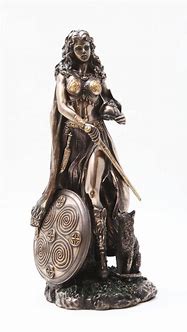
Freya is the Norse goddess of love and war, “Queen of the Valkyries” and “Mistress of Cats”, a divine escort for the souls of the dead and especially for fallen warriors, taking them through to the afterlife.

This goddess is considered a poet’s muse and inspiration.  She’s invoked for issues involving relationships, particularly in matters of love and family.  Freya is also a potent goddess in matters of sensuality and sexuality, igniting passion.  She is considered the most beautiful of the goddesses and totally irresistable to mortal males.

In honor of Freya, Mistress of the Cats, here’s a wee bit of herbal cat magick.  Use the correspondences for this goddess, as well as the correspondences for this herb, to cast some wild wicked cat magick.

Catnip is commonly used in sleeping potions. The easiest and most pleasant way I can think of to use catnip for this purpose is to make a delicious pot of tea. Catnip is one of the herbs that I grow in my own garden, so all I have to do when I want to brew a pot of catnip tea is to step outside and snatch a handful of the fresh herb. I usually use both the flowers and the leaves. How much you use is going to depend upon how strong you like your tea and the size of your pot. You can sweeten it with honey or sugar. Since catnip is a member of the mint family, I’m guessing that if you like mint in your tea, you’ll like catnip, though to me it is more pungent.

Catnip has an absolutely intoxicating effect on cats, and it was actually hard getting the catnip started in my garden because my cats wouldn’t leave it alone. I’d plant a nice lush bunch of catnip, and the next morning I’d go out to find nothing but bare stems.  I can’t tell you how many times we’ve looked out the kitchen windows to watch one of our cats, or a stray cat, rolling around our garden in drunken bliss.

Catnip is sacred to all pagan gods/goddesses who manifest as a cat or feline creature, including: Sekhmet, Bast, Mau, Tefnut, Mafdet, and Freya.

Correspondences for Catnip:

Energy: Feminine (Receptive)
Planet:  Venus
Element: Water
Magick:  cat magick, love, beauty, well-being

It’s believed that a gift of catnip from you to your cat will create a magickal and psychic bond between the two of you. Since I’ve experienced this myself, I have to say that it truly works in beautiful ways. If you make a catnip talisman for your kitty, keep this in mind. Remember that concentrating on your intentions when crafting magickal items imbues that object with the magick. Catnip is also used in love spells, often as an ingredient in mojo bags or candle magick. Just as the cat finds this herb intoxicating and irresistable, so will the one you target in love magick, using catnip to draw them to you. Hang a bunch of dried catnip over the threshold of your home to draw good spirits and good luck, as well as to draw the blessings of cat goddesses. Catnip is also used in beauty spells, either as a tincture you can use to bathe your face, or with candle magic. It’s believed that this herb will mesmerize those targeted in such spells to see you as youthful and beautiful. This type of enchantment is considered a glamoury.

Embracing the Goddess:

Freya is the goddess for all of us “Crazy Cat Ladies”, and I’m proud to count myself in this company.  Call upon this goddess when working cat magic, to call upon the cat as a totem animal, or just to honor this magical creature.

Freya’s Correspondences:

Herbs: catnip, geranium, willow, goldenrod, magnolia
Animal: cat
Color: green, pink
Planet: Venus
Day: Friday
Element: Water
Feminine Face: Maiden
Symbol: cats, the number 13

Goddesses – Flora

Roman Goddess Flora from wytchymystique.com

Her Story:

Flora, the Roman goddess of spring, rules flowers, foliage, and springtime.  Her festivals are celebrated in April and early May.  Flora’s energies and influences include the protection of vegetation from disease, flowering plants and fruits, as well as menstruation– the flowering of young girls into budding womanhood.
____________________
The Blood of the Moon (menstrual blood) is one of the most powerful magickal potions known.   Menstrual blood is used in a variety of spells for love, as well as hexing, and has been used traditionally as such since ancient times.  It is strongly connected to Flora through her very essence as a goddess of maturation, flowering, coming of age, the ascension to womanhood.

In biblical times, menstruating women were considered unclean and banished to The Red Tent.  Here they sat out there isolation from the rest of the community until their periods stopped and they had completed a rigorous “cleansing” ritual.  Only after that were they allowed to resume normal life among the general population.

Unclean?  Really?  I don’t think so.

I have a different theory for their reasons behind isolating menstruating women:  They were afraid of them.

In those very ancient times, still immersed closely with pagan roots and practices, the power of menstrual blood and a menstruating woman would have been very clear in their minds, very close to their hearts.  The people of this time were caught in a struggle, a struggle between the old ways, the old religion– goddess worship, natural earth based spirituality– and the new religions of Judaism and Christianity.  The true power of women would have still been common knowledge.

Embrace this aspect of your womanhood.  Understand the inspiration behind menstruation of creation, and magick, strength, mystery, and miracles.  Align your energies with the Blood of the Moon.  Celebrate the miracle you are.

Embracing the Goddess:

Flora’s most amazing magic, aside from a landscape full of beautiful blossoms, is the budding of young girls into maturity, the coming of age that brings with it the menstrual cycle, emphasizing the feminine connection to the moon and its power, fertility, and passage into womanhood.

Western civilization seems to keep the blossoming of female puberty shrouded in out-dated shame and secrecy.  When a girl gets her first period, it’s generally not something that is mentioned, much less celebrated, particularly in mixed company.  By contrast, in the Apache Native American tradition, the onset of menstruation is a time of open celebration for the entire community.  There are days of rigorous rituals involving a tribal celebration of young girls who are coming of age.  They celebrate the fertility insinuated by the beginning of menstruation.  They celebrate pride in feminine puberty and growth.  They celebrate the wonder of nature and the miracle that it truly is.

Call upon Flora to celebrate the coming of age for yourself, your daughter, your granddaughter, your nieces, or other young women in your life.  Emphasize how special this time is, how beautiful, and how fulfilling it will be.

Flora’s Correspondences:

Herbs: mugwort, oleander, tulip, barley, primrose
Animal: dove
Color: green, brown
Planet: Gaia (earth)
Day: all seven
Element: Earth
Feminine Face: Maiden
Symbol: spring flowers

Goddess – Ix Chel

Ix Chel Mayan goddess of the Moon, fertility, weaving. waters. from gods-and-goddesses.com

Ix Chel is the Mayan goddess of the Moon, fertility, weaving and waters. At times, she is also described as a war goddess.

Ix Chel Facts

Name(s): Ix Chel
Rules over: The Moon, Fertility, Waters
Gender: Female
Symbols: Moon, Upside-Down Jug
Sacred animals: Jaguar
Parents:
Siblings:
Greek Similar: Selene
Roman Similar: Luna

The Mayan pantheon consisted of many different gods with very specific roles. Some of these gods, however, had incredibly wide portfolios. One of these was the goddess Ix Chel, who played a number of important parts and roles in the Mayan world. She had a significant role in childbirth, was the equivalent of a midwife or even a physician goddess, and also had an importance in “weaving” the universe.

Description

Along with having various roles, Ix Chel had multiple descriptions, or profiles.

Ix Chel was capable of taking several forms, or aspects. It is quite possible that some of these aspects of Ix Chel are actually depictions of other, forgotten goddesses. With that said, there are two major aspects of Ix Chel that are relatively agreed upon.

Ix Chel was primarily depicted as an older woman who wore a serpent crown and who dressed in traditional Mayan garb. In this iteration, Ix Chel may have, at times, worn a skirt that had crossed bones on her dress. She also may have, at various times, had claws on her hands and her feet. She was commonly shown with either a large earthen vessel or with a gaping, frightening mouth.

Sometimes, Ix Chel was depicted as a young woman. In this version, she was generally attractive, and sometimes had a beak on her upper lip. She also tended to wear some sort of headdress. This younger iteration of Ix Chel was usually presented in a much friendlier manner than her elder counterpart.

Symbols

The most common symbol associated with Ix Chel is the Moon. There is a great deal of debate over which phase of the moon she should be associated with. Some scholars argue that all phases of the moon fell under her domain, while others believe only the waning moon did.

Ix Chel was also associated with an upside-down jar, which might have represented flooding or possibly abundance. She was also frequently associated with weaving tools in her role as a major figure in Mayan cosmology.

Lastly, she had a tendency to be affiliated with rainbows, which were a negative omen in the Mayan world.

There are several other symbols that were associated with Ix Chel, but there is debate as to which symbols actually belonged to this goddess and which symbols might have belonged to other related goddesses. Some of thes other minor associations included crossed bones, headdresses, and sometimes even spiders. The latter symbols are less certain than the former.

Powers & Abilities

In her role as a fertility goddess, she had power over rain and waters. She was generally considered to have the ability to cause great floods. Whether this meant she had responsibility for catastrophes or for the changing of the seasons is also a matter of debate. Regardless of the exact role of her waters, she seemed to control them through the upside-down jar that she carried.

In Ix Chel’s role as a weaver, she used a special spindle that also served as the center of the universe. Her responsibility for this spindle gave her a great deal of power, though her exact role in ensuring that the universe continued to function is unclear.

Family

As there were a host of different potential myths that may or may not have involved Ix Chel, her family could range fairly widely.

The biggest place in which her family diverged was in the matter of her husband. In some Mayan tales she’s married to Voltan/Votan, and in others she is married to Itzamna.

In the myths in which she’s married to Itzamna, she has thirteen sons. Four of these sons, the Bacabs, are the deities that hold up the sky in Mayan mythology. To make things even more complicated, it should be noted that the four Bacabs may have also been only a single son of Ix Chel and Itzamna known as Bacab.

Ix Chel also had some kind of connection with Hun Hunahpu, the Maize god. Though it’s not known if Hun Hunahpu was one of her thirteen sons, she did aid him in being reborn and also assisted with the birth of his sons.

Worship

A great deal of the worship of Ix Chel happened at Cozumel. Mayan women who wanted to ensure that their upcoming marriages would be successful would make a pilgrimage to Cozumel and speak to an oracle who was hidden in a statue there. There seems to have been a related island called Isla Mujeres where women would bring, leave, or make idols of Ix Chel.

At Tixchel, there were tales of women being sacrificed to a goddess who was most likely Ix Chel. The best evidence of this practice was the fact that the village itself was named for the goddess and that she seems to have been a primary goddess that was worshiped in the region.

There was also a Feast of Ix Chel, in which both shamans and physicians would bring out bundles of medical supplies and divination supplies. Ix Chel was frequently invoked during and after childbirth, specifically in her role as a midwife.

Facts about Ix Chel

  • Ix Chel was a goddess with many domains, including childbirth, midwifery, weaving, destruction, birth, and medicine.
  • Ix Chel had at least two different incarnations that correspond to the waxing and waning moon.
  • Ix Chel was considered not to be not just a goddess of birth, but also a goddess of warfare and perhaps even apocalyptic destruction.
  • Unlike many other Mayan gods, Ix Chel’s classical glyph is still unknown.
  • Ix Chel had several corresponding deities in the Aztec culture.
  • On of the major places she was worshiped was at the now popular tourist destination of Cozumel, Mexico.
  • She was affiliates with the Moon, waters, spindle, jaguar and spiders.

Goddess – Hel

Norse Goddess of Death from gods-and-goddesses.com

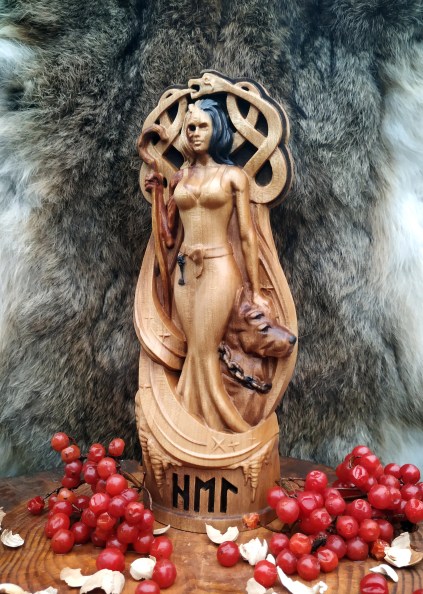
Hel is the Norse goddess of the dead. She ruled over the underworld, Niflheim, where she received the dead. Her name means “one that hides.”

In general, Hel is only mentioned in passing in Old Norse literature. It means her character is ill-defined and her personality little-developed. Some historians even suggest that she is a figment of the imagination of the Norse poets.

Facts About Hel

Name(s): Hel
Rules over: The Underworld
Gender: Female
Symbols: Hagalaz Rune
Linked Animals: Hellhound (named Garmr), Crows
Parents: Loki and Angrboda
Siblings: Fenrir and Jörmungandr
Greek Similar: Hades
Roman Similar: Pluto

Family

In Norse mythology, Hel’s father was the trickster god Loki and her mother the giantess Angrboda. Loki and Angrboda had three children: the wolf Fenrir; the serpent Jörmungandr; and Hel, their only daughter.

Hel was born with the bones on one half of her body fully exposed and, thus, is often depicted as a half-black and half-white monster. She grew up with Fenrir and Jörmungandr in Jotunheim, land of the giants, until Odin, ruler of the Aesir, decided they should live in Asgard where their father came from.

Symbols

Hel is associated with a hellhound named Garmr as well as crows. She is also sometimes affiliated with the Hagalaz Rune stone.

Powers & Duties

In Asgard, the other Norse gods were uncomfortable with Hel’s appearance. For this reason, Odin agreed to send her away, and gave her the World of Niflheim – one of the Nine Realms. There she became queen of the dead.

The Norse believed that most people went to Niflheim when they died. Only warriors who were killed on the battlefield did not go to Niflheim. Instead, half of the warriors who died on the battlefield went to live with Odin in his palatial home Valhalla and the other half with Freya in her afterlife realm Folkvang.

Niflheim was divided into sections, including one called the shore of corpses. Here, a castle filled with venomous serpents stood facing north. It was full of murderers, perjurers, and adulterers who suffered while their blood was sucked by a dragon named Nidhogg.

When Odin’s son Baldur died because of a trick by Loki, his soul was also received in Niflheim. Hermod, another son of Odin’s, agreed to go to Hel to convince her to send Baldur home. But Loki played another trick to make it impossible for Baldur to return to the real world. The eventual exposure of his trickery led to the end of the world, a battle between good and evil known as Ragnarok.

In Niflheim, Hel was waited upon by two servants called Ganglati and Ganglot. It is said they moved so slowly that they appeared to be standing still. They served her meals in a dish named “hunger” and with a knife named “famine.”

Facts About Hel

  • Holland, Helvetia, Helsinki, and Holstein are well-known places that were probably named after Hel;
  • Hel’s appearance could be the inspiration of the masked harlequin who appeared in Commedia dell’ Arte;
  • No-one could hide anything from Hel. She had an eye of fire, which could only see the truth;
  • The Vikings feared Hel’s appearance, and they were wary of Niflheim;
  • Niflheim was an icy cold place rather than a place of fire and brimstone most associated with the modern idea of hell;
  • In the Prose Edda written by Snorri Sturluson in the 13 th century, Niflheim is described as a place where a constant wail can be heard from the residents. It is damp with sleet and the walls are built with worms and the bones of humans;
  • In the Gylfaginning, the first part of the Prose Edda, Hel is described as “rather downcast and fierce-looking”;
  • Hel was feared by the Vikings, but the Gauls, Dutch, and Germanic peoples were more sympathetic towards her. They did not see Niflheim as a place of punishment and had a kinder approach to death;
  • The expression “go to hell” originated with Hel and Niflheim;
  • Niflheim existed beneath the roots of the world tree Yggdrasil;
  • Jacob Grimm, a scholar of Norse mythology, had a theory that Hel was only a “half-goddess.” He argued that because Loki made the giantess Angrboda pregnant, there was no proof that Hel was of full divine blood;
  • Some scholars have suggested that several of the imitation medallions and bracteates which remain from the Migration Period depicts Hel;
  • Hela, the fictional villainess in Marvel Comics’ American comic books, is based on Hel. She is also featured in the webcomic The Order of the Stick, in which she is an antagonist who wants to destroy the world.

Goddess – Nut

Egyptian Goddess Nut from gods-and-goddesses.com

Nut is the Egyptian goddess of the sky. She is a member of the Ennead, the nine original Egyptian gods and goddesses of Heliopolis, which was a city near Cairo and the birthplace of the gods.

Nut Facts

Name(s): Nut
Rules over: Sky
Gender: Female
Symbols: Water Pot, Ladder called maqet
Sacred animals: Cow
Parents: Shu (Father) and Tefnut (Mother)
Siblings: Geb

Family

She is the daughter of Shu and Tefnut, and both sister and wife to Geb, the earth god.

Egyptian mythology said that Nut and Geb were inseparable, which left no room for creation by Atum Ra, the creator god. Atum Ra and Shu, who were jealous of the closeness between Nut and Geb, did not want them to have children. Shu separated them by lifting Nut up. She continued to form the sky, while Geb remained beneath her to form the earth.

In another myth featuring Ra, Nut is referred to as his mother. The Pyramid Texts reveal that her body becomes a pathway for the sun. Ra passes over it during the day before Nut swallows him at night. Then, a new day starts when she gives birth to him again in the morning.

Ra issued a decree that Nut “shall not give birth on any day of the year.” She conspired with Thoth, the god of wisdom, who won five extra days from the moon for her to bear five children. She gave birth to Osiris, ruler of the gods; Horus the Elder, god of war; Set, god of evil; Isis, goddess of magic; and Nephthys, goddess of water. This is the story of how a year came to have 365 days.

Symbols

Nut is most commonly depicted as a naked woman with a water pot on her head; the pot is also the hieroglyph for her name. Sometimes she is pictured in an arch, with her hands and feet on the ground, touching it on the earth’s four cardinal points and serving as the pillars of the sky. Often, Shu is seen holding her as Geb rests propped up by his elbow on the earth.

Nut is often portrayed holding the key of life, called the ankh. She may also be seen holding the was scepter in depictions of her. This scepter is a long staff with an animal head on top and is a symbol of authority and divine power.

Nut is sometimes depicted as a cow with eyes representing the sun and the moon, or a giant suckling sow whose piglets were the stars. The sycamore tree, representing protection and eternity, is another symbol associated with Nut.

Powers & Duties

Nut’s primary duty is being the Egyptian sky goddess. However, because she was said to give birth to many of the major Egyptian gods, she was also referred to as “She who Bore the Gods”. There are inscriptions of Nut at Dendera, the birthplace of Isis, emphasizing her importance as “She who Bore the Gods”.

Nut was also a protector goddess, namely a protector of the dead. The Pyramid Texts contain many prayers to Nut to ask for protection for those who have died.

A picture of Nut was often painted on the inside of a coffin (sarcophagus) to protect the dead. Sometimes she is pictured with protective wings, and other times the symbol of the ladder was used to depict her. Many examples of these can be seen at the Cairo Museum.

Worship

The chief cult center for Nut was at Heliopolis, but she was also worshiped as a healing goddess in Memphis at a shrine called the House of Nut. No known temples were built exclusively for her.

Facts About Nut:

  • Alternative names for Nut are Nueth, Newet, or Nuit;
  • Pictures and depictions of Nut are present in many forms of ancient Egyptian art. They have been found in tombs, temples, and manuscripts. For example, she is represented on the vaults of tombs which are painted in dark blue and with many stars;
  • When Set killed Osiris and Isis put him back together after gathering all the body pieces, Osiris climbs a ladder (called a maqet), a sacred symbol of Nut, to enter her heavenly skies for protection. Set later became god of the underworld while she was regarded as protector of the dead.
  • An ancient Egyptian astronomical text, The Fundamentals of the Course of the Stars, was later renamed to the Book of Nut. It dates back to before 2,000 BC;
  • The passionate relationship between Nut and Geb offers an alternative myth about how night and day came to be. It is said that they separated during the day, but that she would reach down to the earth in the evening to meet him. Darkness set in when she was away from the sky.

Goddess – Minerva

Minerva – Facts and mythology from gods-and-goddesses.com

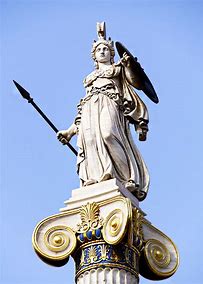
In Roman mythology, Minerva was a goddess jack-of-all-trades. She oversaw many realms that involved art and deep thought. She was regarded as the goddess of “all activities involving mental skill,” such as science, medicine, wisdom, handmade items, skilled professions, and trade. Later, she was seen as a goddess of war.

She was believed to have invented Roman numerals, or numbers, as well as a variety of musical instruments. Many researchers believe that the worship of Minerva in Rome was an extension of the cult of Athena, the Greek goddess with whom Minerva is equated. She may have been introduced to Italy by the Etruscans, who called her Menerva or Menvra. She was said to have had golden hair.

Myths & Stories

Minerva plays a role in many of Rome’s myths. For instance, in the Roman poet Ovid’s Metamorphoses, Minerva is jealous of the lowly human Arachne’s ability to craft objects of wool, as Arachne’s skill rivals her own. Nymphs, humans, and others would travel great distances to view Arachne’s creations and to watch her work.

Minerva had taught Arachne this skill, but she was jealous of her teacher in turn and would give Minerva no credit. Instead, she invited Minerva to compete with her in weaving. Therefore, Minerva disguises herself as an old woman and advises Arachne to entreat Minerva’s forgiveness. When Arachne refuses, Minerva reveals herself and the contest begins. Both woman and goddess weave beautiful tapestries on their looms.

Minerva once again tries to teach Arachne a lesson by weaving into her tapestry scenes of humans losing to gods in various contests, and even her own failure against the god Neptune. Obstinate Arachne replies with weavings of the gods’ less than honorable activities, such as seducing both mortals and immortals. When finished, Minerva could find no flaw in Arachne’s tapestry, yet she “tore up the embroidered tapestry with its stories of the gods’ shameful deeds.”

Then, she beats Arachne’s face with a wooden weaving tool. Arachne tries to strange herself with a noose, but Minerva does not let her perish. Instead, she turned her into a spider through the use of a magic herb, saying she and her descendants would always hang and always weave. Today, spiders are known as “arachnids” due to this myth.

Worship

Along with Jupiter and Juno, Minerva was worshiped as part of the Capitoline Triad, or trinity. They shared a temple on the Capitoline Hill in Rome. A temple devoted exclusively to Minerva was located on the Aventine Hill. This shrine served as a meeting place for the guilds of craftsmen, actors, and poets. Physicians worshiped this goddess as the patroness Minerva Medica.

Minerva was worshiped as a goddess of war alongside the god Mars. After a number of conquests on the Roman Empire’s eastern border, a temple to Minerva was built in Pompey – no doubt funded by the spoils of war. Her worship in Rome reached a peak in the first century A.D. when she was claimed as a special, personal protector by Emperor Domitian.

Festivals

Two events dedicated to Minerva were marked on the Roman Calendar. The first was known as the Quinquatria, celebrated by students and artisans on March 19-23, just after the Ides of March, made famous by the assassination of Julius Caesar and subsequent play by William Shakespeare. On June 13, a shorter observance called the minor Quinquatrus was celebrated. The Quintratrus was also the time of school holidays and when fees for schooling became due. Thus, Minerva was seen as a patron of schoolchildren as well as the skilled workers they would someday become. Minerva shared her festivals with the war god Mars. She was often identified with Nerio, the Sabine goddess who became the consort of Mars.

Today

Today, a church called Santa Maria sopra Minerva is located in a former temple to Minerva. Minerva’s interest in the sciences and pursuit of wisdom still lives in the moniker of the Japanese MINERVA space exploration robot. MINERVA, in this case, is an acronym for MIcro/Nano Experimental Robot Vehicle for Asteroid.

Goddess – Circa (Greek)

Circa (Greek) c. 2011 Lady Abyss

“She-Falcon”.  Dark Moon Goddess; Fate-Spinner.  As the circle, or cirque, she was the fate-spinner, weaver of destinies.  Ancient Greek writers spoke of her as Circe of the Braided Tresses because she could manipulate the forces of creation and destruction by knots and braids in her hair.  Goddess of physical love, sorcery, enchantments, precognitive dreams, evil spells, vengeance, dark magic, witchcraft and cauldrons.

Circe

From greekgodsandgoddesses.net

In GREEK MYTHOLOGY, Circe was a goddess of magic, though she was sometimes depicted as a nymph (minor nature god), a witch or an enchantress.

In any case, she was associated with magic. She knew a lot about potions and herbs, and sometimes used this knowledge against her enemies and people who offended her, turning them into wild animals. She also had a wand or staff called the rhabdos which she also used to channel her magic. In fact, this was the earliest mention of a “magical wand or staff” in Western writings; it was referred to in Homer’s epic poem, the Odyssey, when Circe used it to turn Odysseus’s men into beasts.

Circe was the daughter of HELIOS, a TITAN who represented the Sun, and Perse, an ocean nymph. She was one of three thousand of her kind, daughters of TITANS OCEANUS and TETHYS. In another version, Circe was the daughter of HECATE, a goddess of sorcery.

She had two brothers. One was named Aeetes, and he looked after the GOLDEN FLEECE, a fleece that was the property of royalty. It was made from the wool of a golden ram with wings. Her second brother was PERSES.

PASIPHAE was her only sister, and she was the queen of the Greek island, CRETE, and also the wife of King Minos. It was also said that she gave birth to the MINOTAUR, a creature that was half man, half bull, with the head and horns of a cattle and the body of a man.

In some stories, Circe was exiled by her father Helios to live alone on AEAEA, a fictional island, as punishment for killing the prince of COLCHIS, who was her husband at the time.

She later had children with ODYSSEUS, the king of ITHACA from Homer’s writings. Her three sons were Ardeas, Latinus and Telegonus.

Source: <a href=”https://greekgodsandgoddesses.net/goddesses/circe/”>Circe: https://greekgodsandgoddesses.net</a&gt; – Greek Gods & Goddesses, June 10, 2018

Goddess – Chantico, or Xantico

Chantico, The Aztec Goddess of Fire and the Household from oldworldgods.com

It was not unusual to see that in some religions, there were deities linked to both domestic and military matters. The Aztec goddess Chantico was an example of this link, just like the Roman goddess Vesta was in the Roman religion.

What was Chantico the goddess of?

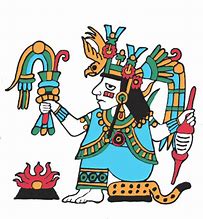
In Aztec religion, Chantico was a domestic deity. She was mainly associated with the fires burning in the house hearth but was considered to be the protectress of the house and of the possessions inside it in general.

Because of a process of extension of her prerogatives, the Aztecs came to think of her as the protectress of their empire as a whole: it has been reported by the Spanish that Moctezuma, one of the last Aztec emperors, had an idol of the Aztec goddess Chantico with a removable leg, that he would have used as a tool to curse the land, obstructing the advance of Hernan Cortes.

For this reason, probably, Chantico had a tight link to the army and to military life in general, which was made evident in her iconography.

The appearance of Chantico goddess of fire

Her representations, in fact, usually displayed a crown made of spikes of a poisonous cactus, which was seen as a sign of aggressivity and peril, and at the top of her head was often present an ornament of feathers, which were a typical symbol of warriors.

In addition, among her accessories could be found the so-called alt-tlachinolli, or water-fire, a necklace which also was linked to warfare. Other elements which help to identify her in codexes and images are the obsidian sandals at her feet, the so-called itzcactli, and a golden pendant at her neck, which probably was a representation of the sun.

Connections and relationships with other Aztec deities

Being the goddess who presided to the domestic fire, Chantico was connected to this element, too, and was therefore linked to the other fire deities of the Aztec pantheon.

In particular, she was often associated with the god Xolotl: their connection was represented by the fact that they both were often depicted wearing the yacaxtuitl, a blue nose ornament.

Her cult was particularly strong among stonecutters. Likely for this reason, she was particularly worshipped in the town of Xochimilco, where stonecutting was widely practiced.

The meaning of Chantico Aztec goddess: Origin of the Name

It seems that the name “Chantico” might have signified “she who lives in the house”, surely alluding to her role as a domestic goddess.

Anyway, she was also referred to with other names. One of these was Quaxolotl, which would have meant “split in the upper part”, and would have therefore been a reference to Chantico’s link to the god of duality and twins, Xolotl.

Among stonecutters, she would have been also called Papaloxaual or Tlappapalo, meaning respectively “butterfly painting” and “the one of the red butterfly”. Anyway, there seem to be no other pieces of information clarifying this association of her with butterflies.

History of Chantico goddess and Most Important Myths Related to Her

According to some scholars, the cult of the Aztec goddess Chantico would have originated there where she was most worshipped, in the town of Xochimilco.

Therefore, it would have spread to all the Aztec Empire, included of course the capital, Tenochtitlan, where Chantico goddess would have been venerated in the most important religious building, the Templo Mayor.

Chantico goddess of fire was the main character of an interesting myth describing food taboos among the Aztecs. Let’s see this story in greater detail.

The Aztec goddess Chantico and the Paprika

According to this story, the Aztec goddess of fire Chantico liked paprika very much. Some suggest that the reason behind this fact could be found in Chantico’s association with fire: paprika, in fact, remembers fire both in color and taste.

Anyway, in Aztec religion, food was a prerogative of the god Tonacatecuhtli, who used to occasionally declare fasts, i.e. days during which some particular foods were banned.

One day, a fast of this sort, forbidding anyone to eat paprika, was pronounced by Tonacatecuhtli; nonetheless, the Aztec goddess Chantico could not resist pouring this beloved spice on her meal, which consisted of roasted fish.

Angered, Tonacatecuhtli changed Chantico into a dog, as a form of punishment. According to some, this might be the reason why dogs love to rest by the hearth.

Powers of the Aztec goddess Chantico

In her role of protectress of possessions, of the house, and, more generally, of the Aztec homeland, the Aztec goddess Chantico was thought to be able to deny access to strangers and enemies.

Symbols of Chantico and Their Meanings

Besides the ones already mentioned, one of Chantico’s symbols was an eagle foot covered with the skin of a jaguar, located on a dish of blood.

Like many others of her attributes, this peculiar image, also, might have represented her link with war, since the dish of blood was a symbol of warrior sacrifice.

Additional Aztec goddess Chantico Facts

Chantico’s figure is linked to one of the most impressive and important archeological remains found in the lands once occupied by the Aztecs: the so-called Coyolxauhqui-Chantico monument.

As its name suggests, this object has been linked by scholars to two Aztec goddesses: one is the goddess of the moon, Coyolxauhqui, while the other is the domestic goddess Chantico.

It represents a giant head and has been discovered in the Templo Mayor, the most important and famous building that could be found in the ancient city of Tenochtitlan, the capital of the Aztec Empire. This head was called this way by Hermann Mayer, an important Mesoamerican scholar.

In fact, he argued, elements related to both deities could be found in it. The form and the subject of the statue, a giant head, surely reminded of Coyolxauhqui, and in particular of her role in the myth describing the birth of Huitzilopochtli: according to this story, in fact, Coyolxauhqui and her brothers would have tried to kill their mother while she was pregnant with Huitzilopochtli, but he would have come out of his mother’s womb and defeated them, beheading Coyolxauhqui.

At the same time, as noted by Eduard Seler, the character to whom the head belongs, represented in other objects, presents elements that can be easily associated with Chantico. In particular, it wears the itzcactli, the obsidian sandals, and a golden pendant which are often displayed in Chantico’s portraits. These facts have led some scholars to think that the two deities might be connected. Anyway, none of the surviving sources in their possession is able to confirm or clarify this point.

Goddess – Epona

The motif of the “Lady of the Animals” lives on this religious depiction. Flanked by two horses, Epona is shown sitting on a throne holding a fruit basket on her lap. The Celtic goddess was revered as the patroness for wagoners. She was also popular among the military. The images was mainly occurred in the provinces of Gaul and Germania. Image credit: Rosemania – Flickr  

Epona – One Of The Oldest And Widely Known Celtic Deities from ancientpages.com

Epona is the Gaulish goddess of horses, donkeys, and mules. She was one of the oldest and most notable Celtic deities and was worshiped in ancient Rome.

Her name, ‘Epona,’ means ‘mare,’ and she was believed to be the protector of horses, donkeys, mules, and ponies.

As involved in ancient beliefs of many cultures, some scholars do not exclude that this goddess was often associated with death, similar to other mother goddesses. In that case, her symbol was a crow, a raven, or a dog symbolizing the afterlife.

As the guide (or companion) of souls, leading the deceased to the land of the dead, Epona had a mysterious key to opening the underworld (otherworld).

No doubt, Epona was a very popular deity in the Roman Empire, but as we said, she was not of Roman origin, for there were no such equestrian goddesses in the pantheon of these people. The Roman army adopted her worship and spread her cult throughout the empire. She was the only Celtic goddess granted a feast day (December 18).

The greatest concentration of inscriptions to Epona, along with altars and depictions of her, have been found in Roman Gaul, especially in Burgundy, and in the Metz-Trier and Meuse valley regions of Germany, Britain, Bulgaria, and North Africa as well.

In Celtic Gaul, Epona was initially associated with the beliefs of the tribe of Aedui, who inhabited the regions between Liger (Loire, the longest river in France) and Arar (the modern Saone river of eastern France).

In historical records, these people were remembered as allies of Rome, who in time supported Vercingetorix, a brave warrior who gathered an army of Gallic people against the Roman Empire and in 52 BC was defeated by Julius Caesar. At the same time, the Aeduians were incorporated into Roman Gaul.

Despite Epona’s wide popularity in ancient times, very little is known about her.  Many believe this goddess had many local incarnations and appeared under other names.

However, there is one interesting mythological story about when our planet Earth was almost empty. There were no gods or humans, only the sea and the land. When the sea met the ground, a white mare, Eiocha, made of sea foam, was born.

In the vicinity of this critical event, a strong oak tree grew, giving support to “a plant with white berries of “foam tears” from the sea. The white mare, Eiocha, ate the berries and grew heavy with the child. She gave birth to the first god, Cernunnos. The birth was painful, and in her struggle, Eiocha ripped pieces of bark from the oak tree and threw them into the sea, thus creating the Giants of the Deep. Cernunnos was lonely and coupled with Eiocha to produce other gods: Maponus, Tauranus, Teutates, and the goddess Epona.” 1

Horses for the Celts were vital because they were used for transport. In war and agriculture, it is only natural that the cult of the goddess – patroness of horses- constituted an essential part of their religious views. She was usually depicted on a horse, feeding a horse from her hand, leading two horses, or standing with horses around her.

Other attributes were a horn of plenty and a loaf of bread, which means she was also worshiped as a fertility goddess.

Goddess Of The Day: VENUS c. 2011

Venus


Lupercalia (Rome)
Themes: Love; Passion; Romance; Sexuality
Symbols: Doves; Flowers; Berries; Trees; Pine Cones
About Venus: Venus was originally an Italic goddess of blossoms; hearts and flowers have slowly become attributed to her loving, passionate energies. In fact, her name became the root for the word to venerate – to lift up, worship, or esteem. So it is that Venus greets prespring efforts for uplifting our hearts with positive relationships.
To Do Today: During Lupercalia, an ancient predecessor of Valentine’s Day, single girls put their names in a box, and unmarried men drew lots to see with whom they would be paired off for the coming year. To be more modern-minded, try pinning five bay leaves to your pillow instead to dream of future loves. If you’re married or otherwise involved, steep the bay leaves in water and drink the resulting tea to strengthen the love in your relationship.
To encourage balance in a relationship, bind together Venus’s symbols, a pine cone and a flower, and put them somewhere in your home. Or, to spice up a passionate moment, feed fresh berries to each others and drink a berry beverage from one cup (symbolizing united goals and destinies).
In Roman tradition, anywhere there’s a large stone adjacent to a tall tree, Venus is also there. Should you know of such a place, go there today and commune with her warm, lusty energy.


)0( 

By Patricia Telesco

Goddess Of The Day: Chihnu

Chihnu

Phra Buddha Bat Fair (Thailand)

  Themes: Arts; Creativity; Tradition; Excellence

Symbols: Woven Items; Thread or Yarn; Home Crafts; Lyres

About Chihnu: In China and surrounding regions, Chihnu’s name means “weaving woman.” According to myths, Chihnu’s talents in this art are so great that she can weave seamless garments for the gods. From her heavenly domain in the constellation Lyre, she acts like a refreshing spring wind to inspire excellence in our inherited arts and crafts.

 To Do Today: This annual Thai festival features folk dancing and traditional handicrafts in honor of Buddha’s footprint, which is enshrined nearby. Generally, it is a time to rejoice in Thai tradition, so if you have a Thai restaurant in the neighborhood, by all means indulge yourself, saying a brief prayer of thanks to the provider of your feast-Chihnu.

 To make a Chihnu-inspired creativity charm, take three strands of yellow thread or yarn (yellow is the color of inventiveness). Braid these together so that the strands cross four rimes, saying,

 One, Chihnu’s power absorbs;

two, inside the magic’s stored;

three, the magic’s alive in me;

four, bear Chihnu’s creativity!

 Carry this when you need more ingenious energy, or leave it near your artistic endeavors so they can absorb Chihnu’s compelling excellence.

 Finally, wear woven or handmade items to honor Chihnu’s talents today.

 .By Patricia Telesco ~ From “365 Goddess”  (FMP) and GrannyMoon’s Morning Feast

c. 2011