October 26 On This Day in HIstory

Important Events

1850 Robert McClure sights the fabled Northwest Passage for the first time (from Banks Island towards Melville Island)

1861 Pony Express (Missouri to California) ends after 19 months

1863 International conference begins in Geneva aimed at improving medical conditions on battlefields – beginning of the Red Cross

1977 Last natural case of smallpox discovered in Merca district, Somalia. Considered the anniversary of the eradication of smallpox, the most spectacular success of vaccination

2019 Raid by US Special Forces kills ISIS founder Abu Bakr al-Baghdadi in Syria

Today’s Historical Events

Today’s Historical Film and TV’s Events

Today’s Historical Music’s Events

Today’s Historical Sport’s Events


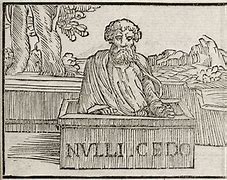
Ancient Roman God Terminus

Terminus

From Pantheon.org – For Sources and References Roman God Terminus

“Border.” A Roman divinity presiding over boundaries and frontiers. His worship is said to have been instituted by Numa who ordered that every one should mark the boundaries of his landed property by stones to be consecrated to Jupiter (Ζεὺς ὅριος), and at which every year sacrifices were to be offered at the festival of the Terminalia.1 These sacred boundaries existed not only in regard to private property, but also in regard to the state itself, the boundary of which was not to be transgressed by any foreign foe. But in later times the latter must have fallen into oblivion, while the termini of private property retained their sacred character even in the days of Dionysius, who states that sacrifices of cakes, meal, and fruit (for it was unlawful to stain the boundary stones with blood), still continued to be offered.

The god Terminus himself appears to have been no other than Jupiter himself, in the capacity of the protector of boundaries.2 The Terminus of the Roman state originally stood between the fifth and sixth milestone on the road towards Laurentum, near a place called Festi, and that ancient/boundary of the Ager Romanus (“the field of Rome“) continued to be revered with the same ceremonies as the boundaries of private estates.3 Another public Terminus stood in the temple of Jupiter in the Capitol, and above it there was an opening in the roof, because no Terminus was allowed to be under cover.4 This is another proof that Terminus was only an attribute of Jupiter, although tradition gave a different reason for this circumstance; for when that temple was to be founded, and it was necessary to exaugurate other sanctuaries standing on the same site, all the gods readily gave way to Jupiter and Juno, but the auguries would not allow the sanctuaries of Terminus and Juventas to be removed. This was taken as an omen that the Roman state would remain ever undiminished and young, and the chapels of the two divinities were inclosed within the walls of the new temple. Here we may ask, what had a Terminus to do on the Capitol, unless he was connected or identical with Jupiter?

October 26 Daily Correspondence Digest for the Northern Hemisphere’s Moon Phase and Planetary Positions

You can use this link to go forward or backward in time for Moon phase information. If you are curious you can even find out what phase the Moon was in when you or anyone else, you know was on the date the person was born.

From Moongiant.com

The Moon’s current phase for today and tonight is a Waning Gibbous Phase. This is the first phase after the Full Moon occurs. It lasts roughly 7 days with the Moon’s illumination growing smaller each day until the Moon becomes a Last Quarter Moon with an illumination of 50%. The average Moon rise for this phase is between 9pm and Midnight depending on the age of the phase. The moon rises later and later each night setting after sunrise in the morning. During this phase the Moon can also be seen in the early morning daylight hours on the western horizon.

Visit the October 2021 Moon Phases Calendar to see all the daily moon phase for this month.

Today’s Waning Gibbous Phase

The Waning Gibbous on October 26 has an illumination of 72%. This is the percentage of the Moon illuminated by the Sun. The illumination is constantly changing and can vary up to 10% a day. On October 26 the Moon is 20.04 days old. This refers to how many days it has been since the last New Moon. It takes 29.53 days for the Moon to orbit the Earth and go through the lunar cycle of all 8 Moon phases.

The 8 Lunar Phases

There are 8 lunar phases the Moon goes through in its 29.53 days lunar cycle. The 4 major Moon phases are Full Moon, New Moon, First Quarter and Last Quarter. Between these major phases, there are 4 minor ones: the Waxing Crescent, Waxing Gibbous, Waning Gibbous and Waning Crescent. For more info on the Moon Cycle and on each phase check out Wikipedia Lunar Phase page.

Phase Details

Phase: Waning Gibbous
Illumination: 72%
Moon Age: 20.04 days
Moon Angle: 0.49
Moon Distance: 403,115.63 km
Sun Angle: 0.54
Sun Distance: 148,677,728.94 km

Useful Moon Resources

26 October Daily Correspondence Digest for the Southern Hemisphere’s Moon Phase and Planetary Positions

You can use this link to go forward or backward in time for Moon phase information. If you are curious you can even find out what phase the Moon was in when you or anyone else, you know was on the date the person was born.

From Moongiant.com

The Moon’s current phase for today and tonight is a Waning Gibbous Phase.

This is the first phase after the Full Moon occurs. It lasts roughly 7 days with the Moon’s illumination growing smaller each day until the Moon becomes a Last Quarter Moon with an illumination of 50%. The average Moon rise for this phase is between 9pm and Midnight depending on the age of the phase. The moon rises later and later each night setting after sunrise in the morning. During this phase the Moon can also be seen in the early morning daylight hours on the western horizon.

Visit the October 2021 Moon Phases Calendar to see all the daily moon phase for this month.

Today’s Waning Gibbous Phase

The Waning Gibbous on October 26 has an illumination of 72%. This is the percentage of the Moon illuminated by the Sun. The illumination is constantly changing and can vary up to 10% a day. On October 26 the Moon is 20.04 days old. This refers to how many days it has been since the last New Moon. It takes 29.53 days for the Moon to orbit the Earth and go through the lunar cycle of all 8 Moon phases.

The 8 Lunar Phases

There are 8 lunar phases the Moon goes through in its 29.53 days lunar cycle. The 4 major Moon phases are Full Moon, New Moon, First Quarter and Last Quarter. Between these major phases, there are 4 minor ones: the Waxing Crescent, Waxing Gibbous, Waning Gibbous and Waning Crescent. For more info on the Moon Cycle and on each phase check out Wikipedia Lunar Phase page.

Phase Details

Phase: Waning Gibbous
Illumination: 72%
Moon Age: 20.04 days
Moon Angle: 0.49
Moon Distance: 403,115.63 km
Sun Angle: 0.54
Sun Distance: 148,677,728.94 km

Useful Moon Resources

A Thought for Today

Dear Sisters, Brothers, and Honored Guests today I leave you with this thought…

One thing I would like to add to Frank Lloyd Wright’s quote is

Anywhere you go the forests, water ways, or a walk around your block take a bag with you for trash. As Pagans, which first meant peasant but as evolve to mean people who follow nature’s spiritual paths, it is our duty to pick up what others were to lazy to dispose of properly. I started out doing this on my own as my children grew old enough to take a walk outside with me and than doing the same with my grandchildren. Who passed it on to their playmates and still do it even with some of my grandchildren being over 20, a couple in college, and the others starting in grammar or pre-school. So I ask you not to think of Earth Day is only on April 22 but as it being every day of the week.

Blessed be dear ones.

October 25 Today in History

Important Events

1415 Battle of Agincourt: Henry V’s forces defeat larger French army and the longbow defeats the armoured knight

1854 The infamous “Charge of the Light Brigade” during the Battle of Balaclava in the Crimean War results in over 100 killed

1962 US Ambassador to the UN Adlai Stevenson demands USSR UN rep Zorin answer regarding Cuban missile bases saying “I am prepared to wait for my answer until hell freezes over”

1971 United Nations votes to expel the Chinese Nationalist ruled Taiwan and admit the Communist People’s Republic of China

2017 Chinese Premier Xi Jinping unveils his new ruling council in the Great Hall of the People, none of the five are young enough to succeed him

Today’s Historical Events

Today’s Historical Events in Film and TV

Today’s Historical Events in Music

Today’s Historical Events in Sports

Ancient Rome A superstitious Society

From HistoryCooperative.org – To read the rest of the article about Omens and Superstations

A superstitious Society

Compare to modern society, the Romans seem extremely superstitious. But then today’s major religions have all throughout their past discouraged, even combatted, superstitions. Also our sciences and our technological world allows little room for superstition.

The Romans lived in an era previous to this. Their world was full of unexplained phenomena, darkness and fear. To Romans these superstitions were a perfectly natural part in the relationship between gods and men.

The Roman habit of interpreting natural phenomena as signs from the beyond stemmed from the Etruscans. The Etruscans, who developed reading omens and auspices into a form of science, knew different means of divination. In their beliefs the signs they read were sent to them by a mythical boy called Tages, who in their mythology was to have been ploughed up from the earth.

They would seek to read the future by examining the entrails of sacrificial animals, the liver being of special importance for that purpose. They would observe lighting and interpret its meanings. And they would try and put meaning to any unusual phenomena which occured.

The belief that objects, or living beings could possess special spiritual properties was widespread in primitive societies. The Romans were no strangers to this idea. Stones, trees, springs, caves, lakes, swamps, mountains – even animals and furniture – were all deemed to be hosts to spirits (numina). Stones in particular were often seen to contain spirits, especially if they were boundary stones, dividing one man’s property from the other.

It is very telling that the Latin word for such a boundary is terminus and that there actually was a Roman god called Terminus. This odd deity took the form of a huge piece of rock which rested in the temple of Jupiter on the Capitoline Hill. Apparently several attempts to move the bolder when…

5 Ways Chamomile Tea Benefits Your Health

(This article is not meant to replace anything you have been prescribed by your primary health care provider. Always check with them before starting to use any herbs for medicinal purposes. Chamomile id from the Daisy Family. So it is possible to be allergic to it if you are allergic to any species of Daisy)

From Healthline.com

Chamomile tea is a popular beverage that also offers a variety of health benefits.

Chamomile is an herb that comes from the daisy-like flowers of the Asteraceae plant family. It has been consumed for centuries as a natural remedy for several health conditions.

To make chamomile tea, the flowers are dried and then infused into hot water.

Many people enjoy chamomile tea as a caffeine-free alternative to black or green tea and for its earthy, somewhat sweet taste.

Furthermore, chamomile tea is loaded with antioxidants that may play a role in lowering your risk of several diseases, including heart disease and cancer.

Chamomile has properties that may aid sleep and digestion, as well.

This article will discuss 5 potential health benefits of drinking chamomile tea.

1. May Improve Sleep Quality…

Astronomy Picture of the Day

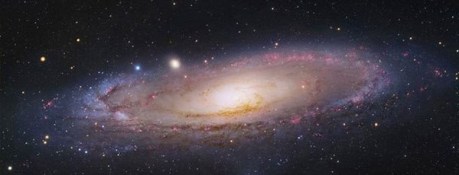
Andromeda Galaxy

The most distant object that most folks can see with the unaided eye is also the closest major galaxy to our own Milky Way. Although the Andromeda Galaxy lies a mind-bending 2.5 million light-years from Earth, its trillion stars are enough to emit a strong glow across the vast reaches of space. Despite the wide gap, the Milky Way and Andromeda are on a collision course and predicted to begin merging in roughly 4.5 billion years. (You’ve been warned.)

The Andromeda Galaxy was once thought to be a nebula. Early in the development of modern astronomy, any diffuse, undefined celestial body was called a ‘nebula,’ including what we now know to be a neighboring galaxy. Our modern definition of nebula refers to galaxies-in-training that will coalesce over cosmic time into something less…nebulous.

24 October Daily Correspondence Digest for the Southern Hemisphere’s Moon Phase and Planetary Positions

If you need to calculate the planetary positions for a specific use and time, click on this link

Currentplanetarypositions.com

To figure out GMT (Greenwich Mean Time) to your local time use this link

For Your Local Time and Date

Today the Moon will be in a Waning Gibbous Phase. This is the first phase after the Full Moon occurs. It lasts roughly 7 days with the Moon’s illumination growing smaller each day until the Moon becomes a Last Quarter Moon with an illumination of 50%. The average Moon rise for this phase is between 9pm and Midnight depending on the age of the phase. The moon rises later and later each night setting after sunrise in the morning. During this phase the Moon can also be seen in the early morning daylight hours on the western horizon.

Visit the October 2021 Moon Phases Calendar to see all the daily moon phase for this month.

Today’s Waning Gibbous Phase

The Waning Gibbous on October 24 has an illumination of 87%. This is the percentage of the Moon illuminated by the Sun. The illumination is constantly changing and can vary up to 10% a day. On October 24 the Moon is 18.26 days old. This refers to how many days it has been since the last New Moon. It takes 29.53 days for the Moon to orbit the Earth and go through the lunar cycle of all 8 Moon phases.

The 8 Lunar Phases

There are 8 lunar phases the Moon goes through in its 29.53 days lunar cycle. The 4 major Moon phases are Full Moon, New Moon, First Quarter and Last Quarter. Between these major phases, there are 4 minor ones: the Waxing Crescent, Waxing Gibbous, Waning Gibbous and Waning Crescent. For more info on the Moon Cycle and on each phase check out Wikipedia Lunar Phase page.

Phase Details

Phase: Waning Gibbous
Illumination: 87%
Moon Age: 18.26 days
Moon Angle: 0.49
Moon Distance: 405,478.83 km
Sun Angle: 0.54
Sun Distance: 148,758,741.90 km

Information About the Anglo-Saxon and Frisian Rune Sets

From The Rune Site – Anglo-Saxon and Frisian Runes

The Anglo-Saxon rune set was adapted early in the 6th century B.C.E. from a rune row known as the Frisian rune row. The Frisian runes were the result of a rapid change in the language in Frisia. With such a rapid change in the language more runes were eventually needed so the Elder Futhark was expanded by 4 symbols to bring the Frisian rune row to a total of twenty-eight rune staves. Later around the 7th century a twenty-ninth rune, Ear, was added to form the Anglo-Saxon rune set.

When the rune row was expanded a slight change was made to the order of the set. Ansuz, the fourth rune of the Elder Futhark, was replaced with a new rune, Os and Ansuz was renamed Aesc. While this may have been the only change to the shapes and names of some of the runes it was not the only change in rune order that we come across with this set (and its similar sets). In various manuscripts and on some carvings we see the runes in different orders. On a knife found in the Thames River in London we see the full rune row but in a different order. On the Thames River knife we still see that the fourth rune is Aesc, but the last eight runes are arranged differently leaving the rune Ear to be at the end of the rune order.

Most of the information for the order of the Anglo-Saxon and Frisian rune sets is known because of the Thames River knife, also known as the Thames scramasax, and the Vienna Codex. The Vienna Codex is an early 9th century Anglo-Saxon manuscript that does provide a complete version of the Anglo-Saxon rune row.

What is the Linestrider Tarot Deck?

From TarotX.net – For more information on the Linestrider Tarot Deck

I. Introduction and review Linestrider Tarot Deck

The Linestrider Tarot, illustrated by Siolo Thompson and released by Llewellyn Publications, is a 78-card deck of travelers between two worlds – whose lives span both worlds, ideas, mental states, or reality.

This deck of cards refers to that concept, combined with the traditional Rider-Waite Smith standard (RWS), creating delicate, minimal, and appealing cards. In folk, there is a margin that separates the visible world from the invisible world on many levels, and Linestriders are magical people who live those lives or gather knowledge from both sides of the line or the edge. Linestriders tour through the routes that separate ideas, discipline, mental state, world, and reality.

With the stable basis of the Rider Waite-Smith Tarot deck, the Linestrider Tarot both expands and reduces the look of the classic Pamela Coleman Smith deck. Human figures appear in only half of this deck while the rest are animals, fulfilling the roles commonly performed by humans in many standard RWS decks. With an unusual sensuality and sensitivity, artist Siolo Thompson described humans as mysterious and dreamy, and animals are wise and intelligent creatures.

This is a 78-card tradition-oriented Tarot deck, with 22 Major Arcana cards and 56 fully illustrated Minor Arcana cards. The Major cards remain the old title and the four Minor suits are Wands, Swords, Cups, and Pentacles. Court cards include Page, Knight, Queen, and King as usual.

The card size is 7 x 12 cm [2.8 x 4.7 inch] – the standard size of a regular Tarot deck. The deck weight is well-made and hand-fitted. The card is quite heavy-handed but flexible, has a smooth edge and a light shade. Linestrider Tarot deck has quite meticulous images, delicate and elegant colors. The work is a bizarre mix of minimalism in many respects such as watercolor, comic style, subtle pencil brush strokes; realism, and symbolism.

The image on the card has an open and blank background; close-up images seem to be simple with a layer of watercolor and pencil that create clever symbols that are consistent with the lower stimulus-center-space-threshold image.

Menu of Contents


Astronomy Picture of the Day

Discover the cosmos! Each day a different image or photograph of our fascinating universe is featured, along with a brief explanation written by a professional astronomer.

2021 October 23

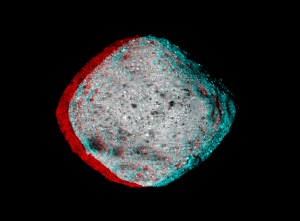
3D Bennu

Image Credit: NASAGSFCU. Arizona – Stereo Image Copyright: Patrick Vantuyne

Explanation: Put on your red/blue glasses and float next to asteroid 101955 Bennu. Shaped like a spinning toy top with boulders littering its rough surface, the tiny Solar System world is about one Empire State Building (less than 500 meters) across. Frames used to construct this 3D anaglyph were taken by PolyCam on the OSIRIS_REx spacecraft on December 3, 2018 from a distance of about 80 kilometers. With a sample from the asteroid’s rocky surface on board, OSIRIS_REx departed Bennu’s vicinity this May and is now enroute to planet Earth. The robotic spacecraft is scheduled to return the sample to Earth in September 2023.

I am Sorry for the Lack of Usual Post

So, I got a refurbished laptop and within a month it had a major problem. It went into sleep mode and would not come out of it. Yesterday WISH online shopping finally sent me the label to send it back. I went last evening and got it started on it way back to WISH. Which left me with either my desktop computer, which I can only sit at for about an hour until my back pain is so bad I have to lay down, or my Kindle tablet which takes me twice as long to post through. My wonderful fiancée took me to Rent-A-Center where he had coupons for a nice reduction in price for a brand new laptop, which I am using now. When we got home with it last evening I could not get on to use it. So, I put it aside very frustrated but I must have done something right because I did not have to take it back to the store to be able to use my own account on it. But as I was having a horrible morning I did not pick this laptop up to try to get on to it again until about 15 minutes ago and now here we are.

Now I have to take this one back because the Delete key doesn’t work. I give up for today. Looks like I will only be doing the daily and birthday horoscopes later today.

For Your Viewing Pleasurer

The fascinating history of cemeteries – Keith Eggener

This is an interesting take on regular burials and cemeteries. The History of Cemeteries

October 21 On This Day in History

From On This Day

Important Events

1805 Battle of Trafalgar: British Admiral Horatio Nelson defeats combined French and Spanish fleet. Nelson shot and killed during battle.

1854 Florence Nightingale with a staff of 38 nurses is sent to the Crimean War

1944 World War II: US troops capture Aachen, 1st large German city to fall

1948 UN rejects Russian proposal to destroy atomic weapons

1950 Chinese forces occupy Tibet

1993 Failed military coup in Burundi, led by ex-President Jean-Baptiste Bagaza, includes assassination President Ndadaye; 525,000 Hutus flee

All these links include birthdays, deaths, weddings and divorces.

Today’s Historical Events

Today’s Film and TV Historical Events

Today’s Historical Music Events

Today’s Historical Sports Events


October 21 Daily Correspondence Digest for the Northern Hemisphere’s Moon Phase and Planetary Positions

You can use this link to go forward or backward in time for Moon phase information. If you are curious you can even find out what phase the Moon was in when you or anyone else, you know was on the date the person was born.

From Moongiant.com

The Moon’s current phase for today and tonight is a Waning Gibbous Phase. This is the first phase after the Full Moon occurs. It lasts roughly 7 days with the Moon’s illumination growing smaller each day until the Moon becomes a Last Quarter Moon with an illumination of 50%. The average Moon rise for this phase is between 9pm and Midnight depending on the age of the phase. The moon rises later and later each night setting after sunrise in the morning. During this phase the Moon can also be seen in the early morning daylight hours on the western horizon.

Visit the October 2021 Moon Phases Calendar to see all the daily moon phase for this month.

Today’s Waning Gibbous Phase

The Waning Gibbous on October 21 has an illumination of 99%. This is the percentage of the Moon illuminated by the Sun. The illumination is constantly changing and can vary up to 10% a day. On October 21 the Moon is 15.56 days old. This refers to how many days it has been since the last New Moon. It takes 29.53 days for the Moon to orbit the Earth and go through the lunar cycle of all 8 Moon phases.

The 8 Lunar Phases

There are 8 lunar phases the Moon goes through in its 29.53 days lunar cycle. The 4 major Moon phases are Full Moon, New Moon, First Quarter and Last Quarter. Between these major phases, there are 4 minor ones: the Waxing Crescent, Waxing Gibbous, Waning Gibbous and Waning Crescent. For more info on the Moon Cycle and on each phase check out Wikipedia Lunar Phase page.

Phase Details

Phase: Waning Gibbous
Illumination: 99%
Moon Age: 15.56 days
Moon Angle: 0.50
Moon Distance: 401,916.47 km
Sun Angle: 0.54
Sun Distance: 148,882,031.18 km

Useful Moon Resources

If you need to calculate the planetary positions for a specific use and time, click on this link

Currentplanetarypositions.com

To figure out GMT (Greenwich Mean Time) to your local time use this link

For Your Local Time and Date

Northeastern Hemisphere

The time for the Custom Planetary Positions is from the local time in Frankfurt, Germany, Europe

21 October 2021
02:00 pm GMT 4:00 PM CET
Zodiac: Tropical (Standard Western)

Sun:28 Libra 23
Moon:09 Taurus 07
Mercury:10 Libra 54
Venus:15 Sagittarius 07
Mars:23 Libra 59
Jupiter:22 Aquarius 21
Saturn:06 Aquarius 58
Uranus:13 Taurus 22 Rx
Neptune:20 Pisces 51 Rx
Pluto:24 Capricorn 22
True Lunar Node:01 Gemini 57 Rx
Mean Lunar Node:03 Gemini 19 Rx
Lilith (Black Moon):10 Gemini 33
Chiron:09 Aries 52 Rx
Ceres:11 Gemini 38 Rx
Pallas:10 Pisces 03 Rx
Juno:22 Sagittarius 11
Vesta:16 Scorpio 05
Eris:24 Aries 12 Rx
Fire:4
Earth:3
Air:9
Water:3
Cardinal:6
Fixed:5
Mutable:8

Northwestern Hemisphere

The time for the Custom Planetary Positions is from the local time in Denver, Colorado, USA

October 21, 2021
10:00 pm GMT 4:00 PM MT
Zodiac: Tropical (Standard Western)

Sun:28 Libra 43
Moon:13 Taurus 08
Mercury:11 Libra 05
Venus:15 Sagittarius 28
Mars:24 Libra 12
Jupiter:22 Aquarius 21
Saturn:06 Aquarius 59
Uranus:13 Taurus 21 Rx
Neptune:20 Pisces 51 Rx
Pluto:24 Capricorn 22
True Lunar Node:01 Gemini 56 Rx
Mean Lunar Node:03 Gemini 18 Rx
Lilith (Black Moon):10 Gemini 35

Chiron:09 Aries 51 Rx

Ceres:11 Gemini 36 Rx
Pallas:10 Pisces 01 Rx
Juno:22 Sagittarius 17
Vesta:16 Scorpio 16
Eris:24 Aries 11 Rx

Fire:4
Earth:3
Air:9
Water:3
Cardinal:6
Fixed:5
Mutable:8

Astronomy Picture of the Day

From NASA – Astronomy Picture of the Day Archive

Discover the cosmos! Each day a different image or photograph of our fascinating universe is featured, along with a brief explanation written by a professional astronomer.

2021 October 21

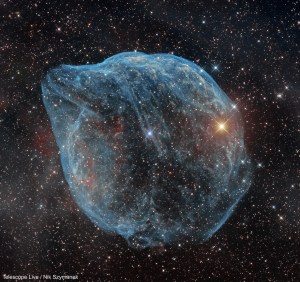
SH2-308: The Dolphin-Head Nebula

Image Credit & Copyright: Nik Szymanek

Explanation: Blown by fast winds from a hot, massive star, this cosmic bubble is huge. Cataloged as Sharpless 2-308 it lies some 5,000 light-years away toward the constellation of the Big Dog (Canis Major) and covers slightly more of the sky than a Full Moon. That corresponds to a diameter of 60 light-years at its estimated distance. The massive star that created the bubble, a Wolf-Rayet star, is the bright one near the center of the nebula. Wolf-Rayet stars have over 20 times the mass of the Sun and are thought to be in a brief, pre-supernova phase of massive star evolution. Fast winds from this Wolf-Rayet star create the bubble-shaped nebula as they sweep up slower moving material from an earlier phase of evolution. The windblown nebula has an age of about 70,000 years. Relatively faint emission captured by narrowband filters in the deep image is dominated by the glow of ionized oxygen atoms mapped to a blue hue. Presenting a mostly harmless outline, SH2-308 is also known as The Dolphin-head Nebula.

21 October Daily Correspondence Digest for the Southern Hemisphere’s Moon Phase and Planetary Positions

You can use this link to go forward or backward in time for Moon phase information. If you are curious you can even find out what phase the Moon was in when you or anyone else, you know was on the date the person was born.

From Moongiant.com

Today the Moon will be in a Waning Gibbous Phase. This is the first phase after the Full Moon occurs. It lasts roughly 7 days with the Moon’s illumination growing smaller each day until the Moon becomes a Last Quarter Moon with an illumination of 50%. The average Moon rise for this phase is between 9pm and Midnight depending on the age of the phase. The moon rises later and later each night setting after sunrise in the morning. During this phase the Moon can also be seen in the early morning daylight hours on the western horizon.

Visit the October 2021 Moon Phases Calendar to see all the daily moon phase for this month.

Today’s Waning Gibbous Phase

The Waning Gibbous on October 21 has an illumination of 99%. This is the percentage of the Moon illuminated by the Sun. The illumination is constantly changing and can vary up to 10% a day. On October 21 the Moon is 15.56 days old. This refers to how many days it has been since the last New Moon. It takes 29.53 days for the Moon to orbit the Earth and go through the lunar cycle of all 8 Moon phases.

The 8 Lunar Phases

There are 8 lunar phases the Moon goes through in its 29.53 days lunar cycle. The 4 major Moon phases are Full Moon, New Moon, First Quarter and Last Quarter. Between these major phases, there are 4 minor ones: the Waxing Crescent, Waxing Gibbous, Waning Gibbous and Waning Crescent. For more info on the Moon Cycle and on each phase check out Wikipedia Lunar Phase page.

Phase Details

Phase: Waning Gibbous
Illumination: 99%
Moon Age: 15.56 days
Moon Angle: 0.50
Moon Distance: 401,916.47 km
Sun Angle: 0.54
Sun Distance: 148,882,031.18 km

Useful Moon Resources