
Dear sisters, brothers, and honored guests may your life be blessed with all things positive!

Dear sisters, brothers, and honored guests may your life be blessed with all things positive!
1620 Mayflower Pilgrims come ashore in Plymouth Bay, traditionally thought to be at Plymouth Rock, Massachusetts [NS: Dec 21]
1792 France’s King Louis XVI goes on trial, accused of high treason and crimes against the state
1913 “Mona Lisa” recovered two years after it was stolen from the Louvre Museum
1931 Statute of Westminster gives complete legislative independence to Canada, Australia, New Zealand, South Africa, Ireland (Free State), and Newfoundland (not then part of Canada)
1946 United Nations International Children’s Emergency Fund (UNICEF) is established by resolution 57(I) of the UN General Assembly
1997 Delegates from 150 industrial nations attending a UN climate conference in Kyoto, Japan, reach agreement to control heat-trapping greenhouse gases

359 Honoratus, first known Prefect of the City of Constantinople, takes office, after the Emperor Constantius creates a new senate for the East
384 St Damasus I dies and ends his reign as Catholic Pope. Began reign 366
1282 Llywelyn ab Gruffydd/Llywelyn the Last, last native Prince of Wales is killed at Cilmeri, near Builth Wells, south Wales. Reigned from 1259.
1395 John “Eleanor” Rykener, a male cross-dressing prostitute, is brought to court in London for “committing that detestable unmentionable and ignominious vice” in late medieval England’s only recorded case on same-sex intercourse (verdict unknown)
1419 Heretic Nicolaas Serrurier exiled from Florence
1477 Duchess Maria of Burgundy ends the ‘Great Privilege’ in states of The Netherlands
1572 Spanish troops begin siege of Haarlem
1602 Surprise attack by forces of the Duke of Savoy and his brother-in-law, Philip III of Spain repelled by citizens of Geneva. Commemorated since as Fête de l’Escalade.
1882 Victorien Sardous play “Fedora” with Sarah Bernhardt premieres in Paris
1909 Colored moving pictures demonstrated at Madison Square Garden, NYC
1948 WHEN (now WTVH) TV channel 5 in Syracuse, NY (CBS) begins broadcasting
1948 WMC TV channel 5 in Memphis, Tennessee (NBC) begins broadcasting
1949 WOAI (now KMOL) TV channel 4 in San Antonio, TX (NBC) 1st broadcast
1953 KTVA TV channel 11 in Anchorage (CBS) becomes Alaska’s 1st TV station
1960 Cy Coleman and Carolyn Leigh’s musical “Wildcat” with Lucille Ball premieres in New York City
1967 “Guess Who’s Coming to Dinner”, directed by Stanley Kramer, starring Spencer Tracy, Sidney Poitier and Katharine Hepburn, premieres in NYC (Hepburn – Academy Award for Best Actress 1968)
1882 Boston’s Bijou Theatre, 1st American playhouse lit exclusively by electricity, 1st performance, Gilbert & Sullivan’s “Iolanthe”
1946 Hank Williams begins to record on Sterling label
1947 Bob Hilliard and Sigman’s musical “Angel in the Wings” opens at Coronet Theater NYC for 308 performances
1950 Paul Hindemith‘s Concerto for Clarinet premieres with Philadelphia Orchestra conducted by Eugene Ormandy, and Benny Goodman as soloist, at the Academy of Music
1951 “The Wild Side of Life” single recorded by Hank Thompson and His Brazos Valley Boys (Billboard Song of the Year, 1952)
1961 Elvis Presley‘s “Blue Hawaii” album goes #1 & stays #1 for 20 wks
1965 “Anya” closes at Ziegfeld Theater NYC after 16 performances
1965 Michael Leonard and Herbert Martin’s musical “The Yearling” closes at Alvin Theater, NYC, after 3 performances
1866 1st yacht race across Atlantic Ocean; schooners Fleetwing, Vesta and the Henrietta, with NY playboy Gordon Bennett on board, leave Sandy Hook for the Scilly Isles (the Henrietta wins)
1926 Leo O’Connor is unbeaten on 143 as Queensland wins their first Sheffield Shield match by 5 wickets vs NSW at the Sydney Cricket Ground
1934 1st Toronto Maple Leaf penalty shot, Conacher unsuccessful vs Rangers
1934 Ford C. Frick becomes president of baseball’s National League
1934 NL votes to permit night baseball (up to 7 games per home team)
1937 25th CFL Grey Cup, Varsity Stadium, Toronto: Toronto Argonauts claim their 4th Championship; beat Winnipeg Blue Bombers, 4-3
1938 National Football League Championship, Polo Grounds, NYC: New York Giants beat Green Bay Packers, 23-17; record title game attendance 48,120
1941 Australian state cricket associations, South Australia, Victoria, Queensland and New South Wales decide at meetings with new Prime Minister John Curtin to abandon all interstate first class matches for the duration of WWII
Avoid shopping or making important decisions from 1:30 PM to 3:30 PM EST today (10:30 AM to 12:30 PM PST). After that, the Moon from Cancer into Leo.
This is a lovely day! You will enjoy cocooning at home; however, you will also enjoy entertaining as well. After the Moon Alert (see above), make plans to socialize and enjoy sports events, fun times with kids, romantic outings and social outings.
This is a feel-good day. In the morning, you might be busy with errands or involved with friends and groups. If so, this will be enjoyable. However, as the day wears on, you might be happy to hide at home and relax. (You like your creature comforts.)
Cash flow, earnings, spending and shopping are on your mind today. Therefore, please be aware of the Moon Alert. Avoid shopping from 1:30 PM to 3:30 PM EST today (10:30 AM to 12:30 PM PST). Afterwards, expect short trips, visits and a busy pace!
Today begins with the Moon in your sign dancing with Jupiter, which gives you feelings of well-being and joy. You will feel warm and friendly to others, and might be concerned about the welfare of someone. After the Moon Alert, your mind turns to shopping, earnings and cash flow.
This is a feel-good day! Because this morning is gentle and quieter, relax with a second cup of coffee. However, after 3:30 PM EST (12:30 PM PST), the Moon enters your sign bringing you extra good luck! It will heighten your emotions and your response to others. Great time to socialize!
This morning you will feel sociable, and keen to talk to friends or groups. You might even entertain at home. Later in the day, you might want to hide or enjoy your own privacy or work behind the scenes. You need a time out.
A heart-to-heart conversation with a friend or a female acquaintance might be meaningful to you this morning. Later in the day, after that Moon changes signs, you’ll be high viz. People will notice you more than usual; and in fact, they might be talking about you for some reason. (Be aware of this.)
This morning short trips and a chance to do something different or explore new turf will appeal to you. Later in the day. you are high viz. People will notice you. They might even be aware of personal details about your private life. (A bit curious.)
This morning you might focus on banking and financial matters connected with shared property. But later in the day, you will enjoy doing something different. Travel and explore your environment. Go someplace you’ve never been before because this will delight you.
Go gently this morning and cooperate with friends, partners and spouses to make life easier. (No biggie.) Set aside some time later this afternoon to check bills and financial papers so that you know what’s happening. When it comes to you money and personal wealth – stay on top of things.
This morning, you might be busy taking care of others or serving someone else’s needs. Perhaps breakfast for the family? Later in the day, time spent with a friend or partner will be significant. Guard against knee-jerk reactions this afternoon. Stay cool.
This day begins in a playful, fun-loving way! Enjoy the company of children and romantic partners. Do something that makes you feel happy. Later in the day, you will have to satisfy duties, obligations and your To Do list. And so it goes.
Rapper, singer, songwriter, actor Mos Def (1973) shares your birthday today. You are independent; however, you are also very warm and caring about others. In fact, at times, you are protective. This is a quieter year. Focus on your most personal relationships. Concentrate on your needs and what makes you happy. Accept help from others.

You can use this link to go forward or backward in time for Moon phase information. If you are curious, you can even find out what phase the Moon was in when you or anyone else was born.
The Moon’s current phase for today and tonight is a Waning Gibbous. During this phase the Moon can be seen in the early morning daylight hours on the western horizon. This is the first phase after the Full Moon occurs. It lasts roughly 7 days with the Moon’s illumination growing smaller each day until the Moon becomes a Last Quarter Moon with an illumination of 50%. The average Moon rise for this phase is between 9pm and Midnight depending on the age of the phase. The moon rises later and later each night setting after sunrise in the morning.
Visit the December 2022 Moon Phases Calendar to see all the daily moon phase for this month.
The Waning Gibbous on December 11 has an illumination of 90%. This is the percentage of the Moon illuminated by the Sun. The illumination is constantly changing and can vary up to 10% a day. On December 11 the Moon is 17.77 days old. This refers to how many days it has been since the last New Moon. It takes 29.53 days for the Moon to orbit the Earth and go through the lunar cycle of all 8 Moon phases.
There are 8 lunar phases the Moon goes through in its 29.53 days lunar cycle. The 4 major Moon phases are Full Moon, New Moon, First Quarter and Last Quarter. Between these major phases, there are 4 minor ones: the Waxing Crescent, Waxing Gibbous, Waning Gibbous and Waning Crescent. For more info on the Moon Cycle and on each phase check out Wikipedia Lunar Phase page.
Check the weather before a night of Moon gazing at weather.com
For a list of all the current meteor showers visit American Meteor Society

If you need to calculate the planetary positions for a specific use and time, click on this link
To figure out GMT (Greenwich Mean Time) to your local time use this link
The time for these Custom Planetary Positions is from the local time in Sao Paulo, Brazil, South America
11 December 2022
03:00 pm GMT 12:00 PM BRT
Zodiac: Tropical (Standard Western)
True Lunar Node:12 Taurus 47 Rx
Mean Lunar Node:11 Taurus 17 Rx
Lilith (Black Moon):26 Cancer 52
Chiron:12 Aries 00 Rx
Ceres:27 Virgo 54
Pallas:25 Cancer 47 Rx
Juno:16 Pisces 47
Vesta:06 Pisces 29
Eris:24 Aries 00 Rx

The time for these Custom Planetary Positions is from the local time in Cape Town, South Africa
11 December 2022
10:00 am GMT 12:00 PM SAST
Zodiac: Tropical (Standard Western)
True Lunar Node:12 Taurus 49 Rx
Mean Lunar Node:11 Taurus 18 Rx
Lilith (Black Moon):26 Cancer 51
Chiron:12 Aries 00 Rx
Ceres:27 Virgo 51
Pallas:25 Cancer 49 Rx
Juno:16 Pisces 42
Vesta:06 Pisces 25
Eris:24 Aries 00 Rx
The time for these Custom Planetary Positions is from the local time in Melbourne, Victoria, Australia
11 December 2022
01:00 am GMT 12:00 PM AEDT
Zodiac: Tropical (Standard Western)
True Lunar Node:12 Taurus 52 Rx
Mean Lunar Node:11 Taurus 19 Rx
Lilith (Black Moon):26 Cancer 48
Chiron:12 Aries 00 Rx
Ceres:27 Virgo 44
Pallas:25 Cancer 52 Rx
Juno:16 Pisces 35
Vesta:06 Pisces 17
Eris:24 Aries 01 Rx
If you want to calculate the planetary positions for a specific use and time, click on this link
To figure out GMT (Greenwich Mean Time) for your local time use this link
The time for these Custom Planetary Positions is from the local time in Los Angeles, California, USA
December 11, 2022
08:00 pm GMT 12:00 PM PST
Zodiac: Tropical (Standard Western)
True Lunar Node:12 Taurus 46 Rx
Mean Lunar Node:11 Taurus 16 Rx
Lilith (Black Moon):26 Cancer 54
Chiron:12 Aries 00 Rx
Ceres:27 Virgo 58
Pallas:25 Cancer 46 Rx
Juno:16 Pisces 51
Vesta:06 Pisces 33
Eris:24 Aries 00 Rx
The time for these Custom Planetary Positions is from the local time in Chicago, Illinois, USA
December 11, 2022
06:00 pm GMT 12:00 PM CST
Zodiac: Tropical (Standard Western)
True Lunar Node:12 Taurus 47 Rx
Mean Lunar Node:11 Taurus 17 Rx
Lilith (Black Moon):26 Cancer 53
Chiron:12 Aries 00 Rx
Ceres:27 Virgo 57
Pallas:25 Cancer 46 Rx
Juno:16 Pisces 49
Vesta:06 Pisces 32
Eris:24 Aries 00 Rx
The time for these Custom Planetary Positions is from the local time in Frankfurt, Germany, Europe
11 December 2022
05:00 pm GMT 6:00 PM CET
Zodiac: Tropical (Standard Western)
True Lunar Node:12 Taurus 47 Rx
Mean Lunar Node:11 Taurus 17 Rx
Lilith (Black Moon):26 Cancer 53
Chiron:12 Aries 00 Rx
Ceres:27 Virgo 56
Pallas:25 Cancer 47 Rx
Juno:16 Pisces 48
Vesta:06 Pisces 31
Eris:24 Aries 00 Rx
Light a yellow candle to promote mental clarity and knowledge. Meditating with a yellow candle promotes creativity, imagination, communication, mental strength and intellect. It is great for requests of creativity, materialization and trust.



 Apollo, Brighid, Helios and Ra are rulers of Sundays.
Amber, Carnelian, Diamond, Tiger’s Eye.
Carrying these gemstones today can bring success and fulfillment of your goals. Wear them as a talisman or simply keep them close to you to harness their energy.
Drink a cup of Honey and Ginger Tea to fill your Sunday with positive energy. Traditional Chinese medicine holds that ginger restores devastated yang¹. It is a symbol of strength and purity. Ginger even appears in the ancient Hindu text, the Kama Sutra, where its use is entrusted to enhance sexual relationships and help flow the energy of love and sensuality.

This week is a mixed bag between dealing with days that feel energetic and productive (like Monday); and days where your energy is flagging and you want to sleep in or hide (like Tuesday). However, for the most part, this week, you will want to socialize, goof off and schmooze with others because the underlying theme is one of festive preparation! “More eggnog, anyone?” In my family, for the first time ever, we have decided not to exchange Christmas gifts this year. (We’re going to rob the neighbours.) Not even stockings. (!) This is a major shift. If anyone wants to give a gift, it has to be food or drink — chocolates, nuts, wine, olive oil, that sort of thing. Frankly, I’m glad. So many gifts might be novel but they’re rarely used. Less focus on consumerism – more focus on eating. (Something tells me that in January, I’ll have to let out another pleat in my shower curtain.)
You begin this week with ideas about travel plans or ideas to enrich your life through further training and education because you’re eager to expand your horizons! Admittedly, you might have second thoughts and renegotiate these plans, but ultimately, you will make plans for something because you’re a doer. You like to think you’ve got something on the books to look forward to. Innovative, original ideas to make money, perhaps a discussion with a boss or someone in authority, will interest you later in the week. Perhaps a parent or a boss will surprise you with an idea that leads to increased earnings? You’re feeling lucky; and so you should be because Jupiter will return to your sign on Tuesday, Dec. 20th. Yeehaw! Lookin’ good!
This week, you’re giving a lot of thought to money and financial situations. This could entail loans, mortgages or something to do with shared assets or the wealth or resources of your partner or someone else. This is a good week to sign on the dotted line. However, something might surprise you, especially later in the week, so make sure you have all your facts. An unexpected opportunity to travel also might fall in your lap. Meanwhile, discussions with a partner or a close friend about future travel plans or something to do with publishing and educational opportunities will be reassuring. Be smart and double check everything to do with financial matters. Assume nothing.
Remember that you need more sleep at this time because your energy will be lagging. Serious discussions with partners and close friends will be fruitful, especially about practical matters. Meanwhile, money might come your way this week. Something unexpected to do with money from the government, inheritances or shared property might catch you off guard. Hopefully, this is a windfall. However, it might be something that requires you to double check something. Mars is still in your sign giving you energy, which can deceive you with respect to your need for rest and more sleep. Be careful. Take care of yourself.
You begin this week ready to work! You have an orderly state of mind and a strong sense of self-discipline. This encourages you to make plans at a concrete level that are doable in your everyday life. Monday’s an excellent day to work with anything that requires attention to detail, perseverance and focus. This is also a good time to get advice from bosses, supervisors and anyone with more experience than you. Meanwhile, a partner or close friend might throw you a curveball later in the week. Or possibly, you will meet someone new who is interesting and different? Don’t worry if your energy to work subsides at times. This week is full of up-and-down fluctuations that affect your production. Relax and go with the flow.
Many of you are making solid, practical plans for the holidays, especially at the beginning of the week. This might include your involvement with kids or vacations. Don’t worry if you feel a bit confused later in the week, and feel you have to revise these ideas. It happens. Meanwhile, get as much done as you can at the beginning of the week because something unusual could impact your job, especially around Thursday. It might be an opportunity; it might be a glitch to technology. (Yikes!) Get as much done as possible so that you can cope with the unexpected. You will be intrigued by new approaches to improve your health.
This is an excellent time for practical family discussions so that you can get things done. A parent or someone older might have advice for you. You might also accomplish a lot if you work from home. Nevertheless, midweek you might be confused about something, especially dealing with a parent. (This is temporary – don’t get your belly in a rash.) Unexpected invitations and opportunities to enjoy outings with kids, or any social event, will come your way this week. Stay on your toes because this window of opportunity will be brief, which means you have to make a fast decision. All social events will delight you this week, so get ready. You want to have fun!
This week begins in earnest for you, which is why you will be organizing, planning and setting things in order. You might also teach or learn because serious topics intrigue you now. Don’t worry about feelings of confusion or doubt that might assail you later in the week. These are temporary. A fleeting dark cloud on your horizon. Stock the fridge because surprise company might arrive this week, which is fine because you’re in the mood to entertain! In fact, you are redecorating and tweaking your digs because you like everything to look festive and welcoming for loved ones. For some, this might include home repairs.
As this week begins, you want to tie up loose ends related to cash flow, earnings and your general financial picture. In fact, this is a good time to impress a boss with your sense of perseverance and attention to detail. (You are a sign that has excellent concentration.) Be aware that midweek, there might be financial confusion, especially related to kids, social events or a vacation. Be on guard. Meanwhile, pay attention to everything you say and do because this is a mildly accident-prone week for you. On the upside, surprise events, original ideas and unexpected meetings with siblings, relatives and neighbours will lift your spirits.
You can get a lot done especially on Monday because you’re in the mood to work! Your mind is focused and you will persevere in whatever you’re doing because you want results. Someone older or more experienced might have advice for you. Admittedly, a family conversation might create some doubts or confusion midweek. Hey, this goes with the territory. Nobody is quite sure what they’re doing. Protect your possessions and money late in the week because something unexpected will impact your assets, your earnings and your wealth. You might have brilliant, moneymaking ideas? Or you might lose something. Be careful.
This week is a mixed bag because in one way, you want to kick back and relax. You might even want to hide. Nevertheless, Mercury and Venus in your sign will encourage you to schmooze and socialize with others. A surprise invitation might come your way. (Make sure you have something nice to wear.) Perhaps something unexpected related to your kids might occur? The beginning of the week is excellent to do research and make practical plans. Don’t be discouraged if later, you feel confused and have second thoughts about things. This is temporary. Basically, others see you as charming, informative and full of new ideas this week. You shine!
Listen to the advice of a parent or someone older or more experienced than you this week, especially Monday because they might steer you in a direction that ultimately brings practical, beneficial results for you. Admittedly, later in the week, you might feel confused about something. You might even be tempted to drop some plans. Don’t do this. Just revisit these same decisions and rethink things. Very likely, you will feel restless this week because you feel you should be doing more than you are actually accomplishing. Don’t worry. You’re doing just fine. Be ready to enjoy social situations involving physical activities and competitive sports, especially with your kids.
You continue to look excellent in the eyes of others because the Sun is still at the top of your chart casting you in a flattering spotlight. (Metaphorically speaking.) Since this happens only once a year, use this to your advantage! Make your pitch and do whatever you can to advance your agenda. A serious discussion with a boss or someone in authority at the beginning of the week will be helpful. Ironically, you might feel confused midweek about something. Don’t worry because this is brief. Meanwhile, someone younger might surprise you with an invitation, a suggestion or their performance in a group situation. This is an excellent week to enjoy the company of younger, creative people. Mars continues to create chaos and confusion on the home front but this will smooth out in January. Thank heavens!

I have gotten today’s posts up along with the weekly horoscopes but now I am done. My cold has gotten worse, woke up with a 102.6 F fever among other things making me feel totally and utterly yucky. Hopefully tomorrow I will feel better and after doing the regular daily posts I will feel up to doing northern hemisphere tomorrow posts as well.

1520 Martin Luther publicly burns papal edict demanding he recant
1684 Isaac Newton‘s derivation of Kepler’s laws from his theory of gravity, contained in the paper De motu corporum in gyrum, is read to the Royal Society by Edmond Halley
1799 Metric system first adopted in France
1901 First Nobel Peace Prizes awarded to Red Cross founder Jean Henri Dunant and peace activist Frederic Passy
1936 Edward VIII signs Instrument of Abdication, giving up the British throne to marry American divorcee Wallis Simpson
1964 Nobel Peace Prize presented to Dr. Martin Luther King Jr. in Oslo, Norway

741 Pope Zachary elected
1041 Michael IV, Paphlagonicus, Byzantium Emperor dies of results of dropsy. His wife Empress Zoe elevates her adoptive son to the throne of the Eastern Roman Empire as Michael V.
1294 Pope Coelestinus V becomes Pope (until Dec 13th)
1508 League of the kingdom signed (covenant against Venice)
1510 Muslim ruler of Goa, Yusuf Adil Shah and his Ottoman allies surrender to Portuguese forces led by Afonso de Albuquerque who puts the Muslim population to the sword
1520 Martin Luther publicly burns papal edict demanding he recant
1582 France begins use of Gregorian calendar
1652 Sea battle at Dungeness: lt-admiral Maarten Tromp beats English fleet
1899 Frank Wedekind‘s play “Der Kammersänger” premieres in Berlin
1926 1st radio broadcast in the Sprinfield area (WCBS)
1952 WSLS TV channel 10 in Roanoke, VA (NBC) begins broadcasting
1953 KOMO TV channel 4 in Seattle, WA (ABC) begins broadcasting
1953 WSTV (now WTOV) TV channel 9 in Steubenville-Wheeling, OH (CBS) begins
1962 David Lean‘s film “Lawrence of Arabia”, based on life of T. E. Lawrence and starring Peter O’Toole, premieres at Odeon Leicester Square (Academy Awards Best Picture 1963)
1963 6-year old Donny Osmond’s singing debut on Andy Williams Show
1967 CBS officially renames CBS-TV Studio 50 in New York (built in 1927 as Hammerstein’s Theatre), as “The Ed Sullivan Theater” in celebration of the 20th anniversary of his program
1854 Hector Berlioz premieres his oratorio “L’enfance du Christ (The Childhood of Christ)”, conducting musicians and soloists from the Opéra-Comique, at the Salle Herz, Paris
1882 Johannes Brahms‘ choir and orchestra piece “Gesang der Parzen” (Song of the Fates) premieres in Basel
1927 “Grand Ole Opry” first named as such during Barn Dance radio broadcast, in Nashville, Tennessee
1953 “John Murray Anderson’s Almanac” opens at Imperial NYC for 229 performances
1963 Leonard Bernstein premieres his Third Symphony “Kaddish” with the Israel Philharmonic Orchestra, in Tel Aviv, Israel
1965 Michael Leonard and Herbert Martin’s musical “The Yearling” opens at Alvin Theater, NYC; runs for 3 performances
1978 “Platinum” closes at Mark Hellinger Theater NYC after 33 performances
1991 “Crucible” opens at Belasco Theater NYC for 32 performances
1810 English bare-knuckle boxer Tom Cribb beats African-American Tom Molineaux in 33rd of 40 round bout at Copthall Common, England; first interracial boxing match
1831 “Spirit of the Times” begins publishing in New York City, the premier sports journal of the 19th century
1918 John Heyder becomes president of baseball’s National League for the 2nd time
1919 NL votes to ban the spitball’s use by all new pitchers
1919 NY, Boston, & Chicago, oppose AL resolution accusing Ban Johnson of overstepping his duties
1922 1st National Football League Championship: undefeated Canton Bulldogs (10-0-2) named inaugural champions
1922 Pete Henry makes longest known NFL drop-kicked field goal, 45 yards
1924 Agreement reached on permanent rotation of World Series with each league, getting games 1, 2, 6, 7 in alternating years
Discover the cosmos! Each day a different image or photograph of our fascinating universe is featured, along with a brief explanation written by a professional astronomer.
2022 December 10
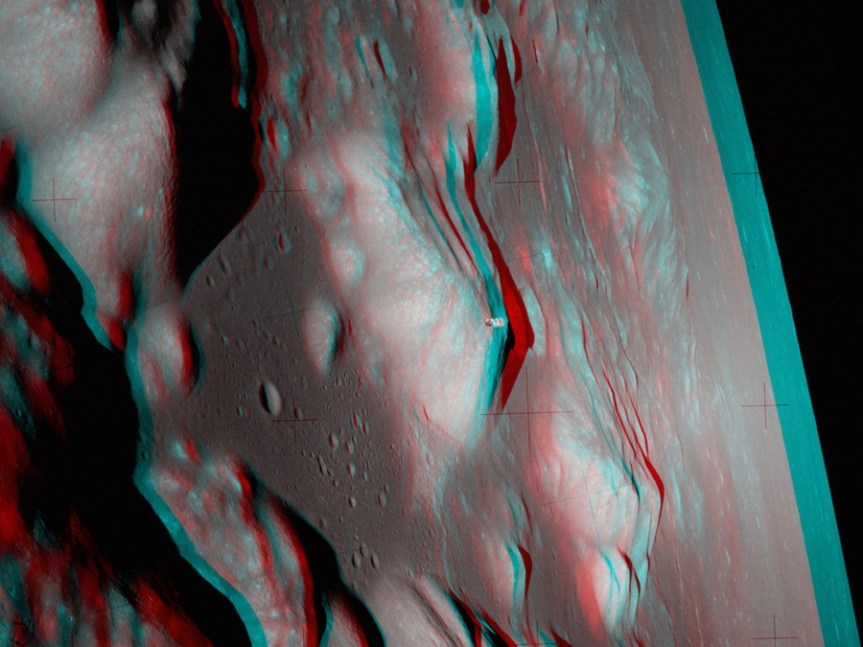
Explanation: Get out your red/blue glasses and check out this stereo view of another world. Fifty years ago the scene was recorded by Apollo 17 mission commander Eugene Cernan on December 11, 1972, one orbit before descending to land on the Moon. The stereo anaglyph was assembled from two photographs (AS17-147-22465, AS17-147-22466) captured from his vantage point on board the Lunar Module Challenger as he and Dr. Harrison Schmitt flew over Apollo 17’s landing site in the Taurus-Littrow Valley. The broad, sunlit face of the mountain dubbed South Massif rises near the center of the frame, above the dark floor of Taurus-Littrow to its left. Piloted by Ron Evans, the Command Module America is visible in orbit in the foreground against the South Massif’s peak. Beyond the mountains, toward the lunar limb, lies the Moon’s Mare Serenitatis.

Avoid shopping or making important decisions from 1 AM to 3 AM EST today. After that, the Moon moves from Gemini into Cancer.
Be careful because this is a tricky day. You feel confident and upbeat. However, this confidence might get you in trouble with a boss or someone in authority. Do not overestimate something. Keep your eyes open and remain realistic.
It’s easy to find yourself at odds with others today; even though initially, things begin in a positive, enthusiastic way before they end up like a runaway train. Probably, it’s best to stick to your convictions. Don’t be talked out of anything.
Be careful with money and finances today because you might initially overestimate something; or conversely, underestimate a problem. Either way, this could lead to you finding yourself in hot water. Best to tread carefully right from the get-go. Check your facts.
Today the Moon is in your sign; however, it is at odds with both Mercury and Jupiter. In one way, this makes you happy and confident! Yet in another way, you will be confrontational with someone, or someone might challenge you. Pull in your reins a little.
Even though you might choose to be low key today, and work alone or behind the scenes, nevertheless, you might find yourself embroiled with others in situations that are work-related, or related to shared property or shared responsibilities. Get your facts before you do anything.
This is a friendly, popular day for you! Nevertheless, as this day wears on, you might find yourself at odds with someone, perhaps a friend, a member of a group, or even a partner or close friend. A dispute with one of your kids is also possible. Assume nothing! Check facts.
Initially, you might be excited to talk to bosses, parents or partners about something because you’re enthusiastic and you want to enlighten others with your discoveries and opinions. (Moreover, people notice you today.) However, others might disagree! Double check that your facts are right.
Be careful with financial discussions today, whether it concerns the wealth of others, shared property, or your own earnings and personal wealth. Either way, something might look better than it is. You might also overlook an important detail. Therefore, tread carefully and double check your facts.
You are ever the optimist, which is why you look on the bright side of things. However, this is why you have to be careful today because something might initially look promising; however, upon closer inspection you find that it is not. Furthermore, others might challenge your assumptions. Do your homework.
Do what you can to keep the peace with others today because you might find yourself gridlocked with people who don’t agree with you, versus people who are cheering you on. Unfortunately, it could be a lose-lose situation. Therefore, don’t get involved.
You might be excited about a project today that relates to the arts or creative people working in a group. Possibly it relates to your job. Whatever the case, make sure you know what’s going on because things might not be as they appear. Take off those rose-coloured glasses.
Today, people are misjudging things, to their chagrin. Don’t overestimate something, especially if you are giving facts and figures to bosses, parents and VIPs today. (It will be easy to make this mistake.) Instead, double check your facts first so that you don’t end up with egg on your face. (Ketchup helps.)
Actress Dame Judi Dench (1934) shares your birthday today. You are confident. You address life with energy and vigour. You work hard for what you want. Nevertheless, privately, you are sensitive and softer than you appear. This year is the end of a nine-year cycle, which means it’s time to let go of anyone and anything holding you back. Clear the decks!
You can use this link to go forward or backward in time for Moon phase information. If you are curious, you can even find out what phase the Moon was in when you or anyone else was born.
The Moon’s current phase for today and tonight is a Waning Gibbous. During this phase the Moon can be seen in the early morning daylight hours on the western horizon. This is the first phase after the Full Moon occurs. It lasts roughly 7 days with the Moon’s illumination growing smaller each day until the Moon becomes a Last Quarter Moon with an illumination of 50%. The average Moon rise for this phase is between 9pm and Midnight depending on the age of the phase. The moon rises later and later each night setting after sunrise in the morning.
Visit the December 2022 Moon Phases Calendar to see all the daily moon phase for this month.
The Waning Gibbous on December 9 has an illumination of 98%. This is the percentage of the Moon illuminated by the Sun. The illumination is constantly changing and can vary up to 10% a day. On December 9 the Moon is 15.98 days old. This refers to how many days it has been since the last New Moon. It takes 29.53 days for the Moon to orbit the Earth and go through the lunar cycle of all 8 Moon phases.
There are 8 lunar phases the Moon goes through in its 29.53 days lunar cycle. The 4 major Moon phases are Full Moon, New Moon, First Quarter and Last Quarter. Between these major phases, there are 4 minor ones: the Waxing Crescent, Waxing Gibbous, Waning Gibbous and Waning Crescent. For more info on the Moon Cycle and on each phase check out Wikipedia Lunar Phase page.
Check the weather before a night of Moon gazing at weather.com
For a list of all the current meteor showers visit American Meteor Society

If you want to calculate the planetary positions for a specific use and time, click on this link
To figure out GMT (Greenwich Mean Time) for your local time use this link
The time for these Custom Planetary Positions is from the local time in Los Angeles, California, USA
December 09, 2022
08:00 pm GMT 12:00 PM PST
Zodiac: Tropical (Standard Western)
True Lunar Node:13 Taurus 00 Rx
Mean Lunar Node:11 Taurus 23 Rx
Lilith (Black Moon):26 Cancer 40
Chiron:12 Aries 01 Rx
Ceres:27 Virgo 22
Pallas:26 Cancer 01 Rx
Juno:16 Pisces 11
Vesta:05 Pisces 52
Eris:24 Aries 01 Rx

The time for these Custom Planetary Positions is from the local time in Chicago, Illinois, USA
December 09, 2022
06:00 pm GMT 12:00 PM CST
Zodiac: Tropical (Standard Western)
True Lunar Node:13 Taurus 01 Rx
Mean Lunar Node:11 Taurus 23 Rx
Lilith (Black Moon):26 Cancer 40
Chiron:12 Aries 01 Rx
Ceres:27 Virgo 21
Pallas:26 Cancer 01 Rx
Juno:16 Pisces 09
Vesta:05 Pisces 51
Eris:24 Aries 01 Rx
The time for these Custom Planetary Positions is from the local time in Frankfurt, Germany, Europe
9 December 2022
11:00 am GMT 12:00 PM CET
Zodiac: Tropical (Standard Western)
True Lunar Node:13 Taurus 02 Rx
Mean Lunar Node:11 Taurus 24 Rx
Lilith (Black Moon):26 Cancer 38
Chiron:12 Aries 02 Rx
Ceres:27 Virgo 15
Pallas:26 Cancer 03 Rx
Juno:16 Pisces 03
Vesta:05 Pisces 45
Eris:24 Aries 01 Rx
Discover the cosmos! Each day a different image or photograph of our fascinating universe is featured, along with a brief explanation written by a professional astronomer.
2022 December 9
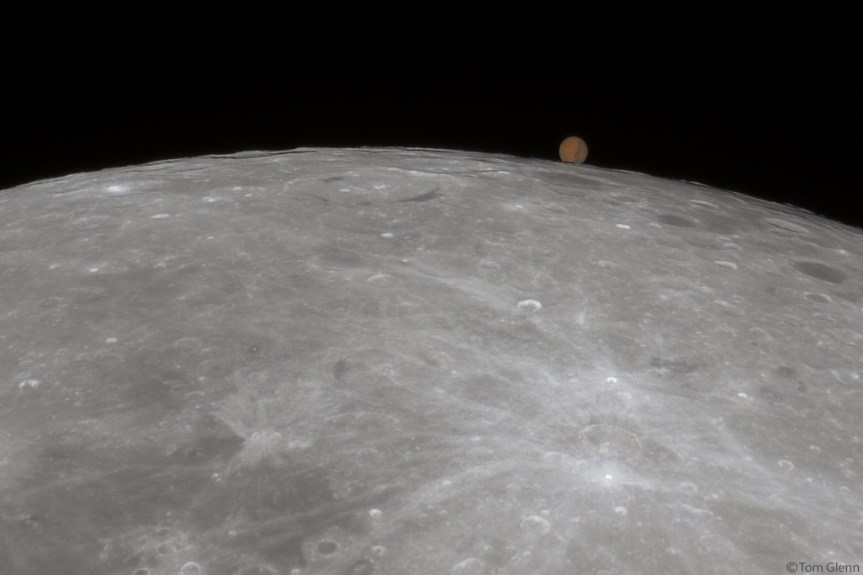
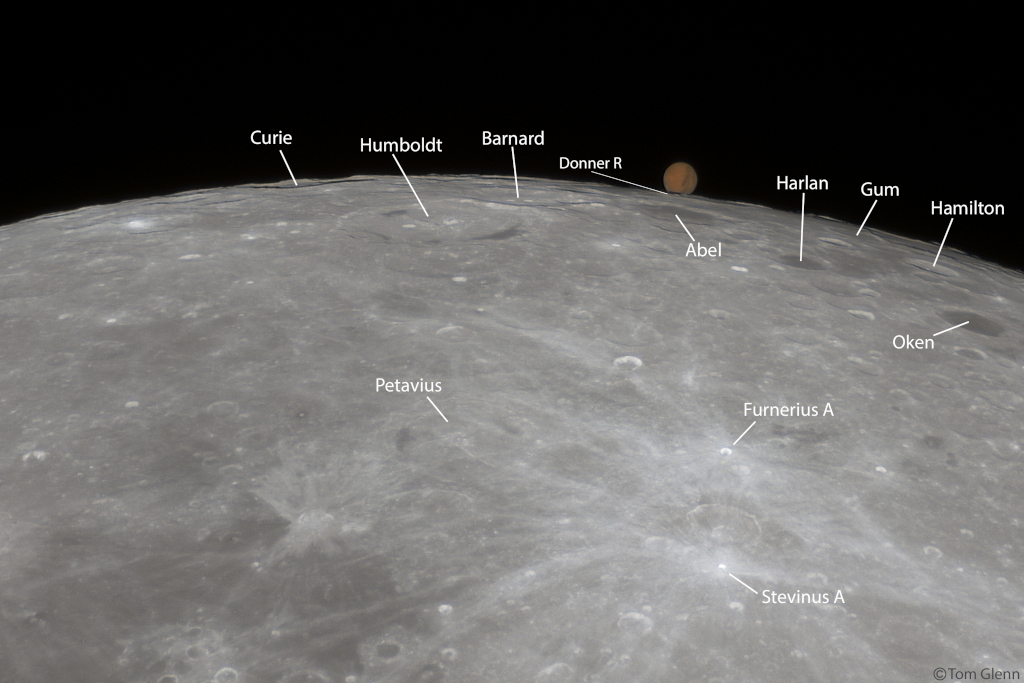
Explanation: On the night of December 7 Mars wandered near the Full Moon. In fact the Red Planet was occulted, passing behind the Moon, when viewed from locations across Europe and North America. About an hour after disappearing behind the lunar disk Mars reappears in this stack of sharp video frames captured from San Diego, planet Earth. With the Moon in the foreground Mars was a mere 82 million kilometers distant, near its own opposition. Full Moon and full Mars were bright enough provide the spectacular image with no exposure adjustments necessary. In the image Mars appears to rise just over ancient, dark-floored, lunar crater Abel very close to the southeastern edge of the Moon’s near side. Humboldt is the large impact crater to its north (left).

Dear sisters, brothers, and honored guests may your life be blessed with all things positive!
Discover the cosmos! Each day a different image or photograph of our fascinating universe is featured, along with a brief explanation written by a professional astronomer.
2022 December 8
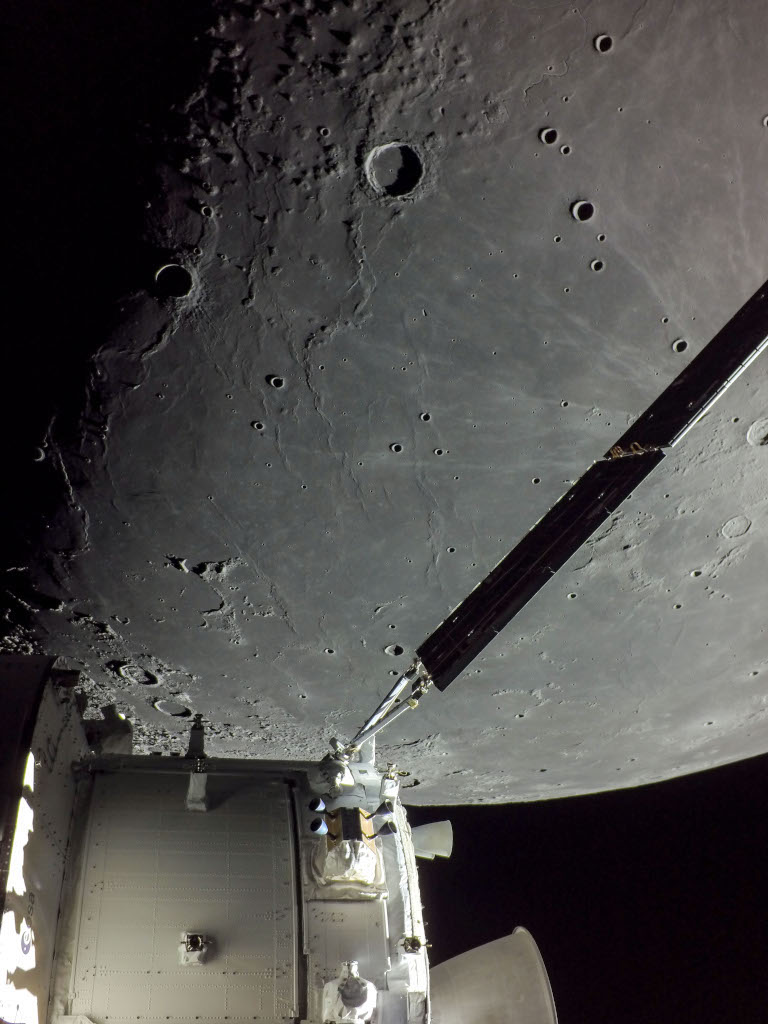
Explanation: A camera on board the uncrewed Orion spacecraft captured this view on December 5 as Orion approached its return powered flyby of the Moon. Below one of Orion’s extended solar arrays lies dark, smooth, terrain along the western edge of the Oceanus Procellarum. Prominent on the lunar nearside Oceanus Procellarum, the Ocean of Storms, is the largest of the Moon’s lava-flooded maria. The lunar terminator, shadow line between lunar night and day, runs along the left of the frame. The 41 kilometer diameter crater Marius is top center, with ray crater Kepler peeking in at the edge, just right of the solar array wing. Kepler’s bright rays extend to the north and west, reaching the dark-floored Marius. Of course the Orion spacecraft is now headed toward a December 11 splashdown in planet Earth’s water-flooded Pacific Ocean.


You must be logged in to post a comment.