
Tag: Wolf Moon
January 2022 Moon Details
The Full Moon for this month will occur on Monday, January 17th. The New Moon is earlier in the month on Sunday, January 2nd.
January Full Moon Name
The very first full moon of the year is known in many cultures as the Full Wolf Moon, which is appropriate given the deep, ancient ties between wolves and January’s full moon. For instance, the Gaelic word for January, Faoilleach, comes from the term for wolves, faol-chù, even though wolves haven’t existed in Scotland for centuries. The Saxon word for January is Wulf-monath, or Wolf Month. Meanwhile, the festival of the Japanese wolf god, Ooguchi Magami, is held in January. The Seneca tribe links the wolf so strongly to the moon, they believe that a wolf gave birth to the moon by singing it into the sky. Just why are wolves so strongly associated with January’s full moon?
The most obvious answer is because wolves are much louder and more noticeable in January, which is when breeding season begins. Wolves begin to howl more frequently and aggressively to establish their territory, threatening neighbors and enemies alike to stay far away from their breeding grounds. A small pack of wolves may even try to make themselves seem like a larger pack by howling together. While a lone wolf can sustain a howl for the duration of a single breath, an entire pack may howl in unison for longer than two minutes during breeding season.
While it makes sense for the haunting howls of wolves to be more memorable during January, how did wolves come to be associated with the full moon itself? Everyone is familiar with the iconic image of a wolf raising its head and howling at the full moon – but do wolves actually sing to the moon? While that might be a romantic idea, there’s no scientific evidence that links wolves to the lunar cycle. Humans may have begun to associate wolves with the moon simpy because they are nocturnal animals that are very active at night. In addition, wolves do raise their heads in the direction of the sky so their howls can travel over far distances to reach their pack mates as they roam. Instead of singing to the moon, they’re actually singing to their friends.
In fact, wolves are so well-known for their tight-knit communities that the Sioux tribe called January’s full moon the Moon Where Wolves Run Together. The wolf is often seen as a symbol of loyalty and protection in many cultures. The Wolf Moon is the perfect time for you to reach out to loved ones and reaffirm your connections, in preparation for deepening your bonds and taking on new challenges together over the upcoming year.
That said, lone wolves are also entirely capable of overcoming hostile conditions on their own with their resourcefulness. According to Celtic mythology, the wolf is infused with lunar power, which refers to its ability to sniff out hidden insights or knowledge, and to detect unexpected sources of danger. In some legends, the wolf even swallows the sun so the wolf can bask in the moon’s overflowing lunar power! The Full Wolf Moon is a great time for you to plan out clever ways to achieve your goals for the upcoming year. Trust your wolfish instincts when it comes to decisions, but also be tenacious in searching for useful knowledge that will help you realize your masterplan.
Local Date and Time for January 2022 Full Moon in major cities around the world:
Los Angeles,
San Francisco,
Vancouver
January 17, 2022
3:48pm PST
Denver,
Salt Lake City,
Calgary
January 17, 2022
4:48pm MST
Chicago,
Houston,
San Antonio
January 17, 2022
5:48pm CST
New York,
Toronto,
Atlanta
January 17, 2022
6:48pm EST
London,
Manchester,
Dublin
January 17, 2022
11:48pm GMT
Paris,
Rome,
Berlin
January 18, 2022
12:48am CET
Athens,
Istanbul,
Helsinki
January 18, 2022
1:48am EET
Dubai,
Abu Dhabi,
Muscat
January 18, 2022
3:48am +04
Bangalore,
Mumbai,
New Delhi
January 18, 2022
5:18am IST
Singapore,
Kuala Lumpur
January 18, 2022
7:48am +08
Perth,
Hong Kong,
Beijing
January 18, 2022
7:48am AWST
Sydney,
Brisbane,
Melbourne
January 18, 2022
10:48am AEDT
From Moongiant.com
January’s Full Wolf Moon!
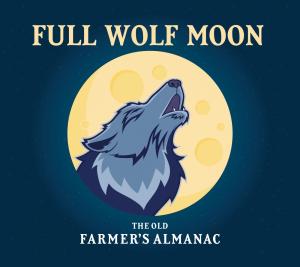
The full Wolf Moon rises on (Nothern Hemisphere) Monday, January 17, 2022 (Southern Hemisphere Tuesday, January 18, 2022). Learn more about when, where, and how to see the January full Moon!
When to See January’s Full Moon
January’s full Wolf Moon reaches peak illumination on Monday, January 17, at 6:51 P.M. EST ( Tuesday, January 18 at 10:48 am AEDT). Look for the Moon to rise from the northeastern horizon around sunset that evening.
Consult our Moonrise Calculator to see what time you can expect to catch a glimpse of the first full Moon of 2022!
The sunset embers smolder low,
The Moon climbs o’er the hill,
The peaks have caught the alpenglow,
The robin’s song is still.
–John L. Stoddard (1850–1931)
Why Is It Called the Full Wolf Moon?
The full Moon names used by The Old Farmer’s Almanac come from a number of places, including Native American, Colonial American, and European sources. Traditionally, each full Moon name was applied to the entire lunar month in which it occurred, not just to the full Moon itself.
The Wolf Moon
It’s thought that January’s full Moon came to be known as the Wolf Moon because wolves were more likely to be heard howling at this time. It was traditionally believed that wolves howled due to hunger during winter, but …
From The Old Farmers Almanac
January’s Full Moon – The Cold Moon

January’s Full Moon – The Cold Moon
In January, the nights are long and dark, and many of us are trying to stay warm under a blanket of snow as the Cold Moon approaches (in some cultures, the Cold Moon is the name given to December’s moon, instead). Some of the native tribes of North America called this time the Wolf Moon, because this was when the wolves were howling, hungry, outside lodges where people stayed warm within. Other groups referred to it as the Snow Moon, for obvious reasons.
This time of year, we’re all feeling a bit slow and “off” as our bodies adjust to chillier temperatures. It’s easy to just lie on the couch watching Netflix and eating comfort food when it’s cold and gloomy outside, and making any kind of magical effort can seem like a real challenge right now.
Correspondences:
Colors: Black and white, silver
Gemstones: Hematite
Trees: Birch, Hazel
Gods: Inanna, Freyja
Herbs: Thistle, nuts and seeds, marjoram
Element: Air
Cold Moon Magic
This is a good time to work on magic related to protection, both physical and spiritual. Use this time to develop your inner self, and advance spiritually, becoming closer to the higher aspects of your deities.
Take the time in your busy schedule to meditate and think about what it is you really want out of life, and whether you’re showing people your true self.
January is also a great time to work on full moon magic – after all, the nights are long and dark, and in some areas the moon itself is the only source of light. Put aside your lethargy, and focus some energy on developing your intuition and wisdom.
Finally, for many people, winter is a season of simplification. Set aside everything you don’t need, and try a minimalist approach instead. On a mundane level, try doing a thorough cleaning of your physical space – get rid of the clutter. On a spiritual and emotional level, try to do the same thing – teach your mind to let go of the things that are creating excess baggage for your spirit and soul.
Author
Patti Wigington, Paganism/Wicca Expert
Article published on & owned by About.com
Calendar of the Moon for January 22nd
Calendar of the Moon
Rowan Tree Moon
Color: Orange-red
Element: Fire
Altar: Upon a cloth of orange-red set a row of red candles, Brigid’s cross, and a bell.
Offerings: Votive candles. Quicken a newborn idea into birth.
Daily Meal: Hot drinks with every meal. Keep food warm.
Luis/Gamelion Invocation
Call: Now is the quickening of the year.
Response: Now is the time of the first movement.
Call: Now the child stirs in the womb.
Response: Now the seed stirs in the earth.
Call: Now the plains flood and our fire is threatened.
Response: Now the cold water drowns our spark.
Call: Now is the time of the hard struggle.
Response: Now is the month of desperation.
Call: Now is the time of desperation to live.
Response: Now is the time of desperation to be born.
Call: We turn in our sleep as the earth turns.
Response: We dream with the sleeping earth.
Call: Each of our dreams is a lit candle in the dark.
Response: Each of our dreams is a single point of hope.
Call: They shine faint and alone in the night of struggle.
Response: They are alone as we are alone.
Call: Yet we are not alone in our dreams.
Response: We are not alone!
Call: We will keep our fires burning.
Response: We will burn against the night!
Call: We will warm our dreams with the force of life.
Response: We will not die alone in the cold!
Call: We will ward off all evil.
Response: Only good shall pass our gates.
Call: We will care for each other.
Response: We will never cease to care!
Call: We will survive the winter.
Response: We will survive!
(Repeat last two lines twice more.)
Chant:
Protect the flame that warms your dreams
And dreams shall never die.

Eyes of the Wolf Spell
Eyes of the Wolf Spell
(Wolf Moon)
As the first full moon after the winter solstice or Yule, the Wolf Moon is one of the most important of the high moons. A full moon occurs when the sun and the moon are aligned on opposite sides of the earth. This alignment of the two celestial bodies has a strong effect on the earth. This alignment of the two celestial bodies has a strong effect on the earth, producing a time when energy is high. This is why full moon rituals can be incredibly powerful times for doing magick.
When looking through the eyes of the wolf, the idea is to perceive the true nature of people, events and experiences. Expand your perception and awareness using the instincts of the wolf. The wolf is part of a pack that use their knowledge and wits to survive a time when the earth is cold and barren.
This is also when new patterns are conceived, setting the stage for what is to come. This is also the ideal time for foretelling the future, clairvoyance, and divination practices.
At midnight, begin by drawing a circle of light. This is done by standing at your altar and pounding the stick end of your wand on the altar nine times. Pick up you athame and point it toward the north point of your circle. Starting and ending in the north, draw a magickal circle of light clockwise around the circle. Next, call in the elements of earth, air, fire and water.
Standing in the middle of the circle, call in the powers of the wolf:
“On this full moon night at this hour
I call now upon the ancient animal powers
To guide me in the ways of the wolf
Where instinct and wit prevail
Through darkness, wind, rain and hail
I am the wolf, the wolf is me
So be it! Blessed be!
As you enjoy your evening, imagine seeing through the eyes of the wolf. Imagine dreaming with the eyes of the wolf. In the morning pull up the circle and thank the elements. Also than the wolf for its guidance and power.
Blue Moon
Blue Moon
Your geographic location can make a difference to your experience of a Blue Moon. Depending on your longitude you may go through a date change prior to other locations which means the full moon is at the first of your new month and falls at the end of the preceding month somewhere else. The “blue” one is always the 2nd full moon in the same month. The regular full moons of each month all have their own individual names as follows: Moon after Yule, Wolf Moon, Lenten Moon, Egg Moon, Milk Moon, Flower Moon, Hay Moon, Grain Moon, Fruit Moon, Harvest Moon, Hunters’ Moon and Moon Before Yule.
Historically the Blue Moon was considered unlucky and a real nuisance when it occurred at various times of the year and upset scheduling of church festivals. In love songs the Blue Moon is often a symbol of sadness and loneliness.
The first appearance in print of this expression goes back to the time of Shakespeare, when some folks felt that sometimes the moon visually appeared blue in the sky. Although the expression dates all that way back, it has only recently come to mean the second Full Moon in one month. Blue Moon seems to be a truly modern piece of folklore, old folklore it is not, but real folklore it is.
A Year of Full Moons
Learn the name and meaning of the Full Moon every month
Tarotcom Staff on the topics of moon, full moon, astrology
In Astrology, the Full Moon signals a time each month when we are able to take a clear look at what is happening in our lives so we can decide if we need to make changes. But culturally and historically speaking, the Full Moon has additional meaning that changes from month to month throughout the year.
Either way, the Full Moon stirs our emotions, so it’s fitting that the Full Moon for each month has a different name and personality. Many of the Full Moon names date back to ancient tribes who followed the Full Moon to help keep track of the seasons.
Other Full Moon names have been created by different cultures around the world, and most of the Full Moons have more than one name — although one is likely more widely used than the others.
Let’s take a glance at a year’s worth of Full Moons!
January: The Wolf Moon
The Full Wolf Moon in January is named for the time when wolves could be heard howling with hunger in the heart of winter. Alternate names: Snow Moon or Old Moon.
February: The Snow Moon
The Full Snow Moon in February is named for the time of the heaviest winter snowfall. This is also a time when hunting is more difficult, so it is also known as the Hunger Moon.
March: The Worm Moon
The Full Worm Moon in March is named for the time of year when the temperature begins to warm, the earth softens and earthworms begin to reappear, followed by the birds. Alternate names: The Sap Moon or the Crow Moon.
April: The Pink Moon
The Full Pink Moon in April is named for the time of year when the earliest pink phlox and wildflowers begin to bloom. Alternate names: The Grass Moon, the Egg Moon or the Fish Moon.
May: The Flower Moon
The Full Flower Moon in May is named for the abundance of flowers that begin to bloom this month. Alternate names: The Corn Planting Moon or the Milk Moon.
June: The Strawberry Moon
The Full Strawberry Moon in June is named for the time of year the Native American Algonquin tribes would rush to gather ripe strawberries. Alternate names: The Honey Moon, the Rose Moon or the Hot Moon.
July: The Full Buck Moon
The Full Buck Moon in July is named for the time of year when buck deer begin to grow new antlers. Alternate names: The Thunder Moon (for frequent thunderstorms) or the Hay Moon.
August: The Sturgeon Moon
The Full Sturgeon Moon of August is named for the time when Native American fishing tribes could most easily catch this fish in certain lakes. Alternate names: The Green Corn Moon, the Red Moon or the Grain Moon.
September: The Corn Moon or Harvest Moon
The Full Corn Moon of September is named for the time of year when Native Americans harvested corn. It’s alternately called the Harvest Moon (which is the Full Moon closest to Fall Equinox and can happen in September or October) or the Barley Moon.
October: The Hunter’s Moon or The Harvest Moon
The Full Hunter’s Moon of October is named for the time of year when Native American tribes hunted for the fattest game and stored provisions for winter. October’s Full Moon is called the Harvest Moon when it falls closest to the Fall Equinox. Alternate names: The Travel Moon or the Dying Moon.
November: The Beaver Moon
The Full Beaver Moon of November is named for the time when Native Americans would set their beaver traps before the water began to freeze over. It’s also the time of year beavers begin to prepare for winter. Alternate name: The Frosty Moon.
December: The Cold Moon or The Long Nights Moon
The Full Cold Moon or Full Long Nights Moon of December is named for the mid-winter month in which the cold really takes hold, and nights become long and dark. Alternate name: Yule Moon.
Eyes of the Wolf Spell (Wolf Moon)
Eyes of the Wolf Spell
(Wolf Moon)
As the first full moon after the winter solstice or Yule, the Wolf Moon is one of the most important of the high moons. A full moon occurs when the sun and the moon are aligned on opposite sides of the earth. This alignment of the two celestial bodies has a strong effect on the earth. This alignment of the two celestial bodies has a strong effect on the earth, producing a time when energy is high. This is why full moon rituals can be incredibly powerful times for doing magick.
When looking through the eyes of the wolf, the idea is to perceive the true nature of people, events and experiences. Expand your perception and awareness using the instincts of the wolf. The wolf is part of a pack that use their knowledge and wits to survive a time when the earth is cold and barren.
This is also when new patterns are conceived, setting the stage for what is to come. This is also the ideal time for foretelling the future, clairvoyance, and divination practices.
At midnight, begin by drawing a circle of light. This is done by standing at your altar and pounding the stick end of your wand on the altar nine times. Pick up you athame and point it toward the north point of your circle. Starting and ending in the north, draw a magickal circle of light clockwise around the circle. Next, call in the elements of earth, air, fire and water.
Standing in the middle of the circle, call in the powers of the wolf:
“On this full moon night at this hour
I call now upon the ancient animal powers
To guide me in the ways of the wolf
Where instinct and wit prevail
Through darkness, wind, rain and hail
I am the wolf, the wolf is me
So be it! Blessed be!
As you enjoy your evening, imagine seeing through the eyes of the wolf. Imagine dreaming with the eyes of the wolf. In the morning pull up the circle and thank the elements. Also than the wolf for its guidance and power.
Rebirthing Ritual (Wolf Moon)
Rebirthing Ritual
(Wolf Moon)
Winter is not only about death, but also about rebirth. The Rebirthing Ritual is similiar to an initiation ritual, where a seeker leaves behind his or her former self in order to be reborn into her or his new self. The idea here is one of transformation in which you leave your old self behind and replace it with the new self.
Collect three things that represent your former self. Before dark, gather them together. Go outside somewhere private, and dig a hole in the earth. Put the objects in the hole, and cover them with dirt. Say three times:
Let the earth take my former self,
And let my new self awaken with joy,
So be it! Blessed Be!
This process acts as a symbolic death of your old self. Say a few personal words as you bury your old self forever. Now take a deep breath, focus on your new self and who you are becoming. Realize you can become whoever you want to be. The choice is yours to make. If you don’t like who you are allow your new self to awaken and live each night and day with passion.
Howling Wolf Tree Dream Meditation (Wolf Moon)
Howling Wolf Tree Dream Meditation
Wolf Moon
The sound of the wind moving through the trees is reminiscent of the howl of wolves. Other Pagan traditions such as the Druids, and the practices of the American Algonquin tribes, also refer to the time after the Winter Solstice as being the Wolf Moon.A half hour before going to sleep, drink a cup of chamomile tea. While drifting off to sleep, imagine yourself as a seedling that is just beginning to sprout. Sense yourself spreading your roots down in the earth, while at the same time moving your trunk or body toward the light. Feel yourself growing all the time. Plants grow more at night than they do during the day.
The popular New Age author and workshop leader Gregg Braden postulates that each cell of our body generates 1.17 volts of energy. When you calculate all the cells together, your body can generate alot of energy, particularly when directed toward a particular focus. You are a conduit or lightning rod of energy, waiting to realize your true potential.
Sense yourself becoming a large tree that has grown for many years. Every part of you emanates with energy as you reach toward the light with every part of your being. You are a connecting point between this world and all worlds. As Lucan said in AD 60 when addressing the Druids: “To you alone it is given to know the truth about the Gods and Deities of the sky. The innermost groves of far-off forests are your abode.”
Riding To The Stars (Wolf Moon)
Riding To The Stars
Wolf Moon
Stars are like horses. When you wish upon a star, it carries your wish like a winged horse flying across the sky. Ride like a dreamer into the morning light and in the light of a new day your wishes will come true.
About an hour before dark, think about and decide what you would like to wish for. Be clear what you want. Go outside this evening and wait for the first star to appear in the sky. As you wait, go over your wish.
Upon seeing the first star, recite the following verse:
“Starlight, star-bright
First star I see tonight,
May I ride the magick carpet of your light,
Floating to the stars like fireflies,
Rising to that place where dreams come true,
When I’m blessed in all things I do.
By the light of the first star, so be it!
Later when going to sleep, envision the first star that you saw in the evening sky. Imagine yourself moving into the star and riding it across the sky. At the other side, see an image in your mind of your dream becoming reality. See it. Touch it. Hear it. Smell it. Taste it. Be it.
 Witches Of The Craft®
You must be logged in to post a comment.