Tag: Samhain
A Thought for Today
A Laugh for Today

God – Xiuhtecuhtli
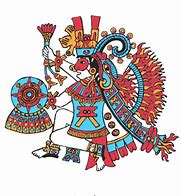
Xiuhtecuhtli – Aztec god of fire, day and heat from en.wikipedia.org
In Aztec mythology, Xiuhtecuhtli [ʃiʍˈtekʷt͡ɬi] (“Turquoise Lord” or “Lord of Fire”),[3] was the god of fire, day and heat.[4] In historical sources he is called by many names, which reflect his varied aspects and dwellings in the three parts of the cosmos.[5] He was the lord of volcanoes,[6] the personification of life after death, warmth in cold (fire), light in darkness and food during famine. He was also named Cuezaltzin [kʷeˈsaɬt͡sin] (“flame”) and Ixcozauhqui [iʃkoˈsaʍki],[7] and is sometimes considered to be the same as Huehueteotl (“Old God”),[8] although Xiuhtecuhtli is usually shown as a young deity.[9] His wife was Chalchiuhtlicue. Xiuhtecuhtli is sometimes considered to be a manifestation of Ometecuhtli, the Lord of Duality, and according to the Florentine Codex Xiuhtecuhtli was considered to be the father of the Gods,[10] who dwelled in the turquoise enclosure in the center of earth.[11] Xiuhtecuhtli-Huehueteotl was one of the oldest and most revered of the indigenous pantheon.[12] The cult of the God of Fire, of the Year, and of Turquoise perhaps began as far back as the middle Preclassic period.[13] Turquoise was the symbolic equivalent of fire for Aztec priests.[14] A small fire was permanently kept alive at the sacred center of every Aztec home in honor of Xiuhtecuhtli.[14]
The Nahuatl word xihuitl means “year” as well as “turquoise” and “fire”,[11] and Xiuhtecuhtli was also the god of the year and of time.[15][16] The Lord of the Year concept came from the Aztec belief that Xiuhtecuhtli was the North Star.[17] In the 260-day ritual calendar, the deity was the patron of the day Atl (“Water”) and with the trecena 1 Coatl (“1 Snake”).[15] Xiuhtecuhtli was also one of the nine Lords of the Night and ruled the first hour of the night, named Cipactli (“Alligator”).[18] Scholars have long emphasized that this fire deity also has aquatic qualities.[13] Xiuhtecuhtli dwelt inside an enclosure of turquoise stones, fortifying himself with turquoise bird water.[19] He is the god of fire in relation to the cardinal directions, just as the brazier for lighting fire is the center of the house or temple.[20] Xiuhtecuhtli was the patron god of the Aztec emperors, who were regarded as his living embodiment at their enthronement.[21] The deity was also one of the patron gods of the pochteca merchant class.[22]
Stone sculptures of Xiuhtecuhtli were ritually buried as offerings, and various statuettes have been recovered during excavations at the Great Temple of Tenochtitlan with which he was closely associated.[23] Statuettes of the deity from the temple depict a seated male with his arms crossed.[24] A sacred fire was always kept burning in the temples of Xiuhtecuhtli.[25] In gratitude for the gift of fire, the first mouthful of food from each meal was flung into the hearth.[21]
Xiuhtecuhtli is depicted in the Codex Borgia.[26]
Attributes
Xiuhtecuhtli’s face is painted with black and red pigment.[16] Xiuhtecuhtli was usually depicted adorned with turquoise mosaic, wearing the turquoise xiuhuitzolli crown of rulership on his head and a turquoise butterfly pectoral on his chest,[27] and he often wears a descending turquoise xiuhtototl bird (Cotinga amabilis) on his forehead and the Xiuhcoatl fire serpent on his back.[28] He owns fire serpent earplugs.[12] On his head he has a paper crown painted with different colors and motifs. On top of the crown there are sprays of green feathers, like flames from a fire.[12] He has feather tufts to each side, like pendants, toward his ears. On his back he has plumage resembling a dragon’s head, made of yellow feathers with marine conch shells.[12] He has copper bells tied to the insteps of his feet. In his left hand he holds a shield with five greenstones, called chalchihuites, placed in the form of a cross on a thin gold plate that covered almost all the shield.[12] In his right hand he has a kind of scepter that was a round gold plate with a hole in the middle, and topped by two globes, one larger than the other, the smaller one had a point.[12] Xiuhtecuhtli is closely associated with youthful warriors and with rulership, and was considered a solar god.[29] His principal symbols are the tecpatl (flint) and the mamalhuatzin, the two sticks that were rubbed together to light ceremonial fires.[30] A staff with a deer’s head was also an attribute of Xiuhtecuhtli, although not exclusively so as it could also be associated with Xochiquetzal and other deities.[31]
Many of the attributes of Xiuhtecuhtli are found associated with Early Postclassic Toltec warriors but clear representations of the god are not common until the Late Postclassic.[28] The nahual, or spirit form, of Xiuhtecuhtli is Xiuhcoatl, the Fire Serpent.[32]
Xiuhtecuhtli was embodied in the teotecuilli, the sacrificial brazier into which sacrificial victims were cast during the New Fire ceremony.[32] This took place at the end of each cycle of the Aztec calendar round (every 52 years),[33] when the gods were thought to be able to end their covenant with humanity. Feasts were held in honor of Xiuhtecuhtli to keep his favors, and human sacrifices were burned after removing their heart.
Annual festival[edit]
The annual festival of Xiuhtecuhtli was celebrated in Izcalli, the 18th veintena of the year.[34] The Nahuatl word izcalli means “stone house” and refers to the building where maize used to be dried and roasted between mid-January and mid-February. The whole month was therefore devoted to fire.[14] The Izcalli rituals grew in importance every four years.[35] A framework image of the deity was constructed from wood and was richly finished with clothing, feathers and an elaborate mask.[34] Quails were sacrificed to the idol and their blood spilt before it and copal was burnt in his honour.[36] On the day of the festival, the priests of Xiuhtecuhtli spent the day dancing and singing before their god.[37] People caught animals, including mammals, birds, snakes, lizards and fish, for ten days before the festival in order to throw them into the hearth on the night of the festival.[38] On the tenth day of Izcalli, during a festival called huauhquiltamalcualiztli (“eating of the amaranth leaf tamales”), the New Fire was lighted, signifying the change of the annual cycle and the rebirth of the fire deity.[39] During the night the image of the god was lit with using the mamalhuatzin.[40] Food was consumed ritually, including shrimp tamales, after first offering it to the god.[38]
Every four years a more solemn version of the festival was held at the temple of Xiuhtecuhtli in Tenochtitlan, attended by the emperor and his nobles.[42] Slaves and captives were dressed as the deity and sacrificed in his honour.[43] Godparents were assigned to children on this day and the children had their ears ritually pierced. After this, the children, their parents and godparents all shared a meal together.[42]
New Fire Ceremony[edit]
Xiuhtecuhtli was celebrated often but especially at the end of every 52-year period. This was the time the 365-day solar and the 260-day sacred calendars ended on the same day and the Aztec celebrated the Binding of the Years with the New Fire Ceremony.[17] In order to perform the ritual, priests marched in solemn procession up the Hill of the Star on a peninsula near Culhuacán to wait for the star Yohualtecuhtli (either Aldebaran in the Taurus constellation or the Pleiades as a whole) to get past its zenith. Having ascertained this, they would tear out the heart of a sacrificial victim and kindle a flame in a small wooden hearth they placed inside the hole left in his chest. Priests used a drill method to generate this sacred flame. It was then carried on pine sticks to light the fires anew in every hearth, including the sacred braziers of perpetual fire, that numbered over 600 in the capital alone.[44]
Goddess – Chantico, or Xantico
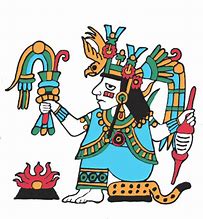
Chantico, The Aztec Goddess of Fire and the Household from oldworldgods.com
It was not unusual to see that in some religions, there were deities linked to both domestic and military matters. The Aztec goddess Chantico was an example of this link, just like the Roman goddess Vesta was in the Roman religion.
Table of Contents
The meaning of Chantico Aztec goddess: Origin of the Name
History of Chantico goddess and Most Important Myths Related to Her
Powers of the Aztec goddess Chantico
What was Chantico the goddess of?
In Aztec religion, Chantico was a domestic deity. She was mainly associated with the fires burning in the house hearth but was considered to be the protectress of the house and of the possessions inside it in general.
Because of a process of extension of her prerogatives, the Aztecs came to think of her as the protectress of their empire as a whole: it has been reported by the Spanish that Moctezuma, one of the last Aztec emperors, had an idol of the Aztec goddess Chantico with a removable leg, that he would have used as a tool to curse the land, obstructing the advance of Hernan Cortes.
For this reason, probably, Chantico had a tight link to the army and to military life in general, which was made evident in her iconography.
The appearance of Chantico goddess of fire
Her representations, in fact, usually displayed a crown made of spikes of a poisonous cactus, which was seen as a sign of aggressivity and peril, and at the top of her head was often present an ornament of feathers, which were a typical symbol of warriors.
In addition, among her accessories could be found the so-called alt-tlachinolli, or water-fire, a necklace which also was linked to warfare. Other elements which help to identify her in codexes and images are the obsidian sandals at her feet, the so-called itzcactli, and a golden pendant at her neck, which probably was a representation of the sun.
Connections and relationships with other Aztec deities
Being the goddess who presided to the domestic fire, Chantico was connected to this element, too, and was therefore linked to the other fire deities of the Aztec pantheon.
In particular, she was often associated with the god Xolotl: their connection was represented by the fact that they both were often depicted wearing the yacaxtuitl, a blue nose ornament.
Her cult was particularly strong among stonecutters. Likely for this reason, she was particularly worshipped in the town of Xochimilco, where stonecutting was widely practiced.
The meaning of Chantico Aztec goddess: Origin of the Name
It seems that the name “Chantico” might have signified “she who lives in the house”, surely alluding to her role as a domestic goddess.
Anyway, she was also referred to with other names. One of these was Quaxolotl, which would have meant “split in the upper part”, and would have therefore been a reference to Chantico’s link to the god of duality and twins, Xolotl.
Among stonecutters, she would have been also called Papaloxaual or Tlappapalo, meaning respectively “butterfly painting” and “the one of the red butterfly”. Anyway, there seem to be no other pieces of information clarifying this association of her with butterflies.
History of Chantico goddess and Most Important Myths Related to Her
According to some scholars, the cult of the Aztec goddess Chantico would have originated there where she was most worshipped, in the town of Xochimilco.
Therefore, it would have spread to all the Aztec Empire, included of course the capital, Tenochtitlan, where Chantico goddess would have been venerated in the most important religious building, the Templo Mayor.
Chantico goddess of fire was the main character of an interesting myth describing food taboos among the Aztecs. Let’s see this story in greater detail.
The Aztec goddess Chantico and the Paprika
According to this story, the Aztec goddess of fire Chantico liked paprika very much. Some suggest that the reason behind this fact could be found in Chantico’s association with fire: paprika, in fact, remembers fire both in color and taste.
Anyway, in Aztec religion, food was a prerogative of the god Tonacatecuhtli, who used to occasionally declare fasts, i.e. days during which some particular foods were banned.
One day, a fast of this sort, forbidding anyone to eat paprika, was pronounced by Tonacatecuhtli; nonetheless, the Aztec goddess Chantico could not resist pouring this beloved spice on her meal, which consisted of roasted fish.
Angered, Tonacatecuhtli changed Chantico into a dog, as a form of punishment. According to some, this might be the reason why dogs love to rest by the hearth.
Powers of the Aztec goddess Chantico
In her role of protectress of possessions, of the house, and, more generally, of the Aztec homeland, the Aztec goddess Chantico was thought to be able to deny access to strangers and enemies.
Symbols of Chantico and Their Meanings
Besides the ones already mentioned, one of Chantico’s symbols was an eagle foot covered with the skin of a jaguar, located on a dish of blood.
Like many others of her attributes, this peculiar image, also, might have represented her link with war, since the dish of blood was a symbol of warrior sacrifice.
Additional Aztec goddess Chantico Facts
Chantico’s figure is linked to one of the most impressive and important archeological remains found in the lands once occupied by the Aztecs: the so-called Coyolxauhqui-Chantico monument.
As its name suggests, this object has been linked by scholars to two Aztec goddesses: one is the goddess of the moon, Coyolxauhqui, while the other is the domestic goddess Chantico.
It represents a giant head and has been discovered in the Templo Mayor, the most important and famous building that could be found in the ancient city of Tenochtitlan, the capital of the Aztec Empire. This head was called this way by Hermann Mayer, an important Mesoamerican scholar.
In fact, he argued, elements related to both deities could be found in it. The form and the subject of the statue, a giant head, surely reminded of Coyolxauhqui, and in particular of her role in the myth describing the birth of Huitzilopochtli: according to this story, in fact, Coyolxauhqui and her brothers would have tried to kill their mother while she was pregnant with Huitzilopochtli, but he would have come out of his mother’s womb and defeated them, beheading Coyolxauhqui.
At the same time, as noted by Eduard Seler, the character to whom the head belongs, represented in other objects, presents elements that can be easily associated with Chantico. In particular, it wears the itzcactli, the obsidian sandals, and a golden pendant which are often displayed in Chantico’s portraits. These facts have led some scholars to think that the two deities might be connected. Anyway, none of the surviving sources in their possession is able to confirm or clarify this point.
Archangel – Gabriel
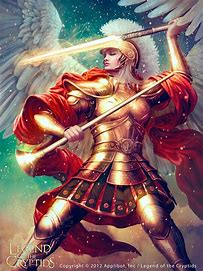
GABRIEL, ARCHANGEL OF STRENGTH from angelarium.net
Gabriel is like the complex feeling of delivering bad news. It’s affecting you as much as you are affecting the people around you. There is a weight in there. It’s a dark weight, but it’s valuable. There’s a message that needs to be said, and you need to be the one to say it.
This Golden Herald embodies those transmissions which are most important. Words, sounds and pictures that carry huge impact. Sometimes the results are glorious and sometimes they are terrible. Either way, there is no way to hold them back. When the herald lifts its lantern, everyone will see it. There’s no escaping it.
Witchcraft Symbols, Terms and Definitions – Dragon
A dragon is a reptilian legendary creature that appears in the folklore of many cultures worldwide. Beliefs about dragons vary considerably through regions, but dragons in western cultures since the High Middle Ages have often been depicted as winged, horned, and capable of breathing fire. Dragons in eastern cultures are usually depicted as wingless, four-legged, serpentine creatures with above-average intelligence. Commonalities between dragons’ traits are often a hybridization of feline, reptilian, and avian features. Scholars believe vast extinct or migrating crocodiles bear the closest resemblance, especially when encountered in forested or swampy areas, and are most likely the template of modern Oriental dragon imagery.[1][2]
Etymology
The word dragon entered the English language in the early 13th century from Old French dragon, which, in turn, comes from the Latin: draconem (nominative draco) meaning “huge serpent, dragon”, from Ancient Greek δράκων, drákōn (genitive δράκοντος, drákontos) “serpent”.[4][5] The Greek and Latin term referred to any great serpent, not necessarily mythological.[6] The Greek word δράκων is most likely derived from the Greek verb δέρκομαι (dérkomai) meaning “I see”, the aorist form of which is ἔδρακον (édrakon).[5] This is thought to have referred to something with a “deadly glance,”[7] or unusually bright[8] or “sharp”[9][10] eyes, or because a snake’s eyes appear to be always open; each eye actually sees through a big transparent scale in its eyelids, which are permanently shut. The Greek word probably derives from an Indo-European base *derḱ- meaning “to see”; the Sanskrit root दृश् (dr̥ś-) also means “to see”.[11]
Myth origins
Draconic creatures appear in virtually all cultures around the globe[12] and the earliest attested reports of draconic creatures resemble giant snakes. Draconic creatures are first described in the mythologies of the ancient Near East and appear in ancient Mesopotamian art and literature. Stories about storm-gods slaying giant serpents occur throughout nearly all Near Eastern and Indo-European mythologies. Famous prototypical draconic creatures include the mušḫuššu of ancient Mesopotamia; Apep in Egyptian mythology; Vṛtra in the Rigveda; the Leviathan in the Hebrew Bible; Grand’Goule in the Poitou region in France; Python, Ladon, Wyvern, and Kulshedra in Albanian Mythology and the Lernaean Hydra in Greek mythology; Jörmungandr, Níðhöggr, and Fafnir in Norse mythology; and the dragon from Beowulf.
Nonetheless, scholars dispute where the idea of a dragon originates from[13] and a wide variety of hypotheses have been proposed.[13]
In his book An Instinct for Dragons (2000), David E. Jones (anthropologist) suggests a hypothesis that humans, like monkeys, have inherited instinctive reactions to snakes, large cats, and birds of prey.[14] He cites a study which found that approximately 39 people in a hundred are afraid of snakes[15] and notes that fear of snakes is especially prominent in children, even in areas where snakes are rare.[15] The earliest attested dragons all resemble snakes or have snakelike attributes.[16] Jones therefore concludes that dragons appear in nearly all cultures because humans have an innate fear of snakes and other animals that were major predators of humans’ primate ancestors.[17] Dragons are usually said to reside in “dank caves, deep pools, wild mountain reaches, sea bottoms, haunted forests”, all places which would have been fraught with danger for early human ancestors.[18]
In her book The First Fossil Hunters: Dinosaurs, Mammoths, and Myth in Greek and Roman Times (2000), Adrienne Mayor argues that some stories of dragons may have been inspired by ancient discoveries of fossils belonging to dinosaurs and other prehistoric animals.[19] She argues that the dragon lore of northern India may have been inspired by “observations of oversized, extraordinary bones in the fossilbeds of the Siwalik Hills below the Himalayas“[20] and that ancient Greek artistic depictions of the Monster of Troy may have been influenced by fossils of Samotherium, an extinct species of giraffe whose fossils are common in the Mediterranean region.[20] In China, a region where fossils of large prehistoric animals are common, these remains are frequently identified as “dragon bones”[21] and are commonly used in traditional Chinese medicine.[21] Mayor, however, is careful to point out that not all stories of dragons and giants are inspired by fossils[21] and notes that Scandinavia has many stories of dragons and sea monsters, but has long “been considered barren of large fossils.”[21] In one of her later books, she states that, “Many dragon images around the world were based on folk knowledge or exaggerations of living reptiles, such as Komodo dragons, Gila monsters, iguanas, alligators, or, in California, alligator lizards, though this still fails to account for the Scandinavian legends, as no such animals (historical or otherwise) have ever been found in this region.”[22]
Robert Blust in The Origin Of Dragons (2000) argues that, like many other creations of traditional cultures, dragons are largely explicable as products of a Click here to learn more about a Dragon from en.wikipedia.org
Flower Meaning, Symbol and Spiritual Meaning – Snapdragon
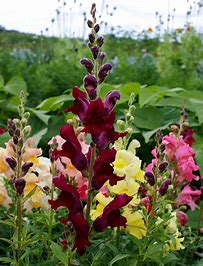
Snapdragon Flower Meaning And Symbolism from florgeous.com
With more than 40 kinds of snapdragon plants all over the world, the snapdragon is a gorgeous flower that not only has a beautiful appearance and a fun-to-say name, but also a lot of hidden meaning.
Named many centuries ago, this flower is often used as a gift between friends and loved ones. Before you choose this flower in your next bouquet, consider its deep meaning and symbolism. Its flower symbol will help you give a gift that is not only lovely to look at, but meaningful, too.
What Does Snapdragon Mean?
The common English name “snapdragon” is taken directly from the appearance of the flower. This gorgeous flower looks just like a dragon’s head when it is squeezed.
Although people don’t find amusement out of this kind of silly hobby nowadays, back when the flower was first named, the snapdragon was a source of great hilarity!
The scientific name for snapdragon is Antirrhinums. There are more than 40 species of snapdragons in this genus. The name is derived from the Greek word “antirrhinum,” which means “nose-like.”
Interestingly, the Greeks had two names for the plant – the other one was ”kynokephelon,” which means “dog-headed.”
What Do Snapdragons Symbolize?
Snapdragons have multiple meanings. They can represent strength, as they’re able to grow in rocky, typically uninhabitable areas, but they can also symbolize themes like deviousness and grace.
Snapdragons are sometimes used as a charm against falsehood. They can also represent the idea of grace under pressure or in the internal strength that is necessary to overcome challenging situations.
What Does a Purple Snapdragon Mean?
Purple snapdragons are usually associated with spirituality. This is a sharp contrast when you compare purple snapdragons to other types of purple flowers – usually, purple flowers are seen as a symbol of royalty.
What Does a Red Snapdragon Symbolize?
Red snapdragons are usually used to symbolize love, passion, and positive energy.
What Does a White Snapdragon Represent?
White snapdragons are usually used to symbolize purity, innocence, and grace, as is common with white flowers of other species, too.
What Does a Yellow Snapdragon Mean?
Yellow snapdragons symbolize happiness, positivity, and good luck.
What is the Cultural Significance of a Snapdragon?
There has been symbolism surrounding the snapdragon since ancient times – even before the Roman Empire. These flowers were used as a charm to protect against falsehood.
In Victorian times, people used to send messages to each other using flowers. Snapdragons were used to symbolize truth-telling.
Originally grown in southern Spain, America, and North Africa, the Romans spread snapdragon throughout much of Europe.
They can vary greatly in size and are some of the most common ornamental plants. According to European folklore, stepping on a snapdragon has the power to break black magic spells, too.
What is the Symbolism of a Snapdragon Tattoo?
When you choose to get a snapdragon tattoo, you are making the decision to add a ton of symbolism to the artwork on your body.
This tattoo can have several meanings. First, a snapdragon can symbolize grace. However, it can also symbolize strength or even deviousness, since it has the ability to grow in rocky areas.
When Should You Give Someone a Snapdragon?
Thinking about giving someone a snapdragon? There are plenty of occasions in which it is appropriate to do so.
You could give a snapdragon as a gift to someone who has overcome a challenge in life – or perhaps to someone who needs to get through a bout of bad luck. It would be a great option on both occasions!
How to Grow and Care for Snapdragon
28 March 2023 Southern Hemisphere’s Planetary Positions

If you need to calculate the planetary positions for a specific use and time, click on this link
Currentplanetarypositions.com
To figure out GMT (Greenwich Mean Time) to your local time use this link
For Your Local Time and Date
Southeastern Hemisphere
This local time is in Sao Paulo, Brazil, South America
28 March 2023
06:00 pm GMT 3:00 PM BRT
Zodiac: Tropical (Standard Western)
Sun:07 Aries 48
Moon:03 Cancer 51
Mercury:19 Aries 08
Venus:14 Taurus 09
Mars:01 Cancer 35
Jupiter:18 Aries 20
Saturn:02 Pisces 23
Uranus:16 Taurus 38
Neptune:25 Pisces 36
Pluto:00 Aquarius 05
Moon:03 Cancer 51
Mercury:19 Aries 08
Venus:14 Taurus 09
Mars:01 Cancer 35
Jupiter:18 Aries 20
Saturn:02 Pisces 23
Uranus:16 Taurus 38
Neptune:25 Pisces 36
Pluto:00 Aquarius 05
True Lunar Node:04 Taurus 21
Mean Lunar Node:05 Taurus 37 Rx
Lilith (Black Moon):08 Leo 52
Chiron:15 Aries 23
Ceres:28 Virgo 44 Rx
Pallas:17 Cancer 23
Juno:09 Taurus 47
Vesta:21 Aries 50
Eris:24 Aries 23
Fire:7
Earth:6
Air:1
Water:5
Earth:6
Air:1
Water:5
Cardinal:9
Fixed:7
Mutable:3
Fixed:7
Mutable:3
Southern Hemisphere
This local time is in Cape Town, South Africa
28 March 2023
03:00 pm GMT 5:00 PM SAST
Zodiac: Tropical (Standard Western)
Sun:07 Aries 40
Moon:02 Cancer 21
Mercury:18 Aries 54
Venus:14 Taurus 00
Mars:01 Cancer 32
Jupiter:18 Aries 19
Saturn:02 Pisces 22
Uranus:16 Taurus 38
Neptune:25 Pisces 36
Pluto:00 Aquarius 05
Moon:02 Cancer 21
Mercury:18 Aries 54
Venus:14 Taurus 00
Mars:01 Cancer 32
Jupiter:18 Aries 19
Saturn:02 Pisces 22
Uranus:16 Taurus 38
Neptune:25 Pisces 36
Pluto:00 Aquarius 05
True Lunar Node:04 Taurus 21
Mean Lunar Node:05 Taurus 37 Rx
Lilith (Black Moon):08 Leo 52
Chiron:15 Aries 23
Ceres:28 Virgo 45 Rx
Pallas:17 Cancer 21
Juno:09 Taurus 43
Vesta:21 Aries 47
Eris:24 Aries 23
Fire:7
Earth:6
Air:1
Water:5
Earth:6
Air:1
Water:5
Cardinal:9
Fixed:7
Mutable:3
Fixed:7
Mutable:3
Southwestern Hemisphere
This local time is in Melbourne, Victoria, Australia
28 March 2023
04:00 am GMT 3:00 PM AEDT
Zodiac: Tropical (Standard Western)
Sun:07 Aries 13
Moon:26 Gemini 46
Mercury:18 Aries 00
Venus:13 Taurus 27
Mars:01 Cancer 18
Jupiter:18 Aries 12
Saturn:02 Pisces 19
Uranus:16 Taurus 37
Neptune:25 Pisces 35
Pluto:00 Aquarius 05
Moon:26 Gemini 46
Mercury:18 Aries 00
Venus:13 Taurus 27
Mars:01 Cancer 18
Jupiter:18 Aries 12
Saturn:02 Pisces 19
Uranus:16 Taurus 37
Neptune:25 Pisces 35
Pluto:00 Aquarius 05
True Lunar Node:04 Taurus 20
Mean Lunar Node:05 Taurus 38 Rx
Lilith (Black Moon):08 Leo 48
Chiron:15 Aries 21
Ceres:28 Virgo 52 Rx
Pallas:17 Cancer 12
Juno:09 Taurus 27
Vesta:21 Aries 34
Eris:24 Aries 23
Fire:7
Earth:6
Air:2
Water:4
Earth:6
Air:2
Water:4
Cardinal:8
Fixed:7
Mutable:4
Fixed:7
Mutable:4
Spell – Casting a Dragon’s Eye Circle
(YOU CAN COPY AND PASTE ANY SPELLS POSTED TO A DOCUMENT TO PRINT AND/OR SAVE ON YOUR COMPUTER)
From spellsofmagic.com
Casting a Dragon’s Eye Circle
You will need the following items for this spell:
appropriate tools to measure and draw a circle and sigil
a pre-planned and focused intent of the desired use of the circle
iron or silver filings (optional)
an athame or other personal tool to represent an act of will (optional)
Casting Instructions
The spell has several uses much like any traditional circle you would draw, and can include; protection, healing, cleansing of a sacred space, and of course as preparation for working a spell or rite/ritual. As such the circle will follow the intent you hold while making it so feel free to incorporate the process into other magics you wish to perform. Typically I draw this circle as a stand-alone when I want to create a small place of power by tapping into elemental energy and the earth’s ley-lines/dragon-lines. The shape of the dragon’s eye sigil is a natural draw of energy to a single point and the circle acts to hold that energy and lets it collect within the circle. To make a temporary or one-time use circle, simply draw it wherever is most convenient for what you intend to do. As long as it is a place where you are not likely to be disturbed for the duration of what you intend to do with it. Ideally in a natural setting where you can make the circle a part of the ground such as in earth among trees, in sand at a beach, or in chalk on the stone of a cave or cliff/rock. For a more permanent circle, you can draw it into a circle of cloth or heavy fabric to carry with you and place where needed, or of course you can incorporate the circle into your altar room. —————- Drawing the circle; 1) Draw your circle using your personal height as the measurement of radius. This is the representation of your connection to and ownership of the circle. Any medium works, so pick based on where the circle is. A branch or knife for earthen places, chalk, wax, etc for a harder surface or one you don’t want damaged/carved. *tip* place a tent stake or weight into/onto the ground and tie a string to it that is measured to your height. Then just go around the circle with it stretched out to draw a smooth one every time. 2) imagine a clock face on the circle, with 12:00 being at north. estimate as close as you can three points on the circle, and mark them just inside the boundary. One at about the 2:00 hour, one at 6:00 hour, and one at 10:00. now connect the 10:00 to the 2:00, 2:00 to the 6:00 and of course the 6:00 to the 10:00 with straight lines, forming a triangle. 3) find a point as close to the middle of the triangle as you can. if there is a mark from the tent peg you used earlier, use that. Draw straight lines connecting each corner of the triangle to that central point. It should now look like a triangle made up of triangles, or like a pyramid if you were looking straight down at it from above. If you want to deepen the protective nature of the circle, you can also lay twelve stones in sun-wise (clockwise) order to represent the light of the twelve star houses, placing each stone with a spoken personal affirmation of protection. My Go-to statement is “I place this stone as I build this wall. The light of the twelve star-houses protects me.” 4) When the drawing of the circle is completed (and the stones are laid), return to the east side of the circle. reach down and smooth out/un-mark an area of the circle that is only wide enough for you to step through. If you placed stones, lift the one from the 3:00 position and place it in your pocket. This will be the key to your ‘door’. 5) Extras; if you have some fine iron or silver filings, you can sprinkle them about within the circle to act as a symbolic conductor of the energies you wish to draw up from below. You can also light incense, or use a singing bowl or chimes to represent the energy you wish to draw from above. Also, if this circle is being drawn as a part of a larger spell or ritual, this is when you would bring within any tools and offerings you plan to use to call your corners and otherwise do your working. ——————- Closing/empowering the circle; 1) When it is time to use the circle and you have done all other preparations for your chosen intent, step to the ‘door’ to your circle and center yourself. A simple breathing exercise suffices. If you have a statement or affirmation you typically use to mark the beginning your magic rituals, you can do that now. If you laid stones, make sure you have the one you took with you when the circle was drawn. If you have a personal symbol of will that is not being included with the rest of your ritual like an athame, spear, sword, staff, or even just a sturdy stick, have that with you as well. 2) Step into the circle with confidence and full intent to use it for the task that it was built. Turn and draw closed the line of the circle so that it is once again complete. If you used stones, place the stone. With the theme of laying them before, I state “The stone is Laid, the wall is built, the lock is sealed.” as I set it down. 3) Stand at the center of the circle, over the focal point of the dragon’s eye sigil. Raise your arms to shoulder height, palms upwards or outwards, your symbol of will (if you are using one) in your dominant hand. Breathe in, visualize yourself in a place of strength, authority, and focused will. Breathe that energy out into your circle. 4)As you breathe in again draw your hands together in front of you at chest height, elbows comfortably bent, repeating your visualization. When your hands come together, breathe out again and release the second wave of energy to empower the first. 5)Finally keep your hands together and raise them up slightly, to the height of your brow while breathing in. While breathing in, repeat the visualization of building energy within for a third time. 4) Once the breath in is completed, without hesitation blow it out firmly in a huff and thrust your hands downward. If you have a symbol of will, press it into the ground at the top of the circle between the border and the sigil. Imagine the built energy following the gesture to fill the ground/floor of your circle and empower the drawn lines within, connecting them into a single continuous, unbroken line of light that glows upward and downward. Imagine that energy connecting to the flowing energy of the earthen dragon-lines and the nebulous strands of the aurora in the sky. You may now use the circle. This is where I usually sit at the center and meditate to raise my vibration to the highest state I can reach, letting the energies all collect and feed each-other to resonate within the circle. After a short time I imagine myself a bridge, allowing the healing and supportive energy of the earth to flow up my body from the soles of my feet through to upwards from the top of my head, and simultaneously imagine the highest vibration I can reach of spirit energy running through me from the top of my head through downwards to flowing out of my feet into the ground. Basically I allow myself to become a pipe to let earth and spirit energy connect into and feed/balance and heal each-other. For me it is a very powerful experience and can make a sacred space absolutely humm. Done even semi-regularly it can change the atmosphere of the whole place for an enduring time. ——————– Opening/releasing the circle; When you are finished with your task, and any summoned spirits/guides/guardians/etc are dismissed and the magic working is fully concluded, simply touch your palm to the place you earlier thrust your hand (or take a hold of your symbol of will) and lift it gently from the spot. While lifting, mentally let go of the pent up energy and imagine it flowing away and fading like a morning mist. If you are keeping the circle in place for future use or to continue the working the next day/night, simply smooth out the eastern side of your circle and/or lift the stone at the 3:00 position and step out. Otherwise if you are finished with the space, clean up the site as you would any other circle by rubbing or washing out the circle and sigil and continue on your way.
A Laugh for Today

Spell for Today – The Secret of Life Unicorn Spell
(YOU CAN COPY AND PASTE ANY SPELLS POSTED TO A DOCUMENT TO PRINT AND/OR SAVE ON YOUR COMPUTER)
From shirleytwofeathers.com
The Secret of Life Unicorn Spell
Did you ever meet someone, an elder perhaps, someone wise and calm, joyful and seemingly ageless, who seems to possess a deep inner peace? Someone who seems to have lived forever, seen everything and has the answers and advice to help us with all our problems?
If we don’t know someone like this, we wish we did, or we long for these qualities in ourselves—the patience and understanding to overcome any obstacle and the ability to learn from our challenges, while keeping a youthful glow and enjoying each day, and finding beauty in everything and everyone around us. Sounds impossible, right? We often attribute these characteristics to fantasy figures. But there truly are people who live this way, yet if we don’t personally know any of them, it seems like fantasy.
So, let’s use fantasy as a bridge to reality, through the magic of the unicorn. Legends of the unicorn speak of them as wise and immortal creatures. This spell is for the unicorn to help us age gracefully with a youthful carefree spirit. This is for people of any age, to ensure the lively and energetic qualities of vitality and joy and, in addition, to help us learn patience and gain wisdom.
You will need:
- A unicorn statue of any size or color
- A piece of white ribbon
- Essential oil or other fragrance blend of your choice
Use your intuition when selecting the oil or blend of oils. Choose a scent that uplifts you and makes you feel cheerful or one you associate with happy memories. Sprinkle a few drops of the oil on the ribbon.
Visualize the unicorn, a wise and experienced sage. She has lived forever and endured many challenges with grace, and now she is bestowing her magic upon you. Make this visualization as detailed as you desire.
If this proves difficult, suspend your disbelief; pretend you are a child again. You meet a unicorn in the wild. Because you carry the white ribbon, the unicorn knows you are a kindred spirit. This ribbon is your link to the unicorn. You drape it around the unicorn’s neck and the two of you walk as companions through the forest. The unicorn confers wisdom upon you. This special wisdom contains the secrets for a happy life, whatever that may be for you.
Tie the ribbon around the statue. This is symbolic of your meeting with the unicorn and your initiation into her mysteries. The secrets will unfold throughout your life as you need them. One of the ways your higher spirit can help you discover what you need is through the use of symbols; the symbol of the unicorn can be a gentle and inspiring teacher and guide.
Speak this chant as you tie the ribbon:
Unicorn of legend, Unicorn of myth,
May your youthfulness and spirit stay with me.
Unicorn of mystery, Unicorn of magic,
May your endurance always offer possibility.
Unicorn of purity, Unicorn of power,
May your strength be at my side in every way.
Unicorn of inspiration, Unicorn of peace,
May your gentleness and grace bless all my days.
Source: Llewellyn
A Laugh for Today

Spell for Today – Spell To Create A Unicorn
(YOU CAN COPY AND PASTE ANY SPELLS POSTED TO A DOCUMENT TO PRINT AND/OR SAVE ON YOUR COMPUTER)
From shirleytwofeathers.com
Spell To Create A Unicorn
You will need the following items for this spell:
- Paper
- Pencil or pen
- Coloring items
Casting Instructions:
Draw what your unicorn will look like. Color in your unicorn, according to the element of your choice (fire, earth, air, or water). Draw yourself next to your unicorn. Draw your height next to the drawing of yourself and color yourself in (optional).
Fold the paper hamburger style. Write it’s info in either side ( name, element, breed, coat color, accessories, behavior, wingspan if have any, tail, what it eats, speed, etc). Fold paper hamburger style again.
Write and say this aloud: ” _____ (element) unicorn of mine, come to me, by egg of _____ (element). I summon the newborn mythical creature. So mote it be.” Then fold paper again. Draw a pentagram know either side. Now fold it once more.
Now every night, for three nights, chant, “God/ Goddess, grant my dream unicorn in the real world from egg to end.* then chant, ” _____ (element) unicorn of mine, come to me, by egg of _____ (element). I summon the newborn mythical creature. So mote it be.”
Gods – Cernunnos

Cernunnos – Wild God of the Forest from learnreligions.com
Cernunnos is a horned god found in Celtic mythology. He is connected with male animals, particularly the stag in rut, and this has led him to be associated with fertility and vegetation. Depictions of Cernunnos are found in many parts of the British Isles and western Europe. He is often portrayed with a beard and wild, shaggy hair–he is, after all, the lord of the forest.
With his mighty antlers, Cernunnos is a protector of the forest and master of the hunt. He is a god of vegetation and trees in his aspect as the Green Man, and a god of lust and fertility when connected with Pan, the Greek satyr. In some traditions, he is seen as a god of death and dying, and takes the time to comfort the dead by singing to them on their way to the spirit world.
History and Worship of Cernunnos
In Margaret Murray’s 1931 book, God of the Witches, she posits that Herne the Hunter is a manifestation of Cernunnos. Because he is found only in Berkshire, and not in the rest of the Windsor Forest area, Herne is considered a “localized” god and could indeed be the Berkshire interpretation of Cernunnos. During the Elizabethan age, Cernunnos appears as Herne in Shakespeare’s Merry Wives of Windsor. He also embodies fealty to the realm, and guardianship of royalty.
Because of his horns (and the occasional depiction of a large, erect phallus), Cernunnos has often been misinterpreted by fundamentalists as a symbol of Satan. Certainly, at times, the Christian church has pointed to the Pagan following of Cernunnos as “devil worship.” This is in part due to nineteenth-century paintings of Satan which included large, ram-like horns much like those of Cernunnos.
Today, many Pagan traditions honor Cernunnos as an aspect of the God, the embodiment of masculine energy and fertility and power.
A Prayer to Cernunnos
God of the green,
Lord of the forest,
I offer you my sacrifice.
I ask you for your blessing.
You are the man in the trees,
the green man of the woods,
who brings life to the dawning spring.
You are the deer in rut,
mighty Horned One,
who roams the autumn woods,
the hunter circling round the oak,
the antlers of the wild stag,
and the lifeblood that spills upon
the ground each season.
God of the green,
Lord of the forest,
I offer you my sacrifice.
I ask you for your blessing.
Honoring Cernunnos in Ritual
If your tradition calls for you to honor Cernunnos in ritual–especially around the season of the Beltane sabbat–be sure to read John Beckett’s article at Patheos, The Cernunnos Ritual. Beckett says,
“His presence, which had been mild but undeniable since we started setting up (what, you think a Forest God is going to sit quietly outside the door till he gets a proper invitation?) became overwhelming. Someone shouted. Someone got up and began to dance. Then another got up, and another, and another. Before long we had a whole line of people dancing, spinning, and chanting around the altar.
Cernunnos! Cernunnos! Cernunnos!”
Juniper, at Walking the Hedge, has an absolutely lovely and moving ritual worth reading about called A Devotional Ritual to Cernunnos. She says,
“I call to Him with feeling, with love with desire. I call until I feel His presence, I do not assume a few words of poetry will be enough and carry on. I call until the hair on the back of my neck stands up and goosebumps run down my arms. I call until I can smell His scent on the air… When Cernunnos has arrived I thank Him with gifts, by showing Him what offerings I have brought for Him and placing it at the foot of the god-stang.”
Other ways you can honor Cernunnos in a ritual setting include making offerings to him, particularly if you have a forest or wooded area nearby. Take some wine, milk, or consecrated water in a chalice and pour it upon the ground while calling to him. You can also decorate your altar with his symbols, such as leaves, shed antlers, moss, and fresh clean soil. If you’ve trying to conceive, and you’ve got a significant other who’s open to the practice of ritual sex magic, consider a bit of outdoor passion some evening, and call upon Cernunnos to bless your union.
Goddess – Epona

The motif of the “Lady of the Animals” lives on this religious depiction. Flanked by two horses, Epona is shown sitting on a throne holding a fruit basket on her lap. The Celtic goddess was revered as the patroness for wagoners. She was also popular among the military. The images was mainly occurred in the provinces of Gaul and Germania. Image credit: Rosemania – Flickr
Epona – One Of The Oldest And Widely Known Celtic Deities from ancientpages.com
Epona is the Gaulish goddess of horses, donkeys, and mules. She was one of the oldest and most notable Celtic deities and was worshiped in ancient Rome.
Her name, ‘Epona,’ means ‘mare,’ and she was believed to be the protector of horses, donkeys, mules, and ponies.
As involved in ancient beliefs of many cultures, some scholars do not exclude that this goddess was often associated with death, similar to other mother goddesses. In that case, her symbol was a crow, a raven, or a dog symbolizing the afterlife.
As the guide (or companion) of souls, leading the deceased to the land of the dead, Epona had a mysterious key to opening the underworld (otherworld).
No doubt, Epona was a very popular deity in the Roman Empire, but as we said, she was not of Roman origin, for there were no such equestrian goddesses in the pantheon of these people. The Roman army adopted her worship and spread her cult throughout the empire. She was the only Celtic goddess granted a feast day (December 18).
The greatest concentration of inscriptions to Epona, along with altars and depictions of her, have been found in Roman Gaul, especially in Burgundy, and in the Metz-Trier and Meuse valley regions of Germany, Britain, Bulgaria, and North Africa as well.
In Celtic Gaul, Epona was initially associated with the beliefs of the tribe of Aedui, who inhabited the regions between Liger (Loire, the longest river in France) and Arar (the modern Saone river of eastern France).
In historical records, these people were remembered as allies of Rome, who in time supported Vercingetorix, a brave warrior who gathered an army of Gallic people against the Roman Empire and in 52 BC was defeated by Julius Caesar. At the same time, the Aeduians were incorporated into Roman Gaul.
Despite Epona’s wide popularity in ancient times, very little is known about her. Many believe this goddess had many local incarnations and appeared under other names.
However, there is one interesting mythological story about when our planet Earth was almost empty. There were no gods or humans, only the sea and the land. When the sea met the ground, a white mare, Eiocha, made of sea foam, was born.
In the vicinity of this critical event, a strong oak tree grew, giving support to “a plant with white berries of “foam tears” from the sea. The white mare, Eiocha, ate the berries and grew heavy with the child. She gave birth to the first god, Cernunnos. The birth was painful, and in her struggle, Eiocha ripped pieces of bark from the oak tree and threw them into the sea, thus creating the Giants of the Deep. Cernunnos was lonely and coupled with Eiocha to produce other gods: Maponus, Tauranus, Teutates, and the goddess Epona.” 1
Horses for the Celts were vital because they were used for transport. In war and agriculture, it is only natural that the cult of the goddess – patroness of horses- constituted an essential part of their religious views. She was usually depicted on a horse, feeding a horse from her hand, leading two horses, or standing with horses around her.
Other attributes were a horn of plenty and a loaf of bread, which means she was also worshiped as a fertility goddess.
Archangel – Ariel
Meet Archangel Ariel, the Angel of Nature from learnreligions.com
Ariel means “altar” or “lion of God” in Hebrew. Other spellings include Ari’el, Arael, and Ariael. Ariel is known as the angel of nature.
As with all archangels, Ariel is sometimes depicted in male form; she is, however, more often seen as female. She oversees the protection and healing of animals and plants, as well as the care of the Earth’s elements (such as water, wind, and fire). She punishes those who harm God’s creation. In some interpretations, Ariel is also a liaison between the human and the elemental world of sprites, faeries, mystical crystals, and other manifestations of magic.
In art, Ariel is often depicted with a globe representing the Earth, or with elements of nature (such as water, fire, or rocks), to symbolize Ariel’s role caring for God’s creation on Earth. Ariel appears sometimes in male form and other times in the female form. She is often shown in pale pink or rainbow colors.
Origins of Ariel
In the Bible, Ariel’s name is used to refer to the holy city of Jerusalem in Isaiah 29, but the passage itself doesn’t refer to Archangel Ariel. The Jewish apocryphal text the Wisdom of Solomon describes Ariel as an angel who punishes demons. The Christian Gnostic text Pistis Sophia also says that Ariel works punishing the wicked. Later texts describe Ariel’s role caring for nature, including the “Hierarchy of the Blessed Angels” (published in the 1600s), which calls Ariel “Earth’s great lord.”
One of the Angelic Virtues
The angels were divided, according to St. Thomas Aquinas and other medieval authorities, into groups sometimes referred to as “choirs.” The choirs of angels include the seraphim and cherubim, as well as many other groups. Ariel is part of (or perhaps the leader of) the class of angels called the virtues, who inspire people on Earth to create great art and make great scientific discoveries, encourage them, and deliver miracles from God into people’s lives. Here is how one of the medieval theologians called Pseudo-Dionysius the Areopagite described the virtues in his work De Coelesti Hierarchia:
“The name of the holy Virtues signifies a certain powerful and unshakable virility welling forth into all their Godlike energies; not being weak and feeble for any reception of the divine Illuminations granted to it; mounting upwards in fullness of power to an assimilation with God; never falling away from the Divine Life through its own weakness, but ascending unwaveringly to the superessential Virtue which is the Source of virtue: fashioning itself, as far as it may, in virtue; perfectly turned towards the Source of virtue, and flowing forth providentially to those below it, abundantly filling them with virtue.”
How to Request Help From Ariel
Ariel serves as the patron angel of wild animals. Some Christians consider Ariel to be the patron saint of new beginnings.
People sometimes ask for Ariel’s help to take good care of the environment and God’s creatures (including both wild animals and pets) and to provide healing that they need, according to God’s will (Ariel works with the archangel Raphael when healing). Ariel can also help you to forge a stronger connection with the natural or elemental world.
To call upon Ariel, you need only request her guidance for goals that are within her realm. For example, you might ask her “please help me to heal this animal,” or “please help me to better understand the beauty of the natural world.” You can also burn an archangel candle dedicated to Ariel; such candles are typically pale pink or rainbow colored.
SOURCE: Hopler, Whitney. “Meet Archangel Ariel, the Angel of Nature.” Learn Religions, Feb. 8, 2021, learnreligions.com/archangel-ariel-the-angel-of-nature-124074.
Witchcraft Symbols, Terms and Definitions – Seax Wica

Seax Wica
From thoughtcatalog.com
Seax Wica is one tradition of Wicca. The symbol of this tradition, also called the the Seax Wica, refers to the moon, the sun, and the eight Wiccan holidays (like Samhain, winter solstice, autumn equinox).
Represents: the moon, the sun, the seasons, the Seax Wica tradition.
Used in rituals for: the Seax Wica tradition.
Herb Magickal and Medicinal Uses – White Willow Bark DO NOT USE IF PREGANT or Try to Become Pregant
Disclaimer: No herb should be used for medicinal use until you have check with your health care professional to ask if it safe for you to use it for any reason. WitchesofTheCraft.com, any staff member of WitchesofTheCraft.com, and Lady Carla Beltane are not responsible for any type of a negative reaction when using this herb for any reason.
The content provided on this is website is for informational purposes only and DOES NOT CONSTITUTE THE PROVIDING OF MEDICAL ADVICE and is not intended to be a substitute for independent professional medical judgment, advice, diagnosis, or treatment. Always seek the advice of your physician or other qualified health providers with any questions or concerns you may have regarding your health.

White Willow Bark magickal properties from hermitscupboard.com
This website sells this herb at what I consider a reasonable price – 1 ounce for $2.49 USD
Description
White Willow Bark magical properties, associations & metaphysical properties are like defining its personality.
Associations:
Feminine – Water – Moon – Saturn- Neptune
Magickal Properties:
Healing – Immortality – Liminal travel – Love – Protection
Associated Deities:
Deities: Artemis – Belenus – Brigit – Ceres – Diana – Hecate – Hera – Orpheus – Mercury – Persephone
Common Names:
European Willow
Willow is one of the 9 sacred woods of the cauldron. Willow is also sacred to Celtic Druid’s. It’s the forth few of the Ogham alphabet which is Saille. It’s meanings include: Feminine Principle Intuition, and Psychic Encounters. It also means moving with the flow and letting go of fixed forms. Willows typically grow on banks of streams or ponds. This is liminal space between Water and Earth. Willow can be used as a portal to liminal space.
White Willow Bark magical properties in use:
- Combine with herbs, oils and crystals that have similar properties to potentially increase magick’s power.
- Use combinations to dress candles for specific intent.
- Make an offering of HERB to a Goddess or God.
- Powder with herbs and resins to create incense. Check out our Charcoal Incense Burners.
- Infusion – Place herb in a cup, then pour hot water over them, steep for 15-20 minutes.
- Infusions can be used in the sacred cup for specific magickal workings, moons, or times of year. – Place herb in a cup, then pour hot water over them, steep for 15-20 minutes, strain. We have an assortment of Mesh Infusers to choose from.
- Add herbs to sachets, or talisman’s.
- When making a spell box include herbs related to your intent.
- Sprinkle herbs around sacred space that match your magickal intent.
Packaged in our 100% compostable packaging. Read more about our herb packaging.
Medical Disclaimer
**Herbs should not be ingested, applied or inhaled by: those who are pregnant or attempting to
become pregnant; individuals who are breast feeding; or those age 17 or younger.
** Use at your own risk.
** Metaphysical properties and/or outcomes are not guaranteed.
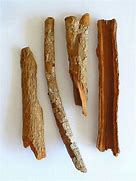
White Willow Bark: The Natural Pain Reliever that Works Like Aspirin
Because frequent use of anti-inflammatory drugs, nonsteroidal anti-inflammatory drugs (NSAIDs) and other pain medications is now linked with a growing number of health concerns, many people are interested in using natural painkillers as alternatives. One option, called white willow bark — which has been utilized in folklore and natural medicines for centuries — shows promise for treating pain naturally with little risk for side effects.
According to a 2015 article published in the journal Pythotherspy Research, “Willow bark extract has been used for thousands of years as an anti-inflammatory, antipyretic, and analgesic.”
In other words, white willow bark benefits include lowering inflammatory responses that contribute to chronic diseases, fighting pain and reducing fevers.
Whether in extract or tea form, willow bark can provide relief to those suffering from back pain, recurring headaches, muscle pains, menstrual cramps, arthritis symptoms and more.
Flower – Rainbow Roses
This rose caught my attention because of its beautiful magickal appearance. Granted it is a man-made variety and at this time I good not find a definitive spiritual meaning for it. To me this rose represents hope and good days ahead.
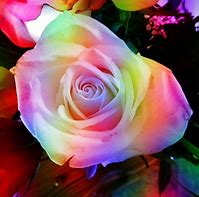
How to Make a Fresh Rainbow Rose Bouquet from thespruce.com
The technique florists use to turn roses into a rainbow. This article has a video with it.
Place Roses Into the Dye
Each color dye will go into its own narrow container, such as bud vases or test tubes. Place sections of each stem into the different containers. Be gentle when bending the stem sections apart as you place them into separate containers. Try not to leave them exposed to air and drying out for more than a few minutes.
You could also use plastic bags filled with dye and attach one to each stem section with rubber bands. That way you can stand roses up in a single larger container. That will minimize the bending of the cut stem sections.
Store Roses Away From Sun
Leave each stem section in the dye mixture for several days.
Place the roses out of direct sunlight while they are absorbing the dye. The cut flowers are already under stress, and extreme heat or light will weaken them further.
Keep Roses Hydrated
Now be patient. You may notice the petals changing color within a couple of hours, but leaving them in the dye for up to a week will result in the most dramatic colors. Make sure the roses are not left sitting in dry containers once the water/dye solution is all absorbed.
Finish Trimming the Stems
Once the desired effect is obtained, you can cut off the split section of the stems and place your roses in a vase of fresh, room-temperature water and enjoy.
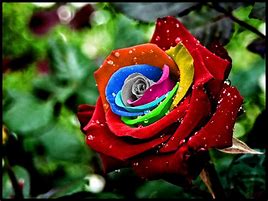
How to Make a Rainbow Rose from thoughtco.com
A Real Rose With Petals the Colors of the Rainbow
How Real Rainbow Roses Work
The “rainbow rose” was developed by Peter van de Werken, the owner of a Dutch flower company. While special roses are used, the plants are not bred to produce rich colors. Actually, the rose bush would ordinarily produce white roses, but the stems of the flowers are injected over time with dyes so that petals form in bright single colors. If the flower isn’t treated as it is growing, the blooms are white, not rainbow. While the rainbow is a special version of the technique, other color patterns are also possible.
It’s not a science trick you can achieve quite so well with your home rose bush, at least not without a lot of experimentation and expense, because most pigment molecules are either too large to migrate into the petals or else too toxic for the rose to flower. Special proprietary organic dyes said to be made from plant extracts are used to color the roses.
Making Rainbow Roses at Home
While you can’t duplicate the exact effect, you can get a lighter version of a rainbow using a white rose and food coloring. The rainbow effect is much easier to achieve with white or light-colored flowers that aren’t as woody as a rose. Good examples to try at home include carnations and daisies. If it has to be a rose, you can do the same project, but expect it to take longer.
- Start with a white rose. It’s best if it is a rosebud because the effect relies on capillary action, transpiration, and diffusion in the flower, which takes some time.
- Trim the stem of the rose so that it is not extremely long. It takes more time for the color to travel up a longer stem.
- Carefully split the base of the stem into three sections. Make the cuts lengthwise up the stem 1-3 inches. Why three sections? The cut stem is fragile and likely to break if you cut it into more parts. You can use color science to achieve the full rainbow using three colors—red, blue, yellow or yellow, cyan, magenta—depending on what dyes you have available.
- Carefully bend the cut sections slightly away from each other. Now, one way to apply the dyes would be to bend the stems into three contains (e.g., shot glasses), each containing a single color of dye and a bit of water, but this is hard to accomplish without breaking the stems. An easier method is to use 3 small plastic baggies, 3 rubber bands, and one tall glass to hold the flower upright.
- Into each bag, add a small amount of water and several (10-20) drops of one color of dye. Ease a section of the stem into the bag so that it is immersed in the dyed water, and secure the bag around the stem with a rubber band. Repeat the process with the other two bags and colors. Stand the flower in a glass. Check to make sure each stem section is immersed in the liquid since the flower needs water to live.
- You may start to see color in the petals as quickly as half an hour, but expect to let the rose soak up dye overnight or possibly for a couple of days. The petals will be the three colors, plus the mixed colors, for petals receiving water from two parts of the stem at once. This way, you’ll get the whole rainbow.
- Once the flower is colored, you can trim off the cut section of stem and keep it in fresh water or a homemade flower food solution.
Helpful Tips
- Flowers take up warm water more quickly than cold water.
- Keep the rose away from light and heat, since these can cause it to wilt and die too quickly.
- If you want to try injecting flowers with natural colors, learn about natural pigments you can use.
SOURCE: Helmenstine, Anne Marie, Ph.D. “How to Make a Rainbow Rose.” ThoughtCo, Sep. 8, 2021, thoughtco.com/how-to-make-a-rainbow-rose-606168.
 Witches Of The Craft®
You must be logged in to post a comment.