
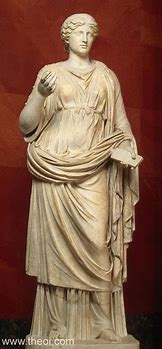
Goddess/Muse – Calliope

THE MUSE CALLIOPE IN GREEK MYTHOLOGY

THE MUSE CALLIOPE

Calliope is a famous name from Greek mythology, for Calliope was one of the Younger Muses, the beautiful goddesses who would inspire writers, artists and artisans.

Calliope the Muse of Epic Poetry, and hers was a name invoked by many writers and poets in antiquity; for they would give praise to the Muse for their ability to bring forth words of great eloquence.

CALLIOPE DAUGHTER OF ZEUS

As one of the Younger Muses, Calliope is the daughter of Zeus and the Titan goddess Mnemosyne; making her sister to Clio, Erato, Euterpe, Melpomene, Terpsichore, Thalia, Polyhmnia and Ourania.

Calliope was named as the eldest of the Younger Muses, conceived on the first night that Zeus lay with Mnemosyne.

CALLIOPE GODDESS OF MUSIC

Calliope was a Greek goddess of music, song and dance, and was specifically named as the Muse of Epic Poetry. In this role, Calliope was normally depicted with a writing tablet in her hand.

Calliope was also said to be the muse who bestowed the gift of eloquence about mortal kings, coming to them when they were a baby, and anointing their lips in honey.

​As a result of Calliope’s actions, when adults, the anointed ones would spout gracious words, and utter true judgements.

Calliope was also considered to be the leader of the Muses, the wisest of the sisters, and also the most assertive.

CALLIOPE MOTHER OF ORPHEUS

Stories from Greek mythology would tell of the marriage of Calliope to the Thracian king Oeagrus, with the wedding taking place at Pimpleia. The marriage of Calliope and Oeagrus was said to have brought forth two notable individuals Orpheus and Linus.  Orpheus was the great musical hero of Greek mythology, and Linus was the inventor of rhythm and melody; alternatively the father of Orpheus and Linus is named as the Olympian god Apollo.

Initially, Calliope and Orpheus were said to reside at Pimpleia, but later Calliope and her son were to be found with the other Younger Muses upon Mount Parnassus. For here Apollo visited to continue the musical training of Orpheus, which had been commenced by Calliope.

CALLIOPE IN GREEK MYTHOLOGY

Calliope was rarely spoken of as an individual but she is named as present, and spoken to by Thetis, when the Muses sang their dirges during the funeral rites of Achilles. Calliope was also certainly present when the Younger Muses were victorious in their contests with the Sirens and Pierides. Indeed, Calliope was said to be the Muse who caused the Pierides to be transformed into magpies after they had had the impudence to challenge Calliope and her sisters. 

Surprise, Surprise It’s Saturday Morning! Have A Blessed One!

I hope everyone is having a super Saturday. I just wanted to drop in and let you know this morning, I will be out promoting our site. Saturday is one of Pinterest’s hottest days. So I plan on covering their front page without nothing expect Pins for the WOTC. Pinterest has a huge following and that is how we end up with new members. They see our Pins, get curious and come over and visit. Right now, this is a fantastic advertising site for us. And besides there are so many people on here right now, I don’t want to interrupt their enjoyment of the site. It is great to see you all here this morning. Read, enjoy, look around, stay as long as you like. (It seems like when I show up to do the postings, everyone disappears, I don’t bite, I swear, Witches’ Honor!)

Anyway I am off to promote, I will be back in bit to start our new herb section and also put on some more strange forms of divination. I hope you have a fantastic day!

Luv & Hugs,

Lady A

Daily OM for December 4th – Now Is the Time

Now Is the Time

Bloom Where You Are Planted


by Madisyn Taylor


The time to blossom is now, not sometime in the future when you believe the stars will be aligned for you.


Having a vision for our future that differs from our current circumstances can be inspiring and exciting, but it can also keep us from fully committing to our present placement. We may become aware that this is happening when we notice our thoughts about the future distracting us from our participation in the moment. We may find upon searching our hearts that we are waiting for some future time or situation in order to self-actualize. This would be like a flower planted in North Dakota putting off blooming because it would prefer to do so in Illinois.

There are no guarantees in this life, so when we hold back we do so at the risk of never fully blossoming. This present moment always offers us the ground in which we can take root and open our hearts now. What this means is that we live fully, wherever we are, not hesitating because conditions are not perfect, or we might end up moving, or we haven’t found our life partner. This can be scary, because we might feel that we are giving up our cherished dreams if we do not agree to wait for them. But this notion that we have to hold back our life force now in order to find happiness later doesn’t really make sense. What might really be happening is that we are afraid to embrace this moment, and ourselves, just exactly as we are right now. This constitutes a tendency to hold back from fully loving ourselves, as we are, where we are.

We have a habit of presenting life with a set of conditions—ifs and whens that must be fulfilled before we will say yes to the gift of our lives. Now is the time for each of us to bloom where we are planted, overriding our tendency to hold back. Now is the time to say yes, to be brave and commit fully to ourselves, because until we do no one else will. Now is the time to be vulnerable, unfolding delicately yet fully into the space in which we find ourselves.


Daily OM

OTHER WAYS OF MARKING OESTARA

OTHER WAYS OF MARKING OESTARA


* Celebrate the arrival of spring with flowers. Bring them into your own home and, in keeping with the theme of balance, give them to others. You do not have to spend a lot of money – one or two blooms given for no other reason than ‘spring is here’ can often bring a smile to even the most gloomy face.

* Do a bit of ‘personal housekeeping’. We live in an age where guilt is more often encouraged then pride, where we are encouraged to dwell upon our ‘negative’ points and habits. This is not the way of the Witch. As Witches we must learn to be as honest about our plus points as society would like us to be about our minuses.

Advertising, probably the most pervasive kind of propaganda, encourages us to think
of ourselves as ‘less than perfect’ unless we look and dress like the people in the
adverts and possess all the things that the advertisers would like us to spend money
on. It is worth bearing in mind that if we truly needed these products then there would
be no need to put them into commercials!

However, to return to the ‘personal housekeeping’, write a list of 20 of your plus points,
things you are good at, and 20 minus points, things you would like to improve. Try
not to be influenced by stereotypes – many female Witches include ‘outspoken’ on
their list of negatives, while males will describe the same quality as positive! If you
absolutely must include your physical attributes on the minus list, then make sure
that these are things which you can sensibly expect to change, but don’t fall into the
advertisers’ trap. From the perspective of the Witch it is far more important that you
should come to terms with the person that you are, rather than worry about the way
people see you.

One of the first tasks of the Witch is to understand and accept themselves, with all
their good and bad points, because it is only when you understand yourself that you
will be in a position to understand others, and therein lies a good portion of Witches’
Magic.

Start to learn about some of the plants and herbs which have been traditionally used
as remedies. A basic knowledge of herbs is part of the heritage of the Witch.