Gods – Thoth

Egyptian God Thoth from gods-and-goddesses.com

Thoth Facts

Name(s): Thoth
Rules over: Knowledge, Wisdom, Moon
Gender: Male
Symbols: Moon Disk
Sacred animals: Ibis bird
Parents: None
Siblings: None
Greek Similar: Apollo, God of Knowledge

Thoth is the Egyptian god of Knowledge. He was widely worshiped as inventor of the written word and credited with the creation of different branches of knowledge.

Thoth is a central figure in ancient Egyptian religion, filling various important roles in the mythological world. However, the worship of Thoth lasted only until the dynastic era. Regardless, the Egyptians and Greeks alike credit him as the inventor of all knowledge.

Family

Egyptian myth told that Thoth was self-created, while at least two alternate stories claim he was either born from the sun god Ra’s lips or from the war god Set’s forehead after Set swallowed the semen of his brother Horus.

Symbols

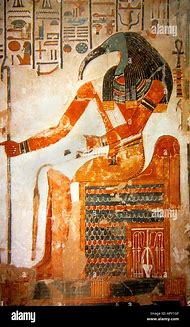
He is commonly depicted in human form with the head of an Ibis, a sacred bird associated with wisdom. The name Thoth is the Greek version of the Egyptian name Djehuti, which means “He Who is Like the Ibis.” Sometimes he is pictured holding an ankh, a famous hieroglyph resembling a cross, and scepter; other times, he is pictured holding a scribe’s palette and stylus. He is also seen wearing the Atef crown usually worn by Osiris. When he took the form of A’an, god of equilibrium, he was depicted with the head of a baboon.

Powers & Duties

Considered to be the author of the Book of the Dead, Thoth also acted as scribe to the gods and of the underworld. In this capacity, he stood by during the weighing of the hearts of deceased persons. Hearts lighter or equal to the weight of a feather could move on to a heavenly existence. Thoth’s just decisions in these and other matters made him a respected judge.

Appropriately, one epithet given to Thoth is “The Reckoner of Time and of Seasons.” He possesses the gift of measuring and recording time. In one popular myth, he added an extra five days to add to the 360 day calendar. This was to enable Nut, the sky goddess, to have a child on each of these days after Ra issued a decree that she was to have no children on any day of the original year.

Worship

Thoth was first worshiped as a moon god. The moon’s cycles played an important role in Egyptian life. The crescent moon resembled an ibis, the bird associated with Thoth.

Thoth’s main temple is at Khmun. Here he led the Ogdoad pantheon, the four gods and four goddesses who made up the principal deities before creation. He has shrines in numerous other cities.

A festival of Thoth was held at Khmun, where his worshipers buried mummified baboons and ibises as votive offerings. Evidence of these have been found by archaeologists at the necropolis of Tuna el-Gebel.

Facts About Thoth

  • When Set killed Osiris, Thoth helped Isis to resurrect him and assisted Anubis with the first act of mummification;
  • Invoked in many spells used in popular magic, Thoth is also seen as a god of magic;
  • Thoth remains a well-known god in popular culture. In modern literature, for example, he is the character Mr. Ibis in Neil Gaiman’s American Gods. He is also featured on his throne on the logo of the University of Cairo;
  • Thoth was associated with Hermes, the messenger god, by the Greeks. They were combined to form Hermes Trismegistus. Thereafter, Khmun became Hermopolis;
  • According to myth, Thoth wrote 42 books containing all the knowledge humanity needs. He was given the title of “Author of Every Work on Every Branch of Knowledge, Both Human and Divine.” Some of this knowledge was so powerful that it could not be revealed to everyone;
  • The Mansion of Thoth was his home in the afterlife. Souls found a safe place to rest here, where they received magic spells to protect them from demons;
  • Some of the disciplines the Greeks credit Thoth for include mathematics, astrology, geometry, botany, and land surveying;
  • Djehuti, an Egyptian pharaoh of the Sixteenth dynasty, was named after Thoth. He ruled for three years.

Goddess – Minerva

Minerva – Facts and mythology from gods-and-goddesses.com

In Roman mythology, Minerva was a goddess jack-of-all-trades. She oversaw many realms that involved art and deep thought. She was regarded as the goddess of “all activities involving mental skill,” such as science, medicine, wisdom, handmade items, skilled professions, and trade. Later, she was seen as a goddess of war.

She was believed to have invented Roman numerals, or numbers, as well as a variety of musical instruments. Many researchers believe that the worship of Minerva in Rome was an extension of the cult of Athena, the Greek goddess with whom Minerva is equated. She may have been introduced to Italy by the Etruscans, who called her Menerva or Menvra. She was said to have had golden hair.

Myths & Stories

Minerva plays a role in many of Rome’s myths. For instance, in the Roman poet Ovid’s Metamorphoses, Minerva is jealous of the lowly human Arachne’s ability to craft objects of wool, as Arachne’s skill rivals her own. Nymphs, humans, and others would travel great distances to view Arachne’s creations and to watch her work.

Minerva had taught Arachne this skill, but she was jealous of her teacher in turn and would give Minerva no credit. Instead, she invited Minerva to compete with her in weaving. Therefore, Minerva disguises herself as an old woman and advises Arachne to entreat Minerva’s forgiveness. When Arachne refuses, Minerva reveals herself and the contest begins. Both woman and goddess weave beautiful tapestries on their looms.

Minerva once again tries to teach Arachne a lesson by weaving into her tapestry scenes of humans losing to gods in various contests, and even her own failure against the god Neptune. Obstinate Arachne replies with weavings of the gods’ less than honorable activities, such as seducing both mortals and immortals. When finished, Minerva could find no flaw in Arachne’s tapestry, yet she “tore up the embroidered tapestry with its stories of the gods’ shameful deeds.”

Then, she beats Arachne’s face with a wooden weaving tool. Arachne tries to strange herself with a noose, but Minerva does not let her perish. Instead, she turned her into a spider through the use of a magic herb, saying she and her descendants would always hang and always weave. Today, spiders are known as “arachnids” due to this myth.

Worship

Along with Jupiter and Juno, Minerva was worshiped as part of the Capitoline Triad, or trinity. They shared a temple on the Capitoline Hill in Rome. A temple devoted exclusively to Minerva was located on the Aventine Hill. This shrine served as a meeting place for the guilds of craftsmen, actors, and poets. Physicians worshiped this goddess as the patroness Minerva Medica.

Minerva was worshiped as a goddess of war alongside the god Mars. After a number of conquests on the Roman Empire’s eastern border, a temple to Minerva was built in Pompey – no doubt funded by the spoils of war. Her worship in Rome reached a peak in the first century A.D. when she was claimed as a special, personal protector by Emperor Domitian.

Festivals

Two events dedicated to Minerva were marked on the Roman Calendar. The first was known as the Quinquatria, celebrated by students and artisans on March 19-23, just after the Ides of March, made famous by the assassination of Julius Caesar and subsequent play by William Shakespeare. On June 13, a shorter observance called the minor Quinquatrus was celebrated. The Quintratrus was also the time of school holidays and when fees for schooling became due. Thus, Minerva was seen as a patron of schoolchildren as well as the skilled workers they would someday become. Minerva shared her festivals with the war god Mars. She was often identified with Nerio, the Sabine goddess who became the consort of Mars.

Today

Today, a church called Santa Maria sopra Minerva is located in a former temple to Minerva. Minerva’s interest in the sciences and pursuit of wisdom still lives in the moniker of the Japanese MINERVA space exploration robot. MINERVA, in this case, is an acronym for MIcro/Nano Experimental Robot Vehicle for Asteroid.

Gods – Mercury

Mercury • Facts & Mythology about the Roman god of communication, trade, business

Mercury is the messenger to the Roman gods. He is well known for his incredible speed. Originally, Mercury was a god of trade related to the corn crop. In fact, his name is derived from the Latin word merces, meaning “merchandise.”

Mercury, who is sometimes referred to as Mercurius, was also lauded as the protector of merchants, travelers, and shopkeepers. He was also defamed as the patron of thieves and those who played practical jokes.

Origins

In early Roman mythology, there was no mention of Mercury as a member of the ruling class of gods. Eventually, he was absorbed into Roman culture from the Greek god Hermes, messenger of the Greek gods. Mercury carried out many of the same functions as Hermes.

Mercury was the son of Jupiter, the Roman equivalent of the Greek god Zeus. The story of the birth of Mercury held that Jupiter secretly impregnated the goddess Maia in a cave on the island of Arcadia. The following day, Maia gave birth to Mercury before wrapping him in swaddling blankets and falling asleep. As his mother slept, Mercury raced across Arcadia to steal cattle from his brother, Apollo, before returning to his mother.

Maia woke to the sight of Mercury wrapped in his swaddling blanket and Apollo accusing him of stealing his cattle. Eventually, Jupiter stepped in to reveal he had watched Mercury steal the cattle and ordered their return. During the night, Mercury had fashioned a lyre from cattle intestines and began playing beautiful music. This inspired Apollo to ask for a trade of the cattle for the lyre.

Appearance

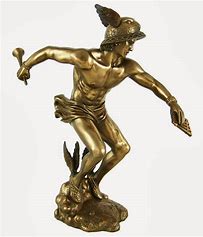
In most portrayals, Mercury is shown as a youthful god of Rome who is clean-shaven and is often little more than a child. Mercury is depicted in Roman artworks as wearing a helmet and sandals with attached wings that reflect his speed and position as the messenger of the gods. The son of Jupiter is also the god of commerce, leading him to being shown in some sculptures and paintings holding a purse.

Symbols

There are many symbols associated with Mercury, including his winged cap and sandals that reflect the speed of the Roman god. Mercury is often depicted as carrying a staff, which was a symbol the members of his cult added to their daily lives.

Mercury is associated with many animals, including the tortoise that played a role in his first day of life. Mercury used the shell of a tortoise to fashion the lyre he would trade for the cattle of Apollo. The tortoise would become a common symbol of Mercury throughout Roman culture and be accompanied by his close links to the ram and the rooster.

The rooster is the symbol of the new day that is brought by Mercury as a messenger of the gods. The ram is a symbol of fertility for the Roman people and is often seen with Mercury in stories and artworks.

Powers & Duties

Mercury’s main power is his ability to move at great speeds. He is most well-known for his role as a messenger to the gods. Interestingly, the role of the messenger also included the task of conducting the passage of individuals from Rome to the underworld when they died.

Mercury is also one of the most duplicitous gods in Roman culture. He is known for his trickery and ability to cheat people out of their belongings.

Myths & Stories

Mercury plays a role in many myths. As noted above, he is said to have stolen cattle and a bow and arrow when just a child. In the myth of Cupid and Psyche, he is called upon by Jupiter to make a proclamation demanding the capture of Psyche.

In the Aeneid, he is sent by Jupiter to Aeneas with orders to leave his lover and “sail away to fulfill his destiny in Italy.” He also plays a role in Roman poetry and theater, much of which was based on mythology.

In the play Amphitruo by the dramatist Plautus, Mercury dresses as a servant and aids Jupiter in disguing himself Amphitryon in order to seduce Amphitryon’s wife.

The poet Horace wrote of him in his Odes. In fact, Horace called himself mercurialis, meaning a lyric poet protected by Mercury.

Many of the myths of Mercury are derived from those of Hermes. Monuments to Hermes were thought to bring good luck, and this idea was perpetuated with Mercury as well. Another borrowed role was that of escorting the souls of the deceased to the underworld. It is speculated that the myths originated among shepherds, lending their interest in “music and fertility.” In fact, in some legends, Mercury is said to have invented the guitar-like lyre, and his son is said to have been a nymph who invented the music of the pastoral societies.

Worship

A temple to Mercury was dedicated on Rome’s Aventine Hill in 495 B.C. The festival of Mercuralia was held on May 15, the anniversary of the temple dedication, in honor of both Mercury and his mother Maia of the Pleiades. Rituals of this festival involved merchants drawing water from the well at Porta Capena to be sprinkled on their trade goods and on their own heads. Trade fairs were also held at the temple, and it was the location of Rome’s busy commercial center.

Art

In art and statues, Mercury is typically depicted as a handsome young man, even boyish in appearance, wearing a white garment. Mercury often carries a money purse, symbolizing his function as patron of merchants and business owners. His fleetness as messenger of the gods is represented by a hat or sandals with wings, called petasus and talaria, respectively. Mercury was thus called Alipes, meaning “with the winged feet.” He is also seen carrying a staff called a caduceus. The caduceus was a symbol of peace, carried by ambassadors to foreign lands. It consisted of a branch with two shoots, originally decorated with ribbons or garlands. In later times, these attributes were replaced by two twining snakes, with a pair of wings above the snakes. The snakes were related to Mercury’s role as a fertility god and in delivering souls to the underworld. Today, this symbol is used to represent physicians, the medical field, and the U.S. Army Medical Corps.

Today

Like many mythical figures, Mercury has been immortalized in the naming of celestial objects. The planet Mercury, as visible just after sunset, was called in ancient times by his Greek counterpart, Hermes. This was likely due to the planet’s rapid motion in comparison to other stellar objects. Interestingly, Mercury’s morning visitation, just before sunrise, was not recognized as being the same “star;” it was thus called Apollos. The element mercury (Hg) , atomic number 80 on the periodic table, was once known as “quicksilver.” The symbol for the planet Mercury was used to represent quicksilver in sixth century alchemy, and thus the chemical took on the name of the god as well.

Facts about Mercury

  • Hermes is the Greek equivalent of the Roman god Mercury.
  • He was the grandson of the Titan Atlas.
  • Woden / Odin was significantly affiliated with Mercury in ancient times. They were referenced together in the Roman author Tacitus’ literary work Germania. Germanic tribes referred to Wednesday as Wodenstag, whereas in Latin Wednesday is called dies Mercurii. This was possibly due to their similar roles in sacrifice and death.
  • Gaulish Mercury refers to worship of Mercury by the early Celtic tribes of western Europe. In these tribes, he was likely held as the highest among the gods.
  • The French translation of Wednesday is Mercredi. In Italian it is Mercoledì. Both are derived from the Latin word for Mercury.
  • Mercury is the closest planet to the Sun. It is the fastest planet to complete a full orbit around the Sun.
  • The element Mercury is named after the Roman god.
  • Mercury was a brand of automobile whose production lasted for 70 years. Production of the cars ceased in 1970.
  • Mercury’s roles included being the god of store owners, merchants, travelers, trade, profit, tricksters, and theives.

Goddess – Hera

Hera – Greek Goddess of Marriage and Queen of Olympus from greekgodsandgoddesses.net

Hera is the Queen of the GODS and is the wife and sister of ZEUS in the Olympian pantheon. She is known for being the Goddess of Marriage & Birth. Despite being the Goddess of Marriage, she was known to be jealous and vengeful towards the many lovers and offspring of her husband Zeus.

She was also known to turn her anger towards mortals who crossed her as well – for example, Paris, who chose APHRODITE over Hera as the most beautiful goddess at the marriage of the sea-nymph Thetis to a mortal called PELEUS.

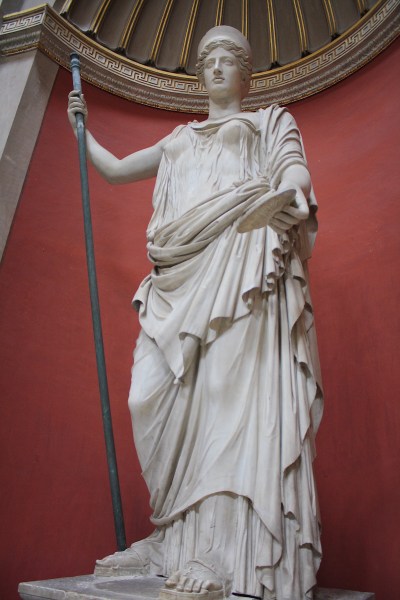
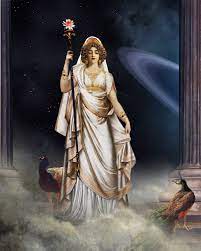
In images and STATUES, Hera is portrayed as being majestic and solemn, crowned with the polos – a high cylindrical crown worn by many of the Great Goddesses.

Even before her marriage with Zeus, she ruled over the heavens and the Earth. This is one reason why she is referred to as ‘The Queen of Heaven’ – ruling over Mount Olympus where all the gods and GODDESSES live.

Even the great Zeus feared his wife Hera. Her never-ending hatred of Heracles, the illegitimate son of Zeus and the mortal Alcmene stemmed from his continuous adultery and, amongst other things, Hera raised a storm at sea in order to drive Heracles out of his course to kill him.

Zeus became so angry that he hung her in the clouds by a golden chain, and attached heavy anvils to her feet. Her son HEPHAESTUS tried to release his mother from her humiliating position, for which Zeus threw him out of heaven, and his leg was broken by the fall.

Facts about Hera

Hera was Queen of the OLYMPIAN GODS.

She was the wife and SISTER OF ZEUS.

Hera was a jealous wife, and she fought with Zeus frequently over his extramarital affairs and illegitimate children. For this reason, Hera was known for punishing offending husbands.

She was the protector of women, presiding over marriages and births.

She had three CHILDREN WITH ZEUS – HEBEARES, and Hephaestus.

While Hera was worshipped in all parts of Greece, temples were erected in her honor at Argos and Salmos.

The peacock was sacred to her.

Hera had few, if any, redeeming qualities. She never forgot an injury.

The Titans Ocean and TETHYS brought her up.

Hera is often described as “cow-faced,” although she was also called the chief among the immortals in beauty.

Though she may have been physically attractive, her vindictive personality makes her less so.

The TROJAN WAR would have ended in peace, but Hera had a vested interest in its outcome and influenced Zeus to either switch sides or remain neutral.

Hera had no concept of justice when angry or jealous; she could not forgive the women with whom Zeus had sexual relations—even if they were innocent of wrongdoing.

Ilithyia, a daughter of Hera’s, assisted women in childbirth.

In the story of the Quest of THE GOLDEN FLEECE, Hera was a gracious protector of the heroes.

Paris awarded Aphrodite the Golden Apple over ATHENA and Hera.

Hera punished one of Zeus’s love interests, Io, by putting her in the charge of Argus. Argus had a hundred eyes and kept vigilant watch over her so that Zeus could not come to her aid.

Hera turned Callisto into a bear because Zeus fell in love with her.

Hera arranged the death of SEMELE, another of Zeus’s mortal conquests, although she did not directly cause it.

Hera never forgave HERCULES for being ZEUS’S SON, but when Hercules died and was taken to heaven, he and Hera reconciled. While in heaven, Hercules married Hera’s daughter Hebe.

In some stories, it was at Hera’s orders that DIONYSUS was torn to pieces. He was brought back to life, and it is this resurrection that was celebrated in theatres.

Source: <a href=”https://greekgodsandgoddesses.net/goddesses/hera/”>Hera – Greek Goddess of Marriage and Queen of Olympus: https://greekgodsandgoddesses.net</a&gt; – Greek Gods & Goddesses, September 19, 2014

Gods – Zeus

Zeus – Greek God Of The Sky and King of the Gods from greekgodsandgoddesses.net

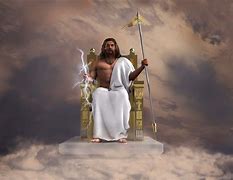
Zeus was the first of the GODS and a very imposing figure. Often referred to as the “Father of Gods and men”, he is a sky god who controls lightning (often using it as a weapon) and thunder. Zeus is king of Mount Olympus, the home of Greek gods, where he rules the world and imposes his will onto gods and mortals alike.

Zeus was the last child of the titans Cronus and RHEA, and avoided being swallowed by his father (who had been told one of his children would overthrow him) when Rhea sought help from URANUS and Gaea. Cronus had previously swallowed DEMETERHESTIAHERAHADES and POSEIDON.

Along with Hades and Poseidon, Zeus shared the rule of the world and became king of Olympus as the children of CRONUS were filled with admiration for their noble brother and sided with him against their unjust father – even following Zeus into The Battle of the Titans.

Zeus mated with many goddesses and mortals (including Aegina, Alcmena, CALLIOPE, Cassiopea, DEMETER, Dione, Europa, Io, Leda, LETOMNEMOSYNE, Niobe, PERSEPHONE and SEMELE) but was married to his sister Hera – goddess of marriage and monogamy.

Roles and responsibilities of Zeus

As the king of the gods and sitting atop the golden throne on MOUNT OLYMPUS, Zeus was revered by all. Mortal kings would boast that they were descendants of Zeus. With this supreme power came a number of roles and responsibilities.

Hesiod described Zeus as a god who “brought peace in place of violence” and referred to him as the “lord of justice”.

Though he is most well known as GOD OF THE SKY and thunder, Zeus was the supreme cultural embodiment of Greek religious beliefs. He had many epithets (titles) that emphasized different aspects of complete and wide ranging authority.

  • Zeus Olympios emphasized Zeus’s kingship over the gods.
  • Zeus Xenios, Philoxenon or Hospites: Zeus was the patron of hospitality (xenia) and guests, ready to avenge any wrong done to a stranger.
  • Zeus Horkios: Zeus he was the keeper of oaths. Exposed liars were made to dedicate a statue to Zeus, often at the sanctuary of Olympia.
  • Zeus Agoraeus: Zeus watched over business at the agora and punished dishonest traders.
  • Zeus Aegiduchos or Aegiochos: Zeus was the bearer of the AEGIS with which he strikes terror into the impious and his enemies.
  • Zeus Tallaios (“solar Zeus”): the Zeus that was worshiped in Crete.
  • Zeus Geōrgos (“earth worker”, “farmer”), the god of crops and harvest, in Athens.
  • Astrapios (“lightninger”)
  • Brontios (“thunderer”)

Appearance and personality of Zeus

According to “Work and Days” by Hesiod (line 59), Zeus was a carefree god who loved to laugh out loud. He was regarded as wise, fair, just, merciful, and prudent. He was also unpredictable – nobody was able to guess the decisions he would make.

He was also easily angered which could be very destructive. He has previously hurled lightning bolts and caused violent storms that wreaked havoc on earth.

Zeus fell in love easily and had many affairs with various women, however he would severely punish anybody who attempted to escort/fall in love with his wife Hera – like the giant PORPHYRION who took a lightning bolt from the engraged god for lusting after his wife (albeit with a little help from the love god Eros).

He is often described as a strong, imposing man with a regal body and long, often curly, hair. He usually had a short beard or scruff and carried his trusty thunderbolt at all times.

How Many Wives Did Zeus Have?

ZEUS HAD SEVEN IMMORTAL WIVES. They are Metis, Themis, EURYNOME, Demeter, Mnemosyne, Hera, and Leto. From these marriages produced many MANY SONS and  DAUGHTERS.

How Did Zeus Become the Leader of the Gods?

Cronus, managed to overthrow his father, Uranus.

But Uranus made a prediction that Cronus would be overthrown by one of his children. Because Cronus was afraid of losing the kingdom, he made the same mistakes his father did and turned into a terrible, angry king and did lots of horrible things to stay in power.

He ate his children, just to keep them from overthrowing him. But Rhea, his wife, managed to fool Cronus by feeding him a large stone and kept one of his children safe. This child was named Zeus. Rhea hid him away in a cave on the island of CRETE so he would be safe.

Once Zeus grew up, he went to his father’s mountain and served him as a cupbearer. His father did not know that Zeus was his son. A TITAN GODDESS NAMED METIS helped Zeus fool his father into drinking a mixture of mustard in his wine.

This caused Cronus to feel sick, and he threw up all of his children that he had eaten, one by one including the stone. Once Cronus had expelled all of Zeus’ brothers and sisters, Zeus talked them into rebelling against Cronus, their father.

This is what started the TITANOMACHY, or the Titan’s War. Zeus and his brothers and sisters rebelled against their father, Cronus. Zeus set the CYCLOPES and the Hecatonchires free from their underground prison and convinced them to join the fight against Cronus too.

Cronus had been the one who locked up his siblings, so they agreed to join Zeus. The Hecatonchires used rocks as weapons, and the Cyclopes made Zeus’ thunderbolts. Together they also made POSEIDON‘s trident and HADES‘ helm of darkness.

The only Titians to fight with Zeus were THEMIS and PROMETHEUS. This war lasted ten years. ATLAS was a major leader on the side of the Titans and Cronus. After the war was over, Zeus imprisoned all of the Titans in TARTARUS, except for Themis and Prometheus who fought for him.

These Titans were imprisoned in the earth the same way that Cronus, HECATONCHIRES and the Cyclopes once were. Hecatonchires guarded the Titans in their prison. Because Atlas was such an important fighter for the opposition, Zeus gave him the special punishment of holding up the world.

After the Titans’ War Zeus and his brothers, Hades and Poseidon decided to divide the universe into three parts. They drew straws to see who would rule over which part. Zeus drew the longest straw, so he was given the title of king of the sky.

This also meant that he was the head of mortals and all the gods, too. Poseidon got the middle straw, so he became king of the sea. Hades drew the shortest straw, so he became the ruler of the UNDERWORLD.

Facts about Zeus

Zeus became the ruler of heaven and earth after a revolt against his father, Kronos. In his position as king of the gods, Zeus had to play mediator when other the immortals were mad at each other.

He is the father of ATHENA, who is said to have SPRUNG FROM HIS HEAD. She was his favorite child, with whom he shared the thunderbolt and aegis.

Hades and Poseidon were his brothers.

His wife Hera was also his sister.

Zeus was not a faithful husband; he was known for having many affairs with mortal women.

Zeus fathered HERCULES, the famous Greek hero, by deception. He disguised himself as Amphitryon, Alcmene’s husband, in order to have sexual relations with her.

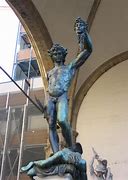
Zeus fathered PERSEUS by impregnating Danaë. When he did so, he appeared to her in the form of a golden shower.

The name Zeus means “bright” or “sky.”

His weapon of choice was the thunderbolt, made for him by the MYTHICAL CREATURES, the CYCLOPS.

Zeus, more recently known for causing thunder and lightning, was once a rain-god. He was always associated with the weather in some form.

The Zeus described in Homer was not an extension of nature; instead, he had a standard of right and wrong that made him more relatable to mankind.

Before monarchies were rendered obsolete, Zeus protected the king and his family.

Hesiod calls Zeus the “the lord of justice.” Perhaps because of this, he was reluctant to join a side in THE TROJAN WAR. He preferred the Trojans, but he wanted to stay neutral because Hera preferred the Greeks. She was insufferable when he opposed her openly.

Metis, the goddess of prudence, was Zeus’s first love.

ARESHEPHAESTUS, Hebe and EILEITHYIA are the CHILDREN OF ZEUS AND HERA.

His union with Leto brought forth the twins APOLLO and Artemis.

Zeus had many children with some believing he had over 50 CHILDREN

When he seduced the Spartan queen Leda, ZEUS TRANSFORMED HIMSELF INTO A BEAUTIFUL SWAN, and two sets of TWINS were born.

When Zeus had an affair with Mnemosyne, he coupled with her for nine nights. This scenario produced nine DAUGHTERS, who became known as the MUSES

Zeus punished men by giving them women.

Zeus’s servants were named Force and Violence.

ZEUS’ FAMILY TREE
Father Cronus Mother Rheas
CHILDREN
Goddesses Mortals
Mother Offspring Mother Offspring
Demeter Persephone Alcmene Heracles
Dione Aphrodite Antiope Amphion, Zethus
Eurynome Charities (Graces) Callisto Arcas
Hera Ares, Eileithyia, Hebe, Hephaestus Danae Perseus
Leto Apollo, Artemis Aegina Aecus
Maia Hermes Electra Dardanus, Harmonia, Iasius
Metis Athena Europa Minos, Rhadamanthys, Sarpedon
Mnemosyne Muses Io Epaphus
Themes Horae (Seasons), Moirae (Fates) Laodamia Sarpedon
Leda Polydeuces (Pollux), Helen
Niobe Argos, Pelasgus
A nymph Tantalus
Semele Dionysus
Taygete Lacadaemon

Zeus FAQS

What is Zeus the God of?

Zeus is the God of sky and thunder in ancient Greek religion, who rules as king of the gods of Mount Olympus.

How many children did Zeus Have?

Zeus had 54 children – 31 by Divine unions including Ares, The Three Graces, The Nine Muses, The Horae and 23 via human unions including Perseus and Heracles.

Who is the Father of Zeus?

The father of Zeus is Cronus, youngest son of Uranus and Gaea, the leader of the first generation of Titans, and, for a brief period, the ruler of all gods and men.

What is the Symbol of Zeus?

The symbols of Zeus include the lightning bolt, the eagle, the bull, and the oak tree. Zeus is often portrayed with a scepter in one hand and the thunderbolt in the other – both symbols of his authority. Sometimes he wears a crown of oak leaves.


Gods -Perses

Perses

Perses from greekgodsandgoddesses.net

Long before the rise of the OLYMPIANS, Titans ruled the world. In Greek mythology, THE TITANS were a race of elder gods. The earliest generation of Titans was born from Chaos. Known as primordial deities, the first Titans represented fundamental principles of the Earth and universe. However, their children and subsequent generations resembled humans and giants with great mystical powers.

As a whole, the Titans are not as well-known as the more famous Olympians of the Greek Pantheon. However, they still play an important role in GREEK MYTHOLOGY.

One Titan whose story is largely lost to the sands of time is Perses. A second-generation Titan god, Perses is the god of destruction. He represents the devastation and disorder that can come from war, depicting the obliteration of land and lives in the process.

The Origins of Perses

Information about Perses is sparse. He did not play a significant role in Greek mythology. Despite his importance to ancient Greeks, he’s only briefly mentioned in poems and texts. Most information comes from “THE THEOGONY” by Hesiod, which is the most trusted source for tracing immortal lineage. Perses is mentioned in the Homeric Hymns and works by Apollodorus as well.

Perses is the son of Titans CRIUS and EURYBIA. Crius was the god of constellations, and Eurybia was the goddess of mastery of the seas. The two elder Titans came from the first primordial deities. Together they bore Perses, Pallas, and ASTRAEUS.

There’s very little information about Perses’ upbringing or personal history. Like many Titans, Greeks didn’t actively worship Perses. The only time Greeks would ask for assistance was during times of war. But outside of that, Perses didn’t have any temples, sanctuaries, or cults.

Perses Depictions

Few artistic depictions exist of Perses exist throughout history. Unlike the Twelve Olympians, Perses and other Titans didn’t get many paintings, sculptures, or pottery. As a result, modern artists have taken many creative liberties with the god’s appearance.

Generally, Perses is shown as a destructive force in the midst of war. As with many other Titans, Perses is usually depicted as a giant among men.

Some scholars believe that Perses was envisioned with animalistic features. The Titan Crius and his three sons have a strong connection to a group of interconnected star constellations, which also hold animal-like qualities. Perses takes the form of a canine. Meanwhile, his brothers Pallas and Astraeus had the form of a goat-like giant and an equine, respectively. Their father, Crius was a ram.

Perses Symbolism

The son of the Titan CRIUS was the personification of destruction. He was a violent and aggressive deity who represented all of the war’s darker aspects. Perses is just one of many war gods. While not as famous as Ares, he certainly made his mark.

Perses had a reputation for his bloodlust. Ancient Greeks knew him as “The Destroyer,” accompanying soldiers in the heat of battle to conquer nations. He had a fondness for chaotic battle, reveling in the ensuing violence.

As mentioned earlier, Perses didn’t have a cult of temples dedicated to his honor. But, that didn’t stop Greeks from praying for his favor. Soldiers often prayed to Perses for assistance during battle. They didn’t just ask for his protection. Greeks turned to Perses for strength and strategy, ensuring that they had what it took to take out their biggest enemies.

According to Hesiod, Perses was also a master of strategy. He reportedly had wisdom that could win battles even if the odds were stacked in his favor. The god was particularly helpful with military strategy, but he also had wisdom that surpassed all men.

Interestingly enough, some versions of Perses’ tale say that he didn’t just focus on destruction. Some scholars believe that Perses was the god of both destruction and peace. In ancient Greece, war was constant. Towns were ransacked frequently as death loomed over territory disputes and simple disagreements.

Many in ancient Greece turned to Perses for more than just success during the war. They asked for a swift end to battle so that they could enjoy the peace that followed. Even if the pause was brief, many saw Perses as a symbol of what came after conflicts were resolved.

Marriage and Children

Perses married Asteria. Asteria was a Titan goddess born from Coeus (Polus) and PHOEBE. She was an immortal inhabitant of Olympus and a dark goddess of necromancy.

Asteria was known to practice witchcraft and communicate with the dead. According to legend, she also predicted the future.

The union of the goddess of necromancy and the god of the destruction resulted in a powerful child. The pair gave birth to Hecate, the GREEK GODDESS of magic, specters, witchcraft, and more.

Confusion with King Perses

The Titan god Perses is often confused with King Perses of COLCHIS. Because there’s not much information about the Titan, some elements of the figures’ stories overlap.

King Perses is a minor figure in Greek mythology. He’s the son of Helios and Perseis, an OCEANID. Helios and Perseis gave birth to multiple children, making Perses the brother of Aeetes, CIRCE, and PASIPHAE.

Of his four siblings, this Perses is one of the least famous. He became the king of Tauric Chersonese. Tauric Chersonese doesn’t exist anymore, but it’s thought to be in the modern-day Crimean peninsula. However, his brother and sisters have a more significant part in Greek mythology. Aeetes became the king of Colchis and is most commonly associated with THE ARGONAUTS. Meanwhile, Circe became a famous sorceress, and Pasiphae married KING MINOS OF CRETE.

Eventually, this Perses did become the king of Colchis. His brother, Aeetes, feared that he would lose his kingdom if THE GOLDEN FLEECE ever left Colchis. If you’re familiar with the story of the hero JASON and his Argonauts, you know what ended up happening with the famed Golden Fleece. It left Colchis, and Perses seized the opportunity to take the throne. Perses threw Aeetes into a prison cell as the sons of HELIOS fell into a full-blown civil war.

Of course, Perses’ rule didn’t last long.

Aeetes’ daughter, Medea, returned to Colchis with her son Medus. The two lied, giving false identities. Perses didn’t recognize his own niece, giving her plenty of opportunities to kill Perses. She gave her son Medus a sword to slay the king of Colchis. Then, she freed her father Aeetes to help him regain his rightful place on the throne.

The story of King Perses doesn’t have any relation to the Titan god Perses. But because their names are the same, many confuse the two. It doesn’t help that names like “Circe” and “Medea” occur in both tales. While there are similarities even in the family tree, most scholars agree that the two Perses’ are unique entities deserving of their own spot in the mythology.

The Legacy of Perses

The Titan Perses doesn’t have much significance in Greek mythology, but he’s important to the earlier history and lore of the ancient religion. Perses was one of the first war gods to exist. As a second-generation Titan, he is an early deity that existed long before the uprising of the Olympians.

He helped ancient Greeks create a path of destruction during war before Ares or ATHENA ever came into the mix. He exhibits the primal nature of warriors and a never-ending lust for blood. The god also represented the powers of war, for better or worse. Even in the wake of massive annihilation, the end of conflicts brought a period of peace that ancient Greeks always longed for.

The Titans eventually fell to ZEUS and the Olympians. How Perses fared in the TITANOMACHY is unknown. Whether or not he participated in the great war is up for debate. One thing scholars do know is that he is not listed among the Titans that were banished to TARTARUS. As a result, most assume that the figure faded into obscurity or served the people of Greece in some other way. He fails to appear in later stories, further cementing the idea that other Greek gods like ARES took over his role.

Trivia:

Perses was the Titan god of destruction.

Not to be confused with King Perses of Colchis, Perseus, the slayer of MEDUSA, or Perses, the ancestor of the Persians.

The name Perses comes from the ancient Greek words “perso” and “pertho,” which has an English translation of “to sack” or “to destroy.”

Perses is the progeny of Titans Crius and Eurybia.

The Titan god Perses belongs to the second generation of Titan gods.

Asteria is Perses’ wife.

With Asteria, Perses had one child: Hecate.

Source: <a href=”https://greekgodsandgoddesses.net/gods/perses/”>Perses – Greek Titan God of Destruction: https://greekgodsandgoddesses.net</a&gt; – Greek Gods & Goddesses, December 22, 2021

Goddess – Circa (Greek)

Circa (Greek) c. 2011 Lady Abyss

“She-Falcon”.  Dark Moon Goddess; Fate-Spinner.  As the circle, or cirque, she was the fate-spinner, weaver of destinies.  Ancient Greek writers spoke of her as Circe of the Braided Tresses because she could manipulate the forces of creation and destruction by knots and braids in her hair.  Goddess of physical love, sorcery, enchantments, precognitive dreams, evil spells, vengeance, dark magic, witchcraft and cauldrons.

Circe

From greekgodsandgoddesses.net

In GREEK MYTHOLOGY, Circe was a goddess of magic, though she was sometimes depicted as a nymph (minor nature god), a witch or an enchantress.

In any case, she was associated with magic. She knew a lot about potions and herbs, and sometimes used this knowledge against her enemies and people who offended her, turning them into wild animals. She also had a wand or staff called the rhabdos which she also used to channel her magic. In fact, this was the earliest mention of a “magical wand or staff” in Western writings; it was referred to in Homer’s epic poem, the Odyssey, when Circe used it to turn Odysseus’s men into beasts.

Circe was the daughter of HELIOS, a TITAN who represented the Sun, and Perse, an ocean nymph. She was one of three thousand of her kind, daughters of TITANS OCEANUS and TETHYS. In another version, Circe was the daughter of HECATE, a goddess of sorcery.

She had two brothers. One was named Aeetes, and he looked after the GOLDEN FLEECE, a fleece that was the property of royalty. It was made from the wool of a golden ram with wings. Her second brother was PERSES.

PASIPHAE was her only sister, and she was the queen of the Greek island, CRETE, and also the wife of King Minos. It was also said that she gave birth to the MINOTAUR, a creature that was half man, half bull, with the head and horns of a cattle and the body of a man.

In some stories, Circe was exiled by her father Helios to live alone on AEAEA, a fictional island, as punishment for killing the prince of COLCHIS, who was her husband at the time.

She later had children with ODYSSEUS, the king of ITHACA from Homer’s writings. Her three sons were Ardeas, Latinus and Telegonus.

Source: <a href=”https://greekgodsandgoddesses.net/goddesses/circe/”>Circe: https://greekgodsandgoddesses.net</a&gt; – Greek Gods & Goddesses, June 10, 2018

God – Xiuhtecuhtli

Xiuhtecuhtli – Aztec god of fire, day and heat from en.wikipedia.org

In Aztec mythologyXiuhtecuhtli [ʃiʍˈtekʷt͡ɬi] (“Turquoise Lord” or “Lord of Fire”),[3] was the god of fire, day and heat.[4] In historical sources he is called by many names, which reflect his varied aspects and dwellings in the three parts of the cosmos.[5] He was the lord of volcanoes,[6] the personification of life after death, warmth in cold (fire), light in darkness and food during famine. He was also named Cuezaltzin [kʷeˈsaɬt͡sin] (“flame”) and Ixcozauhqui [iʃkoˈsaʍki],[7] and is sometimes considered to be the same as Huehueteotl (“Old God”),[8] although Xiuhtecuhtli is usually shown as a young deity.[9] His wife was Chalchiuhtlicue. Xiuhtecuhtli is sometimes considered to be a manifestation of Ometecuhtli, the Lord of Duality, and according to the Florentine Codex Xiuhtecuhtli was considered to be the father of the Gods,[10] who dwelled in the turquoise enclosure in the center of earth.[11] Xiuhtecuhtli-Huehueteotl was one of the oldest and most revered of the indigenous pantheon.[12] The cult of the God of Fire, of the Year, and of Turquoise perhaps began as far back as the middle Preclassic period.[13] Turquoise was the symbolic equivalent of fire for Aztec priests.[14] A small fire was permanently kept alive at the sacred center of every Aztec home in honor of Xiuhtecuhtli.[14]

The Nahuatl word xihuitl means “year” as well as “turquoise” and “fire”,[11] and Xiuhtecuhtli was also the god of the year and of time.[15][16] The Lord of the Year concept came from the Aztec belief that Xiuhtecuhtli was the North Star.[17] In the 260-day ritual calendar, the deity was the patron of the day Atl (“Water”) and with the trecena 1 Coatl (“1 Snake”).[15] Xiuhtecuhtli was also one of the nine Lords of the Night and ruled the first hour of the night, named Cipactli (“Alligator”).[18] Scholars have long emphasized that this fire deity also has aquatic qualities.[13] Xiuhtecuhtli dwelt inside an enclosure of turquoise stones, fortifying himself with turquoise bird water.[19] He is the god of fire in relation to the cardinal directions, just as the brazier for lighting fire is the center of the house or temple.[20] Xiuhtecuhtli was the patron god of the Aztec emperors, who were regarded as his living embodiment at their enthronement.[21] The deity was also one of the patron gods of the pochteca merchant class.[22]

Stone sculptures of Xiuhtecuhtli were ritually buried as offerings, and various statuettes have been recovered during excavations at the Great Temple of Tenochtitlan with which he was closely associated.[23] Statuettes of the deity from the temple depict a seated male with his arms crossed.[24] A sacred fire was always kept burning in the temples of Xiuhtecuhtli.[25] In gratitude for the gift of fire, the first mouthful of food from each meal was flung into the hearth.[21]

Xiuhtecuhtli is depicted in the Codex Borgia.[26]

Attributes

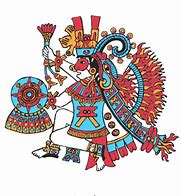
Xiuhtecuhtli’s face is painted with black and red pigment.[16] Xiuhtecuhtli was usually depicted adorned with turquoise mosaic, wearing the turquoise xiuhuitzolli crown of rulership on his head and a turquoise butterfly pectoral on his chest,[27] and he often wears a descending turquoise xiuhtototl bird (Cotinga amabilis) on his forehead and the Xiuhcoatl fire serpent on his back.[28] He owns fire serpent earplugs.[12] On his head he has a paper crown painted with different colors and motifs. On top of the crown there are sprays of green feathers, like flames from a fire.[12] He has feather tufts to each side, like pendants, toward his ears. On his back he has plumage resembling a dragon’s head, made of yellow feathers with marine conch shells.[12] He has copper bells tied to the insteps of his feet. In his left hand he holds a shield with five greenstones, called chalchihuites, placed in the form of a cross on a thin gold plate that covered almost all the shield.[12] In his right hand he has a kind of scepter that was a round gold plate with a hole in the middle, and topped by two globes, one larger than the other, the smaller one had a point.[12] Xiuhtecuhtli is closely associated with youthful warriors and with rulership, and was considered a solar god.[29] His principal symbols are the tecpatl (flint) and the mamalhuatzin, the two sticks that were rubbed together to light ceremonial fires.[30] A staff with a deer’s head was also an attribute of Xiuhtecuhtli, although not exclusively so as it could also be associated with Xochiquetzal and other deities.[31]

Many of the attributes of Xiuhtecuhtli are found associated with Early Postclassic Toltec warriors but clear representations of the god are not common until the Late Postclassic.[28] The nahual, or spirit form, of Xiuhtecuhtli is Xiuhcoatl, the Fire Serpent.[32]

Xiuhtecuhtli was embodied in the teotecuilli, the sacrificial brazier into which sacrificial victims were cast during the New Fire ceremony.[32] This took place at the end of each cycle of the Aztec calendar round (every 52 years),[33] when the gods were thought to be able to end their covenant with humanity. Feasts were held in honor of Xiuhtecuhtli to keep his favors, and human sacrifices were burned after removing their heart.

Annual festival[edit]

The annual festival of Xiuhtecuhtli was celebrated in Izcalli, the 18th veintena of the year.[34] The Nahuatl word izcalli means “stone house” and refers to the building where maize used to be dried and roasted between mid-January and mid-February. The whole month was therefore devoted to fire.[14] The Izcalli rituals grew in importance every four years.[35] A framework image of the deity was constructed from wood and was richly finished with clothing, feathers and an elaborate mask.[34] Quails were sacrificed to the idol and their blood spilt before it and copal was burnt in his honour.[36] On the day of the festival, the priests of Xiuhtecuhtli spent the day dancing and singing before their god.[37] People caught animals, including mammals, birds, snakes, lizards and fish, for ten days before the festival in order to throw them into the hearth on the night of the festival.[38] On the tenth day of Izcalli, during a festival called huauhquiltamalcualiztli (“eating of the amaranth leaf tamales”), the New Fire was lighted, signifying the change of the annual cycle and the rebirth of the fire deity.[39] During the night the image of the god was lit with using the mamalhuatzin.[40] Food was consumed ritually, including shrimp tamales, after first offering it to the god.[38]

Every four years a more solemn version of the festival was held at the temple of Xiuhtecuhtli in Tenochtitlan, attended by the emperor and his nobles.[42] Slaves and captives were dressed as the deity and sacrificed in his honour.[43] Godparents were assigned to children on this day and the children had their ears ritually pierced. After this, the children, their parents and godparents all shared a meal together.[42]

New Fire Ceremony[edit]

Xiuhtecuhtli was celebrated often but especially at the end of every 52-year period. This was the time the 365-day solar and the 260-day sacred calendars ended on the same day and the Aztec celebrated the Binding of the Years with the New Fire Ceremony.[17] In order to perform the ritual, priests marched in solemn procession up the Hill of the Star on a peninsula near Culhuacán to wait for the star Yohualtecuhtli (either Aldebaran in the Taurus constellation or the Pleiades as a whole) to get past its zenith. Having ascertained this, they would tear out the heart of a sacrificial victim and kindle a flame in a small wooden hearth they placed inside the hole left in his chest. Priests used a drill method to generate this sacred flame. It was then carried on pine sticks to light the fires anew in every hearth, including the sacred braziers of perpetual fire, that numbered over 600 in the capital alone.[44]

Goddess – Chantico, or Xantico

Chantico, The Aztec Goddess of Fire and the Household from oldworldgods.com

It was not unusual to see that in some religions, there were deities linked to both domestic and military matters. The Aztec goddess Chantico was an example of this link, just like the Roman goddess Vesta was in the Roman religion.

What was Chantico the goddess of?

In Aztec religion, Chantico was a domestic deity. She was mainly associated with the fires burning in the house hearth but was considered to be the protectress of the house and of the possessions inside it in general.

Because of a process of extension of her prerogatives, the Aztecs came to think of her as the protectress of their empire as a whole: it has been reported by the Spanish that Moctezuma, one of the last Aztec emperors, had an idol of the Aztec goddess Chantico with a removable leg, that he would have used as a tool to curse the land, obstructing the advance of Hernan Cortes.

For this reason, probably, Chantico had a tight link to the army and to military life in general, which was made evident in her iconography.

The appearance of Chantico goddess of fire

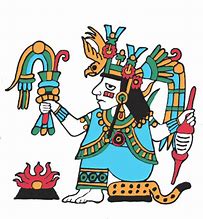
Her representations, in fact, usually displayed a crown made of spikes of a poisonous cactus, which was seen as a sign of aggressivity and peril, and at the top of her head was often present an ornament of feathers, which were a typical symbol of warriors.

In addition, among her accessories could be found the so-called alt-tlachinolli, or water-fire, a necklace which also was linked to warfare. Other elements which help to identify her in codexes and images are the obsidian sandals at her feet, the so-called itzcactli, and a golden pendant at her neck, which probably was a representation of the sun.

Connections and relationships with other Aztec deities

Being the goddess who presided to the domestic fire, Chantico was connected to this element, too, and was therefore linked to the other fire deities of the Aztec pantheon.

In particular, she was often associated with the god Xolotl: their connection was represented by the fact that they both were often depicted wearing the yacaxtuitl, a blue nose ornament.

Her cult was particularly strong among stonecutters. Likely for this reason, she was particularly worshipped in the town of Xochimilco, where stonecutting was widely practiced.

The meaning of Chantico Aztec goddess: Origin of the Name

It seems that the name “Chantico” might have signified “she who lives in the house”, surely alluding to her role as a domestic goddess.

Anyway, she was also referred to with other names. One of these was Quaxolotl, which would have meant “split in the upper part”, and would have therefore been a reference to Chantico’s link to the god of duality and twins, Xolotl.

Among stonecutters, she would have been also called Papaloxaual or Tlappapalo, meaning respectively “butterfly painting” and “the one of the red butterfly”. Anyway, there seem to be no other pieces of information clarifying this association of her with butterflies.

History of Chantico goddess and Most Important Myths Related to Her

According to some scholars, the cult of the Aztec goddess Chantico would have originated there where she was most worshipped, in the town of Xochimilco.

Therefore, it would have spread to all the Aztec Empire, included of course the capital, Tenochtitlan, where Chantico goddess would have been venerated in the most important religious building, the Templo Mayor.

Chantico goddess of fire was the main character of an interesting myth describing food taboos among the Aztecs. Let’s see this story in greater detail.

The Aztec goddess Chantico and the Paprika

According to this story, the Aztec goddess of fire Chantico liked paprika very much. Some suggest that the reason behind this fact could be found in Chantico’s association with fire: paprika, in fact, remembers fire both in color and taste.

Anyway, in Aztec religion, food was a prerogative of the god Tonacatecuhtli, who used to occasionally declare fasts, i.e. days during which some particular foods were banned.

One day, a fast of this sort, forbidding anyone to eat paprika, was pronounced by Tonacatecuhtli; nonetheless, the Aztec goddess Chantico could not resist pouring this beloved spice on her meal, which consisted of roasted fish.

Angered, Tonacatecuhtli changed Chantico into a dog, as a form of punishment. According to some, this might be the reason why dogs love to rest by the hearth.

Powers of the Aztec goddess Chantico

In her role of protectress of possessions, of the house, and, more generally, of the Aztec homeland, the Aztec goddess Chantico was thought to be able to deny access to strangers and enemies.

Symbols of Chantico and Their Meanings

Besides the ones already mentioned, one of Chantico’s symbols was an eagle foot covered with the skin of a jaguar, located on a dish of blood.

Like many others of her attributes, this peculiar image, also, might have represented her link with war, since the dish of blood was a symbol of warrior sacrifice.

Additional Aztec goddess Chantico Facts

Chantico’s figure is linked to one of the most impressive and important archeological remains found in the lands once occupied by the Aztecs: the so-called Coyolxauhqui-Chantico monument.

As its name suggests, this object has been linked by scholars to two Aztec goddesses: one is the goddess of the moon, Coyolxauhqui, while the other is the domestic goddess Chantico.

It represents a giant head and has been discovered in the Templo Mayor, the most important and famous building that could be found in the ancient city of Tenochtitlan, the capital of the Aztec Empire. This head was called this way by Hermann Mayer, an important Mesoamerican scholar.

In fact, he argued, elements related to both deities could be found in it. The form and the subject of the statue, a giant head, surely reminded of Coyolxauhqui, and in particular of her role in the myth describing the birth of Huitzilopochtli: according to this story, in fact, Coyolxauhqui and her brothers would have tried to kill their mother while she was pregnant with Huitzilopochtli, but he would have come out of his mother’s womb and defeated them, beheading Coyolxauhqui.

At the same time, as noted by Eduard Seler, the character to whom the head belongs, represented in other objects, presents elements that can be easily associated with Chantico. In particular, it wears the itzcactli, the obsidian sandals, and a golden pendant which are often displayed in Chantico’s portraits. These facts have led some scholars to think that the two deities might be connected. Anyway, none of the surviving sources in their possession is able to confirm or clarify this point.

Gods – Cernunnos

Cernunnos – Wild God of the Forest from learnreligions.com

Cernunnos is a horned god found in Celtic mythology. He is connected with male animals, particularly the stag in rut, and this has led him to be associated with fertility and vegetation. Depictions of Cernunnos are found in many parts of the British Isles and western Europe. He is often portrayed with a beard and wild, shaggy hair–he is, after all, the lord of the forest.

With his mighty antlers, Cernunnos is a protector of the forest and master of the hunt. He is a god of vegetation and trees in his aspect as the Green Man, and a god of lust and fertility when connected with Pan, the Greek satyr. In some traditions, he is seen as a god of death and dying, and takes the time to comfort the dead by singing to them on their way to the spirit world.

History and Worship of Cernunnos

In Margaret Murray’s 1931 book, God of the Witches, she posits that Herne the Hunter is a manifestation of Cernunnos. Because he is found only in Berkshire, and not in the rest of the Windsor Forest area, Herne is considered a “localized” god and could indeed be the Berkshire interpretation of Cernunnos. During the Elizabethan age, Cernunnos appears as Herne in Shakespeare’s Merry Wives of Windsor. He also embodies fealty to the realm, and guardianship of royalty.

In some traditions of Wicca, the cycle of seasons follows the relationship between the Horned God–Cernunnos–and the Goddess. During the fall, the Horned God dies, as the vegetation and land go dormant, and in the spring, at Imbolc, he is resurrected to impregnate the fertile goddess of the land. However, this relationship is a relatively new Neopagan concept, and there is no scholarly evidence to indicate that ancient peoples might have celebrated this “marriage” of the Horned God and a mother goddess.

Because of his horns (and the occasional depiction of a large, erect phallus), Cernunnos has often been misinterpreted by fundamentalists as a symbol of Satan. Certainly, at times, the Christian church has pointed to the Pagan following of Cernunnos as “devil worship.” This is in part due to nineteenth-century paintings of Satan which included large, ram-like horns much like those of Cernunnos.

Today, many Pagan traditions honor Cernunnos as an aspect of the God, the embodiment of masculine energy and fertility and power.

A Prayer to Cernunnos

God of the green,
Lord of the forest,
I offer you my sacrifice.
I ask you for your blessing.

You are the man in the trees,
the green man of the woods,
who brings life to the dawning spring.
You are the deer in rut,
mighty Horned One,
who roams the autumn woods,
the hunter circling round the oak,
the antlers of the wild stag,
and the lifeblood that spills upon
the ground each season.

God of the green,
Lord of the forest,
I offer you my sacrifice.
I ask you for your blessing.

Honoring Cernunnos in Ritual

If your tradition calls for you to honor Cernunnos in ritual–especially around the season of the Beltane sabbat–be sure to read John Beckett’s article at Patheos, The Cernunnos Ritual. Beckett says,

“His presence, which had been mild but undeniable since we started setting up (what, you think a Forest God is going to sit quietly outside the door till he gets a proper invitation?) became overwhelming. Someone shouted. Someone got up and began to dance. Then another got up, and another, and another. Before long we had a whole line of people dancing, spinning, and chanting around the altar.
Cernunnos! Cernunnos! Cernunnos!”

Juniper, at Walking the Hedge, has an absolutely lovely and moving ritual worth reading about called A Devotional Ritual to Cernunnos. She says,

“I call to Him with feeling, with love with desire. I call until I feel His presence, I do not assume a few words of poetry will be enough and carry on. I call until the hair on the back of my neck stands up and goosebumps run down my arms. I call until I can smell His scent on the air… When Cernunnos has arrived I thank Him with gifts, by showing Him what offerings I have brought for Him and placing it at the foot of the god-stang.”

Other ways you can honor Cernunnos in a ritual setting include making offerings to him, particularly if you have a forest or wooded area nearby. Take some wine, milk, or consecrated water in a chalice and pour it upon the ground while calling to him. You can also decorate your altar with his symbols, such as leaves, shed antlers, moss, and fresh clean soil. If you’ve trying to conceive, and you’ve got a significant other who’s open to the practice of ritual sex magic, consider a bit of outdoor passion some evening, and call upon Cernunnos to bless your union.

Goddess – Epona

The motif of the “Lady of the Animals” lives on this religious depiction. Flanked by two horses, Epona is shown sitting on a throne holding a fruit basket on her lap. The Celtic goddess was revered as the patroness for wagoners. She was also popular among the military. The images was mainly occurred in the provinces of Gaul and Germania. Image credit: Rosemania – Flickr  

Epona – One Of The Oldest And Widely Known Celtic Deities from ancientpages.com

Epona is the Gaulish goddess of horses, donkeys, and mules. She was one of the oldest and most notable Celtic deities and was worshiped in ancient Rome.

Her name, ‘Epona,’ means ‘mare,’ and she was believed to be the protector of horses, donkeys, mules, and ponies.

As involved in ancient beliefs of many cultures, some scholars do not exclude that this goddess was often associated with death, similar to other mother goddesses. In that case, her symbol was a crow, a raven, or a dog symbolizing the afterlife.

As the guide (or companion) of souls, leading the deceased to the land of the dead, Epona had a mysterious key to opening the underworld (otherworld).

No doubt, Epona was a very popular deity in the Roman Empire, but as we said, she was not of Roman origin, for there were no such equestrian goddesses in the pantheon of these people. The Roman army adopted her worship and spread her cult throughout the empire. She was the only Celtic goddess granted a feast day (December 18).

The greatest concentration of inscriptions to Epona, along with altars and depictions of her, have been found in Roman Gaul, especially in Burgundy, and in the Metz-Trier and Meuse valley regions of Germany, Britain, Bulgaria, and North Africa as well.

In Celtic Gaul, Epona was initially associated with the beliefs of the tribe of Aedui, who inhabited the regions between Liger (Loire, the longest river in France) and Arar (the modern Saone river of eastern France).

In historical records, these people were remembered as allies of Rome, who in time supported Vercingetorix, a brave warrior who gathered an army of Gallic people against the Roman Empire and in 52 BC was defeated by Julius Caesar. At the same time, the Aeduians were incorporated into Roman Gaul.

Despite Epona’s wide popularity in ancient times, very little is known about her.  Many believe this goddess had many local incarnations and appeared under other names.

However, there is one interesting mythological story about when our planet Earth was almost empty. There were no gods or humans, only the sea and the land. When the sea met the ground, a white mare, Eiocha, made of sea foam, was born.

In the vicinity of this critical event, a strong oak tree grew, giving support to “a plant with white berries of “foam tears” from the sea. The white mare, Eiocha, ate the berries and grew heavy with the child. She gave birth to the first god, Cernunnos. The birth was painful, and in her struggle, Eiocha ripped pieces of bark from the oak tree and threw them into the sea, thus creating the Giants of the Deep. Cernunnos was lonely and coupled with Eiocha to produce other gods: Maponus, Tauranus, Teutates, and the goddess Epona.” 1

Horses for the Celts were vital because they were used for transport. In war and agriculture, it is only natural that the cult of the goddess – patroness of horses- constituted an essential part of their religious views. She was usually depicted on a horse, feeding a horse from her hand, leading two horses, or standing with horses around her.

Other attributes were a horn of plenty and a loaf of bread, which means she was also worshiped as a fertility goddess.

The Study of Pagan Gods and Goddesses: Vidar c. 2018

Vidar

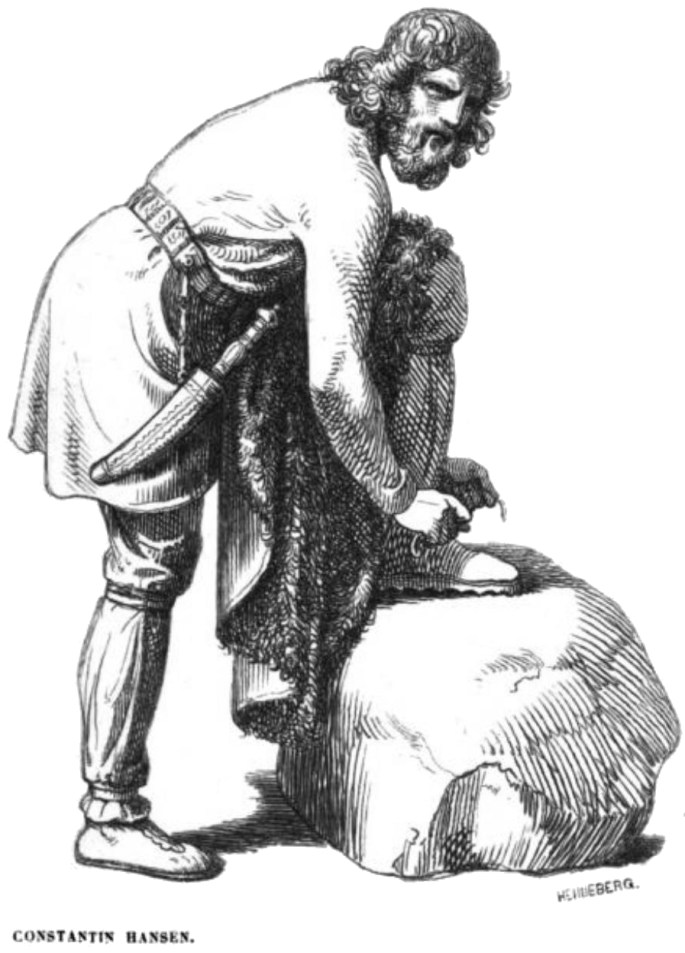
Vidar (Old Norse Víðarr), his name might mean “Wide Ruler” he is the son of the all-father Odin and the giantess Gríðr. Yes, you read that correctly, some of the Æsir have previously been together with the Jotuns, also known as giants. Some of the giants were so beautiful that even the Gods could not resist their beauty.

Vidar is the second strongest of the Æsir only Thor is stronger than him, Vidar might have inherited some of his strength from the giant side of the family. Vidar lives in Asgard in a great hall called Vidi, it’s a peaceful home and the inside looks like a garden.

Vidar is known for being very silent he loves being at peace with nature. Vidar sometimes sits for hours in his garden working on a special shoe.
This special shoe is the strongest of all the shoes and is being made from all bits and pieces of leather that shoemakers throw in the trash when making new shoes in Midgard. Vidar will use this special shoe to revenge his father’s death Odin at Ragnarok (Ragnarök).

This is when Vidar will fight the fearsome Fenris wolf, by placing one foot on Fenris’s lower jaw and pressing his hands on the upper jaw until Fenris’s mouth will be pulled apart. Ragnarok is the doom of the Gods and the end of the world. But from death, there also comes life, and Vidar is one of the few Gods who will survive Ragnarok and rebuilt the new world

—————————————

Hymn to Vidarr

Vidar1Hail to the Silent God
Who sees much and speaks little,
Who waits patiently for the moment
Of injustice that needs to be equalized.
Hail to the God called upon
When cruelty has gone so far
That there is no making things right,
Hail to the God of cold vengeance
Who does what is necessary
To even up the debt,
To bring Fate’s balance true
Quicker than entropy would allow.
Hail to the God of the Thick-Soled Shoe
Whose steps are silent
So that he might approach from behind.
Hail to you, son of Grid the Wise
And Odin the Powerful,
May I know to call upon you
Only as a last resort.

— Seawalker, Author

————————————————–

Vidar

It is said that Odin had an affair with the warrior goddess Grid, and that she bore him a son named Vidarr, who took after his father and became one of the honored Aesir Gods. He is one of the two Gods of Vengeance – the other being his half-brother Váli, as it seems that in ancient Norse culture one deity of vengeance was not enough.

Vidarr’s name may originally have meant “widely ruling”. He is known as “the Silent God”, meaning that he does not flaunt his vengeance; Vidarr is said to speak little, but be a fierce warrior when the moment is needed. It is also said that he is almost as strong as Thor, and that the Gods depend upon him in times of trouble. Some scholars theorize that his “silent God” appellation may have something to do with ancient rituals of vengeance; it may be that individuals who were preparing for a vengeance battle refrained from speaking as part of a ritual purification.

He is also known as the God of the Thick Shoe, as he is constantly in the process of building up the soles of his shoes. This is done so that if Ragnarok comes and he faces Fenrir, he will be able to put his foot on Fenrir’s enormous jaws and strike his heart through his throat. Traditionally, shoemakers (and before that, people who made their own shoes) were encouraged to dedicate the little scraps of leather they trimmed off of their new shoe soles to Vidarr, who would collect them and add them slowly to his own soles.

In the saga Grímnismál, Odin describes the halls of many Gods, including that of his son Vidarr:

Brushwood grows and high grass
widely in Vidar’s land
and there the son proclaims on his horse’s back
that he’s keen to avenge his father.

This latter point is a harbinger of the prophecy that if Ragnarok comes, Fenrir will be loosed and will slay Odin, but he will be slain in turn by Vidarr. Both brothers are said to survive Ragnarok and help to rebuild a new world after Surt’s fires have burnt down. To make an offering to Vidarr, give him a weapon – throw it into icy water, or a bog, or bury it in ice.


Reference

Norse Mythology

Odin’s Family Tribe of Asgard

Goddess Of The Day: VENUS c. 2011

Venus


Lupercalia (Rome)
Themes: Love; Passion; Romance; Sexuality
Symbols: Doves; Flowers; Berries; Trees; Pine Cones
About Venus: Venus was originally an Italic goddess of blossoms; hearts and flowers have slowly become attributed to her loving, passionate energies. In fact, her name became the root for the word to venerate – to lift up, worship, or esteem. So it is that Venus greets prespring efforts for uplifting our hearts with positive relationships.
To Do Today: During Lupercalia, an ancient predecessor of Valentine’s Day, single girls put their names in a box, and unmarried men drew lots to see with whom they would be paired off for the coming year. To be more modern-minded, try pinning five bay leaves to your pillow instead to dream of future loves. If you’re married or otherwise involved, steep the bay leaves in water and drink the resulting tea to strengthen the love in your relationship.
To encourage balance in a relationship, bind together Venus’s symbols, a pine cone and a flower, and put them somewhere in your home. Or, to spice up a passionate moment, feed fresh berries to each others and drink a berry beverage from one cup (symbolizing united goals and destinies).
In Roman tradition, anywhere there’s a large stone adjacent to a tall tree, Venus is also there. Should you know of such a place, go there today and commune with her warm, lusty energy.


)0( 

By Patricia Telesco

Goddess Of The Day: Chihnu

Chihnu

Phra Buddha Bat Fair (Thailand)

  Themes: Arts; Creativity; Tradition; Excellence

Symbols: Woven Items; Thread or Yarn; Home Crafts; Lyres

About Chihnu: In China and surrounding regions, Chihnu’s name means “weaving woman.” According to myths, Chihnu’s talents in this art are so great that she can weave seamless garments for the gods. From her heavenly domain in the constellation Lyre, she acts like a refreshing spring wind to inspire excellence in our inherited arts and crafts.

 To Do Today: This annual Thai festival features folk dancing and traditional handicrafts in honor of Buddha’s footprint, which is enshrined nearby. Generally, it is a time to rejoice in Thai tradition, so if you have a Thai restaurant in the neighborhood, by all means indulge yourself, saying a brief prayer of thanks to the provider of your feast-Chihnu.

 To make a Chihnu-inspired creativity charm, take three strands of yellow thread or yarn (yellow is the color of inventiveness). Braid these together so that the strands cross four rimes, saying,

 One, Chihnu’s power absorbs;

two, inside the magic’s stored;

three, the magic’s alive in me;

four, bear Chihnu’s creativity!

 Carry this when you need more ingenious energy, or leave it near your artistic endeavors so they can absorb Chihnu’s compelling excellence.

 Finally, wear woven or handmade items to honor Chihnu’s talents today.

 .By Patricia Telesco ~ From “365 Goddess”  (FMP) and GrannyMoon’s Morning Feast

c. 2011

God of the Day – Odin

Odin Facts and Mythology from gods-and-goddesses.com

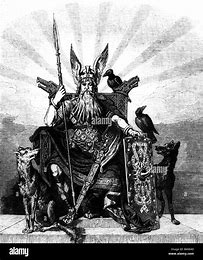
Odin is the Norse king of the Aesir, the principal race of Norse gods. He was considered the father of all the gods and was primarily associated with magic, wisdom, war, poetry, and the runic alphabet.

Mentioned frequently from the period of the Roman occupation to the Viking Age, Odin is a prominent figure in Norse mythology who continues to be acknowledged in modern popular culture. For instance, we are reminded of him every Wednesday, the weekday that was named after him; Odin is Woden in Old English, and Woden’s day became Wednesday.

Appearance

In most Norse texts, Odin is depicted as a long-bearded, one-eyed man wearing a broad hat and a cloak. Odin lost his eye upon visiting a Norse god named Mimir. Mimir was known as an extremely wise god, and he had also possessed a well called Mímisbrunnr. The waters in the well contained substantial wisdom and knowledge, and if someone drank from the well they would also gain wisdom.

However, Mimir required the drinker to sacrifice one of their eyes in order to take a drink. Odin decided to make the trade. Because of this trade, he is traditionally shown as having a dark eye or with a patch over one of his eyes.

Family

Odin had two brothers, named Vili and Ve. Myth has it that Odin created the universe after killing the primal frost giant Ymir with the help of his brothers. The three continued by making the first man and woman, Askr and Embla, from an ash tree and an elm tree.

Odin married Frigg, who is the mother of his sons Baldur, Hod, and Hermod.  With Jord, the earth goddess, he fathered Thor. He is believed to have had more sons by other wives, including Vidar from the giantess Grid.

Symbols

The most common symbol associated with Odin is the Valknut symbol, which is made of three linked or interlocked triangles. This symbol appears in a number of places along with Odin or ravens, including the Tängelgårda stone in Sweden.

There are a number of interpretations about the meaning of the Valknut. Some believe it represented slain warriors, many of which went to stay with Odin in Valhalla. In fact, the word Valknut is derived from the words valr, which means slain warriors, and knut, which means knot. Others think that it may symbolize the heart of Hrungnir.

Another common symbol affiliated with Odin is his spear, called Gungnir, which he acquired from the trickster god Loki after he stole it from the dwarfs who made it.

The ravens Hugin (thought) and Munin (memory) were Odin’s companions. They traveled across the Nine Worlds in Norse cosmology and returned to their master’s shoulder with tales of what they saw.

Odin also had two pet wolves called Geri and Freki. He is said to have created them when he became lonely. Like ravens, they haunt battlefields and feast upon the dead. Odin, who only drinks wine, gave them all his food.

Powers & Duties

In Valhalla, Odin sat on his throne called Hlidskjalf from where he watched over the Nine Realms.

Odin sought further knowledge in the runes, the letters of the runic alphabet. To achieve this, he hung from a tree with a spear in his side for nine days and nights without food or drink. He often used runes to practice wizardry.

Together with Freya, the goddess of love and war, Odin possessed the souls of slain warriors. The half that belonged to him found a final resting place in Valhalla, his palatial home with 640 doors. They were brought here by Odin’s daughters, the Valkyries, who met them on the battlefield.

Odin had a never-ending quest for wisdom. Sometime after he sacrificed his eye, he also took possession of Mimir’s head when Mimir was decapitated by the Vanir, a rival tribe. The head would tell him secrets and give him advice.

Facts About Odin …

God of the Day – Osiris

Osiris

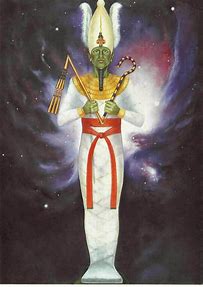
Osiris the god of the afterlife, the underworld, and rebirth in ancient Egyptian religion. He was classically depicted as a green-skinned deity with a pharaoh’s beard, partially mummy-wrapped at the legs, wearing a distinctive atef crown, and holding a symbolic crook and flail. (He was one of the first to be associated with the mummy wrap. When the brother cut him up into pieces after killing him Isis, his wife, found all the pieces and wrapped his body up.) Osiris was at times considered the eldest son of the god Geb and the sky goddess Nut, as well as being brother and husband of Isis, with Horus being considered his posthumously begotten son. He was also associated with the epithet Khenti-Amentiu, meaning “Foremost of the Westerners”, a reference to his kingship in the land of the dead. As ruler of the dead, Osiris was also sometimes called “king of the living”: ancient Egyptians considered the blessed dead “the living ones”. Through syncretism with Iah, he is also the god of the Moon.

Osiris was considered the brother of Isis, Set, Nephthys, and Horus the Elder, and father of Horus the Younger. The first evidence of the worship of Osiris was found in the middle of the Fifth dynasty of Egypt, although it is likely that he was worshiped much earlier; the Khenti-Amentiu epithet dates to at least the first dynasty, and was also used as a pharaonic title. Most information available on the myths of Osiris is derived from allusions contained in the Pyramid Texts at the end of the Fifth Dynasty, later New Kingdom source documents such as the Shabaka Stone and the Contending of Horus and Seth, and much later, in narrative style from the writings of Greek authors including Plutarch and Diodorus Siculus.

Osiris was the judge of the dead and the underworld agency that granted all life, including sprouting vegetation and the fertile flooding of the Nile River. He was described as “He Who is Permanently Benign and Youthful” and the “Lord of Silence”. The Kings of Egypt were associated with Osiris in death – as Osiris rose from the dead so would they in union with him, and inherit eternal life through a process of imitative magic. By the New Kingdom all people, not just pharaohs, were believed to be associated with Osiris at death, if they incurred the costs of the assimilation rituals.

Through the hope of new life after death, Osiris began to be associated with the cycles observed in nature, in particular vegetation and the annual flooding of the Nile, through his links with the heliacal rising of Orion and Sirius at the start of the new year. Osiris was widely worshipped until the decline of ancient Egyptian religion during the rise of Christianity in the Roman Empire.

Etymology of the name

Osiris is a Latin transliteration of the Ancient Greek Ὄσιρις IPA: [ó.siː.ris], which in turn is the Greek adaptation of the original name in the Egyptian language. In Egyptian hieroglyphs the name appears as wsjr, which some Egyptologists instead choose to transliterate ꜣsjr or jsjrj. Since hieroglyphic writing lacks vowels, Egyptologists have vocalized the name in various ways as Asar, Yasar, Aser, Asaru, Ausar, Ausir, Wesir, Usir, Usire or Ausare.

Several proposals have been made for the etymology and meaning of the original name; as Egyptologist Mark J. Smith notes, none are fully convincing. Most take wsjr as the accepted transliteration, following Adolf Erman:

  • John Gwyn Griffiths (1980), “bearing in mind Erman’s emphasis on the fact that the name must begin with an [sic] w“, proposes a derivation from wsr with an original meaning of “The Mighty One”. Moreover, one of the oldest attestations of the god Osiris appears in the mastaba of the deceased Netjer-wser (from nṯr-wsr “Powerful God”).[citation needed]
  • Kurt Sethe (1930) proposes a compound st-jrt, meaning “seat of the eye”, in a hypothetical earlier form *wst-jrt; this is rejected by Griffiths on phonetic grounds.
  • David Lorton (1985) takes up this same compound but explains st-jrt as signifying “product, something made”, Osiris representing the product of the ritual mummification process.
  • Wolfhart Westendorf (1987) proposes an etymology from wꜣst-jrt “she who bears the eye”.
  • Mark J. Smith (2017) makes no definitive proposals but asserts that the second element must be a form of jrj (“to do, make”) (rather than jrt (“eye”)).

However, recently alternative transliterations have been proposed:

  • Yoshi Muchiki (1990) reexamines Erman’s evidence that the throne hieroglyph in the word is to be read ws and finds it unconvincing, suggesting instead that the name should be read ꜣsjr on the basis of Aramaic, Phoenician, and Old South Arabian transcriptions, readings of the throne sign in other words, and comparison with ꜣst(“Isis”).
  • James P. Allen (2000) reads the word as jsjrt but revises the reading (2013) to jsjrj and derives it from js-jrj, meaning “engendering (male) principle”.

Appearance

Osiris is represented in his most developed form of iconography wearing the Atef crown, which is similar to the White crown of Upper Egypt, but with the addition of two curling ostrich feathers at each side (see also Atef crown (hieroglyph)). He also carries the crook and flail. The crook is thought to represent Osiris as a shepherd god. The symbolism of the flail is more uncertain with shepherds whip, fly-whisk, or association with the god Andjety of the ninth nome of Lower Egypt proposed.

He was commonly depicted as a pharaoh with a complexion of either green (the color of rebirth) or black (alluding to the fertility of the Nile floodplain) in mummiform (wearing the trappings of mummification from chest downward).

Early mythology

The Pyramid Texts describe early conceptions of an afterlife in terms of eternal travelling with the sun god amongst the stars. Amongst these mortuary texts, at the beginning of the 4th dynasty, is found: “An offering the king gives and Anubis”. By the end of the 5th dynasty, the formula in all tombs becomes “An offering the king gives and Osiris“.

Father of Horus

Osiris is the mythological father of the god Horus, whose conception is described in the Osiris myth (a central myth in ancient Egyptian belief). The myth describes Osiris as having been killed by his brother, Set, who wanted Osiris’ throne. His wife, Isis finds the body of Osiris and hides it in the reeds where it is found and dismembered by Set. Isis retrieves and joins the fragmented pieces of Osiris, then briefly brings Osiris back to life by use of magic. This spell gives her time to become pregnant by Osiris before he again dies. Isis later gives birth to Horus. As such, since Horus was born after Osiris’ resurrection, Horus became thought of as a representation of new beginnings and the vanquisher of the usurper Set.

Ptah-Seker (who resulted from the identification of Creator god Ptah with Seker) thus gradually became identified with Osiris, the two becoming Ptah-Seker-Osiris. As the sun was thought to spend the night in the underworld, and was subsequently “reborn” every morning, Ptah-Seker-Osiris was identified as king of the underworld, god of the afterlife, life, death, and regeneration.

Ram god

Osiris’ soul, or rather his Ba, was occasionally worshipped in its own right, almost as if it were a distinct god, especially in the Delta city of Mendes. This aspect of Osiris was referred to as Banebdjedet, which is grammatically feminine (also spelt “Banebded” or “Banebdjed“), literally “the ba of the lord of the djed, which roughly means The soul of the lord of the pillar of continuity. The djed, a type of pillar, was usually understood as the backbone of Osiris.

The Nile supplying water, and Osiris (strongly connected to the vegetable regeneration) who died only to be resurrected, represented continuity and stability. As Banebdjed, Osiris was given epithets such as Lord of the Sky and Life of the (sun god) Ra, since Ra, when he had become identified with Atum, was considered Osiris’ ancestor, from whom his regal authority is inherited. Ba does not mean “soul” in the western sense, and has to do with power, reputation, force of character, especially in the case of a god.

Since the ba was associated with power, and also happened to be a word for ram in Egyptian, Banebdjed was depicted as a ram, or as Ram-headed. A living, sacred ram was kept at Mendes and worshipped as the incarnation of the god, and upon death, the rams were mummified and buried in a ram-specific necropolis. Banebdjed was consequently said to be Horus’ father, as Banebdjed was an aspect of Osiris.

Regarding the association of Osiris with the ram, the god’s traditional crook and flail are the instruments of the shepherd, which has suggested to some scholars also an origin for Osiris in herding tribes of the upper Nile. The crook and flail were originally symbols of the minor agricultural deity Andjety, and passed to Osiris later. From Osiris, they eventually passed to Egyptian kings in general as symbols of divine authority.

Mythology

Plutarch recounts one version of the Osiris myth in which Set (Osiris’ brother), along with the Queen of Ethiopia, conspired with 72 accomplices to plot the assassination of Osiris. Set fooled Osiris into getting into a box, which Set then shut, sealed with lead, and threw into the Nile. Osiris’ wife, Isis, searched for his remains until she finally found him embedded in a tamarisk tree trunk, which was holding up the roof of a palace in Byblos on the Phoenician coast. She managed to remove the coffin and retrieve her husband’s body.

In one version of the myth, Isis used a spell to briefly revive Osiris so he could impregnate her. After embalming and burying Osiris, Isis conceived and gave birth to their son, Horus. Thereafter Osiris lived on as the god of the underworld. Because of his death and resurrection, Osiris was associated with the flooding and retreating of the Nile and thus with the yearly growth and death of crops along the Nile valley.

Diodorus Siculus gives another version of the myth in which Osiris was described as an ancient king who taught the Egyptians the arts of civilization, including agriculture, then travelled the world with his sister Isis, the satyrs, and the nine muses, before finally returning to Egypt. Osiris was then murdered by his evil brother Typhon, who was identified with Set. Typhon divided the body into twenty-six pieces, which he distributed amongst his fellow conspirators in order to implicate them in the murder. Isis and Hercules (Horus) avenged the death of Osiris and slew Typhon. Isis recovered all the parts of Osiris’ body, except the phallus, and secretly buried them. She made replicas of them and distributed them to several locations, which then became centres of Osiris worship.

Worship

Annual ceremonies were performed in honor of Osiris in various places across Egypt. These ceremonies were fertility rites which symbolised the resurrection of Osiris. E.A. Wallis Budge stated “Osiris is closely connected with the germination of wheat; the grain which is put into the ground is the dead Osiris, and the grain which has germinated is the Osiris who has once again renewed his life.”

Death or transition and institution as god of the afterlife

Plutarch and others have noted that the sacrifices to Osiris were “gloomy, solemn, and mournful…” (Isis and Osiris, 69) and that the great mystery festival, celebrated in two phases, began at Abydos commemorating the death of the god, on the same day that grain was planted in the ground (Isis and Osiris, 13). The annual festival involved the construction of “Osiris Beds” formed in shape of Osiris, filled with soil and sown with seed.

The germinating seed symbolized Osiris rising from the dead. An almost pristine example was found in the tomb of Tutankhamun by Howard Carter.

The first phase of the festival was a public drama depicting the murder and dismemberment of Osiris, the search of his body by Isis, his triumphal return as the resurrected god, and the battle in which Horus defeated Set.

According to Julius Firmicus Maternus of the fourth century, this play was re-enacted each year by worshippers who “beat their breasts and gashed their shoulders…. When they pretend that the mutilated remains of the god have been found and rejoined…they turn from mourning to rejoicing.” (De Errore Profanorum).

The passion of Osiris was reflected in his name ‘Wenennefer” (“the one who continues to be perfect”), which also alludes to his post mortem power.

Ikhernofret Stela

Much of the extant information about the rites of Osiris can be found on the Ikhernofret Stela at Abydos erected in the 12th Dynasty by Ikhernofret (also I-Kher-Nefert), possibly a priest of Osiris or other official (the titles of Ikhernofret are described in his stela from Abydos) during the reign of Senwosret III (Pharaoh Sesostris, about 1875 BC). The ritual reenactment of Osiris’s funeral rites were held in the last month of the inundation (the annual Nile flood), coinciding with Spring, and held at Abydos/Abedjou which was the traditional place where the body of Osiris/Wesir drifted ashore after having been drowned in the Nile.

The part of the myth recounting the chopping up of the body into 14 pieces by Set is not recounted in this particular stela. Although it is attested to be a part of the rituals by a version of the Papyrus Jumilhac, in which it took Isis 12 days to reassemble the pieces, coinciding with the festival of ploughing. Some elements of the ceremony were held in the temple, while others involved public participation in a form of theatre. The Stela of I-Kher-Nefert recounts the programme of events of the public elements over the five days of the Festival:

  • The First Day, The Procession of Wepwawet: A mock battle was enacted during which the enemies of Osiris are defeated. A procession was led by the god Wepwawet (“opener of the way”).
  • The Second Day, The Great Procession of Osiris: The body of Osiris was taken from his temple to his tomb. The boat he was transported in, the “Neshmet” bark, had to be defended against his enemies.
  • The Third Day: Osiris is Mourned and the Enemies of the Land are Destroyed.
  • The Fourth Day, Night Vigil: Prayers and recitations are made and funeral rites performed.
  • The Fifth Day, Osiris is Reborn: Osiris is reborn at dawn and crowned with the crown of Ma’at. A statue of Osiris is brought to the temple.

Wheat and clay rituals

Contrasting with the public “theatrical” ceremonies sourced from the I-Kher-Nefert stele (from the Middle Kingdom), more esoteric ceremonies were performed inside the temples by priests witnessed only by chosen initiates. Plutarch mentions that (for much later period) two days after the beginning of the festival “the priests bring forth a sacred chest containing a small golden coffer, into which they pour some potable water…and a great shout arises from the company for joy that Osiris is found (or resurrected). Then they knead some fertile soil with the water…and fashion therefrom a crescent-shaped figure, which they cloth and adorn, this indicating that they regard these gods as the substance of Earth and Water.” (Isis and Osiris, 39). Yet his accounts were still obscure, for he also wrote, “I pass over the cutting of the wood” – opting not to describe it, since he considered it as a most sacred ritual (Ibid. 21).

In the Osirian temple at Denderah, an inscription (translated by Budge, Chapter XV, Osiris and the Egyptian Resurrection) describes in detail the making of wheat paste models of each dismembered piece of Osiris to be sent out to the town where each piece is discovered by Isis. At the temple of Mendes, figures of Osiris were made from wheat and paste placed in a trough on the day of the murder, then water was added for several days, until finally the mixture was kneaded into a mold of Osiris and taken to the temple to be buried (the sacred grain for these cakes were grown only in the temple fields). Molds were made from the wood of a red tree in the forms of the sixteen dismembered parts of Osiris, the cakes of ‘divine’ bread were made from each mold, placed in a silver chest and set near the head of the god with the inward parts of Osiris as described in the Book of the Dead (XVII).

Judgment

The idea of divine justice being exercised after death for wrongdoing during life is first encountered during the Old Kingdom in a 6th dynasty tomb containing fragments of what would be described later as the Negative Confessions performed in front of the 42 Assessors of Ma’at.

With the rise of the cult of Osiris during the Middle Kingdom the “democratization of religion” offered to even his humblest followers the prospect of eternal life, with moral fitness becoming the dominant factor in determining a person’s suitability.

At death a person faced judgment by a tribunal of forty-two divine judges. If they led a life in conformance with the precepts of the goddess Ma’at, who represented truth and right living, the person was welcomed into the kingdom of Osiris. If found guilty, the person was thrown to a “devourer” (such as the soul-eating demon Ammit) and did not share in eternal life.

The person who is taken by the devourer is subject first to terrifying punishment and then annihilated. These depictions of punishment may have influenced medieval perceptions of the inferno in hell via early Christian and Coptic texts.

Purification for those who are considered justified may be found in the descriptions of “Flame Island“, where they experience the triumph over evil and rebirth. For the damned, complete destruction into a state of non-being awaits, but there is no suggestion of eternal torture.

Divine pardon at judgement was always a central concern for the ancient Egyptians.

During the reign of Seti I, Osiris was also invoked in royal decrees to pursue the living when wrongdoing was observed, but kept secret and not reported.

Greco-Roman era

Hellenization

The early Ptolemaic kings promoted a new god, Serapis, who combined traits of Osiris with those of various Greek gods and was portrayed in a Hellenistic form. Serapis was often treated as the consort of Isis and became the patron deity of the Ptolemies’ capital, Alexandria. Serapis’s origins are not known. Some ancient authors claim the cult of Serapis was established at Alexandria by Alexander the Great himself, but most who discuss the subject of Serapis’s origins give a story similar to that by Plutarch. Writing about 400 years after the fact, Plutarch claimed that Ptolemy I established the cult after dreaming of a colossal statue at Sinope in Anatolia. His councillors identified as a statue of the Greek god Pluto and said that the Egyptian name for Pluto was Serapis. This name may have been a Hellenization of “Osiris-Apis”. Osiris-Apis was a patron deity of the Memphite Necropolis and the father of the Apis bull who was worshipped there, and texts from Ptolemaic times treat “Serapis” as the Greek translation of “Osiris-Apis”. But little of the early evidence for Serapis’s cult comes from Memphis, and much of it comes from the Mediterranean world with no reference to an Egyptian origin for Serapis, so Mark Smith expresses doubt that Serapis originated as a Greek form of Osiris-Apis’s name and leaves open the possibility that Serapis originated outside Egypt.

Destruction of cult

The cult of Isis and Osiris continued at Philae until at least the 450s CE, long after the imperial decrees of the late 4th century that ordered the closing of temples to “pagan” gods. Philae was the last major ancient Egyptian temple to be closed.


Source

Wikipedia

c. 2018

Goddess Of The Day: HERA

Hera

Daedala (Greece)
 
Themes: Love; Romance; Forgiveness; Humor
Symbols: Oak; Myrrh; Poppy
 
About Hera: Hera rules the earth, its people, and the hearts of those people. Using passion and creativity, Hera nudges star-crossed lovers together, chaperones trysts, and helps struggling marriages with a case of spring twitterpation!
 
Legend tells us that Hera refused to return to Zeus’s bed because of a quarrel. Zeus, however, had a plan. He humorously dressed up a wooden figure to look like a bride and declared he was going to marry. When Hera tore off the dummy’s clothes and discovered the ruse, she was so amused and impressed by Zeus’s ingenuity that she forgave him.
 
To Do Today: Ancient Greeks honored Hera and Zeus’s reconciliation today, often in the company of old oak trees. Small pieces of fallen wood are collected to symbolize the divinities, then burned on the ritual fire to keep love warm. To mirror this custom, find a fallen branch and burn a small part of it as an offering to Hera. Keep the rest to use as a goddess image year-round, burning a few slivers whenever love needs encouragement.
 
Present someone you love or admire with a poppy today to symbolically bestow Hera’s blessings on your relationship. If you have a loved one away from home, burn some myrrh incense in front of their picture so Hera can watch over them and keep that connection strong.
.
By Patricia Telesco ~ From “365 Goddess”  (FMP) and GrannyMoon’s Morning Feast
c. 2011

Goddess Of The Day – Hexe

Hexe

Saint Hildegard Dies


Themes: Health, Banishing:Magic

Symbols: Healing Herbs and Charms


About Hexe: This ancient Germanic witch’s goddess rules over health, banishing curses and teaching

people the effective use of spells, charms and other mystical procedure for improving well being, Thus

we come by the old phrase “hex doctor”.


To Do Today: Living in the 1100’s St Hildegard was a renowned Benedictine nun living in Bingen and

ministering to people with herbal preparations received in visions. Many of these had magical overtone,

perhaps guided by Hexe’s influence. In any case, today’s theme is learning the art of weaving, “Hexes”

for physical, mental and spiritual health.


On the physical level take a natural object like a cut potato and rub it against an inflicted area. Bury the

potato to “bury” the malady and decompose it. Or carry a jet stone to absorb the problem, then cleanse

the rock in saltwater to wash the bas energy away. For mental well being, enjoy a soothing cup of mint

tea stirred countercockwise so tensions and negativity will wane. Or, carry a flourite stone with you

throughout the day to strengthen your mental powers. For spiritual health, sprinkle nutmeg-laden water

clockwise throughout your aura to empower your physic self. Or, carry a lapis or amethyst stone to draw

goddess centered thinking and action into your day.


By Patricia Telesco

Goddess of the Day – Aphrodite

Aphrodite

Greek goddess of love and beauty

By deTraci Regula, About.com Guide

Aphrodite

From ‘The Dictionary of Classical Antiquities’

Aphrodite’s Appearance:Aphrodite is a gorgeous, perfect, eternally young woman with a beautiful body.Aphrodite’s Symbol or Attribute:Her Girdle, which has magical powers to compel love.

Strengths:Potent sexual attractiveness, dazzling beauty.

Weaknesses:A bit stuck on herself, but with a perfect face and body, who can blame her?

Aphrodite’s Parents: One genealogy gives her parents as Zeus, King of the Gods, and Dione, an early earth/mother goddess. More commonly, she was believed to be born of the foam in the sea which bubbled around the severed member of Ouranos when Kronos slew him.

Aphrodite’s Birthplace: Rising from the foam off of the islands of Cyprus or Kythira. Milos, where the famed Venus de Milo was found, is also associated with her in modern times.

Aprhodite’s Husband:Hephaestus, the lame smith-god. Also associated with Ares, god of War.

Children: Eros, a Cupid-like figure.

Some Major Temple Sites of Aphrodite: Kythira, an island she visited; Cyprus.

Basic Story: Aphrodite rises from the foam of the waves of the sea, enchanting anyone who sees her and inciting feelings of love and lust wherever she goes. She is a contender in the story of the Golden Apples, when Paris chooses her as the fairest of the three goddesses (the others were Hera and Athena) and Aphrodite decides to “reward” him for giving her the Golden Apple (the prototype of most modern awards) by giving him the love of Helen of Troy, something of a mixed blessing that led to the Trojan War.

Interesting Fact: The island of Cyprus has many places believed to have been enjoyed by Aphrodite when she was on earth. Recently, the Cypriots have revived a tourist-friendly version of some of Aphrodite’s festivals at the town of Paphos.

Goddess of the Day – Morrigan c. 2012


The Morrigan

Goddess Of Battle, Strife, and Fertility

The Morrígan (“phantom queen”) or Mórrígan (“great queen”), also written as Morrígu or in the plural as Morrígna, and spelt Morríghan or Mór-Ríoghain in Modern Irish, is a figure from Irish mythology who appears to have once been a goddess, although she is not explicitly referred to as such in the texts.

The Morrigan is a goddess of battle, strife, and fertility. She sometimes appears in the form of a crow, flying above the warriors, and in the Ulster cycle she also takes the form of an eel, a wolf and a cow. She is generally considered a war deity comparable with the Germanic Valkyries, although her association with cattle also suggests a role connected with fertility, wealth, and the land.

She is often depicted as a triple goddess, although membership of the triad varies; the most common combination is the Badb, Macha and Nemain, but other accounts name Fea, Anann, and others.

Etymology

There is some disagreement over the meaning of the Morrígan’s name. Mor may derive from an Indo-European root connoting terror or monstrousness, cognate with the Old English maere (which survives in the modern English word “nightmare”) and the Scandinavian mara; while rígan translates as ‘queen’. This can be reconstructed in Proto-Celtic as *Moro-rīganī-s. Accordingly, Morrígan is often translated as “Phantom Queen”. This is the derivation generally favoured in current scholarship.

In the Middle Irish period the name is often spelt Mórrígan with a lengthening diacritic over the ‘o’, seemingly intended to mean “Great Queen” (Old Irish mór, ‘great’; this would derive from a hypothetical Proto-Celtic *Māra Rīganī-s.). Whitley Stokes believed this latter spelling was a due to a false etymology popular at the time. There have also been attempts to link the Morrígan with the fairy Morgan from Arthurian romance, in whose name ‘mor’ may derive from ‘sea’ or ‘water’.

The name is also sometimes spelt Morrígu and given in plural as Morrígna in Old Irish.

Glosses and glossaries

The earliest sources for the Morrígan are glosses in Latin manuscripts, and glossaries (collections of glosses). In a 9th century manuscript containing the Latin Vulgate translation of the Book of Isaiah, the word Lamia is used to translate the Hebrew Lilith. A gloss explains this as “a monster in female form, that is, a morrígan“. Cormac’s Glossary (also 9th century), and a gloss in the later manuscript H.3.18, both explain the plural word gudemain (“spectres”) with the plural form morrígna. The 8th century O’Mulconry’s Glossary says that Macha is one of the three morrígna. It therefore appears that at this time the name Morrígan was seen as referring to a class of beings rather than an individual.

Ulster Cycle

The Morrígan’s earliest narrative appearances, in which she is depicted as an individual, are in stories of the Ulster Cycle, where she has an ambiguous relationship with the hero Cú Chulainn. In Táin Bó Regamna (The Cattle Raid of Regamain), Cúchulainn encounters the Morrígan, but does not recognize her, as she drives a heifer from his territory. In response to his challenge, she insults him, but before he can attack she becomes a black bird on a nearby branch. Cúchulainn now knows who she, and tells her that had he known before, they would not have parted in enmity. She notes that whatever he had done would have brought him ill luck. To his response that she cannot harm him, she makes a series of threats, foretelling a coming battle in which he will be killed. She tells him, enigmatically, “I guard your death”.

In the Táin Bó Cuailnge queen Medb of Connacht launches an invasion of Ulster to steal the bull Donn Cuailnge; the Morrígan, like Alecto of the Greek Furies, appears to the bull in the form of a crow and warns him to flee. Cúchulainn defends Ulster by fighting a series of single combats at fords against Medb’s champions. In between combats the Morrígan appears to him as a young woman and offers him her love, and her aid in the battle, but he spurns her. In response she intervenes in his next combat, first in the form of an eel who trips him, then as a wolf who stampedes cattle across the ford, and finally as a red heifer leading the stampede, just as she had threatened in their previous encounter. However Cúchulainn wounds her in each form and defeats his opponent despite her interference. Later she appears to him as an old woman bearing the same three wounds that her animal forms sustained, milking a cow. She gives Cúchulainn three drinks of milk. He blesses her with each drink, and her wounds are healed. As the armies gather for the final battle, she prophesies the bloodshed to come.

In one version of Cúchulainn’s death-tale, as the hero rides to meet his enemies, he encounters the Morrígan as a hag washing his bloody armour in a ford, an omen of his death. Later in the story, mortally wounded, Cúchulainn ties himself to a standing stone with his own entrails so he can die upright, and it is only when a crow lands on his shoulder that his enemies believe he is dead.

Mythological Cycle

The Morrígan also appears in texts of the Mythological Cycle. In the 12th century pseudohistorical compilation Lebor Gabála Érenn she is listed among the Tuatha Dé Danann as one of the daughters of Ernmas, granddaughter of Nuada.

The first three daughters of Ernmas are given as Ériu, Banba, and Fódla. Their names are synonyms for Ireland, and they were married to Mac Cuill, Mac Cécht, and Mac Gréine, the last three Tuatha Dé Danann kings of Ireland. Associated with the land and kingship, they probably represent a triple goddess of sovereignty. Next come Ernmas’s other three daughters: the Badb, Macha, and the Morrígan. A quatrain describes the three as wealthy, “springs of craftiness” and “sources of bitter fighting”. The Morrígan’s name is said to be Anann, and she had three sons, Glon, Gaim, and Coscar. According to Geoffrey Keating’s 17th century History of Ireland, Ériu, Banba, and Fódla worshipped the Badb, Macha, and the Morrígan respectively, suggesting that the two triads of goddesses may be seen as equivalent.

The Morrígan also appears in Cath Maige Tuireadh (The Battle of Mag Tuired). On Samhain she keeps a tryst with the Dagda before the battle against the Fomorians. When he meets her she is washing herself, standing with one foot on either side of the river Unius. In some sources she is believed to have created the river. After they have sex, the Morrígan promises to summon the magicians of Ireland to cast spells on behalf of the Tuatha Dé, and to destroy Indech, the Fomorian king, taking from him “the blood of his heart and the kidneys of his valour”. Later, we are told, she would bring two handfuls of his blood and deposit them in the same river (however, we are also told later in the text that Indech was killed by Ogma).

As battle is about to be joined, the Tuatha Dé leader, Lug, asks each what power they bring to the battle. The Morrígan’s reply is difficult to interpret, but involves pursuing, destroying and subduing. When she comes to the battlefield she chants a poem, and immediately the battle breaks and the Fomorians are driven into the sea. After the battle she chants another poem celebrating the victory and prophesying the end of the world.

In another story she lures away the bull of a woman called Odras, who follows her to the otherworld via the cave of Cruachan. When she falls asleep, the Morrígan turns her into a pool of water.

Nature and functions

The Morrígan is often considered a triple goddess, but her supposed triple nature is ambiguous and inconsistent. Sometimes she appears as one of three sisters, the daughters of Ernmas: the Morrígan, the Badb and Macha. Sometimes the trinity consists of the Badb, Macha and Nemain, collectively known as the Morrígan, or in the plural as the Morrígna. Occasionally Fea or Anu also appear in various combinations. However the Morrígan also frequently appears alone, and her name is sometimes used interchangeably with the Badb, with no third “aspect” mentioned.

The Morrígan is usually interpreted as a “war goddess”: W. M. Hennessey’s “The Ancient Irish Goddess of War,” written in 1870, was influential in establishing this interpretation. Her role often involves premonitions of a particular warrior’s violent death, suggesting a link with the Banshee of later folklore. This connection is further noted by Patricia Lysaght: “In certain areas of Ireland this supernatural being is, in addition to the name banshee, also called the badhb“.

It has also been suggested that she was closely tied to Irish männerbund groups (described as “bands of youthful warrior-hunters, living on the borders of civilized society and indulging in lawless activities for a time before inheriting property and taking their places as members of settled, landed communities”) and that these groups may have been in some way dedicated to her. If true, her worship may have resembled that of Perchta groups in Germanic areas.

However, Máire Herbert has argued that “war per se is not a primary aspect of the role of the goddess”, and that her association with cattle suggests her role was connected to the earth, fertility and sovereignty; she suggests that her association with war is a result of a confusion between her and the Badb, who she argues was originally a separate figure. She can be interpreted as providing political or military aid, or protection to the king — acting as a goddess of sovereignty, not necessarily a war goddess.

There is a burnt mound site in County Tipperary known as Fulacht na Mór Ríoghna (“cooking pit of the Mórrígan”). The fulachta sites are found in wild areas, and usually associated with outsiders such as the Fianna and the above-mentioned männerbund groups, as well as with the hunting of deer. The cooking connection also suggests to some a connection with the three mythical hags who cook the meal of dogflesh that brings the hero Cúchulainn to his doom. The Dá Chich na Morrigna (“two breasts of the Mórrígan”), a pair of hills in County Meath, suggest to some a role as a tutelary goddess, comparable to Danu or Anu, who has her own hills in County Kerry. Other goddesses known to have similar hills are Áine and Grian of County Limerick who, in addition to a tutelary function, also have solar attributes.

Arthurian legend

There have been attempts by some modern authors of fiction to link the Arthurian character Morgan le Fay with the Morrígan. Morgan first appears in Geoffrey of Monmouth’s Vita Merlini (The Life of Merlin) in the 12th century. However, while the creators of the literary character of Morgan may have been somewhat inspired by the much older tales of the goddess, the relationship ends there. Scholars such as Rosalind Clark hold that the names are unrelated, the Welsh “Morgan” (Wales being the source of Arthurian legend being derived from root words associated with the sea, while the Irish “Morrígan” has its roots either in a word for “terror” or a word for “greatness”.


Origins of The Morrigan

The origins of the Morrigan seem to reach directly back to the megalithic cult of the Mothers. The Mothers (Matrones, Idises, Disir, etc.) usually appeared as triple goddesses and their cult was expressed through both battle ecstasy and regenerative ecstasy. It’s also interesting to note that later Celtic goddesses of sovereignty, such as the trio of Eriu, Banba, and Fotla, also appear as a trio of female deities who use magic in warfare. “Influence in the sphere of warfare, but by means of magic and incantation rather than through physical strength, is common to these beings.” (Ross 205)

Eriu, a goddess connected to the land in a fashion reminiscent of the Mothers, could appear as a beautiful woman or as a crow, as could the Morrigan. The Disir appeared in similar guises. In addition to being battle goddesses, they are significantly associated with fate as well as birth in many cases, along with appearing before a death or to escort the deceased.

There is certainly evidence that the concept of a raven goddess of battle was not limited to the Irish Celts. An inscription found in France which reads Cathubodva, ‘Battle Raven’, shows that a similar concept was at work among the Gaulish Celts.

Valkyries in Norse cosmology. Both use magic to cast fetters on warriors and choose who will die.

During the Second Battle, the Morrigan “said she would go and destroy Indech son of De Domnann and ‘deprive him of the blood of his heart and the kidneys of his valor’, and she gave two handfuls of that blood to the hosts. When Indech later appeared in the battle, he was already doomed.” (Rees 36)

Compare this to the Washer at the Ford, another guise of the Morrigan. The Washer is usually to be found washing the clothes of men about to die in battle. In effect, she is choosing who will die.

An early German spell found in Merseburg mentions the Indisi, who decided the fortunes of war and the fates of warriors. The Scandinavian “Song of the Spear”, quoted in “Njals Saga”, gives a detailed description of Valkyries as women weaving on a grisly loom, with severed heads for weights, arrows for shuttles, and entrails for the warp. As they worked, they exulted at the loss of life that would take place. “All is sinister now to see, a cloud of blood moves over the sky, the air is red with the blood of men, and the battle women chant their song.” (Davidson 94)

An Old English poem, “Exodus”, refers to ravens as choosers of the slain. In all these sources, ravens, choosing of the slain, casting fetters, and female beings are linked.

“As the Norse and English sources show them to us, the walkurjas are figures of awe an even terror, who delight in the deaths of men. As battlefield scavengers, they are very close to the ravens, who are described as waelceasega, “picking over the dead”…” (Our Troth)

“The function of the goddess [the Morrigan] here, it may be noted, is not to attack the hero [Cu Chulainn] with weapons but to render him helpless at a crucial point in the battle, like the valkyries who cast ‘fetters’ upon warriors … thus both in Irish and Scandinavian literature we have a conception of female beings associated with battle, both fierce and erotic.” (Davidson 97, 100)

The Morrigan and Cu Chulainn

She appeared to the hero Cu Chulainn(son of the god Lugh) and offered her love to him. When he failed to recognize her and rejected her, she told him that she would hinder him when he was in battle. When Cu Chulainn was eventually killed, she settled on his shoulder in the form of a crow. Cu’s misfortune was that he never recognized the feminine power of sovereignty that she offered to him.

She appeared to him on at least four occasions and each time he failed to recognize her.

  1. When she appeared to him and declared her love for him.
  2. After he had wounded her, she appeared to him as an old hag and he offered his blessings to her, which caused her to be healed.
  3. On his way to his final battle, he saw the Washer at the Ford, who declared that she was washing the clothes and arms of Cu Chulainn, who would soon be dead.
  4. When he was forced by three hags (the Morrigan in her triple aspect) to break a taboo of eating dogflesh.


THE GREAT GODDESS MORRIGAN

Created By Calesta

The information on Morrigan is vast, and at times contradictory. It would take many, many webpages to tell all of her stories and it was very difficult to narrow this down! From maiden to mother to crone, from the destruction of war and death, to the beauty of the river of rebirth, Morrigan shows us the full circle of life. As with many Divine Feminine images, time can distort, and different cultures take on different attributes. What I have found that is close to the truth in my experience with her follows.

Morrigan is an Irish and Celtic Goddess. She can shapeshift into a crow or raven. It is said that she would take this form and fly over battlefields “calling upon the spirits of slain warriors.” (p. 252, McCoy) She is a triple goddess, with the aspects of the “virgin Ana, flowering fertility- goddess; the mother Babd, “Boiling” the cauldron perpetually producing life; and the crone Macha, “great Queen of the Phantoms” or Mother Death.” (p. 675, Walker). I believe she was also originally connected to the Great Irish Mother Goddess, Anu (later called Danu). In her aspect of Macha she was so powerful her name was the ancient capital of Ireland (p. 186, Kimball).

In the tales of the first people of Ireland, the Tuatha De Danann (literally the people of the Goddess Danu, pg. 189 Kimball), Morrigan was said to have blown a protective fog over all of the land, so that they would not be invaded. This shows the strength of Morrigan, and the protection the people received from her. Morrigan is also connected with death and destruction and battles. One story tells that Macha was forced to race while pregnant with twins, and when she (easily) won she gave birth to the twins. She was so angry at her tormentors for giving birth in public that way, she cursed them with the pain of childbirth before enemies were closing in. For nine generations when Ulster came under attack the men would experience the pains of childbirth (p. 192 Kimball).

Morrigan is a “Goddess of rivers, lakes and freshwaters”, and she was seen by Cu Chulain before his death, washing the clothes and arms. It is said that if one sees Morrigan by the river washing their clothes or body, is is a prediction of death before going into battle. Looking at this story, one can see the river or water as a place of rebirth, that Morrigan as the Goddess washing, anointing the body before being reborn.

Calling upon the strength of a woman that can fight off armies, and wash the dead is very powerful. Darkness, death, is a natural part of life, and brewing in the cauldron of rebirth is new life. But what I have found is to recognize that over time most Goddesses have been demonized… made to be solely focused on sex or death. Taking out pieces of the cycle, and turning them into something evil. Just as the wise crone was turned to hag.


Hymn to the Morrigan by Isaac Bonewits


O Morrigan, we call your name Across the dusty years.
You speak to us, of blood and lust. You show us all our fears.
You are a goddess, old and wise. Of holy power you have no dearth.
Beneath your wings : Black, Red and White, We learn of death and birth.


You walk about, this ancient land, Your hungers raw and clear.
You make the crops, grow rich and strong, As well your geese and deer.
A flirting maid, a lusty hag, A mother of great girth :
Without the touch of your black wings, We cannot heal the earth.


You float upon, a blood red wave, Of swords and spears and knives.
Your voice inspires, fear and dread, That you’ll cut short our lives.
You try the warriors’, courage sore, Our inner souls unearth.
Without the touch of your red wings, We cannot know our worth.


You fly above the silver clouds, To Manannan’s shining Gate.
You lead the dead along that path, To meet our final fate.
The joke’s on us, we find within, A land of laughter and of mirth.
Without the touch of your white wings, We cannot have rebirth.