Guided Meditation with Pluto




The Hilaria (Festival of Joy) was celebrated annually on March 25th in ancient Rome. It was a joyous event which commemorated the triumph of day over night after the Vernal Equinox.
The festivities were brought to a close with a “ceremony of washing” which was believed to promote fertility.
Some credit the ancient Roman festival of Hilaria as the inspiration of April Fools’ Day.

You can use this link to go forward or backward in time for Moon phase information. If you are curious, you can even find out what phase the Moon was in when you or anyone else was born.
Today and tonight the Moon will be in a Third Quarter phase. Sometimes called a Last Quarter Moon, this phase occurs roughly 3 weeks after the New Moon when the Moon is three quarter of the way through it’s orbit around the earth. If you live in the northern hemisphere the Moons left side will be illuminated and the right side will be dark. For those of you in the southern hemisphere it will be the opposite with the right side illuminated. On the day of the Third Quarter phase the Moon will rise around midnight on the eastern horizon and set in the west around noon the next day. In the days following the Third Quarter Phase the Moon’s illumination will decrees each day until the New Moon.
Visit the March 2022 Moon Phases Calendar to see all the daily moon phase for this month.
The Last Quarter on March 25 has an illumination of 47%. This is the percentage of the Moon illuminated by the Sun. The illumination is constantly changing and can vary up to 10% a day. On March 25 the Moon is 22.44 days old. This refers to how many days it has been since the last New Moon. It takes 29.53 days for the Moon to orbit the Earth and go through the lunar cycle of all 8 Moon phases.
There are 8 lunar phases the Moon goes through in its 29.53 days lunar cycle. The 4 major Moon phases are Full Moon, New Moon, First Quarter and Last Quarter. Between these major phases, there are 4 minor ones: the Waxing Crescent, Waxing Gibbous, Waning Gibbous and Waning Crescent. For more info on the Moon Cycle and on each phase check out Wikipedia Lunar Phase page.
Check the weather before a night of Moon gazing at weather.com
For a list of all the current meteor showers visit American Meteor Society

If you need to calculate the planetary positions for a specific use and time, click on this link
To figure out GMT (Greenwich Mean Time) to your local time use this link
The time for these Custom Planetary Positions is from the local time in Sao Paulo, Brazil, South America
25 March 2022
08:00 pm GMT 5:00 PM BRT
Zodiac: Tropical (Standard Western)

The time for these Custom Planetary Positions is from the local time in Cape Town, South Africa
25 March 2022
03:00 pm GMT 5:00 PM SAST
Zodiac: Tropical (Standard Western)
The time for these Custom Planetary Positions is from the local time in Melbourne, Victoria, Australia
25 March 2022
06:00 am GMT 5:00 PM AEDT
Zodiac: Tropical (Standard Western)
You can use this link to go forward or backward in time for Moon phase information. If you are curious, you can even find out what phase the Moon was in when you or anyone else was born.
The Moon’s current phase for today and tonight is a Waning Gibbous Phase. This is the first phase after the Full Moon occurs. It lasts roughly 7 days with the Moon’s illumination growing smaller each day until the Moon becomes a Last Quarter Moon with an illumination of 50%. The average Moon rise for this phase is between 9pm and Midnight depending on the age of the phase. The moon rises later and later each night setting after sunrise in the morning. During this phase the Moon can also be seen in the early morning daylight hours on the western horizon.
Visit the March 2022 Moon Phases Calendar to see all the daily moon phase for this month.
The Waning Gibbous on March 24 has an illumination of 58%. This is the percentage of the Moon illuminated by the Sun. The illumination is constantly changing and can vary up to 10% a day. On March 24 the Moon is 21.36 days old. This refers to how many days it has been since the last New Moon. It takes 29.53 days for the Moon to orbit the Earth and go through the lunar cycle of all 8 Moon phases.
There are 8 lunar phases the Moon goes through in its 29.53 days lunar cycle. The 4 major Moon phases are Full Moon, New Moon, First Quarter and Last Quarter. Between these major phases, there are 4 minor ones: the Waxing Crescent, Waxing Gibbous, Waning Gibbous and Waning Crescent. For more info on the Moon Cycle and on each phase check out Wikipedia Lunar Phase page.
Check the weather before a night of Moon gazing at weather.com
For a list of all the current meteor showers visit American Meteor Society

If you want to calculate the planetary positions for a specific use and time, click on this link
To figure out GMT (Greenwich Mean Time) for your local time use this link
The time for these Custom Planetary Positions is from the local time in Los Angeles, California, USA
March 24, 2022
11:00 pm GMT 5:00 PM PDT
Zodiac: Tropical (Standard Western)
The time for these Custom Planetary Positions is from the local time in Chicago, Illinois, USA
March 24, 2022
09:00 pm GMT 5:00 PM CDT
Zodiac: Tropical (Standard Western)
The time for these Custom Planetary Positions is from the local time in Frankfurt, Germany, Europe
24 March 2022
04:00 pm GMT 5:00 PM CEST
Zodiac: Tropical (Standard Western)
Discover the cosmos! Each day a different image or photograph of our fascinating universe is featured, along with a brief explanation written by a professional astronomer.
2022 March 24
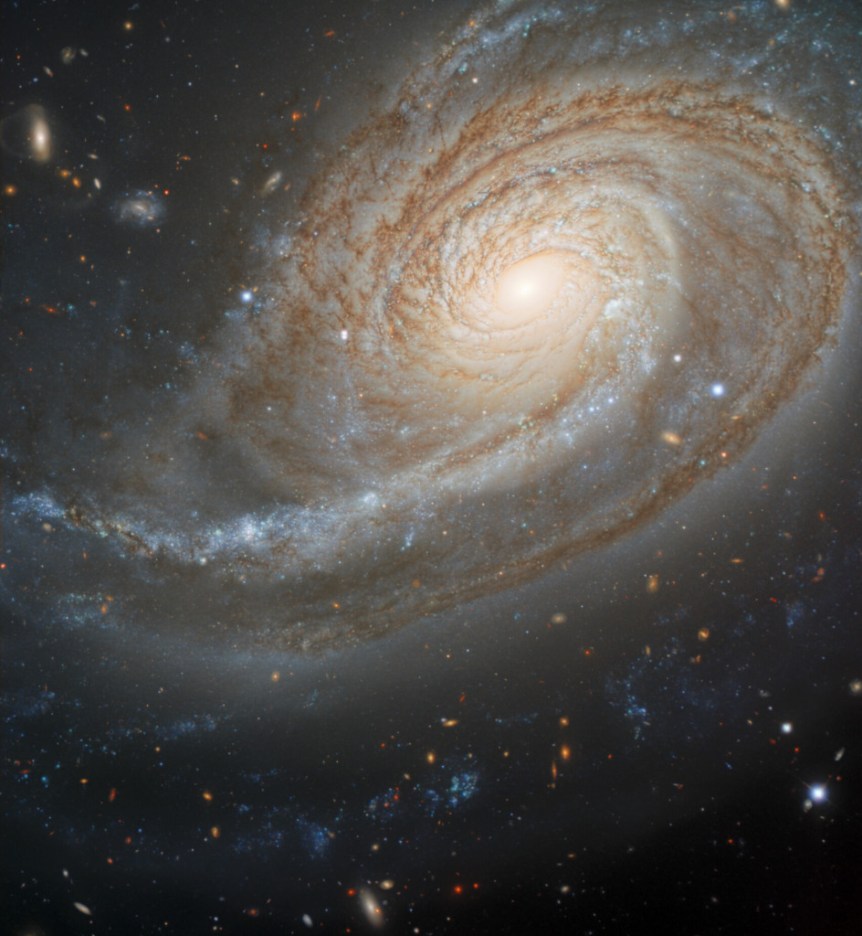
Explanation: Peculiar spiral galaxy Arp 78 is found within the boundaries of the head strong constellation Aries. Some 100 million light-years beyond the stars and nebulae of our Milky Way galaxy, the island universe is over 100,000 light-years across. Also known as NGC 772, it sports a prominent, outer spiral arm in this detailed cosmic portrait from the large Gemini North telescope near the summit of Maunakea, Hawaii, planet Earth. Tracking along sweeping dust lanes and lined with young blue star clusters, Arp 78’s spiral arm is likely pumped-up by galactic-scale gravitational tidal interactions The close companion galaxy responsible is NGC 770, located off the upper right of this frame. But more distant background galaxies are clearly visible in the cosmic field of view.
Most perfume ads suggest that the right scent can make you sexy, alluring and successful. A blend by Black Phoenix Alchemy Labs, meanwhile, offers to make you smell like Hecate, the three-faced Greek goddess of witchcraft.
As a classics scholar who studies both magic and the senses in the ancient world, this idea of a witch-inspired perfume fascinates me – and “Hecate” is just one of many magic-inspired fragrances available today.
What does a witch smell like, and why would you deliberately perfume yourself like one?
Smells are impossible to see or touch, yet they affect us emotionally and even physically. That’s similar to how many people think of magic, and cultures around the world have connected the two. My current research is focused on how magic and scent were linked in ancient Rome and Greece, ideas that continue to shape views of witches in the West today.
Greeks and Romans of all walks of life believed in magic and used spells ranging from curses to healing magic and garden charms. Magical handbooks from the time show that Greco-Egyptian magicians used fragrance extensively in their rituals, even scented inks, and doctors believed strong-smelling plant species to be more medically effective than others. The gods themselves were thought to smell sweet, and places they touched retained a pleasant odor, making scent a sign of contact with the divine.

You can use this link to go forward or backward in time for Moon phase information. If you are curious, you can even find out what phase the Moon was in when you or anyone else was born.
The Moon’s current phase for today and tonight is a Waning Gibbous Phase. This is the first phase after the Full Moon occurs. It lasts roughly 7 days with the Moon’s illumination growing smaller each day until the Moon becomes a Last Quarter Moon with an illumination of 50%. The average Moon rise for this phase is between 9pm and Midnight depending on the age of the phase. The moon rises later and later each night setting after sunrise in the morning. During this phase the Moon can also be seen in the early morning daylight hours on the western horizon.
Visit the March 2022 Moon Phases Calendar to see all the daily moon phase for this month.
The Waning Gibbous on March 24 has an illumination of 58%. This is the percentage of the Moon illuminated by the Sun. The illumination is constantly changing and can vary up to 10% a day. On March 24 the Moon is 21.36 days old. This refers to how many days it has been since the last New Moon. It takes 29.53 days for the Moon to orbit the Earth and go through the lunar cycle of all 8 Moon phases.
There are 8 lunar phases the Moon goes through in its 29.53 days lunar cycle. The 4 major Moon phases are Full Moon, New Moon, First Quarter and Last Quarter. Between these major phases, there are 4 minor ones: the Waxing Crescent, Waxing Gibbous, Waning Gibbous and Waning Crescent. For more info on the Moon Cycle and on each phase check out Wikipedia Lunar Phase page.
Check the weather before a night of Moon gazing at weather.com
For a list of all the current meteor showers visit American Meteor Society

If you need to calculate the planetary positions for a specific use and time, click on this link
To figure out GMT (Greenwich Mean Time) to your local time use this link
The time for these Custom Planetary Positions is from the local time in Sao Paulo, Brazil, South America
24 March 2022
08:00 pm GMT 5:00 PM BRT
Zodiac: Tropical (Standard Western)
True Lunar Node:23 Taurus 41
Mean Lunar Node:25 Taurus 09 Rx
Lilith (Black Moon):27 Gemini 39
Chiron:11 Aries 52
Ceres:10 Gemini 52
Pallas:14 Aries 39
Juno:20 Aquarius 03
Vesta:06 Aquarius 38
Eris:24 Aries 07

The time for these Custom Planetary Positions is from the local time in Cape Town, South Africa
24 March 2022
03:00 pm GMT 5:00 PM SAST
Zodiac: Tropical (Standard Western)
True Lunar Node:23 Taurus 41
Mean Lunar Node:25 Taurus 09 Rx
Lilith (Black Moon):27 Gemini 38
Chiron:11 Aries 51
Ceres:10 Gemini 48
Pallas:14 Aries 34
Juno:19 Aquarius 58
Vesta:06 Aquarius 32
Eris:24 Aries 07
The time for these Custom Planetary Positions is from the local time in Melbourne, Victoria, Australia
24 March 2022
06:00 am GMT 5:00 PM AEDT
Zodiac: Tropical (Standard Western)
True Lunar Node:23 Taurus 41
Mean Lunar Node:25 Taurus 11 Rx
Lilith (Black Moon):27 Gemini 35
Chiron:11 Aries 50
Ceres:10 Gemini 41
Pallas:14 Aries 25
Juno:19 Aquarius 50
Vesta:06 Aquarius 22
Eris:24 Aries 07
You can use this link to go forward or backward in time for Moon phase information. If you are curious, you can even find out what phase the Moon was in when you or anyone else was born.
The Moon’s current phase for today and tonight is a Waning Gibbous Phase. This is the first phase after the Full Moon occurs. It lasts roughly 7 days with the Moon’s illumination growing smaller each day until the Moon becomes a Last Quarter Moon with an illumination of 50%. The average Moon rise for this phase is between 9pm and Midnight depending on the age of the phase. The moon rises later and later each night setting after sunrise in the morning. During this phase the Moon can also be seen in the early morning daylight hours on the western horizon.
Visit the March 2022 Moon Phases Calendar to see all the daily moon phase for this month.
The Waning Gibbous on March 23 has an illumination of 69%. This is the percentage of the Moon illuminated by the Sun. The illumination is constantly changing and can vary up to 10% a day. On March 23 the Moon is 20.28 days old. This refers to how many days it has been since the last New Moon. It takes 29.53 days for the Moon to orbit the Earth and go through the lunar cycle of all 8 Moon phases.
There are 8 lunar phases the Moon goes through in its 29.53 days lunar cycle. The 4 major Moon phases are Full Moon, New Moon, First Quarter and Last Quarter. Between these major phases, there are 4 minor ones: the Waxing Crescent, Waxing Gibbous, Waning Gibbous and Waning Crescent. For more info on the Moon Cycle and on each phase check out Wikipedia Lunar Phase page.
Check the weather before a night of Moon gazing at weather.com
For a list of all the current meteor showers visit American Meteor Society

If you want to calculate the planetary positions for a specific use and time, click on this link
To figure out GMT (Greenwich Mean Time) for your local time use this link
The time for these Custom Planetary Positions is from the local time in Los Angeles, California, USA
March 23, 2022
11:00 pm GMT 5:00 PM PDT
Zodiac: Tropical (Standard Western)
True Lunar Node:23 Taurus 41
Mean Lunar Node:25 Taurus 11 Rx
Lilith (Black Moon):27 Gemini 33
Chiron:11 Aries 49
Ceres:10 Gemini 36
Pallas:14 Aries 18
Juno:19 Aquarius 43
Vesta:06 Aquarius 14
Eris:24 Aries 06

The time for these Custom Planetary Positions is from the local time in Chicago, Illinois, USA
March 23, 2022
09:00 pm GMT 5:00 PM CDT
Zodiac: Tropical (Standard Western)
True Lunar Node:23 Taurus 40
Mean Lunar Node:25 Taurus 12 Rx
Lilith (Black Moon):27 Gemini 33
Chiron:11 Aries 49
Ceres:10 Gemini 34
Pallas:14 Aries 16
Juno:19 Aquarius 41
Vesta:06 Aquarius 12
Eris:24 Aries 06
The time for these Custom Planetary Positions is from the local time in Frankfurt, Germany, Europe
23 March 2022
04:00 pm GMT 5:00 PM CEST
Zodiac: Tropical (Standard Western)
True Lunar Node:23 Taurus 40
Mean Lunar Node:25 Taurus 12 Rx
Lilith (Black Moon):27 Gemini 32
Chiron:11 Aries 48
Ceres:10 Gemini 30
Pallas:14 Aries 11
Juno:19 Aquarius 36
Vesta:06 Aquarius 06
Eris:24 Aries 06
You can use this link to go forward or backward in time for Moon phase information. If you are curious, you can even find out what phase the Moon was in when you or anyone else was born.
The Moon’s current phase for today and tonight is a Waning Gibbous Phase. This is the first phase after the Full Moon occurs. It lasts roughly 7 days with the Moon’s illumination growing smaller each day until the Moon becomes a Last Quarter Moon with an illumination of 50%. The average Moon rise for this phase is between 9pm and Midnight depending on the age of the phase. The moon rises later and later each night setting after sunrise in the morning. During this phase the Moon can also be seen in the early morning daylight hours on the western horizon.
Visit the March 2022 Moon Phases Calendar to see all the daily moon phase for this month.
The Waning Gibbous on March 22 has an illumination of 79%. This is the percentage of the Moon illuminated by the Sun. The illumination is constantly changing and can vary up to 10% a day. On March 22 the Moon is 19.2 days old. This refers to how many days it has been since the last New Moon. It takes 29.53 days for the Moon to orbit the Earth and go through the lunar cycle of all 8 Moon phases.
There are 8 lunar phases the Moon goes through in its 29.53 days lunar cycle. The 4 major Moon phases are Full Moon, New Moon, First Quarter and Last Quarter. Between these major phases, there are 4 minor ones: the Waxing Crescent, Waxing Gibbous, Waning Gibbous and Waning Crescent. For more info on the Moon Cycle and on each phase check out Wikipedia Lunar Phase page.
Check the weather before a night of Moon gazing at weather.com
For a list of all the current meteor showers visit American Meteor Society

If you want to calculate the planetary positions for a specific use and time, click on this link
To figure out GMT (Greenwich Mean Time) for your local time use this link
The time for these Custom Planetary Positions is from the local time in Los Angeles, California, USA
March 22, 2022
12:00 am GMT 5:00 PM PDT
Zodiac: Tropical (Standard Western)
True Lunar Node:23 Taurus 39 Rx
Mean Lunar Node:25 Taurus 18 Rx
Lilith (Black Moon):27 Gemini 20
Chiron:11 Aries 42
Ceres:09 Gemini 58
Pallas:13 Aries 31
Juno:18 Aquarius 58
Vesta:05 Aquarius 19
Eris:24 Aries 05
The time for these Custom Planetary Positions is from the local time in Chicago, Illinois, USA
March 22, 2022
10:00 pm GMT 5:00 PM CDT
Zodiac: Tropical (Standard Western)
True Lunar Node:23 Taurus 40
Mean Lunar Node:25 Taurus 15 Rx
Lilith (Black Moon):27 Gemini 27
Chiron:11 Aries 45
Ceres:10 Gemini 16
Pallas:13 Aries 53
Juno:19 Aquarius 19
Vesta:05 Aquarius 45
Eris:24 Aries 06
The time for these Custom Planetary Positions is from the local time in Frankfurt, Germany, Europe
22 March 2022
04:00 pm GMT 5:00 PM CEST
Zodiac: Tropical (Standard Western)
True Lunar Node:23 Taurus 39
Mean Lunar Node:25 Taurus 16 Rx
Lilith (Black Moon):27 Gemini 25
Chiron:11 Aries 45
Ceres:10 Gemini 11
Pallas:13 Aries 47
Juno:19 Aquarius 13
Vesta:05 Aquarius 38
Eris:24 Aries 06
Discover the cosmos! Each day a different image or photograph of our fascinating universe is featured, along with a brief explanation written by a professional astronomer.
2022 March 22

Explanation: What’s that in the sky? An aurora. A large coronal mass ejection occurred on our Sun earlier this month, throwing a cloud of fast-moving electrons, protons, and ions toward the Earth. Part of this cloud impacted our Earth’s magnetosphere and, bolstered by a sudden gap, resulted in spectacular auroras being seen at some high northern latitudes. Featured here is a particularly photogenic auroral corona captured above a forest in Sweden from a scenic perch overlooking the city of Östersund. To some, this shimmering green glow of recombining atmospheric oxygen might appear like a large whale, but feel free to share what it looks like to you. The unusually quiet Sun of the past few years has now passed. As our Sun now approaches a solar maximum in its 11-year solar magnetic cycle, dramatic auroras like this are sure to continue.
Open Science: Browse 2,700+ codes in the Astrophysics Source Code Library
Discover the cosmos! Each day a different image or photograph of our fascinating universe is featured, along with a brief explanation written by a professional astronomer.
2022 March 21
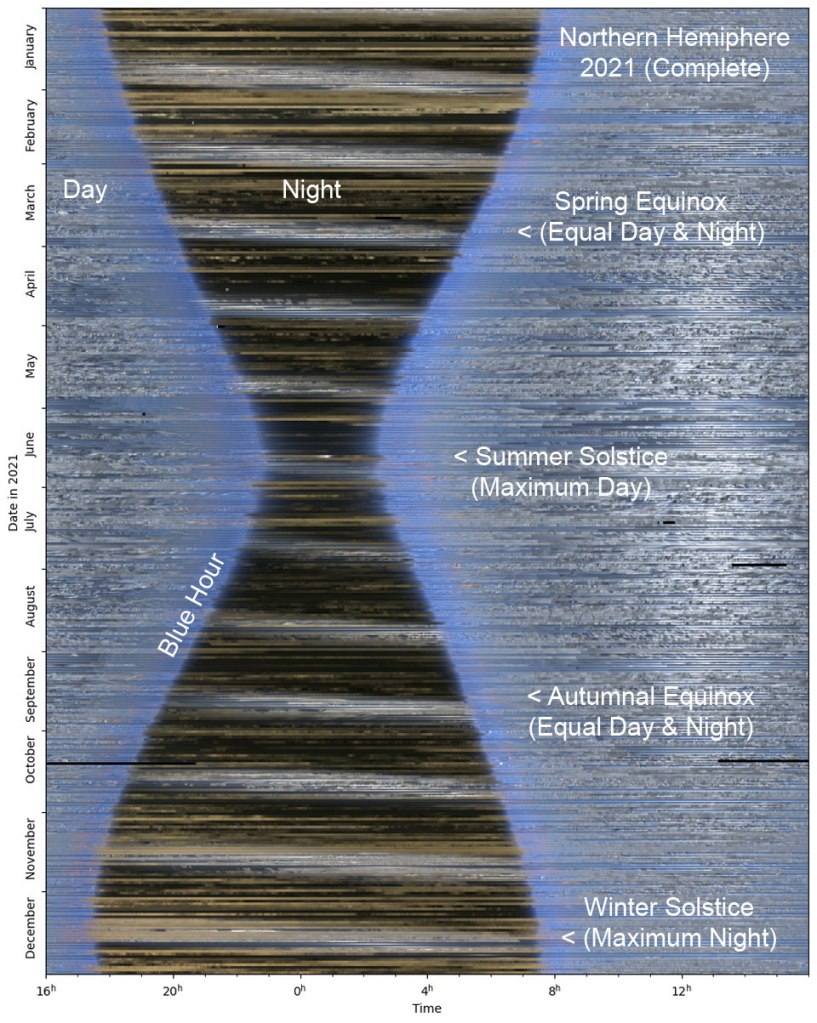
Explanation: What if you could see the entire sky — all at once — for an entire year? That, very nearly, is what is pictured here. Every 15 minutes during 2021, an all-sky camera took an image of the sky over the Netherlands. Central columns from these images were then aligned and combined to create the featured keogram, with January at the top, December at the bottom, and the middle of the night running vertically just left of center. What do we see? Most obviously, the daytime sky is mostly blue, while the nighttime sky is mostly black. The twelve light bands crossing the night sky are caused by the glow of the Moon. The thinnest part of the black hourglass shape occurs during the summer solstice when days are the longest, while the thickest part occurs at the winter solstice. Yesterday was an equinox — when night and day were equal — and the northern-spring equinox from one year ago can actually be located in the keogram — about three-quarters of the way up.
Follow APOD on Instagram in: English, Indonesian, Persian, Portuguese or Taiwanese

You can use this link to go forward or backward in time for Moon phase information. If you are curious, you can even find out what phase the Moon was in when you or anyone else was born.
The Moon’s current phase for today and tonight is a Waning Gibbous Phase. This is the first phase after the Full Moon occurs. It lasts roughly 7 days with the Moon’s illumination growing smaller each day until the Moon becomes a Last Quarter Moon with an illumination of 50%. The average Moon rise for this phase is between 9pm and Midnight depending on the age of the phase. The moon rises later and later each night setting after sunrise in the morning. During this phase the Moon can also be seen in the early morning daylight hours on the western horizon.
Visit the March 2022 Moon Phases Calendar to see all the daily moon phase for this month.
The Waning Gibbous on March 21 has an illumination of 88%. This is the percentage of the Moon illuminated by the Sun. The illumination is constantly changing and can vary up to 10% a day. On March 21 the Moon is 18.12 days old. This refers to how many days it has been since the last New Moon. It takes 29.53 days for the Moon to orbit the Earth and go through the lunar cycle of all 8 Moon phases.
There are 8 lunar phases the Moon goes through in its 29.53 days lunar cycle. The 4 major Moon phases are Full Moon, New Moon, First Quarter and Last Quarter. Between these major phases, there are 4 minor ones: the Waxing Crescent, Waxing Gibbous, Waning Gibbous and Waning Crescent. For more info on the Moon Cycle and on each phase check out Wikipedia Lunar Phase page.
Check the weather before a night of Moon gazing at weather.com
For a list of all the current meteor showers visit American Meteor Society

The Milky Way Galaxy
If you need to calculate the planetary positions for a specific use and time, click on this link
To figure out GMT (Greenwich Mean Time) to your local time use this link
The time for these Custom Planetary Positions is from the local time in Sao Paulo, Brazil, South America
21 March 2022
08:00 pm GMT 5:00 PM BRT
Zodiac: Tropical (Standard Western)
True Lunar Node:23 Taurus 40 Rx
Mean Lunar Node:25 Taurus 18 Rx
Lilith (Black Moon):27 Gemini 19
Chiron:11 Aries 42
Ceres:09 Gemini 55
Pallas:13 Aries 27
Juno:18 Aquarius 54
Vesta:05 Aquarius 15
Eris:24 Aries 05

The time for these Custom Planetary Positions is from the local time in Cape Town, South Africa
21 March 2022
03:00 pm GMT 5:00 PM SAST
Zodiac: Tropical (Standard Western)
True Lunar Node:23 Taurus 40 Rx
Mean Lunar Node:25 Taurus 19 Rx
Lilith (Black Moon):27 Gemini 18
Chiron:11 Aries 41
Ceres:09 Gemini 51
Pallas:13 Aries 22
Juno:18 Aquarius 49
Vesta:05 Aquarius 09
Eris:24 Aries 05
The time for these Custom Planetary Positions is from the local time in Melbourne, Victoria, Australia
21 March 2022
06:00 am GMT 5:00 PM AEDT
Zodiac: Tropical (Standard Western)
True Lunar Node:23 Taurus 40 Rx
Mean Lunar Node:25 Taurus 20 Rx
Lilith (Black Moon):27 Gemini 15
Chiron:11 Aries 40
Ceres:09 Gemini 44
Pallas:13 Aries 13
Juno:18 Aquarius 41
Vesta:04 Aquarius 58
Eris:24 Aries 05
Demeter and Persephone are strongly connected to the time of the Autumn Equinox. When Hades abducted Persephone, it set in motion a chain of events that eventually led to the earth falling into darkness each winter. This is the time of the Dark Mother, the Crone aspect of the triple goddess. The goddess is bearing this time not a basket of flowers, but a sickle and scythe. She is prepared to reap what has been sown.
The earth dies a little each day, and we must embrace this slow descent into dark before we can truly appreciate the light that will return in a few months.
This ritual welcomes the archetype of the Dark Mother and celebrates that aspect of the Goddess which we may not always find comforting or appealing, but which we must always be willing to acknowledge. Decorate your altar with symbols of Demeter and her daughter — flowers in red and yellow for Demeter, purple or black for Persephone, stalks of wheat, Indian corn, sickles, baskets. Have a candle on hand to represent each of them — harvest colors for Demeter, black for Persephone. You’ll also need a chalice of wine, or grape juice if you prefer, and a pomegranate.
If you normally cast a circle, or call the quarters, do so now. Turn to the altar, and light the Persephone candle. Say:
The land is beginning to die, and the soil grows cold.
The fertile womb of the earth has gone barren.
As Persephone descended into the Underworld,
So the earth continues its descent into night.
As Demeter mourns the loss of her daughter,
So we mourn the days drawing shorter.
The winter will soon be here.
Light the Demeter candle, and say:
In her anger and sorrow, Demeter roamed the earth,
And the crops died, and life withered and the soil went dormant.
In grief, she traveled looking for her lost child,
Leaving darkness behind in her wake.
We feel the mother’s pain, and our hearts break for her,
As she searches for the child she gave birth to.
We welcome the darkness, in her honor.
Break open the pomegranate (it’s a good idea to have a bowl to catch the drippings), and take out six seeds. Place them on the altar. Say:
Six months of light, and six months of dark.
The earth goes to sleep, and later wakes again.
O dark mother, we honor you this night,
And dance in your shadows.
We embrace that which is the darkness,
And celebrate the life of the Crone. Blessings to the dark goddess on this night, and every other.
As the wine is replaced upon the altar, hold your arms out in the Goddess position, and take a moment to reflect on the darker aspects of the human experience. Think of all the goddesses who evoke the night, and call out:
Demeter, Inanna, Kali, Tiamet, Hecate, Nemesis, Morrighan.
Bringers of destruction and darkness,
I embrace you tonight.
Without rage, we cannot feel love,
Without pain, we cannot feel happiness,
Without the night, there is no day,
Without death, there is no life.
Great goddesses of the night, I thank you.
Take a few moments to meditate on the darker aspects of your own soul. Is there a pain you’ve been longing to get rid of? Is there anger and frustration that you’ve been unable to move past? Is there someone who’s hurt you, but you haven’t told them how you feel? Now is the time to take this energy and turn it to your own purposes. Take any pain inside you, and reverse it so that it becomes a positive experience. If you’re not suffering from anything hurtful, count your blessings, and reflect on a time in your life when you weren’t so fortunate.
When you are ready, end the ritual.
By Patti Wigington,Paganism/Wicca Expert
Article found on & owned by ThoughtCo





You must be logged in to post a comment.