Ancient temple and theater 3,500 years older than Machu Picchu discovered in Peru

Archaeologists in Peru have unearthed the remains of what they believe are a 4,000-year-old temple and theater, shining a new light on the origins of complex religions in the region.

The team began studying the new archaeological site of La Otra Banda, Cerro Las Animas, in June. Last year, the local government alerted them to looting that had been taking place near the northern Peruvian town of Zaña, according to a press release from the Field Museum in Chicago, Illinois, Wednesday.

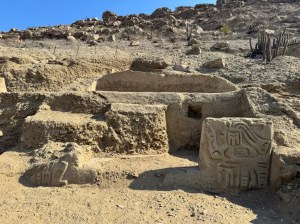
They excavated a plot roughly 33 feet long and 33 feet wide, finding signs of ancient walls made of mud and clay at just six feet deep.

“It was so surprising that these very ancient structures were so close to the modern surface,” Luis Muro Ynoñán, a research scientist at the Field Museum who led the team, said in the release.

After digging deeper, archaeologists found “one section” of a large temple, Muro Ynoñán said, adding that “one of the most exciting” finds was a small theater “with a backstage area and a staircase that led to a stage-like platform.”

“This could have been used to perform ritual performances in front of a selected audience,” he added

One of the theater’s staircases was flanked by mud panels with an elaborate carved design of a mythological bird-like creature, according to the release. The figure resembled other images of mythological creatures dating to the Initial Period, around 2,000 to 900 BC, giving clues to when the temple was built.

“The Initial Period is important because it’s when we first start to see evidence of an institutionalized religion in Peru,” Muro Ynoñan said, adding that Please click here to read the rest of this article

Obon Festival 2024 in Japan: Meaning, Traditions and Dates

The Obon festival (お盆, also known as Bon festival) is an annual Japanese holiday that commemorates and remembers deceased ancestors. It is believed that their spirits return at this time to visit their relatives.

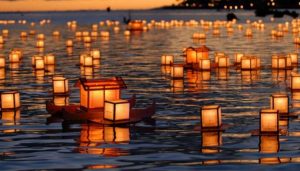
Chochin (paper) lanterns are hung to guide the spirits and Obon dances (bon odori) are performed. Families have reunions and visit the graves of their relatives and make food offerings at altars and temples.

It is observed from the 13th to the 15th day of the 7th month. However, according to the solar calendar the 7th month is July but according to the lunar calendar, the 7th month is August. Obon is therefore celebrated at different times in different regions depending on which calendar is observed.

The official dates are August 13-15 though it will be celebrated between July 13-15 in some places. The Obon week in mid-August is one of Japan’s three major holiday seasons making it one of the busiest times of the year for traveling. Many Japanese people will leave their cities around August 10 and come back on August 17-18.

Obon traditions and celebrations

On the first day of Obon, people take the chochin lanterns to the graves of their families. They call their ancestors’ spirits back home in a ritual called mukae-bon. In some regions, huge fires are lit at the entrances of houses to guide the spirits to enter.

At the end of the Obon festival, families help their ancestors’ spirits return back to the grave by guiding them with their chochin lanterns. The ritual is called okuri-bon. Again, the ritual varies slightly between different regions of Japan.

Floating lanterns (toro nagashi) Please click here to read the rest of this article

Common Practice and Beliefs within Druidry

Introduction

Those who practise Druidry do so through a deep spiritual connection perceived and experienced within the land and its culture. Many, when they first find Druidry, describe the feeling as ‘coming home’; they have rediscovered a connection with the land, its people, history, heritage and culture. This is more than mere interest; imbued with wonder, gratitude, respect and a sense of the perpetual flow of time, it inspires a devotional commitment, an acknowledgement of the sacred and a recognition of deity (male, female and non-gendered gods) within these currents of nature. This is the foundation of Druid practice.

The issue as to whether modern Druidry has any clear link back to pre-Roman Britain is debated. Historically Druidry was essentially an oral tradition and no texts are available written by our pre-Roman ancestors. However, the religious and spiritual traditions survived in folklore, through poetry and mythologies, within the development of British/western philosophy and the bardic colleges. A good deal was incorporated into Christianity when it came to these lands, particularly surviving in rural churches where Paganism continued side by side with the new religion. In the eighteenth century a resurgence of Druidry led to academic scrutiny of Classical and Mediaeval texts and a good deal of today’s common Druidic practice is based on interpretation of that material. This scrutiny continues today and Druids use this as a link to their ancestral past. As a religion today, Druidry is ever evolving. So common practice is gained through Druids coming together and sharing their experiences, rituals and celebrations.

Diversity

Many come to Druidry because of its diversity. Freedom of expression and personal connection to deity is, for them, of paramount importance. Connection to the divine is gained through experience, neither through belief nor through reciting prayers that are essentially another’s understanding or vision. As a polytheistic religion, individuals devote themselves to and revere deities who express different aspects of nature and ancestry. For example, Cerridwen is a goddess of the dark, the waning moon, the cauldron of potential; Brighid is a goddess of fire, light and assertive action. The rituals and practice of Druids honouring one or other of these as their principal deity would differ accordingly.

Druids take their inspiration from Nature. Within the British Isles we have a huge diversity of landscape and this is reflected in the practice of individuals and local groups or Groves. If a Druid is inspired by their local north sea coast, his gods and religious focus would be different from a Druid inspired by the rolling hills and woodlands of the Cotswolds, or the open moors of Devon. Similarly a Druid grove celebrating the festival of midwinter in an urban garden in Kent will look and feel very different from a grove celebrating in the Highlands of Scotland, were most of its members are dependent on rural or agricultural livelihoods: winter means something very different to both groves. All these individuals and groves are equally honouring (and seeking relationship with) Nature.

Druids are inspired too by their ancestors. To a Druid, ancestry is not a vague concept, but a gathering of individuals, each with their strengths and weaknesses, their own stories of success and failure. Druidry’s diversity is further expressed through the fact that each person has a different line of ancestors, and a different relationship with those people: this may manifest through a religious practice that focuses on a certain temple or landscape, myth or poet, skill or occupation. Again, such practice may appear significantly distinct, say, if we were to observe a farmer, a blacksmith, a writer or healer. As Druids, all are honouring their ancestors, nonetheless, by using the skills inherited and so expressing the spiritual devotion, gratitude and reverence required of the Druid.

The reverence for nature that is integral to Druidry also provides a morality or ethical base that is common to all Druids. Like any moral code, whether religious or secular, it is interpreted with slight differences. However, honour, respect, truth and justice are of primary importance and constitute the basis of all Druid practice. This doesn’t dilute Druidry, but brings to it a richness that is welcomed and celebrated. Thus, paradoxically, diversity is both a strength and a cohesive element of Druid practice.

There are further elements of Druid practice and ritual that are common to all within the tradition and these we shall explore.

Major Festivals

Most adherents of modern Druidry celebrate eight major festivals and these can be further subdivided into the Solar Festivals and Celtic Fire Festivals, which may also be known as agricultural, pastoral, seasonal or cross quarter festivals. Some Groves and individuals only work with the Solar and some only with the Fire Festivals. Placed around the course of the year, they occur every 5-7 weeks, and generally Druids will at this time make ritual, giving offerings.

The purpose of the festivals is to ensure two things: Click here to read the rest of this article 

8 Protection Rules Every Witch Should Know

Click here for more information on 8 Protection Rules Every Witch Should Know

New Moon in Gemini 2024 – and Tarot Readings for Each Zodiac Sign

Source: thetarotlady.com

New Moons occur when the Sun and Moon align in the same sign. They signal the beginning of a new lunar cycle and the opportunity to start new things. This year’s New Moon in Gemini is auspicious because a bevy of planets are forming a Gemini conga line in the cosmos. Mercury, Venus, and Jupiter are moving through the sign of the Twins, adding extra oomph to all things associated with Gemini, especially communication, learning, and information. The day could be filled with interesting news or opportunities to expand your mind. Of course, you’ll need to be discerning because disinformation could be in the mix. Gemini energy is tricky like that. Not everything you hear will be accurate, so listen carefully.

Before the New Moon, the Sun and Venus align on the 4th, a potent aspect associated with self-expression, optimism, and attraction. This lays out the red carpet for effective manifestation work. What do you want to bring into your life? Sketch out your dreams and be ready to send those intentions to the Universe when the New Moon arrives on June 6th at 8:38 AM EDT.

The New Moon in Gemini 2024 is supported by a sweet conjunction with Venus at 9:36 AM EDT, which is like a cosmic blessing. Venus is a benefic, so this amplifies luck. In other words: you better wish!

This is also an excellent day for lively conversations, writing, thinking, debating, flirting, and starting new intellectual pursuits. Sign up for that class, begin working on that novel, say heyyyy to that hottie, and catch up on all the latest dirt. Who can be bored when this clever mutable energy is so abundant?

One caveat: the Moon squares off with Saturn at 1:19 PM EDT. This could rain on that Gemini parade, but it won’t last long. If you sense a sour vibe setting in, take a break until it blows over. It’s also possible this might be when disinformation is running wild. Once again, be careful what you take in. If it doesn’t ring true, it’s probably bullshit.

Other than that bit of nonsense, this day is LIT. Let’s do this!

Aries: Four of Swords – Rest up. You have big things coming due and need to conserve your energy.

Taurus: Five of Swords – The ugly truth is revealed. Now you can see other people’s true colors.

Gemini: Two of Wands – You are in a great position. Everything is possible. Think big!

Cancer: Star – A great healing is taking place. Peace, harmony, and health are on the way.

Leo: Three of Cups – Your social life gets busy. Fun, celebration, and good times! Yay!

Virgo: Six of Swords – You are moving on, away from situations that no longer serve you. Look ahead.

Libra: Ten of Swords – Something has come to an end. Rise up! New possibilities are ready to bloom!

Scorpio: Page of Swords – Important professional news is on the way. This could be a mentally stimulating period.

Sagittarius: Nine of Pentacles – Everything prospers you now. Be grateful for your good fortune.

Capricorn: Queen of Cups – Love flows all around you. Open your heart and let it transform you!

Aquarius: The Emperor – You are in the power position. Call the shots and protect the realm.

Pisces: Seven of Swords – It may be necessary to fly under the radar. Don’t reveal your hand.

Blessings,

Theresa

Some Tips on Empowering Charms and Keeping Them Cleansed

First do not use the word talisman or amulet in place of charm. The reason being is they are three different types of objects. Also we are not talking about charms you would find on a charm bracelet. A talisman is the equivalent of a good luck piece or can be spelled for protection and it carried with you all the time. An amulet is usually a necklace with a pendant hang from it the has been spelled and charged for protection, a closed connection to a Goddess or God, a symbol of a person’s spiritual practice. An amulet can be spelled for a purpose such as protection or to keep others’ emotions from getting to you in a limited way and still be a symbol of a person’s spiritual practice. Anything from a leaf to a seven-foot candle including anything you might want to use as a charm in your home, at work, or in your vehicle. Today we will be concentrating on spelling a charm.

Always form a sacred circle to do your spell work in. Remember to either ground or let the positive energy free when you open your sacred circle. You need to cleanse the object of all energy except what it is made of, so when you spell the object there is no one else’s energy involved in it but your own. Call in whatever Goddess(es) and/or God(s) will help you achieve the outcome for your spell.

Make sure your spell wording is very specific for what you want the spell to do before you empower an object. Otherwise, anyone who has touched the object before their energy will remind on or in the object and will weaken your spell work.

So now you have your sacred circle done and the object cleansed awaiting your energy and spell work to empower to make it into a charm. You should repeat your spell a minimum of three times. I repeat the spell nine times for maximum power. I usually than sit in the circle holding the object I just charmed until I feel it is time to put it wherever I am going to use the charmed object. I picture sitting wherever I am placing it and doing whatever I have empowered/spelled it to do. Once you feel you have put as much energy into as you want to for that day let the Goddess(es) and/or God(s) depart with you thanking them for their help.

(I have a glass container in every room in my home they all contain some stones, a feather, wooden matchstick, and a seashell of some sort. I have them charmed to not only help protect our home but to continuedly trickle out loving positive energy. These are simple to make and when we have visitors they really don’t ask about the container and to them strange contents. Pick glass containers that fit in with your homes decor and then they appear as a nick knack. More on these in Tomorrow Spell For Today)

Now it is time to open your sacred circle you can either ground on excess enrgy you raised to Mother Earth for however she wants to use it or just let it go into the Universe to be used however it wants to use it.

These suggestions for charms come from shiroshine:

Whenever I charge a charm of any sort, I mark my calendar to remind me to check-in on it in a week, 2 weeks, 3 weeks, and then, if it has been “good to go” that whole time, I recharge it after a month’s work 🙂 Of course, if it starts Feeling weakened before that, I will recharge it at that time

Suggestion to keep the charm clean with an elemental cleansing which you should do before every time you want to recharge it or you feel the object needs to be cleansed:

Place the object under running water and say three times: Water, please take all energy but mine, the spell on this ____ and what the object is made of.

Either take the object out into the sun or place it in a place where sunlight shines on it and say three times: Fire, take all energy but mine, the spell on this ____ and what the object is made of.

While outside or by an open window or in front of a fan or use a hand fan and say three times: Air take all energy but mine, the spell on this ____ and what the object is made of.

If you are outside place the object on the ground or if inside have some dirt or salt to sprinkle on the object and say three times: Earth, take all energy but mine, the spell on this ____ and what the object is made of.

If you are outside hold the object up in the air if possible and say three times: Spirit, I ask you to recharge the spell on this ____ and what the object is made of.

Copyright by Lady Carla Beltane 1995 All rights reserved. This post cannot be reblogged or copy and pasted or in any other way be reproduced for commercial purpose without express written permission from Lady Carla Beltane.

Common Practice and Beliefs within Druidry

Introduction

Those who practise Druidry do so through a deep spiritual connection perceived and experienced within the land and its culture. Many, when they first find Druidry, describe the feeling as ‘coming home’; they have rediscovered a connection with the land, its people, history, heritage and culture. This is more than mere interest; imbued with wonder, gratitude, respect and a sense of the perpetual flow of time, it inspires a devotional commitment, an acknowledgement of the sacred and a recognition of deity (male, female and non-gendered gods) within these currents of nature. This is the foundation of Druid practice.

The issue as to whether modern Druidry has any clear link back to pre-Roman Britain is debated. Historically Druidry was essentially an oral tradition and no texts are available written by our pre-Roman ancestors. However, the religious and spiritual traditions survived in folklore, through poetry and mythologies, within the development of British/western philosophy and the bardic colleges. A good deal was incorporated into Christianity when it came to these lands, particularly surviving in rural churches where Paganism continued side by side with the new religion. In the eighteenth century a resurgence of Druidry led to academic scrutiny of Classical and Mediaeval texts and a good deal of today’s common Druidic practice is based on interpretation of that material. This scrutiny continues today and Druids use this as a link to their ancestral past. As a religion today, Druidry is ever evolving. So common practice is gained through Druids coming together and sharing their experiences, rituals and celebrations.

Diversity

Many come to Druidry because of its diversity. Freedom of expression and personal connection to deity is, for them, of paramount importance. Connection to the divine is gained through experience, neither through belief nor through reciting prayers that are essentially another’s understanding or vision. As a polytheistic religion, individuals devote themselves to and revere deities who express different aspects of nature and ancestry. For example, Cerridwen is a goddess of the dark, the waning moon, the cauldron of potential; Brighid is a goddess of fire, light and assertive action. The rituals and practice of Druids honouring one or other of these as their principal deity would differ accordingly.

Druids take their inspiration from Nature. Within the British Isles we have a huge diversity of landscape and this is reflected in the practice of individuals and local groups or Groves. If a Druid is inspired by their local north sea coast, his gods and religious focus would be different from a Druid inspired by the rolling hills and woodlands of the Cotswolds, or the open moors of Devon. Similarly a Druid grove celebrating the festival of midwinter in an urban garden in Kent will look and feel very different from a grove celebrating in the Highlands of Scotland, were most of its members are dependent on rural or agricultural livelihoods: winter means something very different to both groves. All these individuals and groves are equally honouring (and seeking relationship with) Nature.

Druids are inspired too by their ancestors. To a Druid, ancestry is not a vague concept, but a gathering of individuals, each with their strengths and weaknesses, their own stories of success and failure. Druidry’s diversity is further expressed through the fact that each person has a different line of ancestors, and a different relationship with those people: this may manifest through a religious practice that focuses on a certain temple or landscape, myth or poet, skill or occupation. Again, such practice may appear significantly distinct, say, if we were to observe a farmer, a blacksmith, a writer or healer. As Druids, all are honouring their ancestors, nonetheless, by using the skills inherited and so expressing the spiritual devotion, gratitude and reverence required of the Druid.

The reverence for nature that is integral to Druidry also provides a morality or ethical base that is common to all Druids. Like any moral code, whether religious or secular, it is interpreted with slight differences. However, honour, respect, truth and justice are of primary importance and constitute the basis of all Druid practice. This doesn’t dilute Druidry, but brings to it a richness that is welcomed and celebrated. Thus, paradoxically, diversity is both a strength and a cohesive element of Druid practice.

There are further elements of Druid practice and ritual that are common to all within the tradition and these we shall explore.

Major Festivals

Most adherents of modern Druidry celebrate eight major festivals and these can be further subdivided into the Solar Festivals and Celtic Fire Festivals, which may also be known as agricultural, pastoral, seasonal or cross quarter festivals. Some Groves and individuals only work with the Solar and some only with the Fire Festivals. Placed around the course of the year, they occur every 5-7 weeks, and generally Druids will at this time make ritual, giving offerings.

The purpose of the festivals is to ensure two things:

  • The Druid is always spiritually awake to the cycles of nature, the seasons, the tides of growth and decay, together with the gifts the gods offer at these times.
  • The Druid attunes his own soul to the cycle of nature around him, working with the seasons internally, spiritually, instead of pushing against them and risking stress, depression, exhaustion, complacency and so on.

Being in harmony with nature’s cycles ensures spiritual health, appreciation, inspired creativity and vibrant community, through reverential relationship with the gods, ancestors and spirits of place.

Druids will also make ritual at various phases of the moon, though which phase is most important to any individual Druid will depend on their own nature. Some Druids will regularly meet with their grove at the dark or new moon, others preferring the full moon, and some acknowledge the quarter moons. This practice encourages and facilitates the Druid’s attunement with the lunar cycle, increasing awareness as to its impact on his own nature and the natural world around him, increasing health, well being and relationships.

Rites of Passage Click here to read the rest of this article

Witch Trials in the 21st Century

The most famous witch trial in history happened in Salem, Massachusetts, during the winter and spring of 1692-1693. When it was all over, 141 suspects, both men and women, were tried as witches. Nineteen were executed by hanging. One was pressed to death by heavy stones.

However, witch trials are not a thing of the past. Indeed, charges of witchcraft and trials of suspected witches are increasing.

Witchcraft

The word witchcraft has good and bad meanings in different cultures around the world. A general definition of witchcraft is the changing of everyday events using supernatural or magical forces.

Witchcraft is usually associated with the power of nature, such as medicinal and poisonous plants, or rains and floods. People accused of witchcraft are said to be able to control natural events such as storms or droughts.

So-called “witch doctors” use combinations of plants and animals, as well as spirituality or supernatural ability, to treat medical conditions. These “witch doctors” are not accused of being witches themselves—they heal illnesses and ailments blamed on witchcraft. “Witch doctor” is often a derogatory term for a traditional healer. Traditional healers, who rely on ancient remedies, are not witch doctors.

Unlike traditional healers, witch doctors use spells. Spells are words or phrases that are suspected of having magical powers. Casting a spell to be wealthy or lucky in love is an example of witchcraft.

Why do some people believe in witchcraft? Using the example of the love spell, some people may believe that Click here to read the rest of this article

Some Information About Spell/Charm Bags

The Proper Timing for Magick c. 2017

Author: Taliesin McKnight

Timing is one of the most important things to consider when doing magick. Astrology can be likened to a great cosmic clock. It reflects the cycles and rhythms of nature. The proper alignment of the stars, the sun, the moon, and the planets should all be taken into consideration. Does this sound complex? I assure you it is not as complicated as it may sound. In fact, this may reduced to two things: the days of the week and the cycles of the moon.

The seven planets rule the seven days of the week. The names even derive from the planets in many different languages. In English these come from the names of the Norse planetary deities. Sunday is the day of the Sun; Monday is the day of the moon; Tuesday is the day of Tue (Mars) ; Wednesday is the day of Wodan (Mercury) ; Thursday is the day of Thor (Jupiter) ; Friday is the day of Freya (Venus) ; and Saturday is the day of Saturn. Therefore, for maximum astrological benefit, a love spell should be done on Friday, the day of Venus (planet ruling love) . In the same way, magick involving education may be done on Wednesday, which is ruled by Mercury. The planetary correspondences are as follows:

The Sun rules Sunday and is good for Success, luck, spirituality, knowledge, and healing. The moon rules on Mondays. This is a good time to do spells for intuition, dreams, astral travel, and communication with spirits. Mars rules on Tuesdays. It is a good time for effective magick involving battle, conflicts, protection, strength, overcoming adversity, and binding.

Mercury is the planet presiding over Wednesdays. This is a time for rituals for education, knowledge, divination, communication, and healing. Thursday is the day of Jupiter, and governs success, prosperity, luck, and leadership. Venus dominated on Fridays and can bring love, romance, heal relationships, and grant new friends. Saturday is governed by the baleful influence of Saturn. This planet grants protection, destruction, binding, curses, purification, and overcoming weakness.

In addition to the seven days of the week, the seven planets also rule the hours in the day. There are several different methods to calculating the planetary hours. One of these involves following the hours from sunrise to sunrise; another divides the hours between sunrise and sunset and divides them into 12 sections and the same is done for the period between sunsets. To avoid all the math and difficulty, a very simple and effective system omits this and simply uses the 24 hours from midnight to midnight. This has worked wonderfully for me and I see no reason to list the other methods. If you would like to examine other methods for calculating planetary hours, that information is readily available online or in other books on magick. For simplicity, just know that the planet for the day also rules the hour at 6 am, 1 pm, and 8 pm.

Now, to illustrate this, let us take an example. If you wanted to do a love spell, it would be a good idea to do this on Friday (the day of Venus) at 8 pm (the hour of Venus) . This acts as a magickal doorway in which the proper astrological conditions are right. In this way the magus moves with the cycles and the rhythms of nature. If one were to bind (or restrict) someone from causing harm to others, Saturday at 6 am would be a good time. The days and hours should be at least partially memorized. The easiest way to do this is to simply memorize which planets rule each day and to simply remember that the planet for that day also rules at 6 am, 1 pm, and 8 pm. In this way, it will not be necessary to look this up every time one wishes to do a spell!

The phases of the moon also have an important impact on the effectiveness of magick. The waxing (growing) phase and the full moon are good from creative magick and bringing things into your life; the waning (decreasing) phase and the new moon are used for destructive spells and getting rid of things in your life. This is the most stressed point in ritual timing in the Wiccan tradition.

The concept of moving with the phases of the moon is very ancient and is found in many different cultures. This can be seen as a more important element in timing than anything else. It is much better to go with the phases of the moon on the wrong day than to do it on the right day of the week and the wrong lunar phase. This aspect of magickal timing should not be over-looked. The full and new moons are peaks of the creative and destructive cycles. The mid-way points (the half moons during increase and decrease) are also times of great magickal power.

The last aspect of ritual timing is the moon sign. The moon passes through the 12 signs of the zodiac, remaining in each sign only for a few days. This is not as important a consideration as the other 2 timing concerns. Nonetheless, this can lend power to rituals and spells. When the moon is in an Earth sign (Taurus, Virgo, and Capricorn) are good for financial concerns; when the sign is in an Air sign (Gemini, Libra, and Aquarius) are ideal for education and spells consistent with the characteristics of the element of Air. When the sign is in a Water sign (Cancer, Scorpio, and Pisces) it is a great time for spells that are connected to the Element of water and to emotions, artistry, and relationships; While the moon is in a Fire sign (Aries, Leo, and Sagittarius) it is a good time to do rituals of a fiery nature.

The individual characteristics of the sign (rather than just the element) should also be considered. This is not a very important aspect to magickal timing, so don’t stress too much over it. As I said before, though, utilizing this can only help and never hinder!

There are other lesser aspects to astrological timing. These would include the weather and the current Sun sign. The reason Sun signs are rarely considered is not so much that it is a weak influence, but rather that it is not practical to wait months just to do a spell, when it will probably no longer even be needed or be too late. This could also be a great aid if followed.

Weather is an issue as well. Storms are usually great for magick because it is a time of great elemental power. Furthermore, if one is doing a ritual involving the Sun, this should be done during the day and when it is sunny. One would assume this would go without saying. On the contrary, however, many people fail to recognize this simple concept. After all, it is only common sense. Thus, weather and the Sun sign can lend a lot of extra power to spells, if you would only harness that power with the use of correct ritual timing.

Now that this has all been laid down and explained, let us take another example to make sure these concepts are well understood. Let us say that someone is looking for a new job and decides to do some magick to help the job search. The moon should be waxing (this is for bringing things into your life) and the spell may be done on a Thursday (the day of Jupiter) at 1 pm (the hour of Jupiter) on a cloudy day because Jupiter is a sky god. The moon should also be in the sign of Capricorn. This would be an extremely good time for such a spell. The conditions are perfect.

Does timing have to be followed? Of course not! In the preceding example, the job is probably needed immediately. It would be foolish to wait for the right conditions during such an emergency. Do spells whenever they are needed. However, WHEN IT IS CONVENIENT, the astrological conditions should be considered. If a spell can wait for the perfect conditions, then great. If they spell can wait a few days for the right day ruled by the proper planet, that is good too. But if the spell can’t wait that long, then do it now. The spell can be repeated when the stars, sun, and moon are aligned right if needed. The spell will still work. The point is lending extra power to your spells. That’s it.

Following the cycles and rhythms of nature is also another way of aligning oneself with the universe. In the ancient Mystery Traditions, from which magick derives, Man was seen as a reflection of the cosmos. One is moving in accordance with the universe. We are moving with the tides of nature. Can magick be done against these cycles and still be effective? Sure. But it is like swimming against a current. Why not “ride with the tide”? It may even carry you a ways if you would only let go and let the currents of the Great Mother take you. Thus, in magick we try to follow the ways of Nature. Magick is merely using Her ways.

Remember, that which separates the initiate from the vulgar is simply that the occultist is aware of the laws of the universe and uses them to his or her advantage while others do not use this power that lies in their hands.

A Talisman or an Amulet… What’s the Difference? (Explained)

Since ancient times, a man has placed faith in the magical power of talismans and amulets, various objects capable of defending their owner from spells and negative influences of all kinds. Not many know that the two terms are not synonymous but are actually very different.

KEY TAKEAWAYS

Talismans and amulets are both objects with distinct purposes.

Talismans are intentionally created objects, often jewelry, designed to attract positive energies or outcomes, such as luck or love. They are charged with specific intentions.

Amulets, on the other hand, are objects, like pendants or charms, primarily used for protection against negative energies or harm.

They are not typically charged with intentions but are chosen for their inherent protective qualities or symbolism.

Contents

What is the difference between a talisman and an amulet?

What is a talisman?

What is an amulet?

Source: Magickal Spot by Tina Caro

History of Witches

Table of Contents

The Origin of Witches

‘Malleus Maleficarum’

Salem Witch Trials

Are Witches Real?

Book of Shadows

Sources

Witches were perceived as evil beings by early Christians in Europe, inspiring the iconic Halloween figure.

Images of witches have appeared in various forms throughout history—from evil, wart-nosed women huddling over a cauldron of boiling liquid to hag-faced, cackling beings riding through the sky on brooms wearing pointy hats. In pop culture, the witch has been portrayed as a benevolent, nose-twitching suburban housewife; an awkward teenager learning to control her powers and a trio of charmed sisters battling the forces of evil. The real history of witches, however, is dark and, often for the witches, deadly.

The Origin of Witches

Early witches were people who practiced witchcraft, using magic spells and calling upon spirits for help or to bring about change. Most witches were thought to be pagans doing the Devil’s work. Many, however, were simply natural healers or so-called “wise women” whose choice of profession was misunderstood.

It’s unclear exactly when witches came on the historical scene, but one of the earliest records of a witch is in the Bible in the book of 1 Samuel, thought be written between 931 B.C. and 721 B.C. It tells the story of when King Saul sought the Witch of Endor to summon the dead prophet Samuel’s spirit to help him defeat the Philistine army.

The witch roused Samuel, who then prophesied the death of Saul and

Click here to read the rest of this article

Some Information About Glamour Spells For Enhanced Beauty Using Witchcraft

With so many types of spells out there, it’s tough to figure out where to start. Glamour spells have been used by witches for centuries, but they aren’t the most well-known types of spells by any means.

Because glamour spells are generally underground, there aren’t many spells on Google or Pinterest that are readily available. I’m hoping that this post will provide you with some simple glamour spell ideas that work.

What Are Glamour Spells?

In magic, a glamour is a veil that hides what’s underneath. A glamour spell brings out one’s natural beauty while hiding those less-than-desirable aspects.

When you’re casting a glamour spell, you can either personally choose the aspects that you want to enhance or you can simply visualize beauty and let the spell choose.

A glamour spell typically doesn’t last that long. I find that most glamour spells I cast will last for a full day or so. I tend to cast glamour spells when I really need them which is mainly for special events.

I personally use glamour spells to appear more like who I truly feel I am inside. I don’t use them to run from myself, but I do have specific aspects of myself that I like more than others, and enhancing those aspects gives me confidence.

When Should You Cast Glamour Spells?

I recommend casting a glamour spell anytime you want to enhance your natural beauty. This might be when you feel a bit down, click here to read the rest of this article

Witchcraft – Definition, History, Varieties, & Facts

Witchcraft, traditionally, the exercise or invocation of alleged supernatural powers to control people or events, practices typically involving sorcery or magic. Although defined differently in disparate historical and cultural contexts, witchcraft has often been seen, especially in the West, as the work of crones who meet secretly at night, indulge in cannibalism and orgiastic rites with the Devil, or Satan, and perform black magic. Witchcraft thus defined exists more in the imagination of contemporaries than in any objective reality. Yet this stereotype has a long history and has constituted for many cultures a viable explanation of evil in the world. The intensity of these beliefs is best represented by the European witch hunts of the 14th to 18th century, but witchcraft and its associated ideas are never far from the surface of popular consciousness and—sustained by folk tales—find explicit focus from time to time in popular television and films and in fiction.

Meanings

The modern English word witchcraft has three principal connotations: the practice of magic or sorcery worldwide; the beliefs associated with the Western witch hunts of the 14th to the 18th century; and varieties of the modern movement called Wicca, frequently mispronounced “wikka.”

The terms witchcraft and witch derive from Old English wiccecraeft: from wicca (masculine) or wicce (feminine), pronounced “witchah” and “witchuh,” respectively, denoting someone who practices sorcery; and from craeft meaning “craft” or “skill.” Roughly equivalent words in other European languages—such as sorcellerie (French), Hexerei (German), stregoneria (Italian), and brujería (Spanish)—have different connotations, and none precisely translates another. The difficulty is even greater with the relevant words in African, Asian, and other languages. The problem of defining witchcraft is made more difficult because the concepts underlying these words also change according to time and place, sometimes radically. Moreover, different cultures do not share a coherent pattern of witchcraft beliefs, which often blend other concepts such as magic, sorcery, religionfolklore, theology, technology, and diabolism. Some societies regard a witch as a person with inherent supernatural powers, but in the West witchcraft has been more commonly believed to be an ordinary person’s free choice to learn and practice magic with the help of the supernatural. (The terms West and Western in this article refer to European societies themselves and to post-Columbian societies influenced by European concepts.) The answer to the old question “Are there such things as witches?” therefore depends upon individual belief and upon definition, and no single definition exists. One thing is certain: the emphasis on the witch in art, literature, theatre, and film has little relation to external reality.

False ideas about witchcraft and the witch hunts persist today. First, the witch hunts did not occur in  click here to read the rest of this article

Have you heard about the 7 Hermetic Laws? by Guest Author Andy

Hey there! Have you heard about the 7 Hermetic Laws? These are ancient universal principles said to guide the workings of the universe and everything in it.

Understanding these laws can help you gain deeper wisdom about yourself and the world. Let’s explore what each one means and how you can apply them in your life!


1. The Principle of Mentalism

The first law states “The All is Mind; The Universe is Mental.” This means that there is one universal mind at play behind everything. This creative intelligence expresses itself through all of existence, including our individual minds!

The Principle of Mentalism states that everything in the universe originated from thought. All matter begins in the mind as an idea or thought form. Physical reality springs from the mental plane of existence. The universe itself is mental and everything is interconnected through consciousness.

This means your thoughts and beliefs shape your outer world. By mastering your inner mental processes, you gain the power to direct energy and manifest the experiences you desire. Your thoughts and expectations influence the flow of events. To transform any circumstance, first shift your state of mind.

2. The Principle of Correspondence

Now for the second law: “As above, so below; as below, so above.” This law tells us there are connections between the physical and spiritual realms. There are parallels between what happens on the inner planes of ideas and emotions and the outer planes of actions and events.

The Principle of Correspondence reveals the interconnectedness between different planes of reality. It states that what happens on one level of existence happens on every other level in similar patterns and ratios. The microcosm reflects the macrocosm.

You can look to fundamental universal laws to better understand any field of knowledge. The ancient phrase “as within, so without” also applies here. The same natural forces operate in our bodies, relationships, societies, and galaxies. By observing nature’s patterns, you gain higher wisdom.

3. The Principle of Vibration

The third law is “Nothing rests; everything moves; everything vibrates.” This law indicates that all energy expressed through the universe is in constant motion and has its own frequency.

The Principle of Vibration decrees that all energy vibrates at specific frequencies. It states that nothing rests; everything moves and vibrates in the universe. The differences between forms of matter and energy are the result of varying rates of vibration. Higher vibration equals higher consciousness.

You attract what you emit vibrationally. By raising your frequency, you elevate your experience. You can change any condition by harmonizing your inner vibration with your desired outcome. To ascend to higher states, attune yourself to joy, gratitude, and love through thoughts and actions.

4. The Principle of Polarity

Now we come to the fourth law: “Everything is dual; everything has poles; everything has its pair of opposites.” This law acknowledges that all things have an equal yet opposing force. There are always two sides to every person, situation, or idea.

According to Wisdom Tavern, the Principle of Polarity teaches that everything contains opposite poles or pairs of opposites. Heat and cold, light and dark, male and female are examples of polarities. Opposite extremes are actually the same, differing only in degree. All truths are but half-truths, and to see the whole picture, you must synthesize opposites.

Challenges provide contrast needed for growth. By accepting and reconciling seeming contradictions, you gain wisdom and wholeness. Remain open to all perspectives so you can transcend polarized thinking and recognize the whole truth. Extremes serve the greater balance.

5. The Principle of Rhythm

Are you noticing a pattern here? The fifth law says “Everything flows, out and in; everything has its tides.” This law recognizes the natural ebb and flow of life between periods of activity and periods of rest.

The Principle of Rhythm decrees that everything flows in cycles, pulses, and patterns. It states that the pendulum swing manifests in all things. The measure of the swing between extremes is the measure of harmony and equilibrium. Mastering rhythm allows you to utilize natural cycles beneficially.

Nature’s ebbs and flows create periods of activity and rest. By cooperating with life’s rhythm, you align with divine flow. There is a season and purpose for every phase. Allow what no longer energizes you to fade so what resonates can emerge. Change is nature’s rhythm.

6. The Principle of Cause and Effect

Now for a big one – the sixth law: “Every cause has its effect; every effect has its cause.” This law reminds you that all actions have consequences. Even thoughts and emotions can be causes that ripple out as effects.


The Principle of Cause and Effect explains that every cause has an effect and every effect has its cause. It states that there is a law of sowing and reaping and that actions produce results of corresponding magnitude. To change any outcome, alter the energy you extend.

You shape your reality through your deeds. What you send out returns multiplied. Every thought, word, and action plants seeds that will blossom similarly. Fulfill your desires by sowing their seeds through focused intention, integrity, and purposeful action.

7. The Principle of Gender

Finally, the seventh law states “Gender is in everything; everything has its masculine and feminine principles.” This law conveys that all forms contain the energies of both masculine and feminine essence.

The Principle of Gender embodies the truth that gender exists in all things. It states that everything contains both the masculine and feminine principles. The masculine projects, directs, and gives life. The feminine receives, integrates, and nurtures. True mastery involves balancing both qualities.

Even same-sex partnerships contain complementary energies. Everyone possesses both energies inside. By embracing your wholeness, you integrate both halves intuitively. Gender principles are essential creative forces. Balancing your inner masculine and feminine allows you to manifest powerfully.


Combine Witchcraft With Switchwords to Boost Your Magical Practice

What Is a Switchword?

The concept of “switchwords” is based on the work of a man called James T. Mangan. As a businessman and motivational author, Mangan was a perpetual student of life and knew how to win it. He concluded that there were certain principles that, if followed, would inevitably lead to a happy and fulfilling life.

He wrote a book called The Secret of Perfect Living in which he explains the principles in great detail. In the book, he also talks about switchwords as a way of flicking on the subconscious to get to wake up and work for you. While the book is excellent in its own way, it is lacking a proper list and guidelines for using these special words. I have written another article, How To Use Switchwords, which explains how they work and which words and combinations of words to use to help you get the desired result.

How the Pope Stole Christmas

How the Pope Stole Christmas

Once in ol’ England, both ancient and vast,Lived folks with traditions, long held and steadfast.

They danced and they sang when winter was nigh,
Under the stars, beneath the cold sky. The solstice was coming, the shortest of days, They prepared for the feast in so many ways.
With holly and ivy, they decked every hall, and a Yule log was burned, a tree once so tall. But just West of Rome, sat a man robed in white,
Pope Greg, in his Vatican… was his hat too tight?
For he pondered and prayed with his furrowed brow, “How can we bring these pagans to vow? VOW! VOW! VOW! VOW! “To our faith, to our fold, in the Christ Child believe, and their old pagan ways they must surely leave.”
So he plotted and planned, found a few saints to send, “We must change their tradition, Saturnalia must end! Shouting, “Let us take over this pagan delight, and make it about the Holy Birth Night.
We’ll infuse their rituals with our good Christian grace,
And Christ’s Mass will slowly take the solstice’s place. “So it happened o’er time, to the pagans’ surprise, Their meals and their dances became Christianized.
Their feasting was now for the Christ Child’s birth, and their parties lost some of their ol’ heathen mirth. Where Odin once rode ‘cross the sky on Sleipnir, soon Saint Nicholas would soar, with eight tiny reindeer.
All the mistletoe, holly, ham, trees, and wassails,
Would all stick around, though the Pope’s plan prevails. For the people adapted, they bent and they swayed,
But the essence of joy in their hearts, it still stayed.
They embraced the new faith, yet remembered the old,
In the stories they recounted, both spirited and bold. Pope Greg had succeeded, but maybe not as he planned,
For the spirit of solstice in their hearts still fanned.
The magic of yule, it forever remained,
Hiding inside the message that Christmas contained. And so, my dear reader, has our tale closed?
Is babe Jesus the victor, to reign unopposed?
Or could his day be stolen out from under his manger?
As Jeff Bezos circles… is “Christmas” still in danger? Perhaps the real lesson is that the season’s so large,
That there is no need to leave just one group in charge.
For the joy and the love, in each heart does reside,
No matter the reason, or the faith that’s applied. We hold one goal in common, or at least we should,
And that dream is just: to do that which is good.
So we’ll wrap up our poem, though last but not least:

Who sitting here will carve the roast beast?

P.S. – If you’d like to share the poem on Facebook, we also posted it there:

https://www.facebook.com/v18.0/plugins/post.php?app_id=&channel=https%3A%2F%2Fstaticxx.facebook.com%2Fx%2Fconnect%2Fxd_arbiter%2F%3Fversion%3D46%23cb%3Df3742b2c9423e6c%26domain%3Dwww.themonastery.org%26is_canvas%3Dfalse%26origin%3Dhttps%253A%252F%252Fwww.themonastery.org%252Ffe151f2ac1d7e8%26relation%3Dparent.parent&container_width=260&href=https%3A%2F%2Fwww.facebook.com%2FUniversalLifeChurch%2Fposts%2Fpfbid0WRnjzJ3d5Tf5LhmpWjSUhYadBisvJrwM4m6Umo7LFP4EcP8R8bkyRHUNv1PogrLnl&locale=en_US&sdk=joey


Everything you need to know about hag stones

Everything you need to know about hag stones

Hag Stones are just any type of stone that has a naturally occuring hole through it, but are considered sacred objects.

It is believed that magick cannot work on moving or running water, and it’s holes are created by the energy of the element of water as it runs acrosss stones and “traps” smaller ones into crevices.

These smaller stones act as drill bits and the longer they stay under running water, the deeper the hole gets until it goes all the way through. The earth power of the stones combined with water and wind make them so magical.

The best place to find them is on a dry river bed or any place that running water has receeded. The flat river bed presents itself as the water level lowers and you can find many of them.

The Lore

In some folk magic practices, these stones are believed to ward off or break hexes, sickness and nightmares. I think most of that came from an old tale that tells that cureses and bad luck are caused by spectral hags.

It is said that when you look through the stone itself, you can see other realms. Some traditions state that you can see the Fae, other dimensions and even nature spirits.

You can hold it up and look at the full moon through them and speak your desires or what you want to get rid of.

These stones have been used as amulets, talismans, in spell work and in ritual to both present the 3 elements and to protect. Since magick doesn’t work in running water, you can use to get rid of hexes and curses, especially when you trap something inside of that hole and take it back down to the river to wash it away and let the water carry it all away from you.

Worn as protection, these were also used as a “toll” to counteract workings against you and paid the witch’s price.

Hanging on a black ribbon or thread over the doorway or window, it is said to “trap” negative energies and can also be used for dreamwork when hung over the bed.

You can hang them in your work area, across windows and door ways, wear them or use them to enhance that “witches” eye by working with the energy of the stones.

These powerful stones are said to help open up your witch or third eye.

The Work

Tie a hag stone to a protection candle.

Tie a stone and hang above your working altar to keep negative energies away.

Use as your “eye” to fire or water scry.

Carry it with you.

Hang one in your car to protect you while on the road.

Hang one over your bed to trap nightmares.

Hang one over your front door to take any bad energy that walks into your house.

Place around water, fire or candle magick with other protective herbs to enforce your circle.

Hide one in your front flower bed.

Spells Of Magic – Part 2 of Spell Casting

Source: witchspellbook.com

Everybody loves some power. Power can open doors that are closed to others and it can close doors to misery. Many people are always wondering what it takes to get the power to change things and live the way they desire. While many will never get the answer, there are some who have discovered it. These are the people who use spells of magic.

know that spells and spell casters are often misunderstood by many people saying that black magic spells are evil and white magic spells are holy. There are also many more who find it challenging to separate magic from evil witchcraft. This is the reason why I am planning to ensure that by the end of this article, you have at least enough knowledge about magic spells; including ancient magic spells.