
Category: Miscellaneous Pagan
A Different Style for Writing a Short, Simple Spell
Let’s try something interesting and useful as a new way to write a short spell.
I have been watching a YouTube family channel designed with the idea for families have fun and maybe try some things they do. Caution they may get loud at times but I have gotten at least a chuckle on the over 30 videos I have watched so far.
The hosts Rhett and Link do some strange things. But one thing they do sometimes is talk in a Japanese from of poetry known as Haiku. Which can be explained easily with this
A traditional Japanese haiku is a three-line poem with seventeen syllables, written in a 5/7/5 syllable count. Often focusing on images from nature, haiku emphasizes simplicity, intensity, and directness of expression.
An explanation of Haiku by Poets.org
As I read about Haiku I realized while it may take some getting use to writing nd reading it, it could be a different way to write a short, simple for something easy. For example (this is my first try in trying to do this so if it sounds strange it gives me room to improve and to find knowledge)
“I want Mother Earth,
To be clean and renewed So
Tell me pick up trash.”
Ok, I guess most people would not really a spell in the sense that we are use to writing them in. But to finish it I would write it on a small 1 inch by 3 inch piece of paper then the roughly burn the piece of paper. Once the ash is COMPLETELY COLD I would grinded it into a fine dust to mix into a small amount of lotion, about 1 tablespoon (if you lotion tends to go a long way when you use it regularly a just the amount you would use for this so you can rub in the lotion completely or than rub a tip of your index finger amount throughly into my crown chakra to remind me to pick up the trash and on my 3rd eye area so I would not over look the trash. Than rub the rest into my hands to remember to grab the trash. I would do this just before bedtime and let the lotion with the spell paper dust in it soak into my skin to set the spell. If you can wear a long weight pair of pure cotton gloves which will help the lotion moisture your hands more.
Here is my first attempt using a Japanese Haiku Poem to do a Spell. I will let you know how it goes.
I am really looking forward to reading your Haiku spell and how you are going to put it into action.
What are Wiccan ethics, the “Wiccan Rede” and “three-fold law?”
What are Wiccan ethics, the “Wiccan Rede” and “three-fold law?”
Wiccan ethics are seldom codified in a legalistic way, but may be informed by some common expressions such as the “Wiccan Rede” and the “three-fold law.” According to most versions of the three-fold law,
whatever one does comes back to one thrice multiplied, in amplified repercussion. One short, rhymed version of the Wiccan Rede states “Eight
words the Wiccan Rede fulfill: An it harm none, do what you will.” Often “none” is interpreted to include the doer themself in analogy to the “golden rule” of other faiths. There are no universal proscriptions
regarding food, sex, burial or military service and Wiccans, as a rule, discourage proselytization (attempts to convert others to a different
religion).
Melbourne’s longest day of the year is happening this weekend – here’s your guide to the 2025 summer solstice

Contributor: Liv Condous
Want to make the most of the extra daylight? Sunday, December 21 is the best time to do so, If the three-day heatwave we’ve just experienced is any indication, Melbourne’s summer is officially in full swing – and we couldn’t be happier about the extra sunshine. So if you’re also a fan the long, warm days and balmy nights, you’ll want to mark your calendar for the summer solstice – aka the longest day of the year – which is happening on Sunday, December 21.
This year in Melbourne, the summer solstice is set to bless us with 14 hours and 47 minutes of sunshine. Here’s a rundown of how long the daylight will last and the exact timings of sunrise and sunset.
What is the summer solstice?
The summer solstice marks the longest day of the year, bringing the most daylight hours between sunrise and sunset. In the Southern Hemisphere, this happens when… Click here to read the rest of this article Source: timeout.com
Winter Solstice 2025

When is the Winter Solstice, and What Is it All About?
Witchcraft Symbols, Terms and Definitions – Receptive Hand
(You may print out or store these definitions on your computer to place in your Book of Shadows/Grimoire for personal use only.)
Being able to use both of my hands interchangeably for most things, even though I do more writing with my right hand I find myself using my left hand in spells and rituals when I want to send something away and my right hand when doing spells and rituals to bring things to me and healing for others.
Source: moonlitpriestess.com
Projective Hand
Dominant hand; generally used to send energy from the body in magick.
Receptive Hand
Opposite of the projective hand; generally used to receive energy or sense information in the body in magick.
(One Person’s View Point) How to Cast a Circle for a Pagan Ritual
Why Cast a Circle?
Do you need to cast a circle every time you perform a spell or ritual?
Much like many other questions in modern Paganism, this is one where the answer really depends on who you ask. Some people opt to always cast a circle prior to formal rituals, but usually do spellwork on the fly without the use of a circle — and this is something that’s doable if you keep your entire home designated as sacred space. That way you don’t need to cast a brand new circle each time you do a spell. Obviously, your mileage may vary on this. Certainly, in some traditions, the circle is required each and every time. Others don’t bother with it at all.
It’s important to remember that traditionally, the use of a circle is to delineate sacred space. If that’s not something you require before spellwork, then it’s not necessary to cast a circle.
If on the other hand, you think you might need to keep some icky stuff away from you during your working, then a circle is definitely a good idea. If you’re not sure how to cast a circle, try the method below. Although this ritual is written for a group, it can easily be adapted for solitaries.
How to Cast a Circle for Ritual or Spellwork Click here to read the rest of this article Source: learnreligions.com
Tips
Have all your tools ready ahead of time — this will save you from scrambling around during the middle of the ritual looking for things!
If you forget what you mean to say when casting the circle, improvise. Talking to your deities should come from the heart.
If you make a mistake, don’t sweat it. The universe has a pretty good sense of humor, and we mortals are fallible.
Magical Workings for The Full Moon c. 2017
Magical Workings for The Full Moon
For many Pagans, the cycles of the moon are important to magical workings. It’s believed in some traditions that the waxing moon, the full moon, the waning moon and the new moon all have their own special magical properties, and so workings should be planned accordingly. If your tradition follows these guidelines — or if you think you’d like to time your magic based upon the phase of the moon — here are some tips on what sort of magic to perform during the various lunar stages.
The Full Moon
The full moon is the point at which we can see an entire side of the moon. For magical purposes, many modern Pagans consider the full moon to include the day before and the day after a full moon, for a total of three days. If your tradition requires you to follow the phases of the moon for your magical workings, this is a good time to do rituals focused on personal growth and spiritual development. Some examples would include:
- Spells related to increasing your intuitive awareness
- Healing magic
- Rituals that connect you closely with deity, such as Drawing Down the Moon
- Any magic related to developing your magical skills
For many Pagans, this is also a time to celebrate with an Esbat ritual. Dorinda is an eclectic witch who lives in Nevada, and she says, “Once a month, during the full moon, I drive out to the desert about half an hour away. There’s a spot that I go that’s really off the beaten path, and I can stand up on a hillside and watch the moon rise, and it’s just magnificent, because there’s no one out there but me. It’s always a very meditative experience, and I can really feel the connection that my body has to the full moon, as well as connecting on a spiritual level. This is when I call upon the gods of my tradition, ask for intuitive guidance, that sort of thing. I always feel so refreshed and aware afterwards, it’s almost hard for me to get to sleep when I get back home.”
Author
Published on ThoughtCo
How the Early Catholic Church Christianized Halloween
After the Romans conquered ancient Celtic realms, pagan traditions were adopted into a holiday honoring Catholic saints.
Halloween may be a secular affair today, dominated by candy, costumes and trick-or-treating, but the holiday is rooted in an annual Celtic pagan festival called Samhain (pronounced “SAH- wane”) that was then appropriated by the early Catholic Church some 1,200 years ago.
The ancient Celts were an assortment of tribes and small kingdoms once scattered across western and Central Europe with distinctive languages and culture, explains Frederick Suppe, a historian specializing in Celtic and medieval history at Ball State University in Indiana.
Even after the Romans conquered their realm, Celts continued to survive and thrive in places such as Brittany, Cornwall, Ireland, the Isle of Man, Scotland, and Wales.
Halloween Inspired by Samhain
Samhain, the Celtic festival that is the ancestor of Halloween, was related to the Celts’ way of looking at the world. “All the Celtic peoples conceived of a fundamental dichotomy between light and dark, with the former representing positive, lucky, fruitful values and the latter representing negative, threatening, destructive values,” Suppe explains.
The Celtic year began at sundown at the end of the autumn harvest, continued through the… Click here to read the rest of this article about How the Early Catholic Church Christianized Halloween
(One Person’s View Point) Paganism 101: Basics of Pagan Spirituality c. 2016
Paganism 101: Basics of Pagan Spirituality Author: Cu Mhorrigan
Introduction:
Paganism has received a lot of attention in recent years with the increased use of the internet, television shows like Charmed, Buffy: the Vampire Slayer, Angel and movies like The Craft, Harry Potter, as well as cartoons like Sabrina the Teen-Aged Witch.
Nowadays, it has become fashionable to announce oneself to be a Pagan, or Neo-Pagan, Wiccan or Witch – especially for teenagers, wishing to attract attention, adults trying to follow the latest fad in spirituality, or just as an excuse to justify weird or aberrant behavior.
However, calling yourself a Pagan is one thing; actually following the spiritual path is something else. It is my hope with this ‘class’ that I might explain in practical terms what it actually means to be a Pagan in our modern age and to assist those who wish to implement the following of this spiritual path.
Definition of the word “Pagan”:
The Word Pagan is derived from the Latin word ‘paganus’, which is loosely translated to mean “of the country”. It should be noted however that the usage of ‘paganus’ within the Roman Empire (Where they spoke Latin. Duh!) was always meant to be a slur meaning “hillbilly, redneck, hick, trailer trash, or white trash”. Much in the same way we would talk about guests on the Jerry Springer Show.
Later, when the Christian faith took over the Roman Empire under Charlemagne, it was used to describe those outside of the Christian faith and those in need of conversion. Not an improvement, because paganus was still pretty much of an insult.
Turning a negative into a positive:
It wasn’t until recently that the term ‘Pagan’ gained a more positive use with the resurgence of Pagan beliefs within the European and American Cultures. Those who sought spirituality closer to that of their “ancestors” adopted it. Eventually, it came to mean ‘those who follow the Old religions’ or ‘those who follow a spiritual path outside of the big three Abrahamic religions’. (What are the big Three Abrahamic religions?)
What DO Pagans Believe?:
An it harm none Do as thou wilt.
Speaking in general terms, Paganism is an earth-centered spirituality, which believes in the sacredness of all things, equality of all persons regardless of gender, sexual, and spiritual and social practices. The practices within Paganism are extremely diverse and open-ended allowing individuals to incorporate whatever rituals and belief systems they feel comfortable with.
Since there is so much diversity within our spiritual path, we stress personal liberty, and responsibility for one’s own actions. That as long as a person does not cause physical, mental, emotional, financial, and spiritual harm to others or himself, he/she is free to pursue one’s physical, mental and spiritual development as he/she sees fit.
Which brings me to my next point: Pagans, in general, do not proselytize! That means you aren’t going to get a call from us at three o’clock in the morning asking us if you are going to ritual or not. There is no High Priestess going around smacking people over the head if they haven’t worked on their Book of Shadows or if they bought the wrong candle for a personal ritual. Aint gonna happen.
Why? We are assuming that if you are here, you want to be here. We’ll give you information, let you know your options, and the rest is up to you. We aren’t going to stand on a street corner and scream at folks for not worshipping Athena nor at women/men who chose not to go around sky clad (That’s ‘nekkid’ for those of us who are really new to this).
The Law of Return (or sowing and reaping):
There are no true “sins” within our spiritual practices. There are only things that cause harm (or, as I like to call them, “Stupid Ideas”) and things that are helpful (Or as I like to call them, “Good Ideas”).
When you do good things, good things tend to happen to you (Eventually). When you do bad things, bad things tend to happen to you (Eventually). Of course, since we do not live in a static environment, and people tend to interact with one another, sometimes things get a little ‘fa-kakhed’. However, the Universe always balances Itself out in the end.
This concept is called, karma and it’s a relatively complicated matter, which I have here boiled down to its lowest common denominator. Of course, there are differing views of Karma, one of which is the Three-Fold Law What you do comes back three-fold, or three times, back at you. (If you are not sure as to whether an act will have some kind of repercussion, ask yourself, how much would I really like this done to me?)
(The self-defense caveat: Like all “Laws”, there are loopholes. If someone else is out to cause you harm in some way it would be a really STUPID (Bad Karma) idea not to protect yourself, or your family, or your friends. However, make sure you have as many facts as possible (like the guy is holding a knife and threatens to cut you up) before beating the oneness of all things back into these individuals.
Pantheons, Divinities, Spirits, Energies:
Okay this is where it gets a little tricky, but stay with me. The most common (and extremely annoying) question we as Pagans get is, “Don’t you folks worship Satan?” (Everyone roll his or her eyes here.)
The answer to that is a resounding, “NO!” For the most part, you need to keep in mind that Paganism is a separate religion from Christianity. Hence Satan (Whom I call, the Christian God of Evil and Nastiness) is not a part of our pantheon. Sorry…
For the most part (depending on the tradition you follow) the Pagan concept of Divinity falls under one of the following expressions:
Duo-Theism: (Duo=Two or Dual, Theos=Divinities):
The Worship of a Co-Equal God and Goddess, each having unlimited power, compassion, wisdom, energy or what-have-you, but maintaining different roles and functions.
The God is aggressive, powerful, sexual adventurous, skillful. He handles the Male side of fertility.
The Goddess is nurturing, passionate, creative, sensual and artistic. She oversees the power of creating life through birth and the Female side of fertility.
This belief is widely held by the Wiccans and Wicca-like factions of Paganism.
Poly Theism: (Poly=Many, Theos=Divinities) The belief in multiple Gods and Goddesses.
Many folks see these Gods as extensions of the God and Goddess (i.e. Monism) with each one taking on different aspects at the time of their encounter with the worshipper. Others (like myself) believe that They are actually separate entities with Their own personalities, quirks and motives.
Not every god or goddess is a real people person nor does every god and goddess have a laid back attitude. If you are going to get involved with a particular deity, you had better make sure you do a LOT of research as to what they like, don’t like, and if a particular god or goddess is right for you. Otherwise your life will get extremely interesting in a bad way.
The third school of though in polytheism is the idea of the gods and goddesses being archetypes within a person’s own psyche. This is sort of like a piece of our own subconscious wrapped up in a costume and a mask in order to teach our conscious minds lessons they need.
Of course, there is more than those three Schools of thought, but I’m just giving the basics here.
Pantheism:
Simply put, this is the idea that the Divine is in everything; hence all things are a part of the energy we call god. Since all things are a part of god, all things are sacred and are expressions of the divine in some way, shape or form. When I worship a tree, I am worshipping the Divine; when I give food to a hungry stray, I am feeding the Divine; when I am hurting someone, I am hurting the Divine.
Then there is the Fourth Category:
I-have-no-Friggin-Clue-ism:
For the beginner, this is the best spiritual idea I can suggest. The idea is essentially, “I have no friggin’ clue if there is a Divinity or not, therefore unless I am shown otherwise, I will not say that the Gods are this way or that. I will respect the Power behind the name, but I will not pledge myself to him/her/it unless I have an absolutely good reason to.”
This is actually one of the safest belief systems to take as a new student of the Pagan path because you are open enough to receive enlightenment, but at the same time, you do not run the risk of making a total, complete ass out of yourself. The Gods will instruct you as They see fit.
Now of course, Pagans will usually incorporate not only one, but perhaps two or three of the ideas listed above. This usually comes from personal experience and cannot be learned any other way.
Keep in mind that it’s okay to shift from one idea to another or even to incorporate two or more of these ideas…it’s all good. Just find out what works best for you.
So How the Hades do I Become a Pagan? (Or stupid questions that are commonly asked)
Well, for the most part, it’s a matter of doing a lot of reading and a lot of self-exploration. It took me at least two years of studying online and reading books and attending classes to even consider myself a Pagan. A lot of the traditions under the banner of Paganism will have different views on training and initiation (think of it as baptism), and how one becomes a member of that tradition.
The best way is to start out attending Pagan gatherings, visiting bookstores and such, and talk to other Pagans. Eventually, you will either find a religious path that works for you or you will throw your arms up in dismay and run screaming back to your religion of birth. And there is nothing wrong with that. NOT AT ALL! We realize that the Pagan spiritual path is not for everyone, and we will not be offended. Just make sure you don’t tell people we sacrificed your cat and you’ll be cool with us.
Do I Need to Buy Special Clothes and Dress in Black?
The answer is: Only if you really want to. Yes, there are special robes some folks wear, but unless your coven says otherwise, you can pretty much wear what you want.
Just some basic suggestions: Wear something comfortable and wear something you won’t mind getting dirty. Most of our rituals take place outdoors and, while you may look really good in an Armani suit and Gucci shoes, there is a good chance your clothes will get messed up and your shoes scuffed.
Loose, light clothes in summer and spring is always a good idea, and warmer clothes in the fall are really smart. Most winter rituals will be held indoors, depending on the weather. If it makes you comfortable to wear black Witch clothes and pointed hats and cloaks… Knock yourself out…You’ll be getting lots of stares and odd looks (mostly from us), but all-in-all, if it makes you comfortable, then that is all that matters.
Do I Need to Buy Special Jewelry?
Again, only if you want to and if you enjoy it. Jewelry is a personal matter to the people who wear it. And it’s usually best to find a piece that says, “HEY! I LIKE YOU. WEAR ME AROUND YOUR NECK!” Otherwise, No special jewelry is required to be a Pagan.
Do I Need to Kill Something (like a kitten) and Drink its Blood?
No, you don’t have to kill an animal to be a Pagan. For the most part, we are animal friendly and don’t believe in killing a critter in order to work our rituals. Yes, there are some Pagan groups that practice animal sacrifice and it is left alone…but fear not, the only thing usually killed has already been slaughtered and put on the feasting table in a sacred bucket marked, KFC.
Do I Need to Become a Vegetarian?
Nope, being a vegetarian is a matter of personal preference and what you feel in your heart. While many of us are vegetarians, a lot of us aren’t. It may be a good idea to eat a little healthier, but no one is going to come down on you for eating meat or using meat-based products. However, you might want to do your own research and come up with your own choices.
So, What DO I Need to Do?
Excellent question. One, as I suggested before, do a lot of research, a lot of reading and, when in doubt, do more research. A lot of Pagans keep what is called a “Book of shadows”, which is just a fancy name for a Journal. Write down everything you learn in that book and when you get a chance, read it. If you see a cool article on the net, feel free to print it (for your personal use only, please).
To create a book of shadows, I would suggest buying a loose-leaf binder and fill it half-way with paper. It’s also a good idea to invest in a three hole punch. That way, you can put articles that you printed from the net and use them for later reference. Do not worry about using blood and special things to “make it official”. It is your study guide — your book — and so, make sure you personalize it to suit your needs.
When you feel you are ready, and you have found a religious tradition you feel comfy with, take that Book of Shadows and attend any class you can afford. A lot of places have very reasonable rates for their classes. The Learning Annex is one source, but so is your local Pagan bookstore. Just make sure you talk to the person running the store to make sure he knows what he/she is talking about. If you are not entirely comfortable in studying there, consider looking for another teacher. Remember, this is about YOUR spiritual growth and enrichment and you need to be in an environment conducive to YOUR learning.
Holidays, and Rituals:
There are eight major Holy Days during the Pagan year that a lot of us agree upon. There are also rituals that are held on the New Moon and the Full moon depending on how often your coven (A group of Pagans you worship with) meets.
The Eight Major Holidays are listed in the order they fall on:
Imbolc (February)
Spring Equinox (March 21)
Beltaine (May 1)
Summer Solstice (Litha) (June 21)
Lughnassadh or Lamas (August)
Autumn Equinox (Mabon) (September 21)
Samhain or Halloween (October 31 to Nov 1)
Winter Solstice (Yule) (December 21)
Each Holy Day represents a certain mythological event in our religion, which will be discussed by the High Priest (ess) in advance.
It’s usually a good idea to find out what you would need to bring so that you can best participate in the ritual.
Now most likely you are going to have a hard time pronouncing the names of the days when you first start out, so don’t be afraid to ask stupid questions; it’s the only way you are going to learn.
Tools For Rituals:
Energy: This is the most important, and since I am assuming people know Jack about Paganism, I’m going to make this explanation brief: When we perform rituals and cast spells, we are attempting to gather energy. This energy comes from the universe and ourselves. Depending on what we are trying to do, we use certain rituals, and tools. Think of it this way: It’s like gathering up a whole bunch of snow together. We eventually gather enough to make a snowball and then we pack it in and send it off to impact your friend. It’s basically the same thing. When we perform these rites, they help our minds to focus on gathering this energy and tell it what we want done. Energy is the most important part of any ritual, and without it, we are just looking stupid.
Cauldron: This is basically a black, three-legged pot to be used for burning incense and for other things. They range from tiny to huge and can be used to burn incense, burn paper, and make potions. Now cauldrons tend to be rather expensive, so if you are a bit “Price Sensitive” like me, find yourself one of those old fashioned iron pots that Mom uses to make rice. Make sure you clean it before and after use. If you have one of these in your own home and have had it for a long time, you are pretty much used to it and it is used to you. So, you really don’t have to “charge” it with energy.
Athemae: Essentially, this is a knife or a really small sword. This is used to direct energy raised up during rituals. THESE ARE NOT USED TO CUT PEOPLE (of any species). It can be used for cutting vegetables. Most traditions prefer a double sided blade, small enough to conceal. (You would be amazed how many cops will stop you for carrying a broad sword.) If you’re unable to get an athamae, it’s totally cool to make yourself a wand or use your index finger to direct energy.
Wands/Rods: Okay, these are wooden or crystal sticks also used to direct energy as well as to draw it to yourself. Wands tend to be no longer than your arm, while rods can be longer. Best way to get a rod is to go out on little walks in the park and look for a stick. Once you find a stick you like and that screams out for you to take it, take it home, and sand it and decorate it until you are totally comfortable with it. Viola! You have a wand or rod. If you have as much mechanical aptitude as a slug, ask around your local occult bookstores. Keep in mind they are going to be slightly expensive and you will have to charge it once you get it home.
Candles: Candles are used in rituals to help get your mind into the practice of Magic (No, I am not spelling magic with a K or a J…I’m keeping this as simple as possible. If you want to use the funky spellings in your own notebooks, knock yourself out. You’re not being graded here). Candles are lit in order to help get the mind into a state where it’s easier to put the patterns in for the energy to flow. I would strongly suggest getting candles of all colors and sizes and as many as you can afford. (Usually one of each color.) You can pick them up anywhere.
Incense: Like candles, incense helps the mind get energy together to cast spells. It’s a good idea to make your own incense or to purchase them from a botanica, or occult bookstore. Incense sticks may be colored, but it’s usually a good idea to purchase them based on their smells. Pungent or spicy incense is normally used to send stuff away. (Mainly because they are offensive.) Sweet incense is used to bring stuff to you. Earthy smells help to facilitate healing and to strengthen you.
Divination tools: Things like Tarot Cards, Runes and what not. These are mainly used to help you to make decisions or to gain some kind of insight as to what is going on around you. Keep in mind, these items themselves are not magical in and of themselves, but are based on your own intuition interpreting what you are seeing.
Books, books and more books: Like I said earlier, it is suggested you read religiously. It’s best to keep a library of things you have read or are about to read. Don’t just pick books only by one author, but of different ones. Some people may know a lot about what they are talking about; others are complete and utter horse feces. However, the only way you are going to find out is if you look for yourself and keep your Book of Shadows nearby while you read. If something sounds like nonsense, or if you aren’t sure about whether or not what is true within a book, do some research. It sounds like a lot of work, but this is your spirituality we are talking about here.
It is a good idea to question everything and find out if there is an agreement between the authors you have read. Another thing to keep in mind is that some folks are completely full of fluff and bluster while others deliberately water stuff down to keep from divulging too much about their path. And some are completely straightforward about the things they are writing about.
One of the best ways to learn about an author is find out when they are going to be doing a book signing near you. Get to meet them (Most book signings are free and most will give a short lecture about their book just to whet your appetite for it.) Some of the most intense learning experiences I gained were in attending some of these lectures; it’s also a great way to actually see the person who is writing.
Use your intuition…and don’t be shy about picking their brains. That is what they are there for. In fact, I would suggest doing the same thing at the store where you get your tools and books. It helps you learn a lot faster; especially when you ask Stupid questions. Yes you will get looks. Yes, you will even get the occasional shake of the head, But if you don’t ask, you wont know. It’s worth it.
Suggested Things to do:
Check out different groups that meet in your area. You can do this by attending open (public) circles or classes. Use them as a way to meet other Pagans and eventually find a group that you feel comfortable studying with. If you are Solitary Pagan, it helps to “meet and greet” other Pagans.
Look around for Pagan shops, botanicas and other places where you can get supplies. Most botanicas are devoted to Santeria or Voudu, but you can get some really good equipment at cheap prices.
Check out the local library, as well as the bookstore for things you can read about your particular pantheon.
Ask a lot of questions. Even stupid ones. It’s one of the chief tenets of Paganism to question everything you come across. If you get an answer that sounds like horsesh*t, then verify, verify, verify.
Things Not To Do:
Don’t panic; this seems like a lot of information, but it really isn’t. This is just the primer for your own research.
Don’t sweat if you cannot find a teacher right away, Nine times out of ten, they usually show up when you are ready to learn more about a particular aspect of your tradition.
Don’t start off calling yourself a High Something of a particular tradition. Most systems within Paganism have their own methods of teaching and credentials for clergy and what not. No faking!
Don’t be afraid of getting criticized; it’s going to happen. Learn to grow a thick skin, and if someone points something out to you, listen and check out your own motives and conscience. If the shoe fits, wear it. If it doesn’t, then don’t.
Don’t take everything at face value…Learn how to question what you hear and not be a total jerk about it.
Don’t try and convert people, It rarely works just put out information let people know where you stand and end it there.
Recommended Websites:
http://pantheon.org — A great place to learn about the Gods of your chosen pantheon. It doesn’t have all the information, but enough for you to get your feet wet and do some research.
Yahoo.com — They have a plethora of Pagan groups and places where you can talk to people of different walks of life. It’s also a great way to meet Pagans in your area.
Google and other search engines — Another great website with links to thousands of Pagan websites.
Recommended Books:
The Truth about Witchcraft Today: Scott Cunningham
Urban Primitive: Tannin Silverstein and Raven Kaldera
The Book of Shamanic Healing: Kristin Madden
The Celestine Prophecy: James Redfield (Yes, it’s a novel but it helps to get an idea about energy-work and how energy can be gathered and stolen.)
The Wiccan Warrior: Kerr Cucuhain
Witchcraft Theory and Practice: Ly de Angeles
When I see the Wild God: Ly de Angeles
Drawing Down the Moon: Margot Adler (of NPR)
The Spiral Dance: Starhawk
Buckland’s Complete Witches Handbook: Raymond Buckland
________________________________________
Footnotes:
Listed in the article…
Banishing and Binding Spells c2012
Banishing & Binding Spells From: “SpiritWolf”
Banishing and binding spells are a hot topic for ethical debates within the
Wiccan community. Some believe these spells should not be done at all. There
are however some situations that may warrant a banishing or binding spell:
1) You or a family member is being harassed or threatened by a person, group
of people or even an entity of some kind.
2) A spell backfires and you need to undo something that was done
unintentionally.
3) You own a piece of jewelry or other object that seems to be radiating
negative energy to anyone who wears or comes in contact with it. The most
famous case of this is of course the Hope Diamond.
4) To perhaps release someone who seems obsessed with someone or something.
The simplest banishment is to draw a pentacle in the opposite manner than
normal. Meaning you would start at the bottom left side of the star and
begin drawing upward away from you. This can be used to use to protect
yourself from strange people. Put up a defensive shield, then make the sign
of the banishing pentacle in front of me in the air, and push/throw it at
the person with your hand. Envisioned the pentacle having a burst of white
light behind it. So when we talk about banishment, it doesn’t always have to
be an involved process. It can be that easy. Another banishment that is
simple and effective if someone is making your daily life miserable, is what
can be called iron binding. Place something of the person, a gift they may
have given you, or something that you associate with them, inside a small
iron cauldron, on your altar. As you do this, simply say something like
“Name of person (or sigil of name), I am putting up an iron wall between me
and thee. No more will you upset me. No more be done, So Mote It be” The
only problem with this type of spell is that you have to leave the item in
the cauldron, for once it is removed the spell is broken. So if you need to
use it for someone you never want to have any contact with again, you would
have to bury the cauldron with the item in it, or perhaps burn the item in
the cauldron to finalize the spell. But if you just want a break from
someone at work, who is making you miserable, then it works well.
Binding Spells: A Commonsense Guideline
Binding Spells: A Commonsense Guideline
If you don’t like the idea of using poppets and have decided to work a binding, and you have a handle on your emotions, then here are some commonsense guidelines that I suggest you follow:
* Bindings are best performed on a Saturday.
* Work the binding at sunset and you pull into the spell the closing energies of not only the day, but of the entire week.
* Work with black candles; they coordinate with Saturn’s energies and they are the classic magickal color for this type of witchery.
Finally, to be crystal clear, a binding is the act of psychically restraining a harmful person or criminal so that their actions cannot harm anyone else. The goddess to call on is Hecate, and she is a mighty magickal force. Consider your words and actions carefully when you call on her. How you choose to work a binding is up to you. At this point, I suggest that you take a moment and draft out your binding spell on paper. Go carefully, and remember to harm none.
You may experience some dramatic special effects when working with Hecate. Don’t be taken aback if the wind picks up….if you candles flicker and snap…..or if you begin to notice barking or howling dogs. The animals sense when Hecate is near. Yes, we have gotten very serious all of a sudden. That’s because a binding is a serious matter. Surprised? Don’t be. Just because I tend to look at things from a humorous perspective doesn’t mean I am not serious when the situation calls for it.
This invocation includes some of the correspondences for Hecate. If you choose, you can add these to your spellwork. (This would also be a fine addition to the opening of poppet magick). A general invocation for Hecate follows.
Source: Book of Witchery Spells, Charms & Correspondences for Every Day of the Week Ellen Dugan
(One Person’s View Point) August witchcraft is All About Harvesting, Vitality, and Appreciation.
We reap what we have sowed at this time of the year, when the sun is still hot but we are entering the liminal energy of autumn.
I am trying to work more closely with the energies that already surround me.
For that reason, I am working with seasonal, monthly, and lunar energies.
If you are like me, and trying to work with the energy around us instead of against it, I hope that these correspondences will help you in that endeavor.
In the end, tuning our spells and rituals to be appropriate for the season we are in can only make our magick stronger.
And isn’t that exactly what we all want?
August Witchcraft Correspondences
The magickal keywords of August witchcraft are harvest, appreciation, vitality, health, friendship, power, courage, and strength.
Keep these keywords in mind when scheduling your magick for the month.
Consider how you can improve your health or friendships, or build your own personal power with witchcraft.
If you have found your courage or strength waning in the previous weeks, now is the time to revitalize those essential elements of life.
The energy of August is very strong, and lends itself well to self improvement.
August is also the month when we celebrate Lammas or Lughnasadh, one of the 3 harvest festivals of the wheel of the year.
| Theme | August Correspondences |
| Spirits | Dryads, phoenix, sphinx, dragon |
| Herbs | Basil, mints, yarrow, meadowsweet, ground ivy, mugwort, elderberries, chamomile, St. Johns wort, bay, fennel, rue, orange, corn, wheat |
| Colors | Yellow, gold, red, orange |
| Flowers | Sunflower, marigold, calendula |
| Scents | Frankincense, heliotropeCrystalsPeridot, sardonyx, spinel, cat’s eye, carnelian, jasper, fire agate, garnet |
| Trees | Hazel, alder, cedar |
| Animals | Lion, crain, falcon, eagle |
| Deities | Lugh, Ganesha, Thoth, Diana, Hecate, Vulcan, Mars, Nemesis, Hathor, Thor |
| Full Moon Name | Sturgeon moon, green corn moon, grain moon, red moon |
| Keywords | Harvest, appreciation, vitality, health, friendship, power, courage, strength |
Full Sturgeon Moon Magic Ritual (August)
Sturgeon Moon is the name of August’s Full Moon. Indigenous tribes of North America knew that in August, the giant sturgeon of the Great Lakes were most readily caught. The sturgeon is a very large, prehistoric-looking fish that has changed very little in over 100 million years. It is truly a “living fossil.”
Having entered the second half of the year, we begin to notice things that need to be removed. In your life, what habit would you like to see go the way of the dinosaurs? What is hindering you or holding you back?
Here is a simple candle-burning ritual for banishing a bad habit from your life with Magic. 🕯️
How does this spell work?
The time of the Sturgeon Moon is an ideal time for getting rid of “old dinosaurs” that continue to weigh you down. This powerful moon occurs towards the end of the Summer, signaling that all seasons must come to an end.
Black is a color that dissolves negative energies. The black candle will assist you in truly getting rid of whatever is holding you back from becoming your best Self.
When you banish something from your life, it leaves a gap in your daily routine. It is therefore essential to fill the space left by the banished behavior with a conscious intention. The strength of the Full Moon will lend power to a positive statement, to help give you the Will to create your new reality.
The best day for this ritual is a Tuesday but you can do this spell on any of the three nights in August when the Moon is full.
Before you begin, make sure you have set an intention for this ritual. It can be anything from quitting smoking / snacking / social media, to severing an unhealthy relationship. This is the time to be bold, clear, and strong in your determination.
Full Sturgeon Moon Magic Ritual
Full Moon banishing ritual with the strength and magic of the Sturgeon Moon (August). This spell of positive witchcraft can help you get rid of a bad habit.
Ingredients
-
1 black candle of any size
-
Pen or pencil
-
Cauldron or fireproof container
-
2 strips of paper
-
Purifying incense (lavender, cinnamon, sage, palo santo, rosemary)
How to cast the spell
- Light the candle and incense on your altar. Relax and take three deep breaths. As you breath out, see yourself expelling the negativity from your body and your space.
- On a strip of paper, write down the habit you wish to break.
- Make sure there’s an adult in the room for this part. Light the paper using the candle’s flame and quickly place it in your cauldron.
- Watch the paper burn as you chant this spell:
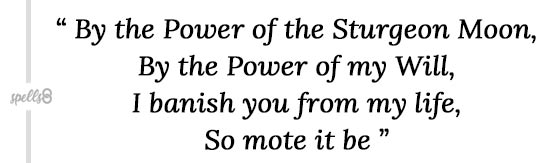
- Take the second strip of paper, and write a new description of yourself in the present tense. For example, “I am a non-smoker.”
- Say the statement three times. Paste the strip of paper on your book of shadows or your journal and leave it there.
- Everyday until the next Full Moon, repeat the statement when you wake up, making eye contact with yourself in a mirror. This will strengthen the spell daily.
Click here to read the rest of this article for more information Source: spells8.com
5 Full Sturgeon Moon Rituals to Harness Depth and Wisdom (Aug 2025)
By August, the year’s light and energy is beginning to shift.
The sun softens, the nights start to stretch out a little longer, and somewhere beneath it all, a quieter rhythm stirs. The Sturgeon Moon, rising this year on August 9, is the full moon of deep waters and ancient knowing.
This isn’t a flashy moon. It’s a moon of depth – of sitting with the first glimpses of your shadows, tapping into the whispers of your intuition, and listening for the messages that only silence can reveal
Named for the great sturgeon fish, a creature that has lived in Earth’s waters since prehistoric times, this full moon carries themes of resilience, emotional endurance, and ancestral memory. It reminds us that wisdom isn’t loud – it’s patient, rooted, and earned.
Energy of the Sturgeon Moon: Depth, Stillness & Sacred Listening
While the Buck Moon in July is bold and wild, the Sturgeon Moon is more subtle, and quiet, urging us to tap into a deeper current moving under the surface of life. It calls you to slow down, go inward, and look beneath the obvious.
This is a time for reflection, shadow work, and intuitive clarity.
In Native American cultures (where the name of this full moon originates) the sturgeon symbolises survival, sacred cycles, and ancient wisdom. These fish have outlived ice ages, mass global pollution, and centuries of change. They represent what endures – what lasts even when the surface world transforms.
Spiritually, this moon asks:
-
- What truths have you been avoiding?
- What are you finally ready to face?
- What guidance could be waiting in the quiet places you usually ignore?
There is no rushing required by the sturgeon moon. Just presence, practice, and the deep gift of seeing clearly – maybe even for the very first time.
5 Rituals to Try Under the Sturgeon Moon
Let this moon guide you gently inward. These rituals are designed to help you connect with the Sturgeon Moon’s watery, emotional, and intuitive energy. They’re ideal for deep soul work, emotional healing, and honouring the wisdom within.
- Moonwater Mirror Gaze
- Deep Depths Journalling Ritual
- Blue Smoke Shadow Release
- River Stone Intuition Grid
- Ancestral Offering to the Deep
Click here to read the rituals in this article Source: themoonschool.org
(One Person’s View Point) What Is the Spiritual Meaning of the August Full Moon?
The August full moon marks a key turning point in the July/August moon cycle (which began with the New Moon on 7/25). It illuminates the effort you’ve poured into your life this year — and brings insight into what’s ready to ripen. Energetically, this full moon asks us to both recognize how far we’ve come, and surrender to the pace of nature’s unfolding.
✨The Sign of Aquarius
Astrologically, this moon falls in Aquarius — the sign of visionary truth, collective wisdom, and emotional clarity. Aquarius brings perspective. While Leo (where the sun currently sits) wants to shine individually, Aquarius pulls us back to see the big picture. This full moon is a moment to reflect not just on your personal growth, but how your gifts support something larger.
Questions to reflect on under this full moon:
- What am I offering the world through my growth?
- What truths are being illuminated for me now?
- How can I root deeper into trust and allow things to unfold in their own time?
Seasonal Energy: The Time of Ripening … Click here to read the rest of this article Source: /theseasonalsoul.com
Code of Ethics for Spiritual Guides c2014
Code of Ethics for Spiritual Guides
Preamble
People have long sought to enrich their lives and to awaken to their full
natures through spiritual practices including prayer, meditation, mind-body
disciplines, service, ritual, community liturgy, holy-day and seasonal
observances, and rites of passage. “Primary religious practices” are
those intended, or especially likely, to bring about exceptional states of
consciousness such as the direct experience of divinity or of cosmic unity.
In any community, there are some who feel called to assist others along
spiritual paths, and who are known as ministers, rabbis, pastors, curanderas,
shamans, priests, or other titles. We call such people ‘guides’: those
experienced in some practice, familiar with the terrain, and who act to
facilitate the spiritual practices of others. A guide need not claim exclusive
or definitive knowledge of the terrain.
Spiritual practices, and especially primary religious practices, carry risks.
Therefore, when an individual chooses to practice with the assistance of a
guide, both take on special responsibilities. The Council on Spiritual Practices
proposes the following Code of Ethics for those who serve as spiritual guides.
1.[Intention] Spiritual guides are to practice and serve in ways that cultivate
awareness, empathy, and wisdom.
2.[Serving Society] Spiritual practices are to be designed and conducted in ways
that respect the common good, with due regard for public safety, health, and
order. Because the increased awareness gained from spiritual practices can
catalyze desire for personal and social change, guides shall use special care to
help direct the energies of those they serve, as well as their own, in
responsible ways that reflect a loving regard for all life.
3.[Serving Individuals] Spiritual guides shall respect and seek to preserve the
autonomy and dignity of each person. Participation in any primary religious
practice must be voluntary and based on prior disclosure and consent given
individually by each participant while in an ordinary state of consciousness.
Disclosure shall include, at a minimum, discussion of any elements of the
practice that could reasonably be seen as presenting physical or psychological
risks. In particular, participants must be warned that primary religious
experience can be difficult and dramatically transformative.
Guides shall make reasonable preparations to protect each participant’s health
and safety during spiritual practices and in the vulnerable periods that may
follow. Limits on the behaviors of participants and facilitators are to be made
clear and agreed upon in advance of any session. Appropriate customs of
confidentiality are to be established and honored.
4.[Competence] Spiritual guides shall assist with only those practices for which
they are qualified by personal experience and by training or education.
5.[Integrity] Spiritual guides shall strive to be aware of how their own belief
systems, values, needs, and limitations affect their work. During primary
religious practices, participants may be especially vulnerable to suggestion,
manipulation, and exploitation; therefore, guides pledge to protect participants
and not to allow anyone to use that vulnerability in ways that harm participants
or others.
6.[Quiet Presence] To help safeguard against the harmful consequences of
personal and organizational ambition, spiritual communities are usually better
allowed to grow through attraction rather than active promotion.
7.[Not for Profit] Spiritual practices are to be conducted in the spirit of
service. Spiritual guides shall strive to accommodate participants without
regard to their ability to pay or make donations.
8.[Tolerance] Spiritual guides shall practice openness and respect towards
people whose beliefs are in apparent contradiction to their own.
9.[Peer Review] Each guide shall seek the counsel of other guides to help ensure
the wholesomeness of his or her practices and shall offer counsel when there is
need.
———-
This draft for public comment was released 17 October 1998. The current version
is available on the Internet at http://www.csp.org.
Copyright © 1995 – 1998 Council on Spiritual Practices
Box 460820 csp@c…
San Francisco, CA 94146-0820 http://www.csp.org
USA
Permission is hereby given to reprint this Code, provided that the text is
reproduced complete and verbatim, including the CSP contact information,
copyright, and this notice of limited permission to reprint.
Spirit Message of the Day – Speak With Your Spirit Guides c 2018
Spirit Message of the Day – Speak With Your Spirit Guides
TEACHING
“Ancient myths and legends tell of the Faery or Elven race. In many tales they are allies of mystics, witches, and shamans, and other seekers of the inner mysteries. Traditionally the doorways between the world of mortal kind and the faery realm open at the equinox and solstice periods. These kindred beings aer sKindred by Mickie Muellerpiritual allies who willingly work with mortals in order to ensure the balance between the worlds. What happens in one dimensional realm affects all others, and the state of the material world can have significant impact on non material realms.”
“This is why the kindred first came to teach mortals the ancient arts, and to establish certain secs as the caretakers or custodians of the material world. Among these sects are the pagans, druids, witches, occultists, and shamans. The card depicts four faery or elven beings. They appear in the light that emanate from their mystical realm. Each wears a circlet upon the forehead, denoting their office as teachers and guides to the inner mysteries.”
THE SHADOW’S EDGE
“The Kindred reveals that we are not alone in the Universe. Beings exist beyond and outside of the material realm. Spiritual fellowships exist that serve beings in earlier stages of evolution through the planes of existence. They spiritual beings within such groups are sometimes called spirit guides, guardians, and allies. Communication and interaction with these beings is possible through dreams and meditations. Forming rapport and relationships with spiritual beings is an aid to our spiritual evolution.”
Today’s message comes from The Seeker’s Guide To The Hidden Path by Raven Grimassi and Stephanie Taylor with art by Mickie Mueller.
Published on Spiritblogger’s Blog
Spirit Guides c 2014
Spirit Guides

Author: Mar-Garet
My Creative Writing teacher (about 20 years ago) had just assigned to us: ‘Imagine an entity who would symbolize to you great wisdom.’ Then we were to write a dialogue with that entity in our journals. My ‘entity’ turned out to be a Porpoise by the name of Rosa! I enjoyed our journal dialogues so much… .I could ask her anything, and she’d always end up give me good (if sometimes quite hilarious) advice!
One day, I was dialoguing with her when she said to me, ‘Wait, I must assume another form in order to answer that question.’ What was going on? She changed form into a beautiful and wise female ‘presence’ who has been with me since I was a very young child. The name of this ‘presence’ I called ‘Saji.’
It turned out that Rosa was simply one aspect, or form, of Saji. I had always wondered why a porpoise would be named after a Rose… .then I remembered that the Rose was one of Saji’s ‘symbols.’ Saji, I finally comprehended, is one of my Life Guides (I have two of them, one female — Saji — and one male). Saji has always been there for me, through all my good times and bad times, to comfort me when I was young, and to guide me as I grow older. Her presence is total love, and I love her with all my heart. To me, she is the voice of the Goddess in my soul.
As I continued my journal dialogues, I found that Saji was there for me whenever I needed her. Sometimes, my male guide, Zohar, would come through—a completely different energy than Saji, but still full of love. I knew they were my Spiritual Guides because they seemed to embody my ‘ideal’ Self, and they never steered me toward any kind of negativity, always toward love and positivity. And they never demanded that I ‘obey’ them. They simply communicated their perspective to me… and it was and IS a much wider perspective than I am usually able to see! And it was then up to me to decide whether to follow their advice or not. When I DID follow their advice, I always found a positive experience.
My Creative Writing teacher was interested in hypnosis as a creative writing tool, and he asked for volunteers to participate in his experiment. I readily agreed to be a volunteer. For 32 hypnosis sessions, we explored the world of my Guides, and met other Spirits also.
These Spirits included: Many of my own past selves, writers and other historical figures who had lived in the past and who we admired, extra-terrestrials, nature-spirits and elementals, dragons, unicorns, etc. Once Spirit called itself (it was beyond gender) my ‘Oversoul, ‘ and mostly showed itself as a bright light! I met Saji’s teacher and was told that his name was Carrefour. I was curious about this and found that in the Vodu religion, Carrefour means ‘crossroads’ and is the Moon God.
I was a little concerned about Carrefour, as I had read that he sometimes has a negative aspect. Eventually, I came to realize that what is important is how *I* relate to him, because I feel that every Spirit I meet reflects something within my own soul. The Carrefour that I know is a Trickster spirit, and yet he is so full of love and compassion that he practically overflows with these qualities!
My subsequent research into Vodu has brought me a lot of interaction with that pantheon. I am learning a very positive path, but always there is much struggle against the prejudices associated with this ancient way. That is part of the challenge I have chosen in this particular incarnation. To me, these ‘Lwa’s’ (as they are called in their own language — also called Loa’s) are ancestors who have progressed to the point of merging with world-Archetypes as interpreted through their own tribal mythology.
My own Past Lives often come to me and inspire me with creative ideas and projects. Some of them teach me (or, more accurately, remind me) what I have forgotten! They also help me recognize certain spiritual qualities in other people, which can come in handy when I am doing a reading or a healing. And they always bring with them Spiritual contacts that harmonize with the culture, mythology, and worldview of those past lives. Working with past life selves is simple — as long as you remember that the PRESENT is where power resides. The purpose and work of the PRESENT LIFE is the most vital and most important.
Certain of my Guides and Past Lives also serve as ‘Gatekeeper’ when I am searching psychically for information and communication from other spirits. They keep it positive, healthy, and filter out any negative vibes.
One book that I found helpful in ‘discerning’ Spirits (and Lwa’s) is Initiation: A Woman’s Spiritual Adventure in the Heart of the Andes by Elizabeth B. Jenkins. In this book, Ms. Jenkins describes her spiritual quest in the Andes, and how she progressed from a worldview that was dominant/submissive to one that was more egalitarian. As a family therapist herself, she had a unique view of Spirit-Human relationships and she had a ‘feel’ for when they became dysfunctional. She explains her own spiritual lessons and how she went from a child-level to an adult-level in functioning on the spiritual plane.
In Ms. Jenkins’ perspective (as well as mine) one becomes a member of a FAMILY of both human and spiritual beings. A family works together for the good of all, and Spirits assist only if invited and welcomed. As the Spirits participate and prove themselves as allies, they become part of the family, too. (You may substitute ‘coven’ for ‘family’ here, also.)
James Redfield, in his book The Tenth Insight: Holding the Vision, describes ‘Soul Groups’ that contain all the past selves of each individual human. These ‘Soul Groups’ contain all the knowledge that the individual has gleaned from life so far! As we move into the Aquarian Age, we find that groups are becoming more and more important in our spiritual evolution. Working with groups is challenging, but promises a great leap forward in our consciousness. As we work ‘for the good of all, according to free will’ (Thanks, Marion Weinstein!), we learn the meaning of spiritual cooperation, without the loss of individuality.
I enjoy groups that form themselves ‘organically, ‘ and just come together in a natural way. As such, families can be defined as a group of entities who are have come together related to each other in intimate ways. Families have something intrinsic in common. And the families we create are connected by love.
Families do not always get along, nor are they always in the same mood. However, they ARE always close to each other, whether they are in group-formation or not. They experience kinship; that is, they recognize each other as ‘my kind.’
In spiritual pantheons like Vodu, or in shamanic paths, one can be called by, adopted by, mentored by, and even married to, a Spirit or a Lwa. This is a more intimate connection and requires a greater level of commitment than just working together. One becomes, essentially, a priest or priestess of that Spirit or Lwa’s specialty. This doesn’t cancel out one’s HUMAN parent, mentor or mate. However, it does require a certain amount of time that must be dedicated to the relationship between the person and the Spirit or Lwa. During this special dedicated time, the person and the Spirit/Lwa learn from each other and cooperate in channeling specialized energy through that archetype.
I have considered being a Priestess of a certain Spirit/Lwa, but have decided that I like to keep things more flexible. I like being able to have a variety of Spirits/Lwa’s to relate to! This is similar to the way I like to relate to my human family and friends. I like a large variety, to bring out the different aspects of myself. (My Venus and Jupiter are in Aquarius, for those astrologically inclined!) I have had many varied incarnations, and I think that I am a very international person!
Other people may have kept to one culture during a lot of their incarnations and, therefore, relate with a smaller number of Spirits/Lwa’s, in a closer and more intimate way. There is nothing wrong with that inclination, either. There are many ways to relate, and many ways to group. There are many kinds of families, but the ones we CHOOSE to create need to be those that encourage us, bring out our talents, support us emotionally, and merge with our own individual style!
Meet Your Spirit Guides c2014
Meet Your Spirit Guides
Before retiring, or going to bed, spend a few minutes in bed relaxing. Just
focus on being relaxed. Be relaxed…
While relaxed, imagine a Veil in front of your eyes. A curtain, or a wall.
Imagine the Veil, or the wall, as being void, black. Accept the Veil, or the
wall. Do not be threatened by the Veil, because you are relaxed, and because
you know the Veil is an illusion, and serves purpose. You are still relaxed.
Then, you visualize the Veil (or wall) slowly lifting. You see the Veil lifting,
and you see stars, you see lights. You know you can see things you haven’t seen
before. You are still relaxed. When you are ready, you ask for Spirit to join
you. You ask Spirit to touch you, and to embrace you, because you are ready to
embrace Spirit. You know that Spirit is Divine Love, you know you are safe, you
know you are loved. You know you are ready to meet Spirit. Hold your hands out.
Let your fingertips feel the touch of Spirit. Know that when you are ready, you
can ask Spirit to embrace your arms; ask for Spirit to give you a huge hug. You
will feel it. Accept the love that is given to you, and know that you have
earned it, that the love is yours. You may feel many things. Electricity, and an
urge to cry, is what I felt, and great joy. There are many methods regarding
meeting your spirit guides. I met my guides in delayed stages. I had two human
guides and three critter guides. This is not “common” but is also not unheard-
of. What is common is for people to have two human guides. For those who study
critter-paths, I believe that they also have two human guides, but that they are
working more consciously with critter-wisdom, and therefore it is likely that
they have “critter-medicine”, and may actually have critter guides, as I do.
Names? Gender? These are generally the first two issues we would like to
distinguish within our guides. What I would recommend, as a matter of deduction,
is that you ask your inner voice, if your entity is Male or Female. You WILL
receive a definite impression. Lesson number one – learn to trust yourself. (I
like to ask the gender question first, as it’s an easy one-two, this or that
approach, and helps to distinguish our own emotional responses.) When it comes
to names, let your mind be open to receive impressions. When I first met Elmo,
my bear, I had a hard time believing that was his name, because I am a “serious”
person, I associated “Elmo” as being playful, and therefore antithetical to what
I thought his name should be. (Yet, I’ve learned a lot from Elmo, including “not
being so uptight” I also learned more about not judging a person – or entity –
by their name.) When I first met Garulf, as a spirit, I thought he had a
fascinating name. Weird name, dynamic personality. This was the label I hanged
on him. How was I to know Garulf was a fairly common, respectable name several
hundreds of years ago, in Denmark? How was I to know Garulf was actually a Soul
name, befitting him perfectly as a spirit, and as a person? So, in other words,
whatever name you get in meditation, or whatever, really is their name?
Sometimes, the names of your spirits will help you bust up your own
preconceptions of what names mean – or what roles people should play in your
lives. What it all really comes down to is trusting your impressions. If you can
do that (we salute you!), but more, you are already on a healthy journey of
rediscovery. Your spirits will help you find the way.
 Witches Of The Craft®
You must be logged in to post a comment.