It is best to find a work area that you can leave untouched for 3 days.
If you must put away your tools, try to leave the spell candle out in the open.
Prepare your work area by setting up any tools you may be using in addition to your spells candle.
(Black) Love or protection incense is recommended.
While setting up your area, concentrate on the purpose of the work.
Bathe or cleanse your self. Do not let negative thought enter your mind.
Go your work area. Cast the Circle, light incense.
Envision a large, white ball of light surrounding you, your work area, and your home.
Hold the candle between the palms of your hand and direct all positive energy into it.
Place the candle and prior to lighting say,
“This candle represents protection over me in all things.”
Light the candle and say,
“As the light of this flame grows, I feel the light and positive energy around me.
As this candle burns, everything around me is blessed with light and love.
I am blessed with light and love. Negative energy is banished.”
Sit back and watch the candle burn.
Keep visualizing the white ball of light and protection around you..
Evision your higher self blessing you and protecting you from harm.
When the candle has burned 1/3 of the way down say,
“As the flame of the candle is extinguished…
Evil, negativity, and harm towards me is banished!
Any entity, ghost or spirit her by mistake go into the light and pass on to the world of spirit,
be not afraid as many wait for you there who you have loved and who love you.
Extinguish the candle. But don’t blow it out!
Repeat this for 2 more nights. Bury or throw away the left over wax.
You can use this link to go forward or backward in time for Moon phase information. If you are curious, you can even find out what phase the Moon was in when you or anyone else was born.
The Moon’s current phase for today and tonight is a Waning Gibbous Phase. This is the first phase after the Full Moon occurs. It lasts roughly 7 days with the Moon’s illumination growing smaller each day until the Moon becomes a Last Quarter Moon with an illumination of 50%. The average Moon rise for this phase is between 9pm and Midnight depending on the age of the phase. The moon rises later and later each night setting after sunrise in the morning. During this phase the Moon can also be seen in the early morning daylight hours on the western horizon.
The Waning Gibbous on February 19 has an illumination of 92%. This is the percentage of the Moon illuminated by the Sun. The illumination is constantly changing and can vary up to 10% a day. On February 19 the Moon is 17.52 days old. This refers to how many days it has been since the last New Moon. It takes 29.53 days for the Moon to orbit the Earth and go through the lunar cycle of all 8 Moon phases.
The 8 Lunar Phases
There are 8 lunar phases the Moon goes through in its 29.53 days lunar cycle. The 4 major Moon phases are Full Moon, New Moon, First Quarter and Last Quarter. Between these major phases, there are 4 minor ones: the Waxing Crescent, Waxing Gibbous, Waning Gibbous and Waning Crescent. For more info on the Moon Cycle and on each phase check out Wikipedia Lunar Phase page.
Phase Details
Phase: Waning Gibbous
Illumination: 92%
Moon Age: 17.52 days
Moon Angle: 0.52
Moon Distance: 379,778.38 km
Sun Angle: 0.54
Sun Distance: 147,909,972.84 km
Useful Moon Resources
Check the weather before a night of Moon gazing at weather.com
Discover the cosmos! Each day a different image or photograph of our fascinating universe is featured, along with a brief explanation written by a professional astronomer.
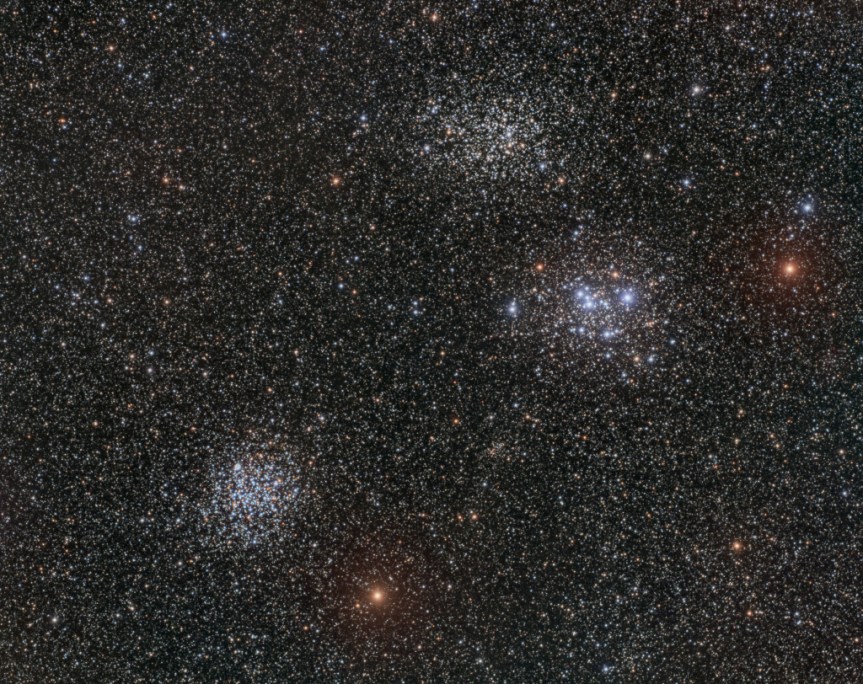
Explanation: Galactic or open star clusters are young. The swarms of stars are born together near the plane of the Milky Way, but their numbers steadily dwindle as cluster members are ejected by galactic tides and gravitational interactions. Caught in this telescopic frame over three degrees across are three good examples of galactic star clusters, seen toward the southern sky’s nautical constellation Puppis. Below and left, M46 is some 5,500 light-years in the distance. Right of center M47 is only 1,600 light-years away and NGC 2423 (top) is about 2500 light-years distant. Around 300 million years young M46 contains a few hundred stars in a region about 30 light-years across. Sharp eyes can spot a planetary nebula, NGC 2438, at about 11 o’clock against the M46 cluster stars. But that nebula’s central star is billions of years old, and NGC 2438 is likely a foreground object only by chance along the line of sight to youthful M46. Even younger, aged around 80 million years, M47 is a smaller and looser star cluster spanning about 10 light-years. Star cluster NGC 2423 is pushing about 750 million years in age though. NGC 2423 is known to harbor an extrasolar planet, detected orbiting one of its red giant stars.
You can use this link to go forward or backward in time for Moon phase information. If you are curious, you can even find out what phase the Moon was in when you or anyone else was born.
The Moon’s current phase for today and tonight is a Waning Gibbous Phase. This is the first phase after the Full Moon occurs. It lasts roughly 7 days with the Moon’s illumination growing smaller each day until the Moon becomes a Last Quarter Moon with an illumination of 50%. The average Moon rise for this phase is between 9pm and Midnight depending on the age of the phase. The moon rises later and later each night setting after sunrise in the morning. During this phase the Moon can also be seen in the early morning daylight hours on the western horizon.
The Waning Gibbous on February 18 has an illumination of 97%. This is the percentage of the Moon illuminated by the Sun. The illumination is constantly changing and can vary up to 10% a day. On February 18 the Moon is 16.51 days old. This refers to how many days it has been since the last New Moon. It takes 29.53 days for the Moon to orbit the Earth and go through the lunar cycle of all 8 Moon phases.
The 8 Lunar Phases
There are 8 lunar phases the Moon goes through in its 29.53 days lunar cycle. The 4 major Moon phases are Full Moon, New Moon, First Quarter and Last Quarter. Between these major phases, there are 4 minor ones: the Waxing Crescent, Waxing Gibbous, Waning Gibbous and Waning Crescent. For more info on the Moon Cycle and on each phase check out Wikipedia Lunar Phase page.
Phase Details
Phase: Waning Gibbous
Illumination: 97%
Moon Age: 16.51 days
Moon Angle: 0.52
Moon Distance: 384,535.53 km
Sun Angle: 0.54
Sun Distance: 147,878,126.13 km
Useful Moon Resources
Check the weather before a night of Moon gazing at weather.com
Purify yourself first. You can do this by meditating, or taking a ritual bath. One way is to, try to keep the water flowing, possibly by leaving the bath plug half in, or by having a shower. This reinforces the idea of washing away any impurities so you are not sitting in your own psychic rubbish. (Scent your bath water with your selection of a sacred or special herb or oil.) Ideally, your towel – if you choose to use one – should be clean and used only for the purpose of your ritual bath.
• • Wear something special if you can, something that you only wear during a ritual or working. You can always add a pretty scarf or a throw in the correct color for your working. This sets apart spell working from everyday confusion.
• • Decide on the extent of your circle, which should be formed in front of your altar. Purify this space by sprinkling the area with water followed by salt – both of these should have been blessed.
• • Sit quietly for as long as you can inside the area that will become your circle.
• • Imagine a circle of light surrounding you. This light could be white, blue or purple. If you are in a hurry and cannot purify and cleanse fully, reinforce the circle of light by visualizing it suffused with the appropriate color for your working.
• • Circle the light around, above and below you in a clockwise direction, like the representation of an atom. Feel it as a sphere or as a cone of power. Sense the power Remember to leave a ‘doorway’ through which your magic energy may exit. You should always feel warm and peaceful within your circle.
• • Use your own personal chant or form of words according to your own belief system to consecrate your circle and banish all evil and negative energy, forbidding anything harmful to enter your space. Remember, you are always safe within your circle if you command it to be so.
• • If appropriate, invite the Gods and Goddesses to attend your circle and magical working.
• • Relax and be happy.
If you wish, you can use objects on the ground to show the boundaries of the circle, such as candles, crystals, cord, stones, flowers or incense. The circle is formed from personal power. This may be felt and visualized as streaming from the body to form a bubble made of mist, or a circle of light. You can use the athame (ritual dagger) or your hands to direct this power.
The cardinal points of the compass may be denoted with lit candles, often white or purple. Alternatively, place a green candle at the North point of the circle, yellow candle at the East, red candle at the South and blue candle at the West. The altar stands in the centre of the circle, facing North in the direction of power.
You can use this link to go forward or backward in time for Moon phase information. If you are curious, you can even find out what phase the Moon was in when you or anyone else was born.
Today and tonight the Moon will be in a Waning Gibbous Phase. This is the first phase after the Full Moon occurs. It lasts roughly 7 days with the Moon’s illumination growing smaller each day until the Moon becomes a Last Quarter Moon with an illumination of 50%. The average Moon rise for this phase is between 9pm and Midnight depending on the age of the phase. The moon rises later and later each night setting after sunrise in the morning. During this phase the Moon can also be seen in the early morning daylight hours on the western horizon.
The Waning Gibbous on February 18 has an illumination of 97%. This is the percentage of the Moon illuminated by the Sun. The illumination is constantly changing and can vary up to 10% a day. On February 18 the Moon is 16.51 days old. This refers to how many days it has been since the last New Moon. It takes 29.53 days for the Moon to orbit the Earth and go through the lunar cycle of all 8 Moon phases.
The 8 Lunar Phases
There are 8 lunar phases the Moon goes through in its 29.53 days lunar cycle. The 4 major Moon phases are Full Moon, New Moon, First Quarter and Last Quarter. Between these major phases, there are 4 minor ones: the Waxing Crescent, Waxing Gibbous, Waning Gibbous and Waning Crescent. For more info on the Moon Cycle and on each phase check out Wikipedia Lunar Phase page.
Phase Details
Phase: Waning Gibbous
Illumination: 97%
Moon Age: 16.51 days
Moon Angle: 0.52
Moon Distance: 384,535.53 km
Sun Angle: 0.54
Sun Distance: 147,878,126.13 km
Useful Moon Resources
Check the weather before a night of Moon gazing at weather.com
Discover the cosmos! Each day a different image or photograph of our fascinating universe is featured, along with a brief explanation written by a professional astronomer.
2022 February 17
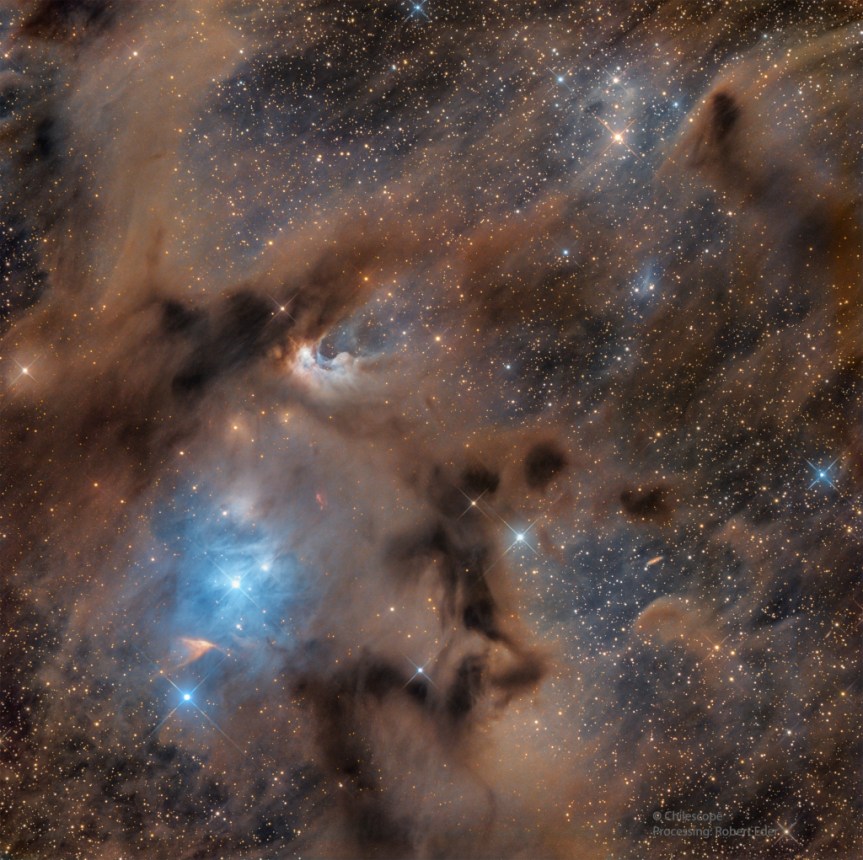
Chamaeleon I Molecular Cloud
Image Credit & Copyright: Acquisition: Stas Volskiy (Chilescope.com), Processing: Robert Eder
Explanation: Dark markings and bright nebulae in this telescopic southern sky view are telltale signs of young stars and activestar formation. They lie a mere 650 light-years away, at the boundary of the local bubble and the Chamaeleon molecular cloud complex. Regions with young stars identified as dusty reflection nebulae from the 1946 Cederblad catalog include the C-shaped Ced 110 just above and left of center, and bluish Ced 111 below it. Also a standout in the frame, the orange tinted V-shape of the Chamaeleon Infrared Nebula (Cha IRN) was carved by material streaming from a newly formed low-mass star. The well-composed image spans 1.5 degrees. That’s about 17 light-years at the estimated distance of the nearby Chamaeleon I molecular cloud.
You can use this link to go forward or backward in time for Moon phase information. If you are curious, you can even find out what phase the Moon was in when you or anyone else was born.
The Moon will be in a Waning Gibbous Phase today and tonight. This is the first phase after the Full Moon occurs. It lasts roughly 7 days with the Moon’s illumination growing smaller each day until the Moon becomes a Last Quarter Moon with an illumination of 50%. The average Moon rise for this phase is between 9pm and Midnight depending on the age of the phase. The moon rises later and later each night setting after sunrise in the morning. During this phase the Moon can also be seen in the early morning daylight hours on the western horizon.
The Waning Gibbous on February 17 has an illumination of 99%. This is the percentage of the Moon illuminated by the Sun. The illumination is constantly changing and can vary up to 10% a day. On February 17 the Moon is 15.52 days old. This refers to how many days it has been since the last New Moon. It takes 29.53 days for the Moon to orbit the Earth and go through the lunar cycle of all 8 Moon phases.
The 8 Lunar Phases
There are 8 lunar phases the Moon goes through in its 29.53 days lunar cycle. The 4 major Moon phases are Full Moon, New Moon, First Quarter and Last Quarter. Between these major phases, there are 4 minor ones: the Waxing Crescent, Waxing Gibbous, Waning Gibbous and Waning Crescent. For more info on the Moon Cycle and on each phase check out Wikipedia Lunar Phase page.
Phase Details
Phase: Waning Gibbous
Illumination: 99%
Moon Age: 15.52 days
Moon Angle: 0.51
Moon Distance: 389,241.12 km
Sun Angle: 0.54
Sun Distance: 147,846,793.70 km
Useful Moon Resources
Check the weather before a night of Moon gazing at weather.com
one Moon because by this point, the tribe’s winter food supplies had usually dwindled to the point where people had to gnaw on bones and cook bone marrow soup in order to survive. For the same reason, the Kalapuya tribe called this moon the Out of Food Moon. Appropriately, it’s also known as the Hunger Moon and the Little Famine Moon. Perhaps due to this month’s association with death, the Cherokee tribe would commune with their dead ancestors during the Bone Moon. A didanawiskawi, or a medicine person, would host a medicine dance for the community. Fasting and rituals for the dead were also common practices.
However, not all cultures associate February’s full moon with extreme cold and death. The Hopi tribe calls it the Moon of Purification and Renewal, which is very fitting because the Full Snow Moon is usually the very first full moon of the year according to the lunar calendar. Cultures that follow the lunar calendar, especially East Asian cultures, tend to associate the Full Snow Moon with new beginnings for this very reason. The ancient Chinese, for example, called it the Budding Moon.
As a matter of fact, celebrations of February’s full moon are the climax of Lunar New Year festivities in various East Asian countries. In China, the Full Snow Moon is celebrated during the Lantern Festival, also known as the Yuanxiao Festival, which is the 15th day of the Lunar New Year. During this festival, the Chinese release kongming lanterns into the sky as they admire the full moon and eat tangyuan, glutinous rice balls that are usually filled with sweet paste. The round shape of the balls symbolize family togetherness and bring good luck to the whole family.
Many East Asian cultures in general also light lanterns and bonfires to celebrate February’s full moon. According to an ancient Chinese legend, not long after Buddhism was brought into China, 17 deities were witnessed flying through the sky during the first full moon of the Lunar New Year. Shocked and excited, the populace lit fires and lanterns to see the godly beings better. They continued to do so year after year, but for more practical reasons – to chase away pests and to pray for a good crop in the upcoming spring.
In Korea, where February’s full moon is known as Daeboreum, these fiery structures are called “Houses of the Burning Moon”. During Daeboreum, Koreans hike mountains despite the freezing temperatures in order to catch a glimpse of the first rise of the first full moon of the Lunar New Year. According to legend, the very first person to accomplish this feat will have their dearest wish come true.
Local Date and Time for February 2022 Full Moon in major cities around the world:
Los Angeles,
San Francisco,
Vancouver
February 16, 2022
8:57am PST
Denver,
Salt Lake City,
Calgary
February 16, 2022
9:57am MST
Chicago,
Houston,
San Antonio
February 16, 2022
10:57am CST
New York,
Toronto,
Atlanta
February 16, 2022
11:57am EST
London,
Manchester,
Dublin
February 16, 2022
4:57pm GMT
Paris,
Rome,
Berlin
February 16, 2022
5:57pm CET
Athens,
Istanbul,
Helsinki
February 16, 2022
6:57pm EET
Dubai,
Abu Dhabi,
Muscat
February 16, 2022
8:57pm +04
Bangalore,
Mumbai,
New Delhi
February 16, 2022
10:27pm IST
Singapore,
Kuala Lumpur
February 17, 2022
12:57am +08
Perth,
Hong Kong,
Beijing
February 17, 2022
12:57am AWST
Sydney,
Brisbane,
Melbourne
February 17, 2022
3:57am AEDT
You can use this link to go forward or backward in time for Moon phase information. If you are curious, you can even find out what phase the Moon was in when you or anyone else was born.
The Moon will be in a Full Moon phase today and tonight. During a Full Moon the moon is 100% illuminated as seen from Earth and is on the opposite side of the Earth from the Sun. The Moon will be visible throughout the night sky rising at sunset in the east and setting with the sunrise the next morning. The point at which a Full Moon occurs can be measured down to a fraction of a second. The time it takes between full moons is known as a Synodic month and is 29.530587981 days long. Keep track of all the Full Moons throughout the year on the Full Moon Calendar >
The Full Moon on February 16 has an illumination of 100%. This is the percentage of the Moon illuminated by the Sun. The illumination is constantly changing and can vary up to 10% a day. On February 16 the Moon is 14.56 days old. This refers to how many days it has been since the last New Moon. It takes 29.53 days for the Moon to orbit the Earth and go through the lunar cycle of all 8 Moon phases.
The 8 Lunar Phases
There are 8 lunar phases the Moon goes through in its 29.53 days lunar cycle. The 4 major Moon phases are Full Moon, New Moon, First Quarter and Last Quarter. Between these major phases, there are 4 minor ones: the Waxing Crescent, Waxing Gibbous, Waning Gibbous and Waning Crescent. For more info on the Moon Cycle and on each phase check out Wikipedia Lunar Phase page.
Phase Details
Phase: Full Moon
Illumination: 100%
Moon Age: 14.56 days
Moon Angle: 0.51
Moon Distance: 393,660.25 km
Sun Angle: 0.54
Sun Distance: 147,815,985.47 km
Useful Moon Resources
Check the weather before a night of Moon gazing at weather.com
Discover the cosmos! Each day a different image or photograph of our fascinating universe is featured, along with a brief explanation written by a professional astronomer.
You can use this link to go forward or backward in time for Moon phase information. If you are curious, you can even find out what phase the Moon was in when you or anyone else was born.
The Moon will be in a Full Moon phase today and tonight. During a Full Moon the moon is 100% illuminated as seen from Earth and is on the opposite side of the Earth from the Sun. The Moon will be visible throughout the night sky rising at sunset in the east and setting with the sunrise the next morning. The point at which a Full Moon occurs can be measured down to a fraction of a second. The time it takes between full moons is known as a Synodic month and is 29.530587981 days long. Keep track of all the Full Moons throughout the year on the Full Moon Calendar >
The Full Moon on February 16 has an illumination of 100%. This is the percentage of the Moon illuminated by the Sun. The illumination is constantly changing and can vary up to 10% a day. On February 16 the Moon is 14.56 days old. This refers to how many days it has been since the last New Moon. It takes 29.53 days for the Moon to orbit the Earth and go through the lunar cycle of all 8 Moon phases.
The 8 Lunar Phases
There are 8 lunar phases the Moon goes through in its 29.53 days lunar cycle. The 4 major Moon phases are Full Moon, New Moon, First Quarter and Last Quarter. Between these major phases, there are 4 minor ones: the Waxing Crescent, Waxing Gibbous, Waning Gibbous and Waning Crescent. For more info on the Moon Cycle and on each phase check out Wikipedia Lunar Phase page.
Phase Details
Phase: Full Moon
Illumination: 100%
Moon Age: 14.56 days
Moon Angle: 0.51
Moon Distance: 393,660.25 km
Sun Angle: 0.54
Sun Distance: 147,815,985.47 km
Useful Moon Resources
Check the weather before a night of Moon gazing at weather.com









 Witches Of The Craft®

You must be logged in to post a comment.