Following Our Ancestors’ Path

Following Our Ancestors’ Path

Author: Gloria Gypsy

Modern Druids must research what Druidism was or is and apply it to our modern times. A modern Druid’s role does not differ much from that of his or her ancient ancestors, although Druids of today face many more challenges in teaching and giving service to the world. Many people have forgotten the ways of they’re ancestors. They are not at one with nature or their spiritual selves. Many people live in crowded urban areas and have lost touch with their bonds to nature. Today’s Druid I believe would spend more time working toward caring for our planet and nature since pollution, over-population and technology have begun to destroy our very life force. Today more than ever we need the Wisdom of the Druid.

One important role for a Druid today would be in preserving our wildlife. So much of our natural woodlands, prairies, etc., have been lost to pave the way for more urban areas. When we destroy a forest or field or what have you we are also destroying the wildlife that lives in that area. As an example, in certain parts of the United States, Wolves, Coyotes and Bears are seen more and more in urban areas looking for food. This is because we are taking away they’re natural habitats and they have nowhere left to go.

And so a modern Druid may join a committee that is dedicated to saving our wildlife or forests. He or she may work toward animal sanctuaries or for a national forest. In preserving and caring for nature we are giving back to our life force. Without it we would not exist.

The Druids were a people of integrity and service. In the past they were healers, judges, priests, poets. But unlike most people today they were all these things and also in tune with spirituality and honor. Today we still seek wisdom and must strive to give as well as receive knowledge, to lend our services to our communities and families (tribe); to nature/the gods; to our planet and also to our self.

Society today lacks much integrity and truth. People are not honest with themselves let alone as a culture or community. The modern Druid has a responsibility not only to him or herself but to they’re community as well to practice and teach the lessons of truth, honor, integrity and love. Without these virtues we are not true to ourselves, each other and our god/s. Passing this knowledge on gives us hope for the next generation and those generations yet to come. “We must give of our selves so that we may receive of ourselves.” (Searles O’Dubhain)

A Druid as teacher could be a father or mother teaching they’re children, judges or law enforcement teaching these lessons by example, and teachers themselves in schools teaching in they’re specialized fields. If we learn and live as the ancient Druids did we are able to communicate on all levels of human awareness, we are the caretakers of nature, and the teachers of wisdom and spirituality. We are enlightening others and ourselves, we are making our lives and our world a better place. We are improving the quality of life and our spirituality. We must research what Druidism was or is and apply it to our modern time.

“The value of a life is great but it is small next to the value of a spirit.” (Searles O’Dubhain)

Following I offer a meditation for speaking with the spirit of place as an example on how to get started becoming one with the earth and learning from the wisdom of the earth.

Meditation: Speaking with the Spirit of Place…

  • Sit down near, preferably touching, that with which you plan to speak with. If it is a tree, perhaps face it, placing your hands on it. Try to avoid animate things such as animals and moving bodies of water until you get better at this. Otherwise the movement will likely break your concentration.
  • Close your eyes or keep them open, depending on what works best and how you feel most comfortable.
  • Calm your mind, and quiet it in an attitude of meditation. Any thoughts that enter, simply acknowledge them as a thought, and push them aside, returning to your concentration.
  • Focus on your breathing. If you find it difficult to quiet your mind, perhaps try chanting (to yourself or aloud) a mantra, play some soft music if you can. Anything to focus your attention.
  • Breath in for a count of four, hold it for two, then out for a count of four. Keep doing this until you feel that your mind is peaceful and calm enough.
  • Focus on moving your consciousness into what you’re trying to speak with. I’ll use the example of a tree. It is easier if you are touching it, and I will assume your hands will be on it. Adapt this as you see fit, however. Move your awareness down into your arms, allowing it to travel to your hands, and then your finger tips. You will find it will slip into the tree with as much ease as it went down your body. Always remember to get permission before moving your consciousness into something that is not your own. If you feel that you are being allowed in, then proceed; otherwise do not.
  • Allow yourself to orient in the tree. When you feel ready attempt to speak with it. If you do not yet feel ready, simply sit with it and hold off until you do feel ready.
  • Think about your own relationship with the Land, what you feel is appropriate, and what you feel needs to be changed. Think on why you should change these things, and why certain things are in right relationship.


Footnotes:
Sources

1.The Traditional Roles of Druids, Searles O’Dubhain

2.The Nine Strands of Druidism, Jason Kirkey

Five Feng Shui Tips for Abundance

Five Feng Shui Tips for Abundance

  • Annie B. Bond

The ancient Chinese system of Feng Shui uses the power of focused intention, as well as the mindful placement of objects, to improve our lives. If you would like more abundance for yourself and your family, try these five simple Feng Shui tips.

The Wealth/Abundance area is located in the far left corner of your house from the front door.

1. Place or keep any of the following in the Wealth area of your home: banknotes, piggy bank, checkbooks, purse. This deceptively simple act will help you to become more mindful of your money and how you manage it.

2. Use the following colors to enhance the Wealth area: gold, red, purple. These colors have deep and ancient associations with prosperity.

3. For the ancient Chinese, fish were considered a symbol of wealth. If you can’t place an aquarium in your Abundance area, you could use a photo or painting of fish to invite more prosperous energies into your life.

4. Images of generosity will inspire your own sense of abundance. You could use a bowl in your Wealth area to collect coins for a charity, or include a statue that symbolizes giving for you. When we give in an open-hearted way, we get the energy-flow of abundance moving in our lives.

5. Lush green plants do well in the Wealth area, reminding us that nature gives great pleasure and peace. Bamboo is traditional, but any healthy plant will do.

Your Daily Feng Shui Tip for December 11th

You know what I like to say: If you got ’em, go ahead and light ’em, especially since tomorrow is ‘World Candle Lighting Day.’ Candles constitute a powerful tool in the Feng Shui pantheon, especially if you use nine red ones in the Fame sector. Located in the back, middle or center back of your main floor, the Fame area is singularly aligned with the Feng Shui fire element. This arena additionally relates to your future as well as your progression through life. This energy also influences promotions that you receive, as well as any enlightenment, recognition or rewards. The gold standard for this location is to place nine (the number associated with fame) red (the color associated with this area) candles into this space and then light them whenever you feel the need to create some steady movement in your career or to propel your promotion into some serious upward mobility. There’s no need for the candles to burn all the way down, and simply allowing the wick to engage the wax while you fire up your intentions to boost your career and speed enlightenment will do the proverbial trick. So get lit on ‘World Candle Lighting Day.’ You’ll be happy that you did!

By Ellen Whitehurst for Astrology.com

Meditation as a Way Through Addiction

Meditation as a Way Through Addiction

  • Deepak Chopra

Alcohol, cigarettes and drugs cause untold damage, but their users derive some kind of pleasure from them, or at least relief from the massive stress that they would otherwise feel. But by exposing their minds to a greater source of satisfaction, the natural tendency would be to head away from the addiction, because the greater satisfaction is more appealing. Support for this new view has existed for almost 20 years.

Going back to the early 1970s, studies in the United States and Europe have repeatedly shown that when addicted people are taught to meditate, their level of anxiety decreases, pulling down with it their use of alcohol, cigarettes, and other drugs.

If the addiction is caught at an early stage, a large proportion of subjects will stop abusing substances altogether. This is a very important point, because the early stage is where most cures are possible.

By removing the distractions of stress, meditation renews the nervous system’s memory of balance. Repeated meditation, day after day, jogs the memory again and again, until in time the cells return to a normal state, exchanging their abnormal receptors for a more normal pattern. Once the pathways of intelligence are repaired, the cells will automatically select the body’s healthy signals, as once they automatically accepted the distorted ones. The circle broken by addiction has been repaired.

Adapted from Perfect Health: The Complete Mind/Body Guide, by Deepak Chopra, M.D. (Harmony Books, 1990).

Support Your Spirit

Support Your Spirit

  • Deepak Chopra

Make this today’s promise to yourself, to look inside for guidance. Everyone needs support, and generally we look outside ourselves–to family, friends, coworkers, and like-minded people–for validation. This kind of support makes you feel that you are right. The ego gets assurance that you are not alone.

But spirit wants to develop uniquely. It sends support to the inner person. Instead of making you feel that you are right, spiritual support adds to your sense of being free, at peace, loving, and aware. Be open to those feelings, because openness is the first step to transformation.

When you feel moments of being uncertain and alone, tell yourself that you have the same worth as your soul. In situations where you feel the urge to assert, disagree, or resist, don’t follow that impulse. Find your own peace; accept the situation, and then watch.

Do you see signs that what you want out of the situation can happen without resistance or assertiveness? When you value the support spirit is giving, the grip of ego is loosened immediately. You are capable of seeing any situation as spirit sees it, not just as ego does. If you value that capacity, it will grow.

Go about your routine, keeping faith with what you honor. By honoring stillness, you are touching one piece of the soul’s treasure.

Adapted from The Deeper Wound: Recovering the Soul from Fear and Suffering, by Deepak Chopra (Harmony Books, 2001).

Your Daily Number for December 10th: 3

Look out! You yield enormous power to influence others today, and may even appear more attractive than usual. You’re upbeat and playful, and the world knows it. If there’s a deal or project you’ve been waiting to close, now is the time to do it. Make sure you’re organized, because there’s also a tendency to be a bit scattered and forgetful.

Fast Facts

About the Number 3

Theme: Expansive, Sociable, Dramatic, Diversified, Creative
Astro Association: Venus
Tarot Association: Empress

Special Kitty of the Day for December 9th

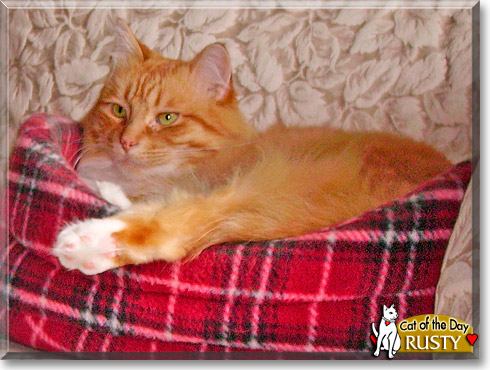
Rusty, the Cat of the Day
Name: Rusty
Age: Nine years old
Gender: Male
Kind: Domestic Medium hair
Home: Brooklyn Park, Minnesota, USA
We adopted Rusty from the local animal humane society. The previous owner did not want him because he quote, “vocalized too much”. When we saw his face in the pictures of adoptable cats, he seemed to be saying “get me out of here!” Once he arrived in our house he immediately became a “momma’s boy”, following my wife around the house, sitting on her lap and snuggling with her in bed.

He is a very loving boy, with a crazy wild side. Once or twice a day he will do what we call “rocket shipping”, bursting down the hall at great speed, jumping on the bed and then taking off again. He is also a champion wrestler and gets into bouts with his older brother daily. Rusty is also capable of some very complex Gymnastic maneuvers, don’t you agree? He has brought us great joy and we treasure him greatly!

Your Daily Feng Shui Tip for December 9th

Even though he one of the most celebrated and beloved clowns of all time (Emmett Kelly, Sr. was the first to portray him), I would say that at this holiday time of year we can all relate to his famous character, Weary Willy. On this ‘Weary Willy Day’ I thought it might be time to take a look at some quick ‘pick-me-ups’ from the world of holistic health and healing. If you feel tired first thing in the morning you may want to try an old New England tonic that could put some spring back into your shopper’s steps. Blend together one cup of warm water, two tablespoons of apple cider vinegar and one teaspoon of honey. Drink it down and do this for at least one week straight. You should soon see a significant difference in your energy and possibly even a small one in your weight! Another way to wake up your energy and your metabolism in the morning is to start the day with fresh squeezed grapefruit juice. Squeeze the juice of one half grapefruit into a glass of warm spring water and drink it down. And I would be remiss at this time of year not to mention the quick lift that figs can give. Figs have a natural, slow burning sugar so they can get you up and at ’em no matter how tired you thought you were. In fact, any of these tips can kill the tired in no time at all!

By Ellen Whitehurst for Astrology.com

The Sacred Household: Rites and Mysteries

The Sacred Household: Rites and Mysteries

Author: Ian Elliott

To Joseph Brazauskas, a true pagan

The Threshold

The sacred household in ancient and more recent indigenous cultures bears certain analogies to the human body. The front door is similar to the eyes, the hearth to the heart or solar plexus, and the central supporting pillar to the spine. Shrines or altars at these locations were guarded by spirits who were linked with internal spirits in each family resident, and the proper worship of the household guardians involved being on familiar terms with their inner analogues and tending their inner shrines.

This study of the sacred household uses the names of Roman household spirits, but it is based more broadly on a number of other cultures. We no longer live in Roman houses, so some latitude must be taken in locating household shrines; and we are not all of Roman descent, so some attention must be paid to the forms of piety practiced by our ancestors from other lands.

It is not enough to study household rites and set up modern versions of ancient shrines. Our early conditioning separates us from some pre-verbal modes of awareness, by teaching us to ignore certain readily available perceptions; these must be recovered if we are to properly install our internal shrines and so link them with those of the household. I have called practices that open up these perceptions ‘mysteries, ’ because having been forgotten they have become secret things.

The Roman god of the threshold was Janus, who has two faces, one looking outside and the other inside the home, as well as forward and backward in time. To enter a house, as H.J. Rose pointed out in Religion in Greece and Rome, is to begin something, and so household piety always began by honoring Janus at the threshold. His annual festival was on January 9th, and offerings at his shrine were made on the Calends (the day after the dark moon of the lunar calendar) , as well at the beginning of any endeavor, such as a journey; also on one’s birthday.

The Romans, even after they came under Greek influence, were by preference an aniconic people; that is, they preferred worship without images. Perhaps this was because they focused on the link between the inner and outer shrines and found external images a distraction. I keep my own threshold shrine simple, hanging a god-face about a foot and a half above a small offering shelf, the shelf set next to the front door a little above eye-level. On the shelf is a candle, a stick incense holder, toy-sized dishes for water and salted grain.

Upon crossing the threshold one always steps over it, never on it, and one should touch the doorpost as an acknowledgement of the threshold guardian and to receive his numen. We can tentatively define numen as liberating and empowering energy that is unknown or at least unfamiliar.

My prayer when offering to Janus is the same as the one I used when setting up his shrine:

Honor and thanks to you, O Janus,
for guarding the threshold of my home.
May only harmonious beings enter here,
and may the discordant depart!
Please accept these offerings of salted grain, water, light and scent,
Open this week [month, journey, etc.] for me on blessings,
and teach me to look out and in at once as you do,
so I may guard the threshold of my inner home;
for I, too, am a threshold guardian.

The god-face for Janus looks straight in, as I prefer to imagine his head imbedded in the wall, with his outer face guarding the outside of my doorway.

The Inner Threshold

This ability to look out and in at the same time holds the clue to Janus’ mysteries, to the pre-verbal mode of perception that will give us the ability to look in the same manner, outward and inward simultaneously. To do this we must ‘stand in the doorway, ’ and Douglas Harding provided the best description of this in his important little book On Having No Head. Harding was hiking in the Himalayas and one morning he suddenly saw the world differently:

“…I stopped thinking…Past and future dropped away. There existed only the Now, that present moment and all that was given in it. To look was enough. And what I found was khaki trouserlegs terminating downwards in a pair of brown shoes, khaki sleeves terminating sideways in a pair of pink hands, and a khaki shirtfront terminating upwards in – absolutely nothing whatever! Certainly not in a head.”

This nothing, however, was filled with everything: mountains, sky, valleys below, extending to the horizon. Harding felt light and liberated. He had ceased to ignore the sensations of his own headlessness, ending a habit acquired in infancy when told that ‘the baby in the mirror’ was merely his own reflection. In addition to his headlessness, he was now attending to the limits of his perceptual field. Consequently, he wasn’t tracking on this or that object, as we spend so much of our time doing, using our eyes as searchlights for our impulses and desires. Instead, he was looking at his whole visual field at once, and the lightness he felt resulted from dropping the burden of his eyes from incessant tracking, and of his mind from incessant thinking.

Indigenous peoples are aware of the difference between these two ways of looking at the world. When the psychologist C. G. Jung visited an Indian pueblo in the American Southwest years ago, he had a conversation with the local chief, Ochwiay Biano (his name means Mountain Lake) .

“The white man’s eyes are always restless, ” the chief told Jung. “He is always looking for something. We think he is mad.”
Jung asked him why they thought that.
“He says that he thinks with his head.”
“Why of course, ” answered Jung. “What do you think with?”
“We think here, ” he answered, indicating his chest.

There are two potential errors in assessing what Ochwiay Biano said. One is to take his words sentimentally, as if he were merely speaking of ‘heartfelt thinking.’ The other error would be to dismiss his words as expressions of a primitive, pre-scientific physiology. The Pueblo chief would not have been troubled to learn that Western science has determined through experiments that we think with our brains. This would have seemed to him irrelevant to what he was talking about, namely the sensation of where the thinker seems to be located in the body. We feel we are located in our heads because of certain muscular tensions around the eyes from tracking, and in our foreheads from ‘knitting our brows, ’ and performing other social cues indicative of taking thought. But these external muscular contractions, though spatially closer to the brain, are nevertheless external to it and involve muscles on the outside of the head. The feeling we get from them of being ‘in our heads, ’ therefore, is no more scientific than the feeling the Pueblo chief evidently got of being in his chest.

When we look at our headlessness, our chests come into view as the closest part of the body that is completely visible; and when mental talk quiets down as a result of tracking being replaced by restful awareness of the whole available visual field, words are employed only as and when necessary for external communication. The rest of the time one simply looks, listens and understands, and this quieter form of awareness allows feelings to come to the fore since they are no longer drowned out by incessant mental chatter. For these reasons, Ochwiay Biano felt that he thought in his chest, or solar plexus.

The Hearth

The ancients associated this part of the body, including the heart, with the hearth, and regarded it as the seat of memory. The hearth was the center of the home as well as the place of contact with ancestors. It was the place where the family gathered and traded experiences of the day, recalling in the process the words and deeds of the past. Without memory there is no family, even if the people living together are all related, as we know now that the hearth has been replaced by the television or computer as the central focus of the house, especially if meals are taken individually in the living room.

In the old days, the hearth gave heat and light to the home and was also where food was cooked. Nowadays some are fortunate enough to own a house with a fireplace, but they usually have a stove as well, so that the functions of the ancient hearth have become divided, and it is difficult to decide where to place the hearth shrine.

I have no fireplace where I live now, so my hearth shrine is near my stove. My stove is electric, but I keep a large candle in the shrine and light that, together with stick incense, when I want to awaken the hearth guardian. Additionally, I keep there somewhat larger versions of the offering dishes described above for the threshold shrine.

The hearth guardian is both a goddess and the hearth fire itself. In ancient Latium she was called Vesta. She accepts offerings for herself and also passes on some of them to the ancestors, godlings and blessed immortals. Because I cannot maintain a perpetual flame, I have a picture of her in my shrine, and close to her picture is a statuette of my family lar. The lar familiaris is an ithyphallic youth pouring wine from a wineskin into a chalice. He symbolizes the vigor and luck of my family line, and as such forms a link back to the ancestors, and onward to posterity. If I want to honor and pray to another deity, I can conveniently place his or her statue in the shrine for the occasion. This saves on shrines.

At the shrine or close by are photos of my parents and maternal grandmother. These are the ancestors who were my caregivers when I was small, and with whom I still share a bond of love. The Romans and other ancient peoples represented their ancestors by small clay figurines on the altar, as seen in some recent films.

When my offerings are laid out, I light the candle saying “Honor to fire, honor to Vesta, honor to the hearth.” Then I light the incense. Then I pray: “Holy Lady, please accept these offerings of salted grain and pure water, light and scent for thine own dear self, and pass on some to the lares and penates, the di manes, daimones and blessed gods, thanking them for their good regard for me and my family, and asking for a continuance of their favor.” To this basic prayer I add anything special for other deities.

While the fire is lit in the shrine, I call on my ancestors and talk to them. I let them know how things are going in the family with me, my sons and grandson, our concerns, blessings, problems and plans, just as I would if they were still in the flesh. If any of them has appeared recently in a dream, I thank him or her for the visit.

At the close of the rite, I bid farewell to ancestors and deities and extinguish the candle, letting the incense burn down. I say the opening prayer in reverse order, ending with “Honor to the hearth, honor to Vesta, honor to fire.” In Roman houses the hearth shrine was decorated with fresh flowers and offerings made at least three times in the lunar month: on the Calends, that is, the day after the dark moon; on the Nones, the ninth day before the full moon; and on the Ides or full moon itself. In Caesar’s solar calendar the Ides was regularized as the fifteenth of each month, which would place the Nones on the seventh.

The Inner Hearth

When we practice ‘standing in the doorway, ’ we naturally do not do so all the time, and this provides us with a contrast between the two modes of experience, so that we begin noticing things that were formerly invisible to us because they were constant. Some of these things are external to our minds, such as shadows and clouds, and some are internal. One of the internal things is the synopsis or background summary we take to experience, the mental account we refer to offhand when answering the common question “How is it going?” The synopsis is more readily observed in dreams, because it is different for each dream-story or sequence, whereas in waking life it is ongoing and only changes gradually except in moments of crisis.

When we enter a dream-story we generally enter in the middle of it, provided with a ready-made background that tells us where we are and what we are supposed to be doing. We are provided with dream-memories, sometimes selected from previous dreams (as in recurring dreams) , and unless we become aware we are dreaming, we do not question it or the actions of other dream-figures.

Similarly, in waking life we are generally absorbed by the problems and affairs of the moment, as supplied by an ongoing mental summary or synopsis. From this we derive our sense of who we are in the present and what we need to do. The synopsis is based on a selection of memories, and these change gradually unless we are in the throes of a crisis, in which case we need to revise our orientation, sometimes on the basis of earlier memories, in order to cope with the situation. At times our synopsis can become so obsessive that we throw it over in a breakdown and temporarily become disoriented.

Standing in the doorway provides a milder sort of disorientation, as the contrast between it and our usual awareness brings the operation of the synopsis to the forefront of attention. Then, as in the onset of lucid dreaming (when we suddenly realize we are dreaming) , we become free to question who we are supposed to be and what we are supposed to be doing in the present moment. The process of interpreting present experience in terms of our usual selection of memories is suspended, and earlier memories are able to surface, bringing with them earlier feelings of ourselves and of life, derived from past synopses. This is a familiar experience when we go on a trip, especially if we visit old neighborhoods we haven’t seen in many years, and perhaps explains why we like to take such trips after surmounting a difficult crisis.

Vesta’s power to call up the ancestors from old memories works in a similar way, and when our focus of awareness has moved to the chest or solar plexus, continual standing in the doorway can help her to perform the same feat for us at our inner hearth, especially if we augment our headless attention with another pre-verbal mode of awareness involving sound.

The first stage is to listen to all the sounds around us, without dividing them into ‘background’ and ‘foreground’. This comes about naturally once our visual attention rests on the limits of the visual field instead of tracking on this or that object. It is easy for the attention to waver, however, so the focus on sounds must be augmented by mentally copying sounds just heard.

Small children learn to speak by mentally copying sounds, and there is reason to believe that animals do something similar. Mentally copying sounds and associating them with specific situations would seem to have been a major part of humanity’s pre-verbal thought processes.

Once we learn to speak, and to speak to ourselves, mental mimicry of sounds is relegated to a minor role and generally limited to copying sounds for which we have words. When we begin ‘thinking with the chest, ’ like Ochwiay Biano, our minds become quieter and we become aware of feelings and images for which we have no words, not because they are ineffable, but simply because no words have yet been assigned to those experiences. Consider smells, for instance. We have many words for colors and quite a few for sounds, but our olfactory vocabulary is very limited. If a dog could be taught to speak, he would find himself at a loss to describe the many odors in his daily experience. If he invented words for the many different odors, we would find it hard to understand him, lacking referents because we are purblind in our noses.

In the same way, this particular sound I have just heard has no precise word describing it. We can say, ‘that is the sound of a car engine, ’ as we say ‘that is a tree, ’ and ignore sensory detail in either case. Our everyday minds can deal with such thumbnail descriptions without having to disturb the selection of memories forming a background to our moment-to-moment synopsis. But if we mentally repeat the precise sound of that car that just went by, our memory background is rendered more porous, as it would become in a crisis, so that feelings and images from past memories are able to emerge.

I tried mentally echoing sounds just heard as an experiment in 1972, while walking along a busy street in Encanto, California. I was also keeping my sunglass frames in view, an earlier version of ‘standing in the doorway’. I did this for an hour or more, and recorded the results in a journal:

“The result of this double exercise was three full days, not counting sleep, in silent awareness of total sensation…At one point the feeling of lightness became like a breeze flowing through my body from back to front. Everything seemed to take on a bluish tinge…By the third day, the breeze had risen to a light wind and was blowing through my memories. My personal history, the sense of who I am, was being shuffled like a deck of cards…By the end of the third day the wind set me down somewhere else in myself; that is, my store of familiar memories was completely revised and my feeling of myself permanently changed from that point on.”

After this experience, my dead grandmother began visiting me regularly in my dreams. I noticed that in many of these dreams I appeared to be younger, and to feel as I did when she was still alive, but my understanding was linked to the present. It was common to realize at the time that I was dreaming, if not at first then as the dream progressed, for I would remember that she had died. These earlier feelings of myself, and of my grandmother when she was alive, enhanced a feeling of harmony with her and allowed us to converse in close intimacy. However, as I had no unresolved issues with her, there was nothing specific to work through. I usually asked her how she was, and she said fine, but she felt tired a lot, and this probably came from memories of her as she was towards the end of her life.

My practices of the threshold and hearth continued over the next several years, and long after my father died I did have some serious issues to work through with him. This took about three years to get through, during which time I was periodically out of work (I was doing contract programming and moving around a lot) . In both dream and waking I agreed with my father to resolve certain problems for good with him in exchange for obtaining help in finding employment. On each of three occasions, I received job offers within twenty-four hours of these conversations. Skeptics may make of this what they will; but taking the view that I was in contact with the spirits of my ancestors, it makes sense that they would find it easier to relate to me after I had recovered earlier feelings of myself and of them, which I had when, they were still alive.

The Pillar

Before chimneys came into general use in the Renaissance, the old-style hearth was usually located centrally under the smoke-hole in the roof, and the central supporting pillar or pillars were set close to it. The main pillar in pagan times corresponded to the World Pillar, round which the heavens appear to revolve and which links the Underworld, Middle-Earth, and the heavenly realms of the cosmos together. It also corresponds to the human spine, and the subtle passage therein known to yogis as the sushumna. An upright person has a straight spine and thus a direct link to the vigor of the ancestors. He or she can stand before the ancestors unashamed, with a record of honorable conduct.

In the old Roman religion, every man was born with a guiding spirit called his genius, and every woman a similar spirit called her juno. These were inner spirits, with a meaning originally connected in some way with sexual vigor, but later they became mixed with the Greek notion of a personal daimon who guided one through life. The connection of the genius with sleep and dream is suggested by the lectus genialis, located in the atrium just opposite the entrance-door. Rose conjectures that in the days of one-room houses it probably served as the marriage bed, hence its sexual significance; but in later times it persisted as a sacred furnishing that was reserved for the genius of the paterfamilias and never used by the house’s human occupants. Presumably the lady of the house had a similar place in the women’s quarters dedicated to her juno.

While we must do without a pillar in modern houses, we can set aside a special area in the home for meditation, and include a shrine to a personal guiding deity, giving external form to our indwelling genius or juno in the shape of an image if we prefer. A staff can be set up in a nearby corner to represent the pillar, perhaps with alternate red and white bands spiraling clockwise around it from the top to the bottom, like a Maypole. The main thing, of course, is to sit there with an erect spine, the seat being raised by one or two cushions.

If you offer to your patron or patroness (or directly to the genius or juno) as at the other shrines, ask for guidance or wisdom in both dreams and waking life. It is also good to do this before going to sleep. If you remember your dreams on awakening, take a few moments to ponder them and try to determine what the deity was saying to you. Even seemingly trivial dreams often contain a message if we take the time to examine them.

The Inner Pillar

As the World Pillar is the link between the realms of our cosmos and thus with the ancestors, so the inner pillar is our own personal link with them through memory. As we have seen, memory contains more than the record of events: Vesta at our inner hearth can recall past versions of ourselves, our feelings and impressions, our viewpoints, joys and fears, all the way back to birth, as well as that strange kind of nostalgia, with phantom images, associated with the distant past which we call far memory. Like the rings on a tree-trunk, these vital memories represent different stages of our growth-journey from the realm of the ancestors, and each is vitally available to the present moment.

It will come as no surprise, then, to learn that each man’s genius and each woman’s juno resides in the inner pillar of memory and has the job of guiding, not just our present selves, but each of these versions of ourselves, guiding all of them together. Thus, as Vesta calls back our previous selves and integrates them with our current self, the genius or juno shows us the path linking them, the plan our life has been following, and the living form of our self through time, of which our current self is the growing tip. For whereas the ancestors are concerned to help that growing tip, our current selves, with advice and vigor, our indwelling genius and juno are concerned with the growth of the whole plant, clear down to the roots. The journey down the inner pillar of memory, taken by the silent, inward-looking self, is not like a train-journey, which leaves behind each station as it travels to the next one. It is rather a projection of awareness from the present back through the past, uniting with the whole trunk of memory as it goes. As such, it is a preparation for the fuller integration that will take place in the Underworld after the death of the body.

In the Underworld the integrated soul will undergo further integration with its selves from previous lives. Thus, the answer to the question, “What age shall I be on the Other Side?” is “All ages to which you have attained.” This is expressed beautifully in the Lakota (Sioux) myth of Falling Star. It seems long ago there were two sisters who wished to marry stars when they grew up. Then, when they were about to go to bed, two men appeared outside the flap of their tepee:

“They were men, but they were not like other men, for they made the light they lived in, and there was no shadow where they stood. This light was soft and kind, and when the two men smiled, it spread about the sisters so that they were not afraid at all. Then they saw that one man was young and one was very old. The younger one was taller than any man the girls had ever seen; but the older one was even taller. I think he stood above the other like a tree, and the light which he made was that much brighter. He was old, old; but he was young too. I think he was older than the other because he had been young so much longer.”

Journeys down the inner pillar can take place in lucid dreams or in waking moments when inner silence begins to deepen on its own, spontaneously. The latter experience feels like being in an old elevator that has suddenly slipped its cable a little. There is a feeling of being lowered into deeper silence. Present sensations continue, but new senses open up, or perhaps feelings, for which we have no descriptions. These seem to be showing through the current landscape, if we are outside, that is. Time undergoes subtle changes as well, with the mind taking in more rapid details occurring, as it were, between successive instants of time. This continues until one has had enough and decides to re-surface into the everyday present.

Standing in the doorway and mentally echoing sounds just heard help to set up lucid dreaming. Additionally, after closing your eyes at night, instead of becoming immersed in thoughts, watch your phosphenes, the lights and shapes created by the pressure of the eyelids on the optic nerve. As we fall asleep, dream images will naturally become superimposed on our phosphenes; but if we fall asleep while watching instead of thinking, we shall watch the images in our dreams afterwards and be less caught up in the words of the dream-synopsis. When dream images become superimposed on phosphenes, it is like a door opening, and when it is fully open we are asleep and immersed in a dream. If we have watched our phosphenes change into dream-images, it is only a step further to realizing we are in a dream, when the journey down the inner pillar can commence.


Footnotes:
Bibliography

BERNSTEIN, Frances, Classical Living, San Francisco, Harper Collins, 2000.
ELIADE, Mircea, Shamanism; Archaic Techniques of Ecstasy, New Jersey,
Princeton University Press, 1964.
HARDING, Douglas, On Having No Head, London and New York, Arkana , 1986.
JUNG, C. G., Memories, Dreams, Reflections, New York, Vintage Books, 1963.
NEIHARDT, John G., When the Tree Flowered, New York, Pocket Books, 1974.
OVID, Fasti, transl. by A. J. Boyle and R. D. Woodard, New York, Penguin Books,
2000.
ROSE, H. J., Religion in Greece and Rome, New York, Harper and Rowe, 1959.

Daily Feng Shui Tip of the Day for Decembe 8th

If you decide that right around now is the perfect time to start celebrating the holidays with a design and decor theme, then be sure to use lots of green in your celebratory color scheme. Long considered a ‘healing’ color (hence its use in hospitals and other health-related environs), this color is also called ‘cooling’ by Feng Shui while also helping to offset the heat that can be created by all the red that we see at this time of year. Other worldwide cultural traditions say that green promotes peace, while evergreen is believed to be able to absorb any sad, conflicted or negative vibes that might be hanging around the house. If you want peace, prosperity and a whole lot of harmony during days that can use a heaping helping of all, just get with the zeitgeist and Go Green. It’s really not nearly as hard as Kermit makes it out to be!

By Ellen Whitehurst for Astrology.com

Remembering Those Proud Men & Women That Lost Their Lives On December 7th

Let’s take a moment out of our busy days to remember those Men & Women of the Armed Forces that lost their lives so long ago.

Uncles, aunts, grandpas and grandmas, all lost from us forever,
Let us pray their souls have found peace and they are with
our Goddess in Her Love and Comfort.
.

Did You Know Me Then?

I was born in a small town in the mid-west or was it a large city back east?
I can’t remember anymore.
Did you know me then?
I remember getting the chores done so I could go to the Saturday matinee or was it the baseball game.
I can’t remember anymore.
Did you know me then?
I remember the depression of the 1930’s and Papa working so hard to care for the family,
Anyway he could with odd jobs. I especially remember Mama making ends meet.
Papa was stern with the family but, Mama sweet Mama , what an angel she was.
Did you know me then?
I remember the swimming hole that we swam in, the bicycle rides, the picnics.
Did you know me then?
I remember school, Boy, do I remember School. I remember the soda shop and the good times after school.
I remember Mary the girl next door or was it Sue the girl I met at the dance.
I can’t remember anymore.
Did you know me then?
I remember people talking about the war in Europe,
But we’re in America why worry about what’s going on there.
This is America, the land of opportunity. We would never get involved in their problems.
Did you know me then?
I remember my brother Bob and I enlisting in the Navy together.
I remember Mama insisting that we serve on the same ship together, so we could take care of each other.
Did you know us then?
I remember our being assigned to the battleship USS Arizona, she was a beautiful sight to behold.
I remember when we were told we were to be home ported in Pearl Harbor, Honolulu.
Wow! Hula girls, grass skirts, beautiful beaches. Paradise, a dream come true.
Did you know us then?
I remember December 6, we all went to Bloch Arena to watch the battle of the music competition.
The music played by the bands was great.
Did you know us then?
I remember Sunday, December 7, not too much going on, just lying around.
Then that thundering noise that broke the Sunday morning quiet. It sounded like hundreds of aircraft.
I remember the explosion, my breath and whole being taken away from me.
Did you know me then?
I can hear Mama crying, Papa hasn’t cried yet.
I want to tell him “It’s ok to cry , Papa, every tear is a prayer”
We’ve been home ported here for a very long time.
I can see our buddies aboard other ships saluting as they pass by. I hope they see me returning their salute.
Do they know me?
My buddies and I are really at peace now. Pray for us!
Did you know me?
Then if you knew us, remember us always.
– John Vierra, Park Ranger, USS Arizona Memorial

 Book & Candle Comments


~Magickal Graphics~

Special Kitty of the Day for November 29th

Little Kitty, the Cat of the Day
Name: Little Kitty
Age: Unknown
Gender: Male
Kind: Tabby Siamese mix
Home: Bailey, North Carolina, USA
Little Kitty (only name he ever answered to, so it stuck) found us about two years ago. He was just sitting outside the house and my son picked him up. He has been with us ever since. We began feeding him and allowed him to remain outside since that was his preference. When it turned cold, I couldn’t leave him outside so that began his wandering in and out. He has always gotten along with my other cats after slowly being introduced to the crew. When we first got him, as you can see, he was young enough so that his mature coloring had not yet fully grown in, so we just know he is somewhere over 2 1/2 years old, but are not sure.Last year, he got out of the house while I was away and had been hit by a car. It took him three days to make it back home. The trip to the vet produced both good and bad news. There was no major damage but he would no longer be able to protect himself properly. He had a broken hip, broken pelvis, multiple broken bones in his foot and damaged claws. He can walk, but he is limited in some activities and can no longer go outside. He was terrified of noises after the accident and would hide at the slightest sound. After much consistency and caution, he is now sitting in the window and only hiding when the offensive vacuum cleaner starts.

He is the most social cat I have ever seen with other cats. He plays with the new kitten and has taken her under his wing. He teaches her everything from the best places to sleep to ‘creatively acquiring’ treats. Helps her hunt, shares his toys and even allows her to play with his tail. He sleeps with the other cats and doesn’t mind at all being used for a pillow by any of them. His favorite places to sleep are my office chair, my spot on the bed, the window and the table I now keep beside my desk. That was the only way I could keep him off my computer!

Although he doesn’t like to be held, he loves to have his belly rubbed, his chin scratched and to be close to me or another cat. I occasionally become a chew toy or pin cushion when he wants something. He’s talkative in a quiet way. Rarely meows, but when he does it is definitely something important! Like opening his window so he can get in it, his empty food dish or that it is time for treats.

His most fascinating personality trait is that he is so protective! He sleeps between me and the door every night. He is usually within sight or within arm’s reach. He gets upset when he thinks that my orange tabby is a little rough with the kitten. Because he is so protective, I was concerned Little Kitty would be upset about the kitten, but he has turned out to be more of a “daddy” than anything else. He has even started fights with my orange tabby over the kitten!

He is loved and he knows it!

Dog-Gone Doggie of the Day for November 29th

Cheeney, the Dog of the Day
Name: Cheeney
Age: Fifteen months old
Gender: Male Breed: Chihuahua, Dachshund mix
Home: Florida Panhandle, USA
I thought maybe I wanted a dog after my son moved away leaving me and the two cats alone in the house, and someone came knocking on the door in the middle of the night scaring me out of my sleep. I arranged for a week off work and thought it would be the perfect time to get a dog… if I got a dog. A week before that, I visited the animal shelter where I walked one small perfect dog. I thought I should look at other dogs just to be fair and picked out a beautiful little long-legged dog that paid me no attention. The shelter lady said she wanted me to see this one other dog. She brought him in, soon he was in my lap and that’s how I got a dog a week before I planned to. He is what we call a Chiweenie (chihuahua dachshund mix).

Cheeney cuddles all the time. He pushes up against me when we sit on the sofa or he puts his head on my leg. If I’m in a chair with no room for him, he stays by my feet. He gets along well with the cats as you can see. He began by chasing my girl cat but she quickly learned that she could take refuge behind a chair then jump out at him and chase him back. Cheeney is smaller than either of the cats.

Cheeney and his mom were given up by people who felt they didn’t have time for them. The mom, a purebred dog, was taken by a no kill shelter. Both dogs were eaten up by fleas when they came in and Cheeney lost a lot of hair. It grew back coarse and grey so he has a sort of white stripe down his back. When I got him a lot of hair was still missing on his tail and I thought he was chewing it off but it all came back nicely.

Before putting him up for adoption, the shelter vet performed some necessary minor surgery on him. He had been at the shelter almost two months when I found him.

Cheeney is not perfect. He’s not quite housebroken. He doesn’t think his paws should get wet and he has to be coaxed outside during or after a rain… unless he hears the neighbors’ dog barking, then wet grass means nothing. But he doesn’t chew up things he shouldn’t; he tries to please; he plays fetch by chasing a toy and bring it back to the sofa for me; he barks when he thinks there’s a good reason. I wouldn’t have waited so long to get a dog if I’d known what great companions they can be.

Paws-Shelter.com is where I got Cheeney. I’ve had him about three months. The other dogs I looked at have since been adopted, too.

Cheeney, the Dog of the Day

According to Feng Shui – Five Gifts You Should Never Give

Five Gifts You Should Never Give

Giving and receiving gifts is a wonderful exchange that shows we care. One would think that any gift that is given from the heart is good. Unfortunately, that is not always the case. An inauspicious gift is bad news no matter how noble your intentions are. Taken in a Feng Shui perspective, some things are worse compared to others. Here are the top 5 gifts you should never give to anyone.

1. Never Give Sharp Objects

Gifts of sharp objects are actually more popular than one would expect because most people don’t see them as such. Examples of sharp objects that are unsuitable as gifts include the following: blade, chainsaw, dagger, hunting knife, letter opener, penknife, scissors, Swiss Army knife, sword, etc (see anything familiar here).

There are a couple of reasons that make sharp items objectionable. Giving sharp objects as a gift will literally sever the friendship. As sharp objects are a natural source of malicious “killing breath” or Shar Chi, such gifts will result in you unintentionally sending bad luck to your friend.

2. Never Give Timepieces

In the West, timepieces are, in fact, quite well-liked as gifts. These include: alarm clock, wall clock, pocket watch, wristwatch, etc.

Timepieces measure the passage of time and this indirectly suggests a limited lifespan, which is very inauspicious. In Chinese (Cantonese), to give a clock or soong joong sounds exactly like the Chinese term for attending a funeral, which is naturally very taboo.

3. Never Give Red Roses

Did you know that you should never give red roses? Long stemmed red roses with sharp thorns are terrible as gifts. The longer the stem and the sharper the thorns … the more the relationship will suffer. If you send your lover a bouquet of red roses – romantic and all – it will be the beginning of the end of the relationship.

It is better for you to give cream or pink roses. Feng Shui-wise, yellow roses work even better to help enhance that loving feeling. Remember to have the thorns removed before you deliver them to your lover.

Never send red and white roses to a loved one who is in hospital. These are so inauspicious that in hospitals all over UK, there is the tradition with regards to floral gifts from well-wishers. If bunches of red and white roses or any variety of flowers arrive for anybody, they throw the flowers away immediately and make sure none of them reach the patients. A gift comprising a bunch of red and white blooms are considered to be a DEATH WISH.

4. Never Give Shoes
In Chinese (Cantonese), the word for shoes, ‘hai’, sounds very much like a sigh. This is very inauspicious as it suggests much unhappiness. A gift of shoes to your friend would be akin to sending bad luck his/her way.

5. Never Give Handkerchiefs

Gifts of handkerchiefs are also traditionally frowned upon. This is because a handkerchief is used to wipe away sweat and tears, which suggests a lot of sadness and frustration. Giving handkerchiefs as gifts suggest that you anticipate him/her to be doing much crying in the future. This generates such an inauspicious chi.

Remedy For Your Predicament

What do you do if you have a really fantastic gift? Something that you know your friend will be truly ecstatic about? Well I have some good news for you. The Chinese have a simple remedy for sharp metal gifts that belong to the first category.

Ask for a coin or some change (make sure it is metal) before you present your gift to the recipient. This simple exchange symbolizes a “purchase”, instead of a “gift”. Since your friend symbolically “paid” for the item, it is no longer considered a “gift”. This uncomplicated remedy works only for sharp metal items.

The WOFS

The Path of an American Traditionalist

The Path of an American Traditionalist

Author: Heather Douglas

I write a blog on blogspot.com called “Path of an American Traditionalist”. I decided to call my blog this for one reason. It all starts with Scott Cunningham and “Wicca: A Guide for the Solitary Practitioner”, which was the first Wicca book I was ever introduced to at the age of fourteen. As common as this sounds my mother saw an A and E special on “witches and Wicca” and became instantly enamored with the idea. She went out and purchased none other than a Scott Cunningham book. As I have previously written in another article this would ultimately lead me down the magical path I am still on today. I consider myself very much a follower of Scott Cunningham.

Scott Cunningham has been a very important, influential and inspirational part of not only my craft, but my spiritual self, as well. A man gone too soon, he never had time to fully develop the exact recipe to create a true American Wicca tradition of witchcraft, but he was well down the path before his passing. What most of us witches heavily rely on today all stems from belief systems of other cultures that are not uniquely American. Most tradition of magic that are popularly practiced today have roots in Europe, Asia, as well as various other countries, but only the branch of paganism that could claim some ownership are the Native Americans.

What most witches don’t understand or appreciate (in my opinion) about Scott Cunningham was the message that took the forefront in all of his books. Wicca does not require a system of clergy, standards, rules or authority. The authority comes only from the Goddess and God. Even most of the Native American traditions had an informal hierarchy. Scott’s message has always been a break from, well, tradition!

Having said that, his books are richly steeped in a “tradition” created solely on his own experience with spell work. That is not to say that he does not solely rely on the work of people like Gardner, Crowley and Leek, but what he does is take his personal interpretations of their work and applies the knowledge to further his own. Furthermore the knowledge he applies to his “encyclopedia” type books are well researched, well-written and informative for any witch! In 2009 “Scott Cunningham’s Book of Shadows”, was published by Llewellyn. For obvious reasons, because of his passing in 1993, a new Scott Cunningham book had not been in circulation for a very long time.

It is mentioned in the forward of the book that Scott’s intentions were to create a system of witchcraft/magic that was uniquely American and without constraint. Scott was taking the knowledge, experience and wisdom he had gained from the many years he spent practicing magic and applying the craft to create a non-uniform system of magical practice that’s roots would be American. The author of the forward states that he is uncomfortable with the world “traditionalist”, applied to the work and legacy of Scott Cunningham. He says this because he believes Scott Cunningham was anything but a Traditionalist. I believe the author misunderstands the word and its usage.

While the word “tradition” does normally conjure up thoughts of rules and guide lines within a community, I believe what Scott was trying to convey was a sense of “Tradition” that would be become the basis for a new way of practicing Wicca without the constraints of the “old ways”. His Tradition would be that of religious freedom inside of paganism and Wicca. By using this word he was not trying to start a new religion, but rather build upon and create something that was uniquely American and create something that was American in taste and flair. He was pulling together a system of practicing a sort of “free-base” magical system that relied on coming up with your own spells, chants, recipes, etc…by applying knowledge taken from other authors, witches and most importantly your own spell work. His “Tradition” would be one heavily influenced by the idea of religious freedom in Wicca, which is the basis for America itself. Which could be interpreted as a play on Aleister Crowley’s infamous quote “Do what thou Wilt shall be the whole of the Law”.

I’m not sure what Scott would have continued, finished or accomplished if he was still here today, but I know it would have been amazing! From all of the research, reading and studying I have done on him, I am confident in saying that he was NOT comfortable with a lot of the “traditions” of witchcraft that preach uniformity in the sense that you have to have this particular book, this candle or this oil, in order to properly perform magic. Even though he revered and respected his pagan friends that choose to go the coven route, Scott himself never felt comfortable in any formal setting of ritual work. In a book by David Harrington entitled “Whispers of the Moon: The Life and Work of Scott Cunningham”, it is often stated that Scott joined several covens and formal magical paths, but always ended up going back to being a solitary practitioner. Scott said to his friends that he always felt more at home being a solitary witch. He was a rebel of sorts in that he took Wicca out of the living room and back to where it belongs, in nature.

My blog is a tiny corner of the world where I can express myself, my craft and my ideas that have all been heavily influenced by Scott Cunningham’s life and work. If Scott Cunningham did create a tradition, even by accident, I am following it by being a living product of his message. You don’t have to have fancy ritual items, or a high-priestess degree to worship the Goddess and perform magic. You don’t have to know and memorize every tiny aspect of the Wiccan religion to be a follower of the Goddess. As Scott believed and always wrote, all you need to contact the divine is an open heart, an open mind and the will that lies within.