

Tag: Lammas/Lugnasadh
CIRCLE MAKING THROUGH THE SEASONS
CIRCLE MAKING THROUGH THE SEASONS
By Selena Fox – Copyright 1985
Reprinted with the expressed written permission of Selena Fox/Circle
Sanctuary
Whether you celebrate the Pagan seasonal holidays indoors or outside, alone or
with others, you can enhance the beauty and effectiveness of you Sabbat
ceremonies by decorating your circle with gifts of Nature appropriate to the
season.
Marking the circle space and the four directions on the ground or floor aids in
visualizing the circle of energy that forms in a place during a ritual. Doing
this is very helpful for beginners in ritual, for new groups, and for ecumenical
workings which include people of many paths. Using seasonal decorations to mark
the circle and quarters strengthens the connection of the participants and the
ceremony with Nature and the particular energy of a holiday. For the same
reason, it also is good to have some seasonal decorations on the altar, whether
it is positioned centrally as we do or at some other place in the circle.
When possible, those taking part in a Sabbat ceremony should ritually collect
decorations for the circle from Nature themselves. When collecting plant parts,
be they dried or fresh, from gardens, parks, or the wilds, before you begin, be
sure to honor the Spirits of the Plants and the Spirit of the Place you are
visiting. Pause a few moments, commune with them through silent meditation,
state your need for circle decorations, and ask for their help. Then, let them
intuitively guide you during the gathering process. When you are done, give
thanks for the gifts you have received. Remember that the decorations you gather
are parts of other life-forms here on Planet Earth, rather than non-sentient
things for you to manipulate for your own purposes. Respect Nature Spirits and
they will become you friends and bring special blessings to your seasonal
celebrations.
Spending time in natural settings to collect decorations before a rite can
greatly help you spiritually align yourself to the season. This is especially
important for you to do if you spend a lot of your waking life inside buildings
and traveling around in heavily urbanized areas. However, if circumstances are
such that you cannot gather decorations from Nature for a holiday, you can still
ask Plant Spirits for guidance in your selection process when you shop in the
marketplace.
Once you have obtained the decorations, as you place them in and around your
circle focus on honoring the space, the plants, the season, and the ritual about
to happen. This can be done silently as a meditation or by jubilantly singing
and moving to a seasonal song. For group rituals, outlining the circle is a
wonderful way to get all participants, including children, involved in preparing
for the ritual. The shared experience of creating the space aids in attunement
and in developing a strong group spirit necessary for effective ceremonies. When
everyone is responsible for bringing a particular kind of decoration to outline
a circle, such as pine boughs for Yule, not only does the circle take form with
greater ease, but more importantly, marking out the circle with everyone’s
contributions symbolizes the blending together of the individual energies of
participants into a harmonious whole.
After a seasonal ritual is over, remove decorations from the circle with the
spirit of thanksgiving. These decorations not only embody the energy of the
Nature Spirits worked with during their gathering, but also contain the energy
of the ritual. They have served as ceremonial tools and should be taken away
with respect, not hurriedly swept up and thrown into a trash can. Often, we
return the natural decorations we have used to Mother Earth, letting wildlife
feed on fruits and grains, and mulching the plants in our gardens with flowers
and greens. Decorations also can be placed on personal altars after the ceremony
as reminders of the season or given as healing gifts to friends who were not
able to be present at the ceremony. If they have been energized for a particular
purpose during a ceremony, decorations can also serve as charms.
The suggestions I present here for each holiday are drawn primarily from my own
experiences doing Sabbats with groups of people in these Northlands, and should
be adapted to suit your own circumstances, such as local climate and vegetation
cycles, ceremonial place, number of ritual participants, and type of spiritual
path. I’ve included ideas for outlining the circle space itself, marking the
quarters and decorating a central altar.
SAMHAIN / HALLOWEEN
Outline the circle with dry colored leaves and perhaps some nuts and sprigs of
dried herbs such as curled dock flowers. At each of the four quarters, stand a
shock of dried corn stalks with a lighted carved pumpkin or jack-o-lantern at
the base. On the altar in the center, place a large jack-o-lantern to symbolize
the Spirit of the holiday and the Otherworld, and surround it with acorns,
symbols of rebirth, and with photographs and other mementos of dead friends,
relatives, and ancestors you would like to honor. You might also place a lit
votive candle by mementos of each loved one to represent their Spirit which
lives on.
YULE / WINTER SOLSTICE
Outline the circle with pine cones and freshly cut pine boughs. Set tall red
candles at the four quarters with holly at their bases. In the center, lay a
Yule wreath of evergreens, preferably one you have fashioned yourself. In the
center of the wreath, place a large red candle to represent the reborn Sun.
Place it in a small cauldron, if you have one, to symbolize the Goddess of
Rebirth. Around the outside of the wreath make another circle with sprigs of
mistletoe which can be energized during the rite and later given to participants
and friends to bring blessings to their homes in the New Solar Year. Our
community Yule altar also contains eight red ribbons representing the Wheel of
the Year, eight plates for Sabbat cakes, and personal blessing candles brought
by participants.
IMBOLC / CANDLEMAS
Outline the circle with white votive candles, symbolizing the purification
aspect of this holiday. Place large white candles at each of the quarters and at
the center. Surround the central candle with any early greens and buds that have
appeared in your area, and with sunflower seeds to represent the promise of
renewed life in coming Spring. The seeds can be later set out for wild birds.
White candles also can be set in the center by participants to symbolize self-
purification and spiritual awakening.
OSTARA / SPRING EQUINOX
Outline the circle with any greenery that has appeared already in the Spring,
such as budding willow branches, ground ivy and other herbs. If Winter snows
still abound, which often is the case here in Wisconsin, use a green cord or
green ribbons to form the circle and represent the greening of Spring. You could
also outline the circle with packets of seeds which will later be planted in
gardens. At each of the four quarters, place a green candle. In the center of
the circle, place a basket with brightly colored hard-boiled eggs in it,
representing the Spring Goddess and the resurrection of life. These eggs can be
eaten as part of the rite or later buried in gardens as fertility charms.
BELTANE / MAY DAY
Outline the circle with a variety of flowers and tree blossoms, symbolizing the
blossoming of life. For group ceremonies, have everyone exchange some of the
flowers they bring with other participants before the outlining of the circle
begins. This ancient gesture of friendship aids in group attunement, generates a
festive mood, and strengthens connection with the love energy of the holiday. At
each of the four quarters, place a basket or vase of flowers. In the center, set
a Maypole decorated with brightly colored ribbons to represent the activating
principle of Nature. The ribbons should be an even number of streamers if the
traditional Maypole dance will be done. Otherwise, each participant should tie a
bit of ribbon around the pole to symbolize wishes for personal growth in the
coming Summer. Free-form ecstatic dancing can then be done around the pole to
energize the wishes. After the rite, take flowers to gardens to bless them and
promote fertility.
LITHA / SUMMER SOLSTICE
Outline the circle with candle lanterns or candles set in earth in wide-mouthed
jars. A beautiful and powerful way to create the circle space with these lights
is to have participants carry the candles in a ritual procession at dusk to the
ceremonial spot, circle it several times clockwise, come to a standstill once a
comfortable sized circle is made, and then set them down behind them. This works
very well especially with large groups and it is a part of each year’s opening
ritual at the International Pagan Spirit Gathering we sponsor at Solstice time.
Luminarias, which are candles set in sand in small paper bags, are another
stunning way to create a ring of light for an evening Solstice ceremony.
However, the ring of light is made, torches or large candles work well in the
four quarters. In the center of the circle, kindle a large bonfire of sacred
woods and herbs, if your location permits. You might want to feed the fire as it
rises with the dried wreath from Yule as we do each year to symbolize the peak
of the Solar Year. Otherwise, set a large red candle in the center, and surround
it with oak boughs, yarrow flowers, and other sacred plants of the season
growing in the area.
LUGHNASSAD / LAMMAS
Outline the circle with stalks of wheat or other grains, if available. Or, if
you prefer, make the circle with sprigs of sweet smelling herbs such as mint and
basil, and with wildflowers such as Queen Anne’s Lace and red clover blossoms.
Set baskets of herbs and Summer flowers at the four quarters and in the center,
representing the productiveness of Nature. Also on the central altar, place a
freshly-bakes loaf of bread to symbolize the Spirit of the holiday. The bread
can be shared among participants and with the Earth as a form of communion.
MABON / FALL EQUINOX
Outline the circle with gourds, apples, nuts, and other foods of the season.
Preferably, these are ones grown in your own gardens or in fields in the local
areas. Set a large gourd or pile of fruits and vegetables at each of the
quarters to represent harvest abundance. In the center, place a thanksgiving
cornucopia or cauldron filled to overflowing with offerings of harvest produce
and herbs. Ears of multi-colored Indian corn also are an excellent seasonal
altar decoration. The foods that ring the circle can later be eaten in a Harvest
feast. The central offerings should be returned to the Earth in thanksgiving.
With my thanks to Lady Abyss for this great information first posted this in January 2011
The Tools Of Ritual Magick
The Tools Of Ritual Magick
Formal ritual magick requires its own special tools. These may be real or symbolic.
The list I give here is intended only as a guide: some of these may not be relevant to your own way of working. I have listed the areas of the circle in which each tool is traditionally placed. There are many sources of magical tools and, as I mentioned in the section on spells, you may already have a number in your home. You do not need to spend a great deal of money unless you wish, but I would suggest that you take time in finding the right items. Even if you work in a group, you may like to build up a set for your own personal work.
Some people prefer to make their own magical tools and this certainly does endow them with energies. I have suggested books that tell you how to make your own candles for special ceremonies and even your own knife. Woodcarvers are an excellent source for small staves suitable as wands and will often make items to order. In time, you will build up a collection of items and by personalising and charging them, you make them not only powerful, but also your own.
Keep your magical tools in a special place, separate from your everyday household items, wrapped in a natural fabric. You can buy excellent hessian bags and may wish to keep fragile or items that will scratch in separate ones. You can also use silk. Secure your bags with three protective knots.
You may have heard various warnings about needing to destroy charged tools on the demise of the owner, and the dire consequences of their being touched by any outsider. This is real late-night-cinema stuff. But common sense dictates that you should not leave knives, sharp wands, etc. where children might harm themselves and on the whole it is better to keep magical items away from the curious and the sceptical.
There is really no reason why you should not use your kitchen knife for cutting vegetables and then, after a quick purification in water or incense, chop herbs in an impromptu spell, or open your circle with it. But on the whole it is better to keep a separate knife for your special ceremonies.
I believe that even formal tools are like electrical devices that are lying unplugged and unused: they contain the potential to help or harm only if misused. What is more, without your personal vibes, which act as your password, the power cannot flow; you have not created an independent life form.
The following tools are commonly used in formal magick.
The Athame
An athame is, quite simply, a ceremonial knife. It is one of the ritual tools that entered the tradition through the influence of magicians and witches who set out the wisdom, mainly at the beginning of the twentieth century and in the upsurge of covens during the 1950s. Gerald Gardener, one of the founding fathers of Wicca, considered ritual knives and swords of prime importance in modern formal witchcraft.
You can obtain an athame from a specialist magical shop, but as I said before, any knife – even a letter opener – will do, although it should preferably have a silver-coloured blade. Athames are traditionally double-edged and black-handled, but a single-edged blade is better if you are new to magick, to avoid unintentional cuts.
There is a vast array of scouting and craft knives available, with black wooden handles on which you can engrave magical symbols such as your zodiacal and planetary glyphs with a pyrographic set obtained from an art shop. You can also paint moons, stars, spirals, suns, or crosses with silver paint. I use a curved-bladed knife with a silver engraved scabbard, which I bought from a souvenir shop in Spain.
The athame is set in the East of the altar and represents the element of Air. Like the sword, it is traditionally used for drawing magical circles on the ground and directing magical Air energies into a symbol. When you are casting a circle, you can point your athame diagonally towards the ground, so that you do not need to stoop to draw (which is not very elegant and bad for the back). With practice, the movement becomes as graceful as with a sword.
The athame can also be used as a conductor of energy, especially in solitary rituals, being held above the head with both hands to draw down light and energy into the body. This uses the same principle as that of arching your arms over your head to create a light body as described on page 124. One method of releasing the power is then to bring the athame down with a swift, cutting movement, horizontally at waist level, then thrust it away from the body and upwards once more to release this power. If others are present, direct the athame towards the centre of the circle. After the ritual you can drain excess energies by pointing the athame to the ground.
An athame may be used to invoke the elemental Guardian Spirits by drawing a pentagram in the air and for closing down the elemental energies after the ritual. With its cutting steel of Mars, it is effective in power, matters of the mind, change, action, justice, banishing magick, protection and for cutting through inertia and stagnation. The athame is sometimes also associated with the Fire element.
If you don’t like the idea of a full-sized athame, there are some lovely paper knives in the shape of swords or with animal or birds’ heads.
Some covens give each of their members a tiny athame, to be used for drawing down energies during ceremonies. The main athame is used by the person leading the ritual who may draw the circle, open all four quarters and close them after the ritual.
An athame with a white handle is used for cutting wands, harvesting herbs for magick or healing, carving the traditional Samhain jack-o’-lantern, and etching runes and other magical or astrological symbols on candles and talismans. Some practitioners believe that you should never use metal for cutting herbs but instead pull them up, shred them and pound them in a mortar and pestle, kept for the purpose. Pearl-handled athames are considered to be especially magical.
The Sword
Like the athame, the sword stands in the East of the circle as a tool of the Air element. Swords are the suit symbol of Air in the Tarot and are also one of the Christian as well as the Celtic Grail treasures.
Each of the Tarot suits and the main elemental ritual items in magick, represented by these four suits, is associated with one of the treasures of the Celts. The treasures belonged to the Celtic Father God, Dagda, and are said to be guarded in the Otherworld by Merlin. There were 13 treasures in total, but four have come into pre-eminence in magick and Tarot reading.
These four main sacred artefacts – swords, pentacles, wands and cups, or chalices – have parallels in Christianity and were associated with the legendary quest of the knights of King Arthur, who attempted to find them. The Grail Cup was the most famous of these. The Christian sword of King David, identified in legend with Arthur’s sword Excalibur, appears in Celtic tradition as the sword of Nuada whose hand was cut off in battle.
With a new hand fashioned from silver, he went on to lead his people to victory. According to one account, the Christian treasures were brought in AD 64 to Glastonbury in England by Joseph of Arimathea, the rich merchant who caught Christ’s blood in the chalice as He was on the cross and took care of His burial after the crucifixion.
Some present-day, peace-loving witches, myself included, do not really like the concept of using swords, even though they are pretty spectacular for drawing out a circle on a forest floor, and swords are rarely used in home ritual magick. If you do want to use one, however, you can obtain reproduction ceremonial swords.
The sword is the male symbol to the female symbol of the cauldron, and plunging the swords into the waters of the cauldron can be used in love rituals and for the union of male and female, god and goddess energies as the culmination of any rite. However, the chalice and the athame, or wand, tend to be used for the same purpose, unless it is a very grand ceremony.
The Bell
The bell stands in the North of the circle and is an Earth symbol. It is an optional tool and can be made from either crystal or protective brass. Best for magick is the kind that you strike.
The bell is traditionally rung nine times at the beginning and close of each ritual; the person ringing the bell should stand in the South of the circle, facing North. (Nine is the magical number of completion and perfection.) It is also rung to invoke the protection of angels or the power of a deity and in ceremonies to welcome departed members to the circle. You can also sound the bell in each of the four elemental quadrants, before creating the invoking pentagram, to request the presence of each elemental guardian. It can also be sounded as you pass your chosen symbol around each quadrant of the circle. However, you should not use the bell to excess – it is better under-utilised.
The Broom
The broom, or besom, was originally – and still is – a domestic artefact. It represents magically the union of male and female in the handle and the bristles and so is a tool of balance. Brooms have several uses in magick. A broom is sometimes rested horizontal to the altar to add protection, and couples jump over one in their handfasting ceremony. Most important, you should use your broom to cleanse the ritual area before every ritual.
Brooms are easily obtainable from any garden centre (you want one in the traditional ‘witches’ broomstick’ shape, not an ordinary brush). Brooms made with an ash handle and birch twigs bound with willow are traditionally recognised as being especially potent, being endowed with protective and healing energies. Some practitioners carve or paint a crescent moon at the top of the handle, others decorate theirs with their personal ruling planetary and birth sign glyphs entwined.
When cleansing the area for rituals, you might like to scatter dried lavender or pot pourri and sweep it in circles widdershins, saying:
Out with sorrow, out with pain,
Joyous things alone remain.
You can also sweep areas of your home such as uncarpeted floors, patio paths and yards to cleanse the home of negativity. Remember to sweep out of the front door, away from the house and eventually into the gutter, or if in you live in a flat, you can collect the lavender and dust in a pan and send it down the waste disposal unit.
You may also wish to cleanse the area further by sprinkling salt and pepper dissolved in water after sweeping. If you are working on carpet, you can use a very soft broom (some modern witches even hoover in circles widdershins and sprinkle the area with water in which a few drops of a cleansing flower essence, such as Glastonbury Thorn, has been added).
The broom is an Earth artefact.
The Cauldron
The cauldron is the one ritual tool that is positively charged by being the centre of domestic life and can replace the altar as a focus for less formal magick spells. If you can obtain a flameproof cauldron with a tripod, you can, on special occasions such as Hallowe’en, light a fire out of doors and heat up a brew of herbs and spices in the cauldron. When not in use, you can keep your cauldron filled with flowers or pot pourri.
If your circle is large enough, you can place your cauldron in the centre. Then, if you are working in a group, form your circle of power around it, so that the altar is within the outer consecrated circle and you make a human inner circle with the cauldron as the hub. If you are working alone, you can have your altar in the centre with the cauldron in front of it. Alternatively, you can have a small pot or cauldron in the centre of the altar.
Experiment with the different positions both for group and solitary work and walk or dance your way around to work out the logistics. Some practitioners do not use a cauldron at all.
In your rituals, you can light a candle in front of the cauldron, fill it with sand in which to stand candles, or surround it with a circle of red candles to represent Fire. Wishes written on paper can be burned in the candles. Water darkened with mugwort may be placed in the cauldron, especially on seasonal festivals such as Hallowe’en and May Eve, and white candle wax dripped on the surface to create divinatory images that offer insights into potential paths.
You can cast flower petals into the cauldron water to get energies flowing. For banishing, add dead leaves and tip the cauldron water into a flowing source of water. You can also burn incense in the cauldron if this is the focus of a ritual.
The cauldron is a tool of Spirit or Akasha, the fifth element.
The Chalice
The chalice, or ritual cup, used for rituals is traditionally made of silver, but you can also use crystal, glass, stainless steel or pewter. The chalice represents the Water element and is placed in the West of the altar. Like the sword, it is a sacred Grail treasure and is a source of spiritual inspiration.
The Grail cup is most usually represented as the chalice that Christ used at the Last Supper, in which His blood was collected after the crucifixion. As such, it signifies not only a source of healing and spiritual sustenance, but also offers direct access to the godhead through the sacred blood it once contained. Tradition says that the original Grail cup was incorporated by Roman craftsmen into a gold and jewelled chalice called the Marian Chalice after Mary Magdalene. In Celtic tradition, it became the Cauldron of Dagda.
In rituals, the chalice can be filled with pure or scented water with rose petals floating on top. I have also mentioned its ritual use with the athame in male/female sacred rites, as the symbolic union of god and goddess that has in many modern covens replaced an actual sexual union (that now tends to occur in privacy between established couples only).
The chalice is also central to the sacred rite of cakes and ale that occurs at the end of formal ceremonies – the pagan and much older equivalent of the Christian holy communion. The offering of the body of the Corn God is made in the honey cakes on the pentacle, or sacred dish, and the beer or wine in the chalice is fermented from the sacrificed barley wine. In primaeval times, actual blood was used to symbolise the sacrifice of the Sacred King at Lughnassadh, the festival of the first corn harvest. The rite goes back thousands of years.
The cakes and ale are consumed by the people acting as High Priestess and Priest in a dual energy rite or by those initiated in those roles. Crumbs and wine are first offered to the Earth Mother or poured into a libation dish (a small dish for offerings). Then the priestess offers the priest a tiny cake and then takes one herself and he offers her the wine before drinking himself. The dual roles work just as well in a single-sex coven. The cakes and ale are then passed round the circle and each person partakes of the body and blood of the Earth, offering a few words of thanks for blessings received.
In some groups each person has an individual chalice set before them, but everyone still drinks one after the other, offering thanks, unless there is a communal chant of blessing before drinking.
The chalice can be filled with wine or fruit juice or water, depending on the needs and preferences of the group.
The cakes and ale ceremony and the male/female chalice rite can both be easily incorporated into a solitary ritual.
The Pentacle
The pentacle is a symbol of the Earth and is familiar to users of Tarot packs. It is placed in the North of the altar.
It consists of a flat, round dish or disc, engraved with a pentagram within a circle. The pentacle has been a magical sign for thousands of years. The five-pointed star of the pentagram within it is a sacred symbol of Isis and the single top point is considered by many to represent the Triple Goddess.
You can place crystals or a symbol of the focus of the ritual or charged herbs on the pentacle to endow it with Earth energies. It can then be passed through the other elements or empowered by passing over the pentacle incense for Air, a candle for Fire and burning oils or water itself for the Water element.
The pentacle can be moved to the centre of the altar once the symbol on it has been fully charged. It is very easy to make a pentacle of clay, wood, wax or metal, and on it mark a pentagram with the single point extending upwards. This is what you might call the all-purpose pentagram – drawn this way it always has a positive influence.
You might also like to make a larger pentacle for holding the tiny cakes for the cakes and ale ceremony. You can find special recipes for these cakes in books but any tiny honey cakes will serve well.
The Wand
The wand is a symbol of Fire and should be placed in the South of the altar.
The wand is sometimes represented by a spear. Both the wand and spear, like the athame and sword, are male symbols. The spear, another Fire symbol, is not used in magick, except occasionally in the form of a sharpened stick in sacred sex rites, when it is plunged into the cauldron or the chalice as a symbol of the sacred union of Earth and Sky, Water and Fire.
The wand is traditionally a thin piece of wood about 50 centimetres (21 inches) long, preferably cut from a living tree (some conservationists disagree unless the tree is being pruned). After a strong wind or in a forest where trees are being constantly felled, it is often possible to find a suitable branch from which the wand can be cut. It should be narrowed to a point at one end and rubbed smooth.
You can make a series of wands from different woods for your ceremonies.
Ash is a magical wood, associated with healing and positive energies.
Elder wands are symbols of faerie magick and so are good for any visualisation work.
Hazel comes from the tree of wisdom and justice and is linked with the magick of the Sun. The wand should be cut from a tree that has not yet borne fruit.
Rowan is a protective wood and so is good for defensive and banishing magick.
Willow is the tree of intuition and is said to be endowed with the blessing of the Moon.
You can also use a long, clear quartz crystal, pointed at one end and rounded at the other, as a wand. In its crystalline form, especially, the wand is used for directing healing energies from the circle to wherever they are needed.
The wand is used for directing energies and for making circles of power in the air – hence the image of the faerie godmother waving her wand – deosil for energies to attract energies and widdershins for banishing. It can be used to draw pentagrams in the air at the four quarters and it can also be used for drawing an invisible circle when you are working on carpet or another fabric that cannot be physically marked.
In some traditions, the wand is a tool of Air and so this and the athame, or the sword, are fairly interchangeable. However, the wand seems more effective for casting and uncasting circles, invoking quarters and closing power. It is also particularly good for directing energies in rites of love, healing, fertility, prosperity and abundance.
— Practical Guide to Witchcraft and Magic Spells By Cassandra Eason
With my thanks to Lady Abyss for this great information first posted in April of 2019
June New Moon 2022 Insider – Anne Ribley

New creation timelines are being called forth. Super-charge intentions with a New Moon Ritual.
Currently, a powerful cycle of growth forward is forging a new future. The 7 easy steps to spiritual practice of the Manifesting New Moon Ritual can create the clarity connection to manifest your clear intentions and hold space for the world needs from each of us at this time.
Put pen to paper, antenna to God/Source,/Creation. Set the intentions with your “write it right” list/letter. Allow yourself to name it and claim it. Open yourself to the support ready to step forth in ways beyond what is known at this time.
June Manifesting New Moon Focus:
1. SETTING NEW CREATIONS INTO LIFE
Powerful new creational energy is being activated to catalyze new creations, ways of being. What’s your energizing word that represents your focus and frequency for the new creations calling your life currently?
2. DEEPER DESIRE LINES
The power of the current time is causing a dropping into the deeper desire lines that have been rising to the surface. Listening in. Leaning in. Loving them to be heard, healed, and honored.
What are the deep desire lines in your life ready to be lifted to the surface for love and attention to come more online and alive?
3. GROW GRACEFUL GROUND…
Click here to read the rest of this article
The June 2022 new moon will bring intense, overwhelming emotions
Let’s get emotional!
A new moon in Cancer will put you in your feels beginning June 28, 2022. New moons open a door to you that had been previously locked, encouraging you to venture forth into new territory.
New moons also offer new beginnings and a chance to look at things from a different perspective, depending on where they fall in the sky. Cancer is a Cardinal Water sign, which means that we are encouraged to assess our emotional stability and security, as well as the foundation our lives stand upon.
We can initiate new emotional journeys now as we also reflect on where we have been and how our ancestors led us to be where we now stand. New moons occur usually once a month and are always tied to fresh starts, new cycles and unique journeys. Depending on where they fall for your Rising and Sun signs, you’ll see an opportunity to seize the day and create actions that will ultimately culminate within the coming year ahead.
Read how your zodiac sign will be affected here and for more information on the new moon, check out the information after the horoscopes. Follow me for daily insight or read 2022 predictions for your zodiac sign or your 2022 love life and relationship horoscopes now!
Click here to read the rest of this article
Happy Litha Blessings

Litha/Summer Solstice Correspondences
From FlyingTheHedge.com – Litha Correspondences
Symbolism: life, fire, rebirth, transformation, power, purity
Symbols: sun flowers, leaves, sword, spear, sun, God’s eye, sun wheels, bonfire, balefires, fire, sun dials, bird feathers, seashells,
Colors: red, gold, orange, yellow, white, green, blue
Food and Drink: mead, ale, summer fruits and vegetables, strawberries, honey cakes, whipped cream, oranges, lemons, summer squash, honey
Herbs: Saint John’s Wort, lavender, rose, peony, vervain, mugwort, chamomile, chickweed, chicory, sun flower, lily, thyme, hemp, fennel, nettle, wisteria, rue, fern, heather, oak, yarrow, holly
Deities: Ra, Bast, Helios, Oak King, Fotuna, Arinna, and other sun god.
Crystals and Gemstones: Lapis, diamond, tiger’s eye, emerald, jade, and other green stones
Animals: butterflies, wren, horse, stag, robin, cattle, phoenix, dragon, faeries, satyrs
Magic: Litha is the time to celebrate the Sun and all that he provides for us. Protection spells and fire magic are great to perform on this night. Make protective amulets to be empowered in the balefire lit on Midsummer’s eve. Looking to promote a transformation, a new career, or create a new or strengthen an old relationship? Litha is a great night to perform such magic. Collect herbs, especially St. John’s Wort, on the eve of this sabbat to bring luck and enhance the herbs’ power. Renew your wedding vows or just enjoy the time with your friends and family. This is also a great time to communicate with faeries and seek their help if you so wish. Be careful though. Faeries can be tricky.
Please note this is not a complete list but a brief overview of symbols, colors, herbs, deities, and the like. If I have missed something that you feel should make the list, please feel free to contact me via the comments or through email. Willow
Spell for Today – Midsummer’s Day Herb Gathering Spell
Midsummer’s Day is a traditional time for Witches in all parts of the world to gather herbs from their gardens or from the wild to use in potions, dream pillows, and other forms of spellcraft. They may be dried and burned on a charcoal disc during your magick spell or ritual. All herbs collected at Litha are considered to have extra magickal and healing properties.
To be recited on Midsummer’s Day, thrice before and thrice after gathering herbs for magickal workings:
“Herbs of magick, herbs of power,
Root and bark, leaf and flower,
Work for me when charms are spoken,
Potions brewed and curses broken!”
Happy Yule Blessings

Celebrating Litha: Traditions, Herbs, Symbols & More
Pagans who base their practices around western European pre-Christian traditions commonly observe a set of holidays. These are often grouped together as the Wheel of the Year, which is a way of visualizing the progression of seasons and sacred days as a cycle.
Litha is a solar festival that takes place on the longest day of the year — Midsummer.
About Litha
Litha is a name given to the summer solstice. In the northern hemisphere, this takes place around June 21st.
Because of the Earth’s axial tilt, this actually corresponds with the winter solstice in the southern hemisphere, so Pagans in the south typically celebrate Litha around December 21st. This is considered to be the time when the sun and solar deities are at the height of their power.
Origins & History
It’s hard to say when summer solstice celebrations really began. As long as humans have relied on plants and grazing animals for food, they’ve tracked the seasons.
The word “solstice” comes from Latin, and roughly translates to “sun stands still.” The solstice, then, is the point when the sun seems to stand still in the sky. In other words, it’s when the daylight hours are at their longest.
Nobody’s really certain where the name “Litha” comes from, either. One source cites a document called The Reckoning of Time (De temporum ratione) written by Saint Bede in 725 CE.
In it, he recorded a lot of Anglo-Saxon Pagan concepts, and the names of the months were among them. This time of year was allegedly named “Līða,” which translated to “gentle” or “easy to navigate.”
It was so named because this time of year marked the best weather for sailing, since the breezes were steady and not too powerful. June was Ǣrra-Līða, or “the first Litha,” while July was “the second Litha.”
Another source, Greer’s New Encyclopedia of the Occult, cites J.R.R. Tolkien’s Lord of the Rings trilogy as the actual origin. In it, the Hobbits’ called midsummer Lithe.
It’s possible that we may never find the true name of this holiday. Many of the cultures that inform modern-day European-based Paganism had strong oral traditions, and placed less emphasis on writing. As a result, the only written records left behind stem largely from invaders and other outside observers.
Traditions
Traditionally, Litha was a time to light bonfires, celebrate marriages, feast, sing, and dance. It’s a time when the weather is at its warmest, and all of the crops are at their most fruitful. This is a celebration of plenty, partnership, and community.
In Wicca, it’s customary to use this time to work solar magic, magic for men’s issues, and rituals for community stability, success, environmental healing, and strengthening relationships.
In ancient Rome, people celebrated Vestalia around midsummer. This was to honor Vesta, a virgin goddess of the hearth, home, and family. Under normal circumstances, only her devotees, the Vestal virgins, were allowed into the sacred inner areas of her temples.
During Vestalia, the inner sanctums of her temples would be opened for all women to come make offerings and request her aid and protection.
Folklore
In some forms of Wicca and …
Click here to read the rest of this article
A Very Happy and Blessed Beltane To All

For Your Viewing Pleasure – Beltane

Edinburgh’s Beltane Fire Festival celebrates the rebirth of summer with fire, dance and drumming c. 2017
Celtic festival of Beltane heats up in Scotland c. 2018
Printable Some Beltane Information

Spell – Home Protection Powder: A Simple Spell Recipe
(YOU CAN COPY AND PASTE ANY SPELLS POSTED TO A DOCUMENT TO PRINT AND/OR SAVE ON YOUR COMPUTER)
Home Protection Powder: A Simple Spell Recipe
From spells8.com
Whether you just moved into a new home or you’ve been living in your home for a while, it is always a good idea to cast a protection spell over your space. This process doesn’t have to be elaborate or complicated. In fact, it generally involves about two steps: cleansing the space and then protecting it. Any other steps in the process are entirely optional and can add to the potency of your spell. If you are in search of a simple protection spell for your home, be sure to read this post to the very end!
Why bother about the energy of your home?
Believe it or not, the energy of your home can have an effect on your physical, mental, and spiritual well-being. This energy usually accumulates over time, but certain factors can play a role in how quickly unpleasant energy settles into your spaces. For example, if you spend a lot of time in emotionally charged situations during the day, you may end up bringing some unpleasant energy home with you. This energy may accumulate faster than if you spent your days in more pleasant or neutral situations. Surrounding yourself with unpleasant energies could lead you to feeling drained, grouchy, and generally not spiritually well in your own home.
Energy can also accumulate due to other people in your life. This includes people you let into your home such as family, friends, and even employees, and people that don’t come into your home but still send their energy in your direction. Putting up a magical protective barrier around your home can help to protect against physical damage such as break-ins, storms, or similar. It can also help protect your home against magical or psychic attacks from others or keep a wandering spirit from making itself too comfortable.
Clearing your home of unpleasant energies and protecting it from external energetic forces is very simple. Keep reading for some tips to get you started.
Make a Connection
Whether you are an animist or not, spend some time in your space. Light some incense if you want, play some nice music, and meditate in the heart of your home. Close your eyes and focus on your surroundings. Your home knows what it needs. If you listen well enough, it will tell you.
Clearing it Out
Once you’ve made the decision to clear out the energy from your home, it’s time to get to work. But what does clearing a space even mean? Well, you are going to be removing all energy from the space. This process clears out the energy, both good, bad, and otherwise, to leave room to call in what you want. If it makes it easier, you can think of this as an energetic cleaning rather than a physical one, though the two may look similar and utilize similar tools. This is step one of a good home protection spell.
One of the easiest methods of clearing a space is to clear it as you clean it. Charge your cleaning supplies with your magickal intention. You can do this by holding them firmly or holding your hands over them and speaking your words of intention over them. This could sound something like, “As I physically clean my space, so too do my cleaning supplies clear my home of unwanted energies and entities.” Then you use them to physically clean your space. At the same time, the energy you put forward to charge your supplies will also magickally clear the space.
Another method of clearing your space would be through the use of smoke or sound. You can burn special incense or herbs that have cleansing properties. One popular herb to burn for cleansing is rosemary, but any that you find clearing will work just as well. If you can’t use smoke you can cleanse with sound through clapping or bells. You can also use homemade cleansing sprays, too.
Calling it In
Once you’ve cleared your space, you will want to call something in to fill it. This step is optional, but keep in mind that nature doesn’t like a vacuum and nothing is truly empty for long. Use this step to call in the energy you want in your home. This can be done by playing some calming music, burning some relaxing or joyful incense, or decorating your home with pleasant flowers. Again, this can all be customized to suit your needs and desires for your space.
Choose Your Ingredients
Once your space is cleared and you have called in the energy you want, now it’s time to protect that energy. We are going to be making a salt powder to be used at the thresholds of our home. For this step, be sure to have some salt on hand. Salt is a wonderful protective ingredient to use in your powders, and for this recipe, it is the base ingredient. Salt is good for repelling and absorbing negative energy, keeping the energy that crosses your threshold in line with your intentions.
Along with salt, here are some more ideas of protective herbs you can include in your recipe.
Simple Home Protection Spell
This powder is designed to protect your home with good energy and keep it free from problems. Support the magickal maintenance of your home with this protection powder.
INGREDIENTS
-
Salt – absorbs and repels negative energy
-
Rosemary – for protection (can substitute other protective herbs)
-
Jar or Bowl – for mixing the ingredients together
DIRECTIONS
- Get your Salt
Salt is protective and also repels negative energy. It is a good foundational ingredient for any witch to have and makes a simple base for our spell. - Get your Rosemary
Rosemary is an herb that is commonly used for protection. In this case, you can use dried rosemary, fresh rosemary, or even substitute with an essential oil or other protective herb. - Mix it Together
In your bowl, mix the salt and your protective herbs together. As you mix them, you can call on your guides, Gods, or other spirit allies to help you if you want. Stir in a clockwise motion to combine the ingredients as you say the following.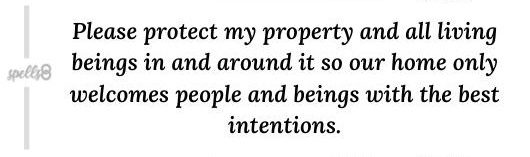
- Sprinkle it Around
With your mantra or affirmation in mind, sprinkle the salt mixture along every threshold and entry into your home. Include all doors, windows, and walkways. You can even repeat the above incantation if you’d like, drawing on the energy of the salt mixture as you do so.
For Your Listening PLeasure – Samhain
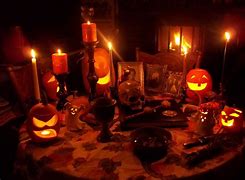
Projects to Celebrate Samhain, the Witches’ New Year
As Samhain approaches, you can decorate your home with a number of easy craft projects. Start celebrating a bit early with these fun and simple ideas that honor the final harvest, and the cycle of life and death
01
of 10
Pagan Treat Bags for Samhain
Do you have Pagan kids coming over for a Samhain event? You can have a kid-friendly celebration by putting together a goodie bag that’s representative of your Pagan spirituality. The key here is to do some creative, outside the box thinking. Sure, there are a ton of Halloween decorations in the store at this time of year, but not all of those are really connected with Pagan religious belief systems. They’re really more about the secular celebration of Halloween, which is fine, unless you’re looking for kid-friendly stuff that honors Pagan spirituality.
Here are a few things to try:
- Decorate the bags themselves with symbols that are meaningful to you – depending on the pantheon your group honors, you might include designs that are associated with Greek, Roman, Celtic, or Norse mythology.
- Small herbal sachets: sew herbs into a fabric pouch. Use lavender to help with dreams, or other appropriate plants.
- Crystals and gemstones: As long as the kids attending your event are beyond the put-everything-in-your-mouth stage, you could include rose quartz for love, hematite for protection, and more.
- A Portable Altar Kit: Depending on how old the kids are, think about making an altar box that fits in a backpack or pocket. This might not be useful or safe for really young children, but older tweens and teens could use it responsibly.
- Divination tools: make a simple pendulum with a stone wrapped in wire and attached to the end of a chain. Add a simple divination set by painting symbols on stones or wooden discs.
- Wands: Make a simple wand with a stick and a crystal wrapped in wire.
- Deity symbols: Does your tradition honor a particular god or goddess? Consider adding representative symbols – owls for Athena, cats for Bastet, or an antler for Cernunnos. Try printing out a wallet-size image of the deity on heavy cardstock, add a prayer to your god/dess on the reverse side, and laminate it.
Finally, remember, Samhain is the same day as Halloween, so never underestimate the power of a few strategically placed pieces of delicious candy!
Click here for more craft ideas for Samhain from learnreligions.com
Wheel of the Year

The Wheel of the Year is a symbol of the eight Sabbats (religious festivals) of Neo-Paganism and the Wicca movement which includes four solar festivals (Winter Solstice, Spring Equinox, Summer Solstice, Fall Equinox) and four seasonal festivals (celebrating or marking a significant seasonal change). Contrary to modern-day Wiccan claims, there is no evidence of an ancient Wheel of the Year in its present form but it is clear that the Celts of thousands of years ago celebrated the festivals the wheel highlights, even if these celebrations were known by another name now long lost.
In the ancient Celtic culture, as in many of the past, time was seen as cyclical. The seasons changed, people died, but nothing was ever finally lost because everything returned again – in one way or another – in a repeating natural cycle. Although time in the modern world is usually regarded as linear, the cyclical nature of life continues to be recognized.
The modern-day Wheel of the Year was first suggested by the scholar and mythologist Jacob Grimm (1785-1863 CE) in his 1835 CE work, Teutonic Mythology, and fixed in its present form in the 1950s and early ’60s CE by the Wicca movement. The wheel includes the following holy days (most dates flexible year-to-year): …
Click here to read the rest of this article about the Wheel of the Year
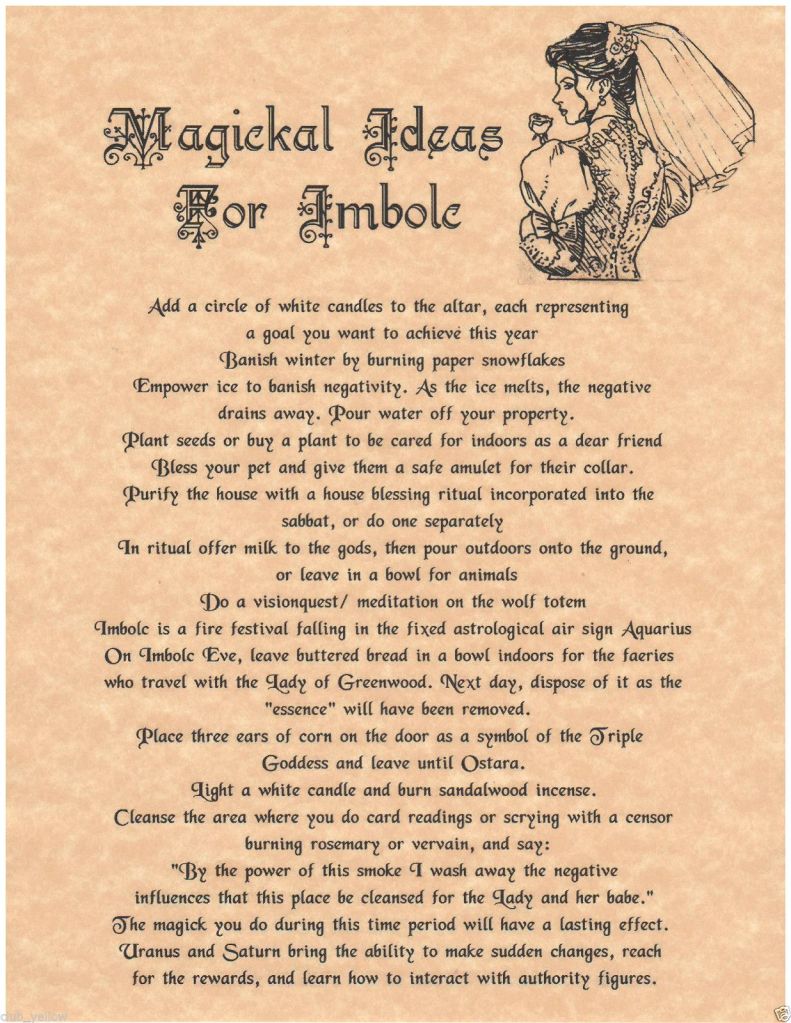
Magickal Ideas for Imbolc
Let’s Have Some Fun – Lammas


Let’s Have Some Fun – Imbolc

 Witches Of The Craft®
You must be logged in to post a comment.