
SONG OF SUMMER SOLSTICE | Kulning & Nyckelharpa
This song is short but sweet.

I don’t know about all of you but even as a child I thought they had the predictions backwards. I mean wouldn’t it make more sense if the groundhog didn’t see his shadow that there would be 6 more weeks of winter? Anyway, no matter whether Punxsutawney Phil sees his shadow or not according to the Sabbat dates on our Northern Hemisphere Wheel of The Year from Imbolc we go approximately 6 weeks and 4 to 5 days to when we celebrate Ostara. I wonder if it means 6 more weeks until fall starts in the Southern Hemisphere? Today is Lammas in the Southern Hemisphere and the end of the 6 weeks and 4 to 5 days would be on Mabon. Well enough of my ramblings on the actual Groundhog Day not the movie.
Here is what CBS News has to say about Groundhog day 2021

May your harvest be plentiful growing from what you sowed on Imbolc.
Blessed be dear ones.

The American Thanksgiving Day began in Plymouth Colony, Massachusetts, in 1621, and celebrated the Pilgrims’ first year’s harvest. Originally set by president Abraham Lincoln as the last Thursday of November, the holiday was changed by Franklin D. Roosevelt in 1939 to the fourth Thursday of November.
Actually, days of thanksgiving are far older than our American can celebration, which is an adaption of Lammas (Loaf Mass Day). In Britain, it was celebrated on August 1, when the wheat crop was good. In fact, most agricultural peoples have special days set aside to celebrate a good crop and the end of the harvest-usually referred to as the Harvest Home. Our modern Thanksgiving is a combination of two very different customs: toms: the harvest home feast and a formal day of thanksgiving proclaimed by community leaders to celebrate a victory.
It was during the Revolutionary War that the need for national holidays, rather than local holidays, developed. It was George Washington that first declared November 1, as a national day of thanksgiving. But regional traditions were too strong and the day never caught on. With the Industrial Revolution and hundreds of immigrants pouring into America, the need for a national day of thanksgiving was once more addressed. It was finally during the Civil War that President Lincoln, in an effort to unite the country, declared the last Thursday of November as Thanksgiving Day. The holiday began with the usual morning ing church service, followed by a feast and then games.
Today we celebrate Thanksgiving with parades, the largest being Macy’s New York display, which began in 1927 with the appearance of Macy’s huge balloons designed by puppeteer Tony Sarg. The construction of the balloons is carefully executed by the Goodyear Aerospace Corporation, in Akron, Ohio. Preparations for the parade are year round, reaching a peak the day before Thanksgiving when the balloons arrive at 77th Street and Central Park West. They are removed from their crates and anchored with sand bags and giant nets. On Thanksgiving Day, more than 2000 of Macy’s employees arrive at 6 a.m. to march in the parade, which, 75 years later, is still the highlight of Thanksgiving Day.

August, the eighth month of the current Gregorian calendar and the third month of Summer’s rule, derives its name from Augustus (Augustus Caesar).
The traditional birthstone amulets of August are the peridot and the sardonyx; and the gladiolus and the poppy are the month’s traditional flowers.
August is shared by the astrological signs of Leo the Lion and Virgo the Virgin, and is sacred to the following Pagan deities: Ceres, the Corn Mother, Demeter, John Barleycorn, Lugh, and all goddesses who preside over agriculture.
During the month of August, the Great Solar Wheel of the Year is turned to Lammas, one of the four Grand Sabbats celebrated each year by Wiccans and modern Witches throughout the world.
August 1~ 2 On this day, the Lammas sabbat is celebrated by Wiccans and Witches throughout the world. Lammas (which is also known as Lughnasadh, August Eve, and the First Festival of Harvest) marks the start of the harvest season and is a time when the fertility aspect of the sacred union of the Goddess and Horned God is honored. The making of corn dollies (small figures fashioned from braided straw) is a centuries-old Pagan custom which is carried on by many modern Witches as part of the Lammas sabbath rite. The corn dollies are placed on the sabbath altar to represent the Mother Goddess who presides over the harvest. It is customary on each Lammas to make or buy a new corn dolly and then burn the old one from the past year for good luck.
On this day in the country of Macedonia, Neo-Pagans celebrate the Day of the Dryads, an annual nature festival dedicated to the maiden spirits who inhabit and rule over forests and trees.
——————————————————————————–
August 2
On this day, the Feast of Anahita is celebrated in honor of the ancient Persian goddess Anahita, a deity associated with love and lunar powers.
Lady Godiva Day is celebrated annually on this date in the village of Coventry, England, with a medieval-style parade led by a nude woman on horseback.
——————————————————————————–
Today Is …
August 3
The harvest season begins on this date in Japan with an annual festival called the Aomori Nebuta. Bamboo effigies with grotesquely painted faces are paraded through the streets in order to drive away the spirits of sleep.
Feast Of Caligo, Mother Of Chaos.
England: Bell-Belt Day In Congleton, Cheshire: drunken excesses were announced by midnight runners wearing belts of bells. In 1601, money destined for the church was hijacked to buy a replacement town bear:
“Congleton rare, Congleton rare, Sold the Bible to pay for a bear”.
Weather Prognostication – Greeks look at the weather on the third day of August to predict the weather for the next three months. If it’s nice, it will be nice for the next three months. Rufus, Anneli, The World Holiday Book, Harper San Francisco 1994
)0( GrannyMoon’s Morning Feast Archives Remember the ancient ways and keep them sacred! )0( Live each Season as it passes; breathe the air, drink the drink, taste the fruit, and resign yourself to the influences of each. ~Henry David Thoreau (1817 – 1862)
Courtesy of GrannyMoonsMorningFeast

| Colors: Gray, green, gold, yellow Symbols: All grains, breads, threshing tools, athame Date: Occurs 1/4 of a year after Beltaine. True astrological point is 15 degrees Leo, but tradition has set August 1st as the day it is typically celebrated. Since the Ancients Celts passed their days from sundown to sundown, the celebration would usually begin the night before on July 31st.The turning of the wheel now brings us to Lughnasadh (LOO-nus-uh), also known by its medieval Christian name of Lammas, named in honor of the Celtic god Lugh, a name which means “light” or “shining.” Although somewhat confusing, we are not celebrating the death of Lugh (the God of light does not mythically die until the autumn equinox), but rather the funeral games that Lugh hosted to commemorate the death of his foster mother, Taillte. In Ireland, Lugnasadh is often called the “Tailltean Games”. A common feature of the games were the “Tailltean marriages”, rather informal and lasting only a year and a day or until next Lammas, at which time the couple would decide to continue the arrangement or stand back to back and walk away, thereby dissolving the marriage. The parish priest was not bothered to perform these trial marriages, they were usually performed by a poet, bard, priest or priestess of the Old Religion, or shanachie, and were very common into the 1500’s. It is from this custom that our present-day Handfastings must come. According to one of his many legends, Lugh was the last great leader of the Tuatha de Dannan. In one of the Tuatha’s victories, Lugh spared the life of Bres, a defeated enemy captain, in exchange for advice on ploughing, sowing, and reaping. He was seen as a multi-talented deity, being capable and quite good at all he undertook. The myths of Lugh include the prevalence of his many skills and the wedding of these skills to the potential or unrealized abundance of the land. According to the writing of Caesar, he was also regarded as the patron of all the arts, traveling, and influence in money and commerce. To the Romans, Lugh was seen as a counterpart to Mercury. Lugh is the son of Arianrhod, who is associated with sacred kingship and Three-fold Death. His wife’s name is Blodeuwedd, also known as the Flower Maiden. Lughnasadh is the first of the three harvest Sabbats, Mabon and Samhain being the other two, which celebrates the ripening grains and corn. With the harvest so prevalent, Pagans see the theme of the sacrificed god motif emerge. His death is necessary for rebirth of the land to take place. Called by many names, “Green Man,” “Wicker Man,” “Corn Man” or just the “Spirit of Vegetation,” his essence begins to merge with the harvested crops, a sacrifice that will be realized with the new growth in the spring. In old times, it was the duty of the King to sacrifice himself for the land, an idea that has been seen in the many legends of cultures both new and old, throughout recorded history. The gathering of the first crops of the year is also used to symbolize the success and extent of the power raised from the Beltane rites when the Sacred Marriage of the Lord and Lady took place. The theme of sexuality and reproduction is carried over into Lughnasadh as well to ensure the remainder of a good harvest. This sabbat is also known as the celebration of bread. As bread was one of the main staples of our ancestors, the ripening of the grain was the cause for great celebration. The reaping, threshing and preparation of these breads spawned great ritual and ceremony to ensure bounty for the following year. This time of the year finds us with fields to harvest, the first of a bountiful crop that will hold us through the winter months. Even though the hottest days of summer are upon us, we have but to observe to see that fall is just around the corner. Shadows are growing longer as the days slowly become shorter. Squirrels are busily gathering food for the coming winter. It is a time to begin canning produce from the garden, a time to save and preserve. Some ideas for celebration include:
And so the wheel turns….. |
|||
| Interact | |||

1. Collect corn husks, dry and store in shade. “Corn” was a generic term for cereal crops (i.e., wheat, barley, oats), and New World corn was added after 1520. Our non-irrigated winter wheat is harvested in June and July where I live. We can collect wild wheat stalks and seeds, tie, and hang in shade. Make a corn dolly and keep until the Yule Celebration. We can pick fruit (apricots, berries, figs and plums) and dry them. Many kinds for fruit are ripe in late July, so place some of these on your home altar. Many garden herbs are at their peak and ready for harvesting to make herbal remedies, air fresheners, use in herbal magic, and for decoration. There are hundreds of good books and websites on the magical, sacramental, and health uses of herbs.
2. Read about and make a loaf of bread. Loaves of bread are a traditional part of the First Harvest Feast. Break bread into four pieces and place at each of the Four Corners altars. Lammas means “Loaf Mass” in the Welsh language. Sharing bread is a common feature of a Lammas celebration. What is the role of baking bread in human culture? Find a really good bakery in your area.
3. This is a good month for celebrating. We, in America, celebrate the Fourth of July, and many counties have their annual Fairs. Be try to be very thankful for our peaceful and bountiful life in America. We are thankful for our religious freedom and the 1st Amendment. Americanism and patriotism are forms of a popular religion – we should reflect on our symbols and heritage. Take a look at Ceisiwr Serith’s website and links on Americanism. Hang up the flags, sing, play, smile, celebrate. Remember our fallen heroes, brave soldiers, and hardworking Ancestors.
4. Prepare for the “Games” of the First Harvest Feast. The Greek Olympics and Roman Heracleia games were held at this time. What games might you play? Horseshoes, boche ball, races, swimmng races, croquet, volleyball, badminton, frisbee, baseball, wrestling, spear throwing, arrow shooting, weight tossing …. Get your equipment and playing court ready, and practice.
5. Renew supplies of your favorite ritual-recreational drug: coffee, tobacco, alcohol (whiskey, beer, wine), fuzzy herbs, etc.. Beer and whiskey, made from barley, are often part of joyful summer harvest feast celebrations. Read about the song John Barleycorn.
6. Think about the power of the sun. How can we use solar power? Dry your clothes in the sun. Build a simple box with screen so you can use the power of the summer sun to dry your fresh fruit.
7. Do some thinking, reflection, or discursive meditation on various themes. Here are some themes to reflect upon: What are the relations between Chaos, Gaia, and Eros? What role does more sunlight play in bringing forth the bountiful harvest? What does summertime mean to you?
8. Implement new ways to stay cool that use less electrical energy. Switch to an evaporative cooler in areas with low humidity. Keep all windows covered. Carefully place fans to circulate air indoors. Work early in the morning and rest in the hot afternoon. Drink plenty of water. If your nights are cooler, under 80, draw the cool air indoors at night. A gable fan can really help reduce heat indoors.
9. Check out astronomical details about the rising of the Dog Star, Sirius, in late July, and the beginning of the “Dog Days of Summer.”
10. The Celtic God, Luga (Lugh, Long Hand), is noted for his high level skills in many arts and crafts: smith, carpenter, bard, healer, herbalist, magician, gamesman, spear throwing, military leadership, etc. Get out your paintbrush. Fix something in the yard or garden or home. Tidy up the garden. Create something, make something. Start learning a new practical skill or craft. Clean your weapons and practice with the weapons.
11. Working and meditating in the garden is an important facet of my spiritual path. I need to regularly reconnect with the earth and the autumn season outdoors. I live in Red Bluff, California, USDA Zone 9, Northern Hemisphere. My late September gardening chores might be quite different from yours, depending upon where you live. Tend your garden daily. Water your garden each day. Weed your vegetable garden. Harvest squash, tomatoes, peppers and other vegetables from your garden each day. Review your own lists of chores for July and August, and act accordingly.
12. Read about Lammas, Lughnasadh, and summer festivals around the world. Add notes and links to books, magazines, and webpages on the subject. See my bibliography and links above. Visit your local public library or college library to obtain access to books, media and magazines on the subject. Study about ancient Indo-European religions. I update my Months webpages on July and September.
13. Add some appropriate Lammas, Lughnasadh, or Mid-Summer songs, chants, prayers, reflections, invocations, or poems to your Neo-Pagan Craft Journal, Book of Shadows, blog, website, or Ritual Handbook. Write in your personal journal. Most spiritual seekers keep a notebook, journal or log as part of their experimental, creative, magical and experiential work.
14. Stay at home. Improve your home, backyard, or garden. Eliminate long driving trips. Do you really need to “Go” anywhere? Do you really need to fly by airplane to another country? Explore your backyard, neighborhood, local community, nearby city, county wide area, regional area within 100 miles. Visit a local “sacred site.” For us, for example, this could be Mt. Shasta, the headwaters spring of the Sacramento River in Mt. Shasta City, the Sacramento River at Woodson Bridge Park, a long walk in the forest below nearby Mt. Lassen, sitting on the shore of Whiskeytown Lake, sitting in my backyard in the moonlight, or visiting a beautiful church or college or park that is nearby. Watch a DVD on a spiritual subject, sacred place, or inspirational topic. Learn more about your local environment.
15. Read solitary or group rites for Lughnasadh available in books and webpages (see above). Create your own ritual for Lughnasadh. Practice the ritual. Conduct the ritual at a convenient time for you, or your family and/or friends, as close to the day of the autumnal equinox as possible. Attend a public Mabon ritual of a local NeoPagan group.
16. A large fire is often lit in your safe outdoor fireplace as part of celebrating Lughnasadh. Take special care because many areas are quite dry in early August. Maybe use a few fireworks left over from the Fourth of July in America.
17. Thoroughly clean, dust, tidy up, refreshen, improve, and add appropriate seasonal decorations to your home altar. This should normally be clean and tidy, however an extra cleaning before the Lughnasadh celebration is a way to express your reverence, create a visible reminder of your thoughts and devotional practices, and to offer hospitality to the nature spirits, ancestors, and Shining Ones. If you don’t have a home altar, read some books and webpages about setting one up in your home or garden, and then establish one this holiday season.
Lughnasadh Celebrations

At Lammas, sometimes called Lughnasadh, it’s time to celebrate the first harvest of the year, and recognize that the hot summer days will soon come to an end. Celebrated July 31st – August 1st, the plants of spring are withering and dropping their seeds to ensure future crops. Grains are ready to be harvested and the fruits are ripe for picking.
As autumn begins, the Celtic Sun God enters his old age, but is not yet dead. The God symbolically loses some of his strength as the Sun rises farther in the South each day and the nights grow longer.
The Christian religion adopted this theme and called it ‘Lammas ‘, meaning ‘loaf-mass’, a time when newly baked loaves of bread are placed on the altar. An alternative date around August 5 (Old Lammas), when the sun reaches 15 degrees Leo, is sometimes used by Covens.
Source:
Wiccan & Pagan Holidays: An Easy Beginner’s Guide to Celebrating Sabbats and Esbats (Living Wicca Today Book 1)
Kardia Zoe

In many cultures, there are different legends and lore surrounding Lammas (Lughnasadh). Here are a few of the stories about this magical harvest celebration from around the world.
In Israel, the festival of Shavout commemorates the beginning of the harvest, as well as honoring the date that Moses received the Torah on Mt. Sinai. The final sheaf of wheat is brought to the rabbi for a blessing, synagogues and homes are decorated with flower, and a great feast is prepared for all to enjoy.
The festival of Onam is celebrated in India, and people dress up in their finest clothes and give food to the poor. Onam is celebrated in honor of King Mahabali, who was a ruler of Kerala. In one story, the god Vishnu approached Mahabali dressed as a beggar, and asked for land, which Mahabali gave him. Mahabli ended up buried under the earth by Vishnu, but was allowed to return once a year, symbolizing the planting of the seed and the subsequent harvest.
Thor’s wife, Sif, had beautiful golden hair, until Loki the prankster cut it off. Thor was so upset he wanted to kill Loki, but some dwarves spun new hair for Sif, which grew magically as soon as it touched her head. The hair of Sif is associated with the harvest, and the golden grain that grows every year.
In the Shetland Islands, farmers believed that grain harvesting should only take place during a waning moon. They also believed this about the fall potato crop, and the cutting of peat.
At Lughnasadh, calves are weaned, and the first fruits are ripe, such as apples and grapes. In some Irish counties, it was believed farmers had to wait until Lughnasadh to start picking these fruits, or bad luck would befall the community.
In some countries, Lammas is a time for warrior games and mock battles. This may hearken back to the days when a harvest festival was held, and people would come from miles around to get together. What better way for young men to show off their strength and impress the girls than by whacking away at all the competition? Games and contests are also held in honor of Lugh, the mighty Celtic craftsman god, in which artisans offer up their finest work.
It’s become a custom to give people the gift of a pair of gloves at Lammastide. In part, it’s because winter is just around the corner, but it’s also related to an old tradition in which landowners gave their tenants a pair of gloves after the harvest. The glove is a symbol of authority and benevolence.
Source:
By Patti Wigington, Pagan and Wicca Expert
Article found on & owned by About.com

Time of Day: Mid-Afternoon, Noon to 5 pm
Time of Life: 40-60’s, Middle Age, Height of Powers, Fatherhood
Decorations: Bread, Corn, Wheat, Fruits, Corn Dolly, Green Man
Foods: Plums, Peaches, Grapes, Wheat, Lamb, Berries, Barley Cakes, Breads
Herbs: Heather, Acacia, Hollyhock, Aloes, Sunflowers, Frankincense, Sandalwood, Rose
Tools: Baskets, Lugh’s Spear (Areadbhar), Sickles, Scythes
Goddesses: Ceres, Demeter, Corn Mother, Pomona, Mother Earth
Gods: Lugh, Mercury, Hermes, Adonis, John Barleycorn, Green Man
Lughnasadh is more of a Men’s Holiday
Themes
Harvest, Transformation, Fruitfulness, Change Abundance, Completion, Prosperity, Robustness, Achievement, Letting Go, Reaping, Sacrifice, Purification, Contentment, Bread of Life, Table of Plenty, Ever Flowing Cup, Chalice of Plenty
Farming Activities
Harvesting and preserving wheat, corn, vegetables
Animals: Crow, Salmon
Tarot, Divination: Wheel of Fortune, Justice
Colors: Golden Yellow, Light Brown, Purple, Orange, Red-Brown, Brown-Grey
Activities, Celebrations
Dancing, Singing, Playing Music, Poetry Reading, Bardic Competitions, Games, Competitions, Men’s Sports, Drinking beer, whiskey, mead, iced tea
Sacred Circle (Valley Spirit): South-West, Violet
Celebrations:
Lughnasadh – Druid, Neo-Pagan, Lammas – Wiccan, Mea’n Fo’mhair (Greenman) – Druid, Welsh
Anyone attending our online coven gathering on Saturday, August 1, 2015 this will be the ritual we are following. Nothing is needed to participate in this ritual. For more information on where and when the gathering will take place please scroll down and click on the banner for Coven Life’s “Home” page. Any questions please email me at ladybeltane@aol.com
LAMMAS GATHERING
I will be closing the circle around us:
With my Sword pointed at the ground: I call upon Fire to guard this circle from all things negative outside of it.
With my Sword pointed at shoulder level: I call upon Water to keep this circle safe from all things negative.
With my Sword above head: I call upon Air to keep this circle safe from all things negative.
We enter this circle in perfect love and perfect trust. We stand in a place that is not a place. In a time that is not a time.
Calling the Watchtowers:
Lay sword on altar.
Facing East: Power of ancient dreams, ancestors of the mighty east
Come forth, O guardians of Air.
Let your wings of intelligence my protection be
Hear this call, let my words draw you near.
Lock the gate that none may pass unless
They come in love and trust. Blessed Be!
Facing South: Power of ancient dreams, ancestors of the mighty south
Come forth, O guardians of Fire.
May your firey breath cleanse my work.
Hear this call, let my words draw you near.
Lock the gate that none may pass unless
They come in love and trust. Blessed Be!
Facing West: Power of ancient dreams, ancestors of the mighty west
Come forth, O guardians of Water.
May your sweeping waters bring protection all around.
Hear this call, let my words draw you near.
Lock the gate that none may pass unless
They come in love and trust. Blessed Be!
Facing North: Power of ancient dreams, ancestors of the mighty north
Come forth, O guardians of Earth.
Let the North Star crown your brow.
Hear this call, let my words draw you near.
Lock the gate that none may pass unless
They come in love and trust. Blessed Be!
This circle is now closed around us and I say: We stand in a place that is not a place, in a time that is outside of time. I welcome you in perfect love and perfect trust. Merry Meet and Merry greet.
I invoke Mother Earth, her of bounty and beauty to come into our circle. I invoke the Lugh, he of craftsmanship in beauty and toil to come into our circle.
Waiting for the power to rise and the deities to enter.
Sitting before me is a loaf of bread made in the shape of a sickle. With it cradled in my hands:
“We thank Mother Earth, Air, Water, Fire and Earth for the grain and other things that made it possible to make this loaf.” (I tear a bite off to save for an offering, that I will place outside for all attending after we are through. Then put the loaf down)
I pick up my chalice: “Lugh we thank you for all the know how you have given us to make instruments for many purposes in our lives.” (I set the chalice back down so the first sip maybe poured on the ground as an offering to Lugh for all attending after we are done.)
Before dismissing the Watchtowers and opening the circle I say: May no harm come to those within or without as we honor this goddess, god, and the elements of Air, Water, Fire and Earth.
I dismiss the Watchtowers starting in the North and walking counter clockwise/witthershins.
Earth I now send you back for where you came with thanks for your protection and power you have given this circle.
Water I now send you back for where you came with thanks for your protection and power you have given this circle.
Fire I now send you back for where you came with thanks for your protection and power you have given this circle.
Air I now send you back for where you came with thanks for your protection and power you have given this circle.
Walking counter clockwise/witthershins
Holding my sword above my head Air I send you back from where you came with heartfelt thanks for your protection.
Holding my sword at should height Water I send you back from where you came with heartfelt thanks for your protection
Holding my sword towards the ground Fire I send you back from where you came with heartfelt thanks for your protection
The circle is now closed. May you go from it with peace and love. Merry part until we Merry meet again.
At Lammas, also called Lughnasadh, the hot days of August are upon us, much of the earth is dry and parched, but we still know that the bright reds and yellows of the harvest season are just around the corner. Apples are beginning to ripen in the trees, our summer vegetables have been picked, corn is tall and green, waiting for us to come gather the bounty of the crop fields.
Now is the time to begin reaping what we have sown, and gathering up the first harvests of grain, wheat, oats, and more.
This holiday can be celebrated either as a way to honor the god Lugh, or as a celebration of the harvest.
Grain has held a place of importance in civilization back nearly to the beginning of time. Grain became associated with the cycle of death and rebirth. The Sumerian god Tammuz was slain and his lover Ishtar grieved so heartily that nature stopped producing. Ishtar mourned Tammuz, and followed him to the Underworld to bring him back, similar to the story of Demeter and Persephone.
In Greek legend, the grain god was Adonis. Twogoddesses, Aphrodite and Persephone, battled for his love. To end the fighting, Zeus ordered Adonis to spend six months with Persephone in the Underworld, and the rest with Aphrodite.
In early Ireland, it was a bad idea to harvest your grain any time before Lammas — it meant that the previous year’s harvest had run out early, and that was a serious failing in agricultural communities.
However, on August 1, the first sheaves of grain were cut by the farmer, and by nightfall his wife had made the first loaves of bread of the season.
The word Lammas derives from the Old English phrase hlaf-maesse, which translates to loaf mass. In early Christian times, the first loaves of the season were blessed by the Church.
In some Wiccan and modern Pagan traditions, Lammas is also a day of honoring Lugh, the Celtic craftsman god. He is a god of many skills, and was honored in various aspects by societies both in the British Isles and in Europe. Lughnasadh (pronounced Loo-NAS-ah) is still celebrated in many parts of the world today. Lugh’s influence appears in the names of several European towns.
In our modern world, it’s often easy to forget the trials and tribulations our ancestors had to endure. For us, if we need a loaf of bread, we simply drive over to the local grocery store and buy a few bags of prepackaged bread. If we run out, it’s no big deal, we just go and get more. When our ancestors lived, hundreds and thousands of years ago, the harvesting and processing of grain was crucial. If crops were left in the fields too long, or the bread not baked in time, families could starve. Taking care of one’s crops meant the difference between life and death.
By celebrating Lammas as a harvest holiday, we honor our ancestors and the hard work they must have had to do in order to survive. This is a good time to give thanks for the abundance we have in our lives, and to be grateful for the food on our tables. Lammas is a time of transformation, of rebirth and new beginnings.
The Wheel of the Year has turned once more, and you may feel like decorating your house accordingly. While you probably can’t find too many items marked as “Lammas decor” in your local discount store, there are a number of items you can use as decoration for this harvest holiday.
Because of its association with Lugh, the skilled god, Lammas (Lughnasadh) is also a time to celebrate talents and craftsmanship. It’s a traditional time of year for craft festivals, and for skilled artisans to peddle their wares. In medieval Europe, guilds would arrange for their members to set up booths around a village green, festooned with bright ribbons and fall colors. Perhaps this is why so many modern Renaissance Festivals begin around this time of year!
Lugh is also known in some traditions as the patron of bards and magicians. Now is a great time of year to work on honing your own talents. Learn a new craft, or get better at an old one. Put on a play, write a story or poem, take up a musical instrument, or sing a song. Whatever you choose to do, this is the right season for rebirth and renewal, so set August 1 as the day to share your new skill with your friends and family.
By: Patti Wigington
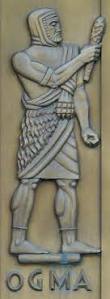
In Irish-Celtic myth, Ogma is the god of eloquence and learning. He is the son of the goddess Danu and the god Dagda, and one of the foremost members of the Tuatha Dé Danann. He is the reputed inventor of the ancient Ogham alphabet which is used in the earliest Irish writings.
In the final battle at Mag Tuireadh he managed to take away the sword of the king of the Fomorians, but had to pay with his life for this feat. His Celtic equivalent is Ogmios.
Ogma or Oghma is a character from Irish mythology. A member of the Tuatha Dé Danann, he is often considered a deity and may be related to the Gaulish god Ogmios.
He fights in the first battle of Mag Tuired, when the Tuatha Dé take Ireland from the Fir Bolg. Under the reign of Bres, when the Tuatha Dé are reduced to servitude, Ogma is forced to carry firewood, but nonetheless is the only one of the Tuatha Dé who proves his athletic and martial prowess in contests before the king. When Bres is overthrown and Nuadu restored, Ogma is his champion. His position is threatened by the arrival of Lugh at the court, so Ogma challenges him by lifting and hurling a great flagstone, which normally required eighty oxen to move it, out of Tara, but Lugh answers the challenge by hurling it back. When Nuadu hands command of the Battle of Mag Tuired to Lugh, Ogma becomes Lugh’s champion, and promises to repel the Fomorian king, Indech, and his bodyguard, and to defeat a third of the enemy. During the battle he finds Orna, the sword of the Fomorian king Tethra, which recounts the deeds done with it when unsheathed. During the battle Ogma and Indech fall in single combat, although there is some confusion in the texts as in Cath Maige Tuired Ogma, Lugh and the Dagda pursue the Fomorians after the battle to recover the harp of Uaitne, the Dagda’s harper.
He often appears as a triad with Lugh and the Dagda, who are sometimes collectively known as the trí dée dána or three gods of skill, although that designation is elsewhere applied to other groups of characters. His father is Elatha and his mother is usually given as Ethliu, sometimes as Étaín. His sons include Delbaeth and Tuireann. He is said to have invented the Ogham alphabet, which is named after him.
Scholars of Celtic mythology have proposed that Ogma represents the vestiges of an ancient Celtic god. By virtue of his battle prowess and invention of Ogham, he is compared with Ogmios, a Gaulish deity associated with eloquence and equated with Herakles. J. A. MacCulloch compares Ogma’s epithet grianainech (sun-face) with Lucian’s description of the “smiling face” of Ogmios, and suggests Ogma’s position as champion of the Tuatha Dé Danann may derive “from the primitive custom of rousing the warriors’ emotions by eloquent speeches before a battle”, although this is hardly supported by the texts. Scholars such Rudolf Thurneysen and Anton van Hamel dispute any link between Ogma and Ogmios.
*
A Proto-Indo-European root *og-mo– ‘furrow, track, incised line’ may be the origin of the stem of the name. In addition, Proto-Celtic had a causative verbal suffix *-ej– ~ *-īj-. A hypothetical Proto-Celtic *Ogm-īj-o-sogm-. This agent noun would therefore mean ‘furrow-maker, incisor’ and may have had a metaphorical sense of ‘impresser.’ therefore looks very much like an agent noun derived from a verb formed by the addition of this causative suffix to the stem *
The Irish god of writing, eloquence and poetry. Ogma was credited of being inventor of the Celtic writing systems that the Druids used for their magic. These scripts were known as Ogham.
Ogma was the son of Dagda and the goddess Danu. Some other writers say that Ogma and Dagda were brothers; in this version they were the sons of Eithne. Ogma had also being called the son of Elatha, the king of the Fomorians.
Ogma was one the seven champions in the First Battle of Moytura (Mag Tuired), but when Bres became the king of Tuatha dé Danann, Ogma was degraded into working on humiliating manual job of gathering firewood.
When Lugh went to Nuada, asking for a place to serve the king, Ogma seemed to be Nuada’s foremost fighter. During the second battle of Moytura, Ogma had killed one of the Fomorian leaders, named Indech, the son of Domnu.
Ogma had married Etain, the daughter of Dian Cécht. Ogma had a son named Caipre. Some say that he was the father of MacCuill, MacCecht and MacGrené (MacGrene), the three Danann kings who ruled Ireland, during the Milesian invasion, though other say that Neit was their father.
To the Celtic Gauls he was called Ogmios. According to both Gallic and Irish myths Ogma was a warrior god, depicted as a wrinkled old man, wearing lion’s skin cloak, carrying a bow and club. The Romans considered Ogmios as the Celtic equivalent of Hercules (Greek Heracles). They also depicting Ogimos as holding people chained to his tongue by their ears, to indicate he was the god of eloquence and poetry.
By Patti Wigington, About.com Guide
To make your own magical Lammas incense, first determine what form you’d like to make. You can make incense with sticks and in cones, but the easiest kind uses loose ingredients, which are then burned on top of a charcoal disc or tossed into a fire. This recipe is for loose incense, but you can adapt it for stick or cone recipes.
Add your ingredients to your mixing bowl one at a time. Measure carefully, and if the leaves or blossoms need to be crushed, use your mortar and pestle to do so. As you blend the herbs together, state your intent. You may find it helpful to charge your incense with an incantation, such as:
We’re thankful this day for the gift of rebirth,
Fruits and vegetables, the bounty of earth.
For the Harvest Mother with her basket and scythe, Abundance and fertility, and the blessings of life.
We’re grateful for the gifts we carry within
And for what will become, and what has been.
A new day begins, and life circles round,
As grain is harvested from the fertile ground.
Blessings to the earth and to the gods from me,
As I will this Lammas, so it shall be.
Store your incense in a tightly sealed jar. Make sure you label it with its intent and name, as well as the date you created it. Use within three months, so that it remains charged and fresh.
By Patti Wigington, About.com Guide
At Lammas, the harvest is kicking in. This is a time of year when the masculine energy of the earth is in full swing. For starters, it’s the season of the spirit of grain, and a time to honor Lugh, the craftsman god. Lugh was not only a craftsman, but a gifted smith and swordsman. The season from late summer to the middle of fall is often a season of heightened energy for those who identify with the warrior soul.
The warrior in today’s society is someone who understands the idea of right action. He or she follows a code of honor, and abides by that code even when it may be inconvenient or unpopular. The warrior recognizes that the forces of creation and destruction must be balanced. The warrior is empowered because he or she knows his own circumstances, limitations and goals. Perhaps most importantly, the warrior is someone who has made past mistakes, owned up to them, and learned not to repeat them.
A note on women and the concept of warrior: the notion of masculine energy and a warrior soul is not exclusive to men. Many women have powerful warrior spirits. Think of the warrior soul as an archetype of personal empowerment. Indeed, throughout history, many women have been known as mighty warriors. If it helps you get in touch with your inner warrior, envision some of them as you work. Picture Boadicaea of the Iceni, conquering the Roman army, or Penthesilea battling her lover, Achilles. If you lean towards more current history, consider France’s Jeanne d’Arc, or Grainne’ni Mhaille, the Irish pirate. For those who connect best with pop culture, even television’s Buffy the Vampire Slayer, Firefly‘s Zoe, or Xena make perfectly good warrior woman archetypes.
You may wish to prepare your mind and body prior to starting the meditation. Some people like to take a ritual bath as a method of cleansing the body, and clearing the mind. If you wish, you can anoint yourself with Blessing Oil or another oil of your choice before beginning. Since you’re performing a warrior meditation, why not try adding a bit of war paint to your face and body?
Before getting started, make sure you can work undisturbed somewhere for about an hour. Turn off the cell phone, get off the Internet, and send the kids off to play with friends for a while. Perform this meditation outside if at all possible. Set up a small altar that you can sit in front of. Since you’re working outside, consider using a flat stone or a tree stump as a natural altar. On it, place symbols of the warrior spirit: a knife, a drum, an arrow, a shield — anything that helps you connect with your inner warrior. If you have ancestors or loved ones that represent the warrior archetype to you, feel free to include photographs or other heirlooms. Finally, add a purple candle – purple is the color of royalty and power, and of honor.
Although this meditation is designed to be performed solo, it can easily be adapted into a group practice, or turned into a full-fledged ritual.
Sit before your altar, and light the purple candle. Focus on the flame, and visualize the fiery passion of the warrior soul. Think about the things you’ve done in your life, incidents in which you should have taken one path, but instead chose another. Consider mistakes you’ve made, and how they’ve affected not only you, but other people. Think about the consequences of these actions. Did you learn anything from these events?
Take this knowledge of past action, and move it into the present. As a warrior, you have followed a particular path to get to the present, one with many roadblocks, twists, and obstacles in the way. How has this helped to shape the person you are now? Think about the person you have become, and how you have grown during the different experiences you’ve had.
Now, think about the person you wish to be, and how the past and present will influence the future. Understand that for you to follow a principle of right action, there may be times when you make decisions that are unpopular. Are you willing to stand up for your convictions? Are you willing to live in a manner that will earn you the respect and honor of others? To do this, you must first and foremost honor and respect yourself. One way to live rightly and with honor is to make a pledge, both to yourself and to the gods of your tradition.
As you focus on the burning flames, say:
I am a warrior.
I am one who lives with honor and pride,
in my deeds, words, and actions.
I am a warrior,
and I pay tribute to myself, my family, and my gods,
by living rightly.
Honor is found not in the sword and the first,
but in wisdom, and courage, and strength.
I will make the changes I need to make,
that I may live in an honorable way
and follow the code of the warrior.
I am a warrior,
and I have control over my mind, my thoughts, and my sword.
I pledge to hold truth in my heart,
to hold strength in my hands,
to be honest in my words,
and to stand on behalf of those who cannot speak for themselves.
This is the way of the warrior,
and I shall live with honor.
While you do this, envision the warrior archetypes that you wish to emulate. Who are some warriors you look up to and hold in high regard? Think about them, and draw their energy into you. When you are ready to end the ritual, put the candle out.
By Patti Wigington, About.com Guide
Grain is the heart of Lammas, and the beginning of the harvest season is a milestone in many societies. Once the grain is threshed and milled it is baked into bread and consumed, honoring the spirit of the grain god. This ritual celebrates both the harvest and the sacrifices we make each year, as well as the sacrifice of the grain god. Decorate your altar with symbols of the season — sickles and scythes, garden goodies like ivy and grapes and corn, poppies, dried grains, and early autumn foods like apples. If you like, light some Lammas Rebirth incense.
The High Priest or High Priestess says:
It is the time of the harvest once again. Life, growth, death and rebirth, all have come full circle. The god of the harvest has died once more, That we may eat and consume him, Giving us strength in the months to come.
We now create dolls in our image. These dolls symbolize our selves, in our many aspects, and all the things we give up each year, so that we may thrive and flourish later on.
Each member of the group constructs a doll to represent themselves. Use the instructions here if you don’t know how to make a doll: Corn Doll or Straw Man. As each person creates their doll, they should energize the doll with personal qualities. These are the essences of self that each person is bringing to sacrifice, so that they may be reborn as the harvest god is each year.
The god of grain is dying, vegetation returns to the earth. We call upon the gods of the harvest, asking them for their blessings. Tammuz and Lugh, Adonis, Dumuzi, Cernunnos and Attis, Mercury, Osiris. You are born each year, and live in our fields and are sacrificed as part of the cycle.
Hoof and horn, hoof and horn, all that dies shall be reborn. Corn and grain, corn and grain, all that falls shall rise again.
or:
Earth my body, water my blood, air my breath and fire my spirit.
When the raising of energy is complete, each person in the group approaches the fire, one at a time, and casts their doll into the fire. They can either say out loud what their sacrifice will be this year, or speak it only to themselves and the gods. As each doll is placed in the fire, direct leftover energy into the flames as well.
Months ago, we planted seeds, and through the summer watched them grow. We have tended the fields in our lives, and now we are blessed with abundance. The harvest has arrived! Thank you, lord of the harvest, For the gifts yet to come. We eat this bread, grain transformed by fire, in your name, and honor you for your sacrifice.
May you reap the blessings of the harvest.
Once everyone has eaten their bread and sipped from the cup, take a moment to reflect on what you have harvested for yourself this season. End the ritual as you normally would or move directly into a Cakes and Ale ceremony or other rites you wish to perform.
By Patti Wigington, About.com Guide
In many cultures, there are different legends and lore surrounding Lammas (Lughnasadh). Here are a few of the stories about this magical harvest celebration from around the world.

In medieval times the feast was sometimes known in England and Scotland as the “Gule of August”, but the meaning of “gule” is unclear. Ronald Hutton suggests following the 18th-century Welsh clergyman antiquary John Pettingall that it is merely an Anglicisation of Gŵyl Awst, the Welsh name of the “feast of August”. OED and most etymological dictionaries give it a more circuitous origin similar to gullet; from O.Fr. goulet, dim. of goule, “throat, neck,” from L. gula “throat,”. A Welsh derivation would point to a pre-Christian origin for Lammas and a link to the Gaelic festival of Lughnasadh.
Several antiquaries beginning with John Brady offered a back-construction to its being originally known as Lamb-mass, under the undocumented supposition that tenants of the Cathedral of York, dedicated to St. Peter ad Vincula, of which this is the feast, would have been required to bring a live lamb to the church,or, with John Skinner, “because Lambs then grew out of season.” This is a folk etymology, of which OED notes that it was “subsequently felt as if from LAMB + MASS“.
For many villeins, the wheat must have run low in the days before Lammas, and the new harvest began a season of plenty, of hard work and company in the fields, reaping in teams. Thus there was a spirit of celebratory play.
In the medieval agricultural year, Lammas also marked the end of the hay harvest that had begun after Midsummer. At the end of hay-making a sheep would be loosed in the meadow among the mowers, for him to keep who could catch it.
In Shakespeare‘s Romeo and Juliet (1.3.19) it is observed of Juliet, “Come Lammas Eve at night shall she [Juliet] be fourteen.” Since Juliet was born Lammas eve, she came before the harvest festival, which is significant since her life ended before she could reap what she had sown and enjoy the bounty of the harvest, in this case full consummation and enjoyment of her love with Romeo.
William Hone speaks in The Every-Day Book (1838) of a later festive Lammas day sport common among Scottish farmers near Edinburgh. He says that they “build towers…leaving a hole for a flag-pole in the centre so that they may raise their colours.” When the flags over the many peat-constructed towers were raised, farmers would go to others’ towers and attempt to “level them to the ground.” A successful attempt would bring great praise. However, people were allowed to defend their towers, and so everyone was provided with a “tooting-horn” to alert nearby country folk of the impending attack and the battle would turn into a “brawl.” According to Hone, more than four people had died at this festival and many more were injured. At the day’s end, races were held, with prizes given to the townspeople.


You must be logged in to post a comment.