Various Types of Witchcraft: Druidism c. 2018

44e685_7404d214ce79438baa1959c38d8184c5~mv2

Druidism


Druidism refers to the system of religion and philosophy (and rites and ceremonies) taught by the Druids, the priestly and learned class in the ancient Celtic societies of Western Europe, Britain and Ireland. Modern attempts at reconstructing, reinventing or reimagining the practices of the ancient Druids are called Neo-Druidism or Druidry.


The earliest written mention of Druids dates from a lost work of the Greek doxographer Sotion of Alexandria in the early 2nd Century BC, and the fullest account comes down to us from Gaius Julius Caesar. The Druids were suppressed by the Roman government and disappeared from the written record by the 2nd Century AD, although they continued to feature prominently in later Irish myth and literature. Our historical knowledge of Druids is very limited, and there is little contemporary evidence for even their existence.


The Celtic communities that Druids served were polytheistic, also showing signs of animism in their reverence for various aspects of the natural world, such as the land, sea and sky, and their veneration of other aspects of nature, such as sacred trees and groves (the oak and hazel were particularly revered), tops of hills, streams, lakes and plants such as the mistletoe.


The Druids, who were almost exclusively male, combined the duties of priest, judge, scholar and teacher in these communities. They enjoyed exemption from military service as well as from payment of taxes. It was not a hereditary caste, and Druidic lore consisted of a large number of verses learned by heart, which could take up to twenty years, although nothing is known to have survived of the Druids’ oral literature, even in translation.


Fire was regarded by the Druids as a symbol of various divinities and was associated with cleansing. They believed in a form of metempsychosis, or reincarnation of the soul after death. They were versed in various methods of divination and were reported to be able to predict the future by observing the flight and calls of birds and by the sacrifice of holy animals. Alleged ritual killing and human sacrifice were aspects of druidic culture that shocked classical writers. They could punish members of Celtic society by a form of excommunication, and this exclusion from society was one of the most dreaded punishments.


There was a revival of interest in the Druids in England and Wales from the 18th Century, much of it historically inaccurate, and Druids began to figure widely in popular culture with the advent of Romanticism. John Toland, who founded the Ancient Druid Order in 1717, shaped many of the ideas about Druids current during much of the 19th Century. The Order was organized by Henry Hurle along the lines of Freemasonry, and it continued until it split into two groups in 1964. The writer and artist William Blake was credited as having been its “Chosen Chief” from 1799 to 1827, although there is no corroboration of this.


John Aubrey, in the 17th Century, was the first modern writer to connect Stonehenge and other megalithic monuments with the Druids, and this theory was spread more widely by William Stukeley in the 18th Century, despite the apparent contradiction of linking the Druidic religion (which dates from the Iron Age) with the much older monument. The Ancient Order of Druids were the first to practise rituals at Stonehenge in 1905, and Stonehenge has since become a popular place of pilgrimage for Neo-Druids and others following Pagan or Neopagan beliefs.

————————————————————

Druidism

One of the most striking characteristics of Druidism is the degree to which it is free of dogma and any fixed set of beliefs or practices. In this way it manages to offer a spiritual path, and a way of being in the world that avoids many of the problems of intolerance and sectarianism that the established religions have encountered.


There is no ‘sacred text’ or the equivalent of a bible in Druidism and there is no universally agreed set of beliefs amongst Druids. Despite this, there are a number of ideas and beliefs that most Druids hold in common, and that help to define the nature of Druidism today:


Theology
Since Druidry is a spiritual path – a religion to some, a way of life to others – Druids share a belief in the fundamentally spiritual nature of life. Some will favour a particular way of understanding the source of this spiritual nature, and may feel themselves to be animists, pantheists, polytheists, monotheists or duotheists. Others will avoid choosing any one conception of Deity, believing that by its very nature this is unknowable by the mind.
Monotheistic druids believe there is one Deity: either a Goddess or God, or a Being who is better named Spirit or Great Spirit, to remove misleading associations to gender. But other druids are duotheists, believing that Deity exists as a pair of forces or beings, which they often characterise as the God and Goddess.


Polytheistic Druids believe that many gods and goddesses exist, while animists and pantheists believe that Deity does not exist as one or more personal gods, but is instead present in all things, and is everything.


Whether they have chosen to adopt a particular viewpoint or not, the greatest characteristic of most modern-day Druids lies in their tolerance of diversity: a Druid gathering can bring together people who have widely varying views about deity, or none, and they will happily participate in ceremonies together, celebrate the seasons, and enjoy each others’ company – realising that none of us has the monopoly on truth, and that diversity is both healthy and natural.


Nature forms such an important focus of their reverence, that whatever beliefs they hold about Deity, all Druids sense Nature as divine or sacred. Every part of nature is sensed as part of the great web of life, with no one creature or aspect of it having supremacy over any other. Unlike religions that are anthropocentric, believing humanity occupies a central role in the scheme of life, this conception is systemic and holistic, and sees humankind as just one part of the wider family of life.


The Otherworld
Although Druids love Nature, and draw inspiration and spiritual nourishment from it, they also believe that the world we see is not the only one that exists. A cornerstone of Druid belief is in the existence of the Otherworld – a realm or realms which exist beyond the reach of the physical senses, but which are nevertheless real.
This Otherworld is seen as the place we travel to when we die. But we can also visit it during our lifetime in dreams, in meditation, under hypnosis, or in ‘journeying’, when in a shamanic trance.


Different Druids will have different views on the nature of this Otherworld, but it is a universally held belief for three reasons. Firstly, all religions or spiritualities hold the view that another reality exists beyond the physical world, rather than agreeing with Materialism, that holds that only matter exists and is real. Secondly, Celtic mythology, which inspires so much of Druidism, is replete with descriptions of this Otherworld. Thirdly, the existence of the Otherworld is implicit in ‘the greatest belief’ of the ancient Druids, since classical writers stated that the Druids believed in a process that has been described as reincarnation or metempsychosis (in which a soul lives in a succession of forms, including both human and animal). In between each life in human or animal form the soul rests in the Otherworld.


Death and Rebirth
While a Christian Druid may believe that the soul is only born once on Earth, most Druids adopt the belief of their ancient forebears that the soul undergoes a process of successive reincarnations – either always in human form, or in a variety of forms that might include trees and even rocks as well as animals.
Many Druids share the view reported by Philostratus of Tyana in the second century that the Celts believed that to be born in this world, we have to die in the Otherworld, and conversely, that when we die here, we are born into the Otherworld. For this reason, Druid funerals try to focus on the idea that the soul is experiencing a time of birth, even though we are experiencing that as their death to us.


The Three Goals of the Druid
A clue as to the purpose behind the process of successive rebirths can be found if we look at the goals of the Druid. Druids seek above all the cultivation of wisdom, creativity and love. A number of lives on earth, rather than just one, gives us the opportunity to fully develop these qualities within us.
Wisdom

The goal of wisdom is shown to us in two old teaching stories – one the story of Fionn MacCumhaill (Finn MacCool) from Ireland, the other the story of Taliesin from Wales. In both stories wisdom is sought by an older person – in Ireland in the form of the Salmon of Wisdom, in Wales in the form of three drops of inspiration. In both stories a young helper ends up tasting the wisdom so jealously sought by the adults. These tales, rather than simply teaching the virtues of innocence and helpfulness, contain instructions for achieving wisdom, encoded within their symbolism and the sequence of events they describe, and for this reason are used in the teaching of Druidry.


Creativity

The goal of creativity is also central to Druidism because the Bards have long been seen as participants in Druidry. Many believe that in the old days they transmitted the wisdom of the Druids in song and story, and that with their prodigious memories they knew the genealogies of the tribes and the stories associated with the local landscape. Celtic cultures display a love of art, music and beauty that often evokes an awareness of the Otherworld, and their old Bardic tales depict a world of sensual beauty in which craftspeople and artists are highly honoured. Today, many people are drawn to Druidry because they sense it is a spirituality that can help them develop their creativity. Rather than stressing the idea that this physical life is temporary, and that we should focus on the after-life, Druidism conveys the idea that we are meant to fully participate in life on earth, and that we are meant to express and share our creativity as much as we can.


Love

Druidry can be seen as fostering the third goal of love in many different ways to encourage us to broaden our understanding and experience of it, so that we can love widely and deeply.


Druidry’s reverence for Nature encourages us to love the land, the Earth, the stars and the wild. It also encourages a love of peace: Druids were traditionally peace-makers, and still are. Often Druid ceremonies begin with offering peace to each cardinal direction, there is a Druid’s Peace Prayer, and Druids plant Peace Groves. The Druid path also encourages the love of beauty because it cultivates the Bard, the Artist Within, and fosters creativity.


The love of Justice is developed in modern Druidry by being mentioned in ‘The Druid’s Prayer’, and many believe that the ancient Druids were judges and law-makers, who were more interested in restorative than punitive justice. Druidry also encourages the love of story and myth, and many people today are drawn to it because they recognize the power of storytelling, and sense its potential to heal and enlighten as well as entertain.


In addition to all these types of love that Druidism fosters, it also recognizes the forming power of the past, and in doing this encourages a love of history and a reverence for the ancestors. The love of trees is fundamental in Druidism too, and as well as studying treelore, Druids today plant trees and sacred groves, and support reforestation programmes. Druids love stones too and build stone circles, collect stones and work with crystals. They love the truth, and seek this in their quest for wisdom and understanding. They love animals, seeing them as sacred, and they study animal lore. They love the body and sexuality believing both to be sacred.


Druidism also encourages a love of each other by fostering the magic of relationship and community, and above all a love of life, by encouraging celebration and a full commitment to life – it is not a spirituality which tries to help us escape from a full engagement with the world.


Some Druid groups today present their teachings in three grades or streams: those of the Bard, Ovate and Druid. The three goals sought by the Druid of love, wisdom and creative expression can be related to the work of these three streams. Bardic teachings help to develop our creativity, Ovate teachings help to develop our love for the natural world and the community of all life, and Druid teachings help us in our quest for wisdom.


Living in the World
The real test of the value of a spiritual path lies in the degree to which it can help us live our lives in the world. It needs to be able to provide us with inspiration, counsel and encouragement as we negotiate the sometimes difficult and even tragic events that can occur during a lifetime.
The primary philosophical posture of Druidism is one of love and respect towards all of life – towards fellow human beings and animals, and all of Nature. A word often used by Druids to describe this approach is reverence, which expands the concept of respect to include an awareness of the sacred. By being reverent towards human beings, for example, Druids treat the body, relationships and sexuality with respect and as sacred. Reverence should not be confused with piousness or a lack of vigorous engagement – true reverence is strong and sensual as well as gentle and kind.


This attitude of reverence and respect extends to all creatures, and so many Druids will either be vegetarian or will eat meat, but support compassionate farming and be opposed to factory farming methods. Again, the belief that we should love all creatures is likely to be tempered with a robust realism that will not exclude the possibility that we might want to kill certain creatures, such as mosquitoes.


For many Druids today the primary position of love and respect towards all creatures extends to include a belief in the idea of causing no harm to any sentient being. This idea is known in eastern traditions as the doctrine of ‘Ahimsa’, or Non-Violence, and was first described in around 800 BCE in the Hindu scriptures, the Upanishads. Jains, Hindus and Buddhists all teach this doctrine, which became popular in the west following the non-violent protests of Mahatma Gandhi. The Parehaka Maori protest movement in New Zealand and the campaigns of Martin Luther King in the USA also helped to spread the idea of Ahimsa around the world.


Many Druids today adopt a similar stance of abstaining from harming others, and of focussing on the idea of Peace, drawing their inspiration from the Classical accounts of the Druids, which portrayed them as mediators who abstained from war, and who urged peace on opposing armies. Julius Caesar wrote: ‘For they [the Druids] generally settle all their disputes, both public and private… The Druids usually abstain from war, nor do they pay taxes together with the others; they have exemption from warfare.’ And Diodorus Siculus wrote: ‘Often when the combatants are ranged face to face, and swords are drawn and spears are bristling, these men come between the armies and stay the battle, just as wild beasts are sometimes held spellbound. Thus even among the most savage barbarians anger yields to wisdom, and Mars is shamed before the Muses.’


In addition Druids today can follow the example of one the most important figures in the modern Druid movement, Ross Nichols, who in common with many of the world’s greatest thinkers and spiritual teachers, upheld the doctrines of non-violence and pacifism. Many of Nichols’ contemporaries, who shared similar interests in Celtic mythology, were also pacifists, including T.H.White, the author of the Arthurian The once & Future King. Nichols often used to finish essays he wrote with the simple sign-off: ‘Peace to all beings.’


The Web of Life and the Illusion of Separateness
Woven into much of Druid thinking and all of its practice is the idea or belief that we are all connected in a universe that is essentially benign – that we do not exist as isolated beings who must fight to survive in a cruel world. Instead we are seen as part of a great web or fabric of life that includes every living creature and all of Creation. This is essentially a pantheistic view of life, which sees all of Nature as sacred and as interconnected.
Druids often experience this belief in their bodies and hearts rather than simply in their minds. They find themselves feeling increasingly at home in the world – and when they walk out on to the land and look up at the moon or stars, or smell the coming rain on the wind they feel in the fabric of their beings that they are a part of the family of life, that they are ‘home’, and that they are not alone.


The consequences of this feeling and belief are profound. Apart from this trusting posture towards life bringing benefits in psychological and physical health, there are benefits to society too. Abuse and exploitation comes from the illusion of separateness. once you believe that you are part of the family of life, and that all things are connected, the values of love, and reverence for life naturally follow, as does the practice of peacefulness, of harmlessness or ‘Ahimsa’.


The Law of the Harvest
Related to the idea that we are all connected in one great web of life is the belief held by most Druids that whatever we do in the world creates an effect which will ultimately also affect us. A similar idea is found in many different traditions and cultures: folk wisdom in Britain says that ‘what goes around comes around’ and in ancient Egypt, the idea attributed to the Apostle Paul when he said ‘As ye sow, so shall ye reap,’ was spoken by the god Thoth several thousand years earlier in the Egyptian Book of the Dead, when he said ‘Truth is the harvest scythe. What is sown – love or anger or bitterness – that shall be your bread. The corn is no better than its seed, then let what you plant be good.’ In Hinduism and Buddhism the idea is expressed as the doctrine of cause and effect (karma).
The two beliefs – that all is connected and that we will harvest the consequences of our actions – come naturally to Druids because they represent ideas that evolve out of an observation of the natural world. Just as the feeling of our being part of the great web of life can come to us as we gaze in awe at the beauty of nature, so the awareness that we will reap the consequences of our actions also comes to us as we observe the processes of sowing and harvesting.


Source:
The Order of Bards Ovates & Druids


Various Traditions of Witchcraft – Gardnerian Wicca/Witchcraft c. 2018

Gardnerian Wicca/Witchcraft

Who Was Gerald Gardner?

Gerald Brousseau Gardner (1884–1964) was born in Lancashire, England. As a teen, he moved to Ceylon, and shortly prior to World War I, relocated to Malaya, where he worked as a civil servant. During his travels, he formed an interest in native cultures, and became a bit of an amateur folklorist. In particular, he was interested in indigenous magic and ritual practices.

After several decades abroad, Gardner returned to England in the 1930s, and settled near the New Forest.

It was here that he discovered European occultism and beliefs, and – according to his biography, claimed that he was initiated into the New Forest coven. Gardner believed that the witchcraft being practiced by this group was a holdover from an early, pre-Christian witch cult, much like the ones described in the writings of Margaret Murray.

Gardner took many of the practices and beliefs of the New Forest coven, combined them with ceremonial magic, kabbalah, and the writings of Aleister Crowley, as well as other sources. Together, this package of beliefs and practices became the Gardnerian tradition of Wicca. Gardner initiated a number of high priestesses into his coven, who in turn initiated new members of their own. In this manner, Wicca spread throughout the UK.

In 1964, on his way back from a trip to Lebanon, Gardner suffered a fatal heart attack at breakfast on the ship on which he traveled.

At the next port of call, in Tunisia, his body was removed from the ship and buried. Legend has it that only the ship’s captain was in attendance. In 2007, he was re-interred in a different cemetery, where a plaque on his headstone reads, “Father of Modern Wicca. Beloved of the Great Goddess.”
Origins of the Gardnerian Path

Gerald Gardner launched Wicca shortly after the end of World War II, and went public with his coven following the repeal of England’s Witchcraft Laws in the early 1950s.

There is a good deal of debate within the Wiccan community about whether the Gardnerian path is the only “true” Wiccan tradition, but the point remains that it was certainly the first. Gardnerian covens require initiation, and work on a degree system. Much of their information is initiatory and oathbound, which means it can never be shared with those outside the coven.

The Book of Shadows

The Gardnerian Book of Shadows was created by Gerald Gardner with some assistance and editing from Doreen Valiente, and drew heavily on works by Charles Leland, Aleister Crowley, and SJ MacGregor Mathers. Within a Gardnerian group, each member copies the coven BOS and then adds to it with their own information. Gardnerians self-identify by way of their lineage, which is always traced back to Gardner himself and those he initiated.
Gardner’s Ardanes

In the 1950s, when Gardner was writing what eventually become the Gardnerian Book of Shadows, one of the items he included was a list of guidelines called the Ardanes. The word “ardane” is a variant on “ordain”, or law. Gardner claimed that the Ardanes were ancient knowledge that had been passed down to him by way of the New Forest coven of witches. However, it’s entirely possible that Gardner wrote them himself; there was some disagreement in scholarly circles about the language contained within the Ardanes, in that some of the phrasing was archaic while some was more contemporary.

This led a number of people – including Gardner’s High Priestess, Doreen Valiente – to question the authenticity of the Ardanes. Valiente had suggested a set of rules for the coven, which included restrictions on public interviews and speaking with the press. Gardner introduced these Ardanes – or Old Laws – to his coven, in response to the complaints by Valiente.

One of the largest problems with the Ardanes is that there is no concrete evidence of their existence prior to Gardner’s revealing them in 1957. Valiente, and several other coven members, questioned whether or not he had written them himself – after all, much of what is included in the Ardanes appears in Gardner’s book, Witchcraft Today, as well as some of his other writings. Shelley Rabinovitch, author of The Encyclopedia of Modern Witchcraft and Neo-Paganism, says, “After a coven meeting in late 1953, [Valiente] asked him about the Book of Shadows and some of its text.

He had told the coven that the material was ancient text passed down to him, but Doreen had identified passages that were blatantly copied from the ritual magic of Aleister Crowley.”

One of Valiente’s strongest arguments against the Ardanes – in addition to the fairly sexist language and misogyny – was that these writings never appeared in any previous coven documents. In other words, they appeared when Gardner needed them most, and not before.

Cassie Beyer of Wicca: For the Rest of Us says, “The problem is that no one’s sure if the New Forest Coven even existed or, if it did, how old or organized it was. Even Gardner confessed what they taught was fragmentary… It should also be noted that while the Old Laws speaks only of the punishment of burning for witches, England mostly hanged their witches. Scotland, however, did burn them.”

The dispute over the origins of the Ardanes eventually led Valiente and several other members of the group to part ways with Gardner. The Ardanes remain a part of the standard Gardnerian Book of Shadows. However, they are not followed by every Wiccan group, and are rarely used by non-Wiccan Pagan traditions.

There are 161 Ardanes in Gardner’s original work, and that’s a LOT of rules to be followed. Some of the Ardanes read as fragmentary sentences, or as continuations of the line before it. Many of them do not apply in today’s society. For instance, #35 reads, “And if any break these laws, even under torture, the curse of the goddess shall be upon them, so they may never be reborn on earth and may remain where they belong, in the hell of the Christians.” Many Pagans today would argue that it makes no sense at all to use the threat of the Christian hell as punishment for violating a mandate.

However, there are also a number of guidelines that can be helpful and practical advice, such as the suggestion to keep a book of herbal remedies, a recommendation that if there is a dispute within the group it should be fairly evaluated by the High Priestess, and a guideline on keeping one’s Book of Shadows in safe possession at all times.

You can read a complete text of the Ardanes here: Sacred Texts – the Gardnerian Book of Shadows
Gardnerian Wicca in the Public Eye

Gardner was an educated folklorist and occultist, and claimed to have been initiated himself into a coven of New Forest witches by a woman named Dorothy Clutterbuck. When England repealed the last of its witchcraft laws in 1951, Gardner went public with his coven, much to the consternation of many other witches in England. His active courting of publicity led to a rift between him and Valiente, who had been one of his High Priestesses. Gardner formed a series of covens throughout England prior to his death in 1964.

One of Gardner’s best known works, and the one that truly brought modern witchcraft into the public eye was his work Witchcraft Today, originally published in 1954, which has been reprinted several times.

Gardner’s Work Comes to America

In 1963, Gardner initiated Raymond Buckland, who then flew back to his home in the United States and formed the first Gardnerian coven in America. Gardnerian Wiccans in America trace their lineage to Gardner through Buckland.

Because Gardnerian Wicca is a mystery tradition, its members do not generally advertise or actively recruit new members.

In addition, public information about their specific practices and rituals is very difficult to find.

__________________________________

Gardnerian Wicca/Witchcraft

Gardnerian Wicca, or Gardnerian witchcraft, is a tradition in the neopagan religion of Wicca, whose members can trace initiatory descent from Gerald Gardner. The tradition is itself named after Gardner (1884–1964), a British civil servant and amateur scholar of magic. The term “Gardnerian” was probably coined by the founder of Cochranian Witchcraft, Robert Cochrane in the 1950s or 60s, who himself left that tradition to found his own.

Gardner claimed to have learned the beliefs and practises that would later become known as Gardnerian Wicca from the New Forest coven, who allegedly initiated him into their ranks in 1939. For this reason, Gardnerian Wicca is usually considered to be the earliest created tradition of Wicca, from which most subsequent Wiccan traditions are derived.

From the supposed New Forest coven, Gardner formed his own Bricket Wood coven, and in turn initiated many Witches, including a series of High Priestesses, founding further covens and continuing the initiation of more Wiccans into the tradition. In the UK, Europe and most Commonwealth countries someone self-defined as Wiccan is usually understood to be claiming initiatory descent from Gardner, either through Gardnerian Wicca, or through a derived branch such as Alexandrian Wicca or Algard Wicca. Elsewhere, these original lineaged traditions are termed “British Traditional Wicca”

Beliefs and practices
Covens and initiatory lines

Gardnerian Wiccans organise into covens, that traditionally, though not always, are limited to thirteen members. Covens are led by a High Priestess and the High Priest of her choice, and celebrate both a Goddess and a God.

Gardnerian Wicca and other forms of British Traditional Wicca operate as an initiatory mystery cult; membership is gained only through initiation by a Wiccan High Priestess or High Priest. Any valid line of initiatory descent can be traced all the way back to Gerald Gardner, and through him back to the New Forest coven.

Rituals and coven practices are kept secret from non-initiates, and many Wiccans maintain secrecy regarding their membership in the Religion. Whether any individual Wiccan chooses secrecy or openness often depends on their location, career, and life circumstances. In all cases, Gardnerian Wicca absolutely forbids any member to share the name, personal information, fact of membership, and so on without advanced individual consent of that member for that specific instance of sharing. (In this regard, secrecy is specifically for reasons of safety, in parallel to the LGBT custom of being “in the closet”, the heinousness of the act of “outing” anyone, and the dire possibilities of the consequences to an individual who is “outed”. Wiccans often refer to being in or out of the “broom closet”, to make the exactness of the parallel clear.)

Theology
In Gardnerian Wicca, the two principal deities are the Horned God and the Mother Goddess. Gardnerians use specific names for the God and the Goddess in their rituals. Doreen Valiente, a Gardnerian High Priestess, revealed that there were more than one. She said that Gardner referred to the Goddess as Airdia or Areda, which she believed was derived from Aradia, the deity that Charles Leland claimed was worshipped by Italian witches. She said that the God was called Cernunnos, or Kernunno, which in Celtic meant “The Horned One”. Another name by which Gardnerians called the God was Janicot (pronounced Jan-e-ko), which she believed was Basque in origin.

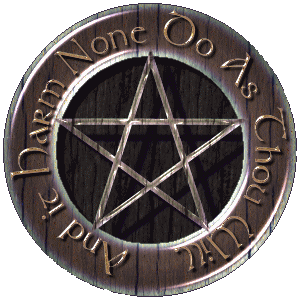
The Gardnerian tradition teaches a core ethical guideline, often referred to as “The Rede” or “The Wiccan Rede”. In the archaic language often retained in some Gardnerian lore, the Rede states, “An it harm none, do as thou wilt.”

Witches … are inclined to the morality of the legendary Good King Pausol, “Do what you like so long as you harm no one”. But they believe a certain law to be important, “You must not use magic for anything which will cause harm to anyone, and if, to prevent a greater wrong being done, you must discommode someone, you must do it only in a way which will abate the harm.”

Two features stand out about the Rede. The first is that the word rede means “advice” or “counsel”. The Rede is not a commandment but a recommendation, a guideline. The second is that the advice to harm none stands at equal weight with the advice to do as one wills. Thus Gardnerian Wiccan teachings stand firm against coercion and for informed consent; forbid proselytization while requiring anyone seeking to become an initiate of Gardnerian Wicca to ask for teaching, studies, initiation. To expound a little further, the qualifying phrase “an (if) it harm none” includes not only other, but self. Hence, weighing the possible outcomes of an action is a part of the thought given before taking an action; the metaphor of tossing a pebble into a pond and observing the ripples that spread in every direction is sometimes used. The declarative statement “do as thou wilt” expresses a clear statement of what is, philosophically, known as “free will.”

A second ethical guideline is often called the Law of Return, sometimes the Rule of Three, which mirrors the physics concept described in Sir Isaac Newton’s Third Law of Motion: “When one body exerts a force on a second body, the second body simultaneously exerts a force equal in magnitude and opposite in direction on the first body.”This basic law of physics is more usually today stated thus: “For every action, there is an equal and opposite reaction.” Like the Rede, this guideline teaches Gardnerians that whatever energy or intention one puts out into the world, whether magical or not, some response of equal effect will return. This teaching underlies the importance of doing no harm—for that would give impetus to a negative reaction centered on oneself or one’s group (such as a coven).

In Gardnerian Wicca, these tradition-specific teachings demand thought before action, especially magical action (spell work). An individual or a coven uses these guidelines to consider beforehand what the possible ramifications may be of any working. Given these two ethical core principles, Gardnerian Wicca hold themselves to a high ethical standard. For example, Gardnerian High Priestess Eleanor Bone was not only a respected elder in the tradition, but also a matron of a nursing home. Moreover, the Bricket Wood coven today is well known for its many members from academic or intellectual backgrounds, who contribute to the preservation of Wiccan knowledge. Gerald Gardner himself actively disseminated educational resources on folklore and the occult to the general public through his Museum of Witchcraft on the Isle of Man. Therefore, Gardnerian Wicca can be said to differ from some modern non-coven Craft practices that often concentrate on the solitary practitioner’s spiritual development.

The religion tends to be non-dogmatic, allowing each initiate to find for him/herself what the ritual experience means by using the basic language of the shared ritual tradition, to be discovered through the Mysteries. The tradition is often characterised as an orthopraxy (correct practice) rather than an orthodoxy (correct thinking), with adherents placing greater emphasis on a shared body of practices as opposed to faith

History
Gardner and the New Forest coven
On retirement from the British Colonial Service, Gardner moved to London but then before World War II moved to Highcliffe, east of Bournemouth and near the New Forest on the south coast of England. After attending a performance staged by the Rosicrucian Order Crotona Fellowship, he reports meeting a group of people who had preserved their historic occult practices. They recognised him as being “one of them” and convinced him to be initiated. It was only halfway through the initiation, he says, that it dawned on him what kind of group it was, and that witchcraft was still being practiced in England.

The group into which Gardner was initiated, known as the New Forest coven, was small and utterly secret as the Witchcraft Act of 1735 made it illegal—a crime—to claim to predict the future, conjure spirits, or cast spells; it likewise made an accusation of witchcraft a criminal offense. Gardner’s enthusiasm over the discovery that witchcraft survived in England led him to wish to document it, but both the witchcraft laws and the coven’s secrecy forbade that, despite his excitement. After World War II, Gardner’s High Priestess and coven leader relented sufficiently to allow a fictional treatment that did not expose them to prosecution, “High Magic’s Aid”.

Anyhow, I soon found myself in the circle and took the usual oaths of secrecy which bound me not to reveal any secrets of the cult. But, as it is a dying cult, I thought it was a pity that all the knowledge should be lost, so in the end I was permitted to write, as fiction, something of what a witch believes in the novel High Magic’s Aid.

After the witchcraft laws were repealed in 1951, and replaced by the Fraudulent Mediums Act, Gerald Gardner went public, publishing his first non-fiction book about Witchcraft, “Witchcraft Today”, in 1954. Gardner continued, as the text often iterates, to respect his oaths and the wishes of his High Priestess in his writing. Fearing, as Gardner stated in the quote above, that witchcraft was literally dying out, he pursued publicity and welcomed new initiates during that last years of his life. Gardner even courted the attentions of the tabloid press, to the consternation of some more conservative members of the tradition. In Gardner’s own words, “Witchcraft doesn’t pay for broken windows!”

Gardner knew many famous occultists. Ross Nichols was a friend and fellow Druid (until 1964 Chairman of the Ancient Order of Druids, when he left to found his own Druidic Order of Bards, Ovates, and Druids). Nichols edited Gardner’s “Witchcraft Today” and is mentioned extensively in Gardner’s “The Meaning of Witchcraft”. Near the end of Aleister Crowley’s life, Gardner met with him for the first time on May 1, 1947, and visited him twice more before Crowley’s death that autumn; at some point, Crowley gave Gardner an Ordo Templi Orientis (OTO) charter and the 4th OTO degree—the lowest degree authorizing use of the charter.

Doreen Valiente, one of Gardner’s priestesses, identified the woman who initiated Gardner as Dorothy Clutterbuck, referenced in “A Witches’ Bible” by Janet and Stewart Farrar.Valiente’s identification was based on references Gardner made to a woman he called “Old Dorothy” whom Valiente remembered. Biographer Philip Heselton corrects Valiente, clarifying that Clutterbuck (Dorothy St. Quintin-Fordham, née Clutterbuck), a Pagan-minded woman, owned the Mill House, where the New Forest coven performed Gardner’s initiation ritual. Scholar Ronald Hutton argues in his Triumph of the Moon that Gardner’s tradition was largely the inspiration of members of the Rosicrucian Order Crotona Fellowship and especially that of a woman known by the magical name of “Dafo”. Dr. Leo Ruickbie, in his Witchcraft Out of the Shadows, analysed the documented evidence and concluded that Aleister Crowley played a crucial role in inspiring Gardner to establish a new pagan religion. Ruickbie, Hutton, and others further argue that much of what has been published of Gardnerian Wicca, as Gardner’s practice came to be known, was written by Blake, Yeats, Valiente and Crowley and contains borrowings from other identifiable sources.

The witches Gardner was originally introduced to were originally referred to by him as “the Wica” and he would often use the term “Witch Cult” to describe the religion. Other terms used, included “Witchcraft” or “the Old Religion.” Later publications standardised the spelling to “Wicca” and it came to be used as the term for the Craft, rather than its followers. “Gardnerian” was originally a pejorative term used by Gardner’s contemporary Roy Bowers (also known as Robert Cochrane), a British cunning man, who nonetheless was initiated into Gardnerian Wicca a couple of years following Gardner’s death.

Reconstruction of the Wiccan rituals

Gardner stated that the rituals of the existing group were fragmentary at best, and he set about fleshing them out, drawing on his library and knowledge as an occultist and amateur folklorist. Gardner borrowed and wove together appropriate material from other artists and occultists, most notably Charles Godfrey Leland’s Aradia, or the Gospel of the Witches, the Key of Solomon as published by S.L. MacGregor Mathers, Masonic ritual, Crowley, and Rudyard Kipling. Doreen Valiente wrote much of the best-known poetry, including the much-quoted Charge of the Goddess.

Bricket Wood and the North London coven

In 1948-9 Gardner and Dafo were running a coven separate from the original New Forest coven at a naturist club near Bricket Wood to the north of London. By 1952 Dafo’s health had begun to decline, and she was increasingly wary of Gardner’s publicity-seeking. In 1953 Gardner met Doreen Valiente who was to become his High Priestess in succession to Dafo. The question of publicity led to Doreen and others formulating thirteen proposed ‘Rules for the Craft’, which included restrictions on contact with the press. Gardner responded with the sudden production of the Wiccan Laws which led to some of his members, including Valiente, leaving the coven.

Gardner reported that witches were taught that the power of the human body can be released, for use in a coven’s circle, by various means, and released more easily without clothing. A simple method was dancing round the circle singing or chanting; another method was the traditional “binding and scourging.”[26] In addition to raising power, “binding and scourging” can heighten the initiates’ sensitivity and spiritual experience.

Following the time Gardner spent on the Isle of Man, the coven began to experiment with circle dancing as an alternative. It was also about this time that the lesser 4 of the 8 Sabbats were given greater prominence. Brickett Wood coven members liked the Sabbat celebrations so much, they decided that there was no reason to keep them confined to the closest full moon meeting, and made them festivities in their own right. As Gardner had no objection to this change suggested by the Brickett Wood coven, this collective decision resulted in what is now the standard eight festivities in the Wiccan Wheel of the year.

The split with Valiente led to the Bricket Wood coven being led by Jack Bracelin and a new High Priestess, Dayonis. This was the first of a number of disputes between individuals and groups, but the increased publicity only seems to have allowed Gardnerian Wicca to grow much more rapidly. Certain initiates such as Alex Sanders and Raymond Buckland who brought his take on the Gardnerian tradition to the United States in 1964 started off their own major traditions allowing further expansion.

Source:

Patti Wigington, Published on ThoughtCo 
Wikipedia 

Various Paths of Witchcraft – Ceremonial Magick

OakTree_Pentagram_Tattoo_by_Ralwor

Various Paths of Witchcraft – Ceremonial Magick

Ceremonial Magick Definition
Ceremonial Magick: Ceremonial Magick is one of the most complicated systems of spiritual attainment in the world. It is a mixture of Jewish, Christian, and ancient Egyptian philosophy mixed with ancient Indian and Chaldean ideas spiced with a hint of earlier Paganism. This is mixed with the ceremonial aspects of Catholicism and Masonry. It usually heavily involves the study of the Kabbalah, the mysticism of the world put into Jewish and Judeo-Christian terms.

source: Truth About Psychic Powers, Donald Michael Kraig

Ceremonial Magick:
The object of ceremonial magick is to stimulate the senses, to power-up the emotions, and to firmly conceptualize the purpose of the operation—which is to create a transcending experience to unite Personality with the Divine Self. To this end, rituals, symbols, clothing, colors, incenses, sound, dramatic invocations and sacraments are selected in accordance with established “correspondences” of one thing to another to transport the magician towards a mystical reality.

______________________

Ceremonial Magick

Ceremonial magic is generally defined as magic in which the practitioner uses specific rituals and invocations to call upon the spirit world. Also called high magic, ceremonial magic uses as its base a blend of older occult teachings–Thelema, Enochian magic, Kabbalah, and other various occult philosophies are typically incorporated.


Ceremonial vs. Natural Magic

Ceremonial magic differs from natural magic, or low magic.

Natural magic is the practice of magic in accordance with the natural world–herbalism, etc.–while ceremonial magic involves the invoking and control of spirits and other entities. Although there is much more to it than this–ceremonial magic in and of itself being fairly complex–these are the main surface differences. Ultimately, the main purpose of performing high magic is to bring the practitioner closer to the Divine itself, whether that is in the form of a deity or another spiritual being.


Origins of Ceremonial Magic

In the late sixteenth century, a translation of Heinrich Cornelius Agrippa’s De incertitudine et vanitate scientiarum described “ceremoniall magicke” as containing two parts, “Geocie and Theurgie,” or goetia and theurgy. Although this was the first documented use of the term ceremonial magic, the practices involved had been around for at least a century or two, as the rituals have been noted in the grimoires of early Renaissance and medieval-era magical practitioners.

Over the years, numerous European occultists studied and practiced many of the rituals and ceremonies still in use today. Francis Barrett was an Englishman, born in the late eighteenth century, who studied metaphysics, the Kabbalah, natural occult philosophy and alchemy. Long intrigued by the writings of Agrippa, and by other esoteric texts, Barrett wrote a work entitled The Magus, heavily influenced by Agrippa’s works, and purporting to be a magical textbook focusing on herbalism, the use of numerology, the four classical elements and other correspondences.

The French occultist Alphonse Louis Constant, better known by his pseudonym Éliphas Lévi, lived in the 1800s, and was part of a number of radical socialist groups. An avid Bonapartist, Lévi developed an interest in the Kabbalah, and subsequently magic, as part of a group of radicals who believed that magic and the occult were essentially a more advanced form of socialism. He was fairly prolific and wrote a number of works on what we today call ceremonial magic, as well as books on spiritualism (The Science of Spirits) and the secrets of the occult (The Great Secret, or Occultism Unveiled).

Like Barrett and Agrippa, Lévi’s flavor of ceremonial magic was heavily rooted in Judeo-Christian mysticism.


Ceremonial Magic Today

During the Victorian era, spiritualist and occult groups flourished, and perhaps none is as well known as the Hermetic Order of the Golden Dawn. This secret society embraced ceremonial magical practices, although it eventually imploded when members couldn’t seem to agree on the actual religious beliefs of the group. Like their predecessors, many Golden Dawn members were Christians, but there was an influx of Pagan beliefs brought in that eventually led to the fragmenting of the Order.

Many of today’s ceremonial magic practitioners trace their roots to the teachings of the Golden Dawn. Ordo Templi Orientis (O.T.O.) is an international organization which was originally modeled on Freemasonry. During the 1900s, under the leadership of occultist Aleister Crowley, O.T.O. began to include elements of Thelema as well. Following Crowley’s death, the organization has seen a number of changes in leadership. Like many ceremonial magic groups, membership includes a series of initiations and rituals.

Builders of the Adytum (B.O.T.A.) is a Los Angeles-based ceremonial magic tradition that carries influence from both the Golden Dawn and the Freemasons. In addition to group ritual work, B.O.T.A. offers correspondence classes on Kabbalah, astrology, divination, and many other aspects of occult studies.

Although information on ceremonial magic often seems to be limited, this is due in part to the need for secrecy within the community. Author Dion Fortune once said of the teachings of ceremonial magic, “Secrecy concerning practical formulae of ceremonial magic is also advisable, for if they are used indiscriminately, the virtue goes out of them.”

Today, there is a great deal of publicly available information on the practice and beliefs of high magic, or ceremonial magic. However, it is said that the information out there is incomplete and that it is only through training and work that a practitioner can unlock all of the secrets of ceremonial magic.

___________________________

Ceremonial Magic

Ceremonial magic or ritual magic, also referred to as high magic and as learned magic in some cases, is a broad term used in the context of Hermeticism or Western esotericism to encompass a wide variety of long, elaborate, and complex rituals of magic. It is named as such because the works included are characterized by ceremony and a myriad of necessary accessories to aid the practitioner. It can be seen as an extension of ritual magic, and in most cases synonymous with it. Popularized by the Hermetic Order of the Golden Dawn, it draws on such schools of philosophical and occult thought as Hermetic Qabalah, Enochian magic, Thelema, and the magic of various grimoires.


Renaissance magic
The term originates in 16th-century Renaissance magic, referring to practices described in various Medieval and Renaissance grimoires and in collections such as that of Johannes Hartlieb. Georg Pictor uses the term synonymously with goetia.
James Sanford in his 1569 translation of Heinrich Cornelius Agrippa’s 1526 De incertitudine et vanitate scientiarum has “The partes of ceremoniall Magicke be Geocie, and Theurgie”. For Agrippa, ceremonial magic was in opposition to natural magic. While he had his misgivings about natural magic, which included astrology, alchemy, and also what we would today consider fields of natural science, such as botany, he was nevertheless prepared to accept it as “the highest peak of natural philosophy”. Ceremonial magic, on the other hand, which included all sorts of communication with spirits, including necromancy and witchcraft, he denounced in its entirety as impious disobedience towards God.

Revival
Starting with the Romantic movement, in the 19th century, a number of people and groups have effected a revival of ceremonial magic.


Francis Barrett
Among the various sources for ceremonial magic, Francis Barrett’s The Magus embodies deep knowledge of alchemy, astrology, and the Kabbalah, and has been cited by the Golden Dawn, and is seen by some[according to whom?] as a primary source. But according to Aleister Crowley, perhaps the most influential ceremonial magician of the Modern era, much of it was cribbed from Agrippa’s Three Books of Occult Philosophy.


Eliphas Levi
Eliphas Lévi conceived the notion of writing a treatise on magic with his friend Bulwer-Lytton. This appeared in 1855 under the title Dogme et Rituel de la Haute Magie, and was translated into English by Arthur Edward Waite as Transcendental Magic, its Doctrine and Ritual.


In 1861, he published a sequel, La Clef des Grands Mystères (The Key to the Great Mysteries). Further magical works by Lévi include Fables et Symboles (Stories and Images), 1862, and La Science des Esprits (The Science of Spirits), 1865. In 1868, he wrote Le Grand Arcane, ou l’Occultisme Dévoilé (The Great Secret, or Occultism Unveiled); this, however, was only published posthumously in 1898.


Lévi’s version of magic became a great success, especially after his death. That Spiritualism was popular on both sides of the Atlantic from the 1850s contributed to his success. His magical teachings were free from obvious fanaticisms, even if they remained rather murky; he had nothing to sell, and did not pretend to be the initiate of some ancient or fictitious secret society. He incorporated the Tarot cards into his magical system, and as a result the Tarot has been an important part of the paraphernalia of Western magicians. He had a deep impact on the magic of the Hermetic Order of the Golden Dawn and later Aleister Crowley, and it was largely through this impact that Lévi is remembered as one of the key founders of the twentieth century revival of magic.


Hermetic Order of the Golden Dawn
The Hermetic Order of the Golden Dawn (or, more commonly, the Golden Dawn) was a magical order of the late 19th and early 20th centuries, practicing a form of theurgy and spiritual development. It was probably the single greatest influence on twentieth century Western occultism. Some aspects of magic and ritual that became core elements of many other traditions, including Wicca, Thelema and other forms of magical spirituality popular today, are partly drawn from the Golden Dawn tradition.


Aleister Crowley
English author and occultist Aleister Crowley often introduced new terminology for spiritual and magical practices and theory. For example, he termed theurgy “high magick” and thaumaturgy “low magick”. In The Book of the Law and The Vision and the Voice, the Aramaic magical formula Abracadabra was changed to Abrahadabra, which he called the new formula of the Aeon of Horus. He also famously spelled magic in the archaic manner, as magick, to differentiate “the true science of the Magi from all its counterfeits.”


Magical tools
The practice of ceremonial magic often requires tools made or consecrated specifically for this use, which are required for a particular ritual or series of rituals. They may be a symbolic representation of psychological elements of the magician or of metaphysical concepts.


In Magick (Book 4), Part II (Magick), Aleister Crowley lists the tools required as a circle drawn on the ground and inscribed with the names of god, an altar, a wand, cup, sword, and pentacle, to represent his true will, his understanding, his reason, and the lower parts of his being respectively. On the altar, too, is a phial of oil to represent his aspiration, and for consecrating items to his intent. The magician is surrounded by a scourge, dagger, and chain intended to keep his intent pure. An oil lamp, book of conjurations and bell are required, as is the wearing of a crown, robe, and lamen. The crown affirms his divinity, the robe symbolizes silence, and the lamen declare his work. The book of conjurations is his magical record, his karma. In the East is the magick fire in which all burns up at last.


Grimoires
A grimoire /ɡrɪmˈwɑːr/ is a record of magic. Books of this genre, are records of magical experiments and philosophical musings, giving instructions for invoking angels or demons, performing divination and gaining magical powers, and have circulated throughout Europe since the Middle Ages.


It is common belief that magicians were frequently prosecuted by the Christian church, so their journals were kept hidden to prevent the owner from being burned. But it is also a well-known fact that church and the rabbi keep records of demonic activity and exorcism too in their own magical records which were used for similar record keeping. Some claim that the new age occultism is a sham and borrowed heavily from these old record books by the religious. Such books contain astrological correspondences, lists of angels and demons, directions on casting charms, spells, and exorcism, on mixing medicines, summoning elemental entities, and making talismans. Magical books in almost any context, especially books of magical spells, are also called grimoires.


Enochian magic
Enochian magic is a system of ceremonial magic centered on the evocation and commanding of various spirits that was the magical exploration made by an English occultist Dr. John Dee. It is based on the 16th-century writings of Dr John Dee and Edward Kelley, who claimed that their information was delivered to them directly by various angels. Dee’s journals contained the Enochian script, and the table of correspondences that goes with it. It claims to embrace secrets contained within the apocryphal Book of Enoch. It is a widely held belief that these revelations were personal and specific to Dee’s life and reality and borrowed on imagination heavily.


Organizations
Among the many organizations which practice forms of ceremonial magic aside from the Golden Dawn are the A∴A∴, Ordo Templi Orientis, and the Builders of the Adytum.


References:
The Llewellyn Encyclopedia
Patti Wigington, ThoughtCo.com
Wikipedia 

Various Paths of Witchcraft: Eclectic Wicca/Witchcraft c. 2018

Eclectic Wicca/Witchcraft

The Merriam Dictionary defines the word ‘eclectic’ as meaning “selecting what appears to be best in various doctrines, methods, or styles .” Eclectic Wiccans (and eclectic Pagans, who are a very similar group) do just that, sometimes on their own and sometimes in informal or formal groups.

Overview of Eclectic Wicca
Eclectic Wicca is an all-purpose term applied to witchcraft traditions, often ​NeoWiccan (meaning modern Wiccan), that doesn’t fit into any specific definitive category.

Many solitary Wiccans follow an eclectic path, but there are also covens that consider themselves eclectic. A coven or individual may use the term ‘eclectic’ for a variety of reasons. For example:

Mixed and matched traditions: A group or solitary may use a blend of beliefs and practices from several different pantheons and traditions.
Modified traditions: A group could be an offshoot of an established tradition of Wicca, such as Gardnerian or Alexandrian, but with modifications to their practice that make them significantly different from that original tradition.
Uniquely individual practices: An individual may be creating his or her own tradition of beliefs and practices, and because this system can’t be defined as something else, it is usually defined as eclectic.
Uninitiated practitioner: A solitary may be practicing what he or she has learned from publicly available sources on Wicca, but not be using oathbound, initiatory material, and so recognizes that his or her practice is eclectic.
Because there is often disagreement about who is Wiccan and who isn’t, there can be confusion regarding existing lineaged Wiccan traditions, and newer eclectic traditions. Some would say that only lineaged covens (based on traditional practices) should be permitted to call themselves Wiccan. By that reasoning, anyone who claims to be eclectic is, by definition, not Wiccan but Neowiccan (‘new’ or nontraditional Wiccan).

Bear in mind that the term Neowiccan simply means someone who practices a newer form of Wicca, and is not meant to be derogatory or insulting.

Church of Universal Eclectic Wicca
One organization that supports practitioners of eclectic Wicca is the Church of Universal Eclectic Wicca. They describe themselves as follows:

Universalism is a religious belief that allows for the existence of truth in a multitude of places. Eclectism is the practice of taking from many places….What we encourage is experimentation and exploration towards those things in your religious life that work and letting go of those things that don’t. UEW defines Wicca as any religion that calls itself Wicca, AND believes in a god/force/power/whatever that is either genderless, both genders or manifests as a male/female polarity that we agree to call “the Lord and Lady.” AND upholds the Five Points of Wiccan Belief.

The Five Points of Wiccan Belief include the Wiccan Rede, the Law of Return, the Ethic of Self-Responsibility, the Ethic of Constant Improvement and the Ethic of Attunement. The Wiccan Rede is written in many ways, but its intent is consistent: “do what you will, so long as it harms none.” The Law of Return states that whatever positive or negative energy a person puts out into the world will be returned to that person three times over.

__________________________


Eclectic Witchcraft

The definition of the eclectic witch is one of the hardest magical traditions to pin down if for no other reason than the fact that the term “eclectic” means different things to different witches. Very simply put an eclectic witch is one who follows more than a single tradition and who utilises different paths, cultures and traditions in the work that she does.

The confusion comes in when discussing to what extent different magical systems can be brought together for positive effect. There is a deal of difference between a witch who is conversant in two or three different traditions and blends the parts of each that call to her into a unified whole which is her own path and a witch who just picks up the odd idea here and there and throws them all haphazardly into the random pot without making any effort to understand the culture and history behind each tradition. Without understanding why a magical practise is relevant to a tradition it is futile to absorb that practise into individual workings and a witch who chooses to do so will not reap much benefit from it. It is important however to understand that some paths are very compatible and an eclectic witch who makes use of ideas from paths from a similar field will likely find it helps her move forward in the development of her own path.

To some extent most modern witches display a certain amount of eclecticism and it could be argued that the witch who does not is missing out as it is hard to imagine any tradition that could not be enriched by the ideas and practises of another. The difficulty with being eclectic comes when non harmonious systems are brought together and the lack of understanding behind the ideas from all of the different systems are not adequately understood. This wouldn’t lead to any danger but it would render the workings of such a witch pretty worthless. One of the most important things to learn about magic is that it works if you understand why you are doing something. Using random ingredients because they have value to a witch on another path but mean nothing to you are unlikely to yield great results. There is also the danger of over-diversifying – a witch who wants to study, learn and work with everything is diluting the essence of every tradition she works with. With no cohesion between the magical paths she chooses to work with her own path will eventually become nothing but a pick and mix of meaningless fragments.

The concept of being eclectic can be extended to fit the idea of a tradition changing over time. Even the most rigid family based traditions adapt and evolve as new family members are born and add their input into the path. There is (at least as far as I am aware) no specific term that fits a witch who adheres to one primary tradition but allows her path to evolve and change. In the absence of such a term we refer to these witches as being eclectic. Strictly speaking they do not fit the term but they do echo the idea that witchcraft cannot stand still and that in order not to stagnate every path needs fresh ideas and input to stay alive.

Eclectic Wicca is a different concept to Eclectic Witchcraft although the principle of choosing different elements from different established strands still rings true. An eclectic Wiccan may practise a blend of Alexandrian and Gardnerian or even a blend between one Wiccan tradition and a different magical path. Where Eclectic Wicca cannot be applied as a term is when the practises of an individual do not confirm to the established structure of the Wiccan religion. You cannot for example make any claim to be Wiccan if you do not believe in deity. Wicca, unlike witchcraft is a defined religious path with specific beliefs at its heart. An individual who does not share the core beliefs cannot claim to be a part of the religion.

Source:

Patti Wigington 
Witch Way Forward

Let’s Talk Witch – Why Witches and Wiccans Cast Spells? c. 2015


Why Witches and Wiccans Cast Spells?

Spellcasting certainly isn’t the sole reason for practicing Wicca, but it dovetails nicely with your spiritual practice. Wiccans are concerned with improving ourselves and, by extension, improving the world. Crafting and casting spells help in both of these areas. Spells offer a method for actively dealing with situations in life that require an additional boost of energy, and also offer an opportunity to maintain or restore balance. Spells are catalysts for change.

When a Wiccan casts a spell, a deity is very often brought into that method of powering change. This creates an interesting form of spiritual spellcraft that merges the basic spell and an act of prayer. Wiccan spellcraft, like other forms of religious spellcraft, adds a ritual dimension to spells, making it much more than simple witchcraft.

The very processes of crafting and casting spells teach you the basics of energy work—whether you realize it or not. Spells teach you how energy moves, how you can harness and handle it, and how you can direct it to affect various areas of your life. Whereas rituals offer you the opportunity to tap into the energy around you to re-attune yourself on a regular basis, spells offer you the opportunity to touch the web of energy that connects those living and organic things day by day, and to see how touching it in a slightly different place produces a slightly different effect.

Source: Solitary Wicca For Life: Complete Guide to Mastering the Craft on Your Own

Arin Murphy-Hiscock


The 13 Principles of Wiccan Belief

In the 1970s in the United States, a coalition of Wiccan groups banded together and set to put and end to misconceptions about Wicca. For too long, they thought, Wicca had been subject to uninformed stereotypes, stigma, and lack of proper recognition. So, what are the thirteen principles exactly?

The Thirteen Principles of Wiccan Belief were a summation to clear up misconceptions about Wicca and they outlined concepts such as: non-harm, disassociation from the devil, acknowledging the power of nature and the spiritual world, and living in harmony with the universe.

They also covered some societal issues like environmental responsibility and equality of the sexes. The federation wanted to communicate what Wicca was, and also what it was not.

The Principles are monumental because Wiccans and neo-Pagans are loosely organised and often can never agree. However the 13 principles of Wiccan belief forged an agreement among these diverse groups. The legacy of this historic agreement still lasts today.

Origination of the 13 Principles of Wiccan Belief

Click here to read the rest of this article found on wiccangathering.com

Full Moon Ritual by Raymond Buckland c.2016

pent

FULL MOON RITUAL

The moon is a powerful tool to use in Witchcraft. Each phase of the moon has its own power, and if we perform spells or rituals to coincide with the phase of the moon, our magick will be stronger.

After erecting circle at esbat but before cookies and wine, kneel with hands held high:

When the moon rides high
as she crosses the sky
and the stars on her gown trail behind
then we wiccan below
are all aglow
just to see her so brightly enshrined.

On the night of the moon
as I sing to the tune
of the Lady who watches above
I raise high my song
as she glides by so strong
and I bask in the light of her light.

Rhythmic chant

Isis, Astarte, Diana, Hecate,
Demeter, Kali, Inanna
(Repeat as often as wanted)

Lovely Lady, you have been known by so many people. Aphrodite, Territory, Diana, Ea, Freyja, Gana Isis and so many more have been your names. It is with these names do I adore and worship you with your Lord by your side, do I give you due honour and invite you to join me on this, your special night.

Sit and meditate

Descend my Lady; descend I pray thee and speak with me, your child.

Meditate; if you do not feel the spirit, do the following:

I am she who watches over thee. Mother of you all. Know that I rejoice that you do not forget me. To pay homage at the full of the moon is meet and right and brings joy unto yourself, even as it does me. Know that, with my good Lord, I weave the skein of life for everyone. I am at the beginning of life and at its end: The Maiden, The Mother, The Crone.

Where ever you may be, if you seek me know that I am always here for I abide deep within you. Look, then, within yourself if you would seek me. I am Life and I am Love. Find me and rejoice, for love is my music and laughter is my song. Be true to me and I will ever be true to you. Love is the law and love is the bond.

So Mote it Be!

From Raymond Buckland’s Complete Book of Witchcraft


Egyptian Art

In 1986, the band “The Bangles” sang about “all the old paintings on the tombs” where the figures they depict are “walking like an Egyptian.” Though he was neither an art historian nor an Egyptologist, songwriter Liam Sternberg was referring to one of the most striking features of ancient Egyptian visual art — the depiction of people, animals and objects on a flat, two-dimensional plane. Why did the ancient Egyptians do this? And is ancient Egypt the only culture to create art in this style?

Drawing any object in three dimensions requires a specific viewpoint to create the illusion of perspective on a flat surface. Drawing an object in two dimensions (height and breadth) requires the artist to depict just one surface of that object. And highlighting just one surface, it turns out, has its advantages.

“In pictorial representation, the outline carries the most information,” John Baines, professor emeritus of Egyptology at the University of Oxford in the U.K. told Live Science. “It’s easier to understand something if it is defined by an outline.”

When drawing on a flat surface, the outline becomes the most important feature, even though many Egyptian drawings and…

Click here to read the rest of this article

Wiccan (Witch/Pagan) Values

The Triple Goddess and Horned God Symbols

Duality of the Divine

Wiccans honor the duality of the divine through understanding while reality is split into the male and female aspects, divinity is ultimately united an as interconnected whole.

Magic is Real

It is often defined using this quote from Crowley, “Magic is the Science and Art of causing Change to occur with the conformity with Will.” Wiccans believe that Magic is not greed or power, rather it is a force by6 which what can be imagined can be created and become real.

Nature is Sacred

The rhythms of nature pulse with that of human life course as the divine is woven into its very fabric. Being attuned with nature means believing that all of nature is sacred and should be held in reverence rather than dominated.

All Paths are Blessed

Wiccans see their chosen path as only one of a myriad of possible spiritual paths available. While many other religions espouse a single path to enlightenment. Wiccans believe that all paths lead to the divine are equally acceptable and blessed.

Personal Connections to the Divine

Whether working with a coven or as a solitary practitioner, the connection to the divine is a very personal process. maintaining, building, and sustaining a relationship with the divine is an individual responsibility.

(Side Note: Here is where I feel different pagan traditions diversify the most. Some traditions do not believe these next two need to be followed or believed in. I am not one of those individuals. After walking a dark path for 2 years I came to fully believe in them and teach them to anyone who apprentices under me. But I do refer to the Wiccan Rede as the Wicce Rede meaning a wise women’s rede.)

The Wiccan Rede

“Do what ye will, lest it harm none.” Wiccans are free to engage in any behavior they choose as long as their actions do not harm themselves or others.

The Rule of Three (or The Three-Fold Law)

All the good and all the harm a person does to others will return threefold in this life. Every magical act sent out into the universe will return to the witch three times over.

Source: spells8.com

Voodoo/Hoodoo Oils and Potions

Oils and Potions

Voodoo Hoodoo not only utilizes roots & herbs for its spells, but also candles, oils, incense, floor washes, sprays, powders – pretty  much anything goes. Many spells are candle oriented for added power. The color of the candle is always in sync with the nature of the spell. By dressing (anointing) the candles with oils and rolled in powdered herbs, you’re in effect adding an enhancement to your candle of power thereby making it that much more precise in your working.
This spills the beans on some of the commonly used oils and potions in Voodoo hoodoo. You will need to know how to make these or you will need to buy them for many of the spells. Most traditional root workers make their own, although modernization of the practice along with internet access makes it easier for some folks to purchase what they need. Do whatever you want; there is no law that says you have to make your own. The advantage of making your own is that you know exactly what is in it and you can charge it yourself.
Many traditions of magic work with plant materials, and most assign some symbolic meanings or ascriptions to these ingredients. Many hoodoo and Voodoo spells require certain blends of oils and powders to accomplish a particular work or to enhance a spell. Always use a natural carrier oil to blend your magickal oils as unblended oils can burn the skin. You should only use a drop or two at a time on the skin. I use Grape Seed oil and almond oil for blending magickal oils, and Olive oil for blending holy oils. Jojoba oil is a good alternative because it won’t go rancid, although it is more expensive than the others. Mineral oil is good for negative works. You should always add tincture of Benzoin or Vitamin E oil to keep to any oils listed to keep them from going rancid.

CARRIER OILS

Below you will find a list of carrier oils and their shelf life that can be used to make magickal anointing oils. This is important information when considering how often you will use the particular oil you make.
Grapeseed Oil
– Shelf life is approximately 3-6 months. Solvent extracted grapeseed oil has a shelf life of 9 months. Keep refrigerated.
Jojoba Oil
– Indefinite shelf life.
Mustard Seed
– Abyssinian Seed Oil
– Shelf life is approximately 18-24 months.
Olive Oil
– Shelf life is approximately 12 months to 18 months if stored properly in a cool dark place.
Sweet Almond Oil
– Shelf life is approximately 3-6 months is not refrigerated. If refrigerated, the shelf life can be increased to 12 months.

A Brief History of Witchcraft: From Ancient Times to Modern Day

Witchcraft, a term often shrouded in mystery and misconception, has a long and fascinating history that spans across ancient civilizations to the modern day. With its roots embedded in beliefs and practices dating back thousands of years, witchcraft has evolved and adapted over time, leaving an indelible mark on cultures worldwide. A Brief History of Witchcraft: From Ancient Times to Modern Day seeks to unravel the enigma surrounding this intricate topic, shedding light on its significance in contemporary society.

Throughout history, witchcraft has been associated with a wide range of beliefs and practices, varying greatly across different cultures and time periods. Ancient civilizations such as the Egyptians and Mesopotamians had their own unique interpretations of magic and divination, often intertwining with religious rituals. The Greek and Roman empires also held a deep fascination with witchcraft, linking it to various deities and goddesses.

During the Middle Ages, Europe witnessed a significant shift in attitudes towards witchcraft. An era marked by widespread fear and superstition, many came to perceive witches as individuals empowered by demonic forces, capable of inflicting harm on others through sorcery. This perception fueled the infamous witch trials, resulting in the persecution and execution of countless individuals, predominantly women, accused of practicing witchcraft.

However, as societal attitudes gradually shifted, so too did the understanding of witchcraft. The witch trials became a source of critique and condemnation, revealing the fallibility of the legal systems and the destructive power of mass hysteria. This pivotal moment in history sparked a reevaluation of witchcraft, leading to the emergence of new philosophical and intellectual movements, such as the Renaissance and the Enlightenment.

In modern times, witchcraft has experienced a resurgence, with an increasing number of individuals embracing it as a spiritual or cultural practice. Paganism and Wicca, two contemporary religious movements, have drawn inspiration from ancient witchcraft beliefs, emphasizing elements of nature worship, divination, and personal empowerment. Today, witchcraft has become a symbol of resistance, a way for individuals to reclaim their autonomy and connect with a deeper, more spiritual aspect of themselves.

As the interest in witchcraft grows, so does the need for comprehensive resources that provide an accurate and unbiased understanding of its history and significance. A Brief History of Witchcraft: From Ancient Times to Modern Day aims to fill this need, presenting an in-depth exploration of the subject matter. By delving into the origins, cultural variations, and contemporary expressions of witchcraft, this book offers readers an invaluable insight into a topic that continues to captivate and intrigue. Whether one approaches the subject from an academic, spiritual, or simply curious standpoint, this historical journey through the world of witchcraft promises to leave a lasting impact, fostering a deeper appreciation for the complexities of human belief systems and the ever-evolving nature of our understanding.

What are the origins of witchcraft and how has it evolved throughout history? Click here to read the rest of this article

Ancient temple and theater 3,500 years older than Machu Picchu discovered in Peru

Archaeologists in Peru have unearthed the remains of what they believe are a 4,000-year-old temple and theater, shining a new light on the origins of complex religions in the region.

The team began studying the new archaeological site of La Otra Banda, Cerro Las Animas, in June. Last year, the local government alerted them to looting that had been taking place near the northern Peruvian town of Zaña, according to a press release from the Field Museum in Chicago, Illinois, Wednesday.

They excavated a plot roughly 33 feet long and 33 feet wide, finding signs of ancient walls made of mud and clay at just six feet deep.

“It was so surprising that these very ancient structures were so close to the modern surface,” Luis Muro Ynoñán, a research scientist at the Field Museum who led the team, said in the release.

After digging deeper, archaeologists found “one section” of a large temple, Muro Ynoñán said, adding that “one of the most exciting” finds was a small theater “with a backstage area and a staircase that led to a stage-like platform.”

“This could have been used to perform ritual performances in front of a selected audience,” he added

One of the theater’s staircases was flanked by mud panels with an elaborate carved design of a mythological bird-like creature, according to the release. The figure resembled other images of mythological creatures dating to the Initial Period, around 2,000 to 900 BC, giving clues to when the temple was built.

“The Initial Period is important because it’s when we first start to see evidence of an institutionalized religion in Peru,” Muro Ynoñan said, adding that Please click here to read the rest of this article

Obon Festival 2024 in Japan: Meaning, Traditions and Dates

The Obon festival (お盆, also known as Bon festival) is an annual Japanese holiday that commemorates and remembers deceased ancestors. It is believed that their spirits return at this time to visit their relatives.

Chochin (paper) lanterns are hung to guide the spirits and Obon dances (bon odori) are performed. Families have reunions and visit the graves of their relatives and make food offerings at altars and temples.

It is observed from the 13th to the 15th day of the 7th month. However, according to the solar calendar the 7th month is July but according to the lunar calendar, the 7th month is August. Obon is therefore celebrated at different times in different regions depending on which calendar is observed.

The official dates are August 13-15 though it will be celebrated between July 13-15 in some places. The Obon week in mid-August is one of Japan’s three major holiday seasons making it one of the busiest times of the year for traveling. Many Japanese people will leave their cities around August 10 and come back on August 17-18.

Obon traditions and celebrations

On the first day of Obon, people take the chochin lanterns to the graves of their families. They call their ancestors’ spirits back home in a ritual called mukae-bon. In some regions, huge fires are lit at the entrances of houses to guide the spirits to enter.

At the end of the Obon festival, families help their ancestors’ spirits return back to the grave by guiding them with their chochin lanterns. The ritual is called okuri-bon. Again, the ritual varies slightly between different regions of Japan.

Floating lanterns (toro nagashi) Please click here to read the rest of this article

Common Practice and Beliefs within Druidry

Introduction

Those who practise Druidry do so through a deep spiritual connection perceived and experienced within the land and its culture. Many, when they first find Druidry, describe the feeling as ‘coming home’; they have rediscovered a connection with the land, its people, history, heritage and culture. This is more than mere interest; imbued with wonder, gratitude, respect and a sense of the perpetual flow of time, it inspires a devotional commitment, an acknowledgement of the sacred and a recognition of deity (male, female and non-gendered gods) within these currents of nature. This is the foundation of Druid practice.

The issue as to whether modern Druidry has any clear link back to pre-Roman Britain is debated. Historically Druidry was essentially an oral tradition and no texts are available written by our pre-Roman ancestors. However, the religious and spiritual traditions survived in folklore, through poetry and mythologies, within the development of British/western philosophy and the bardic colleges. A good deal was incorporated into Christianity when it came to these lands, particularly surviving in rural churches where Paganism continued side by side with the new religion. In the eighteenth century a resurgence of Druidry led to academic scrutiny of Classical and Mediaeval texts and a good deal of today’s common Druidic practice is based on interpretation of that material. This scrutiny continues today and Druids use this as a link to their ancestral past. As a religion today, Druidry is ever evolving. So common practice is gained through Druids coming together and sharing their experiences, rituals and celebrations.

Diversity

Many come to Druidry because of its diversity. Freedom of expression and personal connection to deity is, for them, of paramount importance. Connection to the divine is gained through experience, neither through belief nor through reciting prayers that are essentially another’s understanding or vision. As a polytheistic religion, individuals devote themselves to and revere deities who express different aspects of nature and ancestry. For example, Cerridwen is a goddess of the dark, the waning moon, the cauldron of potential; Brighid is a goddess of fire, light and assertive action. The rituals and practice of Druids honouring one or other of these as their principal deity would differ accordingly.

Druids take their inspiration from Nature. Within the British Isles we have a huge diversity of landscape and this is reflected in the practice of individuals and local groups or Groves. If a Druid is inspired by their local north sea coast, his gods and religious focus would be different from a Druid inspired by the rolling hills and woodlands of the Cotswolds, or the open moors of Devon. Similarly a Druid grove celebrating the festival of midwinter in an urban garden in Kent will look and feel very different from a grove celebrating in the Highlands of Scotland, were most of its members are dependent on rural or agricultural livelihoods: winter means something very different to both groves. All these individuals and groves are equally honouring (and seeking relationship with) Nature.

Druids are inspired too by their ancestors. To a Druid, ancestry is not a vague concept, but a gathering of individuals, each with their strengths and weaknesses, their own stories of success and failure. Druidry’s diversity is further expressed through the fact that each person has a different line of ancestors, and a different relationship with those people: this may manifest through a religious practice that focuses on a certain temple or landscape, myth or poet, skill or occupation. Again, such practice may appear significantly distinct, say, if we were to observe a farmer, a blacksmith, a writer or healer. As Druids, all are honouring their ancestors, nonetheless, by using the skills inherited and so expressing the spiritual devotion, gratitude and reverence required of the Druid.

The reverence for nature that is integral to Druidry also provides a morality or ethical base that is common to all Druids. Like any moral code, whether religious or secular, it is interpreted with slight differences. However, honour, respect, truth and justice are of primary importance and constitute the basis of all Druid practice. This doesn’t dilute Druidry, but brings to it a richness that is welcomed and celebrated. Thus, paradoxically, diversity is both a strength and a cohesive element of Druid practice.

There are further elements of Druid practice and ritual that are common to all within the tradition and these we shall explore.

Major Festivals

Most adherents of modern Druidry celebrate eight major festivals and these can be further subdivided into the Solar Festivals and Celtic Fire Festivals, which may also be known as agricultural, pastoral, seasonal or cross quarter festivals. Some Groves and individuals only work with the Solar and some only with the Fire Festivals. Placed around the course of the year, they occur every 5-7 weeks, and generally Druids will at this time make ritual, giving offerings.

The purpose of the festivals is to ensure two things: Click here to read the rest of this article 

House Cleaning According to Your Zodiac Sign c. 2019

House Cleaning According to Your Zodiac Sign

The holidays are over and we’re all looking forward to spring. As the sun spends more time peeking out at us, it’s also peeking into our homes. Lovely. Until you notice the dust and the smears and the dog hair tumble weeds in the corners. Time for a burst of energetic house cleaning. So, are you full of enthusiasm for the job? Do you look upon it as a massive waste of time? Or perhaps you just can’t see the necessity? A big part of how you approach housework is connected to your personality traits, so how do you tackle house cleaning according to your zodiac sign?


Aries March 21 – April 19

If most Aries can’t persuade someone in their family to do the job, they would rather pay a professional than tackle it themselves. No way do they ever want to deal with all those dirty details. However, there are certain Aries among us who will roll up their sleeves and rush around like a tornado Getting Things Done. It’s rare but it happens. They treat the whole thing as though they are embarking on a great adventure. Don’t ever get in their way.

Taurus April 20 – May 20

Taurus approaches the job methodically. They will spend quite a long time planning their cleaning strategy. It could be organized room-by room, or task-by-task. Once they have their plan, they’ll get to it. It’ll take a while but it will get done, and it will be done well. Having said that, Taurus is so keen on maintaining a clean and tidy home, to the rest of us, it already appears clean enough.

Gemini May 21 – June 20

Most Geminis are a curious mix of everything tidy on the surface, but it’s not so good when you delve down a little. Gemini loves to have a clean house, but they think the cleaning fairies will be along any time now. Eventually it will occur to them that they really need to do something it. They’ll grab a can of furniture spray polish and clean everything with it. Well, that’s what my Gemini used to do when ‘cleaning’ his own apartment.

Cancer June 21 – July 22

Clean and tidy Cancer. Your home is your nest. It is always lovely. Warm, welcoming and shiny as a new pin. We need say nothing more. Unless it isn’t. Enlist help if you need to. Make a list. Get your cleaning supplies and allocate a room to each family member. It doesn’t have to be perfect. While you’re at it, you might think about dealing with those bursting closets and all that collected tat you feel unable to throw out or give away.

Leo July 23 – August 22

Leo, your personal presentation is beautiful. It really is. Your sense of couture is second-to-none. But your home is often a tip. You just can’t see it. Try taking some photos and examining them carefully. Is this really where a gorgeous creature like you should hang out? Here’s an idea: arrange a cleaning party. Know that only your most loyal supporters will turn up. Don’t get distracted, there’s work to be done.

Virgo August 23 – September 22

Cleaning is a way of life for you Virgo. There’s nothing we can tell you except to maybe ease up a little. However, you’d be very welcome to come to our homes and give them a good scrub. We love you, but do you know how inadequate we feel when we look at your beautiful home?

Libra September 23 – October 22

Oh Libra, your room is a mess. I bet you heard that all the time while you were growing up. Nothing changes, does it? What you need is for your friend, Virgo, to come in and give you a hand. No, you can’t stand back and watch. You need some kind of prize or bribe to motivate yourself. It’s not going to work, is it? We will leave you to your clutter. Keep the blinds down.

Scorpio October 23 – November 21

Scorpio starts off sloppy but improves with age. However, when you put your mind to it, there’s no-one who can match you in the spring cleaning department. Once you get going (and the best motivation is for you to be incandescent with rage), there’s no stopping you. You’ll pull an all-night-er in order to get the job done.

Sagittarius November 22 – December 21

Look around. It needs doing, doesn’t it? We know you cleaned the whole place only a month ago, but it’s a big mess again. You aren’t quite in Libra’s league, but still… You need music and a good reason to spring clean, so invite your mother-in-law over for the weekend. There you go.

Capricorn December 22 – January 19

You love your place to look beautiful, yet you have lazy streak when it comes to housework. I know you do, because I am a Capricorn also. You hate things being untidy, yet you are the worst culprit. Self-sabotage. It’s time you worked to that detailed schedule, you spent hours putting together. Look at it, stuck on the side of the fridge. Look how you broke everything down into 10 minute tasks. So why aren’t you/I doing them?

Aquarius January 20 – February 18

Once you’ve got your routines in place, you tend to stick with them. You know it so well, you could do your house cleaning blindfold. Household tip: keep those windows clean and sparkling— your mood will improve a hundred-fold.

Pisces February 19 – March 20

What mess? Pisces, you are living in a complete shambles. It’s time to clean. What is cleaning? Start with a good tidy up. So that you can see the floor. Throw out trash (recycle, please). Then do your best to get rid of things you haven’t used or worn in a year. Your local homeless shelter will love you. Now start in the kitchen, Wash dishes, clean all surfaces. Mop the floor. That’ll do for one day.


Source: LunarCafe.com

8 Protection Rules Every Witch Should Know

Click here for more information on 8 Protection Rules Every Witch Should Know

Friday: The day of beauty


Friday: The day of beauty

Frigg was the Norse goddess of beauty, love, household, fertility and motherhood. She was Odin’s wife. She wonderfully balances out the dreadfulness of all the masculine gods sitting around our week table.

Derived from Latin Dies Veneris, Friday is viernes in Spanish, vendredi in French and venerdi in Italian. The day belongs to Venus, the Roman goddess of beauty, love and fertility.


New Moon in Gemini 2024 – and Tarot Readings for Each Zodiac Sign

Source: thetarotlady.com

New Moons occur when the Sun and Moon align in the same sign. They signal the beginning of a new lunar cycle and the opportunity to start new things. This year’s New Moon in Gemini is auspicious because a bevy of planets are forming a Gemini conga line in the cosmos. Mercury, Venus, and Jupiter are moving through the sign of the Twins, adding extra oomph to all things associated with Gemini, especially communication, learning, and information. The day could be filled with interesting news or opportunities to expand your mind. Of course, you’ll need to be discerning because disinformation could be in the mix. Gemini energy is tricky like that. Not everything you hear will be accurate, so listen carefully.

Before the New Moon, the Sun and Venus align on the 4th, a potent aspect associated with self-expression, optimism, and attraction. This lays out the red carpet for effective manifestation work. What do you want to bring into your life? Sketch out your dreams and be ready to send those intentions to the Universe when the New Moon arrives on June 6th at 8:38 AM EDT.

The New Moon in Gemini 2024 is supported by a sweet conjunction with Venus at 9:36 AM EDT, which is like a cosmic blessing. Venus is a benefic, so this amplifies luck. In other words: you better wish!

This is also an excellent day for lively conversations, writing, thinking, debating, flirting, and starting new intellectual pursuits. Sign up for that class, begin working on that novel, say heyyyy to that hottie, and catch up on all the latest dirt. Who can be bored when this clever mutable energy is so abundant?

One caveat: the Moon squares off with Saturn at 1:19 PM EDT. This could rain on that Gemini parade, but it won’t last long. If you sense a sour vibe setting in, take a break until it blows over. It’s also possible this might be when disinformation is running wild. Once again, be careful what you take in. If it doesn’t ring true, it’s probably bullshit.

Other than that bit of nonsense, this day is LIT. Let’s do this!

Aries: Four of Swords – Rest up. You have big things coming due and need to conserve your energy.

Taurus: Five of Swords – The ugly truth is revealed. Now you can see other people’s true colors.

Gemini: Two of Wands – You are in a great position. Everything is possible. Think big!

Cancer: Star – A great healing is taking place. Peace, harmony, and health are on the way.

Leo: Three of Cups – Your social life gets busy. Fun, celebration, and good times! Yay!

Virgo: Six of Swords – You are moving on, away from situations that no longer serve you. Look ahead.

Libra: Ten of Swords – Something has come to an end. Rise up! New possibilities are ready to bloom!

Scorpio: Page of Swords – Important professional news is on the way. This could be a mentally stimulating period.

Sagittarius: Nine of Pentacles – Everything prospers you now. Be grateful for your good fortune.

Capricorn: Queen of Cups – Love flows all around you. Open your heart and let it transform you!

Aquarius: The Emperor – You are in the power position. Call the shots and protect the realm.

Pisces: Seven of Swords – It may be necessary to fly under the radar. Don’t reveal your hand.

Blessings,

Theresa

Some Tips on Empowering Charms and Keeping Them Cleansed

First do not use the word talisman or amulet in place of charm. The reason being is they are three different types of objects. Also we are not talking about charms you would find on a charm bracelet. A talisman is the equivalent of a good luck piece or can be spelled for protection and it carried with you all the time. An amulet is usually a necklace with a pendant hang from it the has been spelled and charged for protection, a closed connection to a Goddess or God, a symbol of a person’s spiritual practice. An amulet can be spelled for a purpose such as protection or to keep others’ emotions from getting to you in a limited way and still be a symbol of a person’s spiritual practice. Anything from a leaf to a seven-foot candle including anything you might want to use as a charm in your home, at work, or in your vehicle. Today we will be concentrating on spelling a charm.

Always form a sacred circle to do your spell work in. Remember to either ground or let the positive energy free when you open your sacred circle. You need to cleanse the object of all energy except what it is made of, so when you spell the object there is no one else’s energy involved in it but your own. Call in whatever Goddess(es) and/or God(s) will help you achieve the outcome for your spell.

Make sure your spell wording is very specific for what you want the spell to do before you empower an object. Otherwise, anyone who has touched the object before their energy will remind on or in the object and will weaken your spell work.

So now you have your sacred circle done and the object cleansed awaiting your energy and spell work to empower to make it into a charm. You should repeat your spell a minimum of three times. I repeat the spell nine times for maximum power. I usually than sit in the circle holding the object I just charmed until I feel it is time to put it wherever I am going to use the charmed object. I picture sitting wherever I am placing it and doing whatever I have empowered/spelled it to do. Once you feel you have put as much energy into as you want to for that day let the Goddess(es) and/or God(s) depart with you thanking them for their help.

(I have a glass container in every room in my home they all contain some stones, a feather, wooden matchstick, and a seashell of some sort. I have them charmed to not only help protect our home but to continuedly trickle out loving positive energy. These are simple to make and when we have visitors they really don’t ask about the container and to them strange contents. Pick glass containers that fit in with your homes decor and then they appear as a nick knack. More on these in Tomorrow Spell For Today)

Now it is time to open your sacred circle you can either ground on excess enrgy you raised to Mother Earth for however she wants to use it or just let it go into the Universe to be used however it wants to use it.

These suggestions for charms come from shiroshine:

Whenever I charge a charm of any sort, I mark my calendar to remind me to check-in on it in a week, 2 weeks, 3 weeks, and then, if it has been “good to go” that whole time, I recharge it after a month’s work 🙂 Of course, if it starts Feeling weakened before that, I will recharge it at that time

Suggestion to keep the charm clean with an elemental cleansing which you should do before every time you want to recharge it or you feel the object needs to be cleansed:

Place the object under running water and say three times: Water, please take all energy but mine, the spell on this ____ and what the object is made of.

Either take the object out into the sun or place it in a place where sunlight shines on it and say three times: Fire, take all energy but mine, the spell on this ____ and what the object is made of.

While outside or by an open window or in front of a fan or use a hand fan and say three times: Air take all energy but mine, the spell on this ____ and what the object is made of.

If you are outside place the object on the ground or if inside have some dirt or salt to sprinkle on the object and say three times: Earth, take all energy but mine, the spell on this ____ and what the object is made of.

If you are outside hold the object up in the air if possible and say three times: Spirit, I ask you to recharge the spell on this ____ and what the object is made of.

Copyright by Lady Carla Beltane 1995 All rights reserved. This post cannot be reblogged or copy and pasted or in any other way be reproduced for commercial purpose without express written permission from Lady Carla Beltane.

An Herbal Grimoire – Honeysuckle and Lavender

Disclaimer: No herb should be used for medicinal use until you have checked with your health
care professional to ask if it is safe for you to use it for any reason. WitchesofTheCraft.com, any
staff member of WitchesofTheCraft.com, and Lady Carla Beltane are not responsible for any
type of a negative reaction when using this herb for any reason.
The content provided on this website is for informational purposes only and DOES NOT
CONSTITUTE THE PROVIDING OF MEDICAL ADVICE and is not intended to be a
substitute for independent professional medical judgment, advice, diagnosis, or treatment.
Always seek the advice of your physician or other qualified health providers with any questions
or concerns you may have regarding your health. WitchesofTheCraft.com, any staff member of
WitchesofTheCraft.com, Lady Rhiannon, and Lady Carla Beltane are not responsible for any
type of a negative reaction when using this herb for any reason.

Believe it or not, most of the herbs in the B’s have Masculine connections.

Goddess Herb Honeysuckle

Honeysuckle has a feminine aspect. It is closely connected to Jupiter and with the element of Earth.
Honeysuckle is widely used in spellcasting for prosperity spells and love charms as well as memory,
healing and power. But there is an honesty aspect connected with this herb. Ensure you are pure and
honest about your intentions when working with this herb, to not insult it.
Honeysuckle can be very potent and lend significant strength to money spells. But remember, when
asking for personal gains, something we should not do, you must be very specific in your intentions. The
energies that this herb will create can be powerful enough to carry you years.

Spellcrafting hint: When working prosperity spells, please be specific and ensure that when requesting
anything from the Universe that you are not asking for personal gain. So, for example, instead of asking
for money to come to you to go on vacation, ask instead, for long lasting and focused prosperity to carry
you and those you love and care for successfully through the future. To lend energy to your efforts and
your strengths to prosper and keep working to fulfill your own destiny.

God Herb Lavender

Lavender has a masculine aspect. It is closely connected with Mercury and the element of Air. Lavender
is an essential herb to have in Spellcasting or Magickal working. Witches have used this particular herb
for centuries. Lavender lends its energies of protection, love, clarity, purification, peace, protection, as
well as visions, clairvoyance, clarity of thought and inner calming.
Lavender is a very powerful herb. Ask this herb to lend its energies, but be careful. This one simple herb
can have a powerful kick! The energies that come from this one plant can bounce through the Universe
and can touch millions to gain exponential strength as it comes back to you threefold.
Spellcasting with this herb to gain insight, or clarity can and will manifest itself as a quest for knowledge,
a quest for understanding. So, while you may be thinking that it will help you to understand something
that you are struggling with, it may not come that way, instead it may come in the form of pushing you
to educate yourself with research and reading. This will then help you to find that clarity as you are now
more knowledgeable.
Remember Witches, the energies that come back to us from the Universe, may not manifest the way we
intended or even the way we think. But please do understand, those energies will come back to you. If
your intentions are pure and honest and are not meant to harm anyone, you will be rewarded beyond
your imagining.

Blessed Be Brothers & Sisters!
Happy Spellcasting!