

Greek Titans – Rhea, goddess of fertility and motherhood
Rhea (Rheia, Opis, Ops) was a Titan goddess of fertility and motherhood. She was very gentle and comfortable. Her name actually means “ease” as “at ease” and therefore this was probably the reason she was interpreted and worshiped as a goddess of comfort and ease. According to some authors, she is also described as the supreme mother goddess, just like her mother Gaea was and what later her daughter Hera became, but in Orphic hymn Rhea was even described as the supreme goddess, mother of all gods and men and it is said that even Uranus and Gaea derived from her. And as if there were not enough confusion yet, according to various authors, Rhea is also described as Cybelean goddess whose home was in Phyrgia which means that they are equating her with Cybelle, Anatolian earth goddess, but to return back to mainstream belief, backed by most authors, Rhea was a daughter of Uranus and Gaea and, because she was married to her brother Cronus, she was also a queen of the Cosmos. Together they represented “eternal flow” as they gave birth to a new generation of gods who then took control of the world, just like they and other titans had done it in the past. Therefore, she was also identified as a goddess of generations.
Birth of Olympians and plot against Cronus
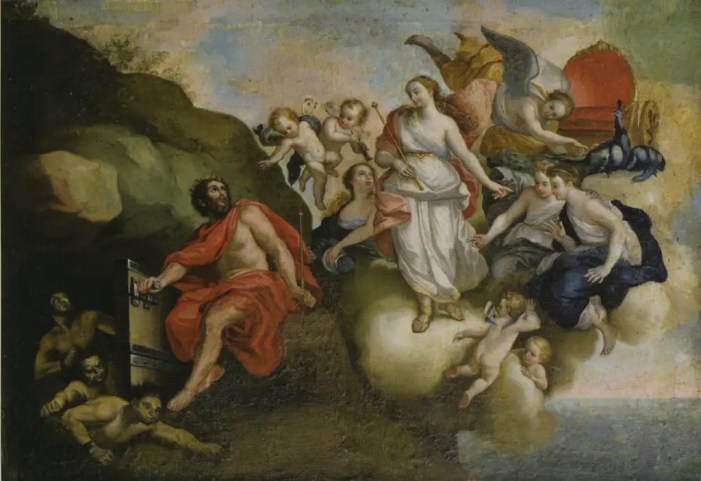
Rhea was very much like her mother and loved her children unconditionally but unfortunately Cronus was like his father, jealous of his children’s powers and in fear of being overthrown. She became mad when Cronus forced her to give him their children to swallow upon birth. She started plotting against him and by the time he had swallowed Hestia, Hera, Poseidon, Hades, and Demeter, Rhea decided that enough is enough. She gave birth to her last childZeusin secrecy and gave Cronus a rock, wrapped in a blanket, to swallow instead. Cronus was pleased, not knowing that Zeus was still out there, and thought he was safe from the prophecy. In Hesiod’s Theogony, it is said that Rhea brought infant Zeus to Crete and gave it to Gaea to look after him. Gaea then guided him to the secret cave beneath Mount Aegeum or Mount Dicte. Zeus was raised there and, when grown up, came to Mount Othrys as a cupbearer and mixed a potion into Cronus’ drink which made him vomit all of his children. Later, in a ten-year war, Zeus and Olympians defeated Cronus and the Titans. They became the next rulers, just like Cronus and his brothers had done in the past, when overthrowing Uranus. In the end, Rhea was the main reason that history repeated itself.
According to Diodorus Siculus, it is said that Poseidon too had escaped the cannibalism of his father and that it was Rhea who had given him to the Telchines to look after him. However, according Pausanias, Rhea had hidden Poseidon among a flock of lambs when he was next to be swallowed.
The desire of motherhood
Like mentioned in Ovid’s Fasti, Rhea was mad and angry because she was often pregnant but never truly a mother of her children due to cannibalism of Cronus who ate most of them while Zeus and, variously, Poseidon on the other hand had to be hidden away from Cronus. She was mentioned to be often in company of lions which she nursed and took care of. The goddess is also said to have helped nurturing the young Dionysus when he was brought to her by Hermes, on Zeus’ orders who had to hide him from jealous and angry Hera. She was also, according to Homeric hymn to Apollo, involved in the birth of Apollo on the island of Delos. Upon the god’s birth, she, along her sisters Tethys and Theia, washed him with pure clean water and placed him in a white garment and took care of him until Leto recovered.
Other myths
Rhea was also involved in the return of Demeter to Mount Olympus. Demeter, in grief and sorrow, withdrew herself from the rest of the gods when Persephone was abducted. When the two were reunited, Demeter, still in anger of Persephone being bound to the underworld, declined to return. However, Rhea came to Demeter and convinced her that her place is among her brothers and sisters on Mount Olympus. In Nonnus’ Dionysiaca, Rhea is also said to had given an Amethyst to Dionysus that protected him from the tyranny of madness when drinking wine.
Greek Titan – Hyperion, god of light and sunlight
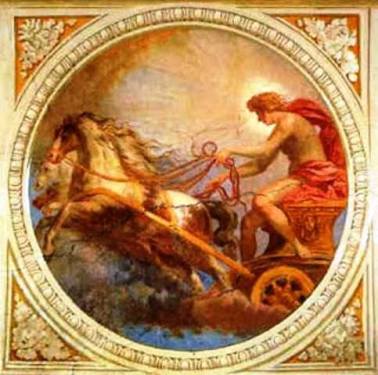
Hyperion was a Titan god of light or sunlight and was associated with watching and observation from above. He was also known as a Pillar of east. Together with his other three brothers, Crius, Coeus and Iapetus, they presided as the Pillars of holding Heaven and Earth apart. He was one of six sons of Uranus and Gaea and is mentioned by Apollodorus as one of the five brothers, all but Oceanus, who participated in rebellion against Uranus and later attacked him. When they overcame him, the four brothers probably held him down while Cronus castrated him. While most of the authors are identifying Hyperion as a unique character, Homer is equating Helios and Hyperion as one and the same character and it can be seen in both of his epics, the Iliad and the Odyssey.
Establishing a rhythm of days and months
Due to his diligent observation, he was first to understand the movements of the sun and the moon, as well as the other stars and seasons. He was believed to have ordered the cycles of the sun, the moon and the dawn. During his time, he married her sister Theia with whom he had three children who presided over these cycles. Helios presided over sun, Selene over the moon and Eos presided over the dawn.
If you want to learn a bit more about Selene, check the page of Theia or Sky deities.
Titanomachy
Although there are notes of Hyperion participating in Titanomachy, there is no reference of his role in the war. It is only known that he sided with his brothers and fellow Titans against younger Olympians. And that he was in the end, after losing the war, imprisoned in Tartarus with his brothers and relatives. However, according to Aeschylus’ lost play , he was later released byZeus from Tartarus with the rest of the titans.







 Witches Of The Craft®
You must be logged in to post a comment.