In Place of a God – Buddhism

Buddhism – Definition, Founder, and Origins from history.com

Buddhism is a faith that was founded by Siddhartha Gautama (“the Buddha”) more than 2,500 years ago in India. With about 500 million followers, scholars consider Buddhism one of the major world religions. Its practice has historically been most prominent in East and Southeast Asia, but its influence is growing in the West. Many Buddhist ideas and philosophies overlap with those of other faiths.

Table of Contents

Buddhism Beliefs

Founder of Buddhism

Types of Buddhism

Dharma

Four Noble Truths

Eightfold Path

Buddhist Holy Book

Dalai Lama

Buddhist Holidays

Buddhism Beliefs

Some key Buddhism beliefs include:

  • Followers of Buddhism don’t acknowledge a supreme god or deity. They instead focus on achieving enlightenment—a state of inner peace and wisdom. When followers reach this spiritual echelon, they’re said to have experienced nirvana.
  • The religion’s founder, Buddha, is considered an extraordinary being, but not a god. The word Buddha means “enlightened.”
  • The path to enlightenment is attained by utilizing morality, meditation and wisdom. Buddhists often meditate because they believe it helps awaken truth.
  • There are many philosophies and interpretations within Buddhism, making it a tolerant and evolving religion.
  • Some scholars don’t recognize Buddhism as an organized religion, but rather, a “way of life” or a “spiritual tradition.”
  • Buddhism encourages its people to avoid self-indulgence but also self-denial.
  • Buddha’s most important teachings, known as The Four Noble Truths, are essential to understanding the religion.
  • Buddhists embrace the concepts of karma (the law of cause and effect) and reincarnation (the continuous cycle of rebirth).
  • Followers of Buddhism can worship in temples or in their own homes.
  • Buddhist monks, or bhikkhus, follow a strict code of conduct, which includes celibacy.
  • There is no single Buddhist symbol, but a number of images have evolved that represent Buddhist beliefs, including the lotus flower, the eight-spoked dharma wheel, the Bodhi tree and the swastika (an ancient symbol whose name means “well-being” or “good fortune” in Sanskrit).

Gods – Aengus (Irish Celtic)

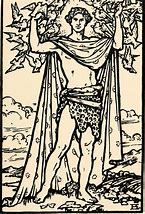
Aengus – God of Love, Youth, Summer and Poetry

The Dagda is not thought to have welcomed the news of the arrival of Aengus.

It is said that upon hearing the news that Boann was pregnant, the Dagda attempted to hide the pregnancy by keeping the sun still in the sky for 9 months so that the gestation would take place in the space of a day.

It is possibly fitting then that Aengus, the Irish god of love, youth, summer and poetry, was in fact a love child himself.

Aengus (or Óengus as is sometimes used) was another member of the Tuatha dé Danann with expert knowledge of weaponry. His sword, Moralltach, or the Great Fury given to him by the god of the sea, Manannan mac Lir, was one of his prized possessions.

One story exists of how the Dagda when assigning land to his children, he forgot to leave land for Aengus.  At this time, the Dagda was living in Newgrange and Aengus tricked him into letting him live there permanently.

Aengus’ skill with poetry was thought to be so great that he was able to break magic spells with this gift, such as the one placed on Étain in the love story with Midir.

In a dream Aengus falls in love with a beautiful maiden, Caer Ibormeith. He searches day and night until he finds her at the Lake of the Dragon’s Mouth.

There was a catch that Caer was stuck in the form of a swan and was only able to return to a human form for one day every second year. In order to marry her, Aengus had to correctly identify her as a swan among 150 other swans, which he was able to do. Then he also transformed into a swan and flew with her to his home in the Brú na Boinne.

Goddesses – Airmid


AIRMID

CELTIC GODDESS OF HEALING

Airmid, also known as Airmed or Airmeith, is the Celtic Goddess of the Healing Arts. She was also a member of the Tuatha De Danaan, the most ancient race of deities in Ireland and just as they did, she had great magickal powers. When the Goddess Danu first created the Tuatha De Danaan, she made sure that its members were very powerful gods, filled with great wisdom and skilled in every possible area of expertise.

Some people believe that the Tuatha De Danaan was comprised of Druids, who were extremely knowledgeable in both prophecy and magick. When the members of the Tuatha De Danaan decided to study something, not only did they simply learn about it, they actually went much farther, by deeply immersing themselves in that particular field to the point where they became the greatest experts in the world. They believed strongly in the three components of life: the Earth, the Mysteries, and the Spirit realm and that they were all of equal importance.

Airmid was the daughter of Diancecht, the God of Medicine, and the Chief Physician and Magician of the Tuatha De Danaan. She also had four brothers: Miach, Cian, Cethe, and Cu, and they all followed closely in their father’s footsteps. Airmid also had a sister named Etan, who was a poet who was also married to Oghma. Coming from that kind of a heritage, there can be little doubt that Airmid and her brothers excelled in the healing arts.

When the Fir Bolgs first arrived in Ireland, the Tuatha De Danaan fought against them in a great war, protecting its people and land from invasion. During the first battle, the Tuatha defeated the Fir Bolgs and killed their king, Eocchid MacEric. Nuada, the King of the Tuatha De Danaan was also seriously injured in that battle when his arm became severed from his body.

Since Diancecht was the Chief Physician of the Tuatha De Danaan, he was immediately called upon to attend to Nuada’s wounds, and he brought Airmid and Miach with him to assist. While Diancecht was working upon Nuada, it became increasingly clear that Airmid’s and Miach’s skills as healers were much greater then those of their father.

While Diancecht had decided to replace Nuada’s severed arm with one that he had constructed from silver, Airmid was actually able to regenerate the King’s own arm to perfect working order. Then Miach, using his amazing surgical skills, took the regenerated arm and re-attached it to the King’s body. These actions were extremely important to the Tuatha De Danaan and especially to Nauda, because according to its laws, no one could ever be its king, whose body was not completely whole. If Nuada’s arm had not been re-attached to his body, through Airmid and Miach’s amazing skills, then his reign as King would have ended.

Airmid, Miach and Diancecht built the Well of Slaine in Ireland, which was also known as the Well of Health. They then caste spells over it, so that the well’s magickal waters could not only restore life to those warriors who had been killed in battle; it could actually return them all to perfect health. When a wounded warrior was brought to the well his body was immediately immersed in its waters, which not only brought him back to life, but also made him well enough to return to the battle.

However, during the second Battle of Moytura, things did not go well for the Tuatha De Danaan because their enemies had filled the Well of Slaine with stones. That made it impossible for them to bring their warriors bodies back to life, and the well soon became known as the “Heapstown Cairn.”

Airmid’s brother Miach was an extremely talented healer, and when Diancecht realized that his son’s abilities were so greatly superior to his own he became extremely jealous. Soon, that jealousy began to turn into rage, and that rage became so great that he drew his sword and slashed Miach quite badly. Miach, however, using his superior medical knowledge and magickal skills, immediately healed the wound.

That just made Diancecht’s anger grow even greater, and for a second time he drew his sword, this time cutting Miach through to the bone. Just as quickly, however, Miach was able to heal himself once more.

It was at that point that Diancecht finally lost what little control he had left over his rage and, once again taking his sword in his hand, he sliced directly into his son’s brain tissue. What happened then was truly miraculous. Miach showed himself to be the outstanding physician that he was, and he actually was able to heal himself one more time.

Finally, it became extremely clear that Diancecht’s hatred of his son had reached the point of no return. Slowly, Diancecht drew his sword and then, for the final time, he struck his son in the head, this time severing Miach’s brain completely from his skull. It was then that Diancecht just walked away, leaving his wounded son who was no longer able to heal himself lying there on the ground to die. Legend has it, that when Diancecht looked down upon his dying son, he never once exhibited even the slightest bit of remorse.

Airmid also had great magickal powers and herb craft was her specialty. Miach had taught her well, and she knew the different uses of each and every plant. When Airmid buried her brother it was with great sorrow. She missed him dearly, since they had always been so very close, and she frequently would go to visit his grave. One day, when she arrived at Miach’s grave, she was amazed to find 365 healing herbs growing on and around his grave, with one herb for every joint and organ of his body.

Methodically, Airmid began to gather up the herbs. Then, quite amazingly, the herbs began to speak to her, telling her of the full range of their healing powers. Airmid then took the herbs and separated each from the other. Then she arranged them systematically upon her cloak, each according to its own particular use or special properties. With the knowledge she had gained from the herbs, she then proceeded to use it to heal people who needed medical attention.

Amazingly, Diancecht’s obsessive hatred for his son did not end with Miach’s death. Still consumed by his enormous rage, Diancecht went over to Airmid’s cloak and overturned it, scattering all the herbs into the wind; thereby making certain that no one except Airmid would ever know the use of the herbs’ healing properties or the secret of how to achieve immortality which was made possible through the herbs proper use.

Even though Diancecht was her father, Airmid found herself unable to have any feelings for him, and refused to have anything to do with him. In fact, she found it so impossible to even go anywhere near him, that she travelled far away to a place where she would never have to see him again.

It is believed that Airmid still works as a Physician, high in the mountains of Ireland, spending much of her time healing Faeries, Elves and humans; bringing them all back to good health through her practical knowledge and amazing magickal skills.

Airmid

Celtic Goddess of Healing, Plants and Herbs

Airmid was a Celtic Goddess of the healing arts especially dealing with herbs and plants. She was the daughter of Dian Cecht who was the God of Medicine and chief physician to the Tuatha de Danann, the Gods of Ireland. Airmid had four brothers Miach, Cian, Cu and Cethe who also followed the path of healing and medicine.

The Tuatha de Danann went to war with the Fir Bolgs when they invaded Ireland.

The king of the Tuatha de Danann, Nuada, was injured in battle and his arm had been severed. According to the laws it was said that no man could be king whose body was not whole, so Nuada immediately called on his physician, Dian Cecht. The physician brought his daughter Airmid and his son Miach with him since they were both skilled healers.

Dian Cecht had planned to reconstruct a new arm for Nuada made of silver but since Airmid was known for her regenerative skills she was able to create an arm made of human flesh.

Miach was known for his surgical skills and he was able to attach the new arm to Nuadas body so that it looked like he had never lost an arm in the first place. So great was Miachs surgical skills that his father became jealous and in a fit of envious rage he grabbed a sword and cut off Miachs head.

Airmid was beside herself with grief after losing her brother.

She buried him and made a cairn of stones over his grave. She visited his grave to mourn his loss everyday for a year. Than one day when she went to sit at his grave she came upon 365 different herbs growing on top and all around his burial site. She laid out her cloak to gather all the herbs and as she gently plucked them from the fertile earth they whispered their unique healing properties to her. There was an herb for each joint, organ and bone in the body.

Her father Dian Cecht, still jealous of his sons vast knowledge, found Airmid and overturned her cloak scattering the herbs to the wind so that no one but she would know of the healing herbs secrets.

Thankfully, Airmid had already committed everything to memory and could regrow all the herbs to continue her and her brothers healing work. Airmid was called upon when men and women were hurt during battle. She was also said to be a healer for the fairies and other magical creatures of the forests and mountains of Ireland.

Airmid can be called upon today for any healing work you are doing.

Or any herbal medicine preparations. She can also be called on while you’re gardening and planting as she will watch over the plants and lend them her healing powers and magic.

Reference:

Love of the Goddess

Goddesses – Calliope

Calliope – The Greek Chief of Nine Muses

Greek goddess Calliope had a way with words. In fact, she was so eloquent and poetic that she was highly regarded by Hesiod and Ovid. Of all THE MUSES, she was considered the “Chief”.

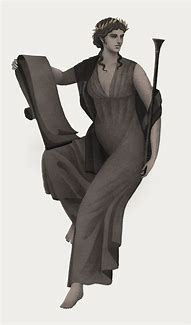
In modern times, you’ll see the goddess depicted as a fine writer with a tablet, roll of paper or book in hand. Occasionally, her role of a mother is emphasized as she is shown with her children. Other artists draw and paint her with a gold crown on her head.

As the oldest of the muses, she had influence. People with creative talents called upon her to help inspire and guide their work which she did regularly. When she wasn’t busy falling in love, she was overseeing music, song, and dance.

Literature Said to Be Inspired by Calliope

Calliope inspired and was referred to in many famous works of literature. It is said that she was the muse for the Iliad and the Odyssey. Although it is not known to be verified, many people believe she is what inspired Homer’s work.

The GREEK GODDESS is also said to be a part of Virgil’s poetry, too. In the Aeneid, she is invoked. Calliope is also referred to in Dante’s Divine Comedy where dead poetry is given new life thanks to the goddess and her abilities to inspire.

Artwork Featuring the Greek Goddess Can Be Found on Pottery in Italy

The goddess inspired artwork, too. Her image is on the Francois Vase, a beautiful work of art created by the potter Ergotimos in 570 BCE. It resides in the Museo Archeologico in Florence, Italy where it is seen and appreciated by new generations of creative people.

Calliope’s Love Life and Family Life

Calliope had children with King Oeagrus of Thrace and loved by the god APOLLO. She had one son, ORPHEUS, with the king and two sons with the latter. They were named Hymen and Ialemus.

The bard Orpheus is the most famous child of the Greek muse. He was murdered by Bacchantes, and Calliope was devastated. The island of Lesbos was dedicated to her son, who has also been mentioned in literature throughout centuries.

Calliope is said to have had a relationship with ACHILLES. She taught him how to sing which encouraged rowdiness while he drank. When you hear about an Achilles’ heel, it refers to the arrow shot by Trojan Paris that brought down the legendary mortal.

SOURCE: <a href=”https://greekgodsandgoddesses.net/goddesses/calliope/”>Calliope: https://greekgodsandgoddesses.net</a&gt; – Greek Gods & Goddesses, October 20, 2019

(Side Note from Lady Carla Beltane: You can thank Calliope for most of the content I post on WOTC. I have been honored by having Calliope as a muse for many years)

Gods – Janus

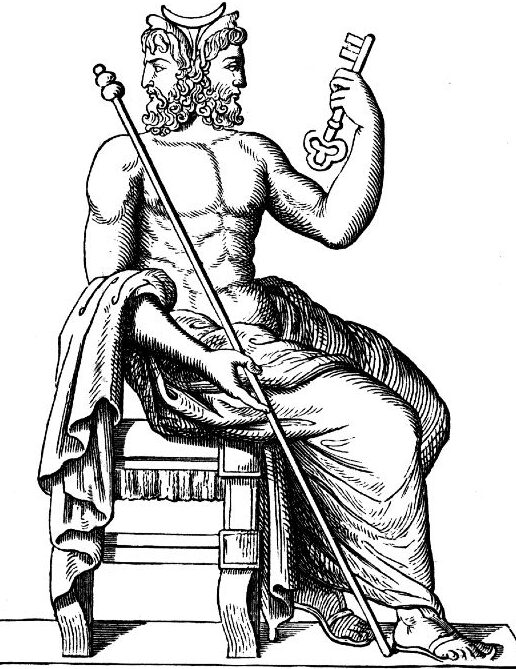
Janus – the Roman god of time, beginnings and endings, transitions, change, war and peace, as well as… doors.

Many think that all Roman gods are just renamed copies of the “original” Greek deities. However, that’s not the case. Meet Janus – the Roman god of time, beginnings and endings, transitions, change, war and peace, as well as… doors.

Janus was a peculiar deity in many ways, including in how he was worshipped, what his name actually means, and his murky origins. More has been left unknown about this deity that has been preserved through history, so let’s try to quickly go over what we do know about him.

Who was Janus?

Janus in Greek Mythology

Why Did Janus have Two Faces?

Importance of Janus in Modern Culture

FAQs About Janus

Wrapping Up

Goddesses – Iris

Iris – Greek Goddess of The Rainbow

A goddess named “Iris” personified the rainbow in the mythology of ancient Greece. Most works of art depict her either in the form of a beautiful rainbow, or as a lovely maiden. She wore wings on her shoulders and usually carried a pitcher in one hand. Her name combined the Greek words for “messenger” and “the rainbow” to signify her dual role. Some accounts depict her as one of the goddess Hera’s assistants. (HERA carries associations with the sky.)

The ancient Greeks considered Iris the female counterpart of HERMES. She served as a messenger from MOUNT OLYMPUS. She would use her pitcher to scoop up water from the ocean and carry it into the clouds. Some legends also hold she used her pitcher to collect water from the River STYX, the shadowy river separating the world of human beings from the underworld. Many Greeks viewed Iris as an important link between MORTALS and the realm of the gods.

IRIS FACTS

Name(s): Iris
Rules over: Rainbows and messenger of the Olympian Gods
Title: Goddess Of The Rainbow
Gender: Female
Symbols: Herald’s wand
Sacred animals:
Items: Pitcher
Parents: Thaumas and Electra
Consort: Zephryos
Other significant others: Siblings: – Arke, Harpies, Hydaspes
Children: Pothos
Roman name: Arcus

The Family Life of Iris

Most sources describe Iris as the daughter of the OCEANID cloud nymph ELEKTRA and Thaumas, a minor god sometimes associated with the sea. She would have been one of the TITAN OCEANUS granddaughters. Her rainbow frequently appeared in the sky over bodies of water.

Legends differ about her life as an adult. Some stories describe her as unmarried and primarily a messenger for the OLYMPIAN GODS. In other accounts, she fell in love with ZEPHYROS, the god of the West Wind. They had a son named Pothos, who personified Desire.

Iris as a Messenger

Iris would frequently use her pitcher to serve nectar to the GODS AND GODDESSES on Mount Olympus. When these major ancient Greek deities needed to send messages to other gods or to human beings, they would sometimes ask Iris to transmit their words. She could travel very quickly from Mount Olympus to Earth, and could even journey quickly into HADES.

Many ancient Greeks considered Iris one of the most beautiful goddesses. The ancient Greeks described her as “swift footed”, suggesting she could respond rapidly to requests. In legends, she carries symbolic associations with messages and communication.

SOURCE: <a href=”https://greekgodsandgoddesses.net/goddesses/iris/”>Iris: https://greekgodsandgoddesses.net</a&gt; – Greek Gods & Goddesses, June 12, 2018

Gods – Achelous

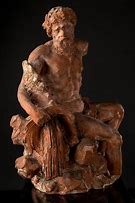
The Greecian patron god of the “silver-swirling” Achelous River

Originally in Greek mythology, Achelous was the god of all rivers and water of the world. During Hellenistic times, he was only associated with the Achelous river. This is the largest river in all Greece. Every river has its own river spirit and Achelous was considered the chief of all the deities of rivers.

ACHELOUS FACTS

Name(s): Achelous
Rules over: The River Achelous
Title: The patron god of the “silver-swirling” Achelous River
Gender: Male
Symbols: Cornucopia
Sacred animals: Bull
Items:
Parents: Oceanus and Tethys
Consort:
Other significant others: Retinue:- Naiad Nymphs
Children: The Sirens by Terpsicore, The Acheloides, Callirhoe
Roman name: Achelous

Etruscan Mythology

In Etruscan mythology, Achelous was considered an important deity. He was intimately associated with water. This has become a Greek tradition. He also has significant underworld associations. In the 8th century, iconography representing a man-faced bull was initially adapted for Achelous as he was considered an Etruscan deity. The Greeks also eventually adopted this tradition of his image.

Important Divinity

Throughout Greece, Achelous was treated as an important divinity from the earliest times. He was invoked when people took oaths, make prayers as well as made sacrifices and more. An oracle was considered a gateway to knowing the will of the gods. Every oracle Achelous gave to humans is believed to have been added to by ZEUS at Dodoma. It included a command to provide sacrifices to Achelous. The meaning of the god himself to people in Greece is illustrated by the widespread worship of Achelous. Some believe this may account for the belief that He is the representative of sweet water in general. This means they believed Achelous to be the source of all nourishment.

Seer-Healer And Mercenaries

One of the most important exponents in Etruscan and Greek societies during the Iron Age were the mercenaries and seer-healers. The image of Achelous was a man with the face of a bull. He was an emblem used by the mercenaries and seer-healers in Greek societies for hundreds of years. It is believed this early figure was initially adapted by the iconographic and mythological traditions of Asalluhi, who was the god of magic and incantations. This was done because he was also considered a princely bison figure in Near Eastern traditions. Achelous was believed to go to the surface of the earth in marshes and spring. He would then eventually begin flowing as rivers.

Achelous Mythology

The king of CALYDON was Oeneus. Achelous was a suitor of the king’s daughter who was named Deianeira. On some thrones in ancient Greece were representations of the contest between Heracles with Achelous. It is in Megarans at Olympic in the treasury where there was a STATUE of Achelous made of gold and cedar wood that was created by a greek named Dontas. There are also many depictions of him as a bearded man in his prime or an older gray-haired man. In Classical and Archaic times, it was common to depict Achelous as a man-faced bull. It was also common for a city’s coinage to feature a man-faced bull.

Heracles Battle

Achelous battled Heracles for the attention of Deianira. She was a river nymph. During the battle, Achelous turned himself into a bull and a serpent. Heracles ripped off one of the horns of Achelous This forced him to surrender to Heracles. Achelous wanted the horn back. He traded the goat horn of Amalthea to HERACLES to get it back. Achelous then gave the horn to the Naiads. They changed the horn into a cornucopia. Deianeria was relieved. She was horrified at the idea of being courted by a river god from the underworld.

Achelous Children

Some consider Achelous to have fathered the Sirens of Terpsicore, Calliope or MELPOMENE. They were created from the blood he lost when Heracles pulled off his horn. Alcmaeon was a god who was the son of Eriphyle and Amphiaraus. After losing a large battle, Alcameon found peace at a spot along the Achelous river. It was here that Achelous offered Alcameon his daughter Callirhoe for marriage. Before this could happen, Achelous required Alcmaeon to get jewellery and clothing from his mother who was called Eriphyle. This was the clothing Eriphyle wore when she sent the father of Achelous to his death. Alcameon agreed and was also going to get the cloths from king Phegeus. This is the person who had sent his sons to murder Alcmaeon.

Italian Middy Feast

When THESEUS was waiting for a river’s raging flood to subside, he was the guest of Achelous. Where Thesus stayed was described as a building made of rough and spongy pumice. It had a floor of soft moss. Oyster and freshwater mussel shells covered the ceiling. In Italy during the sixteenth century, there was a desire to recreate this Classical space. It also inspired these types of dwellings to be built in France. The banquet served at the home of Achelous was written about and became a prototype for midday feasts in Italy. They would take place in garden grottoes under fountain-cooled shade.

Origin Of River Achelous

It is said Achelous lost one of THE SIRENS that was his daughters. During his intense sadness, he invoked his mother Gaea. She received Achelous to her bosom. On the spot where this occurred, Gaea caused a river named Achelous to come forth. It is said that the river had a bull’s voice. The winding of the river is said to have been caused because Achelous could turn himself into a serpent.

Recent studies have shown the substance of Achelous as a god goes back to Old Europe during the Bronze age. This was a time when some Old European cultures disappeared. These traditions eventually made their way to Greece, Sardinia, Italy, and Sicily. No single group of people followed Achelous, but his image has lasted through many generations. A god that is a man-faced bull is found in many places around the Mediterranean.

SOURCE: <a href=”https://greekgodsandgoddesses.net/gods/achelous/”>Achelous: https://greekgodsandgoddesses.net</a&gt; – Greek Gods & Goddesses, October 23, 2019

Goddesses – Melpomene

Melpomene – One of the Nine Greek Muses

In GREEK MYTHOLOGY, the NINE MUSES provided inspiration for literature, art, music, and science. They were the DAUGHTERS OF ZEUSTHE KING OF THE GODS, and the goddess of memory, MNEMOSYNE. The nine Muses were also goddesses who lived above the summits of MOUNT OLYMPUS, Helicon, Parnassus, and the Pindus. Melpomene was one of the nine Muses. Her sisters were CLIOTHALIACALLIOPEPOLYHYMNIAEUTERPEERATOTERPSICHORE, and URANIA. Each Muse was assigned a specific role. These roles were history, comedy, poetry, music, dancing, singing, sacred hymns, rhetoric, and harmony. Melpomene’s role was the tragedy.

A tragedy is a form of ancient Greek drama that was performed in open-air theatres in Athens and forms the foundation of modern theatre. The origin of tragedy is debated by scholars. It is believed that tragedy began as a performance of epic poetry that included worship rituals to the god of theatre, DIONYSUS. The subject matter of Greek tragedy dealt with moral right and wrongs, and the performers would wear masks to impersonate a god. There were up to three performers with speaking roles and up to 15 performers in the chorus who only sang. All performers were male and played both male and female roles.

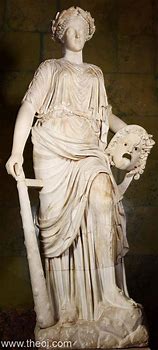
Images of Melpomene often depict her as holding a tragic mask in one hand and a sword in the other hand. She usually has a wreath in her hair and wears boots that were worn by tragic actors called cothurnus. An ancient Greek dramatist would call on the name of Melpomene to help him create his work. All nine Muses were immortal and could bless mortals with artistic gifts that they could use beautify their songs, add grace to their dances, and provide healing and comfort to the sick and heartbroken. Muses could also be resentful toward any mortal who did not believe in their artistic powers.

SOURCE: <a href=”https://greekgodsandgoddesses.net/goddesses/melpomene/”>Melpomene: https://greekgodsandgoddesses.net</a&gt; – Greek Gods & Goddesses, October 21, 2019

Gods – Helios

Helios – The Greek Sun God

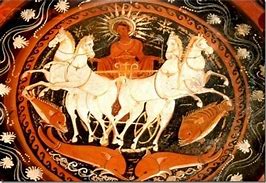
A handsome TITAN with flowing hair, driving a golden chariot pulled by four fiery steeds across the sky. That was the image that would come to the minds of ancient Greeks when they thought of Helios. To them, he was the representation of the sun and sunlight, traveling across the sky every day. Some authors report that select Greeks revered him as much as they did Zeus.

HELIOS FACTS

Name(s): Helios
Rules over: The Sun
Title: Titan God of the Sun
Gender: Male
Symbols: Sun, Chariot, Aureole
Sacred animals: Horse, Rooster, Cattle, Wolf
Items: Frankincense, Cornucopia, Black Poplar, Heliotrope
Parents: Hyperion and Theia
Consort: Clymene, Rhode – possible others: – Clytie, Perse, Leucothea
Other significant others: Siblings: – Selene and Eos
Children: Abundant children including: – The Charites, Phaethon, The Horae, Pasiphae, Circe, Aeëtes, Heliadae, and Heliades
Roman name: Sol

Helios Appearance

Artwork of the time often shows Helios to be wearing a shining aureole, or halo, of the sun upon his head. He had piercing eyes and long, curly hair.

Family History

Helios was the son of the Titan HYPERION and the Titaness, THEIA, making him a second generation Titan.
His sisters were goddesses SELENE, the moon, and EOS, the dawn.

Wives

The Titan had several wives and consorts. Among them were his sister, Selene, and Perse, an OCEANID.

Children of Helios

Helios sired many children with his different wives. The Charites, Phaethon, The HORAEPASIPHAËCIRCE, Aeëtes, Heliadae, and Heliades are among his known offspring.

The All Seeing Eye

It is not uncommon so see Helios given the epitaph Panoptes, or all-seeing, as the Greeks believed that he could witness anything in the heavens or on earth.

According to the myth about PERSEPHONE’S abduction by HADES, it was Helios who saw the crime occur. When DEMETER, Persephone’s mother, demanded to know the whereabout of her daughter, the Titan was able to inform her that Hades had kidnapped the goddess.

Another tale illustrating his ability describes Helios witnessing an affair between APHRODITE and ARES. He reported this to HEPHAESTUS, Aphrodite’s husband, and helped set a trap to catch the two lovers. Caught in the act, the gods then banished Ares from Olympus for his crime.

This ability would have made him a valuable friend to keep and a frightening enemy to have.

Daily Travels

As the sun god, Helios would make a daily journey across the sky. Four horses, Aethon, Pyrois, Phlegon and Eous, drew his chariot.

Each morning, his sister, EOS, would paint the dawn sky with her fingers and pull the misty curtain, through which Helios would appear, aside. He would drive his blazing chariot across the heavens until his travels were complete. At this time, he would he would hide in a golden cup that fell to earth while his sister, Eos, would begin her nightly trek.

Meeting with Hercules

Legend has it that one day while lost in his quest to find the island of Erythia, HERCULES grew frustrated and shot an arrow towards the sun. Upon realizing what he had done, he apologized to the Titan. Helios, however, was so taken with the boldness of this action that he presented Hercules with his golden cup. Hercules was then able to use this cup to reach his destination.

Helios Appearance in The Odyssey

Helios has a small but notable role in the Odyssey. When Odysseus and his men land on Thrinacia, one of the islands dedicated to the sun god, Odysseus warns them not to touch any of Helios’ cattle or sheep that graze on the land. They do not heed this warning and, in his absence, slaughter some of the best of the animals.

Alerted to this by one of his daughters, Helios appeals to ZEUS for revenge. He threatens to take the sun and shine it onto the dead of the UNDERWORLD, instead of on the earth, if the men’s act goes unpunished. Zeus then strikes the crew’s ship with a lightning bolt, killing everyone except for ODYSSEUS.

Cult Worship

The island of Rhodes, believed to have been shaped by Helios, is a place where people honored him as an important deity. Legend has it that when the island first came into being, it was muddy and uninhabitable. Helios dried the land and filled it with life, including seven of his sons known as Heliadae. Because of Helios’ life-giving intervention, some residents of the island worshiped him, and the island became sacred to Helios.

In the 3rd Century BC the people of Rhodes built the COLOSSUS OF RHODES which was a 30 metre (90 foot) statue of Helios, it was won of the SEVEN WONDERS of the Ancient world.

The Dorians, one of the four major ethnic groups of Greece at the time, also seemed to have celebrated Helios more than many Greeks of the era. There is even speculation that they were the people who brought the worship of the sun god to Rhodes.

Conclusion

Despite having what some historians believe to be a significant place in the Greeks’ hearts, Helios did not play a massive part in their mythology, and it seems that he was eventually replaced by APOLLO. Nevertheless, his image as the handsome Titan driving a blazing chariot pulled through the sky by his fire-breathing steeds lives on to this day.

Quick Facts:

Mother: Theia
Father: Hyperion
Siblings: Selene and Eos
Known wives/consorts: Selene, Perse, Clymene, Aegle, Neaera, Rhodos, Ocyrrhoe, Leucothoe, Nausidame, and Gaia
Known as: the Sun God
Roman equivalent: Sol

SOURCE: <a href=”https://greekgodsandgoddesses.net/gods/helios/”>Helios – The Sun God: https://greekgodsandgoddesses.net</a&gt; – Greek Gods & Goddesses, February 9, 2017

Goddesses – Nephthys

Egyptian goddess Nephthys

Nephthys was an ancient goddess, who was referenced in texts dating back to the Old Kingdom. She was a member of the Ennead of Heliopolis as the daughter of Geb and Nut and the sister of OsirisIsis, and Horus, as well as the sister and wife of Set. When the Ennead and Ogdoad merged, Nephthys was given a place on Ra’s boat so that she could accompany him on his journey through the underworld.

Nephthys is the Greek pronunciation of her name. To the Ancient Egyptians she was Nebthwt (Nebhhwt or Nebthet) meaning “the Mistress of the House”. The word “hwt” (“house”) may refer to the sky (as in Hwt-hor, the “House of Horus” – the name of Hathor), but it also refers to either the royal family or Egypt as a whole. The latter makes a great deal of sense as she was described as the head of the household of the gods and was thought to extend her protection to the head female of every household. She was sometimes associated with Ptah-Tanen in representing Lower Egypt, while Khnum and Isis represented Upper Egypt.

It seems that Nephthys was originally conceived of as the female counterpart of Set. He represented the desert, while she represented the air. Set was infertile (like the desert that he represented) and was frequently described as either bisexual or gay, and so Nephthys was often considered to be barren.

As a goddess of the air, she could take the form of a bird, and because she was barren she was associated with the vulture – a bird which the Egyptians believed did not bear children. The Egyptians thought that all vultures were female (because there is very little difference in the appearance of a male vulture), and that they were spontaneously created from the air. While the care shown by a mother vulture for her child was highly respected, the Egyptians also recognised that vultures fed on carrion and associated them with death and decay. As a result, Nephthys became a goddess of death and mourning.

Professional mourners were known as the “Hawks of Nephthys”, in recognition of her role as a goddess of mourning. It was also believed that she protected Hapi in his role as of the Four sons of Horus (who guarded the organs stored in the four canopic jars). Hapi protected the lungs, and as a goddes of the air Nephthys was his guardian.

She was also one of the four goddesses who guarded the shrine buried with the pharaoh. She appears with IsisSelkit (Serqet), and Neith on the gilded shrine of Tutankhamun, but was often depicted with IsisBast, and Hathor in this role. Yet, she was also said to be the source of both rain and the Nile river (associating her with Anuket) and was thought to protect women in childbirth (with the assistance of her sister, Isis). Thus she was closely associated with both death and life.

Although she was technically infertile, later myths claimed that Nephthys was the mother of Anubis by either Osiris or Set (depending on the myth). This came about because Anubis’ position as the god of the dead was usurped by Osiris when the theologies of the Ennead and the Ogdoad merged.

According to one myth Nephthys disguised herself as Isis to get the attention of her neglectful husband Set, but instead seduced Osiris (who apparently did not realise that it was Nephthys). An alternative myth made it clear that Nephthys intended to seduce Osiris from the beginning and drugged his wine to make her task easier, while a less common myth held that she tricked her husband into a brief dalliance in order to conceive Anubis. It is suggested that this tale also explained the flowering of a plant in a normally barren area because Set apparently discovered the adultery when he found a flower left by his brother Osiris.

Isis and Nephthys were very close despite Nephthys’ alleged infidelity with Osiris (the husband of Isis) and her marriage to Set (the murderer of Osiris). Nephthys protected the body of Osiris and supported Isis as she tried to resurrect him. The goddesses are so similar in appearance that only their headdresses can distinguish them and they always appear together in funerary scenes.

Together Isis and Nephthys could be said to represent day and night, life and death, growth and decay. In Heliopolis, Isis and Nephthys were represented by two virginal priestesses who shaved off all of their body hair and were ritually pure.

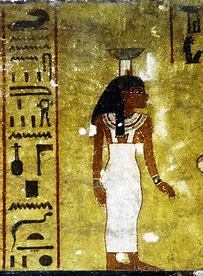
Nephthys was usually depicted as a woman with the hieroglyphs of her name (a basket on top of the glyph representing the plan of an estate) on her head. She could also be depicted as a mourning woman, and her hair was compared to the strips of cloth used in mummification.

Nephthys also occasionally appears as a hawk, a kite, or a winged goddess in her role as a protector of the dead. Her major centers of worship were Heliopolis (Iunu, in the 13th Nome of Lower Egypt), Senu, Hebet, (Behbit), Per-mert, Re-nefert, Het-sekhem, Het-Khas, Ta-kehset, and Diospolites.

Gods – Osiris

Egyptian God Osiris

In Egyptian mythology, Osiris is the god sent by Ra as pharaoh to rule over the first inhabitants of Egypt, along with his sister and wife Isis. Osiris was wise, intelligent, and benevolent. He led mankind on the path to greatness, joy, and prosperity in just a few centuries of reign.

Nevertheless, Osiris’ success was not appreciated by all: Set, Osiris’ brother, became very jealous of Osiris and planned to assassinate him.

Thus, in order to take the power of Osiris by force, Set traps Osiris by organizing a great contest during a banquet organized in the honor of Osiris and Isis. During this feast taking place on the banks of the Nile and welcoming many guests, Set brings a pretty chest decorated with rich jewels that he proposes to offer to anyone who would be able to enter fully into it.

Surprisingly, none of the guests manage to do so. But if no one can get into Set’s chest, it’s for a very simple reason: Set’s chest is specially designed so that only Osiris can enter inside.

When it is the Egyptian ruler’s turn to try to get into the chest, Set immediately welds the openings in the chest. He then throws the chest into the Nile, killing Osiris by drowning.

One of the symbols for Osiris

Osiris is the Egyptian god of life, death and resurrection. He took on many roles, names and forms in ancient Egyptian mythology over time. He is also a prominent god of the Heliopolitan Ennead.

Osiris (the Greek form of his name) was known as Asir in ancient Egypt. Other names or epithets he went by, include “Lord of Eternity”, “Great God” and “Foremost of the Westerners”.

Osiris Facts

Name(s): Osiris, Osiris-Apis
Rules over: Land of Egypt (Old Kingdom), Underworld (New Kingdom)
Gender: Male
Symbols: Atef Crown, Crook
Sacred animals: Ostrich Feathers on Atef Crown
Parents: Geb, Nut
Siblings: Horus, Set, Isis, Nephthys

Family

As the oldest son of Geb, the earth god, and Nut, the sky goddess, Osiris features in many stories and myths documented in ancient religious texts. He is brother to Set, Horus the ElderIsis, and Nephthys, and father to Horus the Younger (with Isis) and Anubis (with Nephthys).

The most famous myth about Osiris is also a central one in ancient Egyptian religion. Different versions are told, but it generally describes how he is killed by his jealous brother Set and his body then scattered in pieces over Egypt. A grieving Isis searches for and finds all the pieces except his penis. Nephthys and Anubis help her put the body back together but have to make him a new penis from gold. He comes back to life just long enough for Isis to become pregnant with Horus the Younger.

Symbols

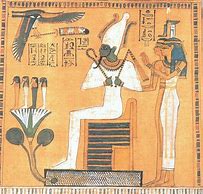
Mostly depicted as a partially mummified pharaoh, Osiris’ complexion is commonly green (representing rebirth), but sometimes black (representing the fertile floodplain of the Nile River). On his head is often the Atef crown, a headdress with two feathers on either side and a disc at the top. He usually has a beard like those of the pharaohs and carried a crook and flail. The crook symbolizes his role as a shepherd god.

Powers & Duties

In Egyptian mythology, Osiris was originally the founder of agriculture. He allegedly persuaded the Egyptians to end cannibalism (though there is no evidence that they were ever cannibals). This myth is linked to his role of presiding over death and resurrection, processes which are compared to the cycles of growth and decay experienced in nature.

Osiris’ prominence was evident in the fact that he was often simply referred to as “god.” He was viewed as an equal and sometimes even superior to Ra, the sun god.

After his death, Osiris became the king of the underworld. Instead of being feared in his role as the god of death, he was associated with resurrection and regeneration, and his presence in the underworld was viewed as comforting. This fact is illustrated in many portrayals where he wears a kind smile on his face.

Worship

In the Early Dynastic period, the center of Osiris’ worship was in Abydos, where his head is said to be buried.

During Akhet, the first season of the ancient Egyptian calendar, festivals were held across Egypt to celebrate Osiris’ life, death, and rebirth.

Osiris absorbed and became associated with many other deities over time. They included Wepwawet, Sahu, Banebdjed, and Anhur. This means that he was almost constantly worshiped across Egypt until the rise of Christianity during the time of the Roman Empire. His cult continued in Philae, an island in the Upper Nile, until the time of Emperor Justinian I (527 to 565).

Facts About Osiris

  • The people of ancient Egypt believed that Osiris disappeared into the underworld with their crops during winter;
  • Examples of corn mummies made of seeded dirt and molded to resemble Osiris were found in Tutankhamen’s tomb. It is believed such “mummies” were placed in many tombs with the dead. The seeds germinated in the dark are a symbol of rebirth;
  • The people of Mendes worshipped Osiris’ soul as an aspect called Banebdjed, with “Ba” referring to his soul and “djed” referring to a pillar. Benebdjed is depicted as a ram in ancient Egyptian art;
  • The ostrich feathers on each side of the Atef crown are said to represent Osiris’ cult center at Djedu;
  • Some myths held the belief that the pharaohs became Osiris when they died;
  • The judgment scene in Book of the Dead describes how Osiris welcomes the deserving dead into his kingdom after being judged by 42 divine judges. Those who did not live a good life are left to the mercy of a “devourer”;
  • After Osiris died at the hand of Set, Anubis presided over his mummification, thereby becoming the first embalmer. Anubis was the original god of the underworld before Osiris took over;

Gods – Anubis

Anubis


Anubis is one of the most iconic gods of ancient Egypt. Anubis is the Greek version of his name, the ancient Egyptians knew him as Anpu (or Inpu). Anubis was an extremely ancient deity whose name appears in the oldest mastabas of the Old Kingdom and the Pyramid Texts as a guardian and protector of the dead. He was originally a god of the underworld, but became associated specifically with the embalming process and funeral rites. His name is from the same root as the word for a royal child, “inpu”. However, it is also closely related to the word “inp” which means “to decay”, and one versions of his name (Inp or Anp) more closely resembles that word. As a result it is possible that his name changed slightly once he was adopted as the son of the King, Osiris. He was known as “Imy-ut” (“He Who is In the Place of Embalming”), “nub-tA-djser” (“lord of the scared land”).

He was initially related to the Ogdoad of Hermopolis, as the god of the underworld. In the Pyramid Texts of Unas, Anubis is associated with the Eye of Horus who acted as a guide to the dead and helped them find Osiris. In other myths Anubis and Wepwawet (Upuaut) led the deceased to the halls of Ma´at where they would be judged. Anubis watched over the whole process and ensured that the weighing of the heart was conducted correctly. He then led the innocent on to a heavenly existence and abandoned the guilty to Ammit.

The ancient Egyptians believed that the preservation of the body and the use of sweet-smelling herbs and plants would help the deceased because Anubis would sniff the mummy and only let the pure move on to paradise. According to early myths, Anubis took on and defeated the nine bows (the collective name for the traditional enemies of Egypt) gaining a further epithet “Jackal ruler of the bows”.


The growing power of the Ennead of Heliopolis resulted in the merging of the two religious systems. However, Osiris was the King of the Underworld in the Ennead and he was more popular (and powerful) than Anubis. So Anubis was relegated to a god of mummification. To save face it was stated that Anubis had voluntarily given up his position when Osiris died as a mark of respect. Some myths even stated that Anubis was the son of Osiris and Nephthys (who was herself associated with the funeral rites). Anubis was still closely involved in the weighing of the heart, but was more a guardian than a ruler.

He became the patron of lost souls, including orphans, and the patron of the funeral rites. In this respect he overlapped with (and eventually absorbed) the Jackal God Wepwawet of Upper Egypt.


During the Ptolemaic Period Anubis became associated with the Greek god Hermes as the composite god Hermanubis. Hermes was messenger of the gods, while Anubis was principally guide of the dead. Hermanubis was some times given attributes of Harpokrates. He was worshipped in Rome until the second century and was popular with Rennaisance alchemists and philosophers.

Priests wore Anubis masks during mummification. However, it is not clear whether the Anubis mask was a later development influenced by the Osirian myth or whether this practice was commonplace in the earlier periods too. Anubis was also closely associated with the imiut fetish used during the embalming ritual. Anubis was credited with a high level of anatomical knowledge as a result of embalming, and so he was the patron of anaesthesiology and his priests were apparently skilled herbal healers.


Tombs in the Valley of the Kings were often sealed with an image of Anubis subduing the “nine bows” (enemies of Egypt) as “Jackal Ruler of the Bows” and it was thought that the god would protect the burial physically and spiritually. One of his epithets, “tpy-djuf” (“he who is on his mountain”) refers to him guarding the necropolis and keeping watch from the hill above the Theban necropolis. He was also given the epithet “khentyamentiu” (“foremost of the westerners” i.e. the dead) because he guarded the entrance to the Underworld.


He was originally thought to be the son of Ra and Hesat, Ra’s wife (who was identified with Hathor), but later myths held that he was the child of Osiris and Nephthys, or Set and Nephthys. He was sometimes described as the son of Bast because of her link to the perfumed oils used in embalming. His wife, Anput (his female aspect) was only really referred to in association with the seventeenth nome of Upper Egypt. It is thought that they were the parents of Kebechet, the goddess of the purification.

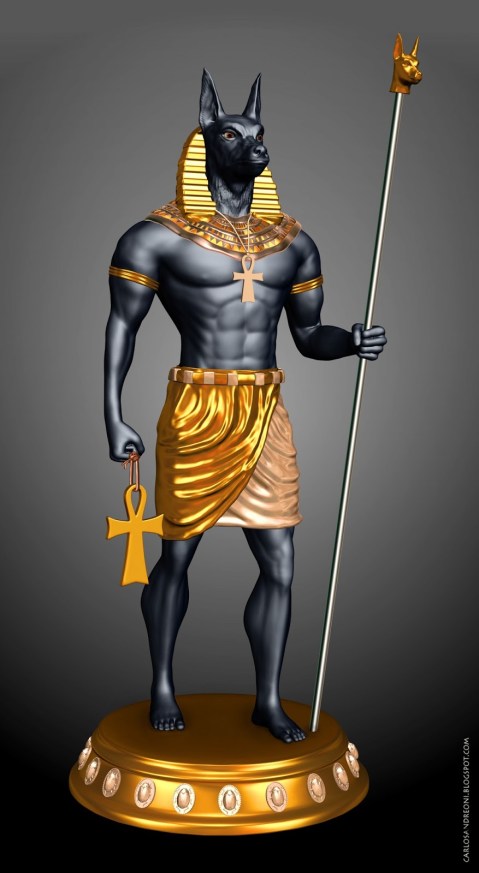
Dogs and jackals often patrolled the edges of the desert, near the cemeteries where the dead were buried, and it is thought that the first tombs were constructed to protect the dead from them. Anubis was usually thought of as a jackal (sAb), but may equally have been a wild dog (iwiw) He was usually depicted as a man with the head of a jackal and alert ears, often wearing a red ribbon, and wielding a flail. He was sometimes depicted as a jackal (such as in the beautiful examples from the tomb of Tutankhamun) but only rarely appears as a man (one example is in the cenotaph temple of Rameses II at Abydos).

His fur was generally black (not the brown associated with real jackals) because black was associated with fertility, and was closely linked to rebirth in the afterlife. In the catacombs of Alexandria he was depicted wearing Roman dress and the sun disk flanked by two cobras.

Anubis was worshipped throughout Egypt, but the center of his cult was in Hardai (Cynopolis) in the the seventeenth nome of Upper Egypt. To the east of Saqqara there was a place known as Anubeion, where a shrine and a cemetery of mummified dogs and jackals was discovered. He was also worshipped at cult centers in Abt (the the eighth nome of Upper Egypt) and Saut (Asyut, in the thirteenth nome of Upper Egypt).

____________________________

Anubis

Anubis (/əˈnuːbɪs/ or /əˈnjuːbɪs/;[1] Ancient Greek: Ἄνουβις, Egyptian: jnpw, Coptic: ⲁⲛⲟⲩⲡ Anoup) is the Greek name of a god associated with mummification and the afterlife in ancient Egyptian religion, usually depicted as a canine or a man with a canine head. Archeologists identified the sacred animal of Anubis as an Egyptian canid, the African golden wolf.

Like many ancient Egyptian deities, Anubis assumed different roles in various contexts. Depicted as a protector of graves as early as the First Dynasty (c. 3100 – c. 2890 BC), Anubis was also an embalmer. By the Middle Kingdom (c. 2055 – 1650 BC) he was replaced by Osiris in his role as lord of the underworld. One of his prominent roles was as a god who ushered souls into the afterlife. He attended the weighing scale during the “Weighing of the Heart,” in which it was determined whether a soul would be allowed to enter the realm of the dead. Despite being one of the most ancient and “one of the most frequently depicted and mentioned gods” in the Egyptian pantheon, Anubis played almost no role in Egyptian myths.

Anubis was depicted in black, a color that symbolized both rebirth and the discoloration of the corpse after embalming. Anubis is associated with Wepwawet (also called Upuaut), another Egyptian god portrayed with a dog’s head or in canine form, but with grey or white fur. Historians assume that the two figures were eventually combined. Anubis’ female counterpart is Anput. His daughter is the serpent goddess Kebechet.

Name
“Anubis” is a Greek rendering of this god’s Egyptian name. In the Old Kingdom (c. 2686 BC – c. 2181 BC), the standard way of writing his name in hieroglyphs was composed of the sound signs jnpw followed by a jackal over a ḥtp sign:
A new form with the “jackal” on a tall stand appeared in the late Old Kingdom and became common thereafter:
Anubis’ name jnpw was possibly pronounced [a.ˈna.pʰa], based on Coptic Anoup and the Akkadian transcription in the name “Reanapa” that appears in Amarna letter EA 315. However, this transcription may also be interpreted as rˁ-nfr, a name similar to that of Prince Ranefer of the Fourth Dynasty.

History
In Egypt’s Early Dynastic period (c. 3100 – c. 2686 BC), Anubis was portrayed in full animal form, with a “jackal” head and body. A “jackal” god, probably Anubis, is depicted in stone inscriptions from the reigns of Hor-Aha, Djer, and other pharaohs of the First Dynasty. Since Predynastic Egypt, when the dead were buried in shallow graves, “jackals” had been strongly associated with cemeteries because they were scavengers which uncovered human bodies and ate their flesh. In the spirit of “fighting like with like,” a “jackal” was chosen to protect the dead, because “a common problem (and cause of concern) must have been the digging up of bodies, shortly after burial, by jackals and other wild dogs which lived on the margins of the cultivation.”

The oldest known textual mention of Anubis is in the Pyramid Texts of the Old Kingdom (c. 2686 – c. 2181 BC), where he is associated with the burial of the pharaoh.

In the Old Kingdom, Anubis was the most important god of the dead. He was replaced in that role by Osiris during the Middle Kingdom (2000–1700 BC). In the Roman era, which started in 30 BC, tomb paintings depict him holding the hand of deceased persons to guide them to Osiris.

The parentage of Anubis varied between myths, times and sources. In early mythology, he was portrayed as a son of Ra. In the Coffin Texts, which were written in the First Intermediate Period (c. 2181–2055 BC), Anubis is the son of either the cow goddess Hesat or the cat-headed Bastet. Another tradition depicted him as the son of his father Ra and mother Nephthys. The Greek Plutarch (c. 40–120 AD) stated that Anubis was the illegitimate son of Nephthys and Osiris, but that he was adopted by Osiris’s wife Isis:

For when Isis found out that Osiris loved her sister and had relations with her in mistaking her sister for herself, and when she saw a proof of it in the form of a garland of clover that he had left to Nephthys – she was looking for a baby, because Nephthys abandoned it at once after it had been born for fear of Seth; and when Isis found the baby helped by the dogs which with great difficulties lead her there, she raised him and he became her guard and ally by the name of Anubis.

George Hart sees this story as an “attempt to incorporate the independent deity Anubis into the Osirian pantheon.” An Egyptian papyrus from the Roman period (30–380 AD) simply called Anubis the “son of Isis.”

In the Ptolemaic period (350–30 BC), when Egypt became a Hellenistic kingdom ruled by Greek pharaohs, Anubis was merged with the Greek god Hermes, becoming Hermanubis. The two gods were considered similar because they both guided souls to the afterlife. The center of this cult was in uten-ha/Sa-ka/ Cynopolis, a place whose Greek name means “city of dogs.” In Book XI of The Golden Ass by Apuleius, there is evidence that the worship of this god was continued in Rome through at least the 2nd century. Indeed, Hermanubis also appears in the alchemical and hermetical literature of the Middle Ages and the Renaissance.

Although the Greeks and Romans typically scorned Egypt’s animal-headed gods as bizarre and primitive (Anubis was mockingly called “Barker” by the Greeks), Anubis was sometimes associated with Sirius in the heavens and Cerberus and Hades in the underworld. In his dialogues, Plato often has Socrates utter oaths “by the dog” (kai me ton kuna), “by the dog of Egypt”, and “by the dog, the god of the Egyptians”, both for emphasis and to appeal to Anubis as an arbiter of truth in the underworld.

Roles
Protector of tombs
In contrast to real wolves, Anubis was a protector of graves and cemeteries. Several epithets attached to his name in Egyptian texts and inscriptions referred to that role. Khenty-imentiu, which means “foremost of the westerners” and later became the name of a different wolf god, alluded to his protecting function because the dead were usually buried on the west bank of the Nile. He took other names in connection with his funerary role, such as tpy-ḏw.f “He who is upon his mountain” (i.e. keeping guard over tombs from above) and nb-t3-ḏsr “Lord of the sacred land”, which designates him as a god of the desert necropolis.

The Jumilhac papyrus recounts another tale where Anubis protected the body of Osiris from Set. Set attempted to attack the body of Osiris by transforming himself into a leopard. Anubis stopped and subdued Set, however, and he branded Set’s skin with a hot iron rod. Anubis then flayed Set and wore his skin as a warning against evil-doers who would desecrate the tombs of the dead. Priests who attended to the dead wore leopard skin in order to commemorate Anubis’ victory over Set. The legend of Anubis branding the hide of Set in leopard form was used to explain how the leopard got its spots.

Most ancient tombs had prayers to Anubis carved on them.

Embalmer
As jmy-wt “He who is in the place of embalming”, Anubis was associated with mummification. He was also called ḫnty zḥ-nṯr “He who presides over the god’s booth”, in which “booth” could refer either to the place where embalming was carried out or the pharaoh’s burial chamber.

In the Osiris myth, Anubis helped Isis to embalm Osiris. Indeed, when the Osiris myth emerged, it was said that after Osiris had been killed by Set, Osiris’s organs were given to Anubis as a gift. With this connection, Anubis became the patron god of embalmers; during the rites of mummification, illustrations from the Book of the Dead often show a wolf-mask-wearing priest supporting the upright mummy.

Guide of souls
By the late pharaonic era (664–332 BC), Anubis was often depicted as guiding individuals across the threshold from the world of the living to the afterlife. Though a similar role was sometimes performed by the cow-headed Hathor, Anubis was more commonly chosen to fulfill that function. Greek writers from the Roman period of Egyptian history designated that role as that of “psychopomp”, a Greek term meaning “guide of souls” that they used to refer to their own god Hermes, who also played that role in Greek religion. Funerary art from that period represents Anubis guiding either men or women dressed in Greek clothes into the presence of Osiris, who by then had long replaced Anubis as ruler of the underworld.

Weighing of the heart

One of the roles of Anubis was as the “Guardian of the Scales.” The critical scene depicting the weighing of the heart, in the Book of the Dead, shows Anubis performing a measurement that determined whether the person was worthy of entering the realm of the dead (the underworld, known as Duat). By weighing the heart of a deceased person against Ma’at (or “truth”), who was often represented as an ostrich feather, Anubis dictated the fate of souls. Souls heavier than a feather would be devoured by Ammit, and souls lighter than a feather would ascend to a heavenly existence.

Bibliography

Main Source: Ancient Egypt Online
Goodenough, Simon (1997) Egyptian Mythology
Grajetzki, W (2003) Burial Customs in Ancient Egypt
Ikram, Salima (1997) Death and Burial in Ancient Egypt
Pinch, Geraldine (2002) Handbook Egyptian Mythology
Redford Donald B (2002) Ancient Gods Speak
Watterson, Barbara (1996) Gods of Ancient Egypt
Wilkinson, Richard H. (2003) The Complete Gods and Goddesses of Ancient Egypt
Wikipedia

Goddess Yemanja

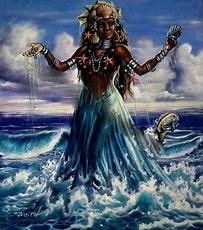
Yemanja

Iemanja Festival (Brazil)


Themes: Foresight, Divination, Psychic Abilities

Symbol: Water


To Do Today: At daybreak on this day, mediums in Brazil begin singing and dancing to summon the spirit of Iemanja, who provides glimpses of the year ahead. Worshipers take offerings carved with the wishes to rivers or to the ocean. Here, Iemanja’s spirit accepts the gifts, and the magic of the wish begins. To follow this custom make any small natural token and toss it in moving water with your wish, the water should be flowing toward you if you wish to being energy and flowing away from you if you want to carry away problems.


In keeping with today’s theme, soak in a mild saltwater bath to cleanse away any unwanted energy and heighten your senses.

Then try your favorite divination tool. Pray to Iemanja beforehand to bless your efforts. See what messages she has for you, especially on emotionally charged matters (water equates in metaphysical traditions).


Finally, to honor Iemanja, wear ocean blue clothing today, carry a blue stone (like lace agate or lapis), put a seashell or coral

in your pocket, dance in the rain (if the weather cooperates), or play in the sprinkler. Rediscover the element of water. 


By Patricia Telesco

Gods – Aten

Click here for more information about the Egyptian God Aten from egyptian-history.com

Do you want to know who was Aten (or Aton), the god representing the Sun in the ancient Egyptian civilization? Do you want to know how Aten almost became the sole god of Egypt during the reign of a “heretic pharaoh”?

Fascinated by ancient Egypt, our team has prepared an article that answers these questions.

Aten is the “Sun disk god” of ancient Egypt: he is the incarnation of the Sun. The god Aten appears during the 25th century BC as a minor god of Egypt. However, it was in 1353 BC that Aten really entered the posterity by becoming the single god of Egypt throughout the reign of Akhenaten, the so-called “heretic pharaoh.”

In this article, you will discover:

  • The place of the solar god Aten in Egyptian mythology
  • The history of the “Cult of Aten” advocated by the pharaoh Akhenaten (who will progressively establish the replacement of all the gods by the unique and almighty Aten)
  • The great problem that Aten posed when he became the sole god of Egypt: the end of the myth of the “Weighing of the Heart”

At the end of this article, you will know everything about the god Aten and the Cult of Aten of Akhenaten.

Let’s start right away by presenting who Aten is according to Egyptian mythology.

1) Who was Aten?

Aten, the Sun disk god, is the personification of the Sun. Aten takes his name from the Egyptian word “yati” meaning “to be far away” (which obviously refers to the Sun high in the sky).

Clearly aware that the Sun is vital for life, the ancient Egyptians praised the multi-armed Sun disk called Aten very early in their history (from the year 2500 BC according to the Egyptian collection of texts called “Pyramid Texts”).

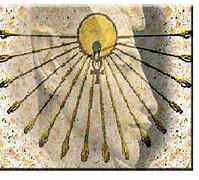
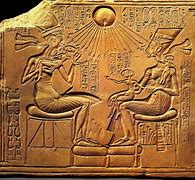
Aten is represented as a radiant sphere with long hands with which he bathes the world with his light, a necessary condition for plant, animal, and human life. In some representations, the Sun disk god has hands holding the Egyptian cross “ankh” (the Egyptian symbol of life) which seems to be stretched out to the earth to bring it food and fertility (thus representing the beneficial effects of the rays of the Sun).

Subsequently, in the course of the history of Egypt, more and more links appear between Aten and the kings of Egypt. According to ancient Egyptian legends, it is the pharaoh who controls the Sun: it is the pharaoh who orders the Sun to rise and set at the same times as he does.

Yet, if Aten is so famous in our modern society, it is because Aten became the one and only god of ancient Egypt during a small period of history: that of the “heresy of Akhenaten.”

2) The Cult of Aten

You now have a glimpse of the divinity embodying the Sun. Now let us discover the history of the establishment of the cult that placed him in the position of single god of Egypt.

A) The god Amun

In order to understand how Aten became the unique god of Egypt, one must understand the story of the almost “almighty” god he replaced: the god Amun.

Amun was initially the god of the creation of life. According to Egyptian mythology, there was only the original Darkness and the original Ocean at the beginning of our world. Then, through the repeated contacts between the Darkness and the Ocean was born the god Atum, the god representing the breath of life. Immediately after this event, responding to the call of Atum (i.e. the call of life),  the two gods Ra and Amun were born by their own will.

The falcon-headed Sun god Ra creates the Earth, the stars, and the Universe by harmoniously mixing the original Darkness and the original Ocean. It is thus he who creates the Sun Aten which he then places like a crown on his head to illuminate the Universe, having known until then only the night.

The god Amun creates life by changing himself into a goose to lay an egg. Then, Amun changes himself into a snake to hatch and fertilize this egg. He thus creates the first animal, vegetable, and human life forms.

During the New Kingdom of Egypt’s period (the period of Egypt from 1550 to 1069 BC), the god Amun will become more and more important in Egyptian beliefs. Amun will gradually become known in his form of Amun-Ra, i.e. a form in which he becomes one with the hawk Sun god Ra. Under this form, Amun is therefore responsible for the creation of the “Universe” in addition to the creation of “life.”

It was during the reign of Akhenaten’s grandfather and father (respectively Thutmose IV and Amenhotep III) that Amun became a god truly more important than all the others.

However, Egypt did not fall into a form of monotheistic religion since, despite his importance, Amun did not replace the other gods and goddesses (the jackal Anubis remained the god of death, the ibis Thoth remained the god of knowledge, the cat Bastet remained the goddess of women and joy, Bes remained the dwarf god of the home . . .).

Goddesses – Vesta

Roman Goddess Vesta from gods-and-goddesses.com

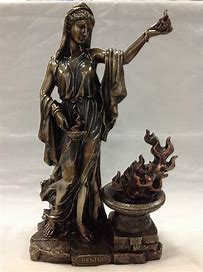
Vesta is the Roman goddess of the hearth. The hearth is the stone floor surrounding a furnace or fireplace. This was important to the Romans, because sources of fire for cooking, lighting, and heating homes were not easy to acquire. Therefore, once a fire was started, it had to be fueled and maintained so that it could keep burning and other fires could be lit from it. This was done at both public hearths and in those of private homes. The hearth also represented family life, and therefore the community life of the Roman State.

Vesta Facts

Name(s): Vesta
Rules over: Home, Hearth
Gender: Female
Symbols: Hearth and Fire, Flame
Sacred animals: Donkey
Parents: Saturn (Father) and Ops (Mother)
Siblings: Jupiter, Ceres, Juno, Pluto, Neptune
Greek Similar: Hestia
Norse Similar: Frigg

Origins

Vesta is one of the original gods of Rome, born to her parents, Saturn and Ops. Saturn became concerned when an ancient prophecy was revealed and told about his children becoming his undoing. He worried about the prophecy and decided to eat his children as they were born, in order to keep his position as king of the Roman gods.

The first-born child of Saturn was Vesta. She was the first to be eaten by the Titan. Saturn would then eat four of her siblings. Eventually, a stone was given to Saturn by Ops in place of the last child, Jupiter, which made him vomit the five children out of his body.

Vesta was the oldest of the children of Saturn and Rhea, but she was the last to return from his stomach, making her both the youngest and the oldest of the children of the Titans.

Appearance

Vesta is a goddess living in a state of eternal innocence and virginity, based on the stories of her life. Vesta’s innocence is shown in artworks, with her always being fully-clothed and appearing in a homely setting. The myths associated with Vesta are based on her life, with Jupiter choosing to keep the peace between Apollo and Neptune over the destiny of the goddess.

Family

The most interesting part of the family life of Vesta was her birth story. The siblings of Vesta include JupiterNeptune, Pluto, Venus and Juno. There are no children associated with Vesta because she decided to ask Jupiter to allow her to remain untouched, and maintain her virginity forever. The myth of the virginity of Vesta explains that a war would have broken out between Neptune and Apollo for the hand of the goddess, had Jupiter not decided Vesta would remain pure forever.

Symbols

Vesta is often seen accompanied by a donkey. This was her animal of choice in her role as patroness to the bakers. Her fire was needed to bake the bread, as was the the donkey’s strength to turn the mill stone, making flour. The braying of the donkey was also said to ward off the lustful advances of other gods.

The symbol of Vesta is the kettle, which was used on the hearth of every Roman home to heat water. Vesta is depicted in a homely setting in most of the images of the goddess, with Vesta often linked directly with a flame lit beside her.

Powers & Duties

Vesta chose to take up the role of the protector of the home fires of Rome, which led to her followers becoming responsible for tending the fires of the Senate. The Vestal Virgins remained untouched and locked away from human view apart from one day per year. Vesta was responsible for the health of the people of Rome and protected the work of bakers reliant on the fire Vesta created.

Myths & Stories

Few myths of Vesta exist today. Roman poet Ovid relates a story in which the fertility god Priapus attempted to seduce Vesta. He was foiled by the loud braying of her donkey. It is thought that her worship was introduced by Numa Pompilius, second king of Rome, between 715 and 673 B.C.

Worship

Each sanctuary or temple of Vesta was usually a circular building that mirrored the round huts formerly used as dwellings in Italy. The shape was also symbolic of the hearth. One such Temple of Vesta was located in the Roman Forum, on the Pallatine Hill, built in the third century B.C. A fire was kept burning there continually by a group of six priestesses called the Vestal Virgins. These priestesses were selected for service by the pontifex maximus, or chief priest, between the ages of six and ten, and served in the temple for at least 30 years. During that time, they tended the fire, prepared ritual food offerings, drew water from a spring outside Rome, lived in the House of the Vestals near the temple, and had to maintain their virginity. If one of the Virgins broke her vow of chastity, the punishment was to be buried alive. After the 30 years had passed, they were free to marry. The Vestals enjoyed a high social status in Rome.

Each year on the Roman New Year, March 1, the perpetual fire in the temple was ritually extinguished and re-lit. If the fire went out at any other time, it was seen as a bad omen for Rome. The festival to Vesta, called the Vestalia, was held on June 7 to 15. Rituals included sweeping out the temple and ritually disposing of the sweepings. The festival was considered a time of bad luck until the sweeping was completed. Normally, the inner sanctuary of the temple, called the penus Vestae, was not open to the public, but on the first day of the festival, women bearing gifts could visit if they entered barefoot. The sacred fire of Vesta was maintained until 394 A.D., when most Roman religious cults were banned.

Because of the need for fire in everyday life, Vesta was worshiped in nearly every Roman home as well. Many homes had a household shrine that included an image of Vesta. She was often worshiped alongside household deities called Penates.

Art

Statues and other artwork depicting Vesta typically show her draped in long, full robes, wearing a stern expression and with her head covered. She often holds a scepter in one hand. Interestingly, a statue of the goddess was not included at any of her temples. However, the penus Vestae housed the Palladium, a statue of the Trojan Athena. This object was considered too sacred for a man too look upon. When it was rescued from a fire that destroyed the temple in 241 B.C., the rescuer – Roman Consul L. Caecilius Metellus, was then blinded for having seen the sacred statue. However, he was also afforded great honor for the daring rescue.

Today

As with many ancient deities, Vesta’s legacy continues in the naming of interstellar objects. In 1807, the asteroid now called Vesta was discovered by Wilhelm Olbers. It is the brightest and second largest asteroid in our solar system’s asteroid belt.

Facts about Vesta

  • Vesta is the Roman goddess of the hearth.
  • Hestia is the Greek goddess who is equivalent to Vesta.
  • Vesta is commonly associated with the donkey and fire.
  • Vesta is the protector of home fires of Rome.
  • She was the oldest of Saturn’s six children.
  • In mythology, she and four of her siblings were eaten by her father, Saturn.
  • A Roman festival called Vestalia was dedicated to her and held from June 7 to 15.
  • The words “Vesta” and “vestibule” are likely derived from similar roots, as vestibule means “a dwelling or front area of a house”.
  • Few ancient statues of the goddess exist.

Goddesses – Ammit

Ammit Egyptian Goddess of Divine Retribution from ancientegyptonline.co.uk

The ancient Egyptian goddess Ammit (also known as Ammut and Ahemait) was the personification of divine retribution. She sat beside the scales of Ma’at ready to devour the souls of those deemed unworthy. Those unfortunate enough to fail the judgement of the dead would suffer the feared second death, and have no chance of the blissful life of the field of reeds, instead roaming restlessly for eternity.

Thankfully, the judges (Osiris or Anubis) were not too harsh, and the prosecutor (Thoth) was a pretty enlightened guy. The deceased made a negative confession (i.e. they listed the large number of evil things they had never been guilty of) and then their heart was weighted against the feather of Ma´at (justice or balance). It was not necessary to be totally good, just reasonably well balanced. There were also a number of spells and amulets the deceased could use to increase their chance of success.

Her name, is generally translated as “Devourer”, but could also be the chilling “Bone Eater”, and she was known as “Devourer of Millions” leading to the suggestion that the god Am-heh was one of her aspects. Some scholars have linked Ammit with the Hippopotamus goddess Tawaret, because of the similarities in their appearance and their role in fighting evil. According to some traditions, she lived by the scales of justice, but other sources suggested that she (like Am-heh) lived by a lake of fire into which the souls of the guilty were thrown. According to these traditions, she did not devour the souls, but protected the lake. This has led some to suggested that she may be linked to Sekhmet due to her lionine characteristics and her role in protecting a lake of fire.

She was generally depicted as a demon with the head of a crocodile, the torso of a wild cat, and the hindquarters of a hippopotamus. However, she also took human form.

Ammit was never worshipped, and was not strictly a goddess, but her image was thought to ward off evil. She was the personification of all that the ancient Egyptians feared and a reminder to live by the principles of Maat. Although she was referred to as a demon, she was in reality a force for order. Moreover, each person was at least given the chance to defend their actions before being consigned to eternal damnation. The heart scarab was used to encourage the person’s heart not to speak out against them and the negative confession allowed a person to defend themselves by pointing out all of the evil actions they had NOT taken.

Ammut in Moon Knight

Recently Ammut (or Ammit) has given a bit of a makeover by Marvel. As a servant of Maat she is given a more active role in judging the dead. She is described as a riddle asking sphinx in the comics (a role ascribed to the sphinx by Greek, not Egyptian mythology).

In the series “Moon Knight” her character is further developed and she is said to want to judge the living for crimes they have yet to commit. She is given power over the scales (as opposed to being restricted to acting upon their judgement). This is a bit of departure for her, but makes for an interesting premise. The series places her in opposition to the god Khonshu. It is suggested that she has been trapped to prevent her from taking vengeance on the living (presumably by Khonshu) and that a winged scarab can lead the way to her tomb.

  • Bard, Kathryn (2008) An introduction to the Archaeology of Ancient Egypt
  • Lesko, Barbara S (1999) The great goddesses of Egypt
  • Pinch, Geraldine (2002) Handbook Egyptian Mythology
  • Redford Donald B (2002) Ancient Gods Speak
  • Wilkinson, Richard H. (2003) The Complete Gods and Goddesses of Ancient Egypt

Gods – Apep

Apep Egyptian Serpent God of Choas from egyptian-history.com

You wish to know who is Apep, the Egyptian serpent god? You want to understand the role played by Apep in the myth of the solar boat of Ra?

Great amateurs of Egyptian mythology, we are here to enlighten you on these subjects.

Apep is a giant Egyptian serpent god whose goal is to devour Ra, the Sun god illuminating the entire universe. According to Egyptian mythology, every night since the creation of the world, Apep has tried to eat Ra, even though the latter was always defended by Set, Sobek, Maat, Isis, and Thoth.

Today, we will discover together:

  • The myth of Apep in the Egyptian mythology
  • The myth of the eternal combat of Apep against Ra
  • The other Apep: the snake Jörmungandr and the asteroid 99942 Apophis

Very soon you will know all about the Egyptian evil snake called Apep.

Let’s discover immediately the story of the largest snake of ancient Egypt!

1) Apep in Egyptian Mythology

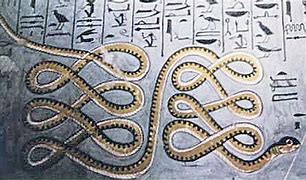
Already present before the creation of the world by Ra, Apep (or Apophis) is an evil entity, the embodiment of darkness and destruction. Apep is a huge snake, allegedly as wide and long as the Nile. This snake is a fundamentally evil being whose sole motivation is to eat the falcon-headed Sun god Ra.

The latter illuminates the world during the day, crossing the sky on his boat before passing through the Underworld to return to his point of departure. It is in the world of darkness that Ra is the target of all types of monsters, demons and ghosts who wish to eat him. Indeed, Ra, a hawk with a Sun on his head, appears extremely appetizing to them.

2) Apep against Ra

Each night, Apep thus leads his army with the aim of eating Ra. Yet, he encounters great difficulty in reaching his objective because Ra has assembled a team of Egyptian gods to defend himself:

– Set, the god of chaos and tempests: with the mission to focus on Apep and repel him with sandstorms and lightning.

– Sobek, the crocodile god of strength and power: Ra’s long-time bodyguard, the god Sobek, unlike Set, focuses on the evil horde of Apep.

– Thoth, the ibis god of knowledge: planning, for each night, a new strategy to surprise Apep and his army.

– Maat, the winged goddess of justice: offering magical healing to her team and, able to fly, catching the team members who have fallen out of the boat of Ra.

– Isis, the goddess of magic: unleashing powerful spells on Apep and his army during difficult situations.

With this shock team, Apep lost every single fight, which never discouraged him. Apep could be mortally wounded, but he had the ability to regenerate when he was covered by the deepest darkness of the world of the dead.

Apep is the antithesis of the gods, representing chaos and darkness, the opposite of the values of the Egyptian pantheon, whose sacred mission was to spread order and light throughout the world. However, Apep contributes to the equilibrium of the universe, being one of its original components, and therefore should not be definitively defeated because his total elimination would destabilize the universe just as much as if the gigantic snake managed to eat Ra.

According to his myth, Apep is responsible for eclipses. Sometimes, Apep succeeded in swallowing Ra during surprise attacks in broad daylight, which made the sun disappear from the sky of mortals. Fortunately, the other gods quickly came to the rescue to pierce the belly of Apep, freeing Ra and thus ending the eclipse.

3) The other version of the myth of Apep: Set, the substitute of Ra

In Egyptian religion, Set gradually takes the place of Ra in the myth of the solar boat and replaces the entire team of Egyptian gods. Ra is then relegated only as the bearer of the Sun and not as the eternal adversary of Apep as he was.

How unfortunate it would be if you missed this great passage in Egyptian mythology: here is a concise summary of the “myth of Osiris” that tells us why Ra was replaced by Set.

A) The myth of Osiris

According to the Egyptian myth of the “Beginning”, Ra created the world by cleverly mixing the Darkness (from which Apep came) and the original Ocean.

From this enlightened mixture came Shu (the wind) and Tefnut (the warmth of the Sun). Shu and Tefnut married to give birth to Geb (the earth) and Nut (the sky). Geb and Nut in turn married and had two sons and two daughters (who also married each other in pairs): Osiris, Set, Isis and Nephthys.

Osiris took his sister Isis as his wife while Set took his sister Nephthys as his wife. Osiris was quickly sent to Earth to become the god-pharaoh who guide mankind.

When he arrived, Osiris fully committed himself to his mission, he brought to humanity a peace, security and unity that had never been seen before.

Set soon became jealous of Osiris’ position but kept this resentment to himself at first. However, when he realized that Nephthys was cheating on him with Osiris, he began to feel a deep hatred for his brother.

Set decided to assassinate Osiris in order to obtain the throne of Egypt. To do so, he visited the best craftsmen in the world to create a beautiful chest covered with precious stones and metals. This chest was made with a certain interior shape so that the only thing it could contain was Osiris himself. Set organized a large banquet on the banks of the Nile to which he invited Osiris and his relatives. At this event, he declared that he would offer the large chest to anyone who entered the chest in its entirety.

Not surprisingly, only Osiris managed to enter the chest. It was at this point that the plan of Set and his accomplices was revealed: they hurled themselves onto the chest and welded its opening before throwing it into the Nile. Osiris drowned.

The chest then drifted down the Nile until it came to a shrub by the riverside that trapped it in its roots. Over the years, the shrub completely absorbed the chest and Osiris. The chest and Osiris gradually found themselves in the middle of its trunk. On its side, the tree grew at a supernatural speed, thanks to the divine presence of the body of the deceased Osiris. The tree grew so large that it fed the lust of a great foreign king, who made it one of the columns of his palace.

Isis, who traveled the world in search of her husband’s body, arrived in this royal palace after years and years of searching. She convinced the king to give the pillar to her and cure her only heir of a fatal disease in appreciation. In possession of the chest (and thus the body of Osiris, she succeeded in reviving him for a single night, which enabled her to become pregnant with Horus).

But before she has time to perform certain rituals to bring Osiris back to life, Set falls on the body of Isis’ unfortunate husband during a hunting trip. To prevent any resurrection that might lead to the end of his reign, Set cuts the body of Osiris into fourteen pieces and scatters them throughout Egypt.

Once again, Isis sets out to find the body of Osiris in tears. These tears attract Nephthys and Anubis (the son Nephthys had with Osiris) who are sympathetic to Isis and help her in her quest. The three of them manage to find 13 of the 14 parts. But as they were about to find the last part, a fish eats it and digests it quickly. This part (namely, the phallus of Osiris) is thus lost forever.

Osiris cannot be reconstituted in its entirety and is brought back to life with an incomplete body. This incomplete body will then prevent him from directing the living. Set will therefore retain his place as king of Egypt (exercising a much less just and upright reign than his brother during his lifetime). Osiris will be forced to leave the world of the living and go to the Underworld where he will rule over the dead.

B) The myth of Horus and Set

As an adult, Horus claims the throne of his father from the greatest and wisest of the gods organized in an instance called the “divine assembly”.

The majority of this enlightened tribunal, composed of Ra (the falcon-headed Sun god)Shu (the god representing the wind), and Thoth (the ibis-headed god of knowledge), immediately rebelled against Egypt’s current situation. Shu and Thoth find despicable that Set could deprive Horus by killing his father of his rightful royal place. The two gods are therefore ready to go to Set and ask him to abdicate without delay.

Nevertheless, the myth cannot stop here: Ra is extremely offended that his opinion is not asked (because he is the father and first of all the gods of Egypt).

The falcon Sun god declares that Horus may well make a bad king. For Ra, the latter must prove his worth before any form of abdication that could put Egypt in a very unfortunate position.

The declaration of Ra is followed by various great trials between Set and Horus: duels, chariot races, and trials of strength, all of which have one thing in common: the countless frauds that Set commits in the course of them. Set wins all the tests organized by the jury by this not very honorable way.

The many trials of the competition culminate in the trial called the “Hippopotamus Trial”. In this event, the two rival gods must each plunge to the bottom of the Nile as hippopotamuses and hold their breath as long as possible. During this test, Isis, out of concern for the future of her son, will create a magic harpoon to catch Set and bring him back to the surface of the Nile (which would make him lose the test). Isis succeeds in touching Set with her harpoon, which makes Horus win (who wins a trial against Set for the first time).

Horus is however very unhappy with the situation because he has the ambition to win fairly. Very angry, Horus tears off his mother’s head and throws it away (fortunately, Thoth fetches this head and resuscitates Isis).

Following this matricide, the court of the three gods is angry against Horus and punishes him by proposing to Set to decide the form of a last trial. This final trial would determine who would be the definitive king and guide of Egypt for millennia to come. Set then chooses a final trial that would be memorable and would legitimize his superiority over Horus forever. Set thus claimed that the final test would be a race of ships built only with stones.

After these events, Horus, exhausted, falls asleep on one of Egypt’s highest mountains to take a well-deserved night’s rest before a challenge that will not be easy. Wanting to ensure his victory, Set discreetly follows him and tears out his left eye while he sleeps.

He then cuts that eye into six equal parts and hides them throughout the world. Seeing in this action a consequent imbalance in the next trial, Thoth will immediately seek to reconstitute the eye of Horus.

While Horus sleeps, the god of knowledge travels around the world at superhuman speed but can only gather five of the six fragments. He thus creates himself the last missing fragment and reconstitutes a new and more efficient eye thanks to a new magical sixth piece. This eye will have the capacity to see “what-is-invisible” (i.e. the future and the past).

As soon as his work is finished, Thoth gives the eye back to Horus, who will thus not be disadvantaged in any way in the upcoming boat race.

The trial begins with a boat construction: Horus starts by looking for some beautiful stones to build his boat. However, his new prodigious eye reveals to him that “he will not win the race”.

Horus becomes very worried: it is important for him to recover the throne that was once stolen from his father. So Horus tries to cheat: he builds a wooden boat with a plaster exterior that has a texture similar to stone.

The next day, the race begins. Set arrives without a boat because he has a rather specific plan. Set is convinced that the top of a high mountain could very well serve as a boat and should float.

However, his plan is a cruel failure because as soon as he launches his boat, the rounded tip of the mountain sinks steeply. The council therefore declares Horus the winner. Mad with rage, Set throws himself on Horus’ boat to ransack it and the deception is revealed. The boat being made of wood, Horus is obviously disqualified.

The divine council decides to meet in order to find the adequate solution to this unprecedented case. They call upon the just and wise Osiris (who became god of the dead after his death) to guide them in their decision. With the will to put his young son in power, Osiris tries to tip the jury’s balance in his favor with a clever stratagem.

He addresses the Sun, the Moon, and all the stars and asks them to follow him into his subterranean realm. Deprived of the light of these vital stars, the world of the living is on the verge of total collapse. Ra, Shu, and Thoth have no choice but to accept Osiris’ request.

Horus defeats the evil Set and comes to power, as he should have done initially. Later, he will marry Hathor, goddess of love and beauty. Having inherited his father’s qualities, he ruled the land of the Nile with a masterly hand.

Set, meanwhile, was banished to the desert, his original kingdom. It was here that he began his long journey of repentance alongside Ra in his solar boat.

It was truly at his redemption that Set became a popular and beloved god. After having been the god of chaos and destruction, now he is able to question himself by working for the good cause. Gradually, he becomes the symbol of the victory of good over evil in the struggle against Ra’s enemy, Apep.

The Egyptian snake god

You now know everything about the mysteries surrounding the largest snake in Egyptian mythology through the myths of the solar bark and the myth of Ra’s replacement by Set. As a bonus, you know more about 99942 Apophis and about Jörmungand (the Apep of Asgard).

If the myths of ancient Egypt are something you are interested in, know that we offer many necklacesringsbracelets and T-shirts referring to ancient Egypt.

In connection with the story of Apep, we obviously invite you to take a look at our collection of Egyptian necklaces. To do so, nothing could be simpler: just click on the image below!


Goddesses – The Morrigan

The Morrigan – Celtic Goddess of War, Fertility and Sovereignty

The Morrigan goddess is usually thought of as the Celtic goddess of war and sometimes the Celtic goddess of death, but she has strong association with fertility and sovereignty as well. Gifted with the ability to shapeshift, she has the capacity to take many forms, but commonly takes the form of a crow.

She is a complex deity known as the Phantom Queen, who is both a single goddess and also a triple goddess. The triple goddess is composed of the goddesses BadbMacha and Nemain.

The crow symbol is thought to connect with Badb (meaning crow in Irish). As a crow, she would fly over the battlefield and either encourage or instill fear in the warriors below. She is also said to have the ability to foretell the outcome of battles and predict violent deaths.

Macha is more usually connected with the land and its fertility and is seen as a protector. There is a strong link between Macha and horses, as well as other livestock. It has been suggested that the origin of her name possibly stems from an area used to graze cattle.

The frenzy of battle is connected with the aspect of Nemian. She is said to be responsible for the rage and fury of a battle and her terrifying scream can kill or paralyze a man.

Badb and Nemain were the wives of Neit, the Irish god of war.

According to some versions, the war goddess Morrigan is the wife of the Dagda and they have a special coupling around the feast of Samhain.

She also set her sights on Cú Chulainn and tried unsuccessfully to seduce him. After a series of failed attempts to seek revenge on him, she ultimately correctly prophesied his death in battle.

Gods – The Dagda

The Dagda – Celtic God of Agriculture, Fertility, Seasons and Weather from letsgoireland.com

Who is the king of the gods in Celtic mythology?

The Dagda Celtic god is believed to be the father of the gods and is thought of as a strong, manly figure with the knowledge and wisdom of the druids.

As a god he had immense power and influence. The Dagda is the Celtic god of agriculturefertility of the land and animalsweathertime and seasons.

He is also connected with life and death. Donn, the Irish god of death may have been an aspect of the Dagda.

Good, fruitful harvests were critical for the survival of Celtic people and animals, so it is easy to see how central a role this god played in the Celtic pantheon.

The fertility and health of cattle was also of primary importance as a person’s wealth was often counted in terms of cattle. Retribution payments for certain crimes were also paid in cattle according to the old Irish Brehon laws.

One ritual to ensure a fruitful harvest in the coming year was the annual coupling of the Dagda with his wife, the Morrigan goddess at the feast of the Samhain (on 1 November).

Some of the Dagda’s most prized possessions included an enchanted harp and a magical staff, with which he could kill 9 men at once with or restore their lives at will. He also had a bottomless cauldron to ensure that no man left his table feeling hungry.

The Dagda was the supposed father of several other important figures in Irish mythology including the goddess Brigid and Bodb Derg who featured a key role in the tale of the Children of Lir.

The river goddess Boann was his lover and mother of his child, and fellow god, Aengus.

Gods – Charge Of The God

Oak and Holly Kings

Charge Of The God on summergoddess.wordpress.com

Since Wicca is about balance in the Universe; a newer addition to the tradition is the “Charge of the God”. Once again, there are several versions out there for you to choose from. I am listing two here for you to see; the first is from my personal Book of Shadows, the second was another version that I liked for its content and poetic flow. (Once again, you will notice that the version I use does not have the names of the God listed within the first line.)

As I said before; Wicca is about balance. For this reason I feel that the Charge of the God is necessary when invoking the combination of the Goddess and the God within your ritual. This gives you the balance of the feminine; (wisdom and emotion,) and the masculine; (strength and protection,) in your rituals and spell casting.

The Charge Of The God

Listen to the words of the Great Father, who of old was called by many names:

My law is harmony with all things.

Mine is the secret that opens the gates of life and Mine is the dish of salt of the Earth that is the body of Cernunnos, which is the eternal circle of rebirth.

I give the knowledge of life everlasting; and beyond death, I give the promise of regeneration and renewal.

I am the sacrifice, the Father of all things and My protection blankets the Earth.

Now hear the words of the dancing God, the music of whose laughter stirs the winds, whose voice circles the seasons:

I who am the Lord of the Hunt and the Power of the Light; sun among the clouds and the secret of the flame, I call upon your bodies to arise and come unto me.

For I am the flesh of the Earth and all its beings.

Through Me all things must die and with Me they are reborn.

Let My worship be in the body that sings–for behold, all acts of willing sacrifice are My rituals.

Let there be desire and fear, anger and weakness, joy and peace, awe and longing within you.

For these; too, are parts of the mysteries found within you, within Me. All beginnings have endings, and all endings have beginnings.