
 |
|||
| Name: | Rudi |
Age: | Unknown |
| Gender: | Male |
Kind: | German Giant Rabbit |
| Home: | Benneckenstein, Germany |
||
|
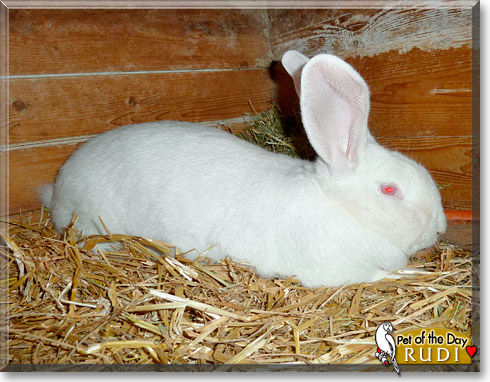
This is my rabbit Rudi. He has this name because he is so big, like a little dog. He is a “Deutscher Riese” – a German Giant Rabbit.
We got Rudi in 2009. He came to us as a stray. One evening my dad said: “There is something white on the road.” And the next morning, my mum went into our garden and Rudi sat there! We knew that he came from our neighbours, but there he would have been slaughtered. Our neighbour told us: “You can keep him.” And so Rudi was and is still our rabbit. When it is warm, my sister and I let Rudi out in the garden and play with him. Then Rudi is very happy. He knocks with his feets and jumps into the sky. That is very funny and fun to watch. Rudi likes to eat very much and sometimes he grunts when we put some new food in his hutch. His favorite food is carrots. Sometimes he is impatient and so he nips but we know he is not bad tempered. I love Rudi very much!!! |
|||
Month: February 2012
Thursday, February 2nd is a wonderful day to…..

Daily Cosmic Calendar for February 2nd
If you are a frequent reader of this calendar, then you know that every so often the cosmos settles down and refrains from blasting earthlings with solar, lunar and planetary discord. Today is one of those one-sided affairs where the potential for good outweighs the potential for its opposite. This is because the only two major celestial alignments are flowing trines of 120-degrees – the first one from the Moon in Gemini to Mercury in Aquarius (6:42AM PST) and the second one happening some 7+ hours later when the Moon forms the same rapport with the Sun in Aquarius (2:02PM PST). Be receptive to visions and insights coming from the great beyond. Think about your higher destiny on Spaceship Earth rather than your personal needs and desires. Literary and educational endeavors as well as cultural and global perspectives win the day over petty peeves and superficial interests. Catch up with email and overseas correspondence. Meanwhile, gear up for a big sea change happening for the planet ruling the oceans as Neptune prepares to enter Pisces for nearly 14 years tomorrow. This orb of dreams, spirituality, religious beliefs and the creative imagination is saying goodbye to Aquarius after a brilliant 14-year run in this third, universal air sign. Now it’s on to the last sign of the zodiac for a trip into unknown waters only Einstein, a double-fish Piscean himself, might perceive with his mystical and kaleidoscopic mind-set.
Calendar of the Moon for Thursday, Feb. 2nd
Calendar of the Moon
Rowan Tree Moon
Color: Orange-red
Element: Fire
Altar: Upon a cloth of orange-red set a row of red candles, Brigid’s cross, and a bell.
Offerings: Votive candles. Quicken a newborn idea into birth.
Daily Meal: Hot drinks with every meal. Keep food warm.
Luis/Gamelion Invocation
Call: Now is the quickening of the year.
Response: Now is the time of the first movement.
Call: Now the child stirs in the womb.
Response: Now the seed stirs in the earth.
Call: Now the plains flood and our fire is threatened.
Response: Now the cold water drowns our spark.
Call: Now is the time of the hard struggle.
Response: Now is the month of desperation.
Call: Now is the time of desperation to live.
Response: Now is the time of desperation to be born.
Call: We turn in our sleep as the earth turns.
Response: We dream with the sleeping earth.
Call: Each of our dreams is a lit candle in the dark.
Response: Each of our dreams is a single point of hope.
Call: They shine faint and alone in the night of struggle.
Response: They are alone as we are alone.
Call: Yet we are not alone in our dreams.
Response: We are not alone!
Call: We will keep our fires burning.
Response: We will burn against the night!
Call: We will warm our dreams with the force of life.
Response: We will not die alone in the cold!
Call: We will ward off all evil.
Response: Only good shall pass our gates.
Call: We will care for each other.
Response: We will never cease to care!
Call: We will survive the winter.
Response: We will survive!
(Repeat last two lines twice more.)
Chant:
Protect the flame that warms your dreams
And dreams shall never die.
Calendar of the Sun for Thursday, Feb. 2nd
Calendar of the Sun
2 Solmonath
Oya’s Day
Colors: Purple, burgundy, dark orange (pottery color), copper
Element: Air
Altar: Lay out the nine sacred items of Oya: the purple cloth, the black flywhisk, the copper crown, the rainstick, the broken pottery rolled up in a woven mat, the earthen pot of candles, the basket of graveyard earth, the buffalo horn, and the glass knife. Burn incense.
Offerings: Plums, eggplants, red wine. The house should be swept thoroughly before the ritual.
Daily Meal: Cooked plums or plum jam. Cooked eggplant. Millet. Red wine. Buffalo meat.
Invocation to Oya
Hail, Lady of the Wind,
Weather goddess most unpredictable,
Whirlwind that sweeps all away
Before its inevitable path!
Hail, Lady of the Rain,
Bringing water to grow
Our crops and slake our thirst!
Hail, Water Buffalo Woman,
Crashing through the underbrush
Unstoppable as fate!
Hail, Carrier of the Container of Fire,
You who can unleash
New beginnings from the ashes!
Hail, Mistress of the Marketplace
Hetaera of the smashed crockery!
Hail, Lady of Death,
Duena de la Cemetaria,
Princess of Graves!
Hail, Keeper of Souls,
Mother of dancing Egungun!
Hail, purifier of the motivations,
In whose mirror we see ourselves,
Who cuts away our illusions!
Hail, Queen of the Air
Whose essence we breathe!
Chant:
O-ya! He-yi! (This should be accompanied by a drum circle, with trance dancing.)
The Wicca Book of Days for February 2nd – Imbolc and Candlemas

Imbolc and Candlemas
The festival of Candlemas has ancient roots, for in Pagan Europe, fires were kindled at this time of year to reflect and encourage the growing strength of the sun. Its name is Christian, however, being derived from the tradition of the future year’s supply of candles being blessed before the first mass of February 2, and then being carried around the church in a pious procession. This is also the feast of the purification of the Virgin Mary and the presentation of the infant Jesus in the Temple; the parallel between the Vrgin Mary an the Goddess in her maiden aspect, and Baby Jesus and the Solar Child of Promise, are unmistakable.
“Candlemas Creativity”
White represents purity, pale green denotes a fresh start and growth and a flame signifies the kindling of creativity. Light candles of these colors to commemorate the concepts symboized by Candlemas. As you gaze at the flaming taper, ask the Goddess for inspiration.
~Magickal Graphics~
Lunar Moon Almanac for Thursday, February 2nd

Lunar Moon Almanac for Thursday, February 2nd
Waxing, First Quarter Moon Age: 10 ¾ days.
Moon at Descending Node.
Moon in 16th degree of the Sign Gemini, the Twins;
also in 24th deg. of the Constellation Taurus, the Bull.
Moonset: 2:53 morn. Moonrise: 12:38 eve. Midheaven: 8:13 eve.
Happy Groundhog’s Day!

The cute, adorable, fuzzy weatherman saw his shadow. So I’m doomed I tell you, doomed. Six More Weeks of Winter, Yuck! It would be lovely to have some beautiful snow but we don’t, it just gets cold.
So did the groundhog see his shadow in your neck of the woods?
Happy & Blessed Imbolc To All My Dear, Dear Friends!

Happy Thursday to you also! In the topic I almost said, “Happy & Blessed Imbolc to you, again!” But I didn’t. I figured I might make some of you angry. Seriously though, have you noticed something about our Sabbats? There is always two dates given to celebrate them now. I don’t know if I am just starting to pay more attention to details now or not. But when I was looking for Imbolc graphics (the graphics always have a little verse or two describing the Sabbat) this time, it was stated, “Imbolc is celebrated around the 1st or 2nd of February. I know this is particularly true for the Spring and Summer Equinoxes. I grew up celebrating them on the 21st. Now it is around or about the 21st or 22nd. It makes me wonder, what on earth is going on? Can’t anyone agree on what day our Sabbats are supposed to be celebrated on? I have decided what I am going to do, though. I am going to start celebrating on the first day all the way to the end of the second! Perhaps I have my thinking all wrong about nobody knowing what days our Sabbats are on. Perhaps this is did on purpose were we can party our little hearts out, lol! That works for me! So when the Spring Equinox rolls around and I say, “Happy Spring,” the first day. Then turn around and say, “Happy Spring Again!” You won’t think I have lost my mind. Poor me, I don’t have that much left to lose!
Anyway, I was just wondering if anyone was noticing this or if it was just me. I hope everyone has a fantastic day.
Happy Imbolc, again!
Lady A
The Shield of Brigid

Every day, every night
that I praise the goddess,
I know I shall be safe:
I shall not be chased,
I shall not be caught,
I shall not be harmed.
Fire, sun, and moon
cannot burn me. Not
lake nor stream nor sea
can drown me. Fairy
arrow cannot pierce me.
I am safe, safe, safe,
singing her praise.
~The Shield of Brigid, Irish Prayer
Candlemas / Purification /Presentation / Our Lady of Candelaria

Candlemas / Purification /Presentation / Our Lady of Candelaria
Jewish women went through a purification ceremony 40 days after the birth of a male child (80 days after the birth of a female child) and brought a lamb to the temple to be sacrificed. According to Mosaic law, Mary and Joseph would also have brought their first-born son to the temple forty days after his birth to offer him to God, like all first-born sons, along with a pair of turtledoves.
The Presentation was originally celebrated in Jerusalem on November 21st but once Christ’s birth was fixed on December 25th (near the winter solstice), the Presentation and Purification rituals would fall forty days later, in early February when torches were carried around the fields.
First celebrated on February 14th, in 350 at Jerusalem, when it would have coincided with the Roman festival of Lupercalia, it was later moved up to February 2nd. Pope Sergius declared it should be celebrated with processions and candles, to commemorate Simeon’s description of the child Jesus as a light to lighten the Gentiles. Candles blessed on this day were used as a protection from evil.
This is the ostensible reason given for the Catholic custom of bringing candles to church to be blessed by the priest on February 2nd, thus the name Candle-Mass. The candles are then taken home where they serve as talismans and protections from all sorts of disasters, much like Brigid’s crosses. In Hungary, according to Dorothy Spicer, February 2nd is called Blessing of the Candle of the Happy Woman. In Poland, it is called Mother of God who Saves Us From Thunder.
Actually this festival has long been associated with fire. Spicer writes that in ancient Armenia, this was the date of Cvarntarach, a pagan spring festival in honor of Mihr, the God of fire. Originally, fires were built in his honor in open places and a lantern was lit which burned in the temple throughout the year. When Armenia became Christian, the fires were built in church courtyards instead. People danced about the flames, jumped over them and carried home embers to kindle their own fires from the sacred flames.
The motif of fire also shows up in candle processions honoring St Agatha (Feb 5) and the legends of St Brigid (Feb 1). The fire represents the spark of new life, like the seeds blessed in northern Europe on St Blaise’s Day (Feb 3) and carried home to “kindle” the existing seed.
The English have many rhymes which prognosticate about future weather based on the weather on Candlemas Day:
If Candlemas Day bring snow and rain
Winter is gone and won’t come again
If Candlemas Day be clear and bright
Winter will have another flight.
These are all similar to the American custom of predicting the weather on Groundhog’s Day, in that you don’t want the groundhog to see his shadow. In Germany, they say that the shepherd would rather see the wolf enter his stable than the sun on Candlemas Day.
The ancient Armenians used the wind to predict the weather for the coming year by watching the smoke drifting up from the bonfires lit in honor of Mihr. The Scots also observed the wind on Candlemas as recorded in this rhyme:
If this night’s wind blow south
It betokeneth warmth and growth;
If west, much milk and fish in the sea;
If north, much cold and snow there will be;
If east, the trees will bear much fruit;
If north-east, flee it, man, woman and brute.
This was also a holiday for Millers when windmills stand idle. In Crete it is said that they won’t turn even if the miller tries to start them.
Blackburn, Bonnie and Leofranc Holford-Strevens, Oxford Companion to the Year, Oxford University Press 1999
Kightly, Charles, The Perpetual Almanack of Folklore, Thames and Hudson 1987
Spicer, Dorothy Gladys, The Book of Festivals, The Woman’s Press 1937
Wednesday, February 1st is a super day for….

Daily Cosmic Calendar for February 1st
February 2012 definitely has some tricks up its sleeve. Therefore, be prepared for anything – especially as Mercury turns the tables on the red planet Mars via a dicey, 135-degree aspect (12:53AM PST). Seemingly smooth discussions can suddenly become spicy debates or raging arguments. Don’t let that happen on your watch. The lunar orb meandering through the end of earthy Taurus may also open some old, tearful wounds if you are not careful. Void Moon observers should note that a short 9-minute cycle occurs from 11:07AM PST to 11:16AM PST. Thereafter, the Moon lunges into eager, curious and flexible Gemini for the next 2+ days. Reading, writing, arts, crafts, and hobbies take center stage. Weather permitting, toss a Frisbee around, fly a kite or ride your bike through the neighborhood. Giving you a run for the money is a Venus-Mars polarity (3:42PM PST) – stretching from Pisces to Virgo. While some romantic sparks can certainly fly, this sky pattern can equally represent a dynamic, illuminating interchange between lovers, friends and almost any type of partners. Tap into emotional empowerment later on as the Sun forms an inspirational, 72-degree rapport with Juno (11:08PM PST). See the beauty and elegance of the universe all around you rather than complain about trivial pursuits.
Calendar of the Moon for February 1st
Calendar of the Moon
1 Luis/Gamelion
Day of the Rowan Tree
Color: Light grey
Element: Earth
Altar: On a cloth of light grey set a vase of rowan twigs, gathered ahead of time and forced into budding, dried rowan berries from the preceding year, a single red candle, a pot of soil, seeds, a bowl of water, and a bell.
Offering: Plant seeds. Keep your dreams alive.
Daily Meal: Vegan. Red food.
Invocation to the Green Man of the Rowan Tree
Hail, Green Man of the Winter!
Rowan tree of the mountains,
Slender of stalk and many of leaf,
Sacred berries that break any spell
And ward any home,
Red as the ochre of our ancestors,
Red as the food of the gods,
Brigid’s pride, magical branch,
Protector of doorways,
Protector of children,
Expunger of evil,
Fire of the forge,
Floods across the plain,
Duck who rides the flood,
We hail you, sacred rowan tree,
Green Man of the Winter,
On this the time of your dreaming.
Chant:
I rise with the sap,
I feel the deep spark,
I find joy in the cold,
I bend with the winds.
(Each comes forward and plants a seed in the pot of soil, saying, “Hail Green Man of the Earth!” Water is poured onto the pot, and then the rest is poured out as a libation. Ring bell and dismiss.)
Calendar of the Sun for February 1st
Calendar of the Sun
1 Solmonath
Brigid’s Day/Candlemas
Color: Red and white
Element: Fire
Altar: Upon a red cloth light as many candles as you can, as well as a Brigid’s cross, a hammer and an anvil, a pen, a bowl of water, and a sword.
Offerings: Brigid’s crosses, twisted of twine or rope. Acts of creativity.
Daily Meal: Red food.
Ritual Note: Like all the eight high holidays, this day should ideally be spent not enclosed and isolated, but in common with the larger pagan community. This can be done a number of ways, including spending the day elsewhere, at the Brigid’s Day ritual of another group or tradition, or by inviting in those pagans who would otherwise not be able to attend a ritual. Either way, the eight holidays should be a time of remembering the place of the house in the greater community. If the choice is made to go elsewhere, then no liturgy is needed for the day. If the choice is made to bring the greater community into the lesser one, the following ritual can be used:
(First four who have been chosen to do the work of the ritual cast the quarters with blade, candle, chalice, and hammer.)
East: Hail, spirits of the East,
Powers of Air!
I call upon Lady Brigid,
At this Her time of the year,
Lady of poetry,
Inventor of alphabets,
Who knows the secrets
Of the Words of Power.
Clear our minds, Lady,
With every cleansing breath.
South: Hail, spirits of the South,
Powers of Fire!
I call upon Lady Brigid
At this Her time of the year,
Warrior goddess of the sword,
Fighting for that which you call your own,
Creative spark and tempering flame!
Light up our spirits, Lady,
With the heat of your laughter.
West: Hail, spirits of the West,
Powers of Water!
I call upon Lady Brigid
At this Her time of the year,
Lady of healing,
Seeker of the sacred herbs,
Curer of illness and mender of body,
Lady of the Holy Well,
May we drink of your overflowing waters.
North: Hail, spirits of the North,
Powers of Earth!
I call upon Lady Brigid
At this Her time of the year,
Lady of labor, Lady of the smithy,
Goddess who is not afraid to work,
Hammer and anvil,
Patron of artisan and craftsman,
Gift our hands with your sacred skill
That we may always do you honor.
Invocation to Brigid
Lady of the Sacred Flame,
Warrior woman with hair like fire
Smith who shapes us
Into tools to change the world,
Give us strength and voice
And hands that do your work
Willingly, of our own choice.
Lady of the Holy Well,
Healer woman who knows wounds
Careful hands who stroke us
Into hearts that change the world,
Give us eyes that see true
And hands that offer help
Willingly, in honor of you.
(Each comes forth and gives thanks for something which has come to them in the past year, and asks for something that they wish for Brigid’s aid in achieving. As they do this, they light the candles one by one, singing the Brid chant. Then the quarters are dismissed and the visitors go to feast in the kitchen.)
Chant:
Brid is come
Oh Brid is come
Brid is welcome
Welcome Brid
February Eve

February Eve
“Dread Lord of death and Resurrection life and the giver of life, Lord within ourselves, whose name is Mystery of Mysteries, encourage our hearts. Let the light crystallize in our blood, fulfilling us of resurrection, for there is no part of us that is not of the Gods.”
The Wiccan Book of Days for Feb. 1 – Imbolc & Maiden’s Milk

February 1
Imbolc and Maiden’s Milk
Between February 1 and 2, Wiccans celebrate the Sabbat of Imbolc(also known as Oimelc or Candlemas), and the return of the Goddess from the underworld in her maiden or virginal form, as exemplified by the Celtic Goddess Brigit (“High One”), Bride or Brigid the name under which the Christians sanctified her. In Ireland, Brigit was venerated as a protector of livestock, a bestower of fertility upon the natural world, a promoter of healing and a patron of poetry and the blacksmith’s art. Oimelc means “ewe’s milk,” for this was the day on which ewes usually began to lactate, and the Goddess’s association with milk was preserved in the notion of Saint Brigid of Kildare’s cows producing milk thrice daily.
“Flowery Words”
In northern climes, the emergence of early spring flowers is evidence that nature is awakening and that Brigit is among us again, so pick a posy and pour a glass of cow’s milk on the ground as a libation to the Goddess.
Happy & Blessed Imbolc, dear friends!
Imbolc (also Imbolg), or St Brigid’s Day (Scots Gaelic Là Fhèill Brìghde, Irish Lá Fhéile Bríde, the feast day of St. Brigid), is an Irish festival marking the beginning of spring. Most commonly it is celebrated on 1 or 2 February (or 12 February, according to the Old Calendar) in the northern hemisphere and 1 August in the southern hemisphere. These dates fall approximately halfway between the Winter Solstice and the Spring Equinox.
The festival was observed in Gaelic Ireland during the Middle Ages. Reference to Imbolc is made in Irish mythology, in the Tochmarc Emire of the Ulster Cycle. Imbolc was one of the four cross-quarter days referred to in Irish mythology, the others being Beltane, Lughnasadh and Samhain. It has been suggested that it was originally a pagan festival associated with the goddess Brigid, who should not be confused with St Brigit of Kildare.
In the modern Irish Calendar, Imbolc is variously known as the Feast of Saint Brigid (Secondary Patron of Ireland), Lá Fhéile Bríde, and Lá Feabhra — the first day of Spring. Christians may call the day “Candlemas”. Long celebrated as “the feast of the Purification of the Virgin”.
One folk tradition that continues in both Christian and Pagan homes on St. Brigid’s Day (or Imbolc) is that of the Brigid’s Bed. The girls and young, unmarried, women of the household or village create a corn dolly to represent Brigid, called the Brideog (“little Brigid” or “young Brigid”), adorning it with ribbons and baubles like shells or stones. They make a bed for the Brideog to lie in. On St. Brigid’s Eve (January 31), the girls and young women gather together in one house to stay up all night with the Brideog, and are later visited by all the young men of the community who must ask permission to enter the home, and then treat them and the corn dolly with respect.
Brigid is said to walk the earth on Imbolc eve. Before going to bed, each member of the household may leave a piece of clothing or strip of cloth outside for Brigid to bless. The head of the household will smother (or “smoor”) the fire and rake the ashes smooth. In the morning, they look for some kind of mark on the ashes, a sign that Brigid has passed that way in the night or morning. The clothes or strips of cloth are brought inside, and believed to now have powers of healing and protection.
On the following day, the girls carry the Brideog through the village or neighborhood, from house to house, where this representation of the Saint/Goddess is welcomed with great honor. Adult women — those who are married or who run a household — stay home to welcome the Brigid procession, perhaps with an offering of coins or a snack. Since Brigid represents the light half of the year, and the power that will bring people from the dark season of winter into spring, her presence is very important at this time of year.
Neopagans of diverse traditions observe this holiday in a variety of ways. As forms of Neopaganism can be quite different and have very different origins, these representations can vary considerably despite the shared name. Some celebrate in a manner as close as possible to how the Ancient Celts are believed to have observed the festival, as well as how these customs have been maintained in the living Celtic cultures. Other types of Neopagans observe the holiday with rituals taken from numerous other unrelated sources, Celtic cultures being only one of the sources used.
Imbolc is usually celebrated by modern Pagans on February 1 or 2nd in the northern hemisphere, and August 1 or 2nd in the southern hemisphere. Some Neopagans time this celebration to the solar midpoint between the winter solstice and spring equinox, which now falls later in the first week or two of February. Since the Celtic year was based on both lunar and solar cycles, it is most likely that the holiday would be celebrated on the full moon nearest the midpoint between the winter solstice and vernal equinox, or when the primroses, dandelions, or other spring flowers rise up through the snow, or when the sun aligned with the passage tombs among the pre-Celtic megaliths.
 Witches Of The Craft®
You must be logged in to post a comment.