Discover the cosmos! Each day a different image or photograph of our fascinating universe is featured, along with a brief explanation written by a professional astronomer.
Explanation: This high cliff occurs not on a planet, not on a moon, but on a comet. It was discovered to be part of the dark nucleus of Comet Churyumov-Gerasimenko (CG) by Rosetta, a robotic spacecraft launched by ESA that rendezvoused with the Sun-orbiting comet in 2014. The ragged cliff, as featuredhere, was imaged by Rosetta in 2014. Although towering about one kilometer high, the low surface gravity of Comet CG would likely make it an accessible climb — and even a jump from the cliff survivable. At the foot of the cliff is relatively smooth terrain dotted with boulders as large as 20 meters across. Data from Rosetta indicates that the ice in Comet CG has a significantly different deuterium fraction — and hence likely a different origin — than the water in Earth’s oceans. Rosetta ended its mission with a controlled impact onto Comet CG in 2016. Comet CG has just completed another close approach to Earth and remains visible through a small telescope.
You can use this link to go forward or backward in time for Moon phase information. If you are curious you can even find out what phase the Moon was in when you or anyone else, you know was on the date the person was born.
The Moon’s current phase for today and tonight is a Third Quarter phase. In this phase the Moon’s illumination is growing smaller each day until the New Moon. During this part of the Moon cycle, the Moon is getting closer to the Sun as viewed from Earth and the night side of the Moon is facing the Earth with only a small edge of the Moon being illuminated. This phase is best viewed an hour or 2 before the sunrise and can be quite beautiful if you’re willing to get up early. It can also be a great time to see the features of the Moon’s surface. Along the edge where the illuminated portion meets the dark side, the craters and mountains cast long shadows making them easier to observe with a telescope or binoculars.
The Waning Crescent on November 28 has an illumination of 40%. This is the percentage of the Moon illuminated by the Sun. The illumination is constantly changing and can vary up to 10% a day. On November 28 the Moon is 23.12 days old. This refers to how many days it has been since the last New Moon. It takes 29.53 days for the Moon to orbit the Earth and go through the lunar cycle of all 8 Moon phases.
The 8 Lunar Phases
There are 8 lunar phases the Moon goes through in its 29.53 days lunar cycle. The 4 major Moon phases are Full Moon, New Moon, First Quarter and Last Quarter. Between these major phases, there are 4 minor ones: the Waxing Crescent, Waxing Gibbous, Waning Gibbous and Waning Crescent. For more info on the Moon Cycle and on each phase check out Wikipedia
Phase Details
Phase: Waning Crescent
Illumination: 40%
Moon Age: 23.12 days
Moon Angle: 0.52
Moon Distance: 381,768.85 km
Sun Angle: 0.54
Sun Distance: 147,563,356.22 km
Useful Moon Resources
Check the weather before a night of Moon gazing at weather.com
You can use this link to go forward or backward in time for Moon phase information. If you are curious you can even find out what phase the Moon was in when you or anyone else, you know was on the date the person was born.
The Moon’s current phase for today and tonight is a Third Quarter phase. Sometimes called a Last Quarter Moon, this phase occurs roughly 3 weeks after the New Moon when the Moon is three quarter of the way through it’s orbit around the earth. If you live in the northern hemisphere the Moons left side will be illuminated and the right side will be dark. For those of you in the southern hemisphere it will be the opposite with the right side illuminated. On the day of the Third Quarter phase the Moon will rise around midnight on the eastern horizon and set in the west around noon the next day. In the days following the Third Quarter Phase the Moon’s illumination will decrees each day until the New Moon.
The Last Quarter on November 27 has an illumination of 50%. This is the percentage of the Moon illuminated by the Sun. The illumination is constantly changing and can vary up to 10% a day. On November 27 the Moon is 22.13 days old. This refers to how many days it has been since the last New Moon. It takes 29.53 days for the Moon to orbit the Earth and go through the lunar cycle of all 8 Moon phases.
The 8 Lunar Phases
There are 8 lunar phases the Moon goes through in its 29.53 days lunar cycle. The 4 major Moon phases are Full Moon, New Moon, First Quarter and Last Quarter. Between these major phases, there are 4 minor ones: the Waxing Crescent, Waxing Gibbous, Waning Gibbous and Waning Crescent. For more info on the Moon Cycle and on each phase check out Wikipedia Lunar Phase page.
Phase Details
Phase: Last Quarter
Illumination: 50%
Moon Age: 22.13 days
Moon Angle: 0.52
Moon Distance: 386,640.14 km
Sun Angle: 0.54
Sun Distance: 147,589,014.09 km
Useful Moon Resources
Check the weather before a night of Moon gazing at weather.com
The illustrations in medieval herbals are beautiful and mysterious. But if you know how to read them, they also convey a wealth of knowledge about the plants they portray.
The illustrated herbal has an almost unbroken line of descent from the ancient Greeks to the Middle Ages. The tradition owes much to a work by the Greek physician Dioscorides called ‘De Materia Medica’ (50–70 CE), which describes around 1,000 medicines, largely derived from plants, along with some animals and mineral substances.
‘De Materia Medica’ was circulated throughout the European and Islamic worlds. During that time it was translated, embellished and added to in commentaries and copies for local use. In Europe, this tradition developed into the medieval herbal, created in monasteries, usually by …
Discover the cosmos! Each day a different image or photograph of our fascinating universe is featured, along with a brief explanation written by a professional astronomer.
Explanation: Big, beautiful spiral galaxy M101 is one of the last entries in Charles Messier’s famous catalog, but definitely not one of the least. About 170,000 light-years across, this galaxy is enormous, almost twice the size of our own Milky Way. M101 was also one of the original spiral nebulae observed by Lord Rosse’s large 19th century telescope, the Leviathan of Parsontown. Assembled from 51 exposures recorded by the Hubble Space Telescope in the 20th and 21st centuries, with additional data from ground based telescopes, this mosaic spans about 40,000 light-years across the central region of M101 in one of the highest definition spiral galaxy portraits ever released from Hubble. The sharp image shows stunning features of the galaxy’s face-on disk of stars and dust along with background galaxies, some visible right through M101 itself. Also known as the Pinwheel Galaxy, M101 lies within the boundaries of the northern constellation Ursa Major, about 25 million light-years away.
Discover the cosmos! Each day a different image or photograph of our fascinating universe is featured, along with a brief explanation written by a professional astronomer.
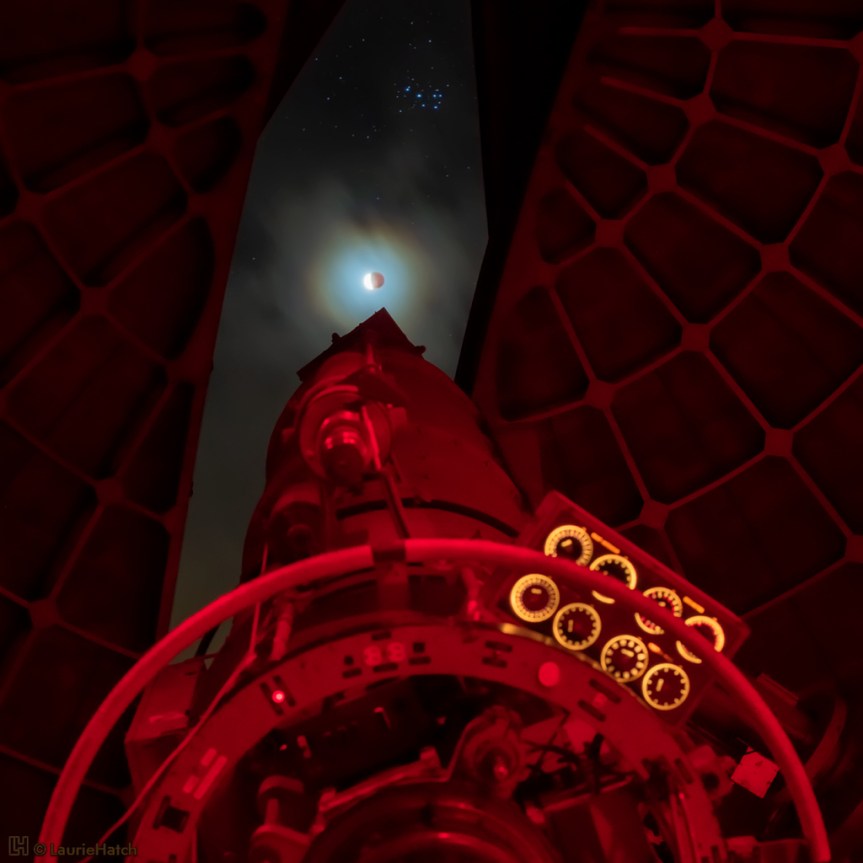
Explanation: Rain clouds passed and the dome of the Lick Observatory’s 36 inch Great Refractor opened on November 19. The historic telescope was pointed toward a partially eclipsed Moon. Illuminated by dim red lighting to preserve an astronomer’s night vision, telescope controls, coordinate dials, and the refractor’s 57 foot long barrel were captured in this high dynamic range image. Visible beyond the foreshortened barrel and dome slit, growing brighter after its almost total eclipse phase, the lunar disk created a colorful halo through lingering clouds. From the open dome, the view of the clearing sky above includes the Pleiades star cluster about 5 degrees from Moon and Earth’s shadow. Notable APOD Submissions: Lunar Eclipse of 2021 November 19
I feel it is important to remember Lady Abyss during a Samhain celebrations, so I bring you an article she wrote in 2013.
I wasn’t going to torture you today with any of my comments. But I have been surfing the web for cartoons (it is actually hard to find good cartoons). I am beginning to think I should never leave the site. I ran across a few images that made my eyes water and then I was taken back centuries ago.
The images were of witches or accused witches tied to a stake and burning. Another was of a woman on a plank being dunked into the water. If you know me well, you know I can talk an hour or two on our ancestors. But what happened today moved my soul. Perhaps in all the hustle and bustle, I had forgotten for a moment what this season is all about. It is the Witches’ New Year but it is also a time to remember our ancestors.
For me, remembering my ancestors is both joyous and heartbreaking. I am into genealogy and was able (thanks to a dear friend) to trace my roots back to Ireland. Knowing where you came from can be a good thing or if your a witch, not so good. I know you are scratching your heads over that one, right? What I mean is, I know how witches were treated in Ireland. Persecuted. Then they sailed to the New World to escape the torment and the persecution. But unfortunately, they didn’t. They were found out and the same thing they were trying to escape confronted them again. No peace whatsoever. What kind of life did they have?
Most of my ancestors were healers. I have ran across a few that were hanged as witches. That makes my blood curdle. Their blood flows through my veins today. I know that for sure. There are times I have flash backs to my ancestors’ time. To see and experience one of your kin being hanged is one of the worse things in your life. You can see it plainly but you are powerless to do anything about it. When the flashback is over, I cry and cry. Why were people so ignorant and judgmental back then? Why couldn’t they just let the witches live in peace?
Perhaps if history didn’t happen the way it did, we wouldn’t have what we do now. Perhaps it was a test of some kind for our ancestors. I know they had to have unbelievable faith, courage and enormous amount of love for our Religion and our Goddess.
One of the reasons I can talk about our ancestors for hours is because I admire them so much. I know what they sacrificed for us. When accused of being a witch, they could have simply turned their backs and denied it. But they didn’t. I know they didn’t want to die anymore than the next person. But sadly enough they did. Some were killed and others went underground to protect our Religion. To ensure it would be passed on from one generation to the next. Everyone of them took risks so we could have what we do today.
This time of the year is very special to all of us. Don’t get caught up in all the festivities and forget what it is really about, remembering our ancestors. We owe them so much. And we never can repay the debt we owe them. But we can remember them. I believe remembering and honoring is the greatest way we can say “Thank You” to them for all they have given us.
Without our ancestors and their sacrifices, we wouldn’t have our Religion. This Samhain, hold the memories of your ancestors dear to your heart. Remember them and give them the honors they deserve. They have given us so much.
In the honor and remembrance of all
our ancestors.
Thank the Goddess for them.
You can use this link to go forward or backward in time for Moon phase information. If you are curious, you can even find out what phase the Moon was in when you or anyone else was born.
The Moon’s current phase for today and tonight is a Waxing Crescent Phase. A Waxing Crescent is the first Phase after the New Moon and is a great time to see the features of the moon’s surface. During this phase the Moon can be seen in the wester sky after the sun dips below the horizon at sunset. The moon is close to the sun in the sky and mostly dark except for the right edge of the moon which becomes brighter as the days get closer to the next phase which is a First Quarter with a 50% illumination.
The Waxing Crescent on June 30 has an illumination of 2%. This is the percentage of the Moon illuminated by the Sun. The illumination is constantly changing and can vary up to 10% a day. On June 30 the Moon is 1.25 days old. This refers to how many days it has been since the last New Moon. It takes 29.53 days for the Moon to orbit the Earth and go through the lunar cycle of all 8 Moon phases.
The 8 Lunar Phases
There are 8 lunar phases the Moon goes through in its 29.53 days lunar cycle. The 4 major Moon phases are Full Moon, New Moon, First Quarter and Last Quarter. Between these major phases, there are 4 minor ones: the Waxing Crescent, Waxing Gibbous, Waning Gibbous and Waning Crescent. For more info on the Moon Cycle and on each phase check out Wikipedia Lunar Phase page.
Phase Details
Phase: Waxing Crescent
Illumination: 2%
Moon Age: 1.25 days
Moon Angle: 0.49
Moon Distance: 404,730.90 km
Sun Angle: 0.52
Sun Distance: 152,093,439.29 km
Useful Moon Resources
Check the weather before a night of Moon gazing at weather.com






 Witches Of The Craft®

You must be logged in to post a comment.