Let’s Have Some Fun – Imbolc


For Your Listening Pleasure – Imbolc

Music for Imbolc – Brigid’s Day Songs (Celtic Festival)

For Your Listening Pleasure – Lammas

Lisa Thiel – Lammas Song

Flashback 2004 Lammas

(This is written for the Northern Hemisphere in 2004. The date of August 7th is wrong for 2022 the Southern or Northern Hemisphere)

Lammas

Lammas is the first of the harvest festivals, a celebration of ripening grains and grapes. If you celebrate traditionally on the second, the planetary energies offer a for great creative energy, drama, and joy. If you celebrate on the astrologically on August 7 at 15 degrees of Leo, the Moon will aid a ceremony with great magic and mystery.

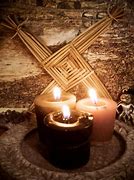
The Sun is wanning, but still holding sway in the sky. A day of circle dances and foot races will honor the Sun; be certain the music encourages exuberant joy. If you planted wheat in a pot or plot, this is the day to ritually harvest it. Use some to make a Brigid’s cross; save a few stalks to return to the earth as compost next spring and lend continuity from harvest to sowing to harvest.

If corn is your grain of choice, bring ripe ears to the altar and use the husks to make corn dollies for use at Imbolc. Indian corn can be dried, ground, and used in corn bread. Make a fiery incense with dragon’s blood and hot herbs like ginger or galangal. Do a ritual at a sacred spot — a well or tree or sacred hill. Use the colors of green and gold and orange for your altar, and encourage everyone to wear them. The harvest has just begun.

Copyright By K. D. Spitzer in Llewellyn’s Witches’ Datebook 2004 Page 89

Flashback 2004 Imbolc

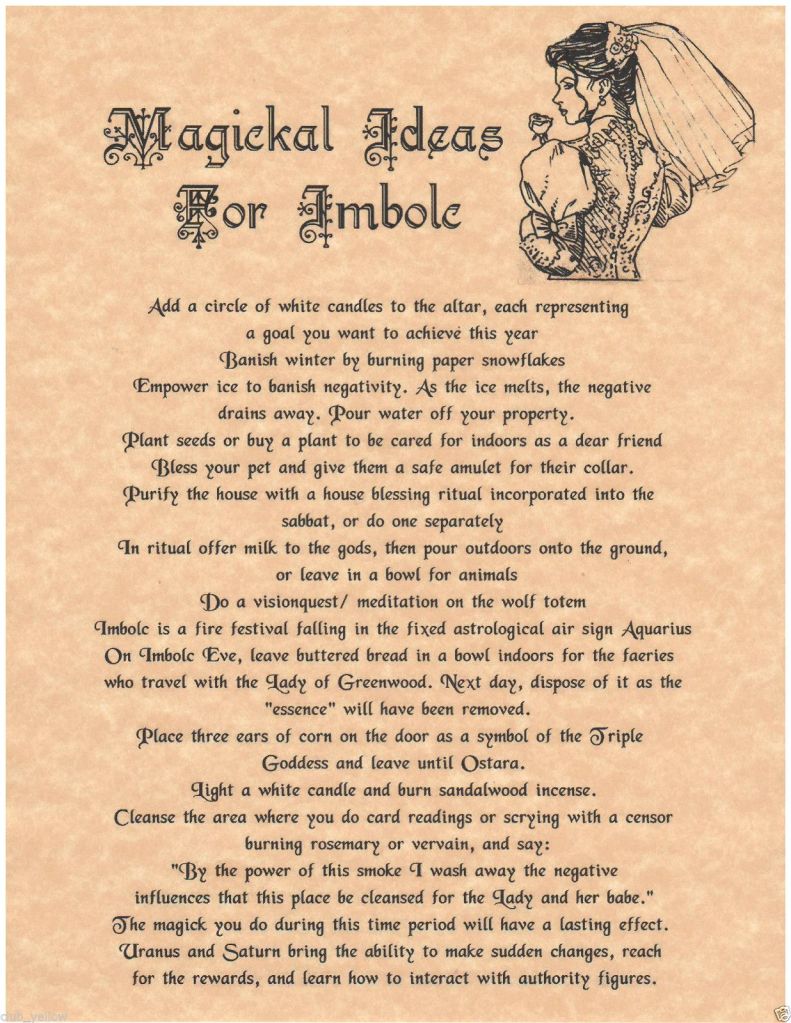
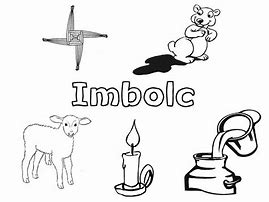
 Imbolc

Celebrate this festival by draping the altar in white and silver. Kepp the entire altar white — white candlesticks, white incense bowls, etc. Represent the Goddess with a figure of a horned cow. If you wear robes in ritual, honor Brigid in her guise as the goddess of the dairy by wearing white. With Neptune lending the glamour to your robes to the Sun this time, as glitter to your robes with sliver and “diamonds.” Let your imagination run wild.

Save snow from the last storm, or use crushed ice, and put it out in bowls on the altar. Scrub clean an old milke bottle or cream jar and fill it with fresh milk; freshly made mozzarella cheese will round out your cakes and ale. Nestle all bowls in the snow.

The planetary energies are particularly favorable this sabbat for working magic for world peace. Place all the candles you’ll be using this year on the altar and start this ritual in the dark — this is, without lights. Add your magic to the returning Sun. Dedicate and consecrate all your candles during this festival of lights, and consecrate your agricultural tools for use in the coming cycle of growth. This is the festival of new beginnings.

Copyright By K. D. Spitzer in Llewellyn’s Witches’ Datebook 2004 Page 39

Flashback 2000 Imbolc

Daylight hours are gradually lengthening, and the Earth is beginning to stir. Although she is still in the middle of her winter’s rest, our planet subtly begins to plan. It’s appropriate that this period is represented by Aquarius, an air sign, since all change begins first in the mind. Every new thought or idea is full of raw potential as the Earth is now,nailing for the touch of fire to ignite her new growth period. Uranus is the ruler of Aquarius, and the planet best known for its jurisdiction over the future. This electric energy only looks forward, never back. It is during Imbolc, in fact, as the Sun is passing through Aquarius, that many ideas are born. As we prepare for the upcoming Equinox, then, it’s important to be sure that we’re looking ahead, as Uranus does, with all the electric enthusiasm and genius of Aquarius. Honor the potential of the coming spring by uncovering your gift of prophecy. Whether you use a crystal ball, a dream journal, or another type of predictive tool, prepare for the Equinox in your heart, by understanding how much is possible now.

©️ By Kim Rogers-Gallagher Llewellyn’s Witches’ Datebook 2000 Page 95

Flashback 2000 Lammas

At Lammas, the Sun is at the very peak of Leo, the sign this planet loves above all others. Our star’s warmth is at its most powerful now in the Northern Hemisphere, as it appears directly overhead. At this time, life too, ia at its peak—as are the crops. The ancients celebrated this festival by giving thanks for their first harvest, most especially the grain harvest, even as they accepted the beginning of the God’s descent into the underworld. The myth of the asteroid-Goddess Ceres (Demeter), giver of the grain, also relates to this season. It was now when she would bid her daughter Farwell, since Persephone was obligated to return to the Underworld to rejoin Hades (Pluto). So bereaved was Ceres to see her daughter leave her, she refused to all the Earth to produce grain until her return. At this time,nothing, modern practitioners should be remind of both astrological principles: the fullness of life the Sun brings, and the necessity for rest, as signified by the coming fall.

©️ By Kim Rogers-Gallagher Llewellyn’s Witches’ Datebook 2000 Page 95

Summer Solstice Printable Coloring Pages

Winter solstice 2021: Why it happens and how we celebrate the first day of winter

For the past six months, the days have grown shorter and the nights have grown longer in the Northern Hemisphere. But that’s about to reverse itself.

Winter solstice 2021, the shortest day of year and the official first day of winter, is on Tuesday, December 21. How it all works has fascinated people for thousands of years.

First we’ll look at the science and precise timing behind the solstice. Then we’ll explore some ancient traditions and celebrations around the world.

From msn.com

Winter Solstice Traditions: How to Celebrate This Holiday Season

For those who are spiritual but not so religious, you may choose to celebrate the December holiday season differently. The winter solstice is a wonderful way to honor your ancestors, the earth and its creatures, and the birth of a new sun during this special time of year.

So what exactly is this ancient holiday, and how do you celebrate the winter solstice? Spoonful of Comfort answers these questions and offers some new-to-you winter solstice traditions that you and your loved ones can embrace.

What Is the Winter Solstice Holiday?

Earth experiences the winter solstice when the shortest and darkest day of the year passes and a new, longer day begins. In 2021, for the Northern Hemisphere, the exact time for this change is December 21 at 10:59 a.m. Eastern Standard Time.

Why Is the Winter Solstice Celebrated?…

Click here to read the rest of this article

Litha History – Celebrating the Summer Solstice

An Ancient Solar Celebration

Nearly every agricultural society has marked the high point of summer in some way, shape or form. On this date–usually around June 21 or 22 (or December 21/22 in the southern hemisphere)–the sun reaches its zenith in the sky. It is the longest day of the year, and the point at which the sun seems to just hang there without moving – in fact, the word “solstice” is from the Latin word solstitium, which literally translates to “sun stands still.” The travels of the sun were marked and recorded. Stone circles such as Stonehenge were oriented to highlight the rising of the sun on the day of the summer solstice.

Did You Know?

  • Early European traditions celebrated midsummer by setting large wheels on fire and then rolling them down a hill into a body of water.
  • The Romans honored this time as sacred to Juno, the wife of Jupiter and goddess of women and childbirth; her name gives us the month of June.
  • The word “solstice” is from the Latin word solstitium, which literally translates to “sun stands still.”

Click here to read the rest of this article

December Solstice 2021 – First Day of Summer in Southern Hemisphere

December Solstice marks the arrival of the first day of summer in the southern hemisphere. That’s why in the earth’s southern areas, the December Solstice is known as the Summer Solstice. In 2021, the official first day of summer in Australia (southern hemisphere) will occur on Wednesday, December 22, at sharp 02:59 Australian Eastern Daylight Time (AEDT).

Not to mention, this astronomical event will also mark the brightest as well as the longest day of the year in the southern hemisphere. On the other hand, for people living in the northern hemisphere, this solstice marks the arrival of the first day of winter. That’s why in the earth’s northern areas, December Solstice is known as the Winter or Hibernal Solstice. Again, for the people living in the northern half of the earth, this astronomical event will also mark the darkest as well as the shortest day of the year.

Simply speaking, one can say that the meaning of solstice changes depending…

Click here to read the rest of this article

For Your Viewing Pleasure – Winter Solstice

What happens during the winter solstice?

The Winter Solstice


The Winter Solstice

The darkest day makes way for the return of light

December 21, 2015 marks the Winter Solstice, which is the official beginning of winter, and the shortest day of the year in the Northern Hemisphere. But there’s a light at the end of this tunnel — literally! As the temperatures fall throughout the winter, the light grows, representing new hope during a time of darkness.

Ancient solstice festivals were the last big feasts before food became scarce during the harsh winter months. This magical day was celebrated from ancient Rome to China, and by the builders of Stonehenge to the Mayans. In fact, we all remember the Winter Solstice on December 21, 2012, which was the apparent end of the Mayan calendar, causing many to believe the end of the world is coming. Obviously, we’re still here!

Many modern holiday traditions, such as Christmas, Hanukkah, Kwanzaa and New Year’s, have their roots in the Winter Solstice celebrations of yesterday. Winter festivals continue today, complete with lights, feasts, dancing and singing, and spending quality time with those we love.

Astrologically, the Winter Solstice marks the moment the Sun — the ruler of the zodiac — moves from adventurous Fire sign Sagittarius to the steady Earth sign of Capricorn. This is the dark night of the year, a day when the Sun appears to stand still. It’s a time for light and laughter, but also deep reflection.

The Sun’s move into steady Capricorn urges us to take some time to look back on 2015 before we make those New Year’s resolutions. What did we do right? What do we wish we’d done differently? Don’t fight the seriousness it brings to the festive holiday season — use it to start 2016 on the right foot! Just make sure to keep some of the Goat’s ambitious energy alive when the Sun makes its next move.

Source:
Tarot.com is a Daily Insight Group Site

The Great Gift of Summer Solstice

For Your Listening PLeasure

SONG OF SUMMER SOLSTICE | Kulning & Nyckelharpa

This song is short but sweet.

Astronomy Picture of the Day

Discover the cosmos! Each day a different image or photograph of our fascinating universe is featured, along with a brief explanation written by a professional astronomer.

2021 November 30

In Motion: Uranus and Moons

Video Credit: David Campbell (U. Hertfordshire), Bayfordbury ObservatoryExplanation: What’s that moving across the sky? A planet just a bit too faint to see with the unaided eye: Uranus. The gas giant out past Saturn was tracked earlier this month near opposition — when it was closest to Earth and at its brightest. The featured video captured by the Bayfordbury Observatory in HertfordshireUK is a four-hour time-lapse showing Uranus with its four largest moons in tow: TitaniaOberonUmbriel and Ariel. Uranus’ apparent motion past background stars is really dominated by Earth’s own orbital motion around our Sun. The cross seen centered on Uranus is called a diffraction spike and is caused by light diffracting around the four arms that hold one of the telescope‘s mirrors in place. The rotation of the diffraction spikes is not caused by the rotation of Uranus but, essentially, by the rotation of the Earth. During the next few months Uranus itself will be visible with binoculars, but, as always, to see its moons will require a telescope.

Astronomy Picture of the Day

Discover the cosmos! Each day a different image or photograph of our fascinating universe is featured, along with a brief explanation written by a professional astronomer.

2021 November 29

The Extraordinary Spiral in LL Pegasi

Image Credit: NASAESAHubbleHLAProcessing & Copyright: Jonathan LodgeDodge

Explanation: What created the strange spiral structure on the upper left? No one is sure, although it is likely related to a star in a binary star system entering the planetary nebula phase, when its outer atmosphere is ejected. The huge spiral spans about a third of a light year across and, winding four or five complete turns, has a regularity that is without precedent. Given the expansion rate of the spiral gas, a new layer must appear about every 800 years, a close match to the time it takes for the two stars to orbit each other. The star system that created it is most commonly known as LL Pegasi, but also AFGL 3068 and IRAS 23166+1655. The featured image was taken in near-infrared light by the Hubble Space Telescope. Why the spiral glows is itself a mystery, with a leading hypothesis being illumination by light reflected from nearby stars.

Astronomy Picture of the Day

Discover the cosmos! Each day a different image or photograph of our fascinating universe is featured, along with a brief explanation written by a professional astronomer.

2021 November 25

At the Shadow’s Edge

Image Credit & Copyright: Jean-Francois Gout

Explanation: Shaped like a cone tapering into space, the Earth’s dark central shadow or umbra has a circular cross-section. It’s wider than the Moon at the distance of the Moon’s orbit though. But during the lunar eclipse of November 18/19, part of the Moon remained just outside the umbral shadow. The successive pictures in this composite of 5 images from that almost total lunar eclipse were taken over a period of about 1.5 hours. The series is aligned to trace part of the cross-section’s circular arc, with the central image at maximum eclipse. It shows a bright, thin sliver of the lunar disk still beyond the shadow’s curved edge. Of course, even within the shadow the Moon’s surface is not completely dark, reflecting the reddish hues of filtered sunlight scattered into the shadow by Earth’s atmosphere.


Notable APOD Submissions: Lunar Eclipse of 2021 November 19

Astronomy Picture of the Day

Dark Matter in a Simulated Universe

Illustration Credit & Copyright: Tom Abel & Ralf Kaehler (KIPACSLAC), AMNHExplanation: Is our universe haunted? It might look that way on this dark matter map. The gravity of unseen dark matter is the leading explanation for why galaxies rotate so fast, why galaxies orbit clusters so fast, why gravitational lenses so strongly deflect light, and why visible matter is distributed as it is both in the local universe and on the cosmic microwave background. The featured image from the American Museum of Natural History‘s Hayden Planetarium Space Show Dark Universe highlights one example of how pervasive dark matter might haunt our universe. In this frame from a detailed computer simulation, complex filaments of dark matter, shown in black, are strewn about the universe like spider webs, while the relatively rare clumps of familiar baryonic matter are colored orange. These simulations are good statistical matches to astronomical observations. In what is perhaps a scarier turn of events, dark matter — although quite strange and in an unknown form — is no longer thought to be the strangest source of gravity in the universe. That honor now falls to dark energy, a more uniform source of repulsive gravity that seems to now dominate the expansion of the entire universe.

Not only Halloween: Today is Dark Matter Day.