Samhain

From History.com

CONTENTS

  1. Ancient Samhain
  2. Samhain Monsters
  3. Myths of Samhain
  4. Samhain in the Middle Ages
  5. Dumb Supper
  6. Christian Samhain
  7. Samhain Merges With Halloween
  8. Wicca and Samhain
  9. Celtic Reconstructionists
  10. Sources

Samhain is a pagan religious festival originating from an ancient Celtic spiritual tradition. In modern times, Samhain (a Gaelic word pronounced “SAH-win”) is usually celebrated from October 31 to November 1 to welcome in the harvest and usher in “the dark half of the year.” Celebrants believe that the barriers between the physical world and the spirit world break down during Samhain, allowing more interaction between humans and denizens of the Otherworld.

READ MORE: Halloween: Traditions, Rituals, Origins

Ancient Samhain

Ancient Celts marked Samhain as the most significant of the four quarterly fire festivals, taking place at the midpoint between the fall equinox and the winter solstice. During this time of year, hearth fires in family homes were left to burn out while the harvest was gathered.

After the harvest work was complete, celebrants joined with Druid priests…

Samhain Celebration Guide

To read more about celebrating Samhain please click on this link

From Plentiful Earth – Northern and Southern Hemispheres Samhain

Sinister Solar System From NASA

Introduction

Our universe is full of mysterious sights, and spine-tingling sounds. Take a journey to the most frightful corners of the cosmos.

Click here for More interesting and fun information about our “Sinister Solar System”

October 30 Astronomy Picture of the Day

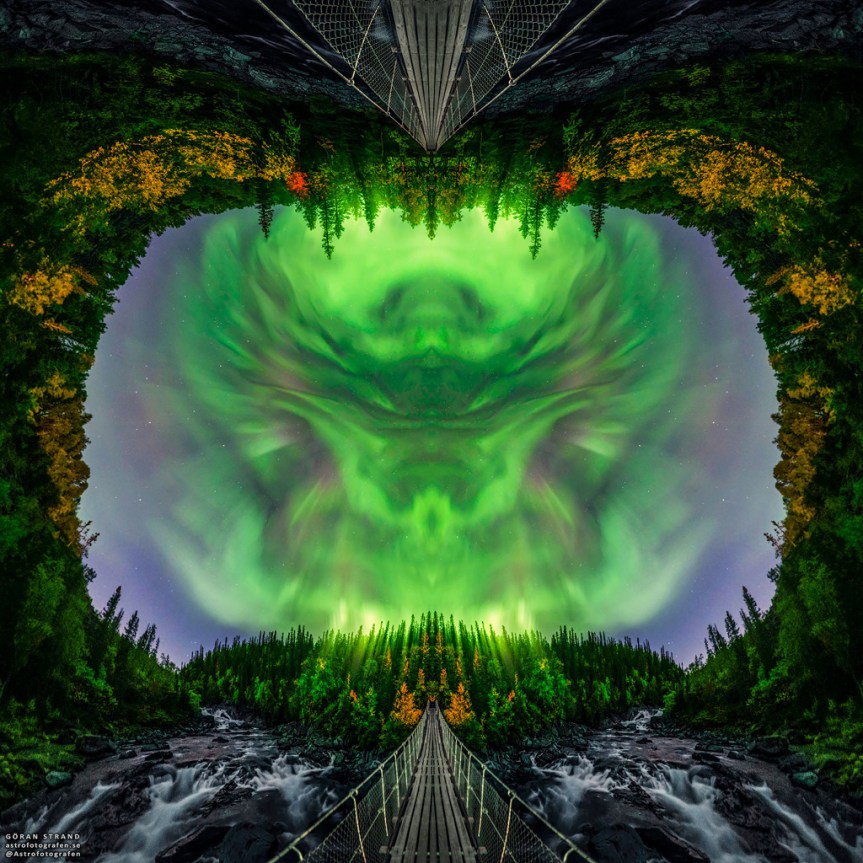
A Rorschach Aurora

Image Credit & Copyright: Göran Strand

Explanation: If you see this as a monster’s face, don’t panic. It’s only pareidolia, often experienced as the tendency to see faces in patterns of light and shadow. In fact, the startling visual scene is actually a 180 degree panorama of Northern Lights, digitally mirrored like inkblots on a folded piece of paper. Frames used to construct it were captured on a September night from the middle of a waterfall-crossing suspension bridge in Jamtland, Sweden. With geomagnetic storms triggered by recent solar activity, auroral displays could be very active at planet Earth’s high latitudes in the coming days. But if you see a monster’s face in your own neighborhood tomorrow night, it might just be Halloween.

Astronomy Picture of the Day

Discover the cosmos! Each day a different image or photograph of our fascinating universe is featured, along with a brief explanation written by a professional astronomer.

2021 October 29

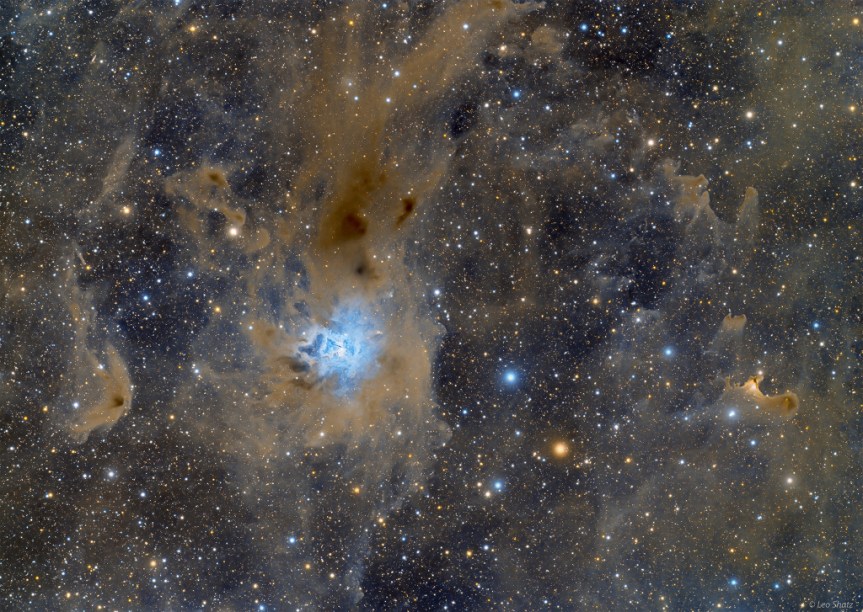
Haunting the Cepheus Flare

Image Credit & Copyright: Leo Shatz

Explanation: Spooky shapes seem to haunt this dusty expanse, drifting through the night in the royal constellation Cepheus. Of course, the shapes are cosmic dust clouds visible in dimly reflected starlight. Far from your own neighborhood, they lurk above the plane of the Milky Way at the edge of the Cepheus Flare molecular cloud complex some 1,200 light-years away. Over 2 light-years across and brighter than most of the other ghostly apparitions, vdB 141 or Sh2-136 is also known as the Ghost Nebula, seen at the right of the starry field of view. Inside the nebula are the telltale signs of dense cores collapsing in the early stages of star formation. With the eerie hue of dust reflecting bluish light from hot young stars of NGC 7023, the Iris Nebula stands out against the dark just left of center. In the broad telescopic frame, these fertile interstellar dust fields stretch almost seven full moons across the sky.

A Version of the History of Beltane

History of Beltane from beltanefire.com.au

The Beltane fire festival welcomes the abundance of the fertile earth and is celebrated with bonfires, Maypoles, burning of the Wickerman, dancing, and a feast, with its roots in European traditions, Beltane is observed by many of today’s Pagans and others as a time for performing rituals

The Celts divided the year into two main seasons. Winter, the beginning of the year fell on November 1 (Irish: Samain) and midyear and summer on May 1 (Irish: Beltaine), opposite for us here in the Southern Hemisphere.

These two junctures were thought to be critical periods when the bonds between the human and supernatural worlds were temporarily erased; on May Eve (southern hemisphere)…

The Origins of Halloween by Silver RavenWolf

Harvest Moon, velvet sky, pumpkins glowing, children laughing, costumes, candy, scary stories—just where did this autumn gaiety begin? Let’s look through those cobwebby corridors of time to unearth the exciting genealogy of the American Celebration we call Halloween!

Nothing is ever as simple as it seems—especially when dealing with history. Too often events and circumstances of our past were written or re-written by people who, for whatever reason, operated under an agenda, or simply wanted history to reflect how it should have been, rather than how it was. How, then, do we determine what is fact and what is fiction? In some cases, we can’t. In other situations, we dig.

The Celts

Many historians feel that the greatest strength in the Celtic people lies in their collective mythos. Wading through the romanticism to find unmodified information can prove a tricky endeavor. The earliest archaeological evidence we have of the Celts rest in France and Western Germany.  The Celtic people moved into Spain, Britain, and Switzerland between the fifth and first century BCE. They even ransacked Rome in 390 BCE.

The Celtic peoples celebrated four festivals called fire festivals–commonly know today as Samhain, Oimelc (Imbolc), Beltane, and Lughnasadh. Samhain (pronounced sow-in, sow rhymes with now) was the first and foremost a harvest festival relating to animal husbandry and preparations for the winter months. Fire is an element of cleaning, a vehicle of eradication, so it is not unlikely that fire would work itself into any type of religious celebration. Fire among the ancient peoples often represented an aspect of the divine.

What does the word Samhain mean? Well, we know what it doesn’t mean. There is no archeological or literary evidence of a Celtic god by the name of Samhain. This little slip of fact appears to have begum in the 1700s and continues in some misinformed publications today. The word Samhain actually means “summers end”.

So, where did this Lord of the Dead thing come in? Over time, Samhain took on a religious significance through ministrations of the Druids (the clergy of the Celt’s). Legends indicate that on Samhain all the hearth fires in Ireland were doused and then lit again from a central fire maintained by the Druids at Tlachtga. To the Celts, Samhain was a turning point from light into darkness, and it was thought that this break or fissure created easier access to their land of the dead, Tir nan Og.

The Druids

We need to know a little bit about the Druids to continue with our history of Halloween. The Druids were versed in all learning and were considered to have the gift of prophecy. They functioned as judge, ambassadors, healers, and religious leaders. The Druids first named the holiday Samhain.

 Feast of the Dead

As the Celtic religious system solidified so did the beliefs of the Celts concerning the dead—as has occurred in all religions, before and after the Celts. Since the turning points of the year were considered fissures in time and space, the Celts believe that the dead they loved so dearly could travel through time and space and return from Tir nan Og to visit them. The custom of leaving food at the table (the birth part of the treat part of trick-or-treat) was a gesture of welcome to the departed. From these visits came the belief that those who had gone beyond the land of the living could provide information on past or future events. This is how divination became associated with Samhain.

The Celts did not believe in devils or demons, but they did believe in the Fairy Folk, whom they thought inhabited the land of the dead (the land in-between). Fairies were thought to be resentful of humankind for taking over their land. Because time and space could be conquered on Samhain, fairies were said to roam countryside creating mischief and kidnapping a human or two now and then—just for fun, you understand.—except the humans never came back. Here then is the root of the scary stuff associated with Halloween. The mischief, of course, was caused by living humans, and accepted by the Celts as a psychological release before the onset of winter gloom—though I doubt they would explain it in those terms.

Is it odd, gross, or unusual that a group of people should set aside a day for the dead? Nope. Different cultures and religions have followed such a practice for centuries. Let’s get on our broom again and check out Rome and its contributions to Halloween.

 As the Celtic religious system solidified so did the beliefs of the Celts concerning the dead—as has occurred in all religions, before and after the Celts. Since the turning points of the year were considered fissures in time and space, the Celts believe that the dead they loved so dearly could travel through time and space and return from Tir nan Og to visit them. The custom of leaving food at the table (the birth part of the treat part of trick-or-treat) was a gesture of welcome to the departed. From these visits came the belief that those who had gone beyond the land of the living could provide information on past or future events. This is how divination became associated with Samhain.

The Celts did not believe in devils or demons, but they did believe in the Fairy Folk, whom they thought inhabited the land of the dead (the land in-between). Fairies were thought to be resentful of humankind for taking over their land. Because time and space could be conquered on Samhain, fairies were said to roam countryside creating mischief and kidnapping a human or two now and then—just for fun, you understand.—except the humans never came back. Here then is the root of the scary stuff associated with Halloween. The mischief, of course, was caused by living humans, and accepted by the Celts as a psychological release before the onset of winter gloom—though I doubt they would explain it in those terms.

Is it odd, gross, or unusual that a group of people should set aside a day for the dead? Nope. Different cultures and religions have followed such a practice for centuries. Let’s get on our broom again and check out Rome and its contributions to Halloween.

A Fly-BY of Ancient Rome

Rome had the habit of changing rulers as many times as you empty the lint trap in your dryer. Between 14 and 37 CE, Christianity had begun its rise in Rome. By 41 CE, Claudius had distinguished himself with the conquest of Britain. The Romans also had a harvest festival, so the Celts didn’t have much trouble blending the two holidays together after they came into contact with the Romans. It was around 314 CE when Constantine the Great declared the Roman Empire to be Christian, and the fate of Samhain and Druids was sealed.

 The Advent of Christianity

By the fourth and fifth centuries , Celtic Christianity had oozed into Ireland. St. Patrick has his hands full, and here is where the kettle starts to boil. At, first, the Pagans openly welcomed Christianity, but as Christianity filtered into the Celtic system, church officials had a few problems—mainly the Celtics didn’t want up their holidays or folk practices. The people were not willing to throw out traditions that were ingrained into their social structure. If you can’t get someone to completely change, what do you do? Compromise. And that’s exactly what happened. Samhain was changed to All Hollow’s Eve. To make the Pagan peoples adhere more closely to this new religion of Christianity, the clergy of the day taught the peasants that fairies were really demons and devils (remember, a concept totally unknown to Celtic belief or history) and their beloved dead were horrid ghosts and ghouls. The early Christian erroneously associated the Celtic land of the dead with the Christian concept of Hell.

To help the belief in Christianity along, Druids priestess were systematically murdered. Early Christians also taught the area peasants that their Lord of the Underworld was in fact Satan, which is ridiculous, as the two mythos don’t have anything in common. It appears that Christians misunderstood what the word Samhain meant: because the peasants use this celebration to honor the dead, Christians assumed that Samhain was the incorrect pronunciation of a Pagan deity in the Bible, recorded as Samuel, from the Semitic Sammael, meaning God of the under world.

The Witches

So far, we’ve talked about the land of the dead, how the early Christians managed to superimpose Satan onto Samhain, and how fairies got zapped into demons, but there has been no mention of Witches, commonly associated in our time with Halloween. Where did Witches come from?

During the Dark Ages, the Church sought to eradicate the Pagans and wise women from the countryside so that the church could amass both power and property. First, they had to devalue women because women kept the holy days, trained the children, and provided the cohesive socialization of the culture, thus women held the power to shape society. The church taught, among other things, that women had no souls. Once this teaching had occurred, it was only a small step to make them inhuman, and the Church was able to incite the superstitious populace.

The Celtic women were the strong hold of the family environment, and although the Celts accepted Christianity at first, they did not want to give up their family traditions or their lifestyle. The Church was not into free thinking—therefore anything that did not follow the church dictates was evil. Hence, the Witches (really the women) became evil. Since Samhain was a primary festival of the Celts and the Church had already determined that Samhain was evil, the association between Witches and Halloween was born.

All Saints’ Day / All Hallow’s EVE / Halloween

All Saints’ Day and All Hallow’s Eve (Halloween) were first introduced in the seventh century CE. All Saints’ Day was originally celebrated in the spring. The date was changed to November 1 to supplant Pagan beliefs because those pesky Pagans just refused to cough up their original Samhain. The day was to honor God and all his saints, known and unknown. All Saints’ Day later became Hallowmass, a mass to honor the dead. The Eve of All Hallow’s Day, October 31, became All Hallow’s Eve, which evolved into the word Hallowe’en. Although the church wished this time to be one of somber prayer and quite custom, the Celtics continued their customary bonfires and fortune telling.

All Souls’ Day is a bit different. This festival falls on November 2, a day to offer prayers and alms to assist the souls of those departed that manage to get stuck in purgatory, an in-between place that is neither heaven nor hell. Over the succeeding centuries, Halloween, like Christmas, picked up various customs and discarded others, depending on the complex socialization of the times and religious dictates.

Halloween Comes to America

Our first inkling of Halloween coming to America revolves not around a specific set of people (many indicate the Irish) but with William Penn’s motley collection of refugees from Europe. In 1663, Penn wrote a promotional tract about the Americans. As a result, fifty ships dropped the anchors in the Delaware River. They discharged persecuted souls from England, Ireland, Wales, and the Rhineland (now Germany). Collectively, the Germans and Irish shared Celtic heritage. Therefore many of the folk customs resonated together—including Halloween.

From 1684 through 1930, Halloween was more a time for tricking rather than for treating. Many of the tricks the German and Irish communities became universal, such as overturning outhouses, dismantling a wagon and putting it back together on top of a house or barn, and tying cows to church bells. The tricks often served as social function, such as mildly chastising a neighbor who exhibited antisocial behavior.

By 1910, several American manufactures were making or importing party products just for the American holiday Halloween. From noisemakers to costumes, a new holiday meant new business and an opportunity to make money.

The drawback to the new holiday came in the form of the “declared” Mischief Night, Goblin Night, or Devil’s night on October 30. Minor offenses, such as trying several garbage cans together and hanging them from a light pole, soaping windows with lard, and later, bars of hand soap, abounded. As the pranks grew to vandalism shopkeepers would bribe youngsters to ward off destruction of their property.

In an effort to stop the criminal behavior, the Boy Scouts, in conjunction with local town councils, cities, boroughs, instituted the custom of Trick-or-Treat night to help keep youngsters from naughty practices. By the 1930s the custom of trick-or-treating was well entrenched in our American culture. Halloween, like Christmas, became a holiday for children, and parents strove to make the holiday as much fun as possible for the enjoyment of their youngsters.

During he 1950s. ’60s, and ’70s our American Halloween stayed primarily the same, but in the ’70s and ’80s, with a recession coupled by a candy scare, groups and organizations once again sought to find appropriate avenues to make Halloween safe for America’s children. Halloween practices extended through the entire month of October. Haunted houses, parties, hay rides, plays, story hours, and numerous other events were held throughout the month.

In the mid-to-late 1990s certain sects of the Protestant Christian church declared war on Halloween. using the same erroneous propaganda cultivated hundreds of years ago. Other groups size Halloween for their own political agendas—hosting haunted houses showing aborted babies, drug addicts, and other modern day violent situations. This did not go over well, as the holiday had become an event primarily for children, not adult political issues. Radical Christian groups said that the holiday was Satanic—which, as we’ve seen from our research, is a bizarre and fantastic claim, based on misinformation, politicking, personal agendas and fear. With America’s policy of separation of church and state the battle for destroying Halloween in the United States is an uphill battle.

The original Samhain marked the the close of the agriculture season and functional third harvest festival. In America, Halloween has become the first holiday in our end-of-year rush for partied gaiety. Our Halloween functions as the opening of the three-month-long celebratory fest that includes Thanksgiving, Christmas, Yule, Kwanzaa, and Chanukkah, and ends with the popular American New Year.

As our children crave pumpkins with delightful chatter, adults find solace in a night when they can be whatever they want to be. We have little doubt about the joy this holiday bring to the American people. I am sure we will forever love the haunted house, the harvest Moon, the thrills and chills of a well-wrought tale—and, of course, the deliciously scary things that go EEEEK! in the night.

 Harvest Moon, velvet sky, pumpkins glowing, children laughing, costumes, candy, scary stories—just where did this autumn gaiety begin? Let’s look through those cobwebby corridors of time to unearth the exciting genealogy of the American Celebration we call Halloween!

Nothing is ever as simple as it seems—especially when dealing with history. Too often events and circumstances of our past were written or re-written by people who, for whatever reason, operated under an agenda, or simply wanted history to reflect how it should have been, rather than how it was. How, then, do we determine what is fact and what is fiction? In some cases, we can’t. In other situations, we dig.

Llewellyn’s Witches’ Datebook1999 Pages 24 to 29

Some Thoughts About Celebrating Samhain

Samhain is a day of reflection of the past year while celebrating the new. It is a day that whatever has not been harvested from gardens, fields, bushes, and trees get left for the wildlife and Fea Folk. It is also a day to communicate with those who have crossed the veil into the Summerlands. Many pagans and witches say it is the day and/or night to honor only those that have crossed in the last year but I do not go along with this way of thinking. While those who have passed since November 1, 2020 up to today do need more comforting and remembering them then those that have crossed over in other years past. The farther back in time you go to those who have crossed before the last year the more chance there is that they will be forgotten totally.

Hypothetically, if crossed the veil say 30 years ago or longer and each generation after you talk about you less and less as each year passes soon you will be forgotten completely. That one reason I have my Book of Shadows and Family Grimoire as one book that I hope keeps growing after I am gone. I have also placed pictures of ancestors at different ages as well as pictures of myself alone and with family members both ancestors and descents. In the section for ancestors I have included a picture of their headstone and where it can be found if I know.

So this Samhain when you are setting the extra place at the table, lighting a candle for each ancestors name, or however you choose to honor your ancestors (remember an ancestor does not have to be blood related they can be anyone in your life that help to mold you into the person you are today.) Set one more place, light one more candle, or whatever your tradition to remember your ancestors is for those who names have been forgotten since the first Homosapien of any branch of the human gene pool lived.

I implore you all to remember that we all can trace our lineage back to this mish mash of a gene pool and that the energy that runs through us connects us to every other living things and not just on Mother Earth. So the next time you have a negative thought about someone for any reason at all remember you are also having that negative thought about yourself.

I picked this song to be included in this post because for me it helps me to remember those, female or male or other, who otherwise might be forgotten

Grandmother

I wish all my family, which means everyone reading this post and by blood, a happy and blessed Samhain.


Lady Beltane 2018

Reed Moon: Celtic Tree Calendar

To read more about the Celtic Reed Month by Sarah Wayt

The celebration of Samhain, now known as Halloween, occurs during the Reed Moon. To the Celts this month hailed the end of the year, a time to cull the livestock and to connect with ancestors. All around the world festivals that honour the dead are celebrated. During the Reed Moon, light a candle for loved ones who have died and you may receive a message from the spirit world.

Releasing old energy

The Reed Moon is a good time to use divination to gain insights into the year that has passed. Perform energy work that will release old energy, burn symbols of illness on your bonfire on November the 5th during your Guy Fawkes celebrations. Remember the Celtic year does not begin until the Winter Solstice so use this interval to dream, not to make plans for the future.

The haunting sound of reed

In the past, the reed was used to make swift-flying arrow shafts that slew both enemies and game. In this way the plant was linked to the season of death and sacrifice, in which trees shed their leaves and the energy of nature became more introspective. Many early musical instruments also used the reed to create a haunting sound that has been connected to rites for the dead and the summoning of spirits.

Wind instruments

Modern day wind instruments have developed the same principle used by original reed instruments. Whereby a current of air is vibrated to produce a melodic sound.

Other traditional uses for reed include thatching. Rooftops were thatched with reeds, and as the Celts withdrew into their homes for the winter they honoured the plant that gave them shelter, making the reed a symbol of royalty and protection.

Reed Moon energy…

Astronomy Picture of the Day

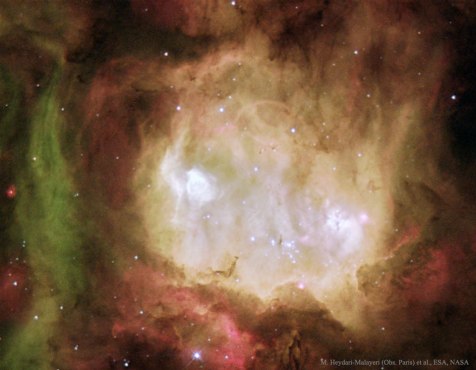
Halloween and the Ghost Head Nebula

Image Credit: Mohammad Heydari-Malayeri (Observatoire de Paris) et al., ESANASA

Explanation: Halloween’s origin is ancient and astronomical. Since the fifth century BC, Halloween has been celebrated as a cross-quarter day, a day halfway between an equinox (equal day / equal night) and a solstice (minimum day / maximum night in the northern hemisphere). With a modern calendar however, even though Halloween occurs next week, the real cross-quarter day will occur the week after. Another cross-quarter day is Groundhog Day. Halloween’s modern celebration retains historic roots in dressing to scare away the spirits of the dead. Perhaps a fitting tribute to this ancient holiday is this view of the Ghost Head Nebula taken with the Hubble Space Telescope. Similar to the icon of a fictional ghost, NGC 2080 is actually a star forming region in the Large Magellanic Cloud, a satellite galaxy of our own Milky Way Galaxy. The Ghost Head Nebula (NGC 2080) spans about 50 light-years and is shown in representative colors.

Astronomy Picture of the Day

Discover the cosmos! Each day a different image or photograph of our fascinating universe is featured, along with a brief explanation written by a professional astronomer.

Today’s Astronomy Picture is a Video. Click here to watch it.

Jupiter Rotates

Video Credit & Copyright: JL DauvergneMusic: Oro Aqua (Benoit Reeves)

Explanation: Observe the graceful twirl of our Solar System’s largest planet. Many interesting features of Jupiter’s enigmatic atmosphere, including dark belts and light zones, can be followed in detail. A careful inspection will reveal that different cloud layers rotate at slightly different speeds. The famous Great Red Spot is not visible at first — but soon rotates into view. Other smaller storm systems occasionally appear. As large as Jupiter is, it rotates in only 10 hours. Our small Earth, by comparison, takes 24 hours to complete a spin cycle. The featured high-resolution time-lapse video was captured over five nights earlier this month by a mid-sized telescope on an apartment balcony in ParisFrance. Since hydrogen and helium gas are colorless, and those elements compose most of Jupiter’s expansive atmosphere, what trace elements create the observed colors of Jupiter’s clouds remains a topic of research.


Discovery + Outreach: Graduate student research position open for APOD


Beltane of the Southern Hemisphere

Today, in the Pagan calendar, the north celebrate the coming of winter at Samhainn. And all the while the sun is peaking up from behind the lush vernal trees and dancing for us once more in the southern hemisphere, as we welcome Beltane on October 31st. Or as I like to refer to it Beltane of the underworld.

A pagan spiral formation in Faerie Glenn where everything is miniature and enchanted. Copyright Content Catnip 2010

Beltane is  the Gaelic seasonal festival historically held to mark the midpoint between the spring equinox & summer solstice (Là Bealltainn in Scottish Gaelic; Lá Bealtaine in Irish). Fire is the traditional means of marking this spring festival of optimism & return.

A famous Ossianic lament…

Click here to read more about Southern Hemisphere Beltane from ContentCatnip.com

I am Sorry for the Lack of Usual Post

So, I got a refurbished laptop and within a month it had a major problem. It went into sleep mode and would not come out of it. Yesterday WISH online shopping finally sent me the label to send it back. I went last evening and got it started on it way back to WISH. Which left me with either my desktop computer, which I can only sit at for about an hour until my back pain is so bad I have to lay down, or my Kindle tablet which takes me twice as long to post through. My wonderful fiancée took me to Rent-A-Center where he had coupons for a nice reduction in price for a brand new laptop, which I am using now. When we got home with it last evening I could not get on to use it. So, I put it aside very frustrated but I must have done something right because I did not have to take it back to the store to be able to use my own account on it. But as I was having a horrible morning I did not pick this laptop up to try to get on to it again until about 15 minutes ago and now here we are.

Now I have to take this one back because the Delete key doesn’t work. I give up for today. Looks like I will only be doing the daily and birthday horoscopes later today.

For Your Viewing Pleasurer

The fascinating history of cemeteries – Keith Eggener

This is an interesting take on regular burials and cemeteries. The History of Cemeteries

October 21 On This Day in History

From On This Day

Important Events

1805 Battle of Trafalgar: British Admiral Horatio Nelson defeats combined French and Spanish fleet. Nelson shot and killed during battle.

1854 Florence Nightingale with a staff of 38 nurses is sent to the Crimean War

1944 World War II: US troops capture Aachen, 1st large German city to fall

1948 UN rejects Russian proposal to destroy atomic weapons

1950 Chinese forces occupy Tibet

1993 Failed military coup in Burundi, led by ex-President Jean-Baptiste Bagaza, includes assassination President Ndadaye; 525,000 Hutus flee

All these links include birthdays, deaths, weddings and divorces.

Today’s Historical Events

Today’s Film and TV Historical Events

Today’s Historical Music Events

Today’s Historical Sports Events


Justice Spell

This is a gray magic spell. The intention of this spell is the person it is being cast on is for them to only suffer as much as you suffered. It is not done to cause any permanent damage to the person on the receiving end of it unless they caused permanent damage to the person casting it.

Be very careful if you write this type of spell that it does not cross over to being a black magick spell. Remember the Threefold Law a.k.a. The Law of Three. Another thing to remember is the Wicce Rede “Do as ye will, lest it harm none”

Justice Spell

WHAT YOU WILL NEED:

A Piece of Paper 2 inch/5 cm by 2 inches/5 cm

A RED pen or pencil

A small jar with lid (like from baby food)

Crushed Egg Shells or Black Salt (enough to fill the jar with the piece of paper inside)

Candle – Whatever color you feel you should use to seal the lid onto the jar

Prepare the Jar for the Spell:

Write the persons full name onto the piece of paper as you think about the wrongs they have done to you then fold it in 3. Keeping thinking of your intention for the person to suffer only as much as what they did to you. Pour half of the egg shells or black salt into the jar, place the paper in the jar and pour the rest of the crushed egg shells or black salt over it, stop when the jar is full to just under the lid.

THE SPELL:

Remember to keep your intention in the fore front of your mind as you say the spell at 3 times. The more you repeat it the stronger it will be but be careful so it does not do more to the person than they did to you or you may wind up feeling everything done to you again.

May (Name Of person) feel, what I felt.

May what (Name of person) did to me,

go back to (Name of person) just as strong as (Name of person) did to me.

May this spell tighten around (Name of person) like a belt.

End the spell whatever way you usually end any spell after you have repeated this spell


Astronomy Picture of the Day

Discover the cosmos! Each day a different image or photograph of our fascinating universe is featured, along with a brief explanation written by a professional astronomer.

2021 October 17

The Einstein Cross Gravitational Lens

Image Credit & LicenseJ. Rhoads (Arizona State U.) et al., WIYNAURANOIRLabNSFExplanation: Most galaxies have a single nucleus — does this galaxy have four? The strange answer leads astronomers to conclude that the nucleus of the surrounding galaxy is not even visible in this image. The central cloverleaf is rather light emitted from a background quasar. The gravitational field of the visible foreground galaxy breaks light from this distant quasar into four distinct images. The quasar must be properly aligned behind the center of a massive galaxy for a mirage like this to be evident. The general effect is known as gravitational lensing, and this specific case is known as the Einstein Cross. Stranger still, the images of the Einstein Cross vary in relative brightness, enhanced occasionally by the additional gravitational microlensing effect of specific stars in the foreground galaxy.

Astronomy Picture of the Day

Discover the cosmos! Each day a different image or photograph of our fascinating universe is featured, along with a brief explanation written by a professional astronomer.

NGC 289: Swirl in the Southern Sky

Image Credit & Copyright: Mike SelbyExplanation: About 70 million light-years distant, gorgeous spiral galaxy NGC 289 is larger than our own Milky Way. Seen nearly face-on, its bright core and colorful central disk give way to remarkably faint, bluish spiral arms. The extensive arms sweep well over 100 thousand light-years from the galaxy’s center. At the lower right in this sharp, telescopic galaxy portrait the main spiral arm seems to encounter a small, fuzzy elliptical companion galaxy interacting with enormous NGC 289. Of course spiky stars are in the foreground of the scene. They lie within the Milky Way toward the southern constellation Sculptor.

BELTANE: SOUTHERN HEMISPHERE

Southern Hemisphere Beltane by Jane Hardwicke Collings

The date for the Southern Hemispheric Beltane is October 31st and ‘May Day’ is November 1st. The climax of Spring!

Beltane is the peak of Spring, a celebration of fertility. In ancient times it was the Beltane Rites that recon- nected each year the King to the Goddess, the masculine to the feminine. It is a time for us to give thanks for our fertile lives, our creativity and our gender specific gifts and roles. Its a time to notice and honour the difference in the masculine and feminine. It is a time of increasing growth, building to almost full potential, of beauty and heightened passion.

Beltane Spiritual Practice

Your being, as part of the Earth, part of the cycle of the seasons, will be influenced by this energy whether you’re paying attention to it or not. If you pay some attention, you will feel it, and you can be in flow with it.

Think like the gardener, and align with the Earth energy of now, contemplate the growth that is peaking in your life, that is getting all the attention…