



Nearly every agricultural society has marked the high point of summer in some way, shape or form. On this date–usually around June 21 or 22 (or December 21/22 in the southern hemisphere)–the sun reaches its zenith in the sky. It is the longest day of the year, and the point at which the sun seems to just hang there without moving – in fact, the word “solstice” is from the Latin word solstitium, which literally translates to “sun stands still.” The travels of the sun were marked and recorded. Stone circles such as Stonehenge were oriented to highlight the rising of the sun on the day of the summer solstice.
December Solstice marks the arrival of the first day of summer in the southern hemisphere. That’s why in the earth’s southern areas, the December Solstice is known as the Summer Solstice. In 2021, the official first day of summer in Australia (southern hemisphere) will occur on Wednesday, December 22, at sharp 02:59 Australian Eastern Daylight Time (AEDT).
Not to mention, this astronomical event will also mark the brightest as well as the longest day of the year in the southern hemisphere. On the other hand, for people living in the northern hemisphere, this solstice marks the arrival of the first day of winter. That’s why in the earth’s northern areas, December Solstice is known as the Winter or Hibernal Solstice. Again, for the people living in the northern half of the earth, this astronomical event will also mark the darkest as well as the shortest day of the year.
Simply speaking, one can say that the meaning of solstice changes depending…


There is beautiful harmony in this song.
Blessed be dear ones.
Midsummer is a celebration of light and life, symbolized by the flame of a candle and the movement of water. A large glass bowl filled with an assortment of floating candles makes a wonderful point of focus for ritual. Choose bright yellow sunflowers, white lilies, and red tulip-shaped candles. Have each person participating in the ritual inscribe his or her desire, with a pin, on a candle. Have each person come forward, place his or her candle in the bowl and light it as he makes his wish. Following the ritual, the bowl is placed outdoors, and the candles are left to burn out.
One of the most popular symbols of Midsummer is the Sun Wheel, the turning of which suggests the turning, or progression, of the seasons. The Wheel is decorated with flowers, fresh herbs, and brightly colored ribbons.
The simplest method for making a Sun Wheel is to buy an already-prepared natural-branch wreath from an arts and crafts store. Affix small branches of rowan to form the spokes of the wheel (four spokes to represent the elements and cross-quarter days or eight to symbolize the eight Wiccan Sabbats). Use floral wire to attach fresh flowers and herbs to the wreath. Embellish with brightly colored ribbons. The wheel can be used as the focal point for your Midsummer rites or hung on the front door of your home for decoration.
The Beltane fire festival welcomes the abundance of the fertile earth and is celebrated with bonfires, Maypoles, burning of the Wickerman, dancing, and a feast, with its roots in European traditions, Beltane is observed by many of today’s Pagans and others as a time for performing rituals
The Celts divided the year into two main seasons. Winter, the beginning of the year fell on November 1 (Irish: Samain) and midyear and summer on May 1 (Irish: Beltaine), opposite for us here in the Southern Hemisphere.
These two junctures were thought to be critical periods when the bonds between the human and supernatural worlds were temporarily erased; on May Eve (southern hemisphere)…
Today, in the Pagan calendar, the north celebrate the coming of winter at Samhainn. And all the while the sun is peaking up from behind the lush vernal trees and dancing for us once more in the southern hemisphere, as we welcome Beltane on October 31st. Or as I like to refer to it Beltane of the underworld.
A pagan spiral formation in Faerie Glenn where everything is miniature and enchanted. Copyright Content Catnip 2010
Beltane is the Gaelic seasonal festival historically held to mark the midpoint between the spring equinox & summer solstice (Là Bealltainn in Scottish Gaelic; Lá Bealtaine in Irish). Fire is the traditional means of marking this spring festival of optimism & return.
The date for the Southern Hemispheric Beltane is October 31st and ‘May Day’ is November 1st. The climax of Spring!
Beltane is the peak of Spring, a celebration of fertility. In ancient times it was the Beltane Rites that recon- nected each year the King to the Goddess, the masculine to the feminine. It is a time for us to give thanks for our fertile lives, our creativity and our gender specific gifts and roles. Its a time to notice and honour the difference in the masculine and feminine. It is a time of increasing growth, building to almost full potential, of beauty and heightened passion.
Beltane Spiritual Practice
Your being, as part of the Earth, part of the cycle of the seasons, will be influenced by this energy whether you’re paying attention to it or not. If you pay some attention, you will feel it, and you can be in flow with it.
Think like the gardener, and align with the Earth energy of now, contemplate the growth that is peaking in your life, that is getting all the attention…
From NASA.gov (USA) National Aeronautics and Space Administration
View our recorded Event Planning Webinar, and join the virtual Global Moon Party on October 9, for resources and activities that can take your International Observe the Moon Night to the next level.

| Wednesday | ||
| Magickal Intentions: Communication, Divination, Writing, Knowledge, Business Transactions, Debt, Fear,Loss, Travel, Money Matters |
Incense: Jasmine Lavender Sweet Pea |
|
| Planet: Mercury Chiron |
Sign: Virgo |
Angel: |
| Colors: Orange Light Blue Grey Yellow Violet |
Herbs/Plants: Fern Lavender Hazel Cherry Perriwinkle |
Stones: Aventurine Bloodstone Hematitie Moss Agate Sodalite |
Angel is Raphael, ruler of Mercury. Raphael is the patron of healers and travellers. He will keep you safe on all of life’s journeys and help you to communicate in a way that promotes healing and peace.
The colours are green and yellow. Yellow calcite and green agate are crystals that can help you connect with this gentle angel. Some scents used to invoke archangel Raphael are chamomile, lemongrass and sandalwood.
I am not sure how large these will print out. I have found the easiest way to print them is to save them to my computer than print them out individually.


[Revisions made September 25,2021 so a couple of dates might be wrong. The dates for my father’s and mother’s births and deaths are correct]
I have often wonder why it almost always rains and is cold on Samhain. Where I live, in the central United States, it usually nice the day before and the day after but rarely the day of.
This morning my Guides gave me an answer to this question that seems so right I have no idea why I never thought of it. It rains on Samhain because the veil between our world and the Summerlands is very thin allowing what the Spirits of our family and friends are feeling about residing in the Summerlands to come into our world and our feelings to go easier into their world. It also makes it easier to converse with them in many different ways (coming soon a post explaining this more)
Just as we weep for loved ones lost because we miss the person they were in this lifetime they weep because they miss us also so. The rain we experience is in reality their tears. The cold is because they do not need heat to keep a incarnated body warm like we do in this world.
When honoring your ancestors this Samhain remember to take into account their feelings and try to explain yours to them. Communication is not just important when we some someone face to face it is important when dealing with those who have crossed over too. Do not think the dialogue has to stop when Samhain is over, it may not be as easy to hear them but if they have something you really need to hear you will. Talk to them, ask them questions, tell them things. Just because they no longer have a physical body does not mean they are not interested in things going on in your life.
When helping those who passed away this past year cross into the Summerlands remind them of the happiness, rest, joy and love they will feel there instead of the cold uncertainty of roaming this world with no physical body. If you feel they are hanging on to something in this world or have unfinished business they want to take care before moving across the veil ask how you can help them let go or finish the unfinished business. It is important for us all to cross into the Summerlands after our physical bodies will no longer support life in this world, so we can rejuvenate and be reborn into our next life time.
Talking with my mom today and helping her to finish something she left undone (this I will not share as it was very personal between the two of us) after dreaming about her the other night (October 2015) for the first time since she passed (Born December 12, 1934 Died August 24, 2015) brought a calm to me I have not felt since the day before she passed. I knew the moment my mom passed as I felt a pull on both my heart and root charkas the two most connected thigs in our human body that connect us our to our parents and our children. She is happy and excited to be fully reunited with my dad, he refused rebirth until she and he could have some time together alone and with my eight siblings, who all passed away shortly before or after birth, in the Summerlands They both told me today that they will wait for me to join them in the future when it is my time to return to the Summerlands before they consider another lifetime in this world. Which made me feel very loved and special. It also makes me cry happy/sad tears every time I think about the sacrifice they choose to make for me. You see my dad (Born March 25, 1934) crossed over the veil exactly one month before my twelfth birthday on April 1, 1970. (Please NO April Fool’s jokes. Thank you)
I am sorry if this post seems to ramble some but I was typing as it came to me and had a couple of interruptions for trick-or-treater, all the kids in the neighborhood love to come to the Witch’s house because she gives out good treat if they do not trick her.
[Some of this paragraph maybe early while some of it could be what you needed to read today] May your Samhain be blessed,. May your time with your ancestors be joyful. My your New Year be filled with everything you need, a warm home, loving family and friends, enough food to keep hunger at bay, clothing to keep you comfortable and even bring you a way to get a couple of things you just want.

2015 Lady Beltane
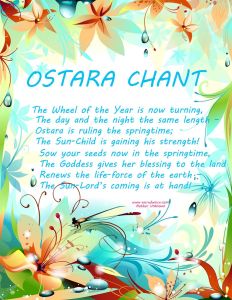
Date: September 20 – 23
Other Names: Spring Equinox, Lady Day, Alban Eiler (Druidic)
Pronunciations: uh-star-uh, oh-star-uh
As Spring reaches its midpoint, night and day stand in perfect balance, with light on the increase. The young Sun God now celebrates a hierogamy (sacred marriage) with the young Maiden Goddess, who conceives. In nine months, she will again become the Great Mother. It is a time of great fertility, new growth, and newborn animals.
The next full moon (a time of increased births) is called the Ostara and is sacred to Eostre the Saxon Lunar Goddess of fertility (from whence we get the word estrogen, whose two symbols were the egg and the rabbit.
The Christian religion adopted these emblems for Easter which is celebrated on the first Sunday after the first full moon following the vernal equinox. The theme of the conception of the Goddess was adapted as the Feast of the Annunciation, occurring on the alternative fixed calendar date of March 25 Old Lady Day, the earlier date of the equinox. Lady Day may also refer to other goddesses (such as Venus and Aphrodite), many of whom have festivals celebrated at this time.
Herbs: Daffodil, Jonquils, Woodruff, Violet, Gorse, Olive, Peony, Iris, Narcissus and all spring flowers
Traditional Foods: Leafy green vegetables, Dairy foods, Nuts such as Pumpkin, Sunflower and Pine. Flower Dishes and Sprouts
Incense: Jasmine, Rose, Strawberry, Floral of any type
Stones: Jasper
Ostara marks the Spring Equinox, which happens between March 19 -23. Ostara is a pagan celebration of the German goddess Eostre and the origins of the Christian celebration of Easter. As the beginning of spring Ostara is a good time to literally and figuratively plant seeds for the future.
In modern day living Ostara is also good time to start taking action on the ideas and goals you started thinking about around Yule and Imbolc. What you plant during Ostara will be ready to be harvested during the coming summer months and the sabbats of Beltane, Litha and Lughnasadh.
Ostara is also a good time to freshen up your home and life. Take time to do some spring cleaning. Cleaning isn’t just limited to your home. Take some time to declutter and clean up areas where you spend a lot of time, like your car, your computer (delete those old emails!) or your work office.
Colors: Green, pink, blue
Foods: Eggs, honey, sprouted greens, baked goods, asparagus
Stones: Aquamarine, amethyst, rose quartz
Symbols: Rabbits, eggs, spring flowers , lambs, clover, baskets
Flowers & Plants: clover, daffodils, crocus, tulips
Deities: Isis, Estotre, Adonis


You must be logged in to post a comment.