
| Your Daily Influences August 8, 2011 |
||
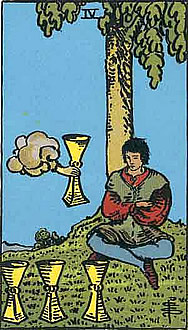 Tarot Influence |
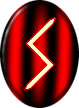
Rune Influence |
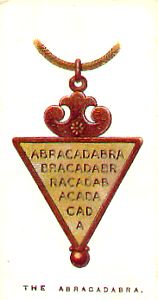 Charm Influence |
| Four of Cups Reversed Awakening from a sedate period. New relationships, goals and ventures are possible. |
||
| Sowilo The Sun Rune, denotes power and strength. That which you want may be attained. Sowilo also denotes mental clarity and added warmth to your relationships. |
||
| Abracadabra The most powerful of all talisman indicating you or someone close to you will recover from an infection. |
||
| Your Daily Influences represent events and challenges the current day will present for you. They may represent opportunities you should be ready to seize. Or they may forewarn you of problems you may be able to avoid or lessen. Generally it is best to use them as tips to help you manage your day and nothing more. | ||
Tag: Religion and Spirituality
Your Deck of Ancient Symbols Card for August 8th is Tree
| Your Deck of Ancient Symbols Card for Today | ||

The Tree The Tree symbolizes spiritual health and growth. The healthy tree is rooted in a rich, nurturing medium, has a strong trunk from which leaf laden branches fan out to capture the sun’s energy. The Tree represents a healthy spirit entrenched in experience and strengthened by wisdom. It is a spirit that is happy with itself, but continues reaching to become even wiser, more complete, happier, stronger. While The Tree represents a strong and independent spirit, it is also a life-force that owes much of its strength and growth to being surrounded by other healthy spirits. As a daily card, The Tree denotes a time when your spiritual self is especially powerful and open for further growth. Now is a time for you to seek out streams of wisdom and knowledge that you can not only draw from but contribute to as well. Don’t disregard sources that seem improbable, as they often produce the most profound revelations and spiritual expansion. |
||
Today’s Runes for August 8th is Wunjo
Today’s Runes
 |
Ice Runes are most commonly used for questions about struggle, conflict, and achievement. Wunjo is the rune of Joy. Since joy is least frequently a solitary emotion, this rune often represents mutual or communal bliss. Wunjo is also seen as a rune of the gods and a rune of perfection, carrying with it the elation that blazes from the creation of a perfect work – perhaps this is the true joy of the gods, that they can create perfection. That aside, this rune does not focus on the struggle for perfection or on our inevitable imperfections, but rather on a job well done and the satisfaction that comes from it. |
Your Daily Number for August 8th: 9
Today you may be feeling a sense of doubt about past decisions; don’t. You may feel a great deal of emotional stress today, so combat negative feelings by being active and creative in your everyday life. Find solace in distraction.
Fast Facts
About the Number 9
 Theme: Encompassing a love for all, Compassion, Patience, Selfless
 Astro Association: Virgo
 Tarot Association: Hermit
The Cult of Mary
The Cult of Mary

Author: Fire Lyte
There is a hidden mystery that exists in the Christian faith that bubbles just under the surface of common knowledge, yet remains in essence an ageless conundrum. This mystery actually started off with the same question that this paper will attempt to answer: “Why me?” Or, more specifically, why Mary? The Catholic Church has hailed her as “the Blessed Virgin, Mother of God, Queen of Heaven; as Our Lady of Lourdes, Walsingham, Guadalupe, Czestochowa; as Flower of Carmel, House of Gold, Ark of the Covenant, ” (Ashe 14) . Men hold Mary close to them as a personal mother, revere her as one of mankind deified, and yet hold her above, still.
The question is why.
There is no data concerning the mother of Christ except in Christian writings, and there is really nothing of Christian merit to compare her to. In order to even fervently research her, one must first accept that Christ existed, which any skeptic could dispel with a call for burden of proof beyond the Bible. Despite this, it is the position of this research to answer the question of “Why Mary?” The answer is that she is the Christian expression of a tradition in place since time immemorial of deifying a Mother Goddess.
In a collection of essays entitled The Blessed Virgin Mary, the author John de Satgé, an evangelical canon, states this about the origin of the veneration of Mary:
The evangelical has a strong suspicion that the deepest roots of the Marian cults are not to be found in the Christian tradition at all. The religious history of mankind shows a recurring tendency to worship a mother-goddess. Three factors in particular suggest that the cult of Mary may be an intrusion into Christianity from the dark realms of natural religion. First, it seems that historically the earliest traces of Marian devotion seem to come from Christian circles to some extent at least tainted with syncretizing Gnosticism.
The second is the ease with which the devotion becomes associated with local holy places so that the faithful make their prayers to our Lady of a particular shrine. May it not be the case, the evangelical wonders, that what we have here is in reality an older religion, a paganism which has been too lightly baptized into Christ and whose ancient features persist under a thin Christian veil? The third factor is an apparent correlation between Marian devotion and an elevation of chastity to a point of esteem where marriage and sexual intercourse are depreciated if not reprehended. (Mascall 77)
Here is a summation of the problem in reasoning Mary’s divinity with Christianity, as Christianity is supposedly patriarchal in nature and supposes that there is only one, true god. This same author goes on to say that the worship of Mary did not begin as the veneration of Christ’s holy mother, but as a deity unto herself. However, Christianity dodges the issue of Mary as a Goddess by referring to a sacred book that one must accept as an article of faith. In point of fact, the veneration, or more adequately, the cult of Mary cannot be fully examined through the lens of Christianity alone. Rather, it must be looked at in a historical context.
There are many variations of this adage, but it is said that to know where you are going you must know where you came from. The same is true in the case of the Goddess Mary and her cult. In order to know why the cult of Mary exists in Christendom, one must know about the veneration of female deity and its importance in ancient cultures. Before the rise of gods or any recorded patriarchal forms of worship, there is evidence to suggest the reverence and worship of goddess worship. More specifically, there is evidence to support worship of The Goddess – or, as Goethe puts it, the Ewig-Weibliche, or Eternal-Womanly (Ashe 24) . It is believed that the stone carvings, dating back to over 10, 000 BC, of women with “gross breasts and bellies” were “exaggerated tokens of motherhood” that were used as cult-objects of early Siberian and European hunting tribes (Ashe 24) .
This early reverence does not stop with the Eternal-Womanly, but continues into every pantheon across the world. Upon moving from the prehistoric era to the oldest recorded myths and legends, The Goddess is “One at her apogee – not always through conscious intercommunication of cults, but psychologically One, under many names and aspects, ” (James 41) . She becomes known by many names, and is credited, depending on your mythos of choice, as a world-matriarch, a wife or mistress, a maiden, an animal, or some combination of the above. She has been called Nintu in Sumeria, Inanna in Babylon as well as Ishtar, Astarte in Canaan, Neith or Isis in Egypt, Cybele in Asia Minor, Artemis or Diana by the Romans, and Aphrodite by the Greeks. (James 77)
By the second millennium BC, however, the waning of The Goddess’ hold had begun. During the reign of The Goddess, however, it has been supposed that a matriarchy was in place with kings married to priestesses as sacred functionaries. (Campbell 315) On the other side, it is more than likely a bit too extreme to suppose that the whole of Europe was under the rule of women. There is much evidence to state the contrary, or at least that women were not in powerful enough positions to rival the reign of a king. Although, more than likely, women were possibly powerful through a knowledge of magic, and, thus, the Eternal-Womanly powerful along with them. (Campbell 316) .
There is also the hint of the idea of matrilinear family lines, that is the tracing of parentage back through the mother’s line rather than the father’s. (Ashe 26) This comes from the now-practical idea that while the mother of a child can be known for certain, his or her father is another matter. Paternal parentage could be hard to prove, or hushed up altogether. Furthermore, the very nature of procreation was a mystery to early peoples. Many cultures, when dealing with the issue of pregnancy, doubted the father’s identity, and some doubted his very existence. (Ashe 27) This deals directly with the nature of this perpetual Goddess ideal. If sex-relations could occur without resulting in a pregnancy, could not pregnancy result without sex-relations?
Early people attempted to answer this question by saying that Earth, the great Cosmic Mother, was a life-giver, and needed no man to do so. In fact, sometimes there was no cause at all other than the Great Mother’s will. Now, we finally get to the point in history where the idea of virgin birth becomes profound and permeates culture. The Egyptian Goddess Neith gives birth to the Sun-God Ra without any aide and by her own power. Cybele splits off a male consort named Attis for herself by her own creation power. In these earliest tales of The Goddess, she is both a virgin and a mother, not unlike a certain Biblical virgin-mother. (Boslooper 162) These days, as was stated earlier, were doomed to end. The days of the reign of The Goddess, in whatever capacity She was in power, began to die out at the beginning of the second millennium BC. (Neumann 163)
The reign of power passed rather swiftly – considering the expanse of time – over to male deities. This happened “partly through the ever-strengthening institution of kingship, partly through changes in kingship, partly through changes in relations between the sexes, [and] partly through war and conquest.” (Ashe 29) The lunar calendar – a female allusion – was replaced by a solar calendar – male-centric. Gods like Zeus became central and chief of many pantheons of Europe, western Asia, and Northeastern Africa. Even worse, however, was what this new male-dominated society did to the veneration of the Goddess. She was torn apart and turned into various, easier to digest deities that seemed much more human and inferior to the now-chief deities. The Goddess in Greece became Athena, Artemis, Hera, Aphrodite, and the rest.
Femininity as a whole was attacked through the myth of Pandora, who was bestowed many gifts by the gods, but was too weak-willed to hold to her pact to never open her ubiquitous box. Thus, the divine feminine was turned into an insipid girl who would never measure up to the standards set before her, and, oh yeah, she was the source of all evil on the planet. (Guthrie 37)
One of the most powerful of female symbols, the serpent, was turned into something that male gods should triumph over.
During New Year’s festivals “Babylonian priests chanted a Creation Epic telling how the god Marduk had created the world by destroying a she-monster of chaos, Tiamat, and re-arranging her fragments. The Goddess’s serpents, formerly wise and benign, were now portrayed as malicious.” (Ashe 30-31) The greatest of these injustices to The Goddess, the Eternal-Womanly, was the Fall. As it went with the change of status among the ancient Israelites, so did it go with the idea of Eve, whose name means Life, and who was the mother of all living. (Gen. 3:20)
At first, she was the naked mother of paradise, walking in the Garden of Eden at the place where a stream turned into four mighty rivers – sources of the earth’s fertility – beside the Tree of Life. (Gen. 2:9) The story quickly turns, however, into the telling of a second-rate creation that causes far too much trouble for the dominant man, and, like Pandora, brings about the evils of the world. How does she do this? Well, the mother eats a fruit tempted her by a serpent; all of these are ancient Goddess symbols that were turned into a warning to paternalistic religious society to condemn the old religion.
Not all feminine entries into Christianity are considered evil. Wisdom, which may very well be a tribute to Athena, is a feminine entity in the Bible, though, admittedly, a widely overlooked entity. When Job asks Yahweh where “Wisdom” is to be found, it is to the feminine counterpart to Yahweh that sits enthroned in Zion to which he is referring. (Ashe 43-44) Wisdom is seen as the mediator between Yahweh and mankind. She was the inspiration for the Torah, supposedly befriended Biblical characters, and guides her devotees to the next world. (Knox 60) In fact, Canon Wilfred Knox says further:
The personified Wisdom is a female figure definitely on the divine side of the gulf, which separates God from man….
There can be little doubt as to the original of this highly coloured portrait. The lady who dwells in the city of Jerusalem and in its Temple, who is also to be compared to all the forest trees of Hermon and the luxuriant verdure of the Jordan valley, is the great Syrian goddess Asarte, at once the goddess of great cities and the mother manifested in the fertility of nature (Knox 70) .
So now the stage is set for the emergence of the cult of Mary. The Goddess, in all of her many aspects, was subdued by a patriarchal society and vilified by its main religion. However, the positive ideal of Her as Wisdom seeped its way into the Bible despite the book’s otherwise masculine leanings. Instead of Wisdom being the mediator and chief female sitting enthroned in Zion, it will soon be Mary, the mother of the savior, who would take that spot.
The deification of Mary was not an overnight creation. When her story was written into the Gospels of the New Testament, she was not immediately charged with the titles aforementioned – Queen of Heaven, etc. To understand how this came about, and how her prominence became so in the first place, one must look to the early church. That is, one must understand the nature of those that wrote the Gospels. According to the Jews, Jesus was not the Messiah, and to consider him such was a blasphemy. (Ashe 50) However, he was a teacher, and he changed the lives of his disciples in the grandest way by seemingly coming back from the dead after his crucifixion.
Christianity was about the teachings of one person, and various subsets or denominations attempted – and still attempt today – to figure out the meaning of Christ’s words. At the heart of the religion was still a man, and the religion is as much about his life as it is about his teachings. His life, however, most definitely includes his mother:
In his [Jesus’] role as dying-and-rising Saviour he could not be readily conceived as standing alone. Such gods had never normally done so. They were rooted in the world of the Goddess, and in some form she accompanied them. You could not have Osiris without Isis, or Attis without Cybele. The death-conquering Christ of the Pauline missions cast a shadow behind him, whether or not Paul was ever aware of it. He evoked a role for another to fill – a woman. The world’s nostalgic desire would prepare a place for her. Doubtless, like Christ, she would transcend myth as well as fulfilling it. And the original relationship of the Young God to the Goddess made Christ’s mother the best candidate (Ashe 53) .
Mary is the cause of Jesus’ first miracle. At her prompting, Jesus turned water into wine at Cana. (John 2:1-12) Other than this, her appearance at his crucifixion, and a handful of other appearances in the Gospels and finally in Acts, she has no place in the rest of the Bible. The author we know as Matthew is chief author that first introduces the symbol of Mary to the Bible. It was said, “Behold, a virgin shall conceive and bear a son, and his name shall be called Emmanuel.” (Isaiah 7:14) This name is said to mean God with us, which symbolically identifies him as the incarnation of Yahweh. However, the word ‘virgin’ may or may not be translated correctly as one who has never been sexually intimate with a man, as it is rather ambiguous in the original Hebrew. (Ashe 66) Whether or not the child was biologically Joseph’s, or any other man’s, is irrelevant, as it is believe that he was the wondrous child conceived without intercourse through a miracle. Sound like a familiar theme? It should.
In fact, several times throughout the Gospels, and a few times in Paul’s Epistles, Joseph is culturally completely taken out of the equation. It was customary to call a man the son of his father even after his father’s death and for several years afterwards. However, Jesus was always called the “son of Mary.” (Mascall 32) Even during the writing of the Gospels, the authors had already begun to slightly venerate Mary more than other characters of the New Testament by turning Joseph into more of a later consort, mentioned far fewer times in the Gospels than Mary.
The problem in studying the idea of the virgin birth quickly turns into a problem of irrefutability, as the only texts on the matter are the Christian texts. There are some whispers of contradiction in the way certain verses are worded throughout the New Testament, however many such discrepancies occurred due to the need to copy these texts by hand over and over again through the years. Mistakes could have happened. Since these discrepancies are negligible and do not provide any concrete evidence of the contrary, they must be thrown out. (Boslooper 230-234) Thus, the problem of irrefutability.
Now we have a Biblical veneration of Mary, as she was assuredly held above Joseph and many others. We have a miraculous virgin birth, echoed from a long-ago history of deifying the sacred feminine, the Eternal-Womanly. The pregnancy itself is a nearly direct mimic of local Greek or Roman culture – a la Zeus and his many supposed impregnations of various female deities. However, the religion and practice of Christianity was still a purely patriarchal one. Yahweh was a solely jealous male god that did not want his followers to put anybody else on a throne. In the late 370s, however, much of that changed with the public singing of hymns popularized by Syrian Gnostics and Ephraem. (Ashe 195-196) These poems, granted, might be a bit beyond the realm of theology, however:
His many hymns and poems include several addressed to the Virgin. Their flowery praise strikes a new note in Christianity. Its language should not be pressed too far…. Still it is arresting to find Ephraem calling Mary Christ’s ‘bride’ or ‘spouse (thus being the first Christian to clear the hurdle of the Goddess-and-Son relationship, though with a wrench to doctrine) , and writing what seem to be prayers to her, implying her power as a living intercessor with God (Palmer 20) .
These same hymns echo a second Eve theme, but begin to title Mary with the names we are so familiar with. He calls Mary “O Virgin Mother of God” – the Blessed Virgin – as well as the “Gate of Heaven, and Ark, in thee I have a secure salvation. Save me, O Lady, out of thy pure mercy.” (Palmer 24) Through these poems, and the later Gnostic Christian beliefs, Mary becomes the Garden of Eden itself, the Earth. Mary is the mediator between mankind and God, one who is addressed as the Mother of God whose “prayers obtainest for thy faithful ones a covenant, peace, and a scepter wherewith to rule all.” (Palmer 24) Granted, these verses are hidden in messages praising the Father God, but they are there, and they quickly permeated society creating a subculture of Mary worship.
Upon the time of Ephraem’s death a few years later, the practice of praying to The Virgin directly for absolution or intercessory prayer had become commonplace. The ideas perpetuated by the Gnostics entered mainstream consciousness, albeit in a less than matriarchal method. However, many sects, including Rome in some instances, began to retroactively credit Mary with being a far greater presence in the Bible than was originally believed. She had become a patroness of celibacy and virgins that had yet to consummate a marriage. (Boslooper 85) Furthering the idea of her expanded presence, St. Augustine, revering Mary in a nearly Goddess-like deification of maidenhood, stated that “[quoting Isaiah 19:1] ‘Behold, the Lord comes seated on a light cloud, ’” and claims that the light cloud is a symbol of Mary, free from any burden of vice. St. Augustine continues to proselytize, “Receive, receive, O consecrated virgins, the spiritual rain that falls from this cloud, which will temper the burning desires of the body.” (Palmer 27)
Mary became a Goddess of Virginity, though very few actually referred to her as the patron Goddess of Virginity. Rather, it is seen more often this sort of allusion, the idea that she is The Virgin, Queen of Heaven, who calms temptations, desires, and worldly ills. She could be compared to several goddesses of peace, but that might be an oversimplification of her reverence.
The rise of Mary’s importance in Christianity happened swiftly over several centuries, and continues until today. Mary is now the patron saint of many locations, known by many names, just as the idea of The Goddess was disseminated into many names and purposes. She is an intercessor of prayer, a healer of humanity, the Mother of God, the Queen of Heaven, and a source of miracles herself. (Ashe 244) In the latter part of the first millennium BC, and well into the second millennium, Mary was and still is attributed with healing many sick and dying individuals. This usually occurs through some medium claiming to be blessed by Mary, or by making a pilgrimage to a site that is purportedly blessed with the presence of The Virgin. (Ashe 245)
The power of Mary as a healer and Holy Virgin Mother holds great sway over many in the Catholic faith still. Gnostic revivalists are mixed about whether or not Mary is the revival of The Goddess, or merely a highly praised saint and important Bible character. The cult of Mary, however, has strikingly similar corollaries to past ideals of The Goddess, and so does her worship. Venerated as Eden itself, she becomes the Goddess of the Earth, the Eternal-Womanly’s oldest and most recognizably universal form.
As The Virgin, her cult harkens back to the days of Artemis, Diana, and the ancient virgin goddesses that created the world without any help from a man, to the time of Cybele who created her own consort without the aide of anything but her own will and sheer power. As a healer and source of miracles, she is likened to the ancient goddesses of magic and spellcraft that abound in Egyptian, Sumerian, Syrian, Greek, Roman, Celtic, and Norse pantheons. As a guider of souls and intercessor of prayer, she is like the psychopomps of ancient times.
But, whether or not Mary, Mother of God, Queen of Heaven, Intercessor, Guider of Maidens, Healer of the World, Eden, the cloud the Lord sits upon, should add “aspect of The Goddess or Eternal-Womanly” to her litany of titles is, perhaps, a mystery for the ages. However, it cannot be denied that the reverence bestowed upon Mary is deserving of the title “Goddess.”
Footnotes:
Ashe, Geoffrey. The Virgin: Mary’s Cult and the Re-Emergence of the Goddess. Great Britain: The History Press, 1976. Print.
‘Common Bible’, Revised Standard Version. translation by Ronald Knox, 1973.
Boslooper, Thomas, The Virgin Birth, Preachers Library, 1962. Print.
Campbell, Joseph. The Masks of God. vol. 1. Secker and Warburg, 1960-5. Print.
Guthrie, W.K.C.. The Greeks and their Gods. Methuen, 1950. Print.
James, E. O.. The Cult of the Mother-Goddess. Thames and Hudson, 1965. Print.
James, E. O.. Prehistoric Religion, Thames and Hudson, 1957. Print.
Knox , W. L., St. Paul and the Church of the Gentiles, Cambridge University Press, 1939.
Mascall, E.L. and Box, H.S (eds) , The Blessed Virgin Mary, Darton, 1963. Print.
Neumann, Erich. The Great Mother. Routledge and Kegan Paul, 1955. Print.
Palmer, Paul S. J., Mary in the Documents of the Church, Burns Oates and Washborne, 1953.
Your Daily Influences for August 7th
| Your Daily Influences August 7, 2011 |
||
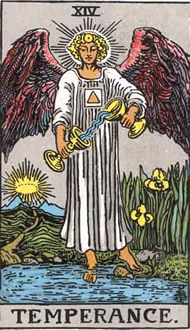 Tarot Influence |
Rune Influence |
 Charm Influence |
| Temperance This card represents harmony, self control and synchronization with the world and others. |
||
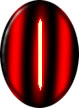
| Isa The Ice Rune, represents stagnation and a passionless existence. Your life’s course may seem blurry at the moment, but if you persevere you will move onto better days. |
||
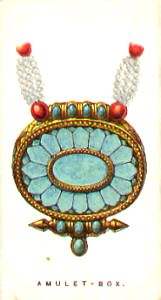
| The Amulet Box There are papers in your near future. This aspect is affected by legal papers of some kind–a contract, a legal action or a fine of some kind. These papers will cost you financially and emotionally. |
||
| Your Daily Influences represent events and challenges the current day will present for you. They may represent opportunities you should be ready to seize. Or they may forewarn you of problems you may be able to avoid or lessen. Generally it is best to use them as tips to help you manage your day and nothing more. | ||
Today’s I Ching Hexagram for August 7th is 52: Keeping Still
52: Keeping Still

General Meaning: Regular periods of keeping still are an important aspect of personal development and forward motion. The most restful person may not be the one who sleeps twelve hours a day, but the one able to grab catnaps while cruising 600 miles-per-hour at 35,000 ft. Learning to act when it is time to act, and to keep still when it is time to keep still, is the key to obtaining the peace of mind which helps you stay focused when clear focus is needed.
Consider the spine, which serves as a switchboard for all the nerves of the body that mediate movement. When the spine is kept flexible and healthy through proper rest and relaxation, active movement can always be undertaken without strain. When the spine is held erect in a balanced sitting posture, the inner balancing of meditation can take place.
Treat your innate spark of energetic vitality like a candle in the wind you are protecting, as your only light in a dark forest on a moonless night. Avoid external conditions that threaten to snuff out the flame, and be careful not to suffocate it with your own ambitions of worries.
Time out. Relax now, take your shoes off and sit a spell. Let go of thinking. Breathe and meditate on the breathing.
Your Daily Number for August 7th: 7
A confrontation with a loved one is possible today, and you may find yourself engaging in somewhat self-critical behavior. Don’t. Today is the perfect day for greater understanding of yourself and others. Make this a time for spiritual realization rather than negative back talk.
Fast Facts
About the Number 7
Theme: Quiet, Insightful, Analytical, Mystical, Intuitive Astro Association: CancerTarot Association: Chariot
Today’s Tarot Card for August 7th is Judgment
Judgment

This Tarot Deck: Visconti-Sforza
General Meaning: What has traditionally been known as the Judgement card, sometimes entitled Resurrection, represents the great reunion that the ancients believed would happen once in every age. This was the time when souls are harvested and taken Home to their place of origin, outside the solar system. Then the World is seeded with a batch of new souls and the process starts over.
From a modern point of view, this great reunion — which includes every personality that you have ever been and every soul that you have done deep work with — reunites to consciously complete the process. In a way, we symbolically celebrate this returning to center every year on our birthday.
In personal terms, the Judgment cards points to freedom from inner conflicts, and so clear a channel, that the buried talents and gifts of past incarnations can come through an individual in this lifetime. This card counsels you to trust the process of opening yourself, because what emerges is of consistently high quality. You can effortlessly manifest as a multi-dimensional being, and assist in evoking that response from others.
A Samhain Meditation for your Ancestors
A Samhain Meditation for your Ancestors
A journey of Memory and what it means to face Death..
We’re going on a journey, that you may find difficult. If at any time, you feel you do not wish to continue, please wait quietly, then turn to the south, and you will see a path leading back to the safety of your grove.
Make yourself comfortable, and breathe slowly from your stomach, and clear your mind of all disturbing thoughts.
Enter your sacred grove and stand in the EAST, for you are beginning a journey of memory. Allow yourself to absorb the peace and tranquillity of your space. You hear a beating of wings and feel the touch of cold air on your face. A Raven flies around you, leading you NORTH-WEST, where it alights on a gate and waits, its coal black eyes watching you. Walk towards the gate and stop. Do not fear the Raven, for it is another aspect of the Cailleach. She comes to you now, to guide you. Put your hand on the gate and open it. As you walk through, cast back in your memory to when you were a baby, a young child and remember something good about that time.
Walk through. There is nothing before you but a black, empty void. Do not be afraid. The Raven flies ahead of you, drawing you on.
As the gate closes behind you, remember when you were at school. As you remember, follow the Raven into the darkness until you come to another gate. Place your hand on this gate, and remember the good times of your school days, and when you were a teenager.
Open the gate, and walk through. There is nothing before you, but a black, empty void. Do not be afraid. Allow the Raven to be your guide.
As the gate closes behind you, remember your first job, your first love. Walk slowly forward into the darkness, remembering the feeling that you had when you left your home for the first time. The Raven circles you and leads you to another gate. Place your hand upon this gate and remember the agony of your first love, the apprehension you felt on your first day at work.
Open the gate and walk through. Before you is dark, a black empty void. Do not be afraid. Let the Raven guide you, for you are not alone.
As the gate closes behind you, remember the first little sparrow that you ever saw; the first notes of a blackbird’s song in the twilight; the first buttercup that you held beneath your chin; the first drop of rain on your face, and the first breath of wind in your hair. Remember the blue sky and the golden sun, the silvery moon and the cotton wool clouds skimming overhead. Walk slowly forward into the darkness, hearing the beat of the Raven’s wings, until you come to another gate.
Place your hand upon this gate and remember the seasons as they changed throughout your life; how each season affected your moods and your emotions; how the snows covered the earth, and the frost killed off the autumn flowers.
The Raven sits on the gate, looking at you. Now you will know and understand that Death is all around us. The death of a bird from the scattered feathers on a lawn, the dying breeze as the clouds move onwards. The Death of the sun as it sinks in the West and its re-birth each morning in the East. Seeds planted to bring new Life, yet they come from the death of the flower or nut. Death is in the seasons, as each gives way to the next. Death is part of Life, as the old gives way to the new.
Open the gate and walk through. Before you is dark, a black empty void. Do not be afraid, for the Raven flies beside you.
In the distance you see a door, of shimmering colours. STOP! Do not touch it. Do not open it. Do not approach it at this time, for this is the final gateway that each of us will pass through, when our time comes. It is not yet.
Now turn around slowly, and gaze back through the gates that you have opened and passed through. You will see a silvery line of footprints that mark your journey through life. And if you look past the very first gate, you will see other silvery lines, footprints that belong to your ancestors. Each gate was a death. An ending of a way of life for you, and each gate was the beginning. Think about Death, not in a morbid way, but as a positive beginning that we must all face. Each has a purpose in Life, and each will have a purpose in Death. Live your Life to its fullest because your Ancestors made it possible. And when your time comes, know that it is not the end, but the beginning of a new existence.
When you are able to accept this, then the Cailleach will be able to give you her wisdom and help you through Life. When you can face Death with a free will, then you will be able to live Life to its fullest, for you will be free of Death’s burden.
Look around for the Raven, it is flying SOUTH, where you see a sunlit path leading back to your grove. If you have stopped along the way at any point, do not worry, for you will now see a sunlit path leading SOUTH back to the safety of your Sacred Grove.
When you are comfortably back in your Grove, relax, become aware of your surroundings. As you return to the present time, think about your memories, and consider whether there is anything you should have done. Something that needs finished; perhaps a quarrel that needs to be mended; or saying thank you to someone who has done a kindness. Life is there to be lived, but remember, none of us knows how many gates we will be allowed to open, before we reach the Door beyond. Only the Cailleach knows these things.
by Ailim, 2003
Inner Smile Meditation
Inner Smile Meditation
Whenever you find yourself in a touch situation, this meditation will give you an instant boost of positive feeling. Imagine that you are looking at your face in a mirror. Watch yourself smile and your eyes light up with joy. Notice how beautiful you look when you smile and appreciate how positive smiling makes you feel. Breathe deeply, bringing that positive feeling to life within you in the present moment.
Life’s Obstacles Meditation
Life’s Obstacles Meditation
(A Meditation Thought)
“For a long time it seemed to me that life was about to begin. But there was always some obstacle in the way, something to get through first, some unfinished business. Only after that would life get under way. At last it dawned on me that these obstacles were life.
Anonymous
Welcoming The Dawn Meditation
Welcoming The Dawn Meditation
In many spiritual traditions dawn–when the world is at its most peaceful–is regarded as an ideal time for meditation. Just before dawn go outside and find a place to sit and watch the sunrise. As the sun emerges above the horizon, fill your awareness with brightening hues of the sky and rejoice in the beauty of the new day. Feel the golden rays of the sun warm your face and allow hope to fill your heart and refresh your spirit. You have started the day well.
If the weather is poor or you are unable to get a clear view of the sunrise, visualize the dawn instead.
Today’s Runes for August 6th is Inguz
Today’s Runes
 |
Spirit Runes are most commonly used for questions about mysticism, spirituality, and religion. Inguz is the rune of completion and fertility. The presence of this rune suggests that tasks which have been initiated will come to fruition. This rune is associated with Ing and Frey, it is this connection that explains its connotations of both fertility and sexuality. The variant of this rune shown here is reminiscent of the twin strands of life, and of the challenge and rewards of bringing together things complimentary. |
Your Daily Number for August 6th: 5
You may find yourself discussing or embarking on a trip today. Not a great day for details; it’s better to take advantage of today’s self-promoting energy to get off the beaten path and be social.
Fast Facts
About the Number 5
Theme: Resourceful, Adventure, Speculation, Travel Astro Association: TaurusTarot Association: Hierophant
Introduction To Scrying – Pathworking
Introduction To Scrying
Pathworking
The term “pathworking” is used for several different practices, ranging from simple meditations through programmed visualizations to visions and astral travel. What they all have in common is the use of symbols traditionally associated with the “paths” of the Tree of Life, e.g., the Tarot trumps. These symbols have been in use for long enough that stable regions reflecting their power have been established in the inner planes. By using the symbols in these practices the person connects to those regions and can learn something of the realities behind the symbols.
Preliminary Steps
1. Pick a visual symbol for the path you want to explore. Tarot cards are good starting points. The cartoon-like images of the Rider or Wang decks are preferable to detailed images like Crowley’s deck; the bright, flat colors of these cards encourage your imagination to fill in the blanks. We’ll use the Rider deck’s “Fool” card as an example.
2. Review what you know about the correspondences of the card. Read what your available sources have to say about the card. Then go on to some unconnected activity for a while and let your unconscious absorb the information; let it make its own connections and conclusions without any effort by your conscious self.
Using the example card, what comes immediately to my mind: The Fool is generally attributed to the element of Air and the path of Aleph. In the Golden Dawn version of the Tree, the path of Aleph connects Kether with Chokmah. In Achad’s version of the Tree, it connects Malkuth with Yesod. The Fool is a primal form of Air, more cosmic and less “earthy” than the Tarot suit of Swords. In the cabala, it represents both the “mind” or “intellect” aspect of being, and the Yetziratic, “formative”, or “Son” aspect of the IHVH sequence. In the Enochian elemental sequence it represents the creative Ideal manifested by the divine, which is the basis for further development and full manifestation through the other elements. In the structure of the planet Earth, it is the atmosphere which lies between the spirit-aspect of the planet’s magnetosphere and the water-aspect of the oceans. And so on.
3. Study the card and note the details, and also note any connections that come to mind. Consider the figure in the card; what does his/her posture, gestures, expression, etc. say about his attitude and emotional state? Where does his attention seem focused? Try to get some idea of the type of personality being expressed.
Ex: The cliff on which the Fools stands seems to be colored using three of the Malkuth colors: black, olive, and russet. The Fool’s boots are citrine, completing the foursome. The mountains in the background are in a Yesodic violet, with snowy tops reflecting the light of the Sun, which is colored in Kether’s white. The sky, dominant in the picture, is an Airy yellow, slightly darker than the citrine of his boots.
The Fool’s outer garment is green with ivy patterns, reminding me of the Green Man of Celtic mythology and Malkuth again. The lining is red, reminiscent of both Fire and the sexual energy of Mars. There are wheels embroidered on the garment, which brings to mind another card, The Wheel of Fortune, attributed to Jupiter, who is Lord of the Air. There are also Fleur-de-Lys on the garment, which are either Lilies (Malkuth, according to Crowley) or Irises (Yesodic by color and shape).
His inner garment is white, again suggesting Kether. A feather is mounted at the front of his hat, and its shape suggests the Uraeus serpent of Egyptian costume, or the feather of Maat. He carries a rose in his left hand and a staff with a bag at the end (rather phallic) in his right.
The Fool’s head is bent back, his eyes focused on something in the distance that only he can see. His posture is somewhat pretentiously “sensitive”, the sort that you would see the French Sun-King use in one of his dances. Overall he reminds me of a Galliard poet of the 13th century, a noble’s over-educated younger son, wandering and pretending to be a minstrel while eschewing mundane tasks. He is about to walk over a cliff. The dog at his heels seems either playful or trying to call his attention to his immediate danger.
You don’t have to go into such detail as in the example; if you are just starting out in magick, you probably won’t have the resources to do it. The important thing is to note the details, and try and interpret the figure’s expression and posture, and the acts in which he seems to be engaged.
These first three steps are preparatory, and should be done before beginning the main part of the practices. Once you have done them, let the information float in your unconscious for a few hours or a day while you do other things. The idea is to gently focus the unconscious on the subject matter, and to let it absorb the information and ideas without your conscious interference. This makes it more willing to participate in the practices, and enhances its ability to make connections with the magickal region behind the card.
Main Practice
4. Sit down and do the relaxation exercises, as described in the earlier section.
5. Place the card in front of you so that you can look at it without straining your eyes or changing your relaxed position. Look at the card without deliberately focusing on any one point; let your eyes move from point to point within the picture in their normal scanning motion.
6. Now enter your magickal space and get your awareness firmly established there. Go to the place where your magick mirror is located and stand where you can view it head-on. Imagine the image from the Tarot card in the mirror, so that it completely fills the frame. Then look at the landscape in the picture; think of what it would look like if it were real and not just a cartoon image. Try to see the image as a three-dimensional world behind the glass of the mirror. Think about the parts of the landscape that are hidden beyond the window frame and fill them in. Keep the colors more or less the same, but fill in the details; build up a picture as if that world were a real place that you can see. Feel free to incorporate details of real places you have seen in your life. (But DON’T use real people as models for the figures.)
Ex: The mountains in the Fool card remind me of the Swiss Alps, violet-tinted rock with permanent snow-cover at their summits. I fill in the picture with the appropriate details of ravines, rockslides, etc. The cliff on which the fool stands looks to me as if it is some sort of moss-covered granite, and the sharpness of the drop suggests that it was carved out by a glacier. The same glacier would have carved a deep, rounded valley below, and I imagine it being there, with fields of grass and copses of pine and fir trees, perhaps with the rooftops of a village small in the distance.
The Fool is walking towards the window, so there must be a trail down into the valley hidden behind the outcrop. I imagine a trail following a curve upwards around the end of the valley to end at the outcrop. I imagine this outcrop is on the side of a mountain the summit of which is somewhere to the right of the visible area.
7. Next, imagine that you have jumped through the window frame and are standing in the world you have been looking at, but at some moment in time just before the living figures of the card appeared on the scene. Don’t try to move through the mirror, just make an instant transition to the place you just imagined. If you have to, build the landscape up again from scratch, but with you inside it.
Turn around and look at the surroundings from your new viewpoint; get a 360-degree view, and fill in the parts of the landscape that were behind your original view through the window. (The window, incidentally, should not be visible.) Imagine what your other senses would tell you if you were in a similar physical location, and add those in to your impressions of this place.
Ex: Looking back towards the window’s position I note that the mountains get lower in that direction, and gradually fall off into rolling farmlands in the far distance. A large lake (like Lake Lucern or Geneva) can be seen just at the edge of visibility. I can see the mountain on whose side I stand, and can see directly the path I had previously imagined behind the outcrop. This path comes up to my current position, then curves around the mountain and up to a pass in the middle distance. Looking down into the valley below, I see that there are light clouds between me and the village, giving the impression that I am in a world above the normal world. I can feel and hear the wind blowing around me, and there are faint scents of pine, grass, and flinty rock in the air, as well as an ozone freshness. Faint sounds of human activity come from the village.
8. Spend some time getting the scene and your viewpoint firmly in your imagination. Don’t worry if details change or shift, and don’t expend any effort trying to change them back. Just get the major outlines and positions firm and let the small detail change as it will. Think of how places look in your regular daydreams; often there is very little detail, and what detail there is is more often understood to be there rather than actually seen. As you continue the practice over weeks or months, your unconscious will gradually learn to fill them in and keep them steady without conscious effort.
9. The next step is in some ways the most difficult, and in some ways the easiest. We have all had daydreams in which we invented face-saving dialogs for some embarrassing past occurrence in our life, and others in which we imagined the events and interactions we would like to see happen in some future meeting, or in some situation we would like to be in but cannot attain in the mundane world. What you do in this step is basically the same. The only difference is that you shouldn’t have any particular desire to control what the other characters say, but instead want to see what they say of themselves.
What you want to do is imagine a scenario by which the Tarot card’s person arrives at the location where you are standing, and begins to converse with you. Using our example, you could think that you hear someone singing in the distance behind you. You turn and look down the trail, and see the fool climbing it, followed by his dog. He sings a cheery tune as he walks. As he comes close enough to hear you, you call out and wave to him; he looks up and waves back. He comes closer and steps onto the escarpment where you stand. He smiles and walks to the edge of the cliff, looking outwards. He stretches his arms and takes a deep breath of the fresh mountain air, and for a moment he is posed in exactly the way he is shown on the Tarot card. Then he turns to you and asks, “Where away, traveller?”
The idea behind this is to give your unconscious mind a credible reason for believing you to be in a situation where you can talk to the card’s character. The part of your unconscious that touches the imagination doesn’t believe in hypothetical situations; to it, things are either real or they aren’t, but anything that is reasonably consistent will be accepted as real. This part of your unconscious mind plays the character’s part while your conscious mind plays yourself. This same part reaches out into other parts of your minds and into the magickal realms and pulls in information to use in building it’s characterization.
9. Now that the character is present, you can ask him questions about himself, the various symbols of his clothing and appurtenances, and about the environment in which you find yourselves. Always act as if the character were a real person, independent of yourself. Treat him with the respect of equals; never act superior to him, and never, ever threaten. If he doesn’t want to answer a particular question, don’t press. Answer any questions he poses honestly, to the best of your ability. But at the same time don’t allow yourself to be threatened or cowed; demand that your interactions be on a basis of equality and nothing else.
Another thing to remember is that in this phase of the exercise there are no wrong results, only results you don’t understand. If something seems out of place with the nature of the card, don’t reject it. Simply admit that you don’t understand and file it away for later consideration. Generally you should follow along with whatever happens; there is no way you can be hurt, so there is no reason not to do so.
10. When you start to tire, or the character indicates he has had enough, it is time to end the exercise. Say goodbye to the character, turn and walk away until he is out of sight. Then “jump” back through your magick mirror and turn around; see the point you just jumped from through the mirror, even if this is not the same point that was there at the start. Then imagine closing the mirror so that it only shows its usual deep blackness.
After leaving your magickal space again, spend a few moments focusing your attention on various objects in your physical environment. Get up and walk around, stretch yourself, get a drink or go to the bathroom, or some other mundane task. Then sit down again and write down what happened during the exercise, in as much detail as you can. Note what was said, any ideas that happened to pop into your mind, any changes in the scenery or movements into other scenes.
It sometimes happens that unexpected things occur during this exercise. For instance, the character might come up behind you and say hello while you are still working on the landscape. Usually it’s best to go along with these happenings rather than insist on following the various stages in order.
Once the character appears, then the rule is to allow whatever wants to happen, as in the “mystery tour” exercise. You should not worry much about keeping the environs steady. The character might change the landscape to make a point, or introduce creatures or objects. Other things might appear and disappear spontaneously. You sometimes find yourself and the character transported to an entirely different scene. All these things are acceptable, and should be taken in a spirit of non-judgmental interest. Remember that the logic of visions is the logic of dreams, where such events are not at all unusual.
After you have worked with this method for a week or two using various Tarot images, try again to invoke a force using a ceremony and getting a response through your mirror. The practice of creating landscapes in the mirror should have overcome any difficulty in that regard. If you still have trouble, try combining the invocation with an appropriate Tarot image.
Introduction To Scrying – Testing your visions
Introduction To Scrying
Testing your visions
It is usually a good idea to apply tests to the images you get in scrying, and to the various beings you might encounter. The ultimate test is, of course, a critical appraisal of the quality, consistency, and value of the results you get from your work; but that test can only be applied after the work is done. Other methods allow you to get some sense of whether there is something wrong at an early point in the session. You can then take appropriate efforts to correct the problem, or if necessary end the session and save your energy for another time.
The most reliable testing method makes use of the symbols in the Golden Dawn’s Greater Pentagram and Greater Hexagram rituals. But the effectiveness of the method requires that you have some experience in performing those rituals, and in getting a good response from them. If you are not already experienced in their use, you should practice using them in your magickal space for a while before implementing this testing procedure.
A limitation of this method is that it only works where the powers being scryed are among the traditional, conventional powers used in magick. That is, the powers are elemental, planetary, or zodiacal in nature. Where the nature of a power is unknown, or it is of an inherently mixed nature, other methods must be applied.
After attaining a steady image of some magickal region in your mirror, you draw the invoking pentagram or hexagram appropriate to the power you invoked, using white lines in the air in front of you. Vibrate the god-names of the power a couple of times, then cast the symbol into the mirror. If the mirror is correctly “tuned” to the power, the pentagram or hexagram will be absorbed and will either have no effect, or will cause the image to become sharper and brighter. If the image becomes darker, becomes distorted, or breaks up entirely, then you know that something is wrong; you should banish and start over.
Similarly, if you have used the mirror as a gate and entered into some region, you should cast the appropriate symbol against any object that appears prominent in the area, and always against any being who appears to serve as your guide. In either of these cases, the being or object should show no effect, or should grow brighter, larger, or more solid as a result of the contact. A false or deceptive being will shrink, or its appearance will become distorted, or it will disappear.
No magickal being worth speaking to will ever object to being tested in this way. There is no reason that it should, since by doing the test you are, effectively, blessing and feeding it; few beings will pass up a free lunch. If a being attempts to convince you to not do the tests, that in itself is a sign that something is wrong.
Note that you should always use the _invoking_ pentagram or hexagram for tests, never the banishing versions. Using a banishing figure is the same as commanding the forces you invoked to disperse again, nullifying your efforts.
Two secondary types of testing seem to depend in some way on the magician having an _intent_ that they will work correctly; there is no obvious reason why they should work, but they usually do, just the same. The first of these is the use of the G.D. grade signs; the second is the use of the Hebrew letters of the planets.
The idea behind the use of the Grade Signs in scrying is the same as their use in Masonic rituals and greetings. By displaying a sign to a spirit you encounter, you claim a right to the “secrets” of that grade and its corresponding element. The spirit should answer back by repeating the sign, thus showing that it is also qualified to deal with the secrets of that grade. (Illustrations of the Grade Signs can be found in most published versions of Crowley’s Liber O, and in Regardie’s The Golden Dawn.)
If a spirit can perform the appropriate sign for the invoked element, this indicates that your vision is on-track. If the spirit cannot perform it, performs it improperly, or its form becomes distorted, this is an indication that something is wrong. However, it is not necessarily proof that you are dealing with a deceiving spirit, particularly if the same spirit has already passed the pentagram/hexagram test. Rather, it is more likely that there is insufficient magickal power present for your communication to be clear. The best course is to vibrate the divine names for the power you are invoking several times, and then repeat the signs again. Only if the spirit is still unable to perform the signs correctly should you end the session.
The exchanging of signs also contains an implicit agreement between you and the spirit being tested. That is, by doing this you are agreeing to deal with the spirit on a basis of equality and brotherhood, neither dominating that spirit nor being subject to it. You are also acknowledging that both of you are “members of the same fraternity”, operating within the general community of workers seeking to align themselves with “god” (or with divinity in whatever form you conceive of it). You should never try to exchange signs with a being you know is not within that community, or with which you must maintain a position of dominance — e.g., a demon or a true “elemental”. Conversely, you should never try to dominate a spirit with whom you have exchanged signs; assume instead that it will assist you willingly and without coercion, and treat it with the same respect that you would wish it to give you.
It sometimes happens that in answering your sign, the spirit will add other signs after repeating the one you used. This is an indication that the spirit is of a mixed elemental nature, or is intrinsically of a higher “grade” than that at which you are working. As an example of the first case, if you were invoking an angel from one of the Lesser Angles of the Enochian Tablet of Earth, you would perform the sign of Set. The angel would be expected to respond with the same sign, but if it were an angel of the Lesser Angle of Fire, it might add the sign of Fire (the goddess Thoum-aesch-Neith) as well. As an example of the latter case, a Senior from the Earth Tablet might add the LVX signs after the sign of Set.
The LVX signs are a special case. Their use indicates that the spirit is aligned with the divinity, is of a “good” character; but does not test for any particular elemental or planetary nature. They should be used in conjunction with the appropriate hexagrams for testing spirits related to the planets or zodiac, or in any case where the benevolence of the spirit is in doubt. All of the Enochian angels will be able to perform these signs, as will any Hebrew-system archangel.
There are no Grade Signs specifically associated with the planets in the Golden Dawn system; one must make do with the LVX signs, and these are usually sufficient. However, those who wish to assemble a set of elegant and effective planetary gestures for testing spirits should consult Planetary Magick by Melitta Denning and Osborn Phillips.
The final form of testing is, in my opinion, the least reliable. I do not use it myself, preferring to trust my own judgment. But I note it for those who might wish to experiment with it.
The Golden Dawn adepts acknowledged that in this sort of work there is always a danger that the visions one sees will not be a true reflection of the forces invoked, but may rather be constructions or projections of the seer’s own mind and emotions. They classified these projections according to an association with the planets:
| Type | Planet | Hebrew letter | Tarot Trump |
| Memory | Saturn (as Time) | Tav | The World |
| Construction | Jupiter | Kaph | Wheel of Fortune |
| Anger | Mars | Peh | Tower |
| Vanity or ego | Sun | Resh | The Sun |
| Pleasure | Venus | Daleth | The Empress |
| Imagination | Mercury | Beth | The Magician |
| Wandering thoughts |
Luna | Gimel | The Priestess |
The theory is that if you suspect that one of these factors may be influencing your vision, you can project an image of the corresponding Hebrew letter or Tarot Trump into the scene. It will cause the scene to darken, diminish, or disappear if the scene is in fact the sort of projection you suspect it to be.
My personal feeling is that introducing extraneous powers into a vision in this way will cause more problems than they will solve. As well, it seems to me that invocation of a force related to a type of projection would tend to enhance the projection rather than eliminating it. However, this may not be the case for you; try it if you wish and see if it works.
Introduction To Scrying – A Magickal Space for Enochian Scrying
Introduction To Scrying
A Magickal Space for Enochian Scrying
Since the Enochian powers are so sensitive to the visual symbols in a magickal space, the general-purpose magickal space developed in the preceding sections of this paper is likely to be inappropriate for Enochian work. The profusion of objects with which you have populated the landscape would all tend to anchor the forces in unexpected or undesired forms. A space with a more neutral visual appearance needs to be used.
A woman I once met made a habit of surveying people about the appearance of their magickal spaces. Amusingly, nearly all the Enochian magicians she knew (most of whom did not know the others) had chosen to build essentially identical spaces for their work. This space might thus be considered an archetypal Enochian workplace. It consists of a broad, gray plain, surrounded at the horizon by low hills; both plain and hills are illuminated in a flat, sourceless light of relatively low intensity. Overhead, there is a night-sky filled with stars. The plain is large enough that the magician always has a previously-unused area available in which to perform a new series of invocations.
The remaining few magicians in her survey had chosen to go even further in the direction of minimalism than this Michael Moorcock landscape. Their workspaces consisted solely of a clear space within a gray mist, with a featureless gray floor underneath, created ab initio for every invocation.
My feeling is that the plain has a slight advantage as a workspace. It allows for the establishment of long-term or permanent structures, useful for advanced works in which the invocations must be done in section, or for building a temple appropriate to a range of Enochian works.
Scrying Techniques for Enochian Magick
Both the “magick mirror” technique and its extension as a “gate” work as well with Enochian powers as they will with other, more conventional magickal powers. I would recommend that you create a new mirror in your Enochian workplace for every series of invocations that you do, and destroy it after completing the series. Since the Enochian powers tend to accumulate over time, this prevents residual forces from previous works from interfering with a new work.
However, as mentioned above, it is often necessary to provide a firm visual anchor for Enochian powers; you may find that the mirror technique is insufficiently exact, and only gives you confused or contradictory results. If that is the case, one of the following methods will be more effective.
The Golden Dawn devised a technique for using visualizations of truncated pyramids as the starting point for visions of individual squares from the Tablets. This practical method has been proven by use to be very effective, precisely because it provides a well-defined symbolic “anchor” for the Enochian powers. I recommend this technique for beginners, both for this reason and because it tends to focus the powers into their most “earthly”, most readily-comprehensible form.
The basic technique is to build a truncated pyramid in your magickal space. The flat top has an area one-ninth the area of its base. The relative sizes of the top and bottom means the sides are tilted inwards at an angle of forty-five degrees. The letter of the square is visualized on the flat top. The sides of the pyramid are colored and labeled with symbols and images according to a complex system of attributes.
(The G.D. system of attributes is described in detail in book 4 of Regardie’s The Golden Dawn; my own alternate system (which I believe to be a substantial improvement over the G.D. system) is described in the papers titled “Godzilla Meets E.T.”, which can be found at: http://www.hermetic.com/browe/index.html. The pyramid method works very well with either system.)
The pyramid is visualized as being large enough to stand on the top. Having vibrated the appropriate Calls for the name in which the square lies, the magician then stands on top of the pyramid in his astral body, and vibrates the hierarchy of names. As he vibrates each name, the magician imagines the power of that name gathering around the pyramid.
When the last name is vibrated, the magician imagines that each side of the pyramid is gathering in the attracted energy, each taking the type appropriate to its attributes and symbols. This energy is seen moving upwards, being focused as it goes by the narrowing of the sides. The flows of energy from the sides reach the top simultaneously, run into each other, and form a beam of light shining up and outwards into the astral worlds, forming a path to a region of magickal space governed by the square. The magician then follows this beam in his astral body until a landscape or other scene forms around him. This scene should symbolize various aspects of the square invoked. From that point, the techniques describe earlier can be used to explore the region.
I prefer a variation of this method, in which the magician stands inside the pyramid. When the energies traveling up the sides reach the top, they come together on the letter and then shine downwards into the pyramid, illuminating the interior. The angel governing the square is invoked to visible appearance within the pyramid and is tested there. After testing, the angel conducts the magician to various scenes that illustrate the square’s nature.
Since a session using this technique only explores the power of one letter of an angel’s name, you only get a partial view of the angel’s nature. To fully understand an angel, all the letters of its name should be explored in sequence.
When you wish to invoke all of an angel’s powers at once rather than a single letter, it is more convenient to make your anchoring image something like a magickal circle, or a talisman sufficiently large that you can stand on it. A example design for such a circle would have the divine names superior to the given angel written around the rim of the circle. The name of the angel being invoked would be written within the circle, oriented so that it appears upright when you are facing in the direction in which you want the angel to appear. If the angel is associated with a particular magickal formula (e.g., Kerubic angels and the INRI formula) symbols appropriate to that formula might also be drawn within the circle.
Note that the intent of this figure is much closer in function to a talisman than to the traditional idea of a magickal circle. It is not intended to block off its interior from the exterior areas; you should feel free to move in and out of it at will. Nor is it intended to “contain” the invoked force. Rather, the idea is that the charged figure will serve to attract the attention of the appropriate being — like putting a big illuminated sign saying “Land Here!” next to a runway — and will also serve to condition the surrounding magickal space so that it reflects the nature of the invoked powers.
Vibrate the appropriate Calls several times; then enter the magickal space and create the circle. Vibrate the divine and angelic names, and as you feel the invoked power arrive, direct it into the lines and letters in the circle so that they glow and re-radiate the power to the surrounding environment. Keep vibrating the names until the intensity of invoked power seems to level off, then vibrate only the name of the being you wish to contact, asking it to appear before you. Vibrate the angel’s name until it does appear; then apply the tests, and ask the angel what you will.
Calling the angel to the circle is my personal preference; I would rather have the guide take me to the place I want to go than go there first and find a guide afterwards. The reverse may be more comfortable for you. If that is the case, you can vary the above method by concentrating the invoked force in the circle instead of allowing it to radiate. Then imagine that the force is creating a “gate” to the power’s magickal space; imagine the center of the circle opening up as the magick mirror did in the earlier exercises, so that you can step directly through it into that space. Or you can imagine that the powers form a beam of light shooting up from the circle, which you can ride to the powers’ space.
Scrying
Scrying
Divination through scrying in to water has a long history. Water is used
in a variety of ways and one of my favourites is using it to pour melted
candle wax in to and use the shapes to tell what the upcoming year will be
like. Some water gazers prefer to have the light of a candle reflected on
the water surface. Others take the bowl outside on a cloudless night and,
capturing the moon’s reflection, divine by its appearance on the water.
Still others take crystals, place them in the bottom of the bowl, swish the
water a bit then divine the meaning from the shapes and patterns the
crystals make.
in a variety of ways and one of my favourites is using it to pour melted
candle wax in to and use the shapes to tell what the upcoming year will be
like. Some water gazers prefer to have the light of a candle reflected on
the water surface. Others take the bowl outside on a cloudless night and,
capturing the moon’s reflection, divine by its appearance on the water.
Still others take crystals, place them in the bottom of the bowl, swish the
water a bit then divine the meaning from the shapes and patterns the
crystals make.
The ancient Greeks believed that nature spirits dwelled in fresh water and
so I believe this is the best kind of water to use however any water will
do. More traditional people feel that you should not use water from a tap
and so if you do get the chance to visit a stream or sacred well, collect
some water for use in your scrying.
To divine the future with your scrying bowl, pour water into it then let it
settle and ask your question. Sit with your back to the light in a darkened
room and gaze into but not at the water. As with a crystal ball, the water
may cloud. Eventually you may begin to see symbols within its cool depths.
Make note of any such symbols. When no further symbols are seen, begin the
process of interpretation.
Author Unknown
——————————————————
Scrying
Scrying is a facinating practice in that it enables you to literally “see” the future (or present or past). Almost any reflective surface can be used for scrying (pronounced to rhyme with “crying”). A crystal ball and gazing mirror are two of the best.
Another form of divination, sometimes used by Witches, is scrying into a fire, called fire scrying.
Author Unknown
Fire Scrying
Fire Scrying
Make a fire of driftwood, on the seashore, after sunset (if you are far from the seashore then you can use any old, weathered wood, such as from an old barn, or the like). When the wood has been well burned and is beginning to die down, lay on it a cedar log, a juniper log and three good handsful of sandlewood chips. Let these burn well. Then, as the fire again begins to die down, gaze deep into the dying embers. In these embers you will see scenes of the past, present and future. You may see the actual scenes, but it is more likely that you will see symbolic scenes that need interpreting. This scrying fire is sometimes referred to as the “Fire of Azrael”, and was described by Dion Fortune in her book The Sea Priestess.
Buckland’s Complete Book Of Witchcraft
Raymond Buckland
ISBN 0-87542-050-8
——————————————————–
Fire ScryingRosemary Kooiman
Fire has long been a standard ritual tool for the Nomadic Chantry of the Gramarye. We scry in the fireplace when the weather is cool enough for us to build a fire. Additionally, the Lady has charged us to ask at the time of the full moon for that which is our desire, so we burn our petitions to the Goddess and the God during our Full Moon Circle. It is the burning of petitions that I will address, as it is an excellent and magical way for the petitioner to clarify, in his own mind, his objective. I use the generic “he” and “his” as it is less cumbersome. If you feel the need, you may substitute “she” and “hers” where appropriate. The petition, ideally, is something that is lacking, or sorely needed, to fulfill the life of the petitioner.
Prior to gathering in Sacred Space to celebrate the Full Moon Circle, each participant is given a small sheet of parchment paper, which is available in most stationery stores, and is encouraged to write his petition on the parchment. The sheet must be small enough (one inch by two is sufficient) to burn thoroughly and quickly so the cauldron will not become clogged with paper and the burning delayed. Petitions should be stated in four or five words. This helps the petitioner to truly define his thoughts. “I want to be rich” does not qualify. We have found that if the petition is lengthy the true wish may be come ill-defined, and may reap less than the desired response. Petitions should be written in pencil. Not only does a pencil write better on the parchment, but it seems to bond the wish more firmly to the parchment, and produces a better result. I have no idea why this is so, but many years of petition burning has proven it to be true. The petitioner will carry the paper into Circle with him.
Supplies required:Sufficient pieces of parchment paper Sufficient pencils
A cauldron large enough to hold the petitions, but not so large that the supply of fuel required would cause a fire larger that anticipated or desired. My small cauldron is three inches high and five across, and will handle up to twenty petitions. For more than this I use my large cauldron which is six inches high by ten and a half inches across.
A supply of fuel. I use grain alcohol. Everclear is one of the names under which it is bottled, and it can be obtained in any liquor store. It seems to burn more evenly and cleaner than the Sterno type of solid fuel. The amount needed is surprisingly small; indoors never more than a shot, and usually much less. Outdoors the amount will vary depending on the depth of the cauldron, the strength of the wind and the ambient dew point and barometric presssure. I strongly advise that the practicioner experiment with the amount of fuel and the size of the cauldron required to burn a specific number of petitions. It could be disastrous to go it blind. The area where the burning is to take place, if in a home, should be magically fireproofed, and a container of water somewhere in the near vicinity is a wise idea. If the burning is to be done outside it is a really good idea to get permission for an open flame if the site is not in your own backyard. Our good name is precious, and we need not antagonize the owners of a property or the guards of a park.
A long taper or match with which to light the cauldron. The word “long” is not used lightly. The flame may jump higher than expected. It is beautiful, but dangerous to the unprotected hand.
During the Circle ceremony, after the cleansing and casting of the circle, and after reading the “Charge of the Goddess, the cauldron is placed in the center of the Circle or the Sacred Space. The HPS declares it is time to petition the Lady and invites the congregation to come forward and present their petitions to the flame while reminding them of their part in the procedure. One receives according to the effort one has put forward to obtain his desire for himself. Truly does the Lord (and Lady) help those who help themselves. While the petitions are being fed into the cauldron, and afterward while they are still burning, the Circle chants the following:
Fire, fire, burning higher, making music like a choir
Bring to me my heart’s desire.
When the fire has burned out the cauldron(s) should be removed from the center of the circle. Please remember the cauldron is HOT, and should be handled with a utensil or with gloves or a pot holder.
The Full Moon ceremony is expanded during the Sabats, each Solstice and Equinox. Since these are a time of transition, two pieces of parchment are prepared; one to rid oneself of a habit, trait or condition that has become unnecessary or honorous during the past year, and one to bring to ones life a new condition or dimension, much like the Full Moon petition. Two cauldrons are used. As one faces North their placement is thus; the one for riddance is in West where the waters may wash the slate clean, and the one for aquisition is in the East where we find beginnings. The procedure is the same, with the cleansing cauldron the one which is lighted first.
During the years we have been burning our petitions, the Goddess, the God and the gods, spirits and watchers have truly blessed us with riches. We have gained new jobs, new dwellings, mates and health. When you have completed your wishing and have received your blessings remember to thank Deity, who helped you get them.
Rosemary Kooiman, Reverend High Priestess Nomadic Chantry of the Gramarye
 Witches Of The Craft®
You must be logged in to post a comment.