
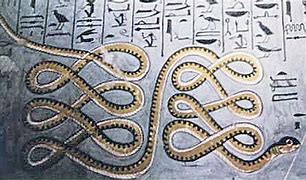
Apep Egyptian Serpent God of Choas from egyptian-history.com
You wish to know who is Apep, the Egyptian serpent god? You want to understand the role played by Apep in the myth of the solar boat of Ra?
Great amateurs of Egyptian mythology, we are here to enlighten you on these subjects.
Apep is a giant Egyptian serpent god whose goal is to devour Ra, the Sun god illuminating the entire universe. According to Egyptian mythology, every night since the creation of the world, Apep has tried to eat Ra, even though the latter was always defended by Set, Sobek, Maat, Isis, and Thoth.
Today, we will discover together:
- The myth of Apep in the Egyptian mythology
- The myth of the eternal combat of Apep against Ra
- The other Apep: the snake Jörmungandr and the asteroid 99942 Apophis
Very soon you will know all about the Egyptian evil snake called Apep.
Let’s discover immediately the story of the largest snake of ancient Egypt!
1) Apep in Egyptian Mythology
Already present before the creation of the world by Ra, Apep (or Apophis) is an evil entity, the embodiment of darkness and destruction. Apep is a huge snake, allegedly as wide and long as the Nile. This snake is a fundamentally evil being whose sole motivation is to eat the falcon-headed Sun god Ra.
The latter illuminates the world during the day, crossing the sky on his boat before passing through the Underworld to return to his point of departure. It is in the world of darkness that Ra is the target of all types of monsters, demons and ghosts who wish to eat him. Indeed, Ra, a hawk with a Sun on his head, appears extremely appetizing to them.
2) Apep against Ra
Each night, Apep thus leads his army with the aim of eating Ra. Yet, he encounters great difficulty in reaching his objective because Ra has assembled a team of Egyptian gods to defend himself:
– Set, the god of chaos and tempests: with the mission to focus on Apep and repel him with sandstorms and lightning.
– Sobek, the crocodile god of strength and power: Ra’s long-time bodyguard, the god Sobek, unlike Set, focuses on the evil horde of Apep.
– Thoth, the ibis god of knowledge: planning, for each night, a new strategy to surprise Apep and his army.
– Maat, the winged goddess of justice: offering magical healing to her team and, able to fly, catching the team members who have fallen out of the boat of Ra.
– Isis, the goddess of magic: unleashing powerful spells on Apep and his army during difficult situations.
With this shock team, Apep lost every single fight, which never discouraged him. Apep could be mortally wounded, but he had the ability to regenerate when he was covered by the deepest darkness of the world of the dead.
Apep is the antithesis of the gods, representing chaos and darkness, the opposite of the values of the Egyptian pantheon, whose sacred mission was to spread order and light throughout the world. However, Apep contributes to the equilibrium of the universe, being one of its original components, and therefore should not be definitively defeated because his total elimination would destabilize the universe just as much as if the gigantic snake managed to eat Ra.
According to his myth, Apep is responsible for eclipses. Sometimes, Apep succeeded in swallowing Ra during surprise attacks in broad daylight, which made the sun disappear from the sky of mortals. Fortunately, the other gods quickly came to the rescue to pierce the belly of Apep, freeing Ra and thus ending the eclipse.
3) The other version of the myth of Apep: Set, the substitute of Ra
In Egyptian religion, Set gradually takes the place of Ra in the myth of the solar boat and replaces the entire team of Egyptian gods. Ra is then relegated only as the bearer of the Sun and not as the eternal adversary of Apep as he was.
How unfortunate it would be if you missed this great passage in Egyptian mythology: here is a concise summary of the “myth of Osiris” that tells us why Ra was replaced by Set.
A) The myth of Osiris
According to the Egyptian myth of the “Beginning”, Ra created the world by cleverly mixing the Darkness (from which Apep came) and the original Ocean.
From this enlightened mixture came Shu (the wind) and Tefnut (the warmth of the Sun). Shu and Tefnut married to give birth to Geb (the earth) and Nut (the sky). Geb and Nut in turn married and had two sons and two daughters (who also married each other in pairs): Osiris, Set, Isis and Nephthys.
When he arrived, Osiris fully committed himself to his mission, he brought to humanity a peace, security and unity that had never been seen before.
Set soon became jealous of Osiris’ position but kept this resentment to himself at first. However, when he realized that Nephthys was cheating on him with Osiris, he began to feel a deep hatred for his brother.
Set decided to assassinate Osiris in order to obtain the throne of Egypt. To do so, he visited the best craftsmen in the world to create a beautiful chest covered with precious stones and metals. This chest was made with a certain interior shape so that the only thing it could contain was Osiris himself. Set organized a large banquet on the banks of the Nile to which he invited Osiris and his relatives. At this event, he declared that he would offer the large chest to anyone who entered the chest in its entirety.
Not surprisingly, only Osiris managed to enter the chest. It was at this point that the plan of Set and his accomplices was revealed: they hurled themselves onto the chest and welded its opening before throwing it into the Nile. Osiris drowned.
The chest then drifted down the Nile until it came to a shrub by the riverside that trapped it in its roots. Over the years, the shrub completely absorbed the chest and Osiris. The chest and Osiris gradually found themselves in the middle of its trunk. On its side, the tree grew at a supernatural speed, thanks to the divine presence of the body of the deceased Osiris. The tree grew so large that it fed the lust of a great foreign king, who made it one of the columns of his palace.
Isis, who traveled the world in search of her husband’s body, arrived in this royal palace after years and years of searching. She convinced the king to give the pillar to her and cure her only heir of a fatal disease in appreciation. In possession of the chest (and thus the body of Osiris, she succeeded in reviving him for a single night, which enabled her to become pregnant with Horus).
But before she has time to perform certain rituals to bring Osiris back to life, Set falls on the body of Isis’ unfortunate husband during a hunting trip. To prevent any resurrection that might lead to the end of his reign, Set cuts the body of Osiris into fourteen pieces and scatters them throughout Egypt.
Once again, Isis sets out to find the body of Osiris in tears. These tears attract Nephthys and Anubis (the son Nephthys had with Osiris) who are sympathetic to Isis and help her in her quest. The three of them manage to find 13 of the 14 parts. But as they were about to find the last part, a fish eats it and digests it quickly. This part (namely, the phallus of Osiris) is thus lost forever.
Osiris cannot be reconstituted in its entirety and is brought back to life with an incomplete body. This incomplete body will then prevent him from directing the living. Set will therefore retain his place as king of Egypt (exercising a much less just and upright reign than his brother during his lifetime). Osiris will be forced to leave the world of the living and go to the Underworld where he will rule over the dead.
B) The myth of Horus and Set
As an adult, Horus claims the throne of his father from the greatest and wisest of the gods organized in an instance called the “divine assembly”.
The majority of this enlightened tribunal, composed of Ra (the falcon-headed Sun god), Shu (the god representing the wind), and Thoth (the ibis-headed god of knowledge), immediately rebelled against Egypt’s current situation. Shu and Thoth find despicable that Set could deprive Horus by killing his father of his rightful royal place. The two gods are therefore ready to go to Set and ask him to abdicate without delay.
Nevertheless, the myth cannot stop here: Ra is extremely offended that his opinion is not asked (because he is the father and first of all the gods of Egypt).
The falcon Sun god declares that Horus may well make a bad king. For Ra, the latter must prove his worth before any form of abdication that could put Egypt in a very unfortunate position.
The declaration of Ra is followed by various great trials between Set and Horus: duels, chariot races, and trials of strength, all of which have one thing in common: the countless frauds that Set commits in the course of them. Set wins all the tests organized by the jury by this not very honorable way.
The many trials of the competition culminate in the trial called the “Hippopotamus Trial”. In this event, the two rival gods must each plunge to the bottom of the Nile as hippopotamuses and hold their breath as long as possible. During this test, Isis, out of concern for the future of her son, will create a magic harpoon to catch Set and bring him back to the surface of the Nile (which would make him lose the test). Isis succeeds in touching Set with her harpoon, which makes Horus win (who wins a trial against Set for the first time).
Horus is however very unhappy with the situation because he has the ambition to win fairly. Very angry, Horus tears off his mother’s head and throws it away (fortunately, Thoth fetches this head and resuscitates Isis).
Following this matricide, the court of the three gods is angry against Horus and punishes him by proposing to Set to decide the form of a last trial. This final trial would determine who would be the definitive king and guide of Egypt for millennia to come. Set then chooses a final trial that would be memorable and would legitimize his superiority over Horus forever. Set thus claimed that the final test would be a race of ships built only with stones.
After these events, Horus, exhausted, falls asleep on one of Egypt’s highest mountains to take a well-deserved night’s rest before a challenge that will not be easy. Wanting to ensure his victory, Set discreetly follows him and tears out his left eye while he sleeps.
He then cuts that eye into six equal parts and hides them throughout the world. Seeing in this action a consequent imbalance in the next trial, Thoth will immediately seek to reconstitute the eye of Horus.
While Horus sleeps, the god of knowledge travels around the world at superhuman speed but can only gather five of the six fragments. He thus creates himself the last missing fragment and reconstitutes a new and more efficient eye thanks to a new magical sixth piece. This eye will have the capacity to see “what-is-invisible” (i.e. the future and the past).
As soon as his work is finished, Thoth gives the eye back to Horus, who will thus not be disadvantaged in any way in the upcoming boat race.
The trial begins with a boat construction: Horus starts by looking for some beautiful stones to build his boat. However, his new prodigious eye reveals to him that “he will not win the race”.
Horus becomes very worried: it is important for him to recover the throne that was once stolen from his father. So Horus tries to cheat: he builds a wooden boat with a plaster exterior that has a texture similar to stone.
The next day, the race begins. Set arrives without a boat because he has a rather specific plan. Set is convinced that the top of a high mountain could very well serve as a boat and should float.
However, his plan is a cruel failure because as soon as he launches his boat, the rounded tip of the mountain sinks steeply. The council therefore declares Horus the winner. Mad with rage, Set throws himself on Horus’ boat to ransack it and the deception is revealed. The boat being made of wood, Horus is obviously disqualified.
The divine council decides to meet in order to find the adequate solution to this unprecedented case. They call upon the just and wise Osiris (who became god of the dead after his death) to guide them in their decision. With the will to put his young son in power, Osiris tries to tip the jury’s balance in his favor with a clever stratagem.
He addresses the Sun, the Moon, and all the stars and asks them to follow him into his subterranean realm. Deprived of the light of these vital stars, the world of the living is on the verge of total collapse. Ra, Shu, and Thoth have no choice but to accept Osiris’ request.
Horus defeats the evil Set and comes to power, as he should have done initially. Later, he will marry Hathor, goddess of love and beauty. Having inherited his father’s qualities, he ruled the land of the Nile with a masterly hand.
Set, meanwhile, was banished to the desert, his original kingdom. It was here that he began his long journey of repentance alongside Ra in his solar boat.
It was truly at his redemption that Set became a popular and beloved god. After having been the god of chaos and destruction, now he is able to question himself by working for the good cause. Gradually, he becomes the symbol of the victory of good over evil in the struggle against Ra’s enemy, Apep.
The Egyptian snake god
You now know everything about the mysteries surrounding the largest snake in Egyptian mythology through the myths of the solar bark and the myth of Ra’s replacement by Set. As a bonus, you know more about 99942 Apophis and about Jörmungand (the Apep of Asgard).
If the myths of ancient Egypt are something you are interested in, know that we offer many necklaces, rings, bracelets and T-shirts referring to ancient Egypt.
In connection with the story of Apep, we obviously invite you to take a look at our collection of Egyptian necklaces. To do so, nothing could be simpler: just click on the image below!
 Witches Of The Craft®
You must be logged in to post a comment.