The fascinating history of cemeteries – Keith Eggener
This is an interesting take on regular burials and cemeteries. The History of Cemeteries

The fascinating history of cemeteries – Keith Eggener
This is an interesting take on regular burials and cemeteries. The History of Cemeteries
1805 Battle of Trafalgar: British Admiral Horatio Nelson defeats combined French and Spanish fleet. Nelson shot and killed during battle.
1854 Florence Nightingale with a staff of 38 nurses is sent to the Crimean War
1944 World War II: US troops capture Aachen, 1st large German city to fall
1948 UN rejects Russian proposal to destroy atomic weapons
1950 Chinese forces occupy Tibet
1993 Failed military coup in Burundi, led by ex-President Jean-Baptiste Bagaza, includes assassination President Ndadaye; 525,000 Hutus flee

You can use this link to go forward or backward in time for Moon phase information. If you are curious you can even find out what phase the Moon was in when you or anyone else, you know was on the date the person was born.
From Moongiant.com
The Moon’s current phase for today and tonight is a Waning Gibbous Phase. This is the first phase after the Full Moon occurs. It lasts roughly 7 days with the Moon’s illumination growing smaller each day until the Moon becomes a Last Quarter Moon with an illumination of 50%. The average Moon rise for this phase is between 9pm and Midnight depending on the age of the phase. The moon rises later and later each night setting after sunrise in the morning. During this phase the Moon can also be seen in the early morning daylight hours on the western horizon.
Visit the October 2021 Moon Phases Calendar to see all the daily moon phase for this month.
The Waning Gibbous on October 21 has an illumination of 99%. This is the percentage of the Moon illuminated by the Sun. The illumination is constantly changing and can vary up to 10% a day. On October 21 the Moon is 15.56 days old. This refers to how many days it has been since the last New Moon. It takes 29.53 days for the Moon to orbit the Earth and go through the lunar cycle of all 8 Moon phases.
There are 8 lunar phases the Moon goes through in its 29.53 days lunar cycle. The 4 major Moon phases are Full Moon, New Moon, First Quarter and Last Quarter. Between these major phases, there are 4 minor ones: the Waxing Crescent, Waxing Gibbous, Waning Gibbous and Waning Crescent. For more info on the Moon Cycle and on each phase check out Wikipedia Lunar Phase page.
Check the weather before a night of Moon gazing at weather.com
For a list of all the current meteor showers visit American Meteor Society

If you need to calculate the planetary positions for a specific use and time, click on this link
To figure out GMT (Greenwich Mean Time) to your local time use this link
The time for the Custom Planetary Positions is from the local time in Frankfurt, Germany, Europe
21 October 2021
02:00 pm GMT 4:00 PM CET
Zodiac: Tropical (Standard Western)
The time for the Custom Planetary Positions is from the local time in Denver, Colorado, USA
October 21, 2021
10:00 pm GMT 4:00 PM MT
Zodiac: Tropical (Standard Western)
Ceres:11 Gemini 36 Rx
Pallas:10 Pisces 01 Rx
Juno:22 Sagittarius 17
Vesta:16 Scorpio 16
Eris:24 Aries 11 Rx
Discover the cosmos! Each day a different image or photograph of our fascinating universe is featured, along with a brief explanation written by a professional astronomer.
2021 October 21
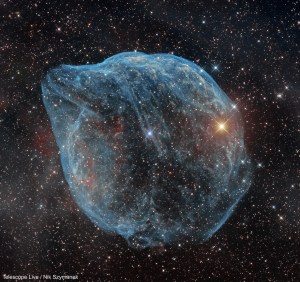
Explanation: Blown by fast winds from a hot, massive star, this cosmic bubble is huge. Cataloged as Sharpless 2-308 it lies some 5,000 light-years away toward the constellation of the Big Dog (Canis Major) and covers slightly more of the sky than a Full Moon. That corresponds to a diameter of 60 light-years at its estimated distance. The massive star that created the bubble, a Wolf-Rayet star, is the bright one near the center of the nebula. Wolf-Rayet stars have over 20 times the mass of the Sun and are thought to be in a brief, pre-supernova phase of massive star evolution. Fast winds from this Wolf-Rayet star create the bubble-shaped nebula as they sweep up slower moving material from an earlier phase of evolution. The windblown nebula has an age of about 70,000 years. Relatively faint emission captured by narrowband filters in the deep image is dominated by the glow of ionized oxygen atoms mapped to a blue hue. Presenting a mostly harmless outline, SH2-308 is also known as The Dolphin-head Nebula.

You can use this link to go forward or backward in time for Moon phase information. If you are curious you can even find out what phase the Moon was in when you or anyone else, you know was on the date the person was born.
From Moongiant.com
Today the Moon will be in a Waning Gibbous Phase. This is the first phase after the Full Moon occurs. It lasts roughly 7 days with the Moon’s illumination growing smaller each day until the Moon becomes a Last Quarter Moon with an illumination of 50%. The average Moon rise for this phase is between 9pm and Midnight depending on the age of the phase. The moon rises later and later each night setting after sunrise in the morning. During this phase the Moon can also be seen in the early morning daylight hours on the western horizon.
Visit the October 2021 Moon Phases Calendar to see all the daily moon phase for this month.
The Waning Gibbous on October 21 has an illumination of 99%. This is the percentage of the Moon illuminated by the Sun. The illumination is constantly changing and can vary up to 10% a day. On October 21 the Moon is 15.56 days old. This refers to how many days it has been since the last New Moon. It takes 29.53 days for the Moon to orbit the Earth and go through the lunar cycle of all 8 Moon phases.
There are 8 lunar phases the Moon goes through in its 29.53 days lunar cycle. The 4 major Moon phases are Full Moon, New Moon, First Quarter and Last Quarter. Between these major phases, there are 4 minor ones: the Waxing Crescent, Waxing Gibbous, Waning Gibbous and Waning Crescent. For more info on the Moon Cycle and on each phase check out Wikipedia Lunar Phase page.
Check the weather before a night of Moon gazing at weather.com
For a list of all the current meteor showers visit American Meteor Society

If you need to calculate the planetary positions for a specific use and time, click on this link
To figure out GMT (Greenwich Mean Time) to your local time use this link
The time for the Custom Planetary Positions is from the local time in Melbourne, Victoria, Australia
21 October 2021
05:00 am GMT 4:00 PM AEDT
Zodiac: Tropical (Standard Western)

The time for the Custom Planetary Positions is from the local time in Sao Paulo, Brazil, South America
21 October 2021
07:00 pm GMT 4:00 PM BRT
Zodiac: Tropical (Standard Western)

Ever since I got up yesterday nothing has gone look it should. Starting with breaking a plate, can’t get my laptop out of sleep mode, no oil in our lawnmower, hit myself in the head with a rake, and on and on it goes. My frustration level is up in outer space somewhere and I don’t want to use my desktop as I have fried a couple in the past because of the way my aura explodes. I’ll be back tomorrow and get the posts up including the birthday horoscope. BTW my fiance is typing this so I don’t fire my Kindle.
I was amazed when I read this article about what manufactured food coloring can do to a person. Than I was excited to read how it explains how to make your own out of vegetables and other things.
Information on how and why to make your own food coloring
It’s hard to imagine birthday cakes without colorful writing, vibrant flowers, or other exciting designs. But the colors in our cakes, candies, and other popular foods may not be as innocuous as their pretty exteriors would lead us to believe.
Research suggests that synthetic food coloring may harm human health in a variety of ways. But in spite of the risk factors, these colorants are cropping up in more foods than ever before. Although they provide no nutritional value, they’re added to a wide range of foods to intensify color or give those foods the color people expect to see.1 (For example, boxed cake batters may be dyed yellow in to look like they’re made from real eggs.)
With a little effort, you can avoid synthetic food coloring. Here’s why

You can use this link to go forward or backward in time for Moon phase information. If you are curious you can even find out what phase the Moon was in when you or anyone else, you know was on the date the person was born.
From Moongiant.com
Today the Moon will be in a Waxing Gibbous phase. This phase is when the moon is more than 50% illuminated but not yet a Full Moon. The phase lasts about 7 days with the moon becoming more illuminated each day until the Full Moon. During a Waxing Gibbous the moon rises in the east in mid-afternoon and is high in the eastern sky at sunset. The moon is then visible through most of the night sky setting a few hours before sunrise. The word Gibbous first appeared in the 14th century and has its roots in the Latin word “gibbosus” meaning humpbacked.
Visit the October 2021 Moon Phases Calendar to see all the daily moon phase for this month.
The Waxing Gibbous on October 18 has an illumination of 96%. This is the percentage of the Moon illuminated by the Sun. The illumination is constantly changing and can vary up to 10% a day. On October 18 the Moon is 12.76 days old. This refers to how many days it has been since the last New Moon. It takes 29.53 days for the Moon to orbit the Earth and go through the lunar cycle of all 8 Moon phases.
There are 8 lunar phases the Moon goes through in its 29.53 days lunar cycle. The 4 major Moon phases are Full Moon, New Moon, First Quarter and Last Quarter. Between these major phases, there are 4 minor ones: the Waxing Crescent, Waxing Gibbous, Waning Gibbous and Waning Crescent. For more info on the Moon Cycle and on each phase check out Wikipedia Lunar Phase page.
Check the weather before a night of Moon gazing at weather.com
For a list of all the current meteor showers visit American Meteor Society

If you need to calculate the planetary positions for a specific use and time, click on this link
To figure out GMT (Greenwich Mean Time) to your local time use this link
The time for the Custom Planetary Positions is from the local time in Melbourne, Victoria, Australia
18 October 2021
05:00 am GMT 4:00 PM AEDT
Zodiac: Tropical (Standard Western)
Mean Lunar Node:03 Gemini 29 Rx
Ceres:11 Gemini 52 Rx
Pallas:10 Pisces 28 Rx
Juno:21 Sagittarius 11
Vesta:14 Scorpio 18
Eris:24 Aries 14 Rx

The time for the Custom Planetary Positions is from the local time in Sao Paulo, Brazil, South America
18 October 2021
07:00 pm GMT 4:00 PM BRT
Zodiac: Tropical (Standard Western)
Ancient Mesopotamian astrologers devised a seven day week inspired by the heavenly bodies that wandered about the sky. There were seven in total. The equally sized flashlight and nightlight in the sky, the sun and moon, along with the other five wandering orbs of light thus form the basis of this alchemical cosmology.
The word planet comes from the Greek planētēs, meaning “wanderer”. So by definition the Sun and Moon were considered planets to the Ancients.
Of the days that are not named directly after the seven planets, their name is derived from the Norse Gods associated with the respective planet. The origin of Sunday is of course from the Sun in the sky. Of the seven known metals, the Sun has always represented gold, irrespective of time and place.
Monday or more properly, ‘Moon-day’, is known as …
Discover the cosmos! Each day a different image or photograph of our fascinating universe is featured, along with a brief explanation written by a professional astronomer.
2021 October 17

Image Credit & License: J. Rhoads (Arizona State U.) et al., WIYN, AURA, NOIRLab, NSFExplanation: Most galaxies have a single nucleus — does this galaxy have four? The strange answer leads astronomers to conclude that the nucleus of the surrounding galaxy is not even visible in this image. The central cloverleaf is rather light emitted from a background quasar. The gravitational field of the visible foreground galaxy breaks light from this distant quasar into four distinct images. The quasar must be properly aligned behind the center of a massive galaxy for a mirage like this to be evident. The general effect is known as gravitational lensing, and this specific case is known as the Einstein Cross. Stranger still, the images of the Einstein Cross vary in relative brightness, enhanced occasionally by the additional gravitational microlensing effect of specific stars in the foreground galaxy.
You can use this link to go forward or backward in time for Moon phase information. If you are curious you can even find out what phase the Moon was in when you or anyone else, you know was on the date the person was born.
From Moongiant.com
Today the Moon will be in a Waxing Gibbous phase. This phase is when the moon is more than 50% illuminated but not yet a Full Moon. The phase lasts about 7 days with the moon becoming more illuminated each day until the Full Moon. During a Waxing Gibbous the moon rises in the east in mid-afternoon and is high in the eastern sky at sunset. The moon is then visible through most of the night sky setting a few hours before sunrise. The word Gibbous first appeared in the 14th century and has its roots in the Latin word “gibbosus” meaning humpbacked.
Visit the October 2021 Moon Phases Calendar to see all the daily moon phase for this month.
The Waxing Gibbous on October 17 has an illumination of 90%. This is the percentage of the Moon illuminated by the Sun. The illumination is constantly changing and can vary up to 10% a day. On October 17 the Moon is 11.8 days old. This refers to how many days it has been since the last New Moon. It takes 29.53 days for the Moon to orbit the Earth and go through the lunar cycle of all 8 Moon phases.
There are 8 lunar phases the Moon goes through in its 29.53 days lunar cycle. The 4 major Moon phases are Full Moon, New Moon, First Quarter and Last Quarter. Between these major phases, there are 4 minor ones: the Waxing Crescent, Waxing Gibbous, Waning Gibbous and Waning Crescent. For more info on the Moon Cycle and on each phase check out Wikipedia Lunar Phase page.
Check the weather before a night of Moon gazing at weather.com
For a list of all the current meteor showers visit American Meteor Society

If you need to calculate the planetary positions for a specific use and time, click on this link
To figure out GMT (Greenwich Mean Time) to your local time use this link
The time for the Custom Planetary Positions is from the local time in Frankfurt, Germany, Europe
17 October 2021
02:00 pm GMT 4:00 PM CET
Zodiac: Tropical (Standard Western)
The time for the Custom Planetary Positions is from the local time in Denver, Colorado, USA
October 19, 2021
10:00 pm GMT 4:00 PM MT
Zodiac: Tropical (Standard Western)
Discover the cosmos! Each day a different image or photograph of our fascinating universe is featured, along with a brief explanation written by a professional astronomer.
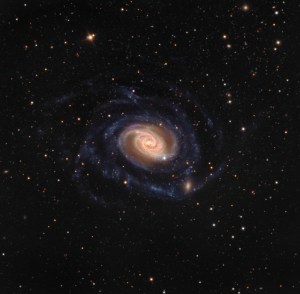
Image Credit & Copyright: Mike SelbyExplanation: About 70 million light-years distant, gorgeous spiral galaxy NGC 289 is larger than our own Milky Way. Seen nearly face-on, its bright core and colorful central disk give way to remarkably faint, bluish spiral arms. The extensive arms sweep well over 100 thousand light-years from the galaxy’s center. At the lower right in this sharp, telescopic galaxy portrait the main spiral arm seems to encounter a small, fuzzy elliptical companion galaxy interacting with enormous NGC 289. Of course spiky stars are in the foreground of the scene. They lie within the Milky Way toward the southern constellation Sculptor.
You can use this link to go forward or backward in time for Moon phase information. If you are curious you can even find out what phase the Moon was in when you or anyone else, you know was on the date the person was born.
Today the Moon will be in a Waxing Gibbous phase. This phase is when the moon is more than 50% illuminated but not yet a Full Moon. The phase lasts about 7 days with the moon becoming more illuminated each day until the Full Moon. During a Waxing Gibbous the moon rises in the east in mid-afternoon and is high in the eastern sky at sunset. The moon is then visible through most of the night sky setting a few hours before sunrise. The word Gibbous first appeared in the 14th century and has its roots in the Latin word “gibbosus” meaning humpbacked.
Visit the October 2021 Moon Phases Calendar to see all the daily moon phase for this month.
The Waxing Gibbous on October 15 has an illumination of 75%. This is the percentage of the Moon illuminated by the Sun. The illumination is constantly changing and can vary up to 10% a day. On October 15 the Moon is 9.82 days old. This refers to how many days it has been since the last New Moon. It takes 29.53 days for the Moon to orbit the Earth and go through the lunar cycle of all 8 Moon phases.
There are 8 lunar phases the Moon goes through in its 29.53 days lunar cycle. The 4 major Moon phases are Full Moon, New Moon, First Quarter and Last Quarter. Between these major phases, there are 4 minor ones: the Waxing Crescent, Waxing Gibbous, Waning Gibbous and Waning Crescent. For more info on the Moon Cycle and on each phase check out Wikipedia Lunar Phase page.
Check the weather before a night of Moon gazing at weather.com
For a list of all the current meteor showers visit American Meteor Society

The time for the Custom Planetary Positions is from the local time in Melbourne, Victoria, Australia
15 October 2021
05:00 am GMT 4:00 PM AEDT
Zodiac: Tropical (Standard Western)
Ceres:12 Gemini 01 Rx
Pallas:10 Pisces 53 Rx
Juno:20 Sagittarius 19
Vesta:12 Scorpio 43
The time for the Custom Planetary Positions is from the local time in Sao Paulo, Brazil, South America
15 October 2021
07:00 pm GMT 4:00 PM BRT
Zodiac: Tropical (Standard Western)
The date for the Southern Hemispheric Beltane is October 31st and ‘May Day’ is November 1st. The climax of Spring!
Beltane is the peak of Spring, a celebration of fertility. In ancient times it was the Beltane Rites that recon- nected each year the King to the Goddess, the masculine to the feminine. It is a time for us to give thanks for our fertile lives, our creativity and our gender specific gifts and roles. Its a time to notice and honour the difference in the masculine and feminine. It is a time of increasing growth, building to almost full potential, of beauty and heightened passion.
Beltane Spiritual Practice
Your being, as part of the Earth, part of the cycle of the seasons, will be influenced by this energy whether you’re paying attention to it or not. If you pay some attention, you will feel it, and you can be in flow with it.
Think like the gardener, and align with the Earth energy of now, contemplate the growth that is peaking in your life, that is getting all the attention…
Click on the hyperlinks below to learn more about the Linestrider Tarot Cards and their meanings.
In the Roman mind, there was a sort of contract between the gods and the mortals. As part of this agreement each side would provide as well as receive services.
Thee role of the mortal in this partnership with the gods was to worship the mighty gods. For this there was prayer and sacrifice. And for both of these activities there was firmly defined rituals. To perform these ritual correctly was of paramount importance. One mistake and one would have to begin all over again.
The very nature of Roman religion itself, with its numerous gods, many of which had multiple roles, was cause for problems. Particularly as in some cases not even the sex of a deity was clear. Hence the phrase ‘wether you be god or goddess’ was a widespread in the worship of certain deities. Many Roman gods also had entire colelction of additional names, according to what aspect of life they were a patron to.
So, for example Juno was Juno Lucina in her role of goddess of childbirth. But as goddess of the mint she was known as Juno Moneta (this curious role came about because for a long time the Roman state mint was housed in her temple on the Capitoline hill).
There appear to have been few things for which there was not a special prayer. So, for example, …
Discover the cosmos! Each day a different image or photograph of our fascinating universe is featured, along with a brief explanation written by a professional astronomer.
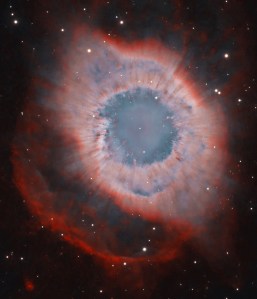
Image Credit & Copyright: Ignacio Diaz BobilloExplanation: A mere seven hundred light years from Earth, toward the constellation Aquarius, a sun-like star is dying. Its last few thousand years have produced the Helix Nebula (NGC 7293), a well studied and nearby example of a Planetary Nebula, typical of this final phase of stellar evolution. A total of 90 hours of exposure time have gone in to creating this expansive view of the nebula. Combining narrow band image data from emission lines of hydrogen atoms in red and oxygen atoms in blue-green hues, it shows remarkable details of the Helix’s brighter inner region about 3 light-years across. The white dot at the Helix’s center is this Planetary Nebula’s hot, central star. A simple looking nebula at first glance, the Helix is now understood to have a surprisingly complex geometry.
Discover the cosmos! Each day a different image or photograph of our fascinating universe is featured, along with a brief explanation written by a professional astronomer.
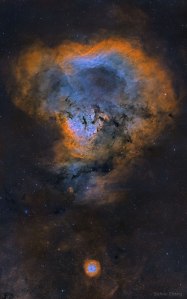
Image Credit & Copyright: Yizhou ZhangExplanation: It may look like a huge cosmic question mark, but the big question really is how does the bright gas and dark dust tell this nebula’s history of star formation. At the edge of a giant molecular cloud toward the northern constellation Cepheus, the glowing star forming region NGC 7822 lies about 3,000 light-years away. Within the nebula, bright edges and dark shapes stand out in this colorful and detailed skyscape. The 9-panel mosaic, taken over 28 nights with a small telescope in Texas, includes data from narrowband filters, mapping emission from atomic oxygen, hydrogen, and sulfur into blue, green, and red hues. The emission line and color combination has become well-known as the Hubble palette. The atomic emission is powered by energetic radiation from the central hot stars. Their powerful winds and radiation sculpt and erode the denser pillar shapes and clear out a characteristic cavity light-years across the center of the natal cloud. Stars could still be forming inside the pillars by gravitational collapse but as the pillars are eroded away, any forming stars will ultimately be cut off from their reservoir of star stuff. This field of view spans over 40 light-years across at the estimated distance of NGC 7822.
 Witches Of The Craft®
You must be logged in to post a comment.