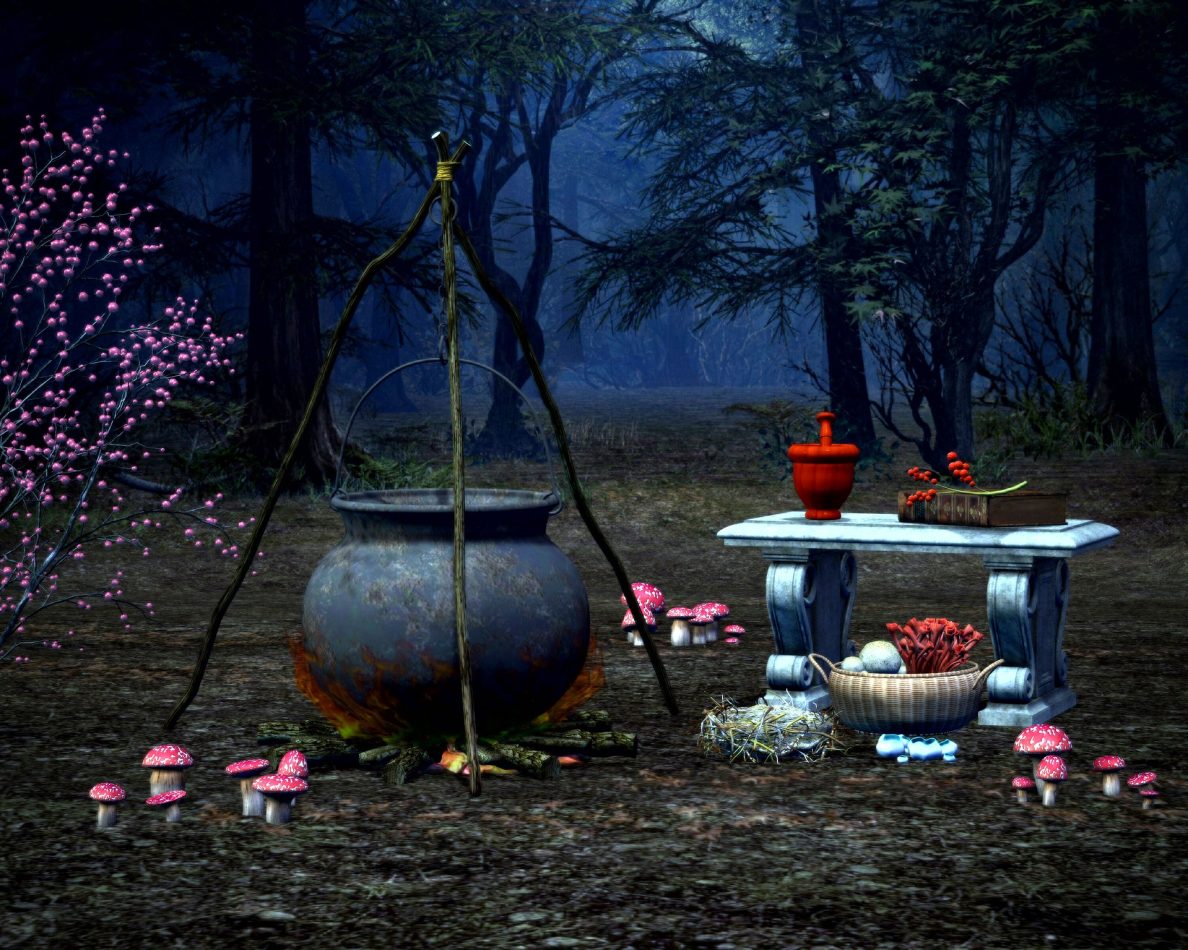
“Candlemas’ is the Christianized name for the holiday, of course. The older Pagan names were Imbolc and Oimelc. ‘Imbolc’ means, literally, ‘in the belly’ (of the Mother). For in the womb of Mother Earth, hidden from our mundane sight but sensed by a keener vision, there are stirrings. The seed that was planted in her womb at the solstice is quickening and the new year grows. ‘Oimelc’ means ‘milk of ewes’, for it is also lambing season. The holiday is also called ‘Brigit’s Day’, in honor of the great Irish Goddess Brigit. At her shrine, the ancient Irish capitol of Kildare, a group of 19 priestesses (no men allowed) kept a perpetual flame burning in her honor. She was considered a goddess of fire, patroness of smithcraft, poetry and healing (especially the healing touch of
midwifery).”
– Daven’s Journal – Imbolic
Category: All Regular Daily Posts
Stress Is Not What You Think
Stress Is Not What You Think
- Ed and Deb Shapiro
Ironically, the holiday season can be the most stressful time of the year. Imagine you are trying to squeeze some toothpaste out of a tube but you have forgotten to take the top off. What happens? Deb actually did this in one of her most unaware moments and the toothpaste soon found another way out through the bottom of the tube and got all over her. It will force a hole in the side or wherever is the weakest point.
Now imagine that the tube of toothpaste is you, under pressure and beginning to experience psychological or emotional stress. But you don’t take your lid off, as it were, by recognizing what is happening and making time to relax or deal with your inner conflicts.
So what happens to the mental or emotional stress building up inside? In her book, Your Body Speaks Your Mind, Deb shows how eventually it has to find a way out and if it can’t come out through the top, as it were, by being expressed and resolved, it will come out somewhere else, whether through your digestion, nerves, immune system, behavior, or sleep patterns. Repressed or ignored stress can manifest as depression, addiction, or anxiety; projected outwards it can become hostility, aggression, prejudice or fear.
We have built into our physiology a fight-or-flight response that enables us to respond to danger if, for instance, we are on the front line of a battle or facing a large bear. The battle may be with your teenage son and bears tend to come in a variety shapes and sizes, such as impatient and angry holiday shoppers. Seemingly unimportant events can even cause a stress reaction, as the brain is unable to tell the difference between real and imagined threats: if you focus on your concern about what might happen it plays as much havoc with your hormones and chemical balance as it does in a real situation.
Recent studies show–as if we didn’t know–that job dissatisfaction, moving house, divorce, and financial difficulties are at the top of the list of known stressors. But we all respond differently to circumstances: a divorce may be a big stressor for one but it may be a welcome relief to another. The difference lies in our response, for although we may have little or no control over the circumstances we are dealing with, we do have control over our reaction to them.
In other words, the cause of stress is not as much the external circumstances, such as having too many demands and not enough time to fill them, as it is our perception of the circumstances as being overwhelming; and our perception of our ability to cope, as when you feel stretched beyond what you perceive yourself to be capable of.
What you believe will color your every thought, word and action. As cell biologist Bruce Lipton says in his book, The Biology of Belief, “Our responses to environmental stimuli are indeed controlled by perceptions, but not all of our learned perceptions are accurate. Not all snakes are dangerous! Yes, perception “controls” biology, but… these perceptions can be true or false. Therefore, we would be more accurate to refer to these controlling perceptions as beliefs. Beliefs control biology!”
In other words, believing that it is your work, family or lifestyle that is causing you stress and that if you could only change these in some way then you would be fine, is seeing the situation from the wrong perspective. It is the belief that it is something out there that is causing the stress. And, although changing the circumstances certainly may help, invariably, no matter what you do, it is a change within your belief system and perception of yourself that will make the biggest difference.
Try It Yourself
If you find yourself feeling stressed, take 10 minutes to breathe more deeply. Most people who are tense breathe short, shallow breaths into the upper part of their chest. If you take slower breaths and deepen your breathing into your belly, the stress will dissolve.
Then find an affirmation that works for you to shift perceptions and belief patterns and to reinforce your strengths, such as: “My mind is at ease and I am capable of doing everything,” or “With every breath I am more relaxed and flowing through my day with ease.”
Overwhelmed? Try An Intuition Check
Overwhelmed? Try An Intuition Check
- Christy Diane Farr
It is easy to be overwhelmed when you can’t decide out of a whole world of possibilities which things are actually true for you.
When I woke up this morning, my mind was swirling with all of the choices. So many, in fact, that I felt a bit off balance. It’s the beginning of the week of Christmas and there are packages to mail, cards to write, and I’ve got to get a bit crafty because a major car repair two weeks ago devoured anything that might have resembled gift money. And except for the holiday greetings we’ve begun to receive, there’s not a single decoration in sight.
Plus it’s a work day. I have my own business and there are emails waiting for a response, a newsletter that needs to be written, and a book that I vowed would be submitted to the publisher by the end of this year. I have checkbooks to balance and marketing to be done for the clutter clearing class that starts again in January.
The floor at my office, which converts magically back into a home when the children arrive at 3:00 pm, needs to be tended, as does the laundry and the half bath. If the dust was glitter, it would look like fairies live here. For the record, the difference in dust since we took out carpet and installed hardwood floors (a most generous gift from dear friends this time last year) makes me wonder if carpet isn’t the nastiest thing on this planet. Seriously, the dust level seems to have tripled since the carpet came out.
Anyway, all of this and more was swirling about in my head when I woke up this morning, “Pick me! Pick me!” My impulse was, I like to think rather understandably, to go back to bed and hide from it all. The reality is that there is no way all of this can be done today. It isn’t even an option. I’m sure that many of you felt the same way this morning. There is so much to do. Much of it is even important. But, this isn’t about being a diligent list writer. This is bigger than staying on task. Some of these things need to be chosen, and a good chunk of it needs to be left behind for another day, another person, and perhaps another lifetime.
Instead of wondering how I’ll get this all done, the question instead becomes, “At this moment, what is the best use of my time, energy, brain power, and other assorted resources?” This is my power position, with great emphasis on in this moment and best use. When I say “best use,” I’m looking specifically for the action that is going to cultivate the best results for me today.
While my brain was buzzing with overwhelm, I searched for the courage to pause–for just a couple of minutes, sometimes only seconds. I had stop and wait for guidance. I had to wait for clarity, a knowing from somewhere deeper, about how best show up in the world at this moment, on this particular day.
I need an intuition check and so, I wrestled myself into a moment of silence.
I do not use the word wrestled lightly here. It’s still a struggle most days, although I hear that eventually some of the resistance will pass. Lots of days, I don’t win the big fight but today I did.
And, it turns out, most of that to-do list isn’t true for me today and I now understand what few things are. I know about connecting with those who’ve written to inquire about working with me. I know to do what I promised I would do for my existing clients. I know that while I will balance the checkbooks, I can’t waste another moment freaking out about the bills that I’m unable to pay today.
When I calm down, freaking out never makes the list. It doesn’t serve me or anyone else. It doesn’t open any doors to allow goodness to flow in. It doesn’t help. Ever. Who can afford to lose another moment to the hysteria?
When I calm down, impossible things don’t make the list either, like decorating today. My back has been acting as if it would like my attention. It doesn’t feel wise to drag the stuff down from the attic, and possibly risking my back wanting even more of my attention. I just need to let it go and trust that a solution will present itself later in the week but today, there are things I can do to bring myself a little closer to ready for Sunday. I can finish that last gift and mail the box of goodies for my people in Colorado, leaving it enough time to get where it’s going.
When I calm down, solutions flow in. People do what they say they are going to do, sometimes even wonderful, generous, helpful things that I don’t expect them to do. The words flow with ease and the time seems to slow and work for me, instead of against me. It’s the same when I do yoga, meditate, journal, dance, or walk in the woods. When I do these things I feel grounded. I can hear my wise self, my intuition, whispering to me about what’s best. I can trust me with me… as long as I remember to listen to my true voice.
Are you listening to your intuition? What does it whisper to you in the still moments? What do you hear in your dreams? What are the activities, people, and places that support your inner dialogue? Are you getting enough of them lately? What do you need to feel supported? What kinds of answers are you looking for? Have you asked for what you need and then, waited for the answers to bubble up from within? If not, are you willing to begin right now?
“Late February, and the air’s so balmy snowdrops and crocuses might be fooled into early blooming. Then, the inevitable blizzard will come, blighting our harbingers of spring, and the numbed yards will go back undercover. In Florida, it’s strawberry season— shortcake, waffles, berries and cream will be penciled on the coffeeshop menus.”
– Gail Mazur, The Idea of Florida During a Winter Thaw
“Keep your faith in beautiful things;
in the sun when it is hidden,
in the Spring when it is gone.”
– Roy R. Gibson
“There are two seasonal diversions that can ease the bite of any winter. One is the January thaw. The other is the seed catalogues.”
– Hal Borland
Tuesday, January 31 is a wonderful day for….

Cosmic Calendar for Tuesday, Jan. 31
One of the calmest days of January 2012 arrives on the scene. Even last night’s fairly intense First Quarter Sun-Moon Phase is pretty much a done deal. In its place, the cosmos only gives you one slight hurdle to jump over – a Moon-Uranus 45-degree skirmish (8:33AM PST). By anticipating some surprises, shocking news or jack-in-the-box type situations, you will be on top of your game and ready to accomplish everything on your pragmatic, to-do list under hardworking Taurus Moon. Handle financial management and budgets like a pro. Get back on track with favorite exercise routines. Check to make sure your garden equipment is spruced up and ready for the growing season. Love vibrations increase in wavelength this evening – thanks to a supportive, 60-degree liaison from the Moon in Taurus to Venus in Pisces (6:09PM PST) supplemented by a flowing trine from the Moon to Mars retrograding in Virgo (8:29PM PST). There is no reason why you cannot combine loving kindness (Venus) with just the right measure of passion (Mars) to guide a primary partnership on to a higher plane of thoughtful interaction. Let the good times roll!
Calendar of the Sun for Jan. 31
Calendar of the Sun
31 Wolfmonath
Imbolc Eve: Day of the Bean Sidhe
Color: Black
Element: Air
Altar: Upon cloth of black place a cup of blood, kept from the last slaughtering. Before it lay bloodstained rags and a flute, and many small unlit votive candles. Block the windows and shut out all sunlight.
Offering: Give aid to a child who has lost their mother.
Daily Meal: Red meat and milk.
Imbolc Eve Invocation
Go, my children, to the riverbank,
In the dark of the night when the wind is howling,
And you shall hear the wails of one who mourns,
And you shall see her kneeling by the water,
Washing the bloody clothes of those
Who did not survive the giving forth of life.
She weeps for the mothers lost,
She weeps for the children lost,
She weeps for the life cut short,
What should have been a joyous day
Become a night of mourning.
She weeps above all for those
Who have no one else to weep for them.
So we shall light a candle, on this night
Before the morn of Candlemas,
For all those who have no one to weep for them,
And we shall shed the tears
And we shall be the voice,
And we shall do the work
Of the lonely Bean Sidhe.
(The cup of blood is poured as a libation. Each comes forward and lights a small votive candle, and then all wail in a great torrent of sound together, with one playing the flute wildly over the cacophony. Those who can shed tears should do so. This should go on until all are exhausted from wailing, and then all should go quietly to their other tasks in silence until Hesperis.
Lunar Moon Almanac for Tuesday, January 31

Lunar Moon Almanac for Tuesday, January 31
Waxing, First Quarter Moon Age: 8 ¾ days.
Ascending Node is at 11° Sagittarius.
Moon in 22nd degree of the Sign, and 0th degree
of the Constellation of Taurus, the Bull.
Moonset: 1:02 morn. Moonrise: 11:14 morn. Midheaven: 6:32 eve.
The Wiccan Book of Days for Jan. 31 – Sanskrit’s Source

Sanskrit’s Source
A fesival dedicated to Sarasvati, the Hindu goddess of education and the arts, is held in the Kathmandu Valley region of Nepal at this time of year, with heartfelt prayers and offerings of fruit and flowers being dedicated to this lovely deity by students who are facing exams. The divine embodiment ofhe Sarasvati River (her name means “She Who Flows”) and the wife of Brahma, the creator God, Sarasvti is depicted with a crescent moon adorning her forehead. Worshipped for having introduced Sanskrit to the Indian Subcontinent, she is called Vac (“Speech” in Sanskrit), and another of her honorific titles is Savitri (“Giver of Life”).
“An Act of Kindness”
Pay your respects either to Sarasvati or to Kwan-yin, the bodhisattva of compassion who is honored by Chinese Buddhists around now. Follow the bodhisttva’s example in carrying out an unsolicited act of kindness in order to improve the lot of someone less fortunate.
Today’s Affirmation, Thought & Meditation for Tuesday, Jan. 31


Affirmation of the Day – At Rest
“I rest in tranquillity and divine grace. In this moment, I am calm, happy and fulfilled.”
Thought of the Day – Find Your Haven
When life gets stormy, feel safe in the knowledge that the soul cannot be touched by external forces. Like a ship finding shelter in a haven, take refuge in your soul when things feel unsettled: it is the calm centre of your being.
Meditation of the Day – Find Your Reservoir of Calm
At our core lies the peace of our essential nature. To access this inner peace, visualize yourself diving into the water of a warm, calm lake. You slip through the water, surrounded by a profound silence. As you reach the sea-bed, you are awed to see that it is carpeted with beautiful white pearls. Imagine returning to the surface of the lake.You realize that the silence, purity and beauty you have just discovered lies within yourself.
Good Tuesday Afternoon, my dear friends!


Good afternoon, dear friends! How is your Tuesday going so far? I have a sinus infection and my head is fuzzy, fuzzy, fuzzy! Then I take a sinus pill and I get down right sleepy. So I am trying to figure out which one is worse, fuzzy or so sleepy I fall asleep on the keyboard, lol! The weather around here is to blame. We have been having 60 and 70 degree days around here. The weather hasn’t been cold enough, long enough to kill out all those nasty bugs. I have to admit this has been on strange weather. I know you didn’t stop by to discuss the weather. So let’s get on with what’s important!
Have a good day and most of all stay healthy!
Lady A
Brighid Lore for Imbolc
Brighid Lore for Imbolc
by Doreen Motheral
The goddess Brighid (also known as Brigit, Bride, Biddy and other names throughout Europe) is a goddess who is near and dear to my heart for many reasons. I like the fact that she is associated with both water (her wells in Kildare and other parts of Ireland) and fire (her fire pit in Kildare). I like the fact that she spans both the pagan and Christian worlds and some of her traditions are still celebrated today.
Since the festival of Imbolc (also called Óimelc) is this weekend I thought I’d write a few thoughts for those who aren’t familiar with her (and perhaps renew an acquaintance for those who already were). Imbolc is the time of the year that the ewes lactated, and the successful timing of this event was approximate, so the exact date of Imbolc could vary from region to region and from year to year depending on the climate. Production of this milk supply was very important to both man and animal. From the milk comes butter and cheese. Newly calved cows were also put under Brighid’s protection. Here’s an old saying:
Samhain Eve without food,
Christmas night without bread,
St. Brighid’s Eve without butter,
That is a sorry complaint.
Cormac mac Cuillenàin, who lived in the 9th century said, “Brighid i.e. a learned woman, daughter of the Dagda. That is Brighid of learning, i.e. a goddess who filid worshipped. For her protecting care was very great and very wonderful. So they call her a goddess of poets. Her sisters were Brighid woman of healing, and Brighid woman of smithcraft, daughters of the Dagda, from whose names among all the Irish a goddess used to be called Brighid” In this writing, Cormac mentions her triple aspect of three sisters, common among the Celts. I often call on one or more of her aspects of creativity, writing and healing, but she is much more than that.
The Christian aspects of Brighid and the pagan aspects often overlap, so it’s difficult to figure out which stories have pre-Christian beginnings. I think there is a seed of paganism in many of the later stories associated with her. We’ll never know for sure, but in my own private practice I take many of her current customs and use them for my own worship of her – and I don’t worry about the pre-Christian aspect of the story or not. Your mileage may vary, of course.
On the eve of Imbolc, a piece of linen, other cloth or ribbons is placed outside (some folks put them on their window sill). This piece of cloth is called Brighid’s Brat or Brighid’s Mantle. It is said that Brighid travels all over the land on Imbolc eve and if she sees this cloth, she will bless it and give it healing powers. Some folks in Ireland say that the older your brat is, the more powerful it is. Mugwort Grove (the grove to which I belong) destroys ours from year to year. We put out a whole piece of linen and tear it into strips for members of the Grove during our Imbolc ritual. People take the strips home to use for healing and some are kept on personal altars throughout the year.
Other folklore says that if the mantle gets bigger overnight, you will be especially blessed. It’s a nice tradition, especially if you have a lot of illness to overcome for the following year, and a brat is nice to have for healing rituals later in the year.
Brighid’s fiery aspect makes her the perfect goddess of the hearth – in fact, my hearth at home is dedicated to Brighid. There are many hearth prayers dedicated to Brighid, especially concerning smooring. Ashes and embers were often deposited in the fields. Also, indoor activity associated with Imbolc often took place near the hearth, and if there was a feast, an extra place was set for Brighid. It is also considered bad luck to do any type of spinning on Brighid’s Day.
There is also the custom of Brighid’s Bed. A small bed is made near the hearth and a doll (called a Brídeog), often made from a sheaf of corn and made into the likeness of a woman and is sometimes placed in the bed. In Ireland the doll was often made from a churn dash decorated in clothing (associations t milk again). Sometimes the doll was carried around town to visit houses in the neighborhood. Songs, music and dances are performed – then prayers are said to St. Brighid for blessings upon the house (this is similar to wassailing in other countries around Christmas). Then the family is asked to contribute a donation – which used to be bread and butter (there’s that dairy again!) but now it’s often money (sometimes given to charity).
There is much, much more about Brighid I could share, but this is just the tip of the iceberg. A bit of trivia – Brighid is so loved by the Irish people that in 1942 a survey was taken on “The Feast of St. Brighid”. The replies about the customs run to 2,435 manuscript pages. A great book, if you can find it, is The Festival of Brighid Celtic Goddess and Holy Woman by Séamas Ó Catháin. There are many really cool stories and legends about her.
Last but not least one of the other interesting aspects of Brighid is a prayer attributed to her from the 11th century which goes like this:
I would like a great lake of ale, for the King of the Kings
I would like the angels of Heaven to be among us.
I would like an abundance of peace.
I would like full vessels of charity.
I would like rich treasures of mercy.
I would like cheerfulness to preside over all.
I would like Jesus to be present.
I would like the three Marys of illustrious renown to be with us.
I would like the friends of Heaven to be gathered around us from all parts.
I would like myself to be a rent payer to the Lord; that I should suffer distress, that he would bestow a good blessing upon me.
I would like a great lake of beer for the King of Kings.
I would like to be watching Heaven’s family drinking it through all eternity.
Drink up!
Lady A’s Spell of the Day for Jan. 30 – Home Safety Spell
Lady A’s Spell of the Day
Home Safety Shield
Items that you will need:
- A nail file, small knife, or other sharp tool
- A black candle
- A candle holder
- Matches
- A piece of white paper
- A ballpoint pen with black ink
Best Time To Perform:
- As needed, but preferably on a Saturday
The Spell:
Collect the items listed above. Cast a circle around the area where you will do your spell. Use the nail file or other tool to engrave a pentagram into the candle wax. Fit the candle in its holder and light.
On the piece of paper, draw a sigil that uses the word “protection.” As you work, envision your home completely surrounded by a very high wall of pure white light that intruders can’t penetrate or scale. If you like, add symbols, words, or other images that convey safety to you. When you’ve created.
Drip a bit of melted candle wax on each corner of the paper. Use the nail file or other tool to inscribe a pentagram in the warm wax. Repeat the procedure, until you’ve made a shield for each door into your home. Extinguish the candle and open the circle. Attach a safety shield to the inside of each door to repel unwanted visitors.
Incense of the Day for Jan. 30 – SABBAT INCENSE
SABBAT INCENSE
4 parts frankincense
2 parts Myrrh
2 parts Benzoin
1/2 part Fennel
1/2 part Bay
1/2 part thyme
1/2 part Pennyroyal
1/2 part Solomon’s Seal
1/4 part Rue
1/4 part wormwood
1/4 part Camomile
1/4 part Rose petals
Burn at Wiccan Sabbats.
Herb of the Day for Jan. 30 – Toadflax
Herb of the Day
Toadflax
Botanical: Linaria vulgaris (MILL.)
Family: N.O. Scrophulariaceae
—Synonyms—Fluellin. Pattens and Clogs. Flaxweed. Ramsted. Snapdragon. Churnstaff. Dragon-bushes. Brideweed. Toad. Yellow Rod. Larkspur Lion’s Mouth. Devils’ Ribbon. Eggs and Collops. Devil’s Head. Pedlar’s Basket. Gallwort. Rabbits. Doggies. Calves’ Snout. Eggs and Bacon. Buttered Haycocks. Monkey Flower.
—Part Used—Herb.
—Habitat—The genus Linaria, to which it belongs, contains 125 species, native to’ the Northern Hemisphere and South America, seven of which are found in England.
The Toadflax grows wild in most parts of Europe, on dry banks, by the wayside, in meadows by hedge sides, and upon the borders of fields. It is common throughout England and Wales, though less frequent in Ireland. In Scotland, it is found, as a rule, only in the southern counties. Having been introduced into North America, probably originally with grain, it has become there a troublesome weed. It is especially abundant in sandy and gravelly soil and in chalk and limestone districts.
—Description—From a perennial and creeping root, the Toadflax sends up severalslender stems, erect and not much branched, generally between 1 and 2 feet long, bearing numerous leaves, which are very long and narrow in form. Both stems and leaves are glaucous, i.e. of a pale bluish tint of green, and are quite destitute of hairs.
The stems terminate in rather dense spikes of showy yellow flowers, the corolla in general shape like that of the Snapdragon, but with a long spur, and with the lower lip orange. The Toadflax flowers throughout the summer, from late June to October.
The mouth of the flower is completely closed and never opens until a bee forces its entrance. The only visitors are the large bees – the humble-bee, honey-bee, and several wild bees – which are able to open the flower, and whose tongues are long enough to reach the nectar, which is so placed in the spur that only long-lipped insects can reach it. The closing of the swollen lower lip excludes beetles from the spur. When the bee alights on the orange palate, the colour of which is specially designed to attract the desired visitor, acting as a honey-guide, it falls a little, disclosing the interior of the flower, which forms a little cave, on the floor of which are two ridges of orange hairs, a track between them leading straight to the mouth of the long, hollow spur. Above this is the egg-shaped seed-vessel with the stamens. Between the bases of the two longer stamen filaments, nectar trickles down along a groove to the spur, from the base of the ovary where it is secreted. The bee pushes into the flower, its head fitting well into the cavity below the seed-vessel and thrusting its proboscis down the spur, sucks the nectar, its back being meanwhile well coated by the pollen from the stamens, which run along the roof, the stigma being between the short and long stamens. It is reckoned that a humble-bee can easily take the nectar from ten flowers in a minute, each time transferring pollen from a previous flower to the stigma of the one visited, and thus effecting cross-fertilization.
The Toadflax is very prolific. Its fruit is a little rounded, dry capsule, which when ripe, opens at its top by several valves, the many minute seeds being thrown out by the swaying of the stems. The seeds are flattened and lie in the centre of a circular wing, which, tiny as it is, helps to convey the seed some distance from the parent plant.
Sometimes a curiously-shaped Toadflax blossom will be found: instead of only one spur being produced, each of the five petals whose union builds up the toad-like corolla forms one, and the flower becomes of regular, though almost unrecognizable shape. This phenomenon is termed by botanists, ‘peloria,’ i.e. a monster. As a rule it is the terminal flower that is thus symmetrical in structure, but sometimes flowers of this type occur all down the spike.
The name Toadflax originated in the resemblance of the flower to little toads, there being also a resemblance between the mouth of the flower and the wide mouth of a toad. Coles says that the plant was called Toadflax, ‘because Toads will sometimes shelter themselves amongst the branches of it.’
The general resemblance of the plant in early summer to a Flax plant, accounts for the latter part of its name, and also for another of its country names, ‘Flaxweed.’ The Latin name, Linaria, from linum(flax), was given it by Linnaeus, from this likeness to a flax plant before flowering. The mixture of light yellow and orange in the flowers has gained for it the provincial names of ‘Butter and Eggs,’ ‘Eggs and Bacon,’ etc.
- Gerard says:
- ‘Linaria being a kind of Antyrrhinum, hath small, slender, blackish stalks, from which do grow many long, narrow leaves like flax. The floures be yellow with a spurre hanging at the same like unto a Larkesspurre, having a mouth like unto a frog’s mouth, even such as is to be seene in the common Snapdragon; the whole plant so much resembleth Esula minor, that the one is hardly knowne from the other but by this olde verse: “Esula lactescit, sine lacte Linaria crescit.”
- ‘ “Esula with milke doth flow,
- Toadflax without milke doth grow.” ‘
This Esula is one of the smaller spurge, Euphorbia esula, which before flowering so closely resembles Toadflax that care must be taken not to collect it in error, the milky juice contained in its stems (as in all the Spurges) will, however, at once reveal its identity.
The leaves of the Toadflax also contain an acrid, rather disagreeable, but not milkyjuice, which renders them distasteful to cattle, who leave them untouched. Among the many old local names given to this plant we find it called ‘Gallwort,’ on account of its bitterness, one old writer affirming that it received the name because an infusion of the leaves was used ‘against the flowing of the gall in cattell.’ The larvae of several moths feed on the plant, and several beetles are also found on it.
—Part Used Medicinally—Cultivation. For medicinal purposes, Toadflax is generally gathered in the wild condition, but it can be cultivated with ease, though it prefers a dry soil. No manure is needed. Seeds may be sown in spring. All the culture needed is to thin out the seedlings and keep them free of weeds. Propagation may also be carried out by division of roots in the autumn.
The whole herb is gathered just when coming into flower and employed either fresh or dried.
When fresh, Toadflax has a peculiar, heavy, disagreeable odour, which is in great measure dissipated by drying. It has a weakly saline, bitter and slightly acrid taste.
—Constituents—Toadflax abounds in an acrid oil, reputed to be poisonous, but no harm from it has ever been recorded. Little or nothing is known of its toxic principle, but its use in medicine was well known to the ancients.
Its constituents are stated to be two glucosides, Linarin and Pectolinarian, with linarosin, linaracin, antirrhinic, tannic and citric acids, a yellow colouring matter, mucilage and sugar.
—Medicinal Action and Uses—Astringent, hepatic and detergent. It has some powerful qualities as a purgative and diuretic, causing it to be recommended in jaundice, liver, skin diseases and scrofula; an infusion of 1 OZ. to the pint has been found serviceable as an alterative in these cases and in incipient dropsy. The infusion has a bitter and unpleasant taste, occasioned by the presence of the acrid essential oil. It was at one time in great reputation among herb doctors for dropsy. The herb distilled answers the same purpose, as a decoction of both leaves and flowers in removing obstructions of the liver. It is very effectual if a little Peruvian bark or solution of quinine and a little cinnamon be combined with it. Gerard informs us that ‘the decoction openeth the stopping of the liver and spleen, and is singular good against the jaundice which is of long continuance,’ and further states that ‘a decoction of Toadflax taketh away the yellownesse and deformitie of the skinne, being washed and bathed therewith.’
The fresh plant is sometimes applied as a poultice or fomentation to haemorrhoids, and an ointment of the flowers has been employed for the same purpose, and also locally in diseases of the skin. A cooling ointment is made from the fresh plant – the whole herb is chopped and boiled in lard till crisp, then strained. The result is a fine green ointment, a good application for piles, sores, ulcers and skin eruptions.
The juice of the herb, or the distilled water, has been considered a good remedy for inflammation of the eyes, and for cleansing ulcerous sores.
Boiled in milk, the plant is said to yield an excellent fly poison, and it is an old country custom in parts of Sweden to infuse Toadflax flowers in milk, and stand the infusion about where flies are troublesome.
The flowers have been employed in Germany as a yellow dye.
Crystal of the Day for Jan. 30 – Amber
Crystal of the Day
Amber

- Common Name: Amber
- Appearance: Light yellow to orange, sometimes found in shades of green
- Element(s): Fire
- Planetary connection: Sun
- Healing powers: Used to treat eyesight disorders, afflictions of the throat
- Magical uses: Provides clarity and confidence, strength and protection
- Other Info: Amber is not truly a stone, but a resin
Deity of the Day for Jan. 30 – SHOU-XING
Deity of the Day
SHOU-XING
Also known as SHOU-HSING, SHOU-LAO, NAN-JI-XIAN-WENG
God of Longevity and Old Age, and the most venerable member of the SAN-XING happiness squad.
His name means ‘Star Of Long Life’. He is old and bald, and always carries a Golden Peach of Immortality from XI-WANGMU’s Holy Peach Garden. These are found only in Heaven and ripen once every three thousand years.
Ironically he didn’t actually get to eat one. His long life came about by quite different means. Once he was a young and sickly lad named Zhao-Yen, who was destined to die when he reached 19. Told by a fortune-teller to enter a certain field armed with a packed lunch, he found two men playing checkers.
Having been warned to keep his mouth shut, he silently offered them spring rolls and wine, which were gratefully accepted. So gratefully, in fact, that the men, revealing themselves to be the Gods of Birth and Death, offered him longevity.
First they took his allotted lifespan of 19 years and reversed it, giving 91 years. Then they munched another spring roll, had another sip of wine, and decided he deserved immortality. That must have been a very impressive packed lunch.
ABOUT SHOU-XING : FACTS AND FIGURES
Location : China
Gender : Male
Category : Deity
Celebration or Feast Day : Unknown at present
Pronunciation : Sshoh Sheeng
Alternative names : SHOU-HSING, SHOU-LAO, NAN-JI-XIAN-WENG
Gender : Male
Category : Deity
Celebration or Feast Day : Unknown at present
Pronunciation : Sshoh Sheeng
Alternative names : SHOU-HSING, SHOU-LAO, NAN-JI-XIAN-WENG
Daily OM for Jan. 30 – Waiting for Someday
Waiting for Someday
Why Not Now?
All the joy and passion you can envision can be yours right now, rather than in a future point in time.
The time we are blessed with is limited and tends to be used up all too quickly. How we utilize that time is consequently one of the most important decisions we make. Yet it is far too easy to put off until tomorrow what we are dreaming of today. The hectic pace of modern existence affords us an easy out; we shelve our aspirations so we can cope more effectively with the challenges of the present, ostensibly to have more time and leisure to realize our purpose in the future. Or we tell ourselves that we will chase our dreams someday once we have accomplished other lesser goals. In truth, it is our fear that keeps us from seeking fulfillment in the here and now—because we view failure as a possibility, our reasons for delaying our inevitable success seem sound and rational. If we ask ourselves what we are really waiting for, however, we discover that there is no truly compelling reason why we should put off the pursuit of the dreams that sustain us.
When regarded as a question, “Why not now?” drains us of our power to realize our ambitions. We are so concerned with the notion that we are somehow undeserving of happiness that we cannot see that there is much we can do in the present to begin courting it. Yet when we look decisively at our existence and state, “Why not now, indeed!” we are empowered to begin changing our lives this very moment. We procrastinate for many reasons, from a perceived lack of time to a legitimate lack of self-belief, but the truth of the matter is that there is no time like the present and no time but the present. Whatever we aim to accomplish, we will achieve it more quickly and with a greater degree of efficiency when we seize the day and make the most of the resources we have at our disposal presently.
All the joy, passion, and contentment you can envision can be yours right now, rather than in some far-flung point in time. You need only remind yourself that there is nothing standing between you and fulfillment. If you decide that today is the day you will take your destiny into your hands, you will soon discover that you hold the keys of fate.


You must be logged in to post a comment.