Gods – Egyptian Anubis God Of Death

Egyptian God Anubis – God Of Death

Anubis Facts

Anubis was the god of the dead and the underworld until the Middle Kingdom, when this role was taken over by Osiris.

He is one of the oldest gods, references in text go back as far as the Old Kingdom.

Anubis is the inventor and god of embalming and mummification.

He guided the death through the underworld (called Duat).

Anubis was the Guardian of the Scales, used to weigh the hearts of dead souls.

His high level of anatomical knowledge due to embalming made him the patron of anesthesiology.

A crouching statue of Anubis took a central place in Tutankhamun’s tomb.

Priests who performed the embalming of dead corpses wore a jackal mask.

Greek mythology blends Hermes with Anubis to result in the god Hermanubis.

Anubis is known as the god of death and is the oldest and most popular of ancient Egyptian deities. The ancient Egyptians revered Anubis highly because they believed he had tremendous power over both their physical and spiritual selves when they died.

References to Anubis are found in texts dating back to the Old Kingdom. His fame lasted until the Middle Kingdom, when his role as God of death was taken over by Osiris and Anubis became Osiris’ assistant.

Ancient Egyptians strongly believed in the afterlife, which was an essential aspect of their culture and religion. They considered death a transition to another realm rather than an end.

His Roles included all the following:

  • God of Mummification
  • Protector of tombs and cemeteries
  • Guide of souls in the afterlife
  • Ruler of the underworld
  • Gardian of the Scales of Justice

Anubis The Jackal God

Anubis was either seen as a man with a jackal head or completely in the form of a jackal.

In ancient Egypt, scavengers like jackals ruled the cemeteries. They dug up the freshly buried and tore at their flesh and ate it. Historians believe that this is what prompted the ancients to portray the god of the afterlife as a jackal, to fight fire with fire. New genetic research indicates that the ancient Egyptian jackal is not a jackal at all, but an ancient wolf.

Anubis’ skin is often depicted as black, while jackals are typically brown. The reason is that the color black is a symbol of death, but also a symbol of the Nile’s fertile and black soil.

The Main Role of Anubis

Absolute ruler of the underworld

In very ancient history Anubis was known to be the absolute ruler of the underworld (called Duat). Later theories indicate that this role was taken over by Osiris. Anubis was responsible for overseeing the realm of the dead and ensuring the souls of the deceased were guided safely to their final resting place. As the ruler of the underworld, Anubis was also tasked with maintaining order, protecting the dead from malevolent forces, and ensuring the proper balance between the worlds of the living and the dead.

The Guardian of the Scales:

One of his many roles surrounding the dead included the Guardian of Scales where he dictated the fate of souls. As depicted in the Book of the Dead, Anubis weighs the decedent’s heart against the weight of a feather. The feather represents “Ma’at” or truth. If the scale of justice tipped toward the heart, the dead person would be consumed by Ammit, a female demon the ancient Egyptian people dubbed “devourer of the dead.” If the scale of justice tipped toward the feather, Anubis would lead the decedent to Osiris so he could ascend to a worthy existence in heaven.

The God of embalming and mummification:

Anubis held the important role of overseeing the embalming and mummification of the dead. It was essential to the ancient Egyptian belief in the afterlife. Mummification was intended to preserve the body, allowing the soul, or “ka”, to recognize and reunite with it in the afterlife. Anubis was believed to oversee and guide the embalmers during the mummification process. Anubis’ role as the god of mummification solidified his importance in the spiritual journey of the deceased.

Several rituals were performed to honor Anubis during the mummification process. One such ritual was the “Opening of the Mouth” ceremony, which involved a priest wearing an Anubis mask and touching the mouth of the mummy or statue with special tools. This ritual was believed to restore the deceased’s ability to speak, breathe, eat, and drink in the afterlife. Offerings of food, drink, and other necessities were presented to Anubis, seeking his favor and protection throughout the mummification process and the journey to the afterlife.

The daughter of Anubis (Kebechet), is frequently seen as his assistant in the mummification process of the dead. Ancient Egyptians believed that Anubis sniffed the bodies of the dead, so they preserved them with sweet smelling herbs and plants.

Protector of Tombs:

As the Egyptian god responsible for protecting the dead, many prayers to Anubis were carved into their tombs and offerings were made to him to ensure the safety of the deceased’s remains. Anubis his role as protector of the deathextended to both the physical protection of the tombs from grave robbers and the spirutual protection of the death from malovent forces Anubis held this role until Osiris gained popularity and took it over.

Scepter and ankh

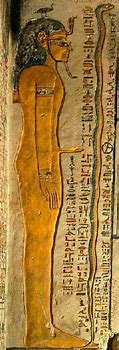
In ancient Egyptian art, Anubis is often depicted holding specific items that symbolize his roles and responsibilities. The most common objects held by Anubis are the “was” scepter and the “ankh.”

The “was” scepter (𓏭) is a long staff with a forked base and a stylized animal head at the top, typically that of a canine. This powerful symbol represents dominion, power, and authority, signifying Anubis’ status as a guardian and protector of the dead. However, the “was” scepter is not exclusive to Anubis, as it can also be seen in the hands of other Egyptian gods and pharaohs.

The “ankh” (☥) is a well-known ancient Egyptian symbol that resembles a cross with a loop at the top. It represents the concept of eternal life and is often called the “key of life” or the “key of the Nile.” When Anubis holds the ankh, it symbolizes his role in guiding the souls of the deceased to eternal life in the afterlife.

Anubis and Osiris

The mythology of the story varies, but according to legend:

  • Osiris’ brother (Seth), killed Osiris by luring him into a fancy coffin, sealing it shut, and pushing it into the Nile.
  • Osiris’ wife and sister (Isis), retrieved Osiris’ body on the Phoenician coastline, but an angry Seth chopped up Osiris’ body and scattered it throughout Egypt.
  • Anubis, Isis and Nephthys, set about to find the pieces and were successful (except for Osiris’ phallus).
  • Another Egyptian God called Thoth, helped restore the body and Anubis wrapped Osiris in linen, the action of which bestowed on him the title, “He Who is in the Place of Embalming”.

Anubis’ role shifted from being the primary god of the dead to a subordinate position to Osiris. Anubis became the god of mummification and guardian of the tombs, while Osiris assumed the role of the ruler of the underworld and judge of the dead.

Despite the shift in their roles, Anubis and Osiris maintained a cooperative and complementary relationship in the afterlif.

Anubis Family

Parents

Several versions exist of how Anubis came into being:

  • Son of Nephthys and Osiris: the most popular version is that Anubis is the son of Nephthys and Osiris. As the Goddess of Darkness, Nephthys would naturally be mother to a god who oversaw the embalming process and also guided souls into the afterlife.
  • Son of Nephthys and Sethit is also speculated that Seth is Anubis’ father. In this version, it is believed that Nephthys disguised herself as Osiris’ beautiful sister, Isis, to beget a half brother for Horus. As Seth is the God of darkness, storms and destruction, it is easy to see how Anubis could be his son.
  • Son of Nephtys and Ra: in early mythology texts, Ra (the sun God), was depicted as being Anubis’ father, while his mother was speculated as being either Hesat the cow goddess, Bastet the cat-headed warfare goddess, or Nephthys.
  • Wife

    Anubis’ wife name is Anput (or Input), a lesser-known goddess in the Egyptian pantheon. Like her husband, she is associated with the afterlife, mummification, and the protection of the dead. Anput is usually depicted as a woman with a jackal or a jackal-headed human, similar to Anubis’ form. Her iconography is less prevalent in ancient Egyptian art and monuments than Anubis, but she is occasionally mentioned in texts and depicted in various artifacts.

  • Daughter

    Anubis and Anput are believed to have a daughter, Kebechet (or Qebehsenuef), who is also associated with the afterlife. Kebechet is typically represented as a snake or a snake-headed woman and is considered the goddess of purification, providing refreshing, purifying waters to the souls of the deceased during their journey to the afterlife. Her role complements that of her parents, further emphasizing the interconnectedness of the ancient Egyptian gods and their various functions in guiding and protecting the dead.

  • Anubis’ family relationships reflect the interconnected nature of ancient Egyptian gods, with each member playing a complementary role in the realm of the afterlife. As a family, Anubis, Anput, and Kebechet work together to guide, protect, and purify the deceased, ensuring their safe passage to the afterlife and ultimate reunification with their eternal body.

    A Shrine for Anubis

    Anubis was worshiped all over Egypt, and his cult center was in Cynopolis, located in the 17th nome (province) of Upper Egypt. Translated, Cynopolis is Greek for “city of the dog,” which fits well because of the close relation between jackals and dogs, and the fact that some scholars believe Anubis was indeed an ancient wolf.

    A shrine for Anubis was discovered in King Tut’s tomb in 1922. Made of wood, plaster, lacquer and gold leaf, the statue depicts Anubis in animal form in a recumbent position exactly how he is in his hieroglyph. As the sledge it rested on would indicate, the shrine was probably used in the funeral procession of the great Pharaoh, and was oriented to the west to help guide the Pharaoh into the afterlife (which the ancient Egyptians believed was in the direction of the setting sun).

    Anubis in Art

    Aside from the Anubis statue discovered in King Tut’s tomb, his representation can be found frequently in ancient Egyptian art. In the Valley of the Kings, an image of Anubis in his role as “Jackal Ruler of the Bows” was often used to seal tombs. The nine bows represented all the enemies of Egypt, and it was believed that Anubis had defeated every one of them. Anubis masks and statuettes dating back to early to late Ptolemaic period (332-30 BC) exist in museums today.

    In tomb paintings and murals, Anubis is often shown accompanying the deceased or presiding over the “Weighing of the Heart” ceremony, showcasing his importance in the soul’s journey through the underworld. Additionally, funerary texts and inscriptions frequently invoke Anubis’ name for protection and guidance, further highlighting his significance in ancient Egyptian religious beliefs and practices.

    Statues of Anubis, often in the form of a jackal or a jackal-headed human, were placed in and around tombs and mortuary temples to serve as guardians against potential physical and spiritual threats. The presence of Anubis was believed to deter grave robbers and protect the tomb from malevolent forces.

    Anubis in Modern Culture

    Anubis continues to hold a place in popular culture, with his image and mythology appearing in various forms of media, including literature, film, television, and video games. His jackal-headed form has become an iconic symbol of ancient Egyptian mythology, often featured in contemporary art and fashion. Anubis has also been a popular subject in fantasy and sci-fi genres, often portrayed as a powerful and mysterious deity with various supernatural abilities. Despite his ancient origins, Anubis’ image and symbolism continue to capture the imagination of modern audiences, serving as a reminder of the enduring legacy of ancient Egyptian culture.

Goddesses – Greek Olympian Demeter, goddess of earth and harvest

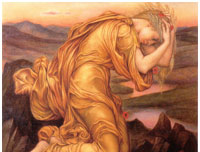
Demeter, goddess of earth and harvest

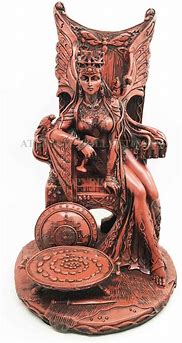
Demeter (Deo, Ceres) was a goddess of earth and harvest. Her greatest gifts to mankind was corn and the knowledge of agricultural techniques. She was also described by Nonnus, Orphic hymn to Ceres and Homeric hymn to Demeter as the Lady of the fruits (of the earth) and according to the latter also as the bringer of seasons. Mostly she was described as a daughter of the titan couple Cronus and Rhea but there are some conflicts among different authors where she was described as a daughter of Cronus and Cybelle. However, GaeaCybelleHestiaRheaHera and even Demeter are quite often referred as the mother earth goddess which is why it comes to misidentifying the correct goddess. Anyhow, it is known that she resided in most of the mystery cults which were promising a path to blessed afterlife. She had several children of which Persephone was the most famous and due to her abduction by Hades, and Demeter’s search for her daughter, mysteries of Demeter were born. Most famous were Eleusinian Mysteries, the festivals which were held once a year, and the great festivals, held every five years at Eleusis in Ancient Greece where it all began and is closely connected to the myth of her daughter’s abduction. This event was of great importance and had its basis from an old agrarian cult which goes back to the Mycenaean period. This ceremony is believed to be the interpretation of the myth in three stages; descent, search and ascent, where the main theme of celebration was the ascent where, in the myth itself, Persephone is reunited with her mother.

Appearance in the works of art

Most of the time, she is depicted as an adult woman, holding torch in one hand and cornucopia in the other. The cornucopia was a goat’s horn that would give its owner whatever he desired. It symbolises rich harvest or an abundance of food. Sometimes, she is depicted with a golden blade, believed to be from the time of Titanomachy.

Gifts to Mankind

As mentioned above, Demeter’s greatest gift to humanity was corn and agricultural techniques. It is said that she was the first who discovered corn and later shared her secret with Tripolmenus while at Eleusis. She is also credited to had taught men how to sow corn, how to plough dirt and how to avoid all the troubles associated with it. According to Hyginus and Orphic hymn to Ceres, she even taught them how to tame oxen in order to help them plough the large amounts of earth later on. But that was not all, Demeter also instruced laws and obidience to men so that they could become accostumed to deal with one another justly and because of all these great blessings to humanity, she was awarded with the most notable honours, generous sacrifices and magnificent feasts and festivals by all men, even barbarians, who had partaken of this kind of food.

Love affairs and her descendants

The goddess was mentioned to had some love affairs but only one was due to her willingness. Her only true love was a mortal man by the name of Iasion, a prince of Samothrace. It is said that they made love in a thrice-ploughed fallow in the rich land of Crete but when Zeus had heard about this affair, he struck Iasion with a thunderbolt because of jelaousy. It was too late though as Demeter got pregnant and gave birth to Plutus and according to Hyginus, who claims that she had borne two sons, also to Philomelus. Zeus of course got his hands on her later and famous Persephone was concieved but some of the authors are not mentioning Zeus as her father. In Clement’s Exhortations, however, Zeus himself was actually a son of Demeter and later had intercourse with her and begat Persephone. Furthermore, Clement also talks about mysteries of Demeter and that they commemorate the amorous embraces of Zeus with his mother Demeter but, considering that she was, by some people, thought to be the mother goddess, this should come as no surprise. Anyway, the goddess was also courted by Poseidon but she had refused his advances and transformed herself into a mare to escape him but the god of the sea was unrelentless and tricked her into mating with him by transforming himself into a beautiful stallion. She later gave birth to a divine horse Arion and, according to Pausanias, to a girl whose surname was “Mistress” but does not want to reveal her first name to the uninitiated (in mysteries) people. Carmanor, a lord of Crete, is also said to be one of her mates with whom she later gave birth to Eubuleus.

The abduction of Persephone

When Persephone, her beloved daughter, was abducted, Demeter was searching for her in vain. Unable to find her, she in sorrow and anger burned all the fruits of the earth or, in another version of the story, she neglected to look after the crops and lands soon became barren. And upon “Demeter’s curse”, which caused great drought on lands and consequently famine, it was Hecate who came to Demeter and told her about what she had heard.

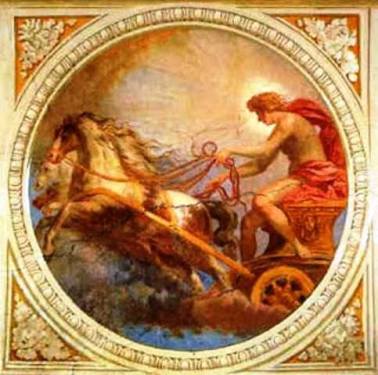
Together they went to Helios who was able to see all deeds from both mortals and immortals. He told Demeter that Zeus and Hades were to blame. The goddess became so mad that she had given ultimatum for the lands to stay barren until she was to see her daughter again. Finally Zeus intervened, scared of potentially seeing all mortals gone. He sent Hermes to the underworld to speak to Hades and try to convince him to let Persephone return to her mother. After Hermes’ successful persuasion, Hades was willing to let her go but on the other hand tricked her with honey-sweet pomegranate seed as farewell gift. Once eaten the seed, she became bound to the underworld and would have to return eventually. Demeter was once again outraged but in the end they had come to an agreement that Persephone could stay two-thirds of the time per year with her mother while she had to return to the underworld for one-third of the time. Demeter lifted the curse from the lands but, as a sign of protest, she was casting her sorrow each year when her daughter had to leave for the underworld. This was known as the winter time. This particular myth is very coveted among ancient authors so therefore the story itself may slightly vary from author to author such as where the abduction took place, where Demeter looked for her and in details where some authors provide further clues of the events that followed or events that had happened before the abduction.

Taking refuge in Eleusis

When Demeter was searching for her daughter Persephone, she took refuge at the palace of Celeus, the king of Eleusis. She took the form of an old woman and asked the king for shelter. Celeus welcomed her in and give her an assignment to nurse his sons Demophon and Triptolemus. As a token of gratitude in her dark times, she planned to make Demophon immortal by placing him in the flames of the heart, to burn away his mortal self. It is also said that, while in her care, the boy grew faster than normal and his face became godlike. When the time had come and Demeter wanted to cover the boy in flames, the ritual was interrupted because the boy’s mother Metanira came in and started screaming. The flames were put out and immortality attempt was put to an end. According to Ovid and Hyginus, however, it was his brother Triptolemus whom the goddess wanted to make immortal. It is said that later, after the failed immortality attempt, Demeter taught Triptolemus all the divine arts and mysteries of agriculture. Triptolemus then in return taught anyone who wished to learn. Before Demeter returned to Olympus, she instructed Triptolemus and Celeus on how to celebrate the rites in her temple which then became known as Mysteries of Demeter. It is also said that the lesser mysteries were held every year, but the greater mysteries only every five years.

Mysteries of Demeter

As mentioned above, Triptolemus was the first who had been initiated into mysteries of Demeter where the goddess shared all her secrets about earth’s fertility with him. He later spread these secrets to the initiated people and the mysteries became known as Eleusinian mysteries. But these were not the only mysteries associated with the goddess. Sabazian and Lernean mysteries and a lot of un-named mysteries are also being related to the mysteries of the goddess and there was also the day of Demeter or the day of Ceres mentioned by Fulgentis and Virgil.

Similar event is described by Ovid who calls it Games of Ceres and reveals how these are connected to the myth of Persephone and how it was celebrated. It is said that torches are present on this day as a memorial of Demeter’s search for her daughter when she kindled two pine-trees to serve her as a light after sunset. It is also said that, because Demeter broke her fast at nightfall after unsuccessful quest of searching for her daughter, the initiates time their meals at night during ceremony and they wear white robes because this is the goddess’ proper color which is believed to be associated with harvest. Ovid also mentions that a fox is burned at the festival as a memorial to the incident of a “vixen fox” which was caught by a young lad and set on fire in retribution for carrying off many farm fowls. But the burning fox had escaped his hands and ran into a corn field that caught on fire and all the crops for the incoming winter perished in flames. Therefore, a certain law of Carseoli forbade to name a fox on that day and as a punishment, to the species for destroying crops, a fox is burned.

Her sacred placesThere are several places mentioned by the authors that were sacred to Demeter. In Homeric hymn to Demeter it is said that Paros and Antron are sacred to the goddess, while both Ovid and Claudian are mentioning Henna, Sicily. Diodorus Siculus on the other hand recokns that the whole island of Sicily is sacred to Demeter. There was also an island in Ionian sea mentioned by Apollonius Rhodius but the author was unsure whether or not it was called Drepane. The island by the ancient name Drepane is now known as island Corfu which is located near Albanian border in Ionian Sea. There was also a river mentioned in Pausanias’ Descriptions of Greece that was precious to her. It was called Rheiti. Claudain, on the other hand, even mentiones a palace of Demeter which was supposedly built by the Cyclopes but the location remains a mystery. On top of all the places, the river and the supposed palace, there is also a giant oak tree mentioned, by Callimachus and Ovid, to be very dear to the goddess. It was cut down by disrespectful Erysichthon who was then punished by Demeter. She had summoned Famine who then breathed her pestilential poison through his mouth and throat and breast, and spread the curse of utmost hunger in his veins.

Other mythsWhile in search of Persephone, Demeter used a spell on her daughter’s maids and changed them into sirens so that they could help in her quest. Originally they were nymphs and daughters of river Acheolus and muse Melpomene. The goddess was also involved in a myth of Pelops who was killed by Tantalus, cut up, cooked and served to the gods at the great feast. The gods soon realised what happened and brought Pelops to life again. They assembled his body once again but he was missing an arm. It was Demeter who had previously, before the discovery, eaten it. Therefore, the goddess wanted to make up for it and solved a puzzle by fitting and enspelling an ivory substitute on his torso. Pelops was alive and complete again and gods satisfied with their just act. In another myth, Demeter showed anger when Triopas, a king of Thessalians, once tore down her temple. She brought infinte hunger upon him so that he could not be satisfied by any amount of food and later when he was already dying she sent a snake to finish the job. He was bitten and died and then placed among stars by the will of the goddess as reminder to others not to mess with her.

Gods – Greek Olympia – Poseidon, god of sea, floods and earthquakes

Poseidon, god of sea, floods and earthquakes

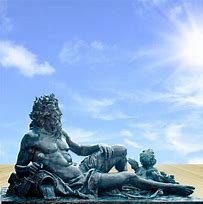
Poseidon (Earthshaker, Dark-haired one, Neptune) was Olympian god of sea, floods and earthquakes. In some cases, he is also referred to as a tamer of horses. He was known for his fast changing temperament and being easily offended. And because he was also dignified and competitive, it was very important not to offend him or argue his statements and acts. Those who angered him became the victims of his wrath. He was known for causing major catastrophic events, such as floods, earthquakes and sea storms, and even unleashed his sea monsters in order to get even. Poseidon was also very lustful and selfish when it came to women. He had numerous affairs with both goddesses and mortals, by either seducing them or tricking them by changing his form, not to mention abducting and violating them. However, Poseidon did have some positives and was always passionate in supporting his cause or the cause of his favourite characters, helping them in many different ways by giving them unique traits and special powers or granting them divine animals. He even changed gender of Caenis and Mestra on their own request.

Appearance in the works of art

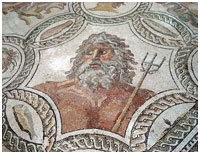
Poseidon is often depicted as a grown man with longer curly hair and long beard, wearing a crown and holding a magical trident. On more than few occasions, he is depicted in his domain of the sea and in company of his wife Amphitrite. Sometimes, he is depicted riding horses or a chariot drawn by horses.

Becoming the Ruler of the Sea

He was a descendant of Cronus and Rhea. With his brothers he fought bravely against the Titans. During the war he received the magical Trident, a weapon of great power made by the Cyclopes as a token of gratitude for helping them to escape from Tartarus. With their new weapons and help from enemies of Cronus, they were able to defeat and imprison the titans. After the victory, when the division of cosmos had to be decided between three brothers, they drew lots and he got the realm of Sea under his control. He also became second in command to Zeus. However, there is an alternative story how he became the ruler of the sea. According to Hyginus, it was Cronus himself who casted him under the sea when he was born, out of fear of dethroning him. Clement affirms this by saying that it was his destiny to become a sea ruler.

Love affairs and his descendants

Divine and semi-divine lovers

The god of the Sea is credited with having numerous love affairs with both goddesses and mortal women but in his honor he only had one wife, a sea-goddess called Amphitrite. With her he had a son Triton, who is also closely related to the sea, and Rhode, a water nymph closely related to Helios and island of Rhodes. Poseidon also had his eye set for Alcyone, one of the Pleiads, and soon he had an intercourse with her. She later gave birth to two sons, Hyrieus and Hyperenor and a daughter Atheusa. Plutarch also mentions Anippê, a daugher of Nile, who gave birth to Burisis by Poseidon. According to Hyginus, he made love with Antiopa, a daughter of Aeolus (supposedly son of Hippotes), who gave birth to two sons Boeotus and Hellen, and Arethusa, a daughter of Nereus, who gave him another son Abas. There was also Amymone, a daughter of Danaus, a mythical king of Egypt, who once called Poseidon to aid her when she was cornered in the woods by a satyr. So he came and drove the creature away and because of this courageous act she laid with him and from this embrace Nauplius was born. He also pursued Demeter who transformed herself into a mare to escape his lust but Poseidon tricked her with transforming himself into a stallion and mated with her. Demter then gave birth to goddess Desponia and variously to Arion, a horse with the ability to speak human language. Poseidon even had an intercourse with Medusa in the temple of Athena. Athena later cursed Medusa by changing her into a monster. It is also said by some authors that she was impregnated and when her head was chopped off by PerseusPegasus and Chrysaor arose from her blood and therefore they are giving credits to Poseidon as the father. He also fathered Polyphemus with the sea-nymph called Thoosa and Euphemus with Europe. It is said by Hyginus that Euphemus had the ability to walk on water.

Mortal lovers

One day, he tricked a mortal woman named Tyro by transforming himself in Enipeus, the river-god of her desire. She then gave birth to twin-boysPelias and Neleus who were known to be famous greek heroes. Aethra, the princess of Troezen is also said to had an intercourse with the god in the shrine of Athena and later gave birth to Theseus. Another famous hero by the name Orion was born to Poseidon and Euryale, a daughter of Minos, and it is said that he had been granted the ability to walk on water by his father. There was also Hippothous or Hippothoon who was begat by Alope after she was embraced by Poseidon. But, because Alope was uncertain who the father of her child was, unfortunate events followed for both of them. She was imprisoned and put to death and the child was exposed to danger twice but each time a mare came and furnished him milk. It was then when Sheperds had realized that it must be the will of the gods to spare him and gave him name Hippothous. It is also said that Alope was then turned, by the god, into a spring near Eleusis. Similar thing happened to Melanippe, a daughter of Desmontes, who was, after being impregnated by Poseidon, blinded and tossed in prison by her father Desmontes and the two sons Aeolus and Boeotus, that she had given birth to, thrown to wild beasts. But they managed to survive and eventually, led by their father, came back to Desmontes, killed him and freed their mother from prison whose sight was restored by Poseidon himself who is also credited as the father of Bellerophon by Eurynome. a daughter of Nysus. Another interesting tale comes from Apollodorus where it is said that Poseidon had a lover by the name Canace and she later gave birth to five sons, AloeusEpopeusHopleusNireus and Triops. Aloeus later married Iphimedia, a daughter of his brother Triops, but she fell in love with Poseidon and the god apparently couldn’t resist missing an opportunity like this because by him she later gave birth to two sons, Ephialtes and Otus. They were known as the Aloads or Aloadae giants.

Wraths of Poseidon

During his time, many vengeful acts were recorded. Most known are from the Odyssey where he chased Odysseus for eight years for blinding his son Polymphemus, the one-eyed cyclops. He was causing deadly storms and earthquakes, trying to drown the hero and prevent him from ever reaching Ithaca. It is also said that he punished Phoeacians by turning their ship into stone because they welcomed and helped the hero. Poseidon also became furious when he helped Laomedon, a king of Troy, with building the walls in exchange for a wealthy ransom. When the walls were built, the king refused to pay the god and therefore Poseidon flooded the region and sent an enormous sea-monster to ravage the lands of Troy.

The Trojan Cetus, as it was called, terrorized the whole country over and over again before the Trojans finally, after consultation with the Oracle, agreed to sacrifice King’s daughter Hesione in order to satisfy Poseidon enough to recall the monster. However, Laomedon had another option which was to promise a reward for Heracles who was just passing by from one of his quests. Heracles agreed, defeated the Cetus, and saved Hesione. In a similar story, where Cassiopeia, a mother of Andromeda, boasted that her daughter is more beautiful than the Nereids, relatives and employes of Poseidon. When they heard of this Cassiopeia’s pride, they complained to Poseidon who then released a Cetus to terrorise the lands of Ethiopia. They were, like the Trojans, advised by the oracle to sacrifice the princess to the monster. Thereafter they had chained Andromeda to the rock and left her to be devoured by the monster. Then Perseus came to rescue, but unlike Heracles, he defeated the Cetus and saved Andromeda because of love at first sight. Another one who offended the god was Inachus who, according to Apollodorus, testified that the land of Argos belonged to Hera after the gods were involved in a dispute. Poseidon was outraged and in revenge dried up all remaining springs, leaving the land completely waterless and useless to Hera.

There had also been a contest for the patronage of Athens between Athena and Poseidon. In order to win city’s deviotion, they had to produce a useful gift for its population. Poseidon was first to act and struck his trident hard in the earth, creating a well with streaming water. However, the water turned out to be salty and not so useful for the people. Athena was next and created the olive tree, by planting an olive branch into the hole that she made with a spear. Delighted with olives, oil and useful wood, people of Athens chose Athena over Poseidon. This angered the god who then, in his vengeful act, flooded the city and lands nearby with salt water. There is, however, an alternative explanation provided by Ovid where it is said nothing about revenge but that Poseidon, instead of giving fresh water to locals, presented a horse to men but the result was the same as they had picked Athena over him because of the olive tree. Then there were also two kings who paid their price for offending the god. First was Minos, a king of Crete, who tricked Poseidon with sacrificing an ordinary bull to him instead of the one given to him by the god as promised. The Earthshaker then had his revenge as he made the promised bull savage and casted a spell on his wife Pasiphae to fall in love with it. As a result of such action, the Minotaur was born which was a punishment enough for Minos. The other one was Erechtheus, a king of Athens, whose army killed Poseidon’s son Eumolpus in the battle for Athens. The god then demanded that one of his daughters should be sacrificed to him but because the daughters of Erechtheus had an agreement with each other that if one dies, the rest would commit suicide, the king of Athens lost all of his daughters. In the end Poseidon also requested from Zeus to struck Eechtheus with a thunderbolt which ended the king’s life and bloodline.

Helping others

Not all accounts are about revenge though. Poseidon could also be very passionate and understanding to those who he favoured and therefore gave good words or interviened himself on their behalf. One of such accounts is the myth of Ares and Aphrodite when they were trapped in the bed of Hephaestus. After all the gods have been summoned to see this adultery and having a laugh at it, it was Poseidon who convinced Hephaestus to let Ares go, in spite of what had been done. This was not the only god he helped. It is said, by Hyginus, that he also protected Leto from vengeful Hera and took her to Ortygia which later became known as Delos after Posedion had transformed it, and he also granted a wish of Aphrodite and accepted her descendants into his realm of Sea. It is worth mentioning that he also accepted a nypmh Leucothea into a divine company in deep waters with open arms and consequently did a great deed for mankind because ever since she supposedly helps seafares who lose their way. The god also once saved Ajax from the sea after previously cracking his boat in half due to hero’s boastful claim that he taught Antichlous everything about horses which of course was not true. Poseidon gave him a lesson but because he favoured the hero he spared his life. Poseidon was also very generous with gifts as he gave his son Peleus two magnificent horses, Balius and Xanthus, and also granted chariots to Idas and Pelops. He also blessed his son Neleus with boundless strength and ability to change shape whenever in a battle and other son Percilymenus the ability to change shape at will. To his grandson Pterelaus he granted immortality by implanting golden hair on his head. There had also been two accounts of sex-change recorded, both on own volition. There was a woman by the name Caenis whom the god once saw walking on the beach and ravished her. He felt bad about it so he offered to grant her any wish desired and she wanted to become a man so that such atrocity would never happen to her again. Poseidon granted her wish and made her a man named Caeneus but also made a new man invulnerable to any blow of sword or spear. Second was one the god’s lovers, named Mestra, who was only temporary changed to a man in order to conceal her from her father and master Erysichthon. He was looking for her and eventually, because he couldn’t find her, gave up and left. Poseidon then turned her back into original form.

Trojan war

Poseidon sided with the Greeks and was helping them all along but on one occasion he is said to had worked against them. It is said by Homer and Quintus Smyrnaeus that the god was jealous because of the impressive wall the Greeks have built around their ships. He was worried that its fame would overshadow his work on Trojan walls and, because of it, helped Trojans destroy it which left consequences on the morale of Greek soldiers. Thereafter, Poseidon had to interviene again and it is said that he encouraged troops indirectly ,because of the rules Zeus had set for immortals not to engage in battle, and fused both Ajaxes with power through his staff when being disguised in the shape of an old seer named Calchas. He is also said to had protected Idomeneus at all costs and even helped him kill Alcathos.

Later in war the god of the Sea became angered because Trojans killed his grandson Amphimachus and his indirect involvement was not helping much as Trojans were taking advantage over them. It was then when he agreed to take part in Hera’s plot to decieve Zeus. After the king of the gods had been put to sleep, Poseidon engaged in the battlefield to lead the Greek army and it is said that he roared so loud as if it were nine thousand men, all to raise morale and finally put an end to Trojans. And it had an effect until Zeus woke up and realised he had been tricked. Immediately he gave orders for all the immortals to withdraw from the battle but Poseidon opposed for a while until he realised that it is best to listen to his brother. He, then, finally withdrew himself from the battlefield and returned to the sea realm. Later, he was summoned to the assembly with the rest of the immortals where Zeus gave them a choice to pick a side and fight for them if they wish to do so. Poseidon is said to had intended to fight Apollo if provoked but the gods came to an agreement and let men decide their battle. When Greeks had finally taken the upper hand in war and when they were attacking Troy, Poseidon is mentioned to had shaken the walls and foundations of the city and driven back posts of Dardan or Dardanian gates. It is also said that after the war was won, he gave Trojans favourable winds which enabled them to escape and prevented further death casualties. According to Homer, he also previously saved Aeneas from a certain death in a battle with Achilles.


Poseidon’s sacred places


Some of the places are being mentioned by the authors that Poseidon had a special bond to. One of such is Onchestus and it is said that he had a precinct there, in his sacred grove. According to Virgil, Delos is also said to be very dear to the god which he previously transformed. Another such island is the island of Calauria which was a part of mainland town of Troezen at the time but Plutarch says that whole Troezen was sacred to Poseidon and that he was a patron god of this land. Very interesting story comes from Pausanias where it is said that Delphi was once controlled by Poseidon and Calauria by Apollo who then offered this beautiful island to the god of the Sea in exchange for the Oracle. According to Homer, there was one other place sacred to the god, named Helice or Helike which was, as the evidence shows, unfortunately sunk by tsunami in the year 373BC.

Other mythsThe god was also involved in other myths such as the war of theGiantsthe great flood and even the plot of the gods against Zeus. It is said by Apollodorus that Poseidon fought a giant Polybotes in Gigantomachy, where the god was forced to destroy part of the island to defeat the giant. It all happened on the island of Cos where Posedion broke off a piece of the island and hurled it at Polybotes. This piece was later known as the island Nisyrum, now Nisyros, and it situated between islands Tilos and Cos in Aegean sea. As mentioned earlier, he was also a part of Zeus‘ master plan to end humanity and it is said that he unleashed a great flood on the command of the King of the gods and later ceased the event by cracking earth open, enabling the water to sink in. This was not the only case where Poseidon helped his brother. It is said by Valerius Flaccus, in accordance to the battle between Zeus and Typhoeus (Typhon), that it was Poseidon who finished the giant by pulling him in the water and sending him to Tartarus. He also helped Zeus in Titanomachy as already said early in this article but there is more to the story. In Hesiod’s Theogony it is said that after the war had ended and when the Titans had been sent to Tartarus, Poseidon built a gate of bronze and fixed it upon the entrance of this unforgivable pit so that none of the prisoners would ever be able to escape. Poseidon also participated in Hera’s plot to overthrow Zeus where they had not further plan after tying him down. Of course the plan was doomed from the beginning and after Zeus was freed, he harshly punished his wife to make an example for others and afterwards even Poseidon wouldn’t dare to complain to his brother.

Goddesses and Gods – Greek Olympians – Goddess Artemis and God Aristaeus

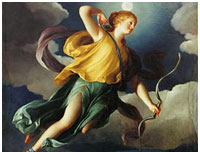
Greek Olympian – Artemis – Goddess of Hunting

ARTEMIS FACTS

Name(s): Artemis, Aeginaea, Aetole, Agrotera, Kourotrophos, Locheia, Cynthia, Amarynthia, Phoebe, Alphaea, Alpheaea, Alpheiusa
Rules over: the Hunt, Forests and Hills, the Moon, Archery
Gender: Female
Symbols: Bow, Arrows, Stags, Hunting dog and moon
Sacred animals: Deer
Parents: Zeus and Leto
Siblings: Ares, Athena, Apollo, Aphrodite, Dionysus, Hebe, Hermes, Heracles, Helen of Troy, Hephaestus, Perseus, Minos, the Muses, the Graces
Roman name: Diana

Greek mythology is filled with respected gods and goddesses that continue to inspire. Artemis is known as the goddess of the hunt and is one of the most respected of all the ancient Greek deities. It is thought that her name, and even the goddess herself, may even be pre-Greek. She was the daughter of ZEUS, king of the gods, and the TITANESS LETO and she has a twin brother, the god APOLLO.

Not only was Artemis the goddess of the hunt, she was also known as the goddess of wild animals, wilderness, childbirth and virginity. Also, she was protector of young children and was know to bring and relieve disease in women. In literature and art she was depicted as a huntress carrying a bow and arrow. She was the goddess of many things, but most remember her as the most recognizable of the hunting deities.

Artemis was a virgin and drew the attention and interest of many gods and men. However, it was only her hunting companion, Orion, that won her heart. It is believed that Orion was accidentally killed either by Artemis herself or by GAIA, the primordial goddess of the earth.

In one version of the stories of ADONIS – who was a late addition to Greek mythology during the Hellenistic period – Artemis sent a wild boar to kill Adonis after he continued to boast that he was a far greater hunter than her.

The Origins of Artemis

Artemis’s origin story is a tumultuous one. She is the DAUGHTER OF ZEUS and Leto. Zeus is the well-known King of gods and the leader of MOUNT OLYMPUS. Despite the many stories of his greatness, Zeus’ weakness was infidelity to his wife, Hera.

Zeus impregnated a Titan called Leto. Hera became angry upon learning of Zeus’ unfaithfulness. In retaliation, she forbade Leto from giving birth on land. Eventually, she found solace on the floating island of Delos. There, she gave birth to Artemis and Apollo.

According to the Homeric Hymn to Artemis, the twins were born on Ortygia. Either way, most of the accounts say that Artemis came first. As a result, she was a fierce protector and nurturer of Apollo.

Not much is known about Artemis’ childhood. Some scholars say that she spent her time participating in archery, perhaps leading to her excellence in hunting.

Artemis Depictions

Artemis was the subject of many works of art throughout Ancient Greece and beyond. Usually, she was shown as a young and beautiful woman carrying a bow and arrow. Typically, she wore a knee-length tunic and was accompanied by various animals.

She was shown alongside various other SYMBOLS when talked about as the goddess of the moon or fertility. For example, she often wore a crescent moon crown or stood by women and nymphs.

Greek Olympian – Aristaeus God of Useful Arts, Countryside and Pastoral Places

ARISTAEUS FACTS

Name(s): Aristaeus
Rules over: Animal Husbandry, Bee-Keeping, Fruit Trees, Cheesemaking, Olive-Growing
Title: Minor Patron God of Animal Husbandry, God of Useful Arts
Gender: Male
Symbols:
Sacred animals: Bees, Sheep
Items: Vine, Olives
Parents: Apollo and Cyrene
Consort: Autonoe
Other significant others: Chiron and the Muses that taught Aristaeus
Children: Actaeon and Macris, Charmos, Kallikarpos
Roman name: Mellona

In Greek mythology, Aristaeus was the god useful arts, such as bee-keeping and cheese-making, olive-growing, herding, and hunting. He was a rustic god, a god of the countryside and pastoral places.

Aristaeus was a minor god in Athens but a prominent god in Boetia, a farming region in central Greece, where he was known as “the pastoral Apollo.” Aristaeus is often pictured on Boetian pottery as a young man with wings.

Aristaeus also appears prominently in the mythology of Macedonia, Arcadia, Sicily, Sardinia, Thessaly, and Ceos. Later, stories about his travel emerged in order to account for his prominence in all these different regions.

Over time, Aristaeus became a popular Greek name, given to many famous public figures in ancient Greek politics and society.


Aristaeus’s Birth and Training

Aristaeus was the son of APOLLO and Cyrene. Apollo seduced Cyrene by promising she would be the founding mother of a great city raised in her name if she would go to Libya with him. After Aristaeus was born, he was taken by HERMES and raised on nectar and ambrosia. The Earth GODDESS GAIA then made him immortal.

Various GODS AND GODDESSES taught Aristaeus the rustic arts. Apollo taught him the art of healing with herbs. The goddess DEMETER taught him how to hunt and how to skin the animals he caught and tan leather. The god DIONYSUS taught him to make beer and wine. The great Earth mother Demeter taught him the arts of herding and agriculture.

From the Myrtle-Nymphs Aristaeous learning to make olive oil, keep bees for honey, and to make butter and cheese.

When Aristaeus became a man he sailed to Boetia and was schooled in deeper mysteries by the Centaur CHIRON. He married Autonoe, a daughter of Cadmus, founder of THEBES. They had a son named Acteon, who was also trained in hunting and other mysteries by the cave-dwelling Chiron.


Aristaeus, Ceos, and the Dog-Star Sirius

According to one myth, the Delphic Oracle advised Aristaeus to visit Ceos, where he would be greatly honored by the local people. When he arrived he found them falling ill due to the early morning rising of Sirius, the Dog-Star. Aristaeus put together a healing ritual that involved a sacrifice to Sirius at its first appearance, thereby cooling the weather and healing the sick populace.

Aristaeus also found that Ceos was overrun by murderers. He found them and had them executed, making Ceos safe once again.

Gods – Pan Greek God of Nature

Pan – Greek God of Nature

The culture of Ancient Greece involved a complex spiritual world of major and minor gods that oversaw human events and engaged in dramas of their own. One of these, called Pan, ruled over nature and pasturelands. He is frequently depicted in literature and artworks. Although he is not one of the major gods of Ancient Greece, he is one of most often referenced figures in Greek mythology.

PAN FACTS

Name(s): Pan
Rules over: Nature, The Wild, Shepherds, Flocks, Goats, Mountain Wilds. Often associated with sexuality
Title: God Of The Wild
Gender: Male. Also a satyr (half man, half-goat)
Symbols: Pan Flute
Sacred animals: Goat
Items: Corsican Pine, Water-Reed
Parents: Hermes and Penelope (some accounts vary)
Consort: Syrinx, Echo, Pitys
Other significant others:
Children: The 12 Panes (mountain spirits), various others including Iynx, Silenos and Krotos
Roman name: Faunus

Pan the God of the Wild

Pan is considered to be one of the oldest of GREEK GODS. He is associated with nature, wooded areas and pasturelands, from which his name is derived. The worship of Pan began in rustic areas far from the populated city centers. Therefore, he did not have large temples built to worship him. Rather, worship of Pan centered in nature, often in caves or grottos. He ruled over shepherds, hunters and rustic music. He was the patron god of Arcadia. Pan was often in the company of the wood nymphs and other deities of the forest.

Pan’s Appearance

Perhaps because of his association with nature and animals, Pan did not have the appearance of a normal man. The bottom half of his body was like a goat, with the top half of his body being like other men. However, he is often depicted with horns on his head, and his face is usually unattractive.

Pan’s Lineage

The parentage of Pan is uncertain. Some accounts say he is the son of HERMES and Dryope. Others say he is the son of  ZEUS or the son of Penelope, wife of Odysseus. The story of his birth says that his mother was so distressed by his unusual appearance that she ran away, but he was taken to Mount Olympus where he became the favorite of the gods.

Pan’s Powers

Like the other GODS OF OLYMPUS, Pan possessed enormous strength. He could also run for long periods of time and was impervious to injury. It was believed he could transform objects into different forms and was able to teleport himself from Earth to Mount Olympus and back. He is depicted as very shrewd with a wonderful sense of humor.

In Ancient Roman mythology, a SIMILAR GOD is called Faunus.

Pan and Music

The MYTHOLOGICAL STORIES involving Pan usually involve his romantic interest in a lovely goddess of the woods who spurns his advances and gets turned into an inanimate object to escape him or who otherwise flees from his ugly appearance. One story concerns Syrinx, a beautiful wood nymph. She flees from Pan’s attentions, and her follow GODDESSES turn her into a river reed in order to hide her from him. As the winds blow through the reeds, they make a gentle musical sound. Because he does not know which reed Syrinx is, he cuts several from reeds from the group and set them in a line to make the musical instrument, the pan flute. Pan’s image is often depicted with this instrument.

Pan Gave Humans the Word “Panic”

One story involving Pan is the tale of war, in which Pan helps his friend survive a vicious struggle by letting out an immense cry that frightened the enemy and caused him to run away. From this story, we get the word “panic,” the sudden, uncontrollable fear that leads people into irrational behavior.

Pan in the Modern World

Over the ages, Pan has been a symbol of the force of nature. In the 1800s, interest in this mythological figure revived, and communities organized festivals in which Pan was the central figure. Mythical stories of his antics abound, and he continues to be a figure representing the ancient mystery of the forest, hunting activities and wildlife.

Like the OTHER GODS of Ancient Greece, Pan embodies many of the qualities of the world over which he ruled. He is depicted as energetic, sometimes frightening, with the wild, unbridled creative force of nature that makes him an interesting, and often entertaining, character.

Gods – Overview The Olympian Gods and Goddesses

There will be a more detailed post for each god and goddess in the upcoming weeks.

The Olympian Gods and Goddesses, Main Greek Gods and Goddesses

The Olympian gods or Olympians are younger gods who got the name after their mythical place Mount Olympus. They had gained rank as the rulers of the world after dethroning the elder gods, known also as the Titans, in a ten-year war called Titanomachy. The Olympians, as they called themselves, were the main gods of Ancient Greece and were representing civilization of the world.

The first generation Olympians were descendants of a titan couple Cronus and Rhea. Together they gave birth to six children, three sons and three daughters. The sons were PoseidonHadesZeus and daughters HeraHestia and Demeter. Zeus, Poseidon, Hera and Demeter are always considered as Olympian gods while Hestia and Hades are only included at some point of their existence. Hades was supposed to live on Mount Olympus and had every honour and right to but was given the realm of death under his control, when the three brothers had to split the cosmos after the victory over titans. And Hestia lived there just for a short period. After being granted a place on Mount Olympus by Zeus she eventually, because of her modesty, gave away her place to keep peace among gods because there were only twelve places on Mount Olympus, and the desire for these was huge among gods. The second generation Olympians were AthenaAresHermesDionysusApolloArtemis and HephaestusAphrodite is also sometimes considered as the second generation goddess but is in general referred to be from the titans generation. Anyway, all of these gods are referred as Olympian gods and together they presided over every aspect of human life.

First generation of Olympian gods

Demeterdemeter

Goddess of harvest and fertility

Hadeshades

God of death and the dead

Herahera

Goddess of marriage and childbirth

Hestiahestia

Goddess of the hearth and domestic affairs

Poseidonposeidon

God of sea, floods and earthquakes

Zeuszeus

God of the sky and weather

Second generation of Olympian gods

Apolloapollo

God of light and sun

Aresares

God of war, violence and destruction

Artemisartemis

Goddess of hunting and wilderness

Athenaathena

Goddess of wisdom, strategy, warfare and skill

Dionysusdionysus

God of wine, festivals and pleasure

Hephaestushephaestus

God of craftsmanship. blacksmiths and stonemasonry

Hermeshermes

God of travel, trade, diplomacy, persuasion, writings and athletics

Aphroditeaphrodite

Goddess of love, beauty, pleasure
There are also Asclepius(son of Apollo and Coronis), Eros(son of Ares and Aphrodite or primeval deity), Hebe(daughter of Zeus and Hera), Heracles(son of Zeus and Alcmene) and Persephone(daughter of Zeus and Demeter) who are sometimes referred to be among Olympians.

Gods – Greek 2nd Generation Titans – Epimetheus and Prometheus

2nd Generation Greek Titan – Epimetheus

2nd Generation Greek Titan – Prometheus

Epimetheus and Prometheus: Representatives of Mankind

Epimetheus

The tale of Epimetheus is one that poets often use to describe the unfavorable habits of humans. His myth involves the creation of man and the disastrous ramifications of acting before thinking. Epimetheus isn’t as well-known as other figures in GREEK MYTHOLOGY, but his story is certainly memorable.

The Origins of Epimetheus

Epimetheus is a second-generation god. He was born from IAPETUS and Clymene. Iapetus is the son of URANUS and GAIA, two primordial beings responsible for starting the succession myth. Clymene was an OCEANID nymph born to Titans OCEANUS and TETHYS.

Epimetheus had three brothers. All of them play important roles in Greek mythology. There was Atlas, who is most famous for the punishment of holding up the heavens put onto him by ZEUS. His second brother was MENOETIUS, who was banished to TARTARUS for his role in the Divine war.

Prometheus was his third brother. PROMETHEUS and Epimetheus share a strong connection due to the part they played in the creation of man. But before that happened, there was the Titanomachy.

THE TITANOMACHY was a vicious ten-year war between the TITANS and the OLYMPIANS. The Titan CRONUS swallowed all of his children in fear of one of them overtaking his spot on the Divine throne. Eventually, his wife RHEA snuck one child away before Cronus could swallow it. That child grew up to be Zeus.

He challenged his father, forcing him to disgorge his siblings. The newly freed children, the Twelve Olympians, waged war against the Titans for revenge. It was a destructive war that lasted an entire decade. Most Titans participated. That included Epimetheus’ brothers ATLAS and Menoetius.

However, Epimetheus and Prometheus did not participate in the Titanomachy. They remained neutral, which would prove to be a smart move that saved them in the end.

The Olympians won the war with help from the three CYCLOPES and the HECATONCHIRES. As the battle concluded, Zeus took the mantle on MOUNT OLYMPUS. He became the King of the gods and swiftly punished the Titans. Once great gods like HYPERION and Cronus were doomed to Tartarus. Epimetheus’ brother, Menoetius, was struck by one of Zeus’ lightning rods during battle. He was subsequently imprisoned before going to Tartarus.

Meanwhile, Epimetheus’ other brother, Atlas, was famously doomed to hold up the heavens for all of eternity!

But Epimetheus and Prometheus? Zeus did not punish them. They were neutral, so he entrusted them with an important task. This is where Epimetheus’ myth truly gets started.

Epimetheus is a second-generation god. He was born from IAPETUS and Clymene. Iapetus is the son of URANUS and GAIA, two primordial beings responsible for starting the succession myth. Clymene was an OCEANID nymph born to Titans OCEANUS and TETHYS.

Epimetheus had three brothers. All of them play important roles in Greek mythology. There was Atlas, who is most famous for the punishment of holding up the heavens put onto him by ZEUS. His second brother was MENOETIUS, who was banished to TARTARUS for his role in the Divine war.

Prometheus was his third brother. PROMETHEUS and Epimetheus share a strong connection due to the part they played in the creation of man. But before that happened, there was the Titanomachy.

THE TITANOMACHY was a vicious ten-year war between the TITANS and the OLYMPIANS. The Titan CRONUS swallowed all of his children in fear of one of them overtaking his spot on the Divine throne. Eventually, his wife RHEA snuck one child away before Cronus could swallow it. That child grew up to be Zeus.

He challenged his father, forcing him to disgorge his siblings. The newly freed children, the Twelve Olympians, waged war against the Titans for revenge. It was a destructive war that lasted an entire decade. Most Titans participated. That included Epimetheus’ brothers ATLAS and Menoetius.

However, Epimetheus and Prometheus did not participate in the Titanomachy. They remained neutral, which would prove to be a smart move that saved them in the end.

The Olympians won the war with help from the three CYCLOPES and the HECATONCHIRES. As the battle concluded, Zeus took the mantle on MOUNT OLYMPUS. He became the King of the gods and swiftly punished the Titans. Once great gods like HYPERION and Cronus were doomed to Tartarus. Epimetheus’ brother, Menoetius, was struck by one of Zeus’ lightning rods during battle. He was subsequently imprisoned before going to Tartarus.

Meanwhile, Epimetheus’ other brother, Atlas, was famously doomed to hold up the heavens for all of eternity!

But Epimetheus and Prometheus? Zeus did not punish them. They were neutral, so he entrusted them with an important task. This is where Epimetheus’ myth truly gets started.

Prometheus

Prometheus was the famous TITAN GOD of fire. His name is thought to mean “forethought’. He is credited with molding mankind out of mud and clay. Unfortunately, his desire to improve the lives of his creations, resulted in constant conflict with Zeus.

Son of the OCEANID Clymene and the Titan IAPETUS, he along with his brother EPIMETHEUS fought for ZEUS and the rest of the OLYMPIANS in the TITANOMACHY. However, after aiding Zeus and helping him win the war, he began to quarrel with him about his unfair treatment of humanity.

Often regarded as a trickster, Prometheus first tested Zeus by tricking the gods during a sacrificial feast. He then stole fire from the gods up in heaven and gave it to mankind, resulting in years of torture.

As punishment for his rebelliousness, Zeus chained him to a cliff and had an eagle feast upon his regenerating liver day in and day out. He also created the first woman, Pandora, to bring misfortune and calamity to the house of man.

Generations later, Zeus’ son, the great hero HERACLES, came to the rescue by shooting the eagle and freeing Prometheus. While he made peace with Zeus afterwards, he would continue to be held in high regard as a spreader of knowledge and romanticized as a hero for his acts.

Prometheus’ Family

Hesiod’s THEOGONY states Prometheus was the son of the Titan Iapetus, and his mother was the Oceanid Clymene. Most scholars agree, but there have been other references to him being the son of Iapetos and Asia, the Titan Eurymedon and HERA, or of URANUS and Clymene.

As far as the rest of his family goes, Prometheus was the brother of fellow Titans MENOETIUSATLAS, and Epimetheus. The duo of Prometheus (Forethought) and Epimetheus (Afterthought) have been referenced countless times throughout Greek mythology.

Prometheus had three children: Deucalion, Hellen, and Aidos. Deucalion was eerily similar to Noah in the Christian Bible. Like Noah, he survived a great flood responsible for wiping out the rest of humanity, and he was able to do so by floating in a massive chest for nine days and nine nights. He and his wife PYRRHA were the only survivors, and they are credited with repopulating the human race.

Prometheus and the Titanomachy

Prior to the creation of humanity, there was a great battle between the Greek gods and a race of giants known as the Titans. The Titans not killed in the battle were driven to TARTARUS to spend their days in eternal hell.

Despite being a Titan himself, Prometheus, whose name translates to foresight, convinced his brother Epimetheus to fight alongside him with the Olympian gods led by Zeus. In fact, Prometheus was one of the battle’s ringleaders, helping Zeus defeat the Titans and take control of the heavens in a struggle said to have lasted over a decade.

He switched sides in support of the victorious Olympians simply because the Titans refused to follow his advice to apply trickery and deception in the battle. His two other brothers, ATLAS and Menoetius, remained loyal and fought with their fellow Titans against Prometheus, Epimetheus, and the Olympians. However, they and the rest of the Titans were defeated, proving it’s wise to follow someone with the name “forethought.”

Prometheus and the Creation of Man

As thanks for fighting alongside the Olympians in the Titanomachy and helping them win the decade long battle, Zeus entrusted the Titan brothers with the responsibility of creating every living thing, including man.

Epimetheus was tasked with blessing creatures with gifts of the gods. He gave flight to some creatures and the ability to race through grass or move through water to others. He gave the beasts sharp claws, soft fur, and glittering scales.

Meanwhile, Prometheus was busy shaping mud to make the first humans. They were formed to reflect the image of the gods. According to some authors, Athena brought the clay figures formed by Prometheus to life.

Despite looking like them, Zeus ordered the humans to remain mortal. They were also ordered to worship the gods of MOUNT OLYMPUS from Earth below.

Why? Well, because Zeus saw the humans as subservient creatures, so he made them dependent on the Olympians for protection from the elements and monstrous creatures like the Hydra, SPHINX, or NEMEAN LION.

However, Prometheus wanted to give his creations a greater purpose and completely opposed Zeus’ decree. So, when asked by Zeus how sacrifices were to be made, the cunning Prometheus devised a trick to give humans a bit more power.

Prometheus’ Crimes

Prometheus is most known as being a punished benefactor to humans. He got that reputation because he did not want humans to go into the world without any skills to help them survive. With Zeus’ refusal to create more attributes, Prometheus decided to steal some.

He chose civilized arts and fire and the gifted skills for humans. He stole the civilized art from ATHENA and fire from Hephaestus. Prometheus quickly gave the attributes and let man go onto Earth. He was successful, but his actions enraged Zeus.

He was punished for essentially covering the mistake of his brother. Prometheus was famously taken to the Caucasus Mountains. There, he was chained up as a crow fed on his regenerating liver for eternity. But before he was whisked away for punishment, he warned his brother not to accept any gifts from Zeus or the Olympians.

Once again, Epimetheus failed to have any forethought.

Gods – Egyptian Geb

Gods – Egyptian Geb

Geb is the Egyptian god of the Earth. He is also a god of fertility and farming, and is associated with birth, death and the life cycle in Egyptian mythology. Geb is also sometimes referred to as “seb” or “keb”. There is some debate over the proper pronunciation and spelling of his name, as well as when different variants of his name were used in ancient Egypt.

Geb Facts

Name(s): Geb
Rules over: Earth, Fertility, Farming
Gender: Male
Symbols: Reeds, Grain
Sacred animals: Goose, Snakes, Rabbits, Bulls
Parents: Shu (Father) and Tefnut (Mother)
Siblings: Seth, Osiris, Nephthys, Isis, Horus
Greek Similar: Gaea, goddess of the earth.
Roman Similar: Terra Mater

Origins

The oldest known depiction of Geb is found in Heliopolis, and is dated to approximately 2600 B.C.E.

Geb was incorporated into the Great Ennead of Heliopolis. Ennead is a Greek term for the number nine, and its meaning relating to Egyptian mythology is “a collection of nine deities”. There were a number of Enneads, or collections of nine deities, created in ancient Egypt at various points of the civilization. The Great Ennead is the most famous of those collections.

The Great Ennead was formed as early as 2600 – 2500 B.C.E. The other eight members of this particular grouping included Atum, Shu, Tefnut, Nut, Osiris, Isis, Seth and Nephthys.

Appearance

In hieroglyphic writings, Geb was usually portrayed in a purely human form. In many of these portrayals, he can be seen covered with plants or vegetation to symbolize fertility in farming. He was sometimes depicted as having green hair or skin, and also at times shown with a goose sitting on top of his head.

He was also shown lying on the ground underneath Nut who was arched high above and covered with stars, or underneath Shu who was between him and Nut.

One example of this is found on the Papyrus of Tentamun, and can be found in other papyrus writings as well. Geb can also at times be found in scenes in a zoomorphic or hybrid form, such as having a snake’s head and human body.

Family

His parents were Tefnut, known as the moisture goddess, and Shu, the god of sunlight, wind and air. Geb also had a twin sister, Nut, who was goddess of the sky.

Geb and Nut produced four offspring – Seth, god of storms and disorder, and OsirisIsis, and Nephthys. At times they were said to have a fifth child, Horus.

According to the Heliopolitan Ennead system, Geb had an important place in the creation story. Some time after he and his sister were born, they began to have a relationship that was incestual. Their father, Shu, was not pleased with them and separated them. Shu held Nut up above his head in the sky, and kept Geb on the earth below him.

In the space between them, Shu created and gave life to nature.1 Even though they were separated, the siblings still had four (or five) children together. Narratives between cities and regions may have differed from this, but many of them had the father Shu holding or supporting Nut and standing on top of Geb.

As a result, Geb became very important to matters relating to the earth. It was said that earthquakes were the result of his laughter. Because of this relation to the earth, he became an important god in farming.

Symbols

Animals associated with him included geese, snakes, rabbits, bulls. Other symbols that were affiliated with him included plants such as grain or reeds.

Worship

There was not a major cult center associated with Geb, but the god did have a high number of appearances in hieroglyphics throughout Egyptian temples, tombs and pyramids. Heliopolis, located near Cairo, is one such place where Geb frequently appears.2

Facts about Geb

  • Depending on the belief system, Geb had four or five siblings, and they were born from Shu and Tefnut.
  • One mythological narrative has Atum becoming angry at Nut and Geb. He curses them so that they can’t have any children in any month. Thoth, the god of knowledge, cunningly adds five days to the lunar calendar to form a new calendar, and the two siblings then had 5 children. This mythological story explained why
    there were 365 days in a calendar year.1
  • An Egyptian Pharaoh or king was known as an ‘heir of Geb’. The god was important during the transfer of power from one Pharaoh or king to the next.2
  • In hieroglyphics, the goose was used to spell the beginning of Geb’s name.

References

  • 1. Schomp, Virginia. “The Ancient Egyptians”, 2007. Marshall Cavendish Publishing.
  • 2. Wilkinson, Toby. “The Egyptian World”, 2007. Routledge.

Gods – Plutus, Greek God of Wealth

Greek God – Plutus

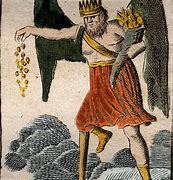
Plutus, which is the Latin spelling of Ploutos, is the god of wealth. He was supposedly born on the Greek island of Crete and is the son of a local hero named Iasion and the goddess DEMETER, who is the goddess of harvest and fertility. He is often depicted as a boy carrying a horn-shaped container of wheat called a cornucopia.

Here are some interesting facts about Plutus:

Plutus Was Originally the God of Agricultural Wealth

The reason Plutus carries wheat was because he was originally meant to only represent wealth in terms of farming output, such as an abundance of crops. But he eventually came to represent wealth in general.

Plutus Was Blind

The Greek god ZEUS blinded Plutus when he was very young, so that he would not just bless wealth onto good people and those who were deserving of it, but onto everybody. Famed ancient Greek playwright Aristophanes once wrote a comedy about Plutus, in which he regains his sight and thereafter only bestows wealth onto those who actually deserve it.

Plutus Was Also Handicapped and Had Wings

Plutus was not just blind, but he was also handicapped. This was to explain why wealth sometimes took a long time to come. He further had wings, which was meant to represent why he left a lot faster than he came.

Often Associated with Pluton

Pluton, which is also written as Plouton, is a Greek god similar to Plutus. He is the god of hidden bounty, and like Plutus, he is often carrying a cornucopia.

Plutus Is Often Depicted as an Infant in the Arms of Goddesses

Many depictions of Plutus show him as baby, sitting in the arms of either TYKHE (TYCHE) — who is the goddess of good fortune — or Eirene (Irene), who is the goddess of peace. This was meant to show that wealth rarely comes alone. It often comes hand-in-hand with good luck or peace.

Plutus is Often Confused with Pluto

While their names may sound similar, Plutus is very different from PLUTO, who is the god of the underworld.

SOURCE: <a href=”https://greekgodsandgoddesses.net/gods/plutus/”>Plutus: https://greekgodsandgoddesses.net</a&gt; – Greek Gods & Goddesses, June 11, 2018

Gods – Greek 2nd Generation Titan – Atlas, God of Endurance and Astronomy

Greek Titan – Atlas

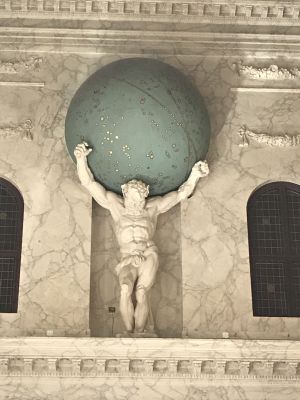
Atlas (the heaven-bearer) was a Titan god of endurance. He was also identified as a god of astronomy because he was the first who instructed mankind in astronomical science which was basically used for navigation and measuring the seasons. It is said, in Library of History by Diodorus Siculus, that he surpassed all others by mastering astrology and was the first to discover spherical nature and therefore being touted as the heaven-bearer. According to Hesiod and Hyginus, Atlas was one of the four sons of Iapetus and oceanid called Clymene but in another source, according to Apollodorus, Iapetus and Asia were his parents. During the war of the gods, unlike his brothers Prometheus and Epimetheus, Atlas sided with the titans along with his other brother Menoetius. After the war he was punished by Zeus who decided not to send him to Tartarus together with his relatives but instead he was sent him to the western edge of the known world, to hold axis between heavens and earth apart and therefore prevent the recurrence of primeval union of Gaea and Uranus and probably a birth of new powerful descendants.

Condemned to a special punishment

During the war against Olympians, Cronusmade Atlas their leader, mostly because of his war skills, extreme orientation and durability. As it turned out, he was quite a leader and it looked like for a long time that they were going to win the war. However, they were outnumbered in the end because Cronus made too many enemies during his ruleage. Atlas was, unlike his relatives, condemned to a special punishment by Zeus himself. He made him as an eternal caretaker of the axis between heavens and earth which were controlled by his predecessors in the past. Because of his endurance, Zeus believed that he was just going to be able to hold them and do nothing else in the meantime. He was right, Atlas was, according to Aeschylus and Ovid, barely supporting the enormous weight of heavens on his shoulders. However, there is an alternative description of the titan by Valerius Flaccus and Virgil who are describing him as an enormous giant standing in the ocean with his feet and his head reaching above the clouds while with ease holding heavens apart from earth.

Descendants of Atlas

But before the punishment, Atlas was in love with Pleione, one of the oceanids, the daughters of Oceanus and Tethys, who gave birth to Pleiades, seven in numbers, that were mentioned by most authors. Their names were AlcyoneAsteropeCelaenoElectra, MaiaMerope and Teygate.

There is a further explanation presented by Hyginus who mentiones in his Fabulae that Atlas and Pleione actually had twelve daughters and a son Hyas. Five of them were Hyades and were named after their brother who was killed by a lion and they had grieved for him so much that they died because of it and were placed among stars. Their names were AmbrosiaCoronisEudoraPhaesyla and Polyxo. And when Hyades died, the rest of the sisters also brought death upon themselves by further grief and were placed among stars known as Pleiades. According to Diodorus Siculus, Atlas also had a brother Hesperus and eventually married one of his daughters by the name of Hesperis. She bore him seven daughters that were named Atlantides, after their father, and Hesperides, after their mother. They were very beautiful and pure and therefore they caught the eye of Egyptian king who dispatched pirates to kidnap them. They were later saved by Heracles.

The account with Heracles

As mentioned above, the daughters of Atlas were kidnapped by pirates while they were playing in their garden and when the pirates stopped to have a meal on their route back to Egypt, Heracles, in one of his last labours, came along. When he found out by the maidens what had happened, he slew the pirates on site and brought ladies back to Atlas. In his gratitude, Atlas helped Heracles in his labour, presumably giving him the apples from his daughter’s garden, and also gave him lessons in astrology.

However, the mainstream belief is that Atlas was encountered by Heracles who came to the titan on the advice of Prometheus in his eleventh labour, when he had to retrieve apples of Hesperides. In need of his services, Heracles offered himself as temporary caretaker. In return he asked the titan to help him with the Golden Apples quest. The garden, controlled by Hera, was tended by Hesperides, the titan’s daughters. Upon return, Atlas tried to convince Heracles to hold the heavens for a bit longer while he was going to deliver the Apples himself which was definitely not the case. Heracles thought of this trickery and asked him to hold the heavens for just a few moments so he could reposition his cloak to serve him as support. The titan fell for the trick and when he reclaimed his position, Heracles took the apples and ran away, and opportunity to escape was gone.

“Released” from his burden

According to Fulgentis’ Mythologies and Ovid’s Metamorphoses, Atlas, with the heavens on his back, was at some point encountered by Perseus who was on his way back to Seriphos Island. Perseus kindly asked the titan for a shelter over night, telling him that he was a son of Zeus. The titan replied by stating that he was a liar which angered the hero and Perseus then in revenge turned Atlas into stone by showing him the head of Medusa and released him from his burden. From that point on he was known as Mount Atlas. Now, this contradicts the story of Atlas meeting Heracles becuase Perseus lived in the times before Heracles and therefore Heracles could not meet Atlas and ask him for help, if he was already turned into a mountain.

Goddesses and Gods – The 21 Main Egyptian Gods and Goddesses

The Egyptian pantheon includes all the gods created by the falcon-headed Sun god Ra. Egyptian gods include many gods with animal heads (Horus, Set, Anubis, Thoth, Bastet, Sekhmet, Ra) and others with human heads (Osiris, Isis, Nephthys, Amun).

We will see together in this article:

  • The gods Ra, Apep, Aten, and Sekhmet involved in the creation of the Universe
  • The gods Set, Osiris, Isis, Nephthys, and Horus involved in the tragedy called “myth of Osiris”
  • The gods Anubis, Thoth, and Ammit involved in the judgment of the Egyptian dead
  • The other important gods: Khepri, Amun, Ptah, Taweret, and Sobek

Let’s begin without further ado by discovering the first of these gods and the creator of the Egyptian world: Ra, the falcon Sun god.

 Ra –

The creation of all the other gods by Ra

The primordial function of Ra in the Egyptian Universe

Apep

Aten

Osiris

Isis

Horus

Set

Nephthys

Sekhmet

Bastet

Hathor

Anubis

Ammit

Thoth

Khepri

Ptah

Amun

Taweret

Sobek

click here to read information presented about the 21 main Egyptian Gods and Goddesses

Goddesses and Gods – A List of Sun Deities

I will use this list to do a more in-depth post on these deities in the future.

Name Nationality/Religion God or Goddess? Notes
Amaterasu Japan Sun Goddess Major deity of the Shinto religion.
Arinna (Hebat) Hittite (Syrian) Sun Goddess The most important of three Hittite major solar deities
Apollo Roman Sun God
Freyr Norse Sun God A fertility god associated with the sun.
Helios Greek Sun God Before Apollo was the Greek sun god, Helios held that position. Helios road a chariot.
Huitzilopochtli (Uitzilopochtli) Aztec Sun God
Hvar Khshaita Iranian/Persian Sun God
Inti Inca Sun God The national patron of the Inca state.
Liza West African Sun God
Lugh Celtic Sun God
Mithras Iranian/Persian Sun God
Ra Egypt Mid-day Sun God An Egyptian god shown with a solar disk. Center of worship was Heliopolis. Later associated with Horus as Re-Horakhty. Also combined with Amun as Amun-Ra, a solar creator god.
Shemesh/Shepesh Ugarit Sun goddess
Sol (Sunna) Norse Sun Goddess She rides in a horse-drawn solar chariot.
Sol Invictus Roman Sun God The unconquered sun. The title was also used of Mithras.
Surya Hindu Sun God Rides the sky in a horse-drawn chariot.
Tonatiuh Aztec Sun God
Utu (Shamash) Mesopotamia Sun God

Goddesses and Gods – 7 Ancient Pagan Gods We Still Love Today

The old pagan gods—those legendary figures out of Norse, Greek, Roman, and many more belief systems—are fascinating subjects. These gods had all of the emotional fallibility of human beings, yet the all the power of the gods they were, and in their stories, they proved capable of shocking levels of pettiness, jealously, and downright cruelty. They were also, however, capable of great kindness, heroism, and justice, making for a set of truly interesting characters. They were us, but moreso.

It’s no wonder, then, that many of these gods that featured in stories thousands of years ago are still prominent in our contemporary fiction. We see them in our superheroes and action stars, who can be thought of as the great grandchildren of the original pagan gods.

But those gods that have survived the millennia with their names and stories intact are the ones we love the most—something about their personalities, their struggles, or their stories intrigues us. They’re the most compelling of them all, so let’s explore them by taking a look at 7 ancient pagan gods we still love today.

Click here to read about the following Gods and Goddesses

Loki

Zeus

Hercules

Odin

Thor

Shinigami

Hel

The Immortality of Entertainment

The fact that we’re still telling stories about these gods and goddesses thousands of years after their heyday is amazing, and these particular 7 beings have a special appeal that goes beyond the norm.

Maybe it’s because they’re powerful. Or perhaps it is because we wish we could affect the world like they do. But likeliest of all is that their larger-than-life personalities and stories simply allow us a glimpse of the extremes of life that few of us ever get to experience.

And that is why the gods will never die.

Goddesses and Gods – Celtic – Medb – Legendary Queen of Ireland and Belenos – The Shining God

Celtic Goddess Medb – Legendary Queen of Ireland

The story of Queen Medb is one of Ireland’s greatest legends. This goddess in the flesh was fierce, seductive, beautiful, and most importantly powerful. No man could be king of Ireland’s ancient sites of Tara or Cruachan without first becoming her husband.

Table of Contents

Celtic God – Belenos The Shining God

A Celtic Deity, also known as Belen, Belenus, Belinus, Bellinus, Bélénos, Belennos, Belenos, Bel, Bilé: The Shining God

Belenos is unusual in Celtic belief, as this deity (under the various version of his name) is known throughout the Celtic world. He is also remembered in place names and personal names throughout the Celtic lands. His symbols are the horse an wheel and his name means ‘The Shining God’. He is one of the Celtic high gods, and is probably a solar deity.

Possibly one of the most widespread of all the Celtic deities he is known from Italy (Cis-Alpine Gaul), Gaul, Britain and Ireland.

In Britain the personal name Bellinus occurs at Binchester (Vinovia), County Durham a name derived from the god-form Belenus, the native Brythonic form of which would be Belenus. Traces of this name having been found at Maryport. To the continental Brython the Cult of Belenus possessed a particular status in that it is mentioned in a number of Classical Literary sources. Ausonius was a poet from Bordeaux, writing in the later 4th century AD and alludes to sanctuaries to Belenus in Aquitania. Tertullian talks of the cult of Belenus in the Norican Alps (Apologeticus 24,7); and Herodian mentions Belenus’ worship at Aquileia in North Italy (History of the Empire after Marcus,8,3.6). In Ireland Beli is known as Bilé and is referred to as ‘The Father of Gods and Men’.

The Celtic fire festival on the first of May, known as Beltane, (the fires of Bel) is probably derived from the name of this deity. Beltane fires were lit to encourage the sun’s warmth. These fires also had restorative properties and cattle were herded between them before being loosed on the new spring pastures. From this it is likely that Beli was a fire deity, a patron of flame and the sun’s restorative powers (which explains his classical association with Apollo). Originally he may have been a pastoral deity and in Cymric myth is associated with cattle, sheep and cropt. Though this may be because Beltane was the time that herds were moved to the high pastures.

His symbols were the horse (as shown, for example, by the clay horse figurine offerings at Belenos’ Sainte-Sabine shrine in Burgundy), and also the Wheel (as illustrated on the famous Gundestrup Cauldron).

The Irish Bilé is a god of death and husband to Dana. In the tale of Lludd and Llefelys, the folk memory of Beli represents him as Belen o Lŷn, son of Manogan and father to Lludd and Llefelys. Both Beli and Lludd lend their names to sites in London; Billingsgate and Ludgate, respecitvely. Beli’s name is also found in the name of one of the most notable Brythonic chieftains before the Roman invasion, Cunobelinos (or, in Brythonic, Cunobel), the hound of Bel.

In Gaulish mythology Belenus’ consort was the goddess Belisama.

It is unlikely, as some have suggested, that the Cymric deity Beli Mawr is etymologically related to Belenos, as though the migration of Brython to old and middle Cymric this is far more likely to yield the name Belen or Belyn. Indeed, this is the name which we see in the Cymric form (Cynfelen) of the Catuvellauni leader during the Claudian invasion of Britain, Cunobelinos (the hound of Belinos). Inded, the tribe name Catuvellauni itself means ‘The Host of Belinos’ and their most well-known leader Cassivellaunos’ name means ‘The Devotee of Belenos’. There is also the figure of ‘Belen o Leyn’ who figures in triad 62 0f the Trioedd Ynys Prydain and is preserved today in the place-name Tyddyn Belyn near Tudweilog on the Llŷn Peninsula ELlSG. Rather, Beli Mawr is more likely derived from the name of the Gaulish deity Bolgios.

Belenos’ name is derived from the reconstructed proto-Celtic elements *belo- (bright/shining), the deicific particle -n- and the masculine ending -os. Thus Belenos is ‘The Shining God’.

Goddesses and Gods – Greek Titans – Rhea, Goddess of Fertility and Motherhood and Hyperion, God of Light and Sunlight

Greek Titans – Rhea, goddess of fertility and motherhood

Rhea (Rheia, Opis, Ops) was a Titan goddess of fertility and motherhood. She was very gentle and comfortable. Her name actually means “ease” as “at ease” and therefore this was probably the reason she was interpreted and worshiped as a goddess of comfort and ease. According to some authors, she is also described as the supreme mother goddess, just like her mother Gaea was and what later her daughter Hera became, but in Orphic hymn Rhea was even described as the supreme goddess, mother of all gods and men and it is said that even Uranus and Gaea derived from her. And as if there were not enough confusion yet, according to various authors, Rhea is also described as Cybelean goddess whose home was in Phyrgia which means that they are equating her with Cybelle, Anatolian earth goddess, but to return back to mainstream belief, backed by most authors, Rhea was a daughter of Uranus and Gaea and, because she was married to her brother Cronus, she was also a queen of the Cosmos. Together they represented “eternal flow” as they gave birth to a new generation of gods who then took control of the world, just like they and other titans had done it in the past. Therefore, she was also identified as a goddess of generations.

Birth of Olympians and plot against Cronus

Rhea was very much like her mother and loved her children unconditionally but unfortunately Cronus was like his father, jealous of his children’s powers and in fear of being overthrown. She became mad when Cronus forced her to give him their children to swallow upon birth. She started plotting against him and by the time he had swallowed HestiaHeraPoseidonHades, and Demeter, Rhea decided that enough is enough. She gave birth to her last childZeusin secrecy and gave Cronus a rock, wrapped in a blanket, to swallow instead. Cronus was pleased, not knowing that Zeus was still out there, and thought he was safe from the prophecy. In Hesiod’s Theogony, it is said that Rhea brought infant Zeus to Crete and gave it to Gaea to look after him. Gaea then guided him to the secret cave beneath Mount Aegeum or Mount Dicte. Zeus was raised there and, when grown up, came to Mount Othrys as a cupbearer and mixed a potion into Cronus’ drink which made him vomit all of his children. Later, in a ten-year war, Zeus and Olympians defeated Cronus and the Titans. They became the next rulers, just like Cronus and his brothers had done in the past, when overthrowing Uranus. In the end, Rhea was the main reason that history repeated itself.

According to Diodorus Siculus, it is said that Poseidon too had escaped the cannibalism of his father and that it was Rhea who had given him to the Telchines to look after him. However, according Pausanias, Rhea had hidden Poseidon among a flock of lambs when he was next to be swallowed.

The desire of motherhood

Like mentioned in Ovid’s Fasti, Rhea was mad and angry because she was often pregnant but never truly a mother of her children due to cannibalism of Cronus who ate most of them while Zeus and, variously, Poseidon on the other hand had to be hidden away from Cronus. She was mentioned to be often in company of lions which she nursed and took care of. The goddess is also said to have helped nurturing the young Dionysus when he was brought to her by Hermes, on Zeus’ orders who had to hide him from jealous and angry Hera. She was also, according to Homeric hymn to Apollo, involved in the birth of Apollo on the island of Delos. Upon the god’s birth, she, along her sisters Tethys and Theia, washed him with pure clean water and placed him in a white garment and took care of him until Leto recovered.

Other myths

Rhea was also involved in the return of Demeter to Mount Olympus. Demeter, in grief and sorrow, withdrew herself from the rest of the gods when Persephone was abducted. When the two were reunited, Demeter, still in anger of Persephone being bound to the underworld, declined to return. However, Rhea came to Demeter and convinced her that her place is among her brothers and sisters on Mount Olympus. In Nonnus’ Dionysiaca, Rhea is also said to had given an Amethyst to Dionysus that protected him from the tyranny of madness when drinking wine.

Greek Titan – Hyperion, god of light and sunlight

Hyperion was a Titan god of light or sunlight and was associated with watching and observation from above. He was also known as a Pillar of east. Together with his other three brothers, CriusCoeus and Iapetus, they presided as the Pillars of holding Heaven and Earth apart. He was one of six sons of Uranus and Gaea and is mentioned by Apollodorus as one of the five brothers, all but Oceanus, who participated in rebellion against Uranus and later attacked him. When they overcame him, the four brothers probably held him down while Cronus castrated him. While most of the authors are identifying Hyperion as a unique character, Homer is equating Helios and Hyperion as one and the same character and it can be seen in both of his epics, the Iliad and the Odyssey.

Establishing a rhythm of days and months

Due to his diligent observation, he was first to understand the movements of the sun and the moon, as well as the other stars and seasons. He was believed to have ordered the cycles of the sun, the moon and the dawn. During his time, he married her sister Theia with whom he had three children who presided over these cycles. Helios presided over sun, Selene over the moon and Eos presided over the dawn.

If you want to learn a bit more about Selene, check the page of Theia or Sky deities.

Titanomachy

Although there are notes of Hyperion participating in Titanomachy, there is no reference of his role in the war. It is only known that he sided with his brothers and fellow Titans against younger Olympians. And that he was in the end, after losing the war, imprisoned in Tartarus with his brothers and relatives. However, according to Aeschylus’ lost play , he was later released byZeus from Tartarus with the rest of the titans.


Goddesses and Gods – Who are the main Celtic Gods and Goddesses?

(The lists below name the more well known Irish Celtic gods and goddesses. There are lessor know ones as well.)

Who are the Celtic Gods and Celtic Goddesses?

Celtic pagan gods and goddesses were thought to have special influential powers over aspects of daily life and the natural world.

The ancient Celts were polytheistic and are thought to have worshiped over 400 Celtic gods and goddesses, although it is difficult to pinpoint an exact figure.

Some of these gods and goddesses of Celtic mythology were revered across the Celtic world, whereas others seemed to have been less well known and worshiped only in certain regions or specific locations.

Table of Contents

1 Who are the Celtic Gods and Celtic Goddesses?

2 Celtic Deities vs Roman Deities

3 Who are the main Celtic Gods and Goddesses?

4 Celtic Gods and Goddesses in Irish Mythology

5 Irish Gods

6 Irish Goddesses

7 Celtic Deity Types

The names of Celtic gods and the names of Celtic goddesses that occur often in Celtic mythology are listed below.

List of Celtic Gods

Lugh – Celtic God of Justice and Mischief

The Dagda – Celtic God of Agriculture, Fertility and Seasons and King of the Gods

Aengus – Celtic God of Love, Youth, Summer and poetry

Manannan – Celtic God of the Sea

Cú Chullain – Demigod and Warrior Hero

Belenus – Celtic God of Fire

Donn – Celtic God of Death

Neit – Celtic God of War

List of Celtic Goddesses

Danu – Celtic Mother Goddess

The Morrigan – Celtic Goddess of War

Áine – Celtic Goddess of Love, Wealth and Sovereignty

Brigid – Celtic Goddess of Healing, Poetry and Blacksmithing

Flidas – Celtic Goddess of Cattle and Fertility

Bébinn – Celtic Goddess of Birth

Airmed – Celtic Goddess of Herbalism

Celtic Gods and Goddesses in Irish Mythology


Goddesses and Gods – Greek Titans – Phoebe, Goddess of Prophetic Radiance and Crius, God of Heavenly Constellations

Greek Titans – Phoebe, goddess of prophetic radiance

Phoebe (Phoibe) was a Titan goddess of prophetic radiance, often associated with Selene (goddess of the moon). She, however, had never been referred as the goddess of the moon. The misinterpretation probably comes because her granddaughter Artemis was also called Phoebe, after her, just like her grandson Apollo was called Phoebus. And latin authors were all referring Phoebe as the moon goddess or moon itself, but they clearly had Artemis in mind doing so. That is why the Titaness is often misidentified as the moon goddess. To the Greeks it was pretty simple and obvious that Selene was the correct goddess. Romans on the other hand associated Artemis, Hera and Selene to the moon amongst others, but there was no mentioning of Titaness Phoebe. However, some researchers believe that Artemis (Diana, Phoebe) became known as the goddess of the moon because of her grandmother whom she got the name after. Anyhow, Phoebe was rather associated with being prophetic, like her sister Themis and her mother Gaea. She was also one of the twelve titans who were the descendants of Uranus and Gaea. She was, like all of her sisters, never involved in the war between Titans and Olympian gods, and was spared from being imprisoned in Tartarus. Instead, she took her place at the oracle of Delphi.

Prophet of the Delphic Oracle

She became the third prophet at the Oracle of Delphi, where she was believed to have heard her mother’s voices. Her predecessors were Gaea and Themis. Gaea honorably gave away her place to her daughter Themis who then gave it to her sister Phoebe. However, according to Aeschylus‘s myth, Phoebe had felt like having extreme burden to carry and gave away her place to her grandson Apollo as a present for his birthday, probably to motivate him. Apollo then presided over the prophetic power of light and heavens.

Asteria and Leto

Phoebe consorted with her brother Coeus, with whom she had two daughters. One of the daughters, called Leto, plays an important role in the later ages, in the time of Olympians. In those times, Phoebe had also developed a lust for mortal men, but her affairs never came to any fruition. According to Hyginus, who also mentions Asteria and Leto, she was also the mother of Perses and Pallas by Coeus.


Asteria – Titan goddess of oracles and prophecies. With her cousin Perses, she gave birth to goddess Hecate. She was also very beautiful like her sister and therefore pursued by Zeus. However, in order to escape from his embraces, she transformed herself into an island Asteria, later known as Delos.

Leto – Titan goddess of modesty and motherhood. She had very beautiful eyes, with which she charmed Zeus and he soon got her pregnant. Because of it, she was pursued relentlessly by jealous Zeus’s wife Hera who drove her from island to island, preventing her to rest and give birth. In the end Leto was finally provided with refuge by her sister Asteria who welcomed her to literally reside on her.

Greek Titans – Crius, god of heavenly constellations

Crius (Krios, the Ram, Aries) was a Titan god of heavenly constellations and was also known as a Pillar of the south pole. Crius, which means “Ram”, was often referred as a starting season of the Greek year, because his constellation was called Aries which nowadays means the start of spring. Together with his other three brothers CoeusHyperion and Iapetus, they presided as the Pillars of holding Heaven and Earth apart. He was one of six sons of Uranus and Gaea and is mentioned by Apollodorus as one of the five brothers, all but Oceanus, who participated in rebellion against Uranus and later attacked him. When they overcame him, the four brothers probably held him down, while Cronus castrated him. According to Pausanias, Crius was the father of Python, a dragon slain by Apollo, and was also closely related with the island of Euboea. The author even names two rivers after the titan.

Titanomachy

In a time of war, he was mentioned siding with the Titans against the younger Olympian gods. After the war, where the titans had lost, Crius was along his brothers and many relatives imprisoned in Tartarus beneath the underworld. Although there is no clear statement made, he was supposed to be condemned to eternal punishment. However, according to Aeschylus’ lost play , he was later released byZeus from Tartarus with the rest of the titans.

Father of the Astraeus, Pallas, and Perses

In his time, he consorted with his half-sister Eurybia, a daughter of Gaea and Pontus. Together they had three children:

Astraeus – Titan god of the stars and the art of astrology. He was also the god of the dusk and father of the Four Winds and the Stars of the Heaven by Eos(goddess of dawn). They also had children who are often associated with the time of twilight.

Pallas – Titan god of warcraft who was defeated during Titanomachy by younger goddess Athena. He was a father of RivalryVictoryStrength and Power.

Perses – Titan god of destruction. He was married with his cousin Asteria with whom he fathered Hecate.

Gods – Gwydion (Welsh – Celtic)

Gwydion (Celtic Welsh)

Gwydion fab Dôn is a magician, hero and trickster of Welsh mythology, appearing most prominently in the Fourth Branch of the Mabinogi, which focuses largely on his relationship with his young nephew, Lleu Llaw Gyffes. He also appears prominently in the Welsh Triads, the Book of Taliesin and the Stanzas of the Graves.

The name Gwydion (which should more properly be spelled Gwyddien in Modern Welsh, as can be adduced from its Old Welsh form Guidgen; cognate with Old Irish Fidgen) may be interpreted as “Born of Trees”.[1]

War with the South
Gilfaethwy, nephew to the Venedotian king, Math fab Mathonwy, falls in love with his uncle’s virgin foot-holder, Goewin. His brother Gwydion conspires to start a war between the north and the south, so as give the brothers the opportunity to rape Goewin while Math is distracted. To this end, Gwydion employs his magic powers to steal a number of otherworldy pigs from the Demetian king, Pryderi, who retaliates by marching on Gwynedd. Meanwhile, Gwydion and Gilfaethwy attack and rape Goewin.

Pryderi and his men march north and fight a battle between Maenor Bennardd and Maenor Coed Alun, but are forced to retreat. He is pursued to Nant Call, where more of his men are slaughtered, and then to Dol Benmaen, where he suaffers a third defeat. To avoid further bloodshed, it is agreed that the outcome of the battle should be decided by single combat between Gwydion and Pryderi. The two contenders meet at a place called Y Velen Rhyd in Ardudwy, and “because of strength and valour and magic and enchantment”, Gwydion triumphs and Pryderi is killed. The men of Dyfed retreat back to their own land, lamenting over the death of their lord.

Birth of Lleu
When Math hears of the assault on Goewin, he turns his nephews into a series of mated pairs of animals: Gwydion becomes a stag for a year, then a sow and finally a wolf. Gilfaethwy becomes a hind deer, a boar and a she-wolf. Each year they produce an offspring which is sent to Math: Hyddwn, Hychddwn and Bleiddwn. After three years, Math releases his nephews from their punishment and begins the search for a new foot-holder. Gwydion suggests his sister Arianrhod, who is magically tested for virginity by Math. During the test, she gives birth to a “sturdy boy with thick yellow hair” whom Math names Dylan and who takes on the nature of the seas until his death at his uncle Gofannon’s hands.

Ashamed, Arianrhod runs to the door, but on her way out something small drops from her, which Gwydion wraps up and places in a chest at the foot of his bed. Some time later, he hears screams from within the chest, and opens it to discover a baby boy. Some scholars have suggested that in an earlier form of the Fourth Branch, Gwydion was the father of Arianrhod’s sons.[2]

The tynghedau of Arianrhod
Some years later, Gwydion accompanies the boy to Caer Arianrhod, and presents him to his mother. The furious Arianrhod, shamed by this reminder of her loss of virginity, places a tynged on the boy: that only she could give him a name. Gwydion however tricks his sister by disguising himself and the boy as cobblers and luring Arianrhod into going to them in person in order to have some shoes made for her. The boy throws a stone and strikes a wren “between the tendon and the bone of its leg”, causing Arianrhod to make the remark “it is with a skillful hand that the fair-haired one has hit it “. At that Gwydion reveals himself, saying Lleu Llaw Gyffes; “the fair-haired one with the skillful hand,” is his name now”. Furious at this trickery, Arianrhod places another tynged on Lleu: he shall receive arms from no one but Arianrhod herself. Gwydion tricks his sister once again, and she unwittingly arms Lleu herself, leading to her placing a third tynged on him: that he shall never have a human wife.

So as to counteract Arianrhod’s curse, Math and Gwydion:
“ [take] the flowers of the oak, and the flowers of the broom, and the flowers of the meadowsweet, and from those they conjured up the fairest and most beautiful maiden anyone had ever seen. And they baptized her in the way that they did at that time, and named her Blodeuwedd. ”
Lleu’s death and resurrection
Blodeuwedd has an affair with Gronw Pebr, the lord of Penllyn, and the two conspire to murder Lleu. Blodeuwedd tricks Lleu into revealing how he may be killed, since he can not be killed during the day or night, nor indoors or outdoors, neither riding nor walking, not clothed and not naked, nor by any weapon lawfully made. He reveals to her that he can only be killed at dusk, wrapped in a net with one foot on a cauldron and one on a goat and with a spear forged for a year during the hours when everyone is at mass. With this information she arranges his death.

Struck by the spear thrown by Gronw’s hand, Lleu transforms into an eagle and flies away. Gwydion tracks him down and finds him perched high on an oak tree. Through the singing of an englyn (known as englyn Gwydion) he lures him down from the oak tree and switches him back to his human form. Gwydion and Math nurse Lleu back to health before reclaiming his lands from Gronw and Blodeuwedd. In the face-off between Lleu and Gronw, Gronw asks if he may place a large stone between himself and Lleu’s spear. Lleu allows him to do so, then throws his spear which pierces both the stone and Gronw, killing him. Gwydion corners Blodeuwedd and turns her into an owl, the creature hated by all other birds. The tale ends with Lleu ascending to the throne of Gwynedd.

The Battle of the Trees
A large tradition seems to have once surrounded the Battle of the Trees, a mythological conflict fought between the sons of Dôn and the forces of Annwn, the Welsh Otherworld. Amaethon, Gwydion’s brother, steals a white roebuck and a whelp from Arawn, king of the otherworld, leading to a great battle.

Gwydion fights alongside his brother and, assisted by Lleu, enchants the “elementary trees and sedges” to rise up as warriors against Arawn’s forces. The alder leads the attack, while the aspen falls in battle, and heaven and earth tremble before the oak, a “valiant door keeper against the enemy”. The bluebells combine and cause a “consternation” but the hero is the holly, tinted with green.

A warrior fighting alongside Arawn cannot be vanquished unless his enemies can guess his name. Gwydion guesses the warrior’s name, identifying him from the sprigs of alder on his shield, and sings two englyns:

“Sure-hoofed is my steed impelled by the spur;
The high sprigs of alder are on thy shield;
Bran art thou called, of the glittering branches.”

Sure-hoofed is my steed in the day of battle:
The high sprigs of alder are on thy hand:
Bran by the branch thou bearest
Has Amathaon the good prevailed.”

Other traditions
Caer Gwydion, the castle of Gwydion, was the traditional Welsh name for the Milky Way.

In the 10th century, Old Welsh “Harleian” genealogies (Harleian MS 3859), mention is made of Lou Hen (“Lou the old”) map Guidgen, who most scholars identify with Lleu and Gwydion (who is implied to be Lleu’s father in the Mabinogi of Math, though this relationship isn’t explicitly stated). In the genealogy they are made direct descendants Caratauc son of Cinbelin son of Teuhant (recte Tehuant), who are to be identified with the historical Catuuellaunian leaders Caratacus, Cunobelinus and Tasciovanus.

A number of references to Gwydion can be found in early Welsh poetry. The poem Prif Gyuarch Taliessin asks “Lleu and Gwydion / Will they perform magics?”, while in the same corpus, the poem Kadeir Cerridwen relates many familiar traditions concerning Gwydion, including his creating of a woman out of flowers and his bringing of the pigs from the south. This poem also refers to a lost tradition concerning a battle between Gwydion and an unknown enemy at the Nant Ffrangon. Another Taliesin poem, Echrys Ynys refers to Gwynedd as the “Land of Gwydion” while in the Ystoria Taliesin, the legendary bard claims to have been present at Gwydion’s birth “before the court of Don”.

The Welsh Triads name Gwydion as one of the “Three Golden Shoemakers of the Island of Britain” alongside Manawydan fab Llyr and Caswallawn fab Beli, and records that Math taught him one of the “Three Great Enchantments”. The Stanzas of the Graves record that he was buried at Dinas Dinlle, the city of Lleu.

A reference to Gwydion is also made in the Dialogue of Taliesin and Ugnach, a dialogue-poem found in the Black Book of Carmarthen. Within the narrative, the character of Taliesin states:

“When I return from Caer Seon
From contending with Jews
I will come to the city of Lleu and Gwydion.”

From: Wiki

The warrior god. Gwydyon was the god of magic, poetry and music.

Gwydyon was the son of Don and Beli. Gwydyon was the son of Amathon, Aranrhod, Gilvaethwy, Govannon, and Nudd. Gwydyon adopted the children of his sister Aranrhod: Dylan and Lleu.

Gwydyon served as the chief adviser of his uncle Math, king of Gwynedd, in northern Wales. He killed Pryderi in single combat over some pigs.

Gwydyon helped Lleu overcome the curses or taboos set by Lleu’s mother (Aranrhod), and rescued his nephew when he was transformed into an eagle.

From: Gwydyon

Gwydion, one of the nephews of Math ap Mathonwy, and brother of Arianrhod. He contrived Gilfaethwy’s rape of the maiden Goewin, Math’s foot holder. He did this by starting a war with Pryderi of Dyfed, stealing his pigs, and thus taking Math away on campaign. But he and Gilfaethwy doubled back and Gwydion forced the other women to leave Goewin with Gilfaethwy, who raped her. When she confessed this to Math, he levied as punishment on his nephews that they spent three years as animals, Gwydion as a stag, a wild sow, and a wolf, breeding each year with his brother Gilfaethwy who was hind, boar, and she-wolf. They produced three offspring, whom Math made human and raised at his court. Afterward, they were restored to the court. Gwydion raised Arianrhod’s virgin-born son Llew Llaw Gyffes, winning for him his name and arms by tricking his mother, and created a woman out of flowers to marry him. After that woman, Blodeuwedd, betrayed Llew to his death, Gwydion restored him to life and turned her into an owl.

From: here

Gwydion fab Dôn is a Cymric (Welsh) god known from the Mabinogi of Math mab Mathonwy and the Welsh Triads. He ranks amongst the foremost and most important of the Cymric gods. He is the arch mage, god of magic and wisdom.

(…)

Gwydion is the elder members of the Plant Dô and also the senior member of the primary triad of deities, Gwydion, Gofannon (great smith) and Amaethon (great husbander) that mark their mother Dôn as a ‘Great Mother’ archetype.

Gwydion is primarily known from the fourth branch of the Mabinogi, the tale of Math mab Mathonwy. Gwydion starts out as the foil of this tale, before emerging as its hero. He starts a war with Pryderi of Dyfed and steals the swine of Annwfn by exchanging them for gifts of steeds and greyhounds he has engendered from mushrooms. All of which is done so that his uncle Math mab Mathonwy goes to war, allowing Gwydion to aid his brother Gilfaethwy.html in raping Math’s foot-holder, Goewin. During the ensuing war Gwydion kills Pryderi and secures the magical swine of Annwfn for Math. As punishment for the rape of Goewin (whom Math marries) Gwydion and Gilfaethwy.html are turned successively into male and female deer, swine and wolves to spend a year in each form and to bear sons one upon the other. This punishment concluded and the rift between Gwydion and Math is healed.

(…)

Gwydion is the archetypal great mage; able to create animals from mushrooms, leather and boats from seaweed, a woman from flowers and able to create the illusion of an invading fleet almost at will. He is great in knowledge (which is also the literal meaning of his name). Indeed, Gwydion could be considered as the deified personification of a druid. Indeed, the Cymric form of druid, Derwydd contains the same same component Gwydd (meaning knowledge) that is also found in Gwydion’s name.

For the full article: Celtnet

Also see:
Mary Jones Celtic Encyclopedia entry

Gods – Coeus, Greek Titan God of Intelligence and Farsight

Coeus, Greek Titan God from greek-gods.org

Coeus (Koios, Polos) was a Titan god of intelligence and farsight, meaning that, due to his inquisitive mind and desire to learn, he was with gained knowledge and understanding able to see beyond the obvious. He was also identified as a god of wisdom and heavenly oracles. Coeus was also known as a Pillar of the north pole from which constellations revolved and, therefore, controlled the axis between Heaven and Earth. Together with his other three brothers CriusHyperion and Iapetus, they presided as the Pillars of holding Heaven and Earth apart. He was one of six sons of Uranus and Gaea and is mentioned by Apollodorus as one of the five brothers, all but Oceanus, who participated in rebellion against Uranus and later attacked him. When they overcame him, the four brothers probably held him down, while Cronus castrated him. His latin name was Polos or Polus and according to Hyginus the name Coeus was used for a giant instead of titan. They are clearly two different characters mentioned by not only Hyginus, but also by Virgil, another latin author.

Titanomachy

In the time of war Coeus fought bravely with his brothers against Olympians but was after defeat imprisoned in Tartarus like the rest of his brothers. When in Tartarus, according to Valerius Flaccus, Coeus had escaped free of his adamantine bonds and in his madness wanted to escape from the underworld and reach heavens, seeking revenge. But was in the end restrained by Cerberus, the three-headed beast, which guarded gates of Hades and prevented anyone from leaving. However, according to Aeschylus’ lost play , he was later released byZeus from Tartarus with the rest of the titans. Also, it is said by some researchers that Coeus then fled back to his north pole and became known as the north star.

Prophetic family

As mentioned above, Coeus was also a god of heavenly oracles. He was believed to be able to hear prophetic voices of his father Uranus(heaven), just like Phoebe could hear prophetic voices of her mother Gaea(earth). Together they had two daughters who inherited powers of their parents. Leto was a goddess of modesty and motherhood and was associated with prophetic power of light and heaven, while Asteria was a goddess of oracles and prophecies. She was associated with prophetic power of night and the dead. Leto represented the light time of a day, while, in contrast, Asteria represented with the night time of a day. These contrary qualities were also passed to their descendants. Apollo inherited the power of the light from his mother Leto and Hecate inherited the power of the night from Asteria.

Still there is no source with clear statement of Coeus being prophetic except having a prophetic family. Being able to predict the future in his case might have come from his intelligence and divine knowledge that he was so eager to gain from his predecessors. Perhaps that is why he was also identified as the god of wisdom. Having knowledge is one thing, but being able to truly understand it and use it for predicting future natural occurrences and events is being wise.


Gods – Uranus Greek Sky God

Uranus – God of The Sky from greekgodsandgoddesses.net

Uranus is one of the old gods in GREEK MYTHOLOGY. He was the god of the sky and the starry heavens.

He ruled the universe, and his name means sky or heaven. He literally was the sky, which the Greeks envisioned as a brass dome studded with stars. He was the husband of GAIA, or Earth. He was not only her husband, but her son.

In some stories Gaia, who is the mother of all living things, conceived him without a father. In others, the father of Uranus is Aether or CHAOS.

Together, Uranus and Gaia had many offspring, including the Titans, pre-Olympian gods and goddesses; the CYCLOPES, the one-eyed giants and the Hecatoncheires, giants who had fifty heads and one hundred hands.

According to myth, Uranus came to Gaia every night and sired the children upon her, but he disliked all of them. He considered them threats to his power. Though his Titan children could be quite beautiful, Uranus was so repelled by the sight of the HECATONCHEIRES that he tried to push them back into Gaia’s womb, which caused her terrible pain. Eventually, Uranus imprisoned the Cyclopes and the Hecatoncheires in TARTARUS, a gloomy place that lay beneath the Earth or Hades.

This caused Gaia to resent Uranus even more, and she plotted with her Titan children to at least overthrow him, since Uranus was immortal and couldn’t be killed. Only her youngest son Cronus agreed to the plot, because he wanted to replace his father as leader of the gods. Gaia fashioned a sickle of flint and gave it to him.

One night, when Uranus came to Gaia, his sons ambushed him and held him down while Cronus used the sickle to castrate him. He threw both the sickle and Uranus’ genitals into the sea. The blood from the mutilation fell on the earth and gave rise to the GIGANTES, or Giants; the ash tree nymphs called THE MELIAE and the Furies, or THE ERINYES. Some myths claim that the Telchines, gods who settled the isle of Rhodes, were also born at this time. The goddess APHRODITE arose from the genitals that were tossed into the sea.

The Giants were not necessarily large, but they were very aggressive and fought the OLYMPIAN GODS. The Meliae helped to raise Cronus and Rhea’s son ZEUS after Rhea needed to hide him from Cronus, who would have swallowed him as he’d swallowed Zeus’ other brothers and sisters.