
Please pray and light a candle for the protection of the people living in Ukraine and that this war does not escalate but is over very soon.

Please pray and light a candle for the protection of the people living in Ukraine and that this war does not escalate but is over very soon.
Discover the cosmos! Each day a different image or photograph of our fascinating universe is featured, along with a brief explanation written by a professional astronomer.
2022 March 4
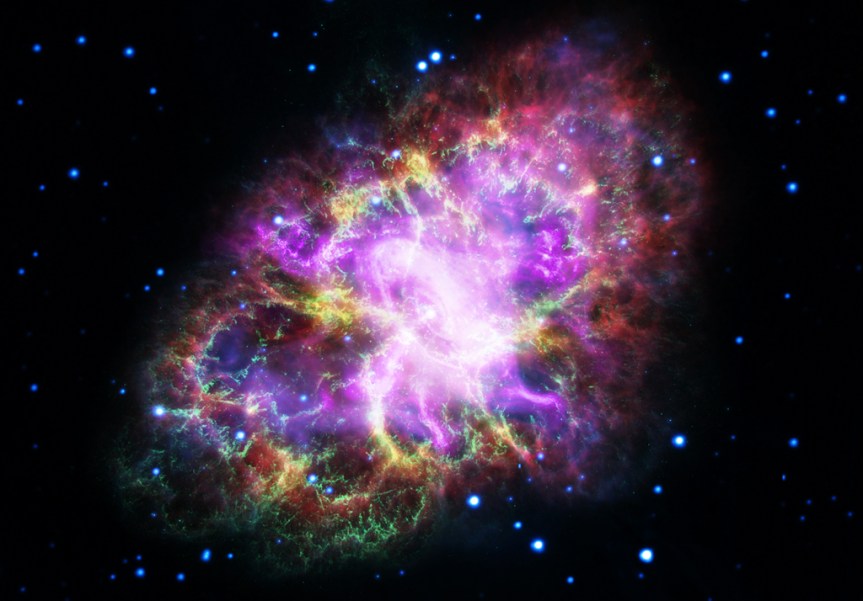
Explanation: The Crab Nebula is cataloged as M1, the first object on Charles Messier’s famous list of things which are not comets. In fact, the Crab is now known to be a supernova remnant, expanding debris from massive star’s death explosion, witnessed on planet Earth in 1054 AD. This brave new image offers a 21st century view of the Crab Nebula by presenting image data from across the electromagnetic spectrum as wavelengths of visible light. From space, Chandra (X-ray) XMM-Newton (ultraviolet), Hubble (visible), and Spitzer (infrared), data are in purple, blue, green, and yellow hues. From the ground, Very Large Array radio wavelength data is shown in red. One of the most exotic objects known to modern astronomers, the Crab Pulsar, a neutron star spinning 30 times a second, is the bright spot near picture center. Like a cosmic dynamo, this collapsed remnant of the stellar core powers the Crab’s emission across the electromagnetic spectrum. Spanning about 12 light-years, the Crab Nebula is 6,500 light-years away in the constellation Taurus.
Discover the cosmos! Each day a different image or photograph of our fascinating universe is featured, along with a brief explanation written by a professional astronomer.
2022 March 3
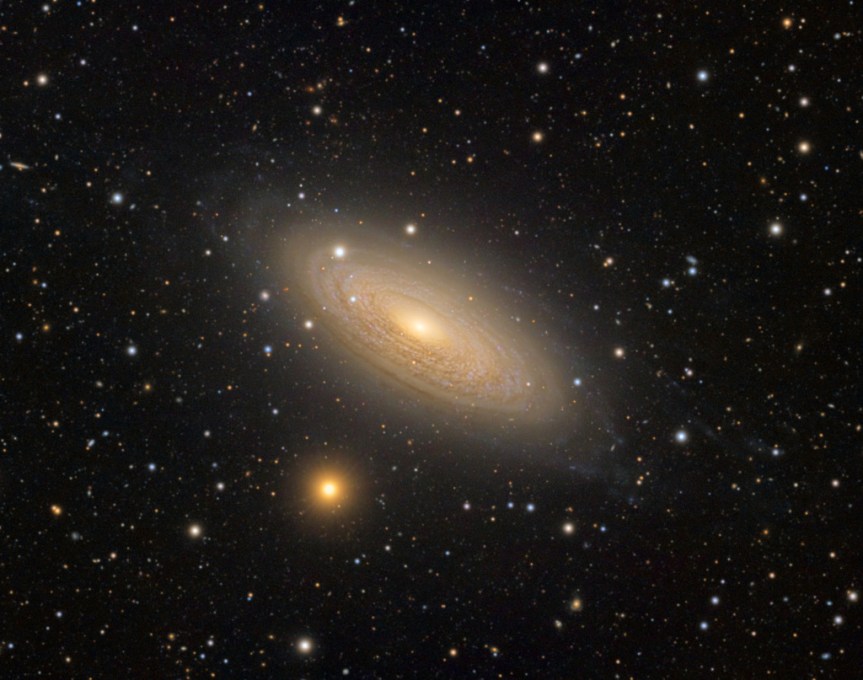
Explanation: A mere 46 million light-years distant, spiral galaxy NGC 2841 can be found in the northern constellation of Ursa Major. This deep view of the gorgeous island universe was captured during 32 clear nights in November, December 2021 and January 2022. It shows off a striking yellow nucleus, galactic disk, and faint outer regions. Dust lanes, small star-forming regions, and young star clusters are embedded in the patchy, tightly wound spiral arms. In contrast, many other spirals exhibit grand, sweeping arms with large star-forming regions. NGC 2841 has a diameter of over 150,000 light-years, even larger than our own Milky Way. X-ray images suggest that resulting winds and stellar explosions create plumes of hot gas extending into a halo around NGC 2841.
Discover the cosmos! Each day a different image or photograph of our fascinating universe is featured, along with a brief explanation written by a professional astronomer.
2022 March 2
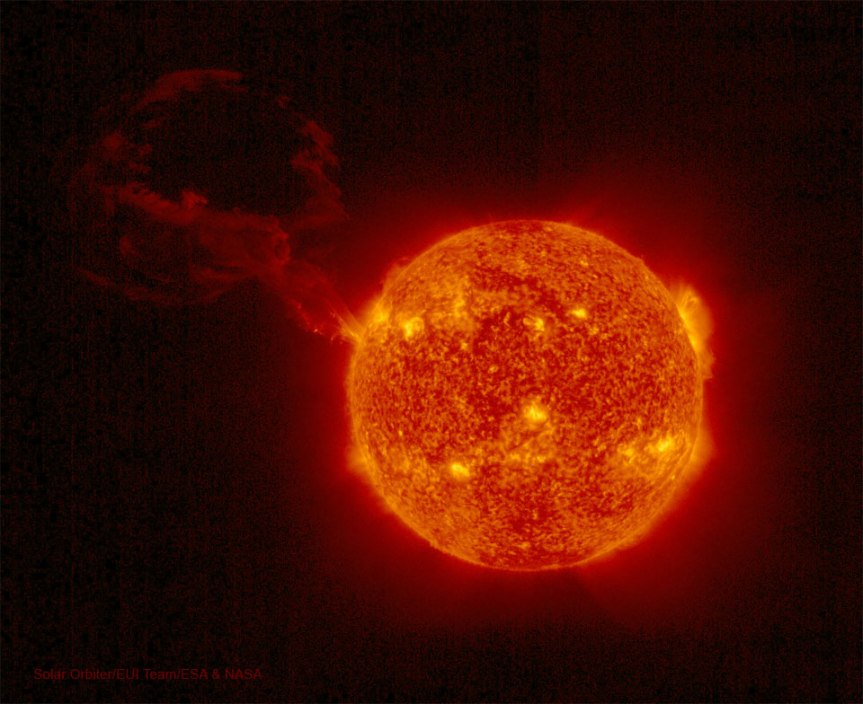
Explanation: What’s happened to our Sun? Last month, it produced the largest prominence ever imaged together with a complete solar disk. The record image, featured, was captured in ultraviolet light by the Sun-orbiting Solar Orbiter spacecraft. A quiescent solar prominence is a cloud of hot gas held above the Sun’s surface by the Sun’s magnetic field. This solar prominence was huge — spanning a length rivaling the diameter of the Sun itself. Solar prominences may erupt unpredictably and expel hot gas into the Solar System via a Coronal Mass Ejection (CME). When a CME strikes the Earth and its magnetosphere, bright auroras may occur. This prominence did produce a CME, but it was directed well away from the Earth. Although surely related to the Sun’s changing magnetic field, the energy mechanism that creates and sustains a solar prominence remains a topic of research.


Planet: Mercury
Element: Air
Colors: Purple, Orange
Keywords: Communication, Wisdom, Travel, Speed, Creative Inspiration, Education
Ruled by Mercury, Wednesdays are best for spell work that has do to with learning, communication, and artistic projects. If you want a little extra luck or speed for something do your spell on a Wednesday!
This day of the week gets its name from Woden’s Day, an Old English name. It is a direct translation of the Latin term mercurri dies, “day of Mercury.” When they translated the day, they changed to god Mercury to a local god, Woden, so people would understand. This is a great day to work on communications, thought, wisdom, self-expression, and the arts. Also a good day for divination.
Color: Purple, orange
Planet: Mercury
Deities: Odin, Woden, Hermes, Mercury, Athena, Lugh
Crystals: Adventuine, agate
Herbs: Aspen, lilies, lavender, fern
Associations: Business, communication, debt, the arts, transportation, fortune, chance, creativity
The angel Raphael rules this day. He is considered a healing angel, as well as the protector of pilgrims. Interestingly, Wednesday is governed by the planet Mercury. This planet (and the Roman god) is symbolic of travel (pilgrimage), translations and exchange in all kinds of communication. Raphael and Mercury combined are a super duo when it comes to exchanging ideas, proposals or feelings to other people. This terrific twosome is a great formula for successful travel. I’m not talking physical travel exclusively. We can also travel places in our minds, through contemplation or meditation. Wednesday is a great day for astral travel, international travel, small day trips – and also auspicious for allowing our words to travel fluidly to our higher power (as in prayer/devotionals) and/or communicating with friends, family, co-workers, etc. Your thoughts and words are best received on this day.
Discover the cosmos! Each day a different image or photograph of our fascinating universe is featured, along with a brief explanation written by a professional astronomer.
2022 March 1

Explanation: What are these two bands in the sky? The more commonly seen band is the one on the right and is the central band of our Milky Way galaxy. Our Sun orbits in the disk of this spiral galaxy, so that from inside, this disk appears as a band of comparable brightness all the way around the sky. The Milky Way band can also be seen all year — if out away from city lights. The less commonly seem band, on the left, is zodiacal light — sunlight reflected from dust orbiting the Sun in our Solar System. Zodiacal light is brightest near the Sun and so is best seen just before sunrise or just after sunset. On some evenings in the north, particularly during the months of March and April, this ribbon of zodiacal light can appear quite prominent after sunset. It was determined only this century that zodiacal dust was mostly expelled by comets that have passed near Jupiter. Only on certain times of the year will the two bands be seen side by side, in parts of the sky, like this. The featured image, including the Andromeda galaxy and a meteor, was captured in late January over a frozen lake in Kanding, Sichuan, China.
Most people are trained to ignore intuition, so they let their psychic potential go to waste. Few realize that everyone has psychic abilities, some more than others, but everyone nonetheless. These spiritual skills can be developed and perfected; clairvoyants need little more than inner peace and meditation to keep their abilities strong. Without following certain steps, however, even psychics would be living in suspense. These ten steps that once helped them to improve their psychic abilities, and now they can help you:
Negative thoughts hinder psychic abilities. However long it takes, just have faith and stay upbeat. You will meet your goals in time. Find inspiration whenever and wherever you can. Read stories about others who honed their psychic abilities, and keep learning ways to follow in their footsteps. Let go of any skepticism you have. Allow yourself to trust in your own natural power, as well as the power of the supernatural. Anything less than 100% effort is unacceptable. There is no room for doubt during your spiritual ventures.
To fall into a deep state of relaxation, most people meditate or breathe slowly while concentrating on nothingness. Not only does it clear your mind, but meditation actually changes brain wave patterns. This decreases metabolic rate and relieves tension. It has cured hypertension and improved heart health. Meditation also temporarily alters the prefrontal cortex, allowing for better mental performance and even boosting energy levels – exactly what people need in order to get in touch with the spiritual side of life. Release your stress. Just breathe.
People cannot be in tune with their mystic gifts unless they are at peace with themselves and …
Discover the cosmos! Each day a different image or photograph of our fascinating universe is featured, along with a brief explanation written by a professional astronomer.
2022 February 28
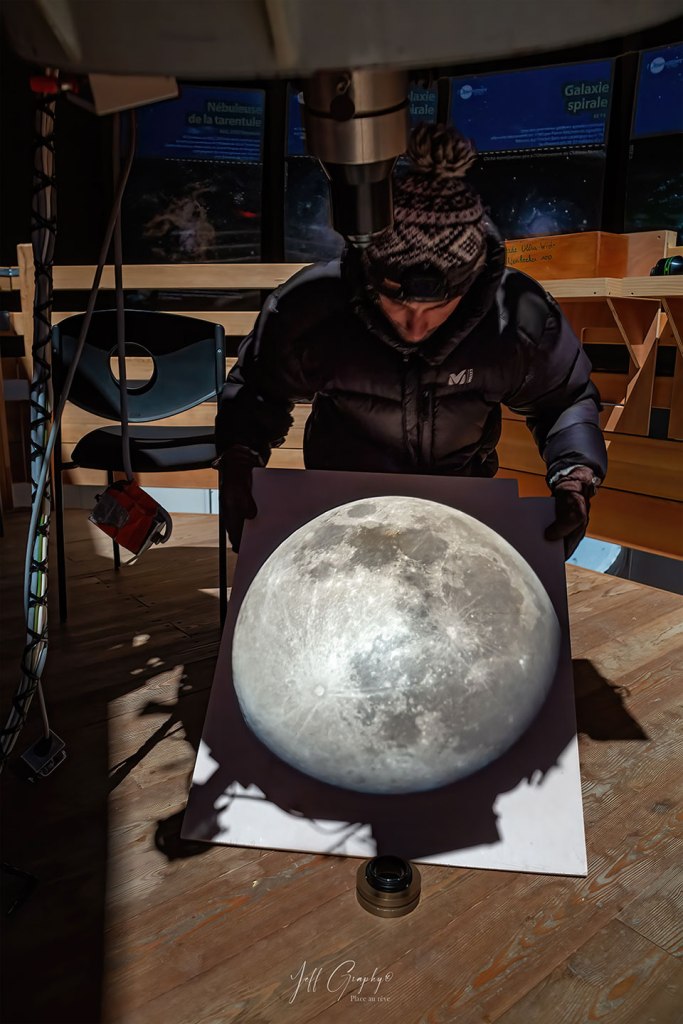
Explanation: You don’t have to look through a telescope to know where it’s pointing. Allowing the telescope to project its image onto a large surface can be useful because it dilutes the intense brightness of very bright sources. Such dilution is useful for looking at the Sun, for example during a solar eclipse. In the featured single-exposure image, though, it is a too-bright full moon that is projected. This February full moon occurred two weeks ago and is called the Snow Moon by some northern cultures. The projecting instrument is the main 62-centimeter telescope at the Saint-Véran Observatory high in the French Alps. Seeing a full moon directly is easier because it is not too bright, although you won’t see this level of detail. Your next chance will occur on March 17.
Light a pink candle to connect with your most sensitive and receptive side, harmonizing bonds of friendship and love. Meditating with a pink candle helps relief depression and promotes self-love.


 Áine, Eros, Aphrodite, Freyja, Hathor, Isis and Venus are rulers of Fridays.
Aventurine, Emerald, Jade, Rose Quartz, Pink Tourmaline, Peridot.
Carrying these gemstones today can bring success and fulfillment of your goals. Wear them as a talisman or simply keep them close to you to harness their energy.
Drink Hibiscus Tea to enhance your relationship with yourself and others. Hibiscus is an aphrodisiac flower, so it is closely related to love and sex. It has been used to make love potions and charms, as well as medicine.
Note: Expecting mothers should not take Hibiscus.

Planet: Venus
Element: Water
Colors: Aqua, Pink
Keywords: Love, Beauty, Harmony, Affection, Fertility, Romance, Friendship
Fridays are your day if you want to do a spell around love of any kind be it romantic, friendships, family, or self.
Freya’s day
Planet: Venus.
Colours: Green, Light Blue, Pink and Copper tones.
Metal: Copper.
Crystals: Jade, Lapis Lazuli, Rose Quartz, Coral, Emerald, Malachite.
Archangel: Haniel
Angel: Anael
Discover the cosmos! Each day a different image or photograph of our fascinating universe is featured, along with a brief explanation written by a professional astronomer.
2022 February 25
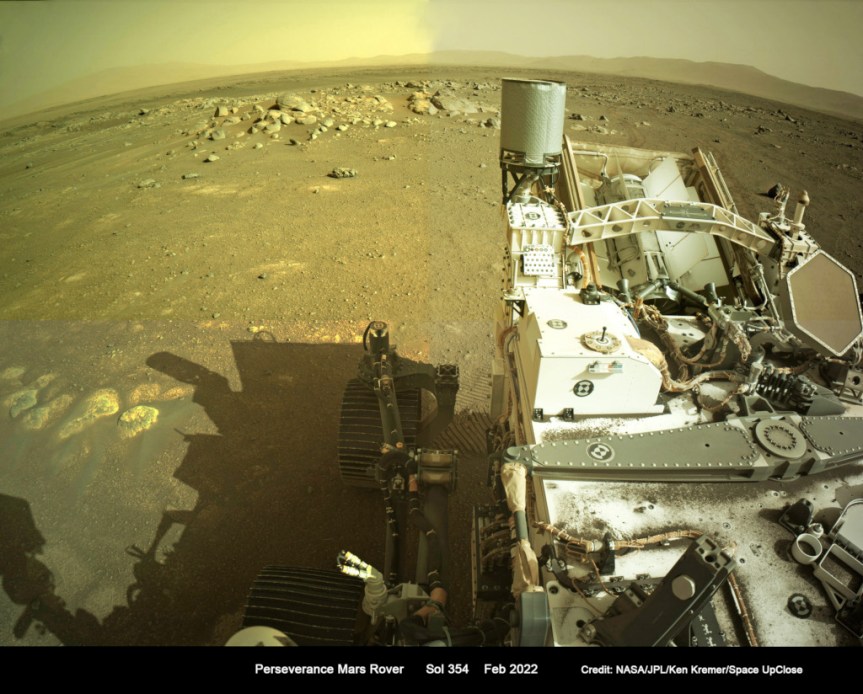
Explanation: This Navcam mosaic from Perseverance looks out over the car-sized rover’s deck, across the floor of Jezero crater on Mars. Frames used to construct the mosaic view were captured on mission sol 354. That corresponds to Earth calendar date February 17, 2022, nearly one Earth year after the rover’s landing. With a mass of over 1,000 kilograms, six-wheeled Perseverance is the heaviest rover to touch down on Mars. During its first year of exploration the rover has collected six (so far) rock core samples for later return to planet Earth, served as the base station for Ingenuity, the first helicopter on Mars, and tested MOXIE (Mars Oxygen In-Situ Resource Utilization Experiment), converting some of the Red Planet’s thin, carbon dioxide-rich atmosphere into oxygen.
Discover the cosmos! Each day a different image or photograph of our fascinating universe is featured, along with a brief explanation written by a professional astronomer.
2022 February 24
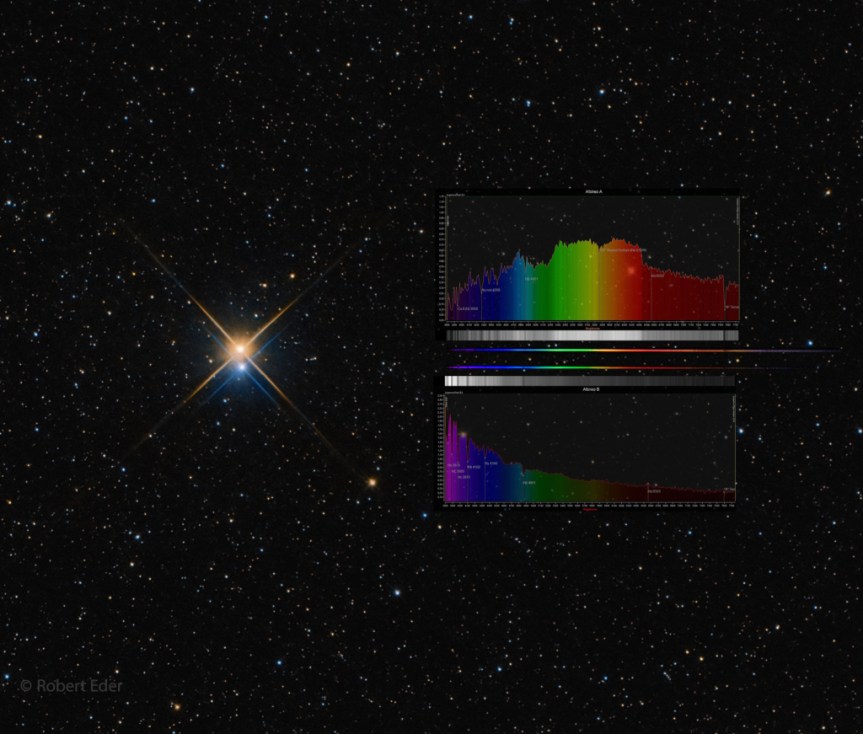
Explanation: Beta Cygni is a single bright star to the naked eye. About 420 light-years away it marks the foot of the Northern Cross, famous asterism in the constellation Cygnus. But a view through the eyepiece of a small telescope will transform it into a beautiful double star, a treasure of the night sky in blue and gold. Beta Cygni is also known as Albireo, designated Albireo AB to indicate its two bright component stars. Their visually striking color difference is illustrated in this telescopic snapshot, along with their associated visible spectrum of starlight shown in insets to the right. Albireo A, top inset, shows the spectrum of a K-type giant star, cooler than the Sun and emitting most of its energy at yellow and red wavelengths. Below, Albireo B has the spectrum of a main sequence star much hotter than the Sun, emitting more energy in blue and violet. Albireo A is known to be a binary star, two stars together orbiting a common center of mass, though the two stars are too close together to be seen separately with a small telescope. Well-separated Albireo A and B most likely represent an optical double star and not a physical binary system because the two components have clearly different measured motions through space.
Discover the cosmos! Each day a different image or photograph of our fascinating universe is featured, along with a brief explanation written by a professional astronomer.
2022 February 23
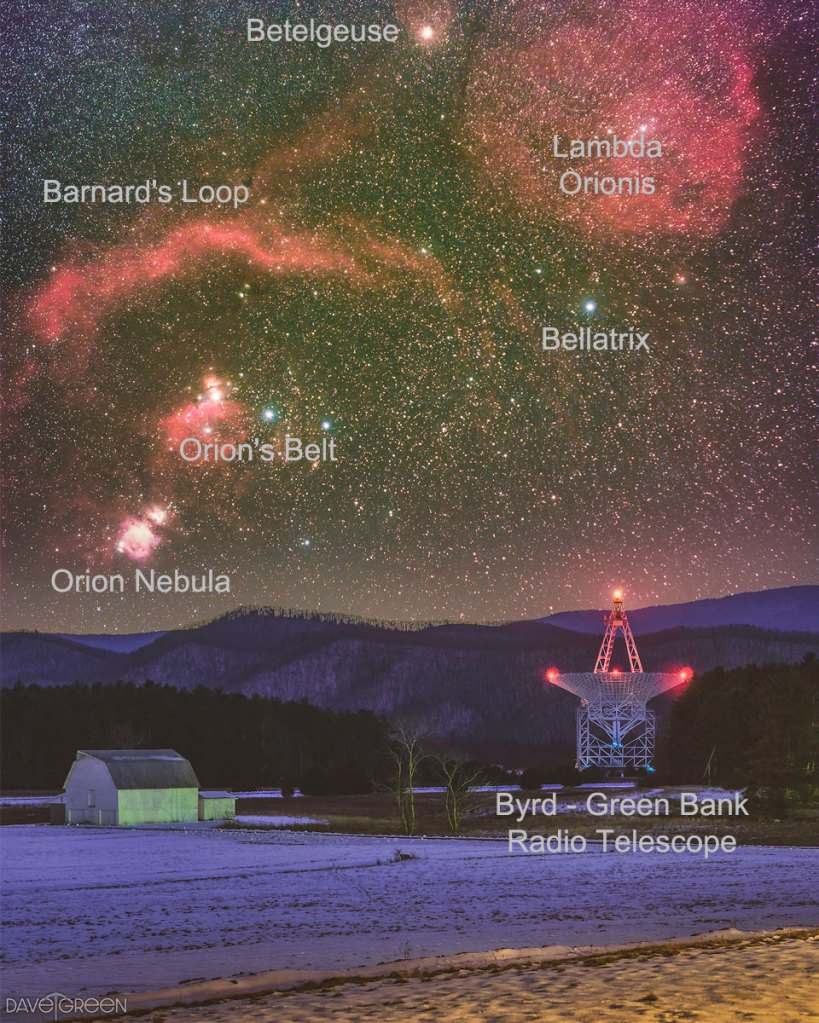
Explanation: What will the huge Green Bank Telescope discover tonight? Pictured, the Robert C. Byrd Green Bank Telescope (GBT) on the lower right is the largest fully-pointable single-dish radio telescope in the world. With a central dish larger than a football field, the GBT is nestled in the hills of West Virginia, USA in a radio quiet zone where the use of cell phones, WiFi emitters, and even microwave ovens are limited. The GBT explores our universe not only during the night — but during the day, too, since the daytime sky is typically dark in radio waves. Taken in late January, the featured image was planned for months to get the setting location of Orion just right. The image is a composite of a foreground shot taken over a kilometer away from the GBT, and a background shot built up of long exposures during the previous night. The deep background image of Orion is fitting because the GBT is famous for, among many discoveries, mapping the unusual magnetic field in the Orion Molecular Cloud Complex.
Ancient mythology and folklore is filled with witches, including the Bible’s Witch of Endor and Russian folklore’s Baba Yaga. These enchantresses are known for their magic and trickery, which is sometimes used for good and sometimes for mischief.
The Christian Bible has an injunction against practicing witchcraft and divination, and that can probably be blamed on the Witch of Endor. In the first Book of Samuel, King Saul of Israel got in some trouble when he sought assistance from the witch and asked her to predict the future. Saul and his sons were about to march into battle against their enemies, the Philistines, and Saul decided it was time to get a bit of supernatural insight as to what was going to happen the next day. Saul started off by asking God for help, but God stayed mum…and so Saul took it upon himself to seek answers elsewhere.
According to the Bible, Saul summoned the witch of Endor, who was a well-known medium in the area. Disguising himself so she wouldn’t know she was in the presence of the king, Saul asked the witch to revive the dead prophet Samuel so that he might tell Saul what was going to happen.
Who was the witch of Endor? Well, like many other biblical figures, no one really knows. Though her identity is lost to myth and legend, she has managed to appear in more contemporary literature. Geoffrey Chaucer makes reference to her in The Canterbury Tales, in the tale spun by the friar to entertain his fellow pilgrims. The Friar tells his listeners:
“Yet tell me,” said the summoner, “if true:
Do you make your new bodies always so
Out of the elements?” The fiend said, “No,
Sometimes it’s only some form of disguise;
Dead bodies we may enter that arise
To speak with all the reason and as well
As to the Endor witch spoke Samuel.”
Discover the cosmos! Each day a different image or photograph of our fascinating universe is featured, along with a brief explanation written by a professional astronomer.
2022 February 21
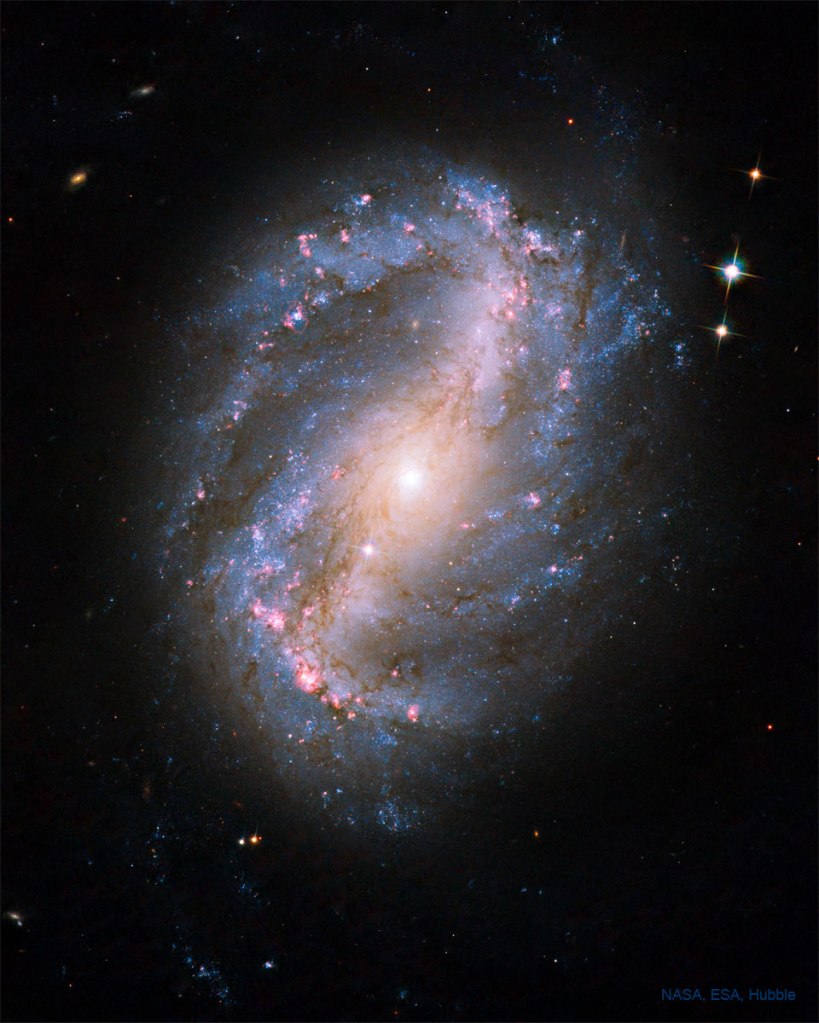
Explanation: Many spiral galaxies have bars across their centers. Even our own Milky Way Galaxy is thought to have a modest central bar. Prominently barred spiral galaxy NGC 6217, featured here, was captured in spectacular detail in this image taken by the Advanced Camera for Surveys on the orbiting Hubble Space Telescope in 2009. Visible are dark filamentary dust lanes, young clusters of bright blue stars, red emission nebulas of glowing hydrogen gas, a long bar of stars across the center, and a bright active nucleus that likely houses a supermassive black hole. Light takes about 60 million years to reach us from NGC 6217, which spans about 30,000 light years across and can be found toward the constellation of the Little Bear (Ursa Minor).
APOD in world languages: Arabic, Bulgarian, Catalan, Chinese (Beijing), Chinese (Taiwan), Croatian, Czech, Dutch, French,
French (Canada), German, Hebrew, Indonesian, Japanese, Korean, Montenegrin, Polish, Russian, Serbian, Slovenian, Spanish, Taiwanese, Turkish, Turkish, and Ukrainian

The Celtic Tree Calendar is based on the ogham alphabet and its association with trees.
It consists of 13 months, each 28 days long, following the lunar cycle, as Roman accounts have suggested the Druids did, with one extra day representing the 23rd December, the ‘Day of Creation’.
Each of the 13 months is represented by a tree together with its ogham letter.
The calendar was conceived by the British poet and scholar Robert Graves. It was an idea put forward in his book The White Goddess, a historical grammar of poetic myth, first published in 1948.
The book focused on the mythology of Ireland, Britain, Europe and the Middle East, interpreting it in Grave’s individual and poetic style.
As historical accounts of ancient Druids are scarce, many of Graves’ ideas regarding the Celtic Tree Calendar were based on the works of Irish historian Ruaidhrí Ó Flaithbheartaigh, (Roderick O’Flaherty). Ó Flaithbheartaigh had published Ogygia in 1685, an elaborate history of Ireland that journeys back to the time of myths and legends and contains within it a chapter on understanding the ancient ogham alphabet.
Graves’ works may also have been influenced by the 14th century Book of Ballymote which contains a chapter on the ogham in which many varieties of the alphabet appear in the form of several diagrams thought to be used as secret codes.
Although the calendar is quite new in a historical sense, its influences lie within ancient Celtic mythology and folklore. It is a beautiful example of how modern spiritual beliefs and the customs of ancient times can be combined to form something enchanting.


Discover the cosmos! Each day a different image or photograph of our fascinating universe is featured, along with a brief explanation written by a professional astronomer.
2022 February 20

Explanation: Sometimes both heaven and Earth erupt. Colorful auroras erupted unexpectedly a few years ago, with green aurora appearing near the horizon and brilliant bands of red aurora blooming high overhead. A bright Moon lit the foreground of this picturesque scene, while familiar stars could be seen far in the distance. With planning, the careful astrophotographer shot this image mosaic in the field of White Dome Geyser in Yellowstone National Park in the western USA. Sure enough, just after midnight, White Dome erupted — spraying a stream of water and vapor many meters into the air. Geyser water is heated to steam by scalding magma several kilometers below, and rises through rock cracks to the surface. About half of all known geysers occur in Yellowstone National Park. Although the geomagnetic storm that caused the auroras subsided within a day, eruptions of White Dome Geyser continue about every 30 minutes.
Discover the cosmos! Each day a different image or photograph of our fascinating universe is featured, along with a brief explanation written by a professional astronomer.
2022 February 19

Explanation: The spiky stars in the foreground of this backyard telescopic frame are well within our own Milky Way Galaxy. But the two eye-catching galaxies lie far beyond the Milky Way, at a distance of over 300 million light-years. Their distorted appearance is due to gravitational tides as the pair engage in close encounters. Cataloged as Arp 273 (also as UGC 1810), the galaxies do look peculiar, but interacting galaxies are now understood to be common in the universe. Nearby, the large spiral Andromeda Galaxy is known to be some 2 million light-years away and approaching the Milky Way. The peculiar galaxies of Arp 273 may offer an analog of their far future encounter. Repeated galaxy encounters on a cosmic timescale can ultimately result in a merger into a single galaxy of stars. From our perspective, the bright cores of the Arp 273 galaxies are separated by only a little over 100,000 light-years.

 Witches Of The Craft®



You must be logged in to post a comment.