

Day: March 20, 2024
A Smile for Today

Who says chocolate bunnies, eggs, etcetera is just for a Christian Easter? Enjoy dying your eggs, making Ostara baskets for yourself and your family!
I try to do this every year and my grandchildren love they get goodies and small toys baskets twice. I don’t do an egg hunt anymore as most of my grandchildren are to old to believe in a Goddess hiding eggs or parents are working during the week and it would be hard for a 1 and 5 year old to find them in the dark. After the 1 year old was born in January 2023 we did an egg hunt inside. It was banned as an egg I hid, I make a map to make sure none are forgotten started with my children decades ago, wasn’t where it should have been a search of the area around there turned up nothing. Will my grandson who was 4 at time found it about a month later and ate it. He had moved it so grandma could find it. Unfortunately he did get sick from eating the rotten egg, thankfully he was better in a couple of days.
Let’s Have Some Fun – Printable Ostara Coloring Pages


THE WICCAN CALENDAR: OSTARA (SPRING EQUINOX)
When is Ostara: March 19-23
Ostara pronunciation: OH-star-ah
Themes: balance, renewal, action, beginnings, hope, new possibilities
Also known as: Alban Eiler, Rites of Spring, Eostra’s Day, Vernal Equinox, March Equinox, Spring Equinox, Lady Day, Bacchanalia
Ostara is the second of three spring festivals on the Wheel of the Year. Coming in between Imbolc and Beltane, this is a time for celebrating the balance between extremes that is found amid the seasons. Although it may still be chilly in many regions, this is the official beginning of Spring in the Northern Hemisphere—it is the Vernal (Spring) Equinox, the moment of exact balance between the light and the dark.
Though it’s typically celebrated on March 20, the exact moment of the Equinox varies from year to year. This is due to a slight misalignment between the Gregorian calendar and the actual rate of the Earth’s rotation around the Sun. The Equinox also occurs at differing local times, so depending on where you live, it may fall the day before or the day after the date listed on any given calendar. For this reason, a date range of March 19-21 is often cited in sources on the Wheel of the Year.
In the Wiccan mythology, the growing daylight is evidence of the God moving from infancy toward maturity. Likewise, the Earth becomes warmer and more fertile as the Goddess is coming into the full power of her Maiden aspect. The promise of greener, warmer, more bountiful times is becoming apparent as buds and blossoms emerge from the trees and shrubs, bees return to begin the pollination cycle, and fields of grass wake up from their winter slumber. This is a time of innocence and child-like wonder as the end of Winter finally becomes a reality and being outdoors is pleasant again. We have not yet arrived at the passion and heat of Summer, but are instead enjoying the more balanced energies of this Equinox.
To honor the energies of this time of year, you can decorate your altar Click here to read the rest of this article about Ostara/Spring Equinox
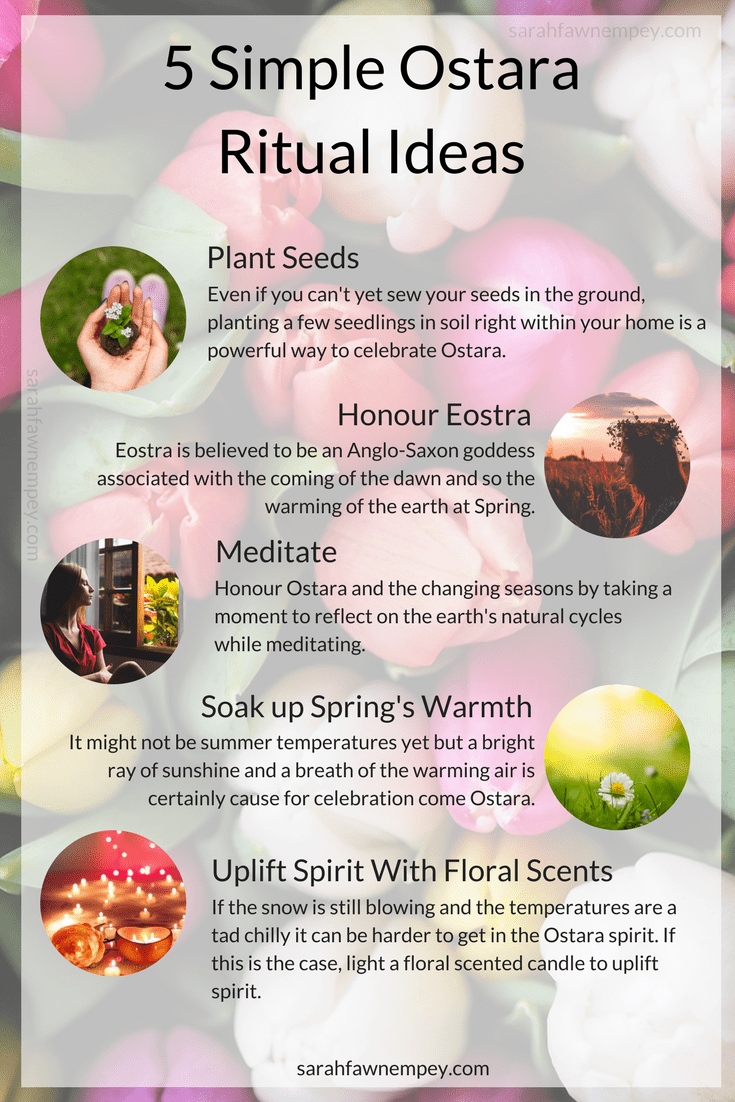
Spell for Today – 5 Simple Ostara Rituals
(YOU CAN COPY AND PASTE ANY SPELLS POSTED TO A DOCUMENT TO PRINT AND/OR SAVE ON YOUR COMPUTER)
Spell For Today – Ways to Honor Mabon c. 2017
(YOU CAN COPY AND PASTE ANY SPELLS POSTED TO A DOCUMENT TO PRINT AND/OR SAVE ON YOUR COMPUTER)

Some of the Witchcraft/Magickal Correspondence and Symbols For Ostara c.2022
(YOU CAN COPY AND PASTE ANY COROSPONDENCES POSTED TO A DOCUMENT TO PRINT AND/OR SAVE ON YOUR COMPUTER)
Correspondences & Symbols of Ostara
Symbols used to represent Ostara include the egg-for fertility and reproduction, and the hare-for rebirth and resurrection, the New Moon, butterflies and cocoons. Symbolically, many Pagans choose to represent Ostara by the planting of seeds, potted plants, ringing bells, lighting new fires at sunrise, either in the fireplace, in the cauldron, or light a balefire outdoors. I always give myself a gift of a newly potted plant or take a seed and plant it within my cast Circle. Ritually, a fire may be lit in the cauldron during (not before) the rite itself. You may want to decorate your altar with a colorful bouquet of Spring wildflowers. Other traditional activities include working on magickal gardens and practicing all forms of herbal work—magickal, artistic, medicinal, culinary, and cosmetic. author unknown
Ostara Deities: Eostre, the adolescent Spring Maiden, the adolescent Spring Lord, All Youthful and Virile Gods and Goddesses, Sun Gods, Mother Goddesses, Love Goddesses, Moon Gods and Goddesses, and all Fertility Deities including :Persephone, Blodeuwedd, Eostre, Aphrodite, Athena, Gaia, Cybele, Hera, Isis, Ishtar, Minerva, Venus, Robin of the Woods, the Green Man, Cernunnos, Lord of the Greenwood, The Dagda, Attis, The Great Horned God, Mithras, Odin, Thoth, Osiris, and Pan.
Symbolism of Ostara: Renewed promise of life, The Union of the Goddess and the God, Fertility, and dispensing of the old and making way for the new.Resurrection of life , The Season of Rebirth
Symbols of Ostara: Eggs, bunnies, new moon, butterflies, cocoons, dragons, flowers,trees.
Colors: lemon yellow, pale green and pale pink. Other appropriate colors include green, all pastels, Robin’s egg blue, violet, and white.
Ostara Foods: eggs, egg salad, hard-boiled eggs, honey cakes, first fruits of the season, fish, cakes, biscuits, cheeses, honey and ham. You may also include foods made of seeds, such as sunflower, pumpkin and sesame seeds, as well as pine nuts. Sprouts are equally appropriate, as are leafy, green vegetables.
Plants and Herbs: acorn, broom, celandine, cinquefoil, crocuses, daffodil, dandelion, dogwood, elder, ginger, Gorse, honeysuckle (woodbine), iris, jasmine, jonquils, irish moss, lavender, lemon balm, lilac, Lily, lily of the valley, lovage, marjoram, meadowsweet, narcissus, oak, oakmoss, olive, orris root, peony, rose, rose hips, sage, snowdrops, strawberry, tansy, tarragon, thyme, trefoil (purple clover), tulip, vervain, violet, willow, woodruff and all spring flowers.
Incense: jasmine, frankincense, myrrh, dragon’s blood, cinnamon, nutmeg, aloes wood, benzoin, musk, African violet, sage, strawberry, lotus, violet flowers, orange peel, or rose petals.
Gemstone: agate, amazonite, amethyst, aquamarine, bloodstone, clear quartz crystal, garnet, lapis lazuli, moonstone, red jasper and rose quartz.
Spellwork for Ostara: Spellwork for improving communication and group interaction are recommended, as well as fertility, balance and abundance
Animals and Mythical Beasts: rabbits,snakes,unicorns, merpeople, and pegasus
Candle Colors: Yellow and Green.
Tree: The Alder, a tree sacred to the God Bran, who is said to protect the British Isles. Trees are very
important to Witches, and indeed important to us all. They are the lungs of the Earth, purifying the very air we breathe as they shade us and protect us.
Straight from
March 20 and 21, 2024 Current Moon Phase for the Northern and Southern Hemispheres

You can use this link to go forward or backward in time for Moon phase information. If you are curious, you can even find out what phase the Moon was in when you or anyone else was born.
Source: MoonGiant.com
The 8 Lunar Phases
There are 8 lunar phases the Moon goes through in its 29.53 days lunar cycle. The 4 major Moon phases are Full Moon, New Moon, First Quarter and Last Quarter. Between these major phases, there are 4 minor ones: the Waxing Crescent, Waxing Gibbous, Waning Gibbous and Waning Crescent. For more info on the Moon Cycle and on each phase check out Wikipedia Lunar Phase page.
Useful Moon Resources
Check the weather before a night of Moon gazing at weather.com
For a list of all the current meteor showers visit American Meteor Society
Northern Hemisphere
March 20, 2024
Today the Moon will be in a Waxing Gibbous phase. Visible through most of the night sky setting a few hours before sunrise. This phase is when the moon is more than 50% illuminated but not yet a Full Moon. The phase lasts about 7 days with the moon becoming more illuminated each day until the Full Moon. This September Full Moon will be the forth and final supermoon of 2023.
During a Waxing Gibbous the moon rises in the east in mid-afternoon and is high in the eastern sky at sunset. The word Gibbous first appeared in the 14th century and has its roots in the Latin word “gibbosus” meaning humpbacked.
Visit the March 2024 Moon Phases Calendar to see all the daily moon phase for this month.
Today’s Waxing Gibbous Phase
The Waxing Gibbous on March 20 has an illumination of 81%. This is the percentage of the Moon illuminated by the Sun. The illumination is constantly changing and can vary up to 10% a day. On March 20 the Moon is 10.48 days old. This refers to how many days it has been since the last New Moon. It takes 29.53 days for the Moon to orbit the Earth and go through the lunar cycle of all 8 Moon phases.
Phase Details
Phase: Waxing Gibbous
Illumination: 81%
Moon Age: 10.48 days
Moon Angle: 0.50
Moon Distance: 400,035.49 km
Sun Angle: 0.54
Sun Distance: 149,029,640.75 km
Illumination: 81%
Moon Age: 10.48 days
Moon Angle: 0.50
Moon Distance: 400,035.49 km
Sun Angle: 0.54
Sun Distance: 149,029,640.75 km
Southern Hemisphere
21 March 2024
Today the Moon will be in a Waxing Gibbous phase. Visible through most of the night sky setting a few hours before sunrise. This phase is when the moon is more than 50% illuminated but not yet a Full Moon. The phase lasts about 7 days with the moon becoming more illuminated each day until the Full Moon. This September Full Moon will be the forth and final supermoon of 2023.
During a Waxing Gibbous the moon rises in the east in mid-afternoon and is high in the eastern sky at sunset. The word Gibbous first appeared in the 14th century and has its roots in the Latin word “gibbosus” meaning humpbacked.
Visit the March 2024 Moon Phases Calendar to see all the daily moon phase for this month.
Today’s Waxing Gibbous Phase
The Waxing Gibbous on March 21 has an illumination of 88%. This is the percentage of the Moon illuminated by the Sun. The illumination is constantly changing and can vary up to 10% a day. On March 21 the Moon is 11.38 days old. This refers to how many days it has been since the last New Moon. It takes 29.53 days for the Moon to orbit the Earth and go through the lunar cycle of all 8 Moon phases.
Phase Details
Phase: Waxing Gibbous
Illumination: 88%
Moon Age: 11.38 days
Moon Angle: 0.49
Moon Distance: 402,709.98 km
Sun Angle: 0.54
Sun Distance: 149,071,773.69 km
Illumination: 88%
Moon Age: 11.38 days
Moon Angle: 0.49
Moon Distance: 402,709.98 km
Sun Angle: 0.54
Sun Distance: 149,071,773.69 km
Happy and Blessed Ostara/ Spring Equinox

 Witches Of The Craft®
You must be logged in to post a comment.