Prayer for Hekate (or Hecate)

“Oh Hekate,
Mother of all witches,
Be my guide,
Be my light in the dark,
Show me the way,
Enhance my faith,
Open my intuition and lead me to perfection
The moon, the light, the magic
Might them be part of my craft
I am ready to open my heart
So be it”

From magickalspot.com

Some of the Witchcraft/Magickal Correspondence for Hekate or Hecate

From wytchymystique.com

Her Story: 

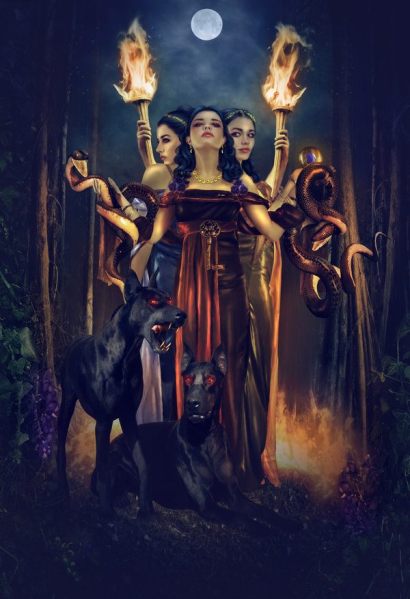
Hecate is one of the triple goddesses, often depicted in art as a single body with three heads.  She is the goddess of witchcraft; the moon; the spirit realm; nature and night visions; considered protectress of the Witches.  She also protects women in childbirth, is the guardian of the spirit world, and “Queen of the Crossroads”– a place of dark magic, spiritual wisdom, and terrible power.
____________________
The moon’s shadow fell as a pattern on the dirt road beneath the trees.  The young woman’s cloak hid her face as she leaned on her knees to dig a small hole, depositing a knotted scarf holding herbs and stones, a tiny carved image, and her menstrual blood.  Her lips moved silently as she invoked the presence of Hecate.

As the young woman covered her sacred bundle with earth and rose from her knees, the sound of a hound baying at the moon echoed in the distance.  The breeze picked up, moving the tree limbs above, shifting the shadows on the road into eerie patterns.  A chill ran up the woman’s spine, and she gathered her cloak more tightly about her shoulders, shivering with the knowledge that the great goddess Hecate was moving through the crossroads.

Embracing the Goddess:

Don’t be afraid to stand up for yourself.  So often women are under the impression that someone else is responsible for their protection, but this isn’t true.  We’re responsible for protecting ourselves, and sometimes this can mean making difficult decisions.

Hecate’s correspondences:

Herbs: garlic, lavender, honey
Animal: dog
Color: purple
Planet: Jupiter
Day: Thursday
Element: Earth
Feminine Face: Crone
Symbols: a torch; a dagger; the crossroads;
the moon; the serpent; fire

Witchcraft Symbols, Terms and Definitions

Some terms listed on this page may seem like common-sense words; however, they’re defined here as most often used in Wicca, Witchcraft, and general Paganism. Some terms have a different meaning in general society, other religions, and other sub-cultures.

Please keep this in mind when learning the terms as they’re listed here.

Did you come across a term on this site or another Wiccan/Pagan source that you’re unfamiliar with or uncertain of and can’t find it on this page? Please send us a message so we can add it to this page for you!

If you already know what term you’re looking for, you can use Ctrl-F (Windows) or Cmd-F (Mac) to search. Likewise, if you’re using a tablet or smartphone, you may use your browser’s “Find” setting to search this page.

Today’s Word is

Absolute:

concentrated, highly aromatic mixture similar to essential oils.

Spell for Today – Three Times Three Spell

This is one of the best known binding spells. This three times three spell is to use on people who were corrupt in their ways. It has no negative consequence unless you think ill of the person while casting it.

“Wind in the north, run through the trees
Three times three, let them see, let them see
Sands of the east, rich soils beneath
Three times three, set them free, set them free
Fires in the south, awaken from sleep
Three times three, let them see, let them see
Water of the west, flow to the seas
Three times three, set them free, set them free.”
 

It works best if you have something representing that person, like a strand of their hair or a fingernail. The spell may not work instantly; you may have to repeat it for the person to see errors in their ways. Please be sure you’re not being hypocritical, because that may cause negative feedback.

March 9, 2023 Daily Horoscopes

Click here to read Georgia Nicols Daily Horoscopes

Moon Alert

There are no restrictions to shopping or important decisions today. The Moon is in Libra.

Aries (March 21-April 19)

It’s time to start to downsize and get rid of what you no longer need or use. Go through cupboards, closets, storage areas, the garage and recycle, sell or turf what is only taking up space and is actually a burden to you. Just do it. (You’re good at this.)

Taurus (April 20-May 20)

This is a popular time for you, especially dealing with groups and organizations. However, even though you might feel that everyone wants a piece of you, be aware that this is your year to stand up for yourself. You can cooperate with others but you can also make time for you.

Gemini (May 21-June 20)

This is a time when you will see clearly what is working and what is not. Of course, what is working will bring you accolades. What is not working might bring failure. Don’t dwell on this. It’s your time of harvest so acknowledge what’s happening and move on.

Cancer (June 21-July 22)

Grab every opportunity to travel or take courses and get further education because this is a time of preparation for you for about two or three years from now when you will shine! Remind yourself that this is your year to get performance ready.

Leo (July 23-Aug. 22)

The interesting thing about this year is that although many of you will have to get along with less (and this is certainly true); nevertheless, you will also see ways to make extra money. Or perhaps a boon will somehow just come to you. Keep your pockets open!

Virgo (Aug. 23-Sept. 22)

It’s important to protect yourself and take good care of yourself because this year, you might feel exhausted and world-weary because Saturn is opposite your sign. It might feel like you’re getting older, but when Saturn leaves in two years, you will feel young again! Courage!

Libra (Sept. 23-Oct. 22)

Your ability to work hard and be productive is exemplary this year, which is why you will be busting your buns. It will please you to see how much you can accomplish. Admittedly, you will work hard to do so. And so it goes.

Scorpio (Oct. 23-Nov. 21)

Many of you will have increased involvement or increased responsibilities with your children this year. Personally, now is the time for you to learn more about yourself and how to express yourself in the best way possible, especially through teaching or in the arts.

Sagittarius (Nov. 22-Dec. 21)

It is totally appropriate for you to make plans about how to better secure your home, which is why you are making lists of repairs and DIY projects. Some of you might even move again. Some will consider major renovations this year. It’s serious stuff.

Capricorn (Dec. 22-Jan. 19)

You can feel the winds of change blowing, which is why some of you instinctively know that this year you might change jobs or residences or both. Almost certainly, this will happen in the next two years. Think back to 1994-1996.

Aquarius (Jan. 20-Feb. 18)

This year will be so much easier for you! It’s as if you have escaped the jaws of the lion. Now it’s time to learn what it is that is really important to you. In other words, what do you value? What matters in life, to you? How can you make good decisions if you don’t know what you really value?

Pisces (Feb. 19-March 20)

This is a pivotal year for you, which is why many of you will sail off into something completely different. A new journey. The beginning of reinventing yourself. It might be so different that you actually change your daily wardrobe. Exciting!

If Your Birthday Is Today

Actress Juliette Binoche (1964) shares your birthday today. You are a passionate romantic who loves to explore and learn. Others admire you because you are upbeat and enthusiastic about life. You get things done because you are focused and determined. This year is the beginning of a new nine-year cycle for you. Open any door!

March 9, 2023 Moon Goddess Current Phase

You can use this link to go forward or backward in time for Moon phase information. If you are curious, you can even find out what phase the Moon was in when you or anyone else was born.

From MoonGiant.com

The Moon’s current phase for today and tonight is a Waning Gibbous. During this phase the Moon can be seen in the early morning daylight hours on the western horizon. This is the first phase after the Full Moon occurs. It lasts roughly 7 days with the Moon’s illumination growing smaller each day until the Moon becomes a Last Quarter Moon with an illumination of 50%. The average Moon rise for this phase is between 9pm and Midnight depending on the age of the phase. The moon rises later and later each night setting after sunrise in the morning.

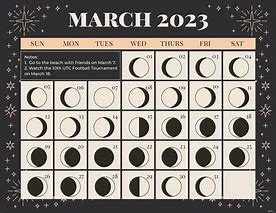
Visit the March 2023 Moon Phases Calendar to see all the daily moon phase for this month.

Today’s Waning Gibbous Phase

The Waning Gibbous on March 9 has an illumination of 96%. This is the percentage of the Moon illuminated by the Sun. The illumination is constantly changing and can vary up to 10% a day. On March 9 the Moon is 16.59 days old. This refers to how many days it has been since the last New Moon. It takes 29.53 days for the Moon to orbit the Earth and go through the lunar cycle of all 8 Moon phases.

Phase Details

Phase: Waning Gibbous
Illumination: 96%
Moon Age: 16.59 days
Moon Angle: 0.51
Moon Distance: 392,949.04 km
Sun Angle: 0.54
Sun Distance: 148,549,475.87 km

The 8 Lunar Phases

There are 8 lunar phases the Moon goes through in its 29.53 days lunar cycle. The 4 major Moon phases are Full Moon, New Moon, First Quarter and Last Quarter. Between these major phases, there are 4 minor ones: the Waxing Crescent, Waxing Gibbous, Waning Gibbous and Waning Crescent. For more info on the Moon Cycle and on each phase check out Wikipedia Lunar Phase page.

Useful Moon Resources

March 9, 2023 Northern Hemisphere’s Planetary Positions

If you need to calculate the planetary positions for a specific use and time, click on this link

Currentplanetarypositions.com

To figure out GMT (Greenwich Mean Time) to your local time use this link  

For Your Local Time and Date 

Northwestern Hemisphere For 1500 PST GMT 2300 For 1500 PDT GMT 2200 START 3/12/2023

This local time is in Los Angeles, California, USA


Northern Hemisphere For 1500 CST GMT 2100 For 1500 CDT GMT 2000 STARTS 3/12/2023

This local time is in Chicago, Illinois, USA


Northeastern Hemisphere For 1600 CEST GMT 1500 For 1500 CET GMT 1400 STARTS 3/12/2023 FOR 1600 CEST GMT 1500 STARTS 3/26/2023

This local time is in Frankfurt, Germany, Europe


March 9th Today in Worldwide History

Today’s Important Historical Events

141 BC Liu Che, posthumously known as Emperor Wu of Han, assumes the throne of the Han Dynasty in China and rules for 54 years

1522 Martin Luther begins preaching his “Invocavit Sermons” in the German city of Wittenberg, reminding citizens to trust God’s word rather than violence and thus helping bring to a close the revolutionary stage of the Reformation

1776 Adam Smith publishes the influential economics book “The Wealth of Nations”

1918 Russian Bolshevik Party becomes the Communist Party

1933 US Congress is called into special session by President Franklin D Roosevelt, beginning its “100 days”

1961 Soviet flight Sputnik 9 carries and returns from orbit a dog named Chernushka (Blackie), frogs and a guinea pig

Today’s Historical Events

141 BC Liu Che, posthumously known as Emperor Wu of Han, assumes the throne of the Han Dynasty in China and rules for 54 years

590 Bahram Chobin is crowned as King Barham VI of Persia

1009 First known written mention of Lithuania, in the annals of Quedlinburg

1230 Bulgarian Tsar Ivan Asen II defeats Theodore of Epirus near the village of Klokotnitsa

1276 Augsburg becomes an Imperial Free City

1496 Jews are expelled from Carintha, Austria

1497 Nicolaus Copernicus‘ 1st recorded astronomical observation

1500 Pedro Álvares Cabral departs Lisbon, Portugal at the head of a 13 ship expedition to India that will also claim Brazil for Portugal

Today’s Historical Events in Flim and TV

1933 “42nd Street” a musical film revolving around rehearsals for a Broadway show, directed by Lloyd Bacon, with choreography by Busby Berkeley, and songs by Harry Warren and by Al Dubin, premieres at the Strand, NYC; later adapted as a stage musical

1954 1st local color TV commercial WNBT-TV (WNBC-TV) NYC (Castro Decorators)

1954 WMUR TV channel 9 in Manchester, NH (ABC) begins broadcasting

1961 The Supremes release singles “I Want A Guy” and “Never Again”

1979 “The Passage”, directed by J. Lee Thompson and starring Anthony Quinn, is released in the United States

1981 7th People’s Choice Awards: Clint EastwoodJane Fonda & Goldie Hawn win (Motion Picture) and Alan Alda & Carol Burnett win (TV)

1981 Dan Rather becomes primary anchorman of CBS-TV News

Today’s Historical Events in Music

1842 Giuseppe Verdi‘s opera “Nabucco” premieres in Milan

1844 Giuseppe Verdi‘s opera “Hernani” premieres in Venice

1849 Carl Nikolais opera “Die lustigen Weiber von Windsor” premieres

1868 The opera “Hamlet” by Ambroise Thomas premieres in Paris

1897 Premiere of (parts of) Gustav Mahler‘s 3rd Symphony, in Berlin, Germany

1930 Kurt Weill and Bertolt Brecht‘s satirical opera “The Rise and Fall of the City of Mahagonny” premieres in Leipzig, Germany

1959 “Juno” opens at Winter Garden Theater NYC for 16 performances

1959 The Coasters’ single “Charlie Brown” peaks at #2 on the Billboard Top 100

Today’s Historical Events in Sports

1864 26th Grand National: George Stevens wins his 3rd GN aboard 10/1 Emblematic; winning mare’s full sister Emblem the race winner the previous year

1870 32nd Grand National: George Stevens wins consecutive GN’s aboard 7/2 favourite The Colonel; his 5th and final GN victory

1895 Stanley Cup, Victoria Rink, Montreal, Quebec: Montreal Victorias clinches trophy as Montreal HC beats Queens University (Kingston, Ontario), 5-1

1897 Cleveland Indians fans start calling the team “Indians” (in 1915 becomes official)

1897 MLB Cleveland Spiders sign Louis Sockalexis, full-blooded Penobscot

1904 Brandon’s Lester Patrick becomes 1st hockey defenseman to score a goal

1908 Italian football club Inter Milan founded as Foot-Ball Club Internazionale

1923 NHL Championship: Montreal Canadiens outscore Ottawa Senators, 3-2, in 2

9 March 2023 Southern Hemisphere’s Planetary Positions

If you need to calculate the planetary positions for a specific use and time, click on this link

Currentplanetarypositions.com

To figure out GMT (Greenwich Mean Time) to your local time use this link  

For Your Local Time and Date 

Southeastern Hemisphere

This local time is in Sao Paulo, Brazil, South America

9 March 2023
06:00 pm GMT 3:00 PM BRT
Zodiac: Tropical (Standard Western)

Sun:18 Pisces 54
Moon:14 Libra 08
Mercury:11 Pisces 59
Venus:21 Aries 18
Mars:22 Gemini 45
Jupiter:13 Aries 52
Saturn:00 Pisces 15
Uranus:15 Taurus 50
Neptune:24 Pisces 53
Pluto:29 Capricorn 43

True Lunar Node:04 Taurus 44 Rx
Mean Lunar Node:06 Taurus 37 Rx

Lilith (Black Moon):06 Leo 45

Chiron:14 Aries 18
Ceres:03 Libra 01 Rx
Pallas:12 Cancer 36
Juno:28 Aries 55
Vesta:13 Aries 12

Eris:24 Aries 12

Fire:7
Earth:4
Air:3
Water:5
Cardinal:10
Fixed:4
Mutable:5

Southern Hemisphere

This local time is in Cape Town, South Africa

9 March 2023
03:00 pm GMT 5:00 PM SAST
Zodiac: Tropical (Standard Western)

Sun:18 Pisces 46
Moon:12 Libra 34
Mercury:11 Pisces 45
Venus:21 Aries 09
Mars:22 Gemini 42
Jupiter:13 Aries 50
Saturn:00 Pisces 14
Uranus:15 Taurus 49
Neptune:24 Pisces 52
Pluto:29 Capricorn 43

True Lunar Node:04 Taurus 45 Rx
Mean Lunar Node:06 Taurus 37 Rx

Lilith (Black Moon):06 Leo 44

Chiron:14 Aries 18
Ceres:03 Libra 03 Rx
Pallas:12 Cancer 35
Juno:28 Aries 50
Vesta:13 Aries 09

Eris:24 Aries 12

Fire:7
Earth:4
Air:3
Water:5
Cardinal:10
Fixed:4
Mutable:5

Southwestern Hemisphere

This local time is in Melbourne, Victoria, Australia

9 March 2023
04:00 am GMT
Zodiac: Tropical (Standard Western)

Sun:18 Pisces 19
Moon:06 Libra 51
Mercury:10 Pisces 55
Venus:20 Aries 36
Mars:22 Gemini 30
Jupiter:13 Aries 43
Saturn:00 Pisces 11
Uranus:15 Taurus 48
Neptune:24 Pisces 51
Pluto:29 Capricorn 42

True Lunar Node:04 Taurus 46 Rx
Mean Lunar Node:06 Taurus 39 Rx

Lilith (Black Moon):06 Leo 41

Chiron:14 Aries 17
Ceres:03 Libra 09 Rx
Pallas:12 Cancer 30
Juno:28 Aries 35
Vesta:12 Aries 56

Eris:24 Aries 12

Fire:7
Earth:4
Air:3
Water:5
Cardinal:10
Fixed:4
Mutable:5

A Thought for Today

(Side Note: There are fewer posts today because I was tired yesterday and honestly did not feel like working today. See post about my semi-days off coming up for a more detailed explanation.)

Does this poem describe you? I have to say being born on a Thursday I have for many parts of my life thought I was constantly walking uphill never to reach my goals.

Monday’s Child Poem: Your Child’s Personality by Day of the Week

Will your child be fair, graceful, or woeful? Is your baby a Monday’s child? Tradition holds that you can predict your child’s temperament based on the day of the week they were born. Enter the Monday’s Child Poem.

Fortune telling rhymes based on the weekday of birth originated in England around the 1500s. Many superstitions existed regarding the days of the week. The fortunes, personalities, and temperaments of children were considered regulated by their weekday of birth.

What Day of the Week was your Child Born?

Find your child’s weekday of birth with our handy online calculator.button1

Monday’s Child Nursery Rhyme

Monday’s child is fair of face
Tuesday’s child is full of grace
Wednesday’s child is full of woe
Thursday’s child has far to go
Friday’s child is loving and giving
Saturday’s child works hard for his living
And the child that is born on the Sabbath day
Is bonny and blithe, and good and gay.

Monday’s Child poem is an old English nursery rhyme poem first recorded in 1838 Traditions of Devonshire. Numerous versions of the poem exist, with both positive and negative connotations associated with each day.

Rather than a literal interpretation, the Monday’s Child poem is best used as a song to help young children learn the days of the week.

Click here to download a pdf printable of The Monday’s Child Nursery Rhyme.

Various Interpretations and Meanings of Monday’s Child

The Woodcutter Family in the 2002 book Enchanted by Alethea Kontis centers around sisters named for each day of the week based on click here to read the rest of this article

A Laugh for Today – Funny Headlines

From Reader’s Digest

FUNNY HEADLINE

Headline from the Seattle PostIntelligencer: “Mom Warns Son to ‘Watch Out for Idiots,’ Rear‑Ends His Motorcycle.”

DOLPHIN SPY THRILLERS

A few months ago, Hamas “arrested” a dolphin for being an Israeli spy. Readers of Reason magazine came up with titles for the film this action might inspire: • Orcapussy…

PLOTTING YOUR AFTERLIFE

Spotted in the classifieds: “For sale: cemetery plot, $200, so 
I don’t have to spend all eternity 
beside my ex!” Anthony Cialella, New Castle, Pennsylvania

Spell for Today – Truth Spell – Printable

Goddess of the Day – Wadjet

Wadjet

Wadjet (Wadjyt, Wadjit, Uto, Uatchet, Edjo, Buto) was one of the oldest Egyptian goddesses. Her worship was already established by the Predynastic Period, but did change somewhat as time progressed. She began as the local goddess of Per-Wadjet (Buto) but soon became a patron goddess of Lower Egypt.

By the end of the Predynastic Period, Wadjet was considered to be the personification of Lower Egypt rather than a distinct goddess and almost always appeared with her sister Nekhbet (who represented Upper Egypt). The two combined represented the country as a whole and were represented in the “nebty” (one of the pharaoh’s names, also known as “the two ladies”) which indicated that the king ruled over both parts of Egypt. The earliest recovered example of the nebty name is from the reign of Anedjib of the First Dynasty.

In the Pyramid Texts it is suggested that Wadjet created the first papyrus plant and primordial swamp. Her link to the papyrus is strengthened by the fact that her name was written using the glyph of a papyrus plant and the same plant was the heraldic plant of Lower Egypt.

According to another myth Wadjet was the daughter of Atum (or later Ra) who sent her as his “eye” to find Tefnut (moisture) and Shu (air) when they were lost in the waters of Nun. He was so happy when they returned that he cried and created the first human beings from his tears. To reward his daughter, he placed her upon his head in the form of a cobra so that she would always be close to him and could act as his protector.

Wadjet was one of the goddesses given the title “Eye of Ra” (connecting her to BastHathorSekhmet, and Tefnut among others). In fact, the symbol of the “Eye of Ra” was often called “the Wedjat”.

In this form she was sent out to avenge her father and almost caused the destruction of mankind. Humanity was saved when she was tricked with some beer which had been dyed red with pomegranate juice to resemble blood.

There is also a suggestion that she was very closely linked to the principle of Ma’at (justice or balance). Before being crowned as king, Geb attacked and raped his mother Tefnut. When he went to take his place as pharaoh and put the Royal Ureas on his own forehead, the snake reared up and attacked the god and his followers. All of Geb’s retinue died and the god himself was badly injured. Clearly, his actions were against Ma’at and Wadjet was not prepared to allow him to go unpunished.

Wadjet is often described as an agressive deity while while her sister Nekhbet was thought of as a more matronly protector. However, she also had her gentler side. Wadjet was believed to have helped Isis nurse the young Horus and to help mother and baby hide from Set in the marshes of the delta. She was also considered to offer protection to all women during childbirth.

Wadjet and her sister also protected the adult Horus from the followers of Set. Horus pursued them in the form of a winged sun disc and Nekhbet and Wadjet flanked him in the form of crowned snakes. This protection was also extended towards the pharaoh who wore the “Royal Ureas” (serpent) on his (or her) forehead.

From the Eighteenth Dynasty the queens also added one or two snakes to their headdresses representing Wadjet and her sister.

Wadjet was associated with the fifth hour of the fifth day of the month and with “iput-hmt” (Epipi), the harvest month of the Egyptian calendarFestivals were held in her honour on the 10th day of “rh-wr” (Mekhir) which was also called “the day of going forth of the Goddess”, the 7th day of “khnty-khty” (Payni), and the 8th day of “Wpt-rnpt” (Mesori). These latter two dates coincide roughly with the winter and spring solstices.

She was worshiped at the Temple of Wadjet, known as “Pe-Dep”. This temple was already long established by the Old Kingdom and is referred to in the Pyramid Texts. In this temple, Wadjet was linked with Horus.

Wadjet was thought to be the wife of Hapi in Lower Egypt and was linked to Set in his role as a representative of Lower Egypt. She was sometimes described as the wife of Ptah and the mother of Nefertem, probably because she occasionally took the form of a lion like Sekhmet.

Her sacred animal was the cobra, and Wadjet was often depicted as either a rearing cobra, a winged cobra, or a woman with the head of a cobra. She was also depicted as a woman wearing the red crown of Lower Egypt. She often appears with her sister Nekhbet who appeared as a snake or woman.

By the Late Period Wadjet was also associated with the ichneumon (a mongoose-like creature). This animal was known for its skill in killing snakes and was also sacred to Horus.The Egyptians placed mummified ichneumon and shrew (small mice) inside statuettes of Wadjet which were interred with the dead. The two animals represented day (ichneumon) and night (shrew). She was also worshipped as a vulture Goddess. In her form of the “eye of Ra” she was depicted as a lion-headed woman wearing a solar disc and the Uraeus (cobra).

Bibliography
  • Bard, Kathryn (2008) An introduction to the Archaeology of Ancient Egypt
  • Budge, E Wallis (1904) The Gods of the Egyptians
  • Goodenough, Simon (1997) Egyptian Mythology
  • Kemp, Barry J (1991) Ancient Egypt: Anatomy of a Civilisation
  • Lehner, Mark (1997) The Complete Pyramids
  • Pinch, Geraldine (2002) Handbook Egyptian Mythology
  • Redford Donald B (2002) Ancient Gods Speak
  • Watterson, Barbara (1996) Gods of Ancient Egypt
  • Wilkinson, Richard H. (2003) The Complete Gods and Goddesses of Ancient Egypt
  • Wilkinson, Richard H. (2000) The Complete Temples of Ancient Egypt

A New Daily Post – God of the Day – Ra


Ra – Sun God
The ancient Egyptians revered Ra as the god who created everything. Also known as the Sun God, Ra was a powerful deity and a central god of the Egyptian pantheon. The ancient Egyptians worshiped Ra more than any other god and pharaohs often connected themselves with Ra in their efforts to be seen as the earthly embodiment of the Sun God.
Who is Ra?
Ra (pronounced ray) represents sunlight, warmth and growth. It was only natural that the ancient Egyptians would believe him to be the creator of the world, as well as part of him being represented in every other god. The ancient Egyptians believed that every god should illustrate some aspect of him, while Ra himself should also represent every god.
Ra’s Appearance
Ra was usually depicted in human form. He had a falcon head which is crowned with a sun disc. This sun disc was encircled by a sacred cobra named Uraeus. Ra has also been depicted as a man with the head of a beetle and also a human man with the head of a ram. The ancients also depicted Ra in full species form such as a serpent, heron, bull, lion, cat, ram, hawk, beetle, phoenix and others. His main symbol, however, is the sun disk.
Ra Mythology
The ancient Egyptians believed that as the sun god, Ra’s role was to sail across the heavens during the day in his boat called the “Barque of Millions of Years.” In the morning when Ra emerged from the east, his boat was named, “Madjet” which meant “becoming strong.” By the end of the day the boat was called, “Semektet” which meant “becoming weak.” At the end of the day, it was believed that Ra died (swallowed by Nut) and sailed on to the underworld, leaving the moon in his place to light up the world. Ra was reborn at dawn the very next day. During his journey across the heavens during the day, he fought with his main enemy, an evil serpent named Apep, or also, The Lord of Chaos. In some stories, Ra, in the form of a cat named Mau, defeats the evil serpent, Apep. This is part of the reason why cats are so highly-revered in Egypt.
Ra created himself from the primordial chaos. He is also known as Re and Atum. His children are Shu, the God of Dry Air and Father of the Sky, and his twin sister Tefnut, the Goddess of Moisture and Wetness. As a lion-headed goddess, Tefnut is responsible for dew and freshness. Humans were created from Ra’s tears.
Although Ra was highly revered and devoutly worshiped by the ancient Egyptians, there is a story to suggest he eventually grew weak. In the Legend of Ra, Isis and the Snake, as Ra grew old, he dribbled saliva. Isis knew that Ra’s power was hidden in his secret name. Isis gathered Ra’s saliva and created a snake out of it. She set the snake in Ra’s path and it bit him. Isis wanted the power Ra had always enjoyed, but she knew she had to get him to tell her his secret name. Eventually, because of the pain he was in, Ra allowed Isis to “search through him” and in so doing, she healed him and Ra’s power was transferred over to her.
The Tree of Life is an important religious symbol to the Egyptians. The Tree of Life was located within Ra’s sun temple in Heliopolis and was considered sacred. The fruit that sprang from this tree was not available to humans, but only in aging-rituals reserved for pharaohs. The Tree of Life is also referred to as the mythical, sacred Ished tree. Eternal life came to those who ate the fruit from the Tree of Life.
Another important ancient Egyptian symbol connected to Ra is the “Bennu”. Bennu is the name of the bird that represented Ra’s soul. This bird is a phoenix and it was seated at the Tree of Life in Ra’s Sun Temple in Heliopolis. Inside the temple, on top of an obelisk, sat the Benben Stone. This pyramid-shaped stone served as a beacon to Bennu and is also an important ancient Egyptian religious symbol.
Worship of the Sun God
Solar temples were built for Ra but did not contain a statue of the god. Instead, they were created to be open to the sunlight that Ra represented. The earliest known temple built in honor of Ra exists in Heliopolis (what is now a Cairo suburb). This solar temple is known as “Benu-Phoenix” and is believed to have been erected in the exact spot where Ra emerged into creation.
Although Ra dates back to the second dynasty, he is not the oldest of the Egyptian gods. It wasn’t until the fifth dynasty that Ra became closely associated with the pharaoh. As the king and leader of Egypt, the pharaoh was seen as the human manifestation of Horus, so the two gods became connected. This new deity fusion was then referred to as “Ra-Horakhty” meaning Ra is Horus of the Horizon. Ra’s relationship with other gods did not stop there. As the powerful creator of mankind and the sun god, he also became associated with Atum to make “Atum-Ra.”
Fifth Dynasty and subsequent pharaohs were all known as “The son of Ra” and Ra became incorporated into every pharaoh’s name from then onward. During the Middle Kingdom, the new deity, Amun-Ra was formed. Amun was one of the gods who formed the Ogdoad (the assembly of eight gods who represented eight elements of creation).
The New Kingdom brought new heights of worship to Ra. Many tombs in the Valley of the Kings portray depictions of Ra and his journey through the underworld. During this time, many solar temples were built.
Eye of Ra
Present in the ancient Egyptian mythology is the Eye of Ra, shown as the sun disk with two ‘uraeus’ cobras coiled around it, next to the white and red crowns of Upper and Lower Egypt. Initially associated with Horus (similarly to the wadjet, the Eye of Horus), the Eye of Ra shifted positions in the myths, becoming both an extension of Ra’s power and a separate entity altogether.
Click here to learn more about The Eye of Ra
Ra God Facts
The ancient Egyptians worshiped Ra to such an extent above other gods that some historians have argued that ancient Egyptian religion was indeed a monotheistic one with Ra as the singular god.
Historians believe that the pyramids might represent rays of sunlight, further connecting the pharaohs with Ra, the sun god.
During Ra’s journey through the heavens he was accompanied by several other gods including Thoth, Horus, Hathor, Maat, Abtu, and Anet.
Nut, goddess of the sky and heavens, is sometimes referred to as Ra’s mother, because he emerges from her and is reborn every morning.
The morning manifestation of Ra is known as “Khepri the scarab God.”
The evening manifestation of Ra is known as the ram-headed god, Khnum.
The sacred cobra that encircled Ra’s crown symbolized royalty, sovereignty and divine authority.
The right eye of Ra represented the Sun; while the left eye of Ra represented the moon.
Ra is also closely associated with the Tree of Life myth, the Ben-Ben Stone and the Bennu Bird myths.
Ra’s glory came to an end during the time when the Roman’s conquered Egypt in 30BC.

Witchcraft Symbols, Terms and Definitions – Ouroboros

From symbolsandmeanings.net

Rich with cultural significance and religious meaning, the ouroboros symbol embodies rebirth, eternity, self-reliance, immortality, and nature’s cyclic character. Commonly known as “the snake eating itself”, the ouroboros is among the most prominent ancient symbols found in the history of different cultures, religions and civilizations.

One surely does wonder how a single symbol managed to endure the test of time and make its mark on so many civilizations and cultural beliefs.

Let us get right into it and have a closer look at its meaning, symbolism, origin and uses throughout history.

Ancient Egyptian Tombs: The First Appearance of The Ouroboros Symbol

The ouroboros first appeared on a golden shrine in King Tut’s (Tutankhamen) tomb in Egypt in the 13th century BC. The tombs featured two ouroboroi engraved on the gilded shrine along with some strange text. These ouroboroi appeared as serpents wrapped around the head and feet of a mummified figure, which is believed to have been King Tut himself, or the sun god Ra, or perhaps an amalgamation of both.

According to expert Egyptologists, the symbol was to “refer to the mystery of cyclical time, which flows back to itself”. Since the ancient Egyptians saw time as repetitive, constantly evolving cycles instead of a linear path, the ouroboros represented the immortality of human beings and its interconnection to nature’s cycles.

Ouroboros Meaning and Symbolism

The ouroboros symbol has appeared on temples, ancient artifacts, tombs, and artwork throughout history. Pronounced as ‘oo.ruh.bo.ruhs’, this symbol represents how everything in this universe is interconnected, going back to nature and becoming one with it once again after death. The unbroken circle of the snake eating itself represents universal unity, rebirth, and renewal through death.

The term ouroboros is derived from two ancient Greek words – ‘oura’ and ‘boros’. ‘Oura’ refers to tail while ‘boros’ means eating. When we combine the two words, it results in the meaning ‘he that eats his own tail’ or even just simply ‘tail eater’.

Believed to be based on serpents shedding their skin to make place for a new one, the ouroboros is an ancient symbol of eternal life and infinite growth. Although historians are unsure of the exact origins of the ouroboros symbol, it is believed to be inspired by snakes, serpents, and lizards that curl up to protect themselves.

With numerous different interpretations, some claim it represents the cycle of life and death, with the universe remaining central to it all. Others believe it represents the recreation of life through death or even the rebirth of the dead to reach an immortal state.

Snake Eating Itself: Association with Ancient Mythology and Civilizations

Being one of the most popular ancient symbols, the ouroboros has appeared throughout history in different ancient civilizations and cultures. Like the ever-rising sun, this symbol is believed to have gone through its own journey from Egypt to the ancient Greek alchemists and eventually making its way to the modern era.

After being featured predominantly in Egyptian civilization, the ouroboros slithered out to ancient Greek mythology through the Phoenician culture, where it received a new representation.

Greek Philosophy

For Plato, the ouroboros represented self-reliance and showed a perfect being that needed nothing but itself. He further believed the symbol showed a dark side with self-destruction and the tendency to devour itself.

Historians also draw a parallel between the ouroboros and the Greek myth about Sisyphus. According to the myth, Zeus punishes Sisyphus by making him roll a boulder up a hill. As soon as he gets to the top, the boulder inevitably falls back down, and he has to roll it up once again.

Ancient Romans

The ouroboros symbolized infinity for the Romans. They also associated the symbol with the god Saturn who controlled the cycles of each year. Roman philosophy states that Saturn connected each year to the next, forming an endless loop that is depicted by the snake eating its own tail.

Norse Mythology: Manuscripts and Jörmungandr

Vikings told stories of a giant serpent called Jörmungandr, who guarded Midgard (their name for Earth). Jörmungandr was one of Loki’s three children and was thrown into the great ocean by Odin.

There, he grew into a size so big that he could eventually encircle the whole world to reach and devour his own tail. It was said that if the World Serpent, or Jörmungandr, released his tail, Ragnarok would begin. The World Serpent was closely associated with the ouroboros symbol.

Ouroboros Symbol in the Modern World: Becoming The Infinity Symbol

In recent times, the ouroboros has undergone significant reinterpretation to become the infinity symbol. This concept was initiated in the 20th century with Mobius strips, the Droste Effect, and numerous paintings depicting the symbol reproducing itself. It is commonly worn as bracelets, rings, and even tattooed on the body to serve as a constant reminder of life’s cyclic journey.

An early 20th-century psychotherapist, Carl Jung, saw the ouroboros as a symbol of the human psyche. Jung had studied the symbol in alchemy and claimed that it represented the human ability to regenerate through self-reflection, just as a serpent sheds off old skin to become anew.

He justified it through a perspective that believed humans can only become whole after integrating our conscious selves with our shadow selves.

Moreover, the ouroboros often appears in the field of cybernetics, the study of feedback loops and circular causality. Cybernetics is based on the theory that inputs create certain outputs, which are then used as inputs for further outcomes – completing the circle.

Mathematicians and philosophers both appreciate the symbol similarly, applying the cybernetics theory to justify concepts in psychology, biology, computer science, and even engineering.

Outside of the research and STEM fields, people use the ouroboros symbol to represent the constant flow of creation, symbol of destruction, and recreation that makes our world come to a full circle. It instills the belief that every part of life is connected, with joy following sorrow and failure, eventually leading to success.

We may be worlds apart from the early Egyptian civilizations and the alchemists that ran experiments in their shabby workshops, but the ouroboros continues to light our paths with wisdom.

The Snake Eating Itself, Ouroboros Tattoo Meaning

Ouroboros tattoo meaning may differ according to the shape and form of the symbol drawn. It is a rebirth symbol, that is why a person who has overcome difficulties and troubles recently might want to have an ouroboros tattoo.

On the other end, it is also the symbol of infinity, so the person carrying an ouroboros tattoo might have had it to represent something that is ‘eternal’ for them.

In that sense, when seen next to a date, an ouroboros tattoo represents the idea that something that happened on that date is eternal, e.g. getting married or meeting someone special.

And if you believe in reincarnation, an ouroboros ink is obviously just the perfect choice for you.

Did you know that this ancient symbol heavily inspired similar artwork that appeared in the immensely popular Fullmetal Alchemist Brotherhood series with many symbols created by brilliant Japanese artist Hiromu Arakawa?

This wraps up our piece on the ouroboros symbol,  the snake eating itself, its origins, symbolism and meanings.

Crystal, Gems, and Stones Meanings and Magickal Usage – Amythest

From galleries.com

The gemstone Amethyst is the Birthstone for February. It is also the Zodiac stone for the constellation of Pisces. Amethyst is associated with spirituality, wisdom, sobriety, and security.

Amethyst is the purple variety of the mineral quartz and is a popular gemstone. Although it must always be purple to be amethyst, it can and does have a wide range of purple shades. Its color is unparalleled, and even other, more expensive purple gemstones are often compared to its color and beauty. If it were not for its widespread availability, amethyst would be very expensive.

The name “amethyst” comes from the Greek and means “not drunken.” This was perhaps due to a belief that amethyst would ward off the effects of alcohol, but most likely the Greeks were referring to the almost wine-like color of some stones that they may have encountered.

Amethyst can occur as long prismatic crystals that have a six sided pyramid at either end or can form as druzes that are crystalline crusts that only show the pointed terminations. As a mineral specimen, amethyst is popular for its color and nice crystal shapes that produce a handsome, purple, sparkling cluster.

However, amethyst is not the same everywhere. Different localities can produce a unique amethyst to that particular region or even to that particular mine. Experts can often identify the source mine that a particular amethyst came from. The key to this is the specimen’s color, shape of crystal, inclusions, associations and character of formation.

The following is a list of many of the more noteworthy localities and some of the attributes that characterize the amethyst found there.

  • Vera Cruz, Mexico — very pale, clear, prismatic crystals that are sometimes double terminated and have grown on a light colored host rock. Crystals are typically phantomed, having a clear quartz interior and an amethyst exterior. Some are sceptered and phantomed.
  • Guerrero, Mexico — dark, deep purple, prismatic crystals that radiate outward from a common attachment point. Often the crystals are phantomed opposite of Vera Cruz amethyst having a purple interior with a clear or white quartz exterior. These are some of the most valuable amethysts in the world.
  • Minas Gerais and Rio Grande do Sul, Bahaia, Brazil — crystals form in druzy crusts that line the inside of sometimes large volcanic rock pockets or “vugs”. Some of the vugs may have formed from trees that were engulfed in a lava (or ash) flow millions of years ago and have since withered away. Other vugs are just gas bubbles in the lava. Some vugs can be quite large. The crystals that form are usually light to medium in color and only colored at the tops of the crystals. Most clusters form with gray, white and blue agate and have a green exterior on the vugs. Calcite sometimes is associated and inclusions of cacoxenite are common. On occasion, even excellent crystals of gypsum have been found nestled inside these amethyst lined vugs.
  • Maraba, Brazil — large crystals with unattractive surfaces that are of a pale to medium color and often carved or cut into slices. The large “Maraba points” are nearly always polished to remove the rough and milky surface, revealing the beautiful purple amethyst inside.
  • Thunder Bay, Canada — a distinct red hematite inclusion just below the surface of the crystals is unique to this locality. Clusters are druzy crusts that line the fissures formed in ancient metamorphic rocks.
  • Uruguay — crystals are dark to medium and form in druzy crusts of small crystals that line the inside of volcanic vugs that have a gray or brown exterior. The crystals are usually colored throughout, unlike the Brazilian crystals, and form with a multicolored agate that often contains reds, yellows and oranges. Often amethyst- coated stalactites and other unusual formations occur inside these vugs. The intense color of these druzy crusts is exceptional.
  • Africa — crystals are usually large but not attractive. However, the interior color and clarity are excellent and polished slices and carvings as well as many gemstones are prized and admired.
  • Maine, USA — Dark druzy clusters that are not widely distributed today.
  • North Carolina, USA — Druzy clusters that have a bluish-violet tint.
  • Pennsylvania, USA — druzy clusters that filled fractures in metamorphic rocks. They are generally a brownish purple and patchy in color.
  • Colorado, USA — druzy clusters form crusts inside of fissures in sandstone, often on top of a crust of green fluorite. Crystals are dark but rather small.
  • Italy — both Vera Cruz like crystals, although not as well defined, and large parallel growth clusters with good evenly distributed color.
  • Germany — associated with colorful agates that form a druzy light-colored crust.
  • Ural Mountains, Russia — a very clear and dark variety that is cut for fine expensive gemstones, natural uncut clusters are rarely on the market.

Often, cut gems of amethyst are graded using the terms: Siberian, Uruguayan or Bahain to represent high medium and low grade respectively, regardless of the actual source. Because of the patchiness of the color distribution in the crystals, Amethyst is often cut as brilliant round cuts to maximize the color. Other cuts can be used when the color is better distributed.

The color purple is traditionally the color of royalty and amethyst has been used since the dawn of history to adorn the rich and powerful monarchs and rulers. Today, amethyst is a lovely and affordable gemstone that is fortunately available in a wide variety of cut and uncut stones that we can all possess and admire.

Prasiolite is the leek-green variety of quartz, rare in nature but used as a gemstone, sometimes (wrongly) called Green Amethyst.

For natural amethyst specimens, including crystals and large geodes, see our Amethyst specimens pages.

Flower Meaning, Symbolize, and Spiritual Meaning

(Someone asked Lady Abyss about this flower years ago. This was the best information I could find about it.)

All about Abutilon – History, Meaning, Facts, Care & More from littleflowerhut.com.sg

Abutilon belongs to the family Malvaceae, it is a shrub, which is grayish green color and hairy. It has heart-shaped leaves and their length is normally 6.9-11.9cm.

Abutilon is a bell shaped flower and the color of the flower ranges from yellow to pink to orange to deep red. The leaves of this flower are palmate like a maple therefore it is also called flowering maple.

The calyx in the flower has a cup-shaped appearance, greenish in color and it’s about 1.5cm long. Petals of this flower are normally shorter than the calyx and their color is not uniform which means that they are reddish on the lower surface and bright green on the upper surface.

It has leaves like maple trees with colorful flowers and the flowers have resemblance to crepe paper. It is commonly called as flowering maple although it has no relation to maple tree.

Abutilon is grown on annual basis but it is also possible to grow them during winters by maintaining the temperature. It is commonly present in tropical and warm temperate regions where it is grown outside however where the weather is extremely cold it is grown in greenhouses.

Abutilon is normally used as ornamental plant in gardens due to their five-petaled blossoms which are white to dark orange in color.

It has such fascinating and beautiful colors that it attracts birds like hummingbirds and other beneficial insects to your garden that will help your garden to bloom.

History of Abutilon

Abutilon is commonly called as Chinese lantern which is quite misleading because they are not completely Asian in origin. There are almost 200 species of this flower and majority of them are originated from South America.

These flowers were commonly grown in the tropical and subtropical regions of Africa, Asia and also Australia. Other species are also native to Mexico and Southwest America.

The name of this flower Abutilon is derived from Arabic word aubutilon which was given to the flower by a Persian astronomer and physician Avicenna, who is often referred to as the father of the modern medicine.

From some other available text it is said that this flower has Indian origin and it was first reported from India in the year 1826 but the exact history behind this flower is not known.

Characteristics of Abutilon

Abutilon is a genus of Mallow family; it is classified as tender and evergreen which are mostly used as seasonal houseplants in the Midwest. These flowers were very popular during the Victoria era later they lost their importance in the gardening world but then again they came back in gardens in many forms.

grow Abutilon flower

In the Malvaceae family, Abutilon is a very large group of flowering plants and it has around 200 species which are present in the tropical and subtropical regions.

The height of these plants ranges from 18 inches to 10 feet and they are shrubs, perennials or small trees. The flowers of Abutilon are oven invisible from the distance because they are hidden inside the leaves but once close you can spot the flowers with beautiful purplish color anther which gives it a fascinating appearance.

Abutilon are generally erect shrubs with arching branches, the branches normally bend downwards due to the weight of the flowers.

Leaves of this flower are normally palmate and they can be heavily lobed and jagged. The flowers are cup-like with a habit of downwards drooping.

Use of Abutilon

Abutilon is a shrub that is most commonly found in Asian countries including India. Apart from being used as ornamental plants in indoor gardens there are some other fabulous uses of this flower.

It has been reported that this flower has some great medicinal uses. Due to the presence of different useful metabolites it can effectively be used as anti-diabetic, blood tonic agent and anti-inflammatory agent. Apart from that, Abutilon is used for the treatment of leprosy, diarrhea, vaginal infections and for ear problems.

In Sidha medicines this plant is very much used for different ailments. Its bark, leaves, stems, flowers as well as seeds are used for medicinal purposes by the Tamils.

The leaves are grinded and the paste is applied to wounds and ulcers.

The flower’s extraction is used for the treatment of flu and cleaning wounds which means that this plant is a multipurpose plant which can be used to treat ailments as well increase the beauty of your garden.

How to Take care of Abutilon

As far as taking care of Abutilon is concerned it falls in two categories

A: when the plant is outdoors i.e. during summers

B: when it is indoors during winters

When Abutilon is outside in summers it should be kept in full or partial sun. When it is grown in northern areas where winters are quite harsh then the best thing is to grow the plants in containers so that it becomes easy to move the plant according to the weather conditions.

The pH of the soil must be neutral but most importantly it has to be well drained. These flowers do too much blooming that is why they need to be feed quite heavily which means that once in a week one must use water soluble fertilizer in order to keep them healthy.

During winters when you grow the plant as an indoor plant, then it will not require a lot of sunlight. Keep the plant in a cool room, don’t water the plant too much during this time instead spray the leaves and flowers once in a while.

If you notice any pest attack then apply Neem oil to cope up with the problem.

March 8, 2023 Daily Horoscopes

Click here to read Georgia Nicols Daily Horoscopes

Moon Alert

Avoid shopping or important decisions from 9 AM to 10 AM EST today (6 AM to 7 AM PST). After that, the Moon moves from Virgo into Libra.

Aries (March 21-April 19)

Once a month, the Moon is opposite your sign for a couple of days, and when this occurs, you have to be accommodating. It’s best to go along to get along. This is why today it’s in your best interests to cooperate with others, especially partners and close friends.

Taurus (April 20-May 20)

You might be more focused on your health today. Meanwhile, at work, you will both want the help of others and at the same time, you might have to give your assistance to help someone else. Yes, it’s a two-way street. A pet might require your attention today.

Gemini (May 21-June 20)

This is a playful day! Make a point of setting aside time for enjoyment and pleasure. Anything from a long lunch, to a coffee break with a friend, to a few laughs at Happy Hour, or time with your favourite TV show. Give yourself a treat. Fun activities with kids will appeal.

Cancer (June 21-July 22)

Despite your desire to travel, explore and learn new things at this time, today you are happy to cocoon at home. Maneuver things so that you can relax where you live among familiar surroundings and take it easy. Deep contemplation might be thought provoking.

Leo (July 23-Aug. 22)

Today you want others to hear what you have to say because you really do want to enlighten someone. This is why you will be irritated or impatient with people who just want to chat about meaningless trivia. Life is short! Let’s get down to it.

Virgo (Aug. 23-Sept. 22)

Today you might feel a bit possessive about something that you own, which is why you don’t want to lend it to someone. Or you might be fussy about taking care of it. That’s okay, we all feel this way at times. (“My precious!”) Sort out banking details.

Libra (Sept. 23-Oct. 22)

Because the Moon is in your sign today and tomorrow, your feelings will be heightened. If you have a bigger reaction to something that goes on around you – no biggie. The good news is that your luck will improve slightly, which gives you an edge over all the other signs.

Scorpio (Oct. 23-Nov. 21)

Solitude in pleasant surroundings will appeal to you today. This is a playful time, which is why you might be socializing, attending sports events and enjoying fun activities with kids, as well as romantic diversions. Take time out today to catch your breath.

Sagittarius (Nov. 22-Dec. 21)

A heart-to-heart talk with a friend or a member of a group might be meaningful for you today. You will welcome even a slight suggestion that there is a bond between you. It’s good to have bonds with others because we like to feel needed, loved and appreciated.

Capricorn (Dec. 22-Jan. 19)

Today and tomorrow, for some reason, you will be high viz. This means people will notice you more than usual. In fact, they might know personal details about your private life. (Whaaat?) Do be aware of this in case you have to do some damage control.

Aquarius (Jan. 20-Feb. 18)

This is a playful time for you. And today in particular, you will love to travel or do something different because you want to learn new things and have a bit of adventure! Therefore, do something different. Explore your neighbourhood.

Pisces (Feb. 19-March 20)

This is a good day to tie up loose ends about banking details, inheritances and anything that you own jointly with others. This might also include issues related to inheritances and shared property. Just do it.

If Your Birthday Is Today

Tattoo artist Kat Von D (1982) shares your birthday today. You appear friendly and easy-going; however, you have strong convictions and you hold to them. You value your independence. This year is the last year of a nine-year cycle, which means it’s time to let go of anyone and anything that is holding you back.

March 8, 2023 Moon Goddess Current Phase

You can use this link to go forward or backward in time for Moon phase information. If you are curious, you can even find out what phase the Moon was in when you or anyone else was born.

From MoonGiant.com

The Moon’s current phase for today and tonight is a Waning Gibbous. During this phase the Moon can be seen in the early morning daylight hours on the western horizon. This is the first phase after the Full Moon occurs. It lasts roughly 7 days with the Moon’s illumination growing smaller each day until the Moon becomes a Last Quarter Moon with an illumination of 50%. The average Moon rise for this phase is between 9pm and Midnight depending on the age of the phase. The moon rises later and later each night setting after sunrise in the morning.

Visit the March 2023 Moon Phases Calendar to see all the daily moon phase for this month.

Today’s Waning Gibbous Phase

The Waning Gibbous on March 8 has an illumination of 99%. This is the percentage of the Moon illuminated by the Sun. The illumination is constantly changing and can vary up to 10% a day. On March 8 the Moon is 15.65 days old. This refers to how many days it has been since the last New Moon. It takes 29.53 days for the Moon to orbit the Earth and go through the lunar cycle of all 8 Moon phases.

Phase Details

Phase: Waning Gibbous
Illumination: 99%
Moon Age: 15.65 days
Moon Angle: 0.50
Moon Distance: 396,933.27 km
Sun Angle: 0.54
Sun Distance: 148,510,297.95 km

The 8 Lunar Phases

There are 8 lunar phases the Moon goes through in its 29.53 days lunar cycle. The 4 major Moon phases are Full Moon, New Moon, First Quarter and Last Quarter. Between these major phases, there are 4 minor ones: the Waxing Crescent, Waxing Gibbous, Waning Gibbous and Waning Crescent. For more info on the Moon Cycle and on each phase check out Wikipedia Lunar Phase page.

Useful Moon Resources

March 8, 2023 Northern Hemisphere’s Planetary Positions

If you need to calculate the planetary positions for a specific use and time, click on this link

Currentplanetarypositions.com

To figure out GMT (Greenwich Mean Time) to your local time use this link

For Your Local Time and Date

Northwestern Hemisphere

This local time is in Los Angeles, California, USA

March 08, 2023
11:00 pm GMT 3:00 PM PST
Zodiac: Tropical (Standard Western)

Sun:18 Pisces 06
Moon:04 Libra 16
Mercury:10 Pisces 33
Venus:20 Aries 20
Mars:22 Gemini 25
Jupiter:13 Aries 41
Saturn:00 Pisces 10
Uranus:15 Taurus 48
Neptune:24 Pisces 51
Pluto:29 Capricorn 42

True Lunar Node:04 Taurus 47 Rx
Mean Lunar Node:06 Taurus 39 Rx

Lilith (Black Moon):06 Leo 39

Chiron:14 Aries 16
Ceres:03 Libra 11 Rx
Pallas:12 Cancer 27
Juno:28 Aries 28
Vesta:12 Aries 51

Eris:24 Aries 12

Fire:7
Earth:4
Air:3
Water:5
Cardinal:10
Fixed:4
Mutable:5

Northern Hemisphere

This local time is in Chicago, Illinois, USA

March 08, 2023
09:00 pm GMT 3:00 PM CST
Zodiac: Tropical (Standard Western)

Sun:18 Pisces 01
Moon:03 Libra 14
Mercury:10 Pisces 24
Venus:20 Aries 14
Mars:22 Gemini 23
Jupiter:13 Aries 39
Saturn:00 Pisces 09
Uranus:15 Taurus 48
Neptune:24 Pisces 51
Pluto:29 Capricorn 42

True Lunar Node:04 Taurus 48 Rx
Mean Lunar Node:06 Taurus 40 Rx

Lilith (Black Moon):06 Leo 39

Chiron:14 Aries 16
Ceres:03 Libra 12 Rx
Pallas:12 Cancer 26
Juno:28 Aries 25
Vesta:12 Aries 49

Eris:24 Aries 12

Fire:7
Earth:4
Air:3
Water:5
Cardinal:10
Fixed:4
Mutable:5

Northeastern Hemisphere

This local time is in Frankfurt, Germany, Europe

8 March 2023
03:00 pm GMT
Zodiac: Tropical (Standard Western)

Sun:17 Pisces 46
Moon:00 Libra 08
Mercury:09 Pisces 56
Venus:19 Aries 56
Mars:22 Gemini 16
Jupiter:13 Aries 36
Saturn:00 Pisces 07
Uranus:15 Taurus 47
Neptune:24 Pisces 50
Pluto:29 Capricorn 41

True Lunar Node:04 Taurus 49 Rx
Mean Lunar Node:06 Taurus 41 Rx

Lilith (Black Moon):06 Leo 37

Chiron:14 Aries 15
Ceres:03 Libra 15 Rx
Pallas:12 Cancer 24
Juno:28 Aries 17
Vesta:12 Aries 42

Eris:24 Aries 11

Fire:7
Earth:4
Air:3
Water:5
Cardinal:10
Fixed:4
Mutable:5