Gods – Osiris

Egyptian God Osiris

In Egyptian mythology, Osiris is the god sent by Ra as pharaoh to rule over the first inhabitants of Egypt, along with his sister and wife Isis. Osiris was wise, intelligent, and benevolent. He led mankind on the path to greatness, joy, and prosperity in just a few centuries of reign.

Nevertheless, Osiris’ success was not appreciated by all: Set, Osiris’ brother, became very jealous of Osiris and planned to assassinate him.

Thus, in order to take the power of Osiris by force, Set traps Osiris by organizing a great contest during a banquet organized in the honor of Osiris and Isis. During this feast taking place on the banks of the Nile and welcoming many guests, Set brings a pretty chest decorated with rich jewels that he proposes to offer to anyone who would be able to enter fully into it.

Surprisingly, none of the guests manage to do so. But if no one can get into Set’s chest, it’s for a very simple reason: Set’s chest is specially designed so that only Osiris can enter inside.

When it is the Egyptian ruler’s turn to try to get into the chest, Set immediately welds the openings in the chest. He then throws the chest into the Nile, killing Osiris by drowning.

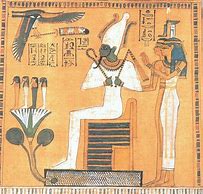
One of the symbols for Osiris

Osiris is the Egyptian god of life, death and resurrection. He took on many roles, names and forms in ancient Egyptian mythology over time. He is also a prominent god of the Heliopolitan Ennead.

Osiris (the Greek form of his name) was known as Asir in ancient Egypt. Other names or epithets he went by, include “Lord of Eternity”, “Great God” and “Foremost of the Westerners”.

Osiris Facts

Name(s): Osiris, Osiris-Apis
Rules over: Land of Egypt (Old Kingdom), Underworld (New Kingdom)
Gender: Male
Symbols: Atef Crown, Crook
Sacred animals: Ostrich Feathers on Atef Crown
Parents: Geb, Nut
Siblings: Horus, Set, Isis, Nephthys

Family

As the oldest son of Geb, the earth god, and Nut, the sky goddess, Osiris features in many stories and myths documented in ancient religious texts. He is brother to Set, Horus the ElderIsis, and Nephthys, and father to Horus the Younger (with Isis) and Anubis (with Nephthys).

The most famous myth about Osiris is also a central one in ancient Egyptian religion. Different versions are told, but it generally describes how he is killed by his jealous brother Set and his body then scattered in pieces over Egypt. A grieving Isis searches for and finds all the pieces except his penis. Nephthys and Anubis help her put the body back together but have to make him a new penis from gold. He comes back to life just long enough for Isis to become pregnant with Horus the Younger.

Symbols

Mostly depicted as a partially mummified pharaoh, Osiris’ complexion is commonly green (representing rebirth), but sometimes black (representing the fertile floodplain of the Nile River). On his head is often the Atef crown, a headdress with two feathers on either side and a disc at the top. He usually has a beard like those of the pharaohs and carried a crook and flail. The crook symbolizes his role as a shepherd god.

Powers & Duties

In Egyptian mythology, Osiris was originally the founder of agriculture. He allegedly persuaded the Egyptians to end cannibalism (though there is no evidence that they were ever cannibals). This myth is linked to his role of presiding over death and resurrection, processes which are compared to the cycles of growth and decay experienced in nature.

Osiris’ prominence was evident in the fact that he was often simply referred to as “god.” He was viewed as an equal and sometimes even superior to Ra, the sun god.

After his death, Osiris became the king of the underworld. Instead of being feared in his role as the god of death, he was associated with resurrection and regeneration, and his presence in the underworld was viewed as comforting. This fact is illustrated in many portrayals where he wears a kind smile on his face.

Worship

In the Early Dynastic period, the center of Osiris’ worship was in Abydos, where his head is said to be buried.

During Akhet, the first season of the ancient Egyptian calendar, festivals were held across Egypt to celebrate Osiris’ life, death, and rebirth.

Osiris absorbed and became associated with many other deities over time. They included Wepwawet, Sahu, Banebdjed, and Anhur. This means that he was almost constantly worshiped across Egypt until the rise of Christianity during the time of the Roman Empire. His cult continued in Philae, an island in the Upper Nile, until the time of Emperor Justinian I (527 to 565).

Facts About Osiris

  • The people of ancient Egypt believed that Osiris disappeared into the underworld with their crops during winter;
  • Examples of corn mummies made of seeded dirt and molded to resemble Osiris were found in Tutankhamen’s tomb. It is believed such “mummies” were placed in many tombs with the dead. The seeds germinated in the dark are a symbol of rebirth;
  • The people of Mendes worshipped Osiris’ soul as an aspect called Banebdjed, with “Ba” referring to his soul and “djed” referring to a pillar. Benebdjed is depicted as a ram in ancient Egyptian art;
  • The ostrich feathers on each side of the Atef crown are said to represent Osiris’ cult center at Djedu;
  • Some myths held the belief that the pharaohs became Osiris when they died;
  • The judgment scene in Book of the Dead describes how Osiris welcomes the deserving dead into his kingdom after being judged by 42 divine judges. Those who did not live a good life are left to the mercy of a “devourer”;
  • After Osiris died at the hand of Set, Anubis presided over his mummification, thereby becoming the first embalmer. Anubis was the original god of the underworld before Osiris took over;

Gods – Apep

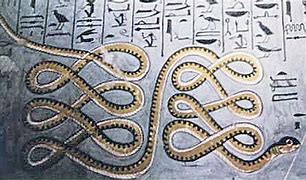
Apep Egyptian Serpent God of Choas from egyptian-history.com

You wish to know who is Apep, the Egyptian serpent god? You want to understand the role played by Apep in the myth of the solar boat of Ra?

Great amateurs of Egyptian mythology, we are here to enlighten you on these subjects.

Apep is a giant Egyptian serpent god whose goal is to devour Ra, the Sun god illuminating the entire universe. According to Egyptian mythology, every night since the creation of the world, Apep has tried to eat Ra, even though the latter was always defended by Set, Sobek, Maat, Isis, and Thoth.

Today, we will discover together:

  • The myth of Apep in the Egyptian mythology
  • The myth of the eternal combat of Apep against Ra
  • The other Apep: the snake Jörmungandr and the asteroid 99942 Apophis

Very soon you will know all about the Egyptian evil snake called Apep.

Let’s discover immediately the story of the largest snake of ancient Egypt!

1) Apep in Egyptian Mythology

Already present before the creation of the world by Ra, Apep (or Apophis) is an evil entity, the embodiment of darkness and destruction. Apep is a huge snake, allegedly as wide and long as the Nile. This snake is a fundamentally evil being whose sole motivation is to eat the falcon-headed Sun god Ra.

The latter illuminates the world during the day, crossing the sky on his boat before passing through the Underworld to return to his point of departure. It is in the world of darkness that Ra is the target of all types of monsters, demons and ghosts who wish to eat him. Indeed, Ra, a hawk with a Sun on his head, appears extremely appetizing to them.

2) Apep against Ra

Each night, Apep thus leads his army with the aim of eating Ra. Yet, he encounters great difficulty in reaching his objective because Ra has assembled a team of Egyptian gods to defend himself:

– Set, the god of chaos and tempests: with the mission to focus on Apep and repel him with sandstorms and lightning.

– Sobek, the crocodile god of strength and power: Ra’s long-time bodyguard, the god Sobek, unlike Set, focuses on the evil horde of Apep.

– Thoth, the ibis god of knowledge: planning, for each night, a new strategy to surprise Apep and his army.

– Maat, the winged goddess of justice: offering magical healing to her team and, able to fly, catching the team members who have fallen out of the boat of Ra.

– Isis, the goddess of magic: unleashing powerful spells on Apep and his army during difficult situations.

With this shock team, Apep lost every single fight, which never discouraged him. Apep could be mortally wounded, but he had the ability to regenerate when he was covered by the deepest darkness of the world of the dead.

Apep is the antithesis of the gods, representing chaos and darkness, the opposite of the values of the Egyptian pantheon, whose sacred mission was to spread order and light throughout the world. However, Apep contributes to the equilibrium of the universe, being one of its original components, and therefore should not be definitively defeated because his total elimination would destabilize the universe just as much as if the gigantic snake managed to eat Ra.

According to his myth, Apep is responsible for eclipses. Sometimes, Apep succeeded in swallowing Ra during surprise attacks in broad daylight, which made the sun disappear from the sky of mortals. Fortunately, the other gods quickly came to the rescue to pierce the belly of Apep, freeing Ra and thus ending the eclipse.

3) The other version of the myth of Apep: Set, the substitute of Ra

In Egyptian religion, Set gradually takes the place of Ra in the myth of the solar boat and replaces the entire team of Egyptian gods. Ra is then relegated only as the bearer of the Sun and not as the eternal adversary of Apep as he was.

How unfortunate it would be if you missed this great passage in Egyptian mythology: here is a concise summary of the “myth of Osiris” that tells us why Ra was replaced by Set.

A) The myth of Osiris

According to the Egyptian myth of the “Beginning”, Ra created the world by cleverly mixing the Darkness (from which Apep came) and the original Ocean.

From this enlightened mixture came Shu (the wind) and Tefnut (the warmth of the Sun). Shu and Tefnut married to give birth to Geb (the earth) and Nut (the sky). Geb and Nut in turn married and had two sons and two daughters (who also married each other in pairs): Osiris, Set, Isis and Nephthys.

Osiris took his sister Isis as his wife while Set took his sister Nephthys as his wife. Osiris was quickly sent to Earth to become the god-pharaoh who guide mankind.

When he arrived, Osiris fully committed himself to his mission, he brought to humanity a peace, security and unity that had never been seen before.

Set soon became jealous of Osiris’ position but kept this resentment to himself at first. However, when he realized that Nephthys was cheating on him with Osiris, he began to feel a deep hatred for his brother.

Set decided to assassinate Osiris in order to obtain the throne of Egypt. To do so, he visited the best craftsmen in the world to create a beautiful chest covered with precious stones and metals. This chest was made with a certain interior shape so that the only thing it could contain was Osiris himself. Set organized a large banquet on the banks of the Nile to which he invited Osiris and his relatives. At this event, he declared that he would offer the large chest to anyone who entered the chest in its entirety.

Not surprisingly, only Osiris managed to enter the chest. It was at this point that the plan of Set and his accomplices was revealed: they hurled themselves onto the chest and welded its opening before throwing it into the Nile. Osiris drowned.

The chest then drifted down the Nile until it came to a shrub by the riverside that trapped it in its roots. Over the years, the shrub completely absorbed the chest and Osiris. The chest and Osiris gradually found themselves in the middle of its trunk. On its side, the tree grew at a supernatural speed, thanks to the divine presence of the body of the deceased Osiris. The tree grew so large that it fed the lust of a great foreign king, who made it one of the columns of his palace.

Isis, who traveled the world in search of her husband’s body, arrived in this royal palace after years and years of searching. She convinced the king to give the pillar to her and cure her only heir of a fatal disease in appreciation. In possession of the chest (and thus the body of Osiris, she succeeded in reviving him for a single night, which enabled her to become pregnant with Horus).

But before she has time to perform certain rituals to bring Osiris back to life, Set falls on the body of Isis’ unfortunate husband during a hunting trip. To prevent any resurrection that might lead to the end of his reign, Set cuts the body of Osiris into fourteen pieces and scatters them throughout Egypt.

Once again, Isis sets out to find the body of Osiris in tears. These tears attract Nephthys and Anubis (the son Nephthys had with Osiris) who are sympathetic to Isis and help her in her quest. The three of them manage to find 13 of the 14 parts. But as they were about to find the last part, a fish eats it and digests it quickly. This part (namely, the phallus of Osiris) is thus lost forever.

Osiris cannot be reconstituted in its entirety and is brought back to life with an incomplete body. This incomplete body will then prevent him from directing the living. Set will therefore retain his place as king of Egypt (exercising a much less just and upright reign than his brother during his lifetime). Osiris will be forced to leave the world of the living and go to the Underworld where he will rule over the dead.

B) The myth of Horus and Set

As an adult, Horus claims the throne of his father from the greatest and wisest of the gods organized in an instance called the “divine assembly”.

The majority of this enlightened tribunal, composed of Ra (the falcon-headed Sun god)Shu (the god representing the wind), and Thoth (the ibis-headed god of knowledge), immediately rebelled against Egypt’s current situation. Shu and Thoth find despicable that Set could deprive Horus by killing his father of his rightful royal place. The two gods are therefore ready to go to Set and ask him to abdicate without delay.

Nevertheless, the myth cannot stop here: Ra is extremely offended that his opinion is not asked (because he is the father and first of all the gods of Egypt).

The falcon Sun god declares that Horus may well make a bad king. For Ra, the latter must prove his worth before any form of abdication that could put Egypt in a very unfortunate position.

The declaration of Ra is followed by various great trials between Set and Horus: duels, chariot races, and trials of strength, all of which have one thing in common: the countless frauds that Set commits in the course of them. Set wins all the tests organized by the jury by this not very honorable way.

The many trials of the competition culminate in the trial called the “Hippopotamus Trial”. In this event, the two rival gods must each plunge to the bottom of the Nile as hippopotamuses and hold their breath as long as possible. During this test, Isis, out of concern for the future of her son, will create a magic harpoon to catch Set and bring him back to the surface of the Nile (which would make him lose the test). Isis succeeds in touching Set with her harpoon, which makes Horus win (who wins a trial against Set for the first time).

Horus is however very unhappy with the situation because he has the ambition to win fairly. Very angry, Horus tears off his mother’s head and throws it away (fortunately, Thoth fetches this head and resuscitates Isis).

Following this matricide, the court of the three gods is angry against Horus and punishes him by proposing to Set to decide the form of a last trial. This final trial would determine who would be the definitive king and guide of Egypt for millennia to come. Set then chooses a final trial that would be memorable and would legitimize his superiority over Horus forever. Set thus claimed that the final test would be a race of ships built only with stones.

After these events, Horus, exhausted, falls asleep on one of Egypt’s highest mountains to take a well-deserved night’s rest before a challenge that will not be easy. Wanting to ensure his victory, Set discreetly follows him and tears out his left eye while he sleeps.

He then cuts that eye into six equal parts and hides them throughout the world. Seeing in this action a consequent imbalance in the next trial, Thoth will immediately seek to reconstitute the eye of Horus.

While Horus sleeps, the god of knowledge travels around the world at superhuman speed but can only gather five of the six fragments. He thus creates himself the last missing fragment and reconstitutes a new and more efficient eye thanks to a new magical sixth piece. This eye will have the capacity to see “what-is-invisible” (i.e. the future and the past).

As soon as his work is finished, Thoth gives the eye back to Horus, who will thus not be disadvantaged in any way in the upcoming boat race.

The trial begins with a boat construction: Horus starts by looking for some beautiful stones to build his boat. However, his new prodigious eye reveals to him that “he will not win the race”.

Horus becomes very worried: it is important for him to recover the throne that was once stolen from his father. So Horus tries to cheat: he builds a wooden boat with a plaster exterior that has a texture similar to stone.

The next day, the race begins. Set arrives without a boat because he has a rather specific plan. Set is convinced that the top of a high mountain could very well serve as a boat and should float.

However, his plan is a cruel failure because as soon as he launches his boat, the rounded tip of the mountain sinks steeply. The council therefore declares Horus the winner. Mad with rage, Set throws himself on Horus’ boat to ransack it and the deception is revealed. The boat being made of wood, Horus is obviously disqualified.

The divine council decides to meet in order to find the adequate solution to this unprecedented case. They call upon the just and wise Osiris (who became god of the dead after his death) to guide them in their decision. With the will to put his young son in power, Osiris tries to tip the jury’s balance in his favor with a clever stratagem.

He addresses the Sun, the Moon, and all the stars and asks them to follow him into his subterranean realm. Deprived of the light of these vital stars, the world of the living is on the verge of total collapse. Ra, Shu, and Thoth have no choice but to accept Osiris’ request.

Horus defeats the evil Set and comes to power, as he should have done initially. Later, he will marry Hathor, goddess of love and beauty. Having inherited his father’s qualities, he ruled the land of the Nile with a masterly hand.

Set, meanwhile, was banished to the desert, his original kingdom. It was here that he began his long journey of repentance alongside Ra in his solar boat.

It was truly at his redemption that Set became a popular and beloved god. After having been the god of chaos and destruction, now he is able to question himself by working for the good cause. Gradually, he becomes the symbol of the victory of good over evil in the struggle against Ra’s enemy, Apep.

The Egyptian snake god

You now know everything about the mysteries surrounding the largest snake in Egyptian mythology through the myths of the solar bark and the myth of Ra’s replacement by Set. As a bonus, you know more about 99942 Apophis and about Jörmungand (the Apep of Asgard).

If the myths of ancient Egypt are something you are interested in, know that we offer many necklacesringsbracelets and T-shirts referring to ancient Egypt.

In connection with the story of Apep, we obviously invite you to take a look at our collection of Egyptian necklaces. To do so, nothing could be simpler: just click on the image below!

 

Thoughts on Mixing Deities

Thoughts on Mixing Deities

Author:   Ignacio Ceja   

I grew up reading mythology. Greek, Roman, Aztec, Egyptian, it didn’t matter where it came from. Nearly every afternoon could find me in the school library. The head librarian came to the practice of setting books out just for me.

When I became Pagan, and the choice of deity was mine to make, I assumed I’d pick a pantheon and go with it. The idea seemed simple enough. I had background lore in several pantheons; all I had to do was make a choice. This proved easier said than done. I was a solitary, with no Pagan friends with whom to discuss this. Even having friends, I realize in retrospect, would have only further complicated my choice. The affinity I felt for various figures and Gods was too strong for me to be content with a single pantheon. There was also my all to critical Gemini nature, which lead, and leads, me to boredom quickly. I imagined it must be easier for someone who is brought up, brought into, or finds his/her way into a coven or practice where the choice of deity is already made. There was also the fact that I didn’t feel comfortable with all the Gods of any particular pantheon. I wasn’t ready then to accept every aspect of myself. I certainly couldn’t accept every aspect of a pantheon. I know that if I had been a whole person, it wouldn’t have mattered. But what teenager is a whole person? I’ve never known one. I also didn’t want to be devoted to only one deity, I’d had enough of that already.

It seemed pretty obvious to me that if I liked specific deities, I should honor them, despite their origins. Initially I felt guilty about this. A part of what I felt stemmed from not having a personal touchstone to what I was reaching for. I am not Egyptian, for instance, so although I can relate to Egyptian Gods, I feel no personal connection. The same could be said of just about any pantheon. The only one I had a personal link to was Aztec. My biggest drawback with relation to this pantheon was my lack of ability to relate. The first thing I thought of when I considered Aztec mythology was human sacrifice. Hearts offered up to Huitzilopochtli, the Sun and War God. I simply couldn’t relate to a culture and a time period where and when such a practice would have been necessary. So I dismissed the feelings of guilt. After all, I’d left organized guilt behind me; it would be harmful to dredge it up and attach it to my new beliefs.

In mixing Gods from different pantheons, I suppose the first order of business is, “Will these Gods get along and play nicely together?” There are legends of Gods within a particular pantheon who don’t get along. In Santeria, Yemaya tricked Oya into swapping the cemetary, which was Yemaya’s, for the oceans. The resulting bitterness between these two Goddesses is so strong that they will not socialize, and cannot be honored together1 . Mt Olympus is filled to overflowing with stories of Gods with grudges against one another because of a love affair here, a stolen treasure there. Take a trip down to Egypt and look at the intense competition between Set and Horus for the throne after the fall of Osiris. That particular conflict involves more than just these two Gods. I’ve never read about inter-pantheonic rivalries, where the Gods of one culture have grievences with the Gods of another, say Norse vs. Egyptian. Each culture seems to have quasi-isolated beliefs in regard to “their” deities. I’ve never seen anything about the Gods of different cultures interacting, except on TV’s Hercules and Xena, Warrior Princess.

In my early years, I just worked with God and Goddess using the terms “Lord” and “Lady”. As time passed and I learned new concepts, I honored new deities. After a while, I began to want my own personal approach to deity. To establish this, I turned to my family heritage. My mother is a German woman, half German actually, and since she raised me, I felt my strongest family connection through her. I began reading about the Norse Gods. It took a while before I felt anything personal though. It must be something about actually having to do the work involved, so I took a year to work with them. Ritual took on a whole new feel after that. Having a personal link to the deities I was reaching out to allowed me to feel like I belonged, like I was a child of the powers I was addressing. This experience had been lacking, noticeably, up to that time. It was the first time since I was a child that I actually felt fulfilled by an act of faith. To say that this really worked for me would be an understatement, so I did the same with my father’s Mexican heritage. In doing so, I came to know Guadalupe. This proved to be a much more difficult task, because there is a strong bias in the information that is available. Although one could argue that every face is her “true” face, I found that I had to sift through both church and historical myth to find her most “complete” face.

I found that Guadalupe is the current incarnation of Tonanzin, an Aztec mother Goddess. I use the term “current” lightly, as Guadalupe made her first recorded appearance in the mid 1500s. She appeared to a young Indian named Juan Diego, and asked him to carry a message to the local priests. She wanted a temple built to her on Tepayac Hill. Juan Diego did as she asked, but the priests didn’t believe him. Tepayac Hill was a site sacred to Tonanzin. The priests avoided it. Besides, why would the Mother of God reveal herself to a common person when they were always listening for her will? Twice more, Guadalupe appeared to Juan Diego, and twice more he carried out her wishes. The last time, however, she caused roses to grow from the desert floor. If he carried her roses to the local priests, they would believe him. Juan Diego gathered Guadalupe’s roses into his blanket and set off. Again, the priests didn’t believe him, but when he showed them the roses, they all saw that his blanket had been imprinted with the image of Guadalupe. The temple was built, and the blanket was kept there as a sacred object. It can still be seen there today. Although I still have more research to do on Guadalupe, I’ve kept a shrine to her in my room for the last four years.

I began reading about various Afro-Carribean faiths a year before I went to Mississippi to study weather. The ones I spent the most time with were Voudo, Santeria and Condomble. My only link to these faiths is my Hispanic heritage. Santeria has flourished in Latin America, and although it is recognized for its African roots, Santeria and the Yoruba faith practiced in Nigeria are marked in their differences. I’m not saying that Santeria belongs to Latin America. I don’t believe that any faith belongs to any particular group; however, I do believe that Santeria has become ingrained in the background of Latin American culture.

While I was in weather school, I made two altars. One I erected to Chango and Oya, and the second to Yemaya. Chango and Oya each rule fire. Oya, additionally, has charge of the winds. Yemaya rules the oceans. As heating, moisture and air are all necessary for weather, these three Gods were ideally suited to assist me in my course of learning.2

I have three main altars in my room now. My Goddess altar has a shrine to Guadalupe, surrounded by Goddess images from various cultures. My God altar has a statue of Pan, with a few different Green Man/Horned God images. The third altar is to my ancestors, as the dead hold a special place in my beliefs. I have created my own pantheon. They are my personally selected support group of deities and spirits. I worship a Greek God and a Meso-American Goddess. Can mixing deities work? I suppose it’s a very personal thing. As I feel that I’m doing just fine, I’m inclined to a resounding “Yes.” You know the saying, “You can’t pick you family, but you can pick your friends.” I’m happy to say that you can also pick your Gods.

Blessed Be.

1Oya and Yemaya are both important Orishas in the Yoruba pantheon. Both will be honored in a practitioner’s home, but their sacred objects are kept separate.

2The bitterness referred to above is the reason why I created separate altars. I also honored them on different days.

Ignatious Fireweaver