

Category: Yule/Winter Solstice
Difference Between the Winter and Summer Solstices?
To understand the difference between summer and winter solstices, we need to have a clear understanding of the word solstice. We know that earth revolves around sun in an elliptical orbit, but it also spins around its own axis. This is an imaginary line going right across the planet from North Pole to South Pole. Fortunately for our planet, this axis is not perpendicular but tilted about 23.5 degrees and it is this tilt that gives us seasons on earth. This tilt makes one half of earth receive more direct rays from sun than the other half which remains away from earth.
The axis, when it tilts towards the sun, it makes northern hemisphere receive more direct rays from the sun than southern hemisphere. This phenomenon occurs between June and September and thus this is the period when it is summer season in the northern hemisphere. Again, this axis tilts away from the sun between December and March which is why we have winter season in the northern hemisphere during this period. While it is summers in northern hemisphere as it receives more direct rays from the sun, it is winter in the southern hemisphere, and vice versa in winters.
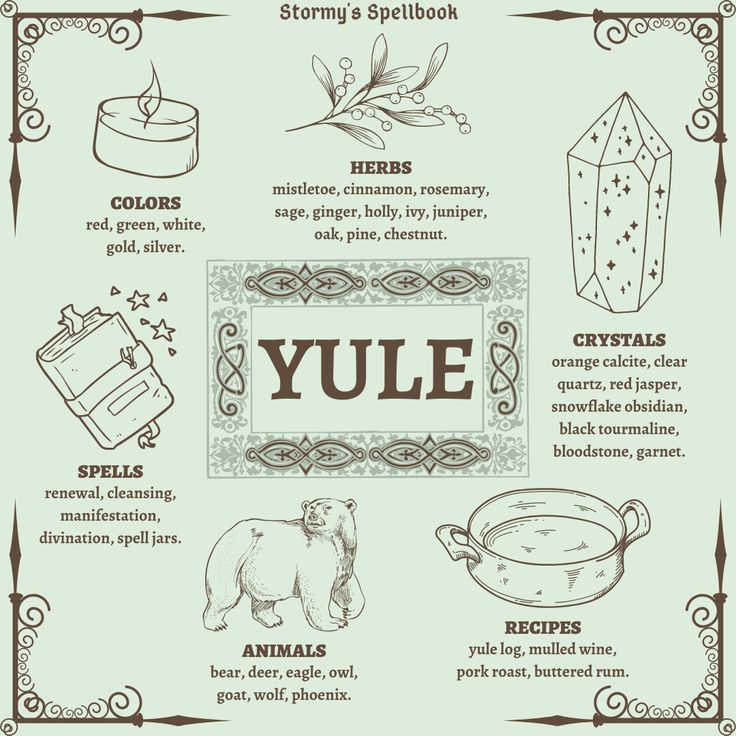
Some of the Witchcraft/Magickal Correspondence for Yule/Winter Solstice – Printable
(YOU CAN COPY AND PASTE ANY COROSPONDENCES POSTED TO A DOCUMENT TO PRINT AND/OR SAVE ON YOUR COMPUTER)
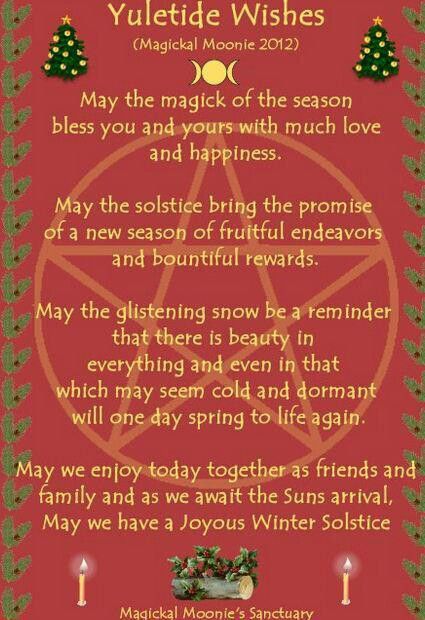
Happy Yule
From all of us at WOTC may you and your family have a blessed Yule!

Winter starts in the southern hemisphere on 22 June 2023 at 12:57 PM AEST
.
As the Oak King is Reborn…
From all of us at WOTC we wish you and your family the best of luck as the days get longer.
Yule and Winter Solstice 2022: Meaning and Traditions For Yuletide
Yule and Winter Solstice is the most magical time of the year, and 2022 is no different! However, it can also be one of the most stressful. Remember to take a moment to notice the beauty around you during this yuletide season. Reflect on the current position of the Winter Solstice sun and feel its light shining down on you.
Nature is slowing down, and so should you. Be still and observe the peaceful silence and renewal taking place.
Engage all your senses, take deep breaths, and be truly present. Pause for a few moments to look at the beautiful sparkling lights, listen to your favorite winter song, smell the cold crisp air mixed with the scent of cinnamon or pine, taste your favorite warm drink, or snuggle up with a cozy blanket. Turn off electronics and be still.
Many Pagans, Witches, and those interested in Nature Spirituality celebrate the seasonal cycles. Sometimes referred to as the Wheel of the Year, and consisting of eight celebrations. Four of these festivals (Imbolc, Beltane, Lughnasadh, and Samhain) are rooted in Celtic history and origins.
The other four (Spring Equinox, Summer Solstice, Autumn Equinox, and Winter Solstice) represent the sun’s location. I created a complete guide to each season, including history, traditions, symbols, correspondences, ritual ideas, and how you can celebrate.
Please note that I make every effort to ensure this information is correct and accurate through my own experiences and referencing sources throughout AND at the bottom of this article.
Posts on this site may contain affiliate links that allow me to earn a small commission from your purchases (at no extra cost to you!)
Table of Contents
When is Yule and Winter Solstice in 2022?
How Do You Pronounce Yule and Winter Solstice
Yule and Winter Solstice Spiritual Meaning
Yule and Winter Solstice Traditions
Yule and Winter Solstice Correspondences
Simple Yule and Winter Solstice Rituals in 2022
Yule Music or Winter Solstice Songs
How To Celebrate Yule and Winter Solstice in 2022
How To Have A (Stress-Less) Present & Mindful Yule and Winter Solstice Holiday
From thepeculiarbrunette.com
For Your Viewing Pleasure – Summer Solstice vs. Winter Solstice: Side-by-Side Time-lapse 2017

Summer Solstice vs. Winter Solstice: Side-by-Side Time-lapse
Synchronized side-by-side time-lapse of the summer solstice and winter solstice from Manchester, UK, at the latitude of 53.5°N. Music: Discovery One Orbits Jupiter by TeknoAXE (https://www.youtube.com/watch?v=dGH5G…)
© Scott Richards 2017 •
December Solstice: Longest and Shortest Day of the Year

Solstice and Equinox in the Northern Hemisphere

Solstice and Equinox in the Southern Hemisphere
There are two solstices every year: one in December and one in June. The December solstice marks the shortest day north of the equator and the longest day in the south.
Sun Reaches Most Southerly Point
The December solstice is the moment the Sun is directly above the Tropic of Capricorn in the Southern Hemisphere. This is the southernmost latitude it reaches during the year. After the solstice, it begins moving north again.
10 facts about the December solstice
Solstice Local Time & Date
In Plainfield, Illinois, USA: Wednesday, December 21, 2022 at 3:48 pm CST (Change location)
This corresponds to Wednesday, December 21, 2022 at 21:48 UTC.
Sun rise/set and day length around this solstice
Local times for this solstice worldwide
Shortest Day in the North
Since the Northern Hemisphere is tilted away from the Sun in December, it receives less sunlight during the course of a day. At the solstice, the North Pole’s tilt away from the Sun is greatest, so this event marks the shortest day of the year north of the equator.
This effect is greatest in locations that are farther away from the equator. In tropical areas, the shortest day is just a little shorter than 12 hours; in the temperate zone, it is significantly shorter; and places within the Arctic Circle experience polar night, when the Sun does not rise at all.
Longest Day in the South
Conversely, the day of the December solstice is the longest day of the year in the Southern Hemisphere. Here, too, the effect is greater the farther a location is away from the equator.
Places within the Antarctic Circle experience Midnight Sun, when the Sun does not set at night.
Sun times at the South Pole in December
What Does “Solstice” Mean?
During the course of a year, the subsolar point—the spot on the Earth’s surface directly beneath the Sun—slowly moves along a north-south axis. Having reached its northernmost point at the June solstice, it starts moving southward until it crosses the equator on the day of the September equinox. At the December solstice, which marks the southernmost point of its journey, it stops again to start its journey back toward the north.
This is how the solstices got their name: the term comes from the Latin words sol and sistere, meaning “Sun” and “to stand still”.
Initially, the naming arose from observations of how the Sun’s apparent path across the sky changes slightly from one day to the next, which is caused by the same process as the subsolar point’s movement described above.
In the months leading up to the December solstice, the position of sunrise and sunset creeps southward. On the day of the solstice, it reaches its southernmost point. After that, the daily path of the Sun across the sky begins to creep northward again.
Why Does the Sun Move North and South?
The subsolar point moves north and south during the year because the Earth’s axis is tilted at an angle of about 23.4° in relation to the ecliptic, an imaginary plane created by Earth’s path around the Sun. In June, the Northern Hemisphere is tilted toward the Sun, and the subsolar point is north of the equator. As the Earth travels toward the opposite side of its orbit, which it reaches in December, the Southern Hemisphere gradually receives more sunlight, and the subsolar point travels south.
The Solstices and the Seasons
The December solstice marks the start of winter in the Northern Hemisphere and the start of summer in the Southern Hemisphere, according to one definition.
Equinox and solstice dates—years 1-2149
Sunrise and Sunset Times Lag Behind
The shortest day of the year is commonly associated with the latest sunrise and earliest sunset of the year. However, in most locations, the earliest sunset happens a few days before the solstice, while the latest sunrise occurs some days after it. Find out why
 Witches Of The Craft®
You must be logged in to post a comment.