Some of the Witchcraft/Magickal Correspondence for the March Full Moon

From theastartehome.wordpress.com

Signifier for Life

Names: 

  • Chaste Moon
  • Crow Moon
  • Crust Moon
  • Hrethkmonath (Hertha’s Month)
  • Lenting Moon
  • Lentzinmanoth (Renewal Month)
  • Moon of the Snowblind
  • Moon of Winds
  • Plow Moon
  • Raven Moon
  • Sap Moon
  • Seed Moon
  • Storm Moon
  • Sugar Moon
  • Windy Moon
  • Worm Moon

Angels:  Choose an angel that matches your intention

Animals:  Worm

Chakras:  Root

Colors:

  • Green
  • Yellow
  • Light Purple

Crystals/Metals:

  • Amethyst
  • Aquamarine
  • Aventurine
  • Bloodstone
  • Jasper
  • Moonstone
  • Obsidian
  • Opal
  • Rose Quartz
  • Tiger’s Eye
  • Topaz (blue)

Direction:  West

Element:  Water

Goddesses and Gods:

  • Artemis
  • Cybele
  • Isis
  • The Morrighan

Herbs/Oils: 

  • Apple Blossom
  • High John
  • Pennyroyal
  • Wood Betony

Intentions/Powers/Spell Uses:

  • Breaking illusions
  • Career Reinvention
  • Cleaning
  • Exploring
  • Fertility
  • Flow breaks into the open
  • Growth
  • Innocence
  • Lean living
  • Magikal tool cleansing
  • New beginnings
  • Prosperity
  • Purity
  • Rebirth
  • Seeing life truth even though it may be painful
  • Spirituality
  • Success

Reiki Symbol:  Hon Sha Ze Sho Nen

Tarot:

  • The Moon
  • The Sun

Time of Day:  Midnight

Trees/Plants: 

  • Cherry
  • Dogwood
  • Honeysuckle
  • Lilacs
  • Lotus

Virtues: 

  • balance
  • justice
  • harmony

Zodiac:  dependent on the sign in which the full moon takes place

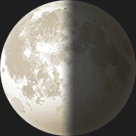
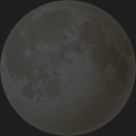
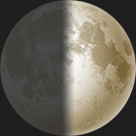
March 2023 Moon Phase Calendar – Printable

From en.tutiempo.net

1 2 3 4 5
6 7 Full 8 9 10 11 12
13 14 15 16 17 18 19
20 21 New 22 23 24 25 26
27 28 29 30 31

Information About the Snow Moon: Full Moon in February 2023

Got your snow shovels ready? February’s full Snow Moon reaches its peak on Sunday, February 5! Why is it called the full Snow Moon? Find out in our February Moon Guide!

When to See the Full Moon in February 2023

February’s full Snow Moon reaches peak illumination at 1:30 P.M. EST on Sunday, February 5. It will be below the horizon at this time, so for the best view of this Moon, look for it starting the night before or later on Sunday; it will drift above the horizon in the east around sunset and reach its highest point in the sky around midnight. See when the Moon will be visible in your area.

Why Is It Called the Snow Moon?

The full Moon names used by The Old Farmer’s Almanac come from a number of places, including Native American, Colonial American, and European sources. Traditionally, each full Moon name was applied to the entire lunar month in which it occurred, not just to the full Moon itself.

The Snow Moon

The explanation behind February’s full Moon name is a fairly straightforward one: it’s known as the Snow Moon due to the typically heavy snowfall that occurs in February. On average, February is the United States’ snowiest month, according to data from the National Weather Service. In the 1760s, Captain Jonathan Carver, who had visited with the Naudowessie (Dakota), wrote that the name used for this period was the Snow Moon, “because more snow commonly falls during this month than any other in the winter.”

Alternative February Moon Names

Names for this month’s Moon have historically had a connection to animals. The Cree traditionally called this the Bald Eagle Moon or Eagle Moon. The Ojibwe Bear Moon and Tlingit Black Bear Moon refer to the time when bear cubs are born. The Dakota also call this the Raccoon Moon, certain Algonquin peoples named it the Groundhog Moon, and the Haida named it Goose Moon.

Another theme of this month’s Moon names is scarcity. The Cherokee names of Month of the Bony Moon and Hungry Moon give evidence to the fact that food was hard to come by at this time.

Click here to find out more about February’s Full Moon and other topics from The Farmers Almanac

February 2023 Moon Details

You can use this link to go forward or backward in time for Moon phase information. If you are curious, you can even find out what phase the Moon was in when you or anyone else was born.

From MoonGiant.com

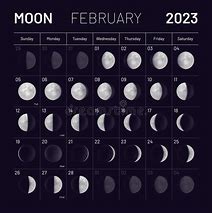
The Full Moon for this month will occur early in the month on Sunday, February 5th. The New Moon will happen later in February on Monday, February 20th.

February’s Full Moon

As the snowiest month in the United States, February’s full moon is commonly known as the Full Snow Moon in Native American cultures. These ancient tribes named this moon after the way trees cracked in the cold, or how people had to sit shoulder to shoulder around the fire for warmth. Even the Celts called it the Moon of Ice. As expected of the coldest month in the year, the Full Snow Moon is also known by more sinister names, such as the Bone Moon.

The Cherokee tribe called February’s full moon the Bone Moon because by this point, the tribe’s winter food supplies had usually dwindled to the point where people had to gnaw on bones and cook bone marrow soup in order to survive. For the same reason, the Kalapuya tribe called this moon the Out of Food Moon. Appropriately, it’s also known as the Hunger Moon and the Little Famine Moon. Perhaps due to this month’s association with death, the Cherokee tribe would commune with their dead ancestors during the Bone Moon. A didanawiskawi, or a medicine person, would host a medicine dance for the community. Fasting and rituals for the dead were also common practices.

However, not all cultures associate February’s full moon with extreme cold and death. The Hopi tribe calls it the Moon of Purification and Renewal, which is very fitting because the Full Snow Moon is usually the very first full moon of the year according to the lunar calendar. Cultures that follow the lunar calendar, especially East Asian cultures, tend to associate the Full Snow Moon with new beginnings for this very reason. The ancient Chinese, for example, called it the Budding Moon.

As a matter of fact, celebrations of February’s full moon are the climax of Lunar New Year festivities in various East Asian countries. In China, the Full Snow Moon is celebrated during the Lantern Festival, also known as the Yuanxiao Festival, which is the 15th day of the Lunar New Year. During this festival, the Chinese release kongming lanterns into the sky as they admire the full moon and eat tangyuan, glutinous rice balls that are usually filled with sweet paste. The round shape of the balls symbolize family togetherness and bring good luck to the whole family.

Many East Asian cultures in general also light lanterns and bonfires to celebrate February’s full moon. According to an ancient Chinese legend, not long after Buddhism was brought into China, 17 deities were witnessed flying through the sky during the first full moon of the Lunar New Year. Shocked and excited, the populace lit fires and lanterns to see the godly beings better. They continued to do so year after year, but for more practical reasons – to chase away pests and to pray for a good crop in the upcoming spring.

In Korea, where February’s full moon is known as Daeboreum, these fiery structures are called “Houses of the Burning Moon”. During Daeboreum, Koreans hike mountains despite the freezing temperatures in order to catch a glimpse of the first rise of the first full moon of the Lunar New Year. According to legend, the very first person to accomplish this feat will have their dearest wish come true.

Local Date and Time for February 2023 Full Moon in major cities around the world:

Los Angeles,
San Francisco,
Vancouver
February 5, 2023
10:28am PST

Denver,
Salt Lake City,
Calgary
February 5, 2023
11:28am MST

Chicago,
Houston,
San Antonio
February 5, 2023
12:28pm CST

New York,
Toronto,
Atlanta
February 5, 2023
1:28pm EST

London,
Manchester,
Dublin
February 5, 2023
6:28pm GMT

Paris,
Rome,
Berlin
February 5, 2023
7:28pm CET

Athens,
Istanbul,
Helsinki
February 5, 2023
8:28pm EET

Dubai,
Abu Dhabi,
Muscat
February 5, 2023
10:28pm +04

Bangalore,
Mumbai,
New Delhi
February 5, 2023
11:58pm IST

Singapore,
Kuala Lumpur
February 6, 2023
2:28am +08

Perth,
Hong Kong,
Beijing
February 6, 2023
2:28am AWST

Sydney,
Brisbane,
Melbourne
February 6, 2023
5:28am AEDT

December 2022 NEW AND FULL MOONS

From modernwellnesswitch.com

Each phase of the moon presents different types of energies. As the moon waxes and wanes, so does the magic around us mimic the moon’s celestial influence. Let’s see what each magical phase of the moon provides so you can time your rituals and practice powerfully.

DECEMBER 8TH

COLD MOON IN GEMINI

Magical Influence: A period of darkness, death and rebirth. Reach out to friends and family.

Moon Correspondences:

Plants: English ivy, holly, mistletoe, Christmas cactus, fir, poinsettia, & pine

Colors: Black, white, & bright red

Stones: Peridot, jacinth, & serpentine

Animals: Bear, rook, mouse, deer, snowy owl, horse, & robin

DECEMBER 23RD

NEW MOON IN CAPRICORN

Magical Influence: Reflect on how you’ve changed and what’s been left behind.

November 2022 Moon Phase Calendar – Printable


November 2022 Moon Phase Information

The Full Moon for this month will occur in the second week on Tuesday, November 8th. The New Moon will happen later in November on Wednesday, November 23rd.

About November’s Full Moon

With the changing of the seasons, November’s full moon marks the beginning of the end. In many different cultures, November’s full moon is intimately connected with death and loss, on both a literal and symbolic level. The Celts, for instance, called it the Reed Moon, comparing the mournful music made by wind instruments to the ghoulish sounds of spirits being drawn into the underworld. And not without good reason – the Full Mourning Moon marks a dangerous time of the year where people could easily slip into the underworld with a single misstep.

We may enjoy the luxury of winter coats and central heating now, but freezing to death during the long, dark winters used to be a very real threat to early inhabitants of Northern America. In order to survive, making warm winter clothing out of beaver fur was crucial for American colonists and Native American tribes. This is why November’s full moon is also known as the Beaver Moon. During this month, beavers are very active, working hard on dam construction, and so this was a good time to start harvesting their fur.

Missing the timing for this would mean death for these early Northern American communities, as the rivers would freeze over, making it impossible to set out traps. Many Native American tribes, including the Cree, Arapaho, and Abenaki tribes, called November’s full moon the “Moon When Rivers Start to Freeze”. This name drives home the importance of November’s full moon as a signal for these Native American tribes to begin trapping beavers before it was too late, as well as to complete their preparations for the darkest depths of winter.

For the Pagans, on the other hand, the final stage of their winter preparations involve the very important process of “mourning” – which is why they call the last moon before the winter solstice the Mourning Moon. After a full year of accumulating possessions, both physically and otherwise, the Mourning Moon is the perfect time to let go of old, unnecessary things, while giving yourself permission to mourn their passing. Practicing Pagans may perform a moonlit ritual where they write down the things they want to rid themselves of, and ask their Goddess for help in removing unwanted burdens.

Pagan traditions aside, anyone can benefit from taking the time to self-reflect and to let go. Take advantage of the Full Mourning Moon this November to look back on your year and take stock of your desires, your ambitions, your mental and behavioral habits, and the people you spend your energy on. Clean your living and work spaces, and sort out the physical objects that are not contributing to your well-being. Take the time to fully mourn and let go of anything – or anyone – that does not bring you joy, so that you can begin to move forward, unfettered, towards a lighter and happier new year.

Local Date and Time for November 2022 Full Moon in major cities around the world:

Los Angeles,
San Francisco,
Vancouver
November 8, 2022
3:02am PST

Denver,
Salt Lake City,
Calgary
November 8, 2022
4:02am MST

Chicago,
Houston,
San Antonio
November 8, 2022
5:02am CST

New York,
Toronto,
Atlanta
November 8, 2022
6:02am EST

London,
Manchester,
Dublin
November 8, 2022
11:02am GMT

Paris,
Rome,
Berlin
November 8, 2022
12:02pm CET

Athens,
Istanbul,
Helsinki
November 8, 2022
1:02pm EET

Dubai,
Abu Dhabi,
Muscat
November 8, 2022
3:02pm +04

Bangalore,
Mumbai,
New Delhi
November 8, 2022
4:32pm IST

Singapore,
Kuala Lumpur
November 8, 2022
7:02pm +08

Perth,
Hong Kong,
Beijing
November 8, 2022
7:02pm AWST

Sydney,
Brisbane,
Melbourne
November 8, 2022
10:02pm AEDT

July 2022 Moon Details

From MoonGiant.com

The Full Moon for this month will occur in the second week on Wednesday, July 13th. The New Moon will happen later in July on Thursday, July 28th.

The Full Thunder Moon of July

July’s full moon is called the Full Thunder Moon, after the frequent thunderstorms that roll in during early summer. Thunderstorms are more likely to form in humid environments during summer because of the moist, hot air rising from the ground to the higher, colder parts of our atmosphere. The Full Thunder Moon is, therefore, a warning sign for a surprisingly dangerous time of the year.

Did you know that you are more likely to get hit by lightning twice in your lifetime than win the Powerball lottery, and that summer is usually when most lightning fatalities happen? As the Full Thunder Moon rises to prominence during the warm summer months, people are more likely to be taking part in outdoor activities, which increases their risk of being hit by the frequent thunder and lightning strikes that happen during this period. Everyone knows to avoid trees and bodies of water during thunderstorms, but that basic precaution alone is not enough.

According to experts, you should head inside a safe building immediately when you hear thunder, no matter how safe you think you are. Lightning can strike from up to 10 miles away, and nothing can protect you when you’re outdoors. Wearing rubber soles or crouching down low will not stop lightning from hurting you. Lying down on the ground is an even worse idea, as it’ll make you even more vulnerable to currents traveling through the ground.

If you do get caught outdoors with no way to make it into a building safely, sheltering in a completely closed, all-metal car is an option as long as you don’t touch anything metal. You should also avoid open areas such as fields. Just keep moving as fast as you can until you reach shelter. If you happen to be in a group, spread out so that if one of you gets struck, the others can provide emergency CPR and other help. Remember that it’s completely safe to touch a person after they’ve been struck. Lightning-related deaths are most often caused by the heart stopping due to the sudden surge of electricity, and so it is very important to administer CPR to a lightning strike victim immediately.

Ultimately, the best way to avoid being caught outdoors in a thunderstorm is to take a little of your time each day to monitor the weather situation, and have backup plans for shelter if you’re heading outdoors. That said, being indoor doesn’t necessarily guarantee that you’re safe either. Make sure to stay far away from any plumbing, metal objects, electronic devices and equipment, or anything that might conducts electricity. Avoid windows or doors at all costs. Not even concrete walls and floors are safe, since they contain metal rods that conduct electricity, so never allow yourself to lean against concrete walls or come into contact with concrete floors. The risk of a strike remains for 30 minutes after the last flash of lightning or peal of thunder.

The Full Thunder Moon is a great time for you to brush up on your lightning safety knowledge and educate other people as well. Feel free to head to the wild outdoors to observe deers whose velvety antlers are growing out during this period – which is why July’s full moon is also known as the Full Buck Moon – but also make sure to take the necessary safety precautions.

Local Date and Time for July 2022 Full Moon in major cities around the world:

Los Angeles,
San Francisco,
Vancouver
July 13, 2022
11:37am PDT

Denver,
Salt Lake City,
Calgary
July 13, 2022
12:37pm MDT

Chicago,
Houston,
San Antonio
July 13, 2022
1:37pm CDT

New York,
Toronto,
Atlanta
July 13, 2022
2:37pm EDT

London,
Manchester,
Dublin
July 13, 2022
7:37pm BST

Paris,
Rome,
Berlin
July 13, 2022
8:37pm CEST

Athens,
Istanbul,
Helsinki
July 13, 2022
9:37pm EEST

Dubai,
Abu Dhabi,
Muscat
July 13, 2022
10:37pm +04

Bangalore,
Mumbai,
New Delhi
July 14, 2022
12:07am IST

Singapore,
Kuala Lumpur
July 14, 2022
2:37am +08

Perth,
Hong Kong,
Beijing
July 14, 2022
2:37am AWST

Sydney,
Brisbane,
Melbourne
July 14, 2022
4:37am AEST

Planetary location of the Moon and Their Association With Spellwork


Moon in Aries: Spells involving authority, willpower and rebirth.

Moon in Taurus: Spells involving love, real estate, and money.

Moon in Gemini: Spells involving communication, public relations and travel.

Moon in Cancer: Spells involving domestic life and honoring lunar deities.

Moon in Leo: Spells involving power over others, courage, child birth.

Moon in Virgo: Spells involving employment matters, health and intellectual matters.

Moon in Libra: Spells involving court cases, partnerships and artistic matters.

Moon in Scorpio: Spells involving secrets, power and psychic growth.

Moon in Sagittarius: Spells involving publications, sports and the truth.

Moon in Capricorn: Spells involving career, political matters and ambition.

Moon in Aquarius: Spells involving science, freedom, personal expression, problem solving and friendship.

Moon in Pisces: Spells involving music, telepathy and clairvoyance.

The Effects the Full Moon Has On Us