Some of the Witchcraft/Magickal Correspondence Digest for Saturday

From WitchSwap.com

Saturday

is associated with Saturn (imagine that!), the planet that rules over responsibility, self-discipline, limitations and boundaries. Zodiac signs include Aquarius as well as Capricorn and Libra (due to the planetary correlation to Saturn). Elements corresponding to Saturday are Earth and Water. Saturn is the Roman God who is known for liberation and dissolution. Because of this, spells having to do with break ups (yeah, controversial and this isn’t’ an endorsement, either, just to be clear), ending a relationship or a partnership of any kind, business, personal, etc. as well as banishment, justice, swift karma and protection spells will all be favorable if performed on a Saturday. Gods/Goddesses: Saturn. Colors: Black and purple. **a black candle is great to use to banish negativity or to reverse a situation, it is not only used in baneful spells**. Angel: Barachiel

A Laugh for Today

I hope your Saturday is not squirrely which can lead to making you feel nuts 🥜🥜

Planets Retrograde In July 2022

There Will Be Three Planets Retrograde in July, But It’s Not All Doom and Gloom

There haven’t been this many retrograde planets in the cosmos since January.

I hope you enjoyed the hiatus, because July is bringing retrogrades back to the cosmos with a bang, and just in time for your summer vacation *cue collective groans*. It’s not all bad, though, since retrogrades tend to be a time where you’re called to review, revise, and re-visit certain themes in your life that are potentially outdated or in need of some new, refreshing energy. You’re getting plenty of opportunities to do so, too, because three planets will be retrograde in the sky for July 2022.

While retrogrades can cause some discomfort, they ultimately bring forth the biggest life lessons, and challenge you to grow and evolve as a person. The good thing is, since the planets retrograding in July will be outer planets, you don’t have to brace yourself for any earth-shattering shifts that’ll catch you completely off guard. Instead, you’ll want to gear up for longer retrograde periods since outer planets move much slower than Mercury, Venus, and Mars. Because these planets take much longer to retrograde through the sky, the effects tend to be easier to overlook until the retrograde is complete, but you’ll definitely still notice a calling to check in with the topics those planets rule over in your birth chart. Since July 2022 will have not one, not two, but three planets retrograding through the cosmos, you’ll definitely be called to make some pretty big changes.

What Planets Will Be Retrograde During July 2022?

Click here to read the rest of this article on elitedaily.com

A Thought for Today

Until we meet again dear sisters, brothers, and honored guests may your life be filled with all things positive!

July 1 Astronomy Picture of the Day

Discover the cosmos! Each day a different image or photograph of our fascinating universe is featured, along with a brief explanation written by a professional astronomer.

2022 July 1

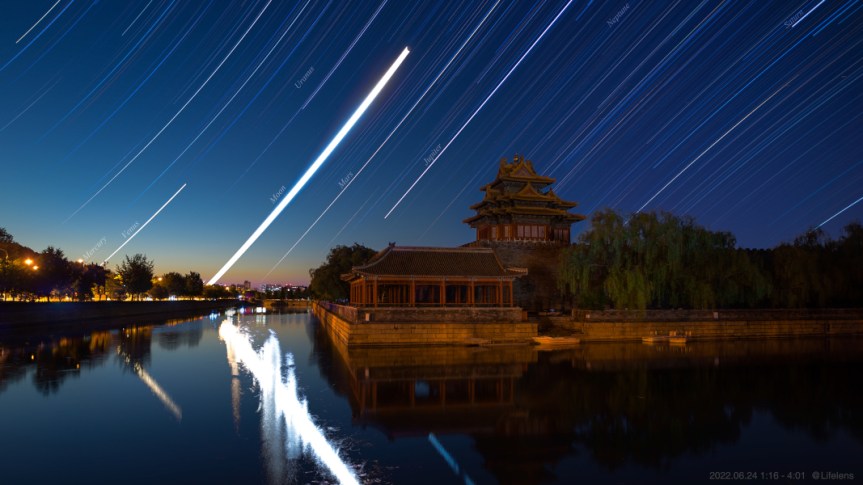
The Solar System’s Planet Trails

Image Credit & CopyrightZheng Zhi

Explanation: Stars trail through a clear morning sky in this postcard from a rotating planet. The timelapse image is constructed from consecutive exposures made over nearly three hours with a camera fixed to a tripod beside the Forbidden City in Beijing, China on June 24. Arcing above the eastern horizon after the series of exposures began, a waning crescent Moon left the brightest streak and watery reflection. On that date the planets of the Solar System were also lined up along the ecliptic and left their own trails before sunrise. Saturn was first to rise on that morning and the ringed planet’s trail starts close to the top right edge, almost out of the frame. Innermost planet Mercury rose only just before the Sun though. It left the shortest trail, visible against the twilight near the horizon at the far left. Uranus and Neptune are faint and hard to find, but mingled with the star trails the Solar System’s planet trails are all labeled in the scene.

A Laugh for Today

A Thought for Today

Until we meet again dear sisters, brothers, and honored guests may your life be filled with all things positive!

A Thought for Today

Until we meet again dear sisters, brothers, and honored guests may your life be filled with all things positive!

Some of the Witchcraft/Magickal Correspondence Digest Thursday

Magickal Intentions: Luck, Happiness, Health, Legal Matters, Male Fertility, Treasure and Wealth, Honor, Riches, Clothing Desires, Leadership, Public Activity, Power and Success

Incense: Cinnamon, Must, Nutmeg and Sage

Planet: Jupiter

Sign: Sagittarius and Pisces

Angel: Sachiel

Colors: Purple, Royal Blue and Indigo

Herbs/Plants: Cinnamon, Beech, Buttercup, Coltsfoot, Oak

Stones: Sugilite, Amethyst, Turquoise, Lapis Lazuli and Sapphire

Oil: (Jupiter) Clove, Lemon Balm, Oakmoss, Star Anise

Jupiter presides over Thursday. The vibrations of this day attune well to all matters involving material gain. Use them for working rituals that entail general success, accomplishment, honors and awards, or legal issues. These energies are also helpful in matters of luck, gambling, and prosperity.


June 30 Astronomy Picture of the Day

Discover the cosmos! Each day a different image or photograph of our fascinating universe is featured, along with a brief explanation written by a professional astronomer.

2022 June 30

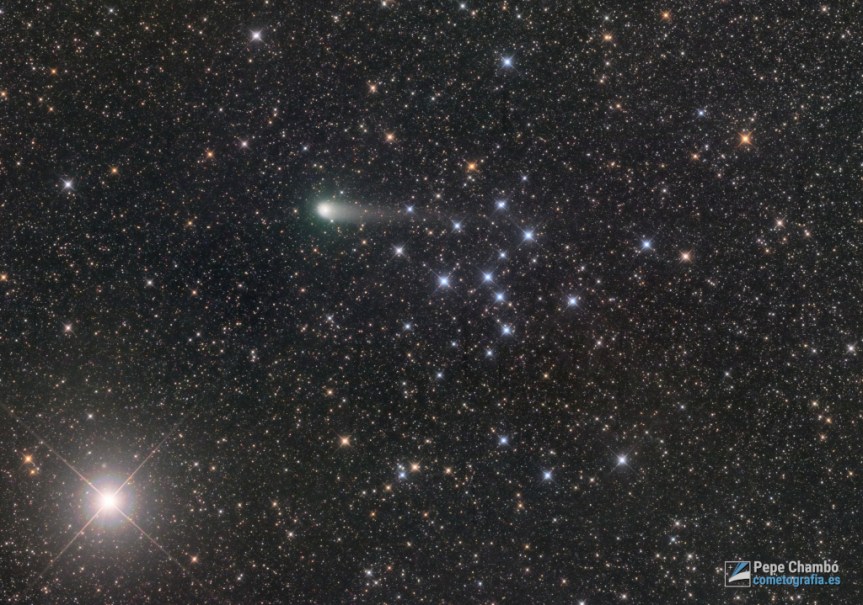
Comet C/2017 K2 (PanSTARRS)

Image Credit & CopyrightJose J. Chambo (Cometografia)

Explanation: Imaged on June 20 2022, comet C/2017 K2 (PanSTARRS) shares this wide telescopic field of view with open star cluster IC 4665 and bright star Beta Ophiuchi, near a starry edge of the Milky Way. On its maiden voyage to the inner Solar System from the dim and distant Oort cloud, this comet PanSTARRS was initially spotted over five years ago, in May 2017. Then it was the most distant active inbound comet ever found, discovered when it was some 2.4 billion kilometers from the Sun. That put it between the orbital distances of Uranus and Saturn. Hubble Space Telescope observations indicated the comet had a large nucleus less than 18 kilometers in diameter. Now visible in small telescopes C/2017 K2 will make its closest approach to planet Earth on July 14 and closest approach to the Sun this December. Its extended coma and developing tail are seen here at a distance of some 290 million kilometers, a mere 16 light-minutes away.

Let’s Talk Witch – 13 Meditations for a Short Attention Span

Ultimately, meditation has only one rule: you must turn communication within yourself. For most people, this means not communicating with others during meditative time. Even if you can only cut off the world for fifteen seconds, do it— outside input is NOT meditation. While the meditation may come in stolen moments, it is a cumulative skill, and even those tiny meditations make you better at it.

There are, ultimately, many reasons why traditional deep meditation might not work. People with jobs and families just don’t have much time to meditate. Others suffer from ADHD or other neurological dysfunctions, and between corporate life and traditional schooling, it’s very easy to fall into the trap of the “more, better, faster” mentality.

For people in these situations who want to use meditation to break out of them, small present-moment techniques work best. You may not be able to step entirely out of the flow of life, but you can take a single moment and make it yours. A moment as tiny as pushing the off button on your computer monitor to savor a sip of coffee can count as an act of meditation.

The following thirteen techniques are indeed meditation methods; each one can, with practice, train your brain to reach a meditative state. For beginners, it’s more important that you know how to get to that state than it is that you stay in it for any particular amount of time.

Count to two, and repeat. Seriously, that’s it. You don’t need to count slowly. Count at the natural speed of your own mind. Do so without timing it to your breath for as long as you can stand it. It’s about directing your attention and giving your mind something to do at a time when it might fight you with excessive boredom or stress signals. You may also try counting to 100 at any natural speed. This is a popular and effective technique in anger management, too.

Find your achy body parts and breathe into them. Identify an area that has tension and picture every breath you inhale entering through your pores where the ache is, and each exhalation as the pain leaving. If your attention shifts, move on to a different spot on your body, or stop— you’ve worked your attention as far as it can go for the time being.

Pick an image and see how long you can hold it in your mind. For example, you could choose a tarot card and continue to picture it as you go about other business. At the end of the day, you can stop to evaluate what you learned. You may receive insights into the card, object, or person that you can write about.

Walk. The simple act of walking alone is a type of meditation. You are not communicating with others, but you are paying attention to the world around you. To advance the walking meditation, walk and count. You can count the steps to a tree ahead of you on the path. Count how many steps to your car from your doorway. Count how many steps to the coffee maker from your desk. It keeps you focused entirely on what you are doing— and that is in itself a meditative state.

Stack or line up some items, and then deliberately scatter them. The act of clearing space and positioning items like pencils, paperclips, or shoes, is actually a meditative practice. You can find yourself engaged with making things line up just right, and just as Buddhist monks scatter their sand mandalas when finished, you scatter your tidy stacks in an exercise of nonattachment/ enjoying mild chaos. You will still need to sweep up. Playful meditation has as much value as serious meditation— perhaps even more, as it can stimulate creativity in ways that gigantic revelations rarely can.

Close your eyes and listen to all ambient noise. Meditation does not require you to ignore everyone and everything around you— it requires you to focus your attention on specific things without engaging with them. Rather than trying to shut out the noises of traffic, chatty neighbors, or the children, close your eyes and simply listen as though they are static or other low-meaning noise.

Name objects in front of you. You can do this anywhere— at work, during a long car ride, even at home. Look at one object, and say its name to yourself: “book,” “wall art,” “carpet,” and so on. Simply name every item immediately before you.

Keep a small bottle of a favorite fragrance on hand. Sniff every so often— this alters your mood, and brings your attention fully to one thing in your environment. Clary sage and lemongrass are both wonderful fragrances for meditative clarity.

Use your sense of touch. Comparing the textures of your clothing can give you a brief meditative timeout. Run your hands over your legs and over your abdomen. Notice the differences in how the fabric of different pieces of clothing feels.

Try stretching your hands. Touch each one of your fingers to the thumb on the same hand. Press down with each connection. In some cases, it may take some practice stretching your fingers.

Visualize as many colors as you can in one sitting. This pulls together the right and left hemispheres of your brain and is a key skill for most chakra work. Notice which colors you dwell on, and which you have trouble picturing.

Tell yourself a story. If you are alone, speak that story aloud. It can be about something as simple as a chicken crossing the road, or involve monks and dragons. The point is to engage yourself on your own power, not with the input of a book or television. Do not write these stories down— they are for you in your moment. They need not be long— two or three sentences, maybe even just one sentence.

Practice the slow version of what dancers call spotting. Turn your head and focus on one point of the wall. Stay there for two to three seconds, then look up and focus on the ceiling for two to three seconds. Then focus on another spot on the wall, then the carpet, etc. This is all about directing attention and only takes seconds to practice.

Source:
13 Meditations for a Short Attention Span
Author: Diana Rajchel
Llewellyn’s 2014 Magical Almanac: Practical Magic for Everyday Living


A Thought for Today

Until we meet again dear sisters, brothers, and honored guests may your life be filled with all things positive!

June 29 Astronomy Picture of the Day

Discover the cosmos! Each day a different image or photograph of our fascinating universe is featured, along with a brief explanation written by a professional astronomer.

2022 June 29

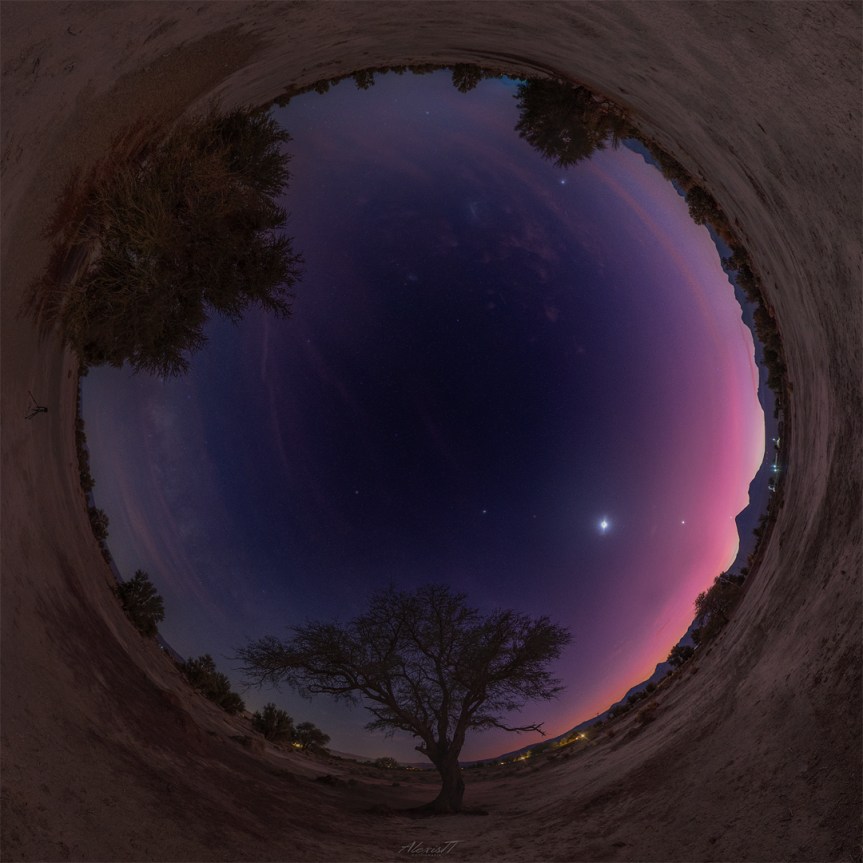
Solar System Family Portrait

Image Credit & Copyright: Alexis Trigo

Explanation: Yes, but have you ever seen all of the planets at once? A rare roll-call of planets has been occurring in the morning sky for much of June. The featured fisheye all-sky image, taken a few mornings ago near the town of San Pedro de Atacama in Chile, caught not only the entire planet parade, but the Moon between Mars and Venus. In order, left to right along the ecliptic plane, members of this Solar System family portrait are EarthSaturnNeptuneJupiterMarsUranusVenusMercury, and Earth. To emphasize their locations, Neptune and Uranus have been artificially enhanced. The volcano just below Mercury is Licancabur. In July, Mercury will move into the Sun’s glare but reappear a few days later on the evening side. Then, in August, Saturn will drift past the direction opposite the Sun and so become visible at dusk instead of dawn. The next time that all eight planets will be simultaneously visible in a morning sky will be in 2122.


Notable Submissions to APOD: Morning Planet Parade 2022 June

A Laugh for Today

You guys too!

We can all fly by the dark of the Moon and wonder at the stars and planet all around us in our vast universe. Just have to be careful of all the sky rise buildings or splat we will go.

A Thought for Today

Until we meet again dear sisters, brothers, and honored guests may your life be filled with all things positive!

June 28 Astronomy Picture of the Day

Discover the cosmos! Each day a different image or photograph of our fascinating universe is featured, along with a brief explanation written by a professional astronomer.

2022 June 28

Mercury from Passing BepiColombo

Image Credit & LicenseESAJAXABepiColomboMTM

Explanation: Which part of the Moon is this? No part — because this is the planet Mercury. Mercury’s old surface is heavily cratered like that of Earth’s Moon. Mercury, while only slightly larger than Luna, is much denser and more massive than any Solar System moon because it is made mostly of iron. In fact, our Earth is the only planet more dense. Because Mercury rotates exactly three times for every two orbits around the Sun, and because Mercury’s orbit is so elliptical, visitors on Mercury could see the Sun rise, stop in the sky, go back toward the rising horizon, stop again, and then set quickly over the other horizon. From Earth, Mercury’s proximity to the Sun causes it to be visible only for a short time just after sunset or just before sunrise. The featured image was captured last week by ESA and JAXA‘s passing BepiColombo spacecraft as it sheds energy and prepares to orbit the innermost planet starting in 2025.

A Laugh for Today

If I had only remembered to get creamer 😥

A Thought for Today

Until we meet again dear sisters, brothers, and honored guests may your life be filled with all things positive!

June 27 Astronomy Picture of the Day

Discover the cosmos! Each day a different image or photograph of our fascinating universe is featured, along with a brief explanation written by a professional astronomer.

2022 June 27

The Gum Nebula over Snowy Mountains

Image Credit & Copyright: Wang Jin

Explanation: The Gum Nebula is so large and close it is actually hard to see. This interstellar expanse of glowing hydrogen gas frequently evades notice because it spans 35 degrees — over 70 full Moons — while much of it is quite dim. This featured spectacular 90-degree wide mosaic, however, was designed to be both wide and deep enough to bring up the Gum — visible in red on the right. The image was acquired late last year with both the foreground — including Haba Snow Mountain — and the background — including the Milky Way’s central band — captured by the same camera and from the same location in Shangri-LaYunnanChina. The Gum Nebula is so close that we are only about 450 light-years from the front edge, while about 1,500 light-years from the back edge. Named for a cosmic cloud hunter, Australian astronomer Colin Stanley Gum (1924-1960), the origin of this complex nebula is still being debated. A leading theory for the origin of the Gum Nebula is that it is the remnant of a million year-old supernova explosion, while a competing theory holds that the Gum is a molecular cloud shaped over eons by multiple supernovas and the outflowing winds of several massive stars.