
(One Person’s Point of View c 2013) You Call It Hallowe’en… We Call It Samhain

You Call It Hallowe’en… We Call It Samhain    by Peg Aloi


October 31st, commonly called Hallowe’en, is associated with many customs, some of them mysterious, some light-hearted, some of them downright odd. Why do we bob for apples, carve pumpkins into jack-o-lanterns, and tell ghost stories on this night? Why do children go door-to-door asking for candy, dressed in fantastical costumes? How is Hallowe’en connected to All Soul’s Day, celebrated by some Christian denominations on November 1st? And what is the significance of this holiday for modern-day Witches?

A Brief History of Hallowe’en

Hallowe’en has its origins in the British Isles. While the modern tradition of trick or treat developed in the U. S., it too is based on folk customs brought to this country with Irish immigrants after 1840. Since ancient times in Ireland, Scotland, and England, October 31st has been celebrated as a feast for the dead, and also the day that marks the new year. Mexico observes a Day of the Dead on this day, as do other world cultures. In Scotland, the Gaelic word “Samhain” (pronounced “SAW-win” or “SAW-vane”) means literally “summer’s end.”

Other names for this holiday include: All Hallows Eve (“hallow” means “sanctify”); Hallowtide; Hallowmass; Hallows; The Day of the Dead; All Soul’s Night; All Saints’ Day (both on November 1st).

For early Europeans, this time of the year marked the beginning of the cold, lean months to come; the flocks were brought in from the fields to live in sheds until spring. Some animals were slaughtered, and the meat preserved to provide food for winter. The last gathering of crops was known as “Harvest Home, ” celebrated with fairs and festivals.

In addition to its agriculture significance, the ancient Celts also saw Samhain as a very spiritual time. Because October 31 lies exactly between the Autumnal Equinox and the Winter Solstice, it is theorized that ancient peoples, with their reliance on astrology, thought it was a very potent time for magic and communion with spirits. The “veil between the worlds” of the living and the dead was said to be at its thinnest on this day; so the dead were invited to return to feast with their loved ones; welcomed in from the cold, much as the animals were brought inside. Ancient customs range from placing food out for dead ancestors, to performing rituals for communicating with those who had passed over.

Communion with the dead was thought to be the work of witches and sorcerers, although the common folk thought nothing of it. Because the rise of the Church led to growing suspicion of the pagan ways of country dwellers, Samhain also became associated with witches, black cats (“familiars” or animal friends), bats (night creatures), ghosts and other “spooky” things…the stereotype of the old hag riding the broomstick is simply a caricature; fairy tales have exploited this image for centuries.

Divination of the future was also commonly practiced at this magically-potent time; since it was also the Celtic New Year, people focused on their desires for the coming year. Certain traditions, such as bobbing for apples, roasting nuts in the fire, and baking cakes which contained tokens of luck, are actually ancient methods of telling fortunes.

So What About Those Jack-O-Lanterns?

Other old traditions have survived to this day; lanterns carved out of pumpkins and turnips were used to provide light on a night when huge bonfires were lit, and all households let their fires go out so they could be rekindled from this new fire; this was believed to be good luck for all households. The name “Jack-O-Lantern” means “Jack of the Lantern, ” and comes from an old Irish tale. Jack was a man who could enter neither heaven nor hell and was condemned to wander through the night with only a candle in a turnip for light. Or so goes the legend…

But such folk names were commonly given to nature spirits, like the “Jack in the Green, ” or to plants believed to possess magical properties, like “John O’ Dreams, ” or “Jack in the Pulpit.” Irish fairy lore is full of such references. Since candles placed in hollowed-out pumpkins or turnips (commonly grown for food and abundant at this time of year) would produce flickering flames, especially on cold nights in October, this phenomenon may have led to the association of spirits with the lanterns; and this in turn may have led to the tradition of carving scary faces on them. It is an old legend that candle flames which flicker on Samhain night are being touched by the spirits of dead ancestors, or “ghosts.”

Okay, What about the Candy?

“Trick or treat” as it is practiced in the U. S. is a complex custom believed to derive from several Samhain traditions, as well as being unique to this country. Since Irish immigrants were predominantly Catholic, they were more likely to observe All Soul’s Day. But Ireland’s folk traditions die hard, and the old ways of Samhain were remembered. The old tradition of going door to door asking for donations of money or food for the New Year’s feast, was carried over to the U. S. from the British Isles. Hogmanay was celebrated January 1st in rural Scotland, and there are records of a “trick or treat” type of custom; curses would be invoked on those who did not give generously; while those who did give from their hearts were blessed and praised. Hence, the notion of “trick or treat” was born (although this greeting was not commonly used until the 1930’s in the U. S.). The wearing of costumes is an ancient practice; villagers would dress as ghosts, to escort the spirits of the dead to the outskirts of the town, at the end of the night’s celebration.

By the 1920’s, “trick or treat” became a way of letting off steam for those urban poor living in crowded conditions. Innocent acts of vandalism (soaping windows, etc.) gave way to violent, cruel acts. Organizations like the Boy Scouts tried to organize ways for this holiday to become safe and fun; they started the practice of encouraging “good” children to visit shops and homes asking for treats, so as to prevent criminal acts. These “beggar’s nights” became very popular and have evolved to what we know as Hallowe’en today.

What Do Modern Witches Do at Hallowe’en?

It is an important holiday for us. Witches are diverse, and practice a variety of traditions. Many of us use this time to practice forms of divination (such as tarot or runes). Many Witches also perform rituals to honor the dead; and may invite their deceased loved ones to visit for a time, if they choose. This is not a “seance” in the usual sense of the word; Witches extend an invitation, rather than summoning the dead, and we believe the world of the dead is very close to this one. So on Samhain, and again on Beltane (May 1st), when the veil between the worlds is thin, we attempt to travel between those worlds. This is done through meditation, visualization, and astral projection. Because Witches acknowledge human existence as part of a cycle of life, death and rebirth, Samhain is a time to reflect on our mortality, and to confront our fears of dying.

Some Witches look on Samhain as a time to prepare for the long, dark months of winter, a time of introspection and drawing inward. They may bid goodbye to the summer with one last celebratory rite. They may have harvest feasts, with vegetables and fruits they have grown, or home-brewed cider or mead. They may give thanks for what they have, projecting for abundance through the winter. Still others may celebrate with costume parties, enjoying treats and good times with friends. There are as many ways of observing Samhain as there are Witches in the world!
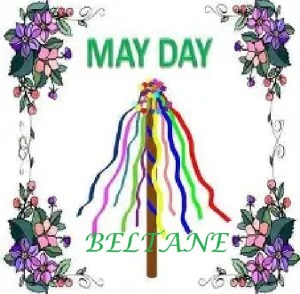
(One Person’s Viewpoint c 2015) Celebrating May Day – Beltane History

Celebrating May Day – Beltane History


The Fires of Tara:

Beltane kicks off the merry month of May, and has a long history. This fire festival is celebrated on May 1 with bonfires, Maypoles, dancing, and lots of good old fashioned sexual energy. The Celts honored the fertility of the gods with gifts and offerings, sometimes including animal or human sacrifice. Cattle were driven through the smoke of the balefires, and blessed with health and fertility for the coming year.

In Ireland, the fires of Tara were the first ones lit every year at Beltane, and all other fires were lit with a flame from Tara.

Roman Influences:

The Romans, always known for celebrating holidays in a big way, spent the first day of May paying tribute to their Lares, the gods of their household. They also celebrated the Floralia, or festival of flowers, which consisted of three days of unbridled sexual activity. Participants wore flowers in their hair (much like May Day celebrants later on), and there were plays, songs, and dances. At the end of the festivities, animals were set loose inside the Circus Maximus, and beans were scattered around to ensure fertility. The fire festival of Bona Dea was also celebrated on May 2nd.

A Pagan Martyr:

May 6 is the day of Eyvind Kelda, or Eyvind Kelve, in Norse celebrations. Eyvind Kelda was a Norwegian martyr who was tortured and drowned on the orders of King Olaf Tryggvason for refusing to give up his Pagan beliefs. A week later, Norwegians celebrate the Festival of the Midnight Sun, which pays tribute to the Norse sun goddess.

This festival marks the beginning of ten straight weeks without darkness.

The Greeks and Plynteria:

Also in May, the Greeks celebrated the Plynteria in honor of Athena, the goddess of wisdom and battle, and the patroness of the city of Athens (which was named after her). The Plynteria includes the ritual cleansing of Athena’s statue, along with feasting and prayers in the Parthenon. On the 24th, homage is paid to the Greek moon-goddess Artemis (goddess of the hunt and of wild animals). Artemis is a lunar goddess, equivalent to the Roman moon-goddess Diana – she is also identified with Luna, and Hecate.

The Green Man Emerges:

A number of pre-Christian figures are associated with the month of May, and subsequently Beltane. The entity known as the Green Man, strongly related to Cernunnos, is often found in the legends and lore of the British Isles, and is a masculine face covered in leaves and shrubbery. In some parts of England, a Green Man is carried through town in a wicker cage as the townsfolk welcome the beginning of summer. Impressions of the Green Man’s face can be found in the ornamentation of many of Europe’s older cathedrals, despite edicts from local bishops forbidding stonemasons from including such pagan imagery.

Jack-in-the-Green:

A related character is Jack-in-the-Green, a spirit of the greenwood. References to Jack appear in British literature back as far as the late sixteenth century. Sir James Frazer associates the figure with mummers and the celebration of the life force of trees. Jack-in-the-Green was seen even in the Victorian era, when he was associated with soot-faced chimney sweeps. At this time, Jack was framed in a structure of wicker and covered with leaves, and surrounded by Morris dancers. Some scholars suggest that Jack may have been a ancestor to the legend of Robin Hood.

Ancient Symbols, Modern Rites:

Today’s Pagans celebrate Beltane much like their ancestors did. A Beltane ritual usually involves lots of fertility symbols, including the obviously-phallic Maypole dance. The Maypole is a tall pole decorated with flowers and hanging ribbons, which are woven into intricate pattern by a group of dancers. Weaving in and out, the ribbons are eventually knotted together by the time the dancers reach the end.

In some Wiccan traditions, Beltane is a day in which the May Queen and the Queen of Winter battle one another for supremacy. In this rite, borrowed from practices on the Isle of Man, each queen has a band of supporters. On the morning of May 1, the two companies battle it out, ultimately trying to win victory for their queen. If the May Queen is captured by her enemies, she must be ransomed before her followers can get her back.

There are some who believe Beltane is a time for the faeries — the appearance of flowers around this time of year heralds the beginning of summer and shows us that the fae are hard at work. In early folklore, to enter the realm of faeries is a dangerous step — and yet the more helpful deeds of the fae should always be acknowledged and appreciated. If you believe in faeries, Beltane is a good time to leave out food and other treats for them in your garden or yard.

For many contemporary Pagans, Beltane is a time for planting and sowing of seeds — again, the fertility theme appears. The buds and flowers of early May bring to mind the endless cycle of birth, growth, death and rebirth that we see in the earth. Certain trees are associated with May Day, such as the Ash, Oak and Hawthorn. In Norse legend, the god Odin hung from an Ash tree for nine days, and it later became known as the World Tree, Yggdrasil.

If you’ve been wanting to bring abundance and fertility of any sort into your life — whether you’re looking to conceive a child, enjoy fruitfulness in your career or creative endeavors, or just see your garden bloom — Beltane is the perfect time for magical workings related to any type of prosperity.


Source: Article found on & owned by About.com  Author:

Spell for Samhain – A Samhain Chant c. 2018

(YOU CAN COPY AND PASTE ANY SPELLS POSTED TO A DOCUMENT TO PRINT AND/OR SAVE ON YOUR COMPUTER FOR PERSONAL USE ONLY)

Flashback to 2022 – Spell for Beltane – Charm to “Tie the Knot”

(YOU CAN COPY AND PASTE ANY SPELLS POSTED TO A DOCUMENT TO PRINT AND/OR SAVE ON YOUR COMPUTER FOR PERSONAL USE ONLY)

Beltane Charm to “Tie the Knot”

Much as the Great God and Great Goddess are said to “tie the knot” of marriage at Beltane, we can create our own knot-based magickal charm to honor this ancient and festive sabbat of which the tied-up Maypole is its emblem! When it comes to Beltane a vast majority of ancient pagans – and certainly any Neopagan worth their salt – understands that gender and orientation are of little consequence.  Love is love. Whoever we are and however we are, let’s craft a charm of nine loving knots. Feel free to chant the traditional Wiccan knot spell* if it aids your focus. This can be found online and in a variety of Witchcraft books.

Using a long strip of natural fabric (red or white are ideal), tie nine knots, each of which should contain within a small stone, herb, charm, or written prayer specifically for the energy of love** – cosmic, social, and personal – however your intuition guides. After preforming your magick, hang the charm near the front door or bedroom in order for its blessing to illuminate today and onward.

Source: Raven Digitalis in Llewellyn’s Witches’ Datebook 2022 page 71

Short List of Tuesday’s Correspondences c2016

October 28, 2025 Current Southern Hemisphere/Tomorrow’s Northern Hemisphere Moon Phase

You can find more moon phase details on both of the websites used in this post by clicking on each hyperlink.

Source: nineplanets.org

Moon Phase for Tuesday Oct 28th, 2025…

The Moon phase for October 28th, 2025 is a Waning Crescent phase. This is the phase where the moon is less than 50% illuminated but has not yet reached 0% illumination (which would be a New Moon).

In this part of the moon cycle, it is getting closer and closer to the Sun as viewed from Earth and the night side of the Moon is facing earth with a decreasingly thin crescent being illuminated.

The waning (shrinking) crescent Moon will rise at around midnight, transit the meridian after sunrise, before setting after noon. This phase is best viewed 1-2 hours before sunrise and is a great time to see the features of the Moon’s surface. Along the illuminated crescent you can see the craters and mountains of the moon casting long shadows.

Fun fact: …

Phase Details

Phase: Waning Crescent

Moon age: 6.8 days

Moon illumination: 38.49%

Moon tilt: 116.022°

Moon angle: 0.5

Moon distance: 396,507.49 km

Moon sign: Capricorn

Source: MoonGiant.com

You can use this link to go forward or backward in time for Moon phase information. If you are curious, you can even find out what phase the Moon was in when you or anyone else was born.

Today – October 28, 2025…

Today’s Waxing Crescent Phase

The Waxing Crescent on October 28 has an illumination of 40%. This is the percentage of the Moon illuminated by the Sun. The illumination is constantly changing and can vary up to 10% a day. On October 28 the Moon is 6.43 days old. This refers to how many days it has been since the last New Moon. It takes 29.53 days for the Moon to orbit the Earth and go through the lunar cycle of all 8 Moon phases.

Phase Details

Phase: Waxing Crescent
Illumination: 40%
Moon Age: 6.43 days
Moon Angle: 0.51
Moon Distance: 394,161.93 km
Sun Angle: 0.54
Sun Distance: 148,589,927.14 km

Diviational Journal

Lady Carla Beltane picks out the symbol, rune, tarot card, etc., but the information is from the website in the hyperlink. The description of these is one person’s view on them. Please click on the hyperlink for more information.

Tarot Cards

Source: tarotx.net

The Hierophant – Major Arcana


Menu of Contents

I. Image description on The Hierophant Mermaid Tarot

II. The message of The Hierophant Mermaid Tarot in a reading

III. The Hierophant Mermaid Tarot upright meanings

IV. The Hierophant Mermaid Tarot reversed meanings

Animal Spirit Guide or Helper

Source: uniguide.com

Dog

Table of Contents:

Rune

Source: white-magic-help.net

INGWUZ

… It is the completion of the initiation that Inguz needs. It may indicate a time of joyful liberation, a new life, a new way. As a rune of great power it means that you have the strength to reach you completion, the solution from which there is a new beginning. The completion, the finish/finalization is most important. This Rune indicates that you have to fertilize the soil for your own liberation. Everything is changing, and we cannot live constantly in the midst of obstacles.

Witches Rune

Source: groveandgrotto.com

The Birds

News, business matters, communication, inspiration and beginnings.

Ogham

Source: learnreligions.com

Gort

month of October and the Samhain sabbat, Ivy often lives on after its host plant has died–a reminder to us that life goes on, in the endless cycle of life, death and rebirth.

In folklore from the British Isles, Ivy is believed to be a bringer of good fortune, particularly to women. Allowing it to creep up the walls of your home would protect inhabitants from baneful magic and curses. It also appears in love divination in parts of England; it was said that a girl carrying Ivy in her pockets would soon see the young man who was meant to be her husband. Medicinally, an Ivy tonic could be brewed to keep away diseases such as whooping cough and respiratory ailments It was even believed to keep away the plague, but there’s no clear evidence that this worked.

Gort Correspondences

Mundane Aspects: Banish the negative things from your life, and eliminate toxic relationships. Place a barricade of some sort between you and the things or people that would bring you down.

Magical Aspects: Look inward to find self-growth, but turn outward to find spiritual companionship with like-minded individuals. If you’ve thought about joining or forming a group of some sort, consider it well if Gort appears.

I Ching

Source: ichingonline.net

Hexagram Sixty-Four/64

… SITUATION ANALYSIS:

Resist the rush to completion.
Anticipation of fulfillment may cause you to be careless before you have fully absorbed the lessons of the journey.
The endpoint of this Quest will only prove to be the threshold for another.
You are short steps from Mastery on this plane, yet you stride toward Ignorance of the challenges lying beyond.
Savor this accomplishment.
Fully Become.
Take full possession of your world before embarking to discover the next one.
That voyage begins soon enough, and you will reminisce about this one.
These are the Good Old Days.

Numerology

Source: worldnumerology.com


It enhances all the qualities of the 1. It is a powerful leader, sharply focused, and streamlined for success. It can be ruthless in the pursuit of its goals. It can become a dominating tyrant.

Angel Number
