

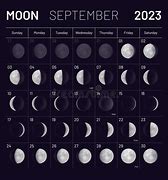
The Moon’s current phase for today and tonight is a New Moon.
The on September 14 has an illumination of 0%. This is the percentage of the Moon illuminated by the Sun. The illumination is constantly changing and can vary up to 10% a day. On September 14 the Moon is 29.01 days old. This refers to how many days it has been since the last New Moon. It takes 29.53 days for the Moon to orbit the Earth and go through the lunar cycle of all 8 Moon phases.
Check the weather before a night of Moon gazing at weather.com
For a list of all the current meteor showers visit American Meteor Society
There are 8 lunar phases the Moon goes through in its 29.53 days lunar cycle. The 4 major Moon phases are Full Moon, New Moon, First Quarter and Last Quarter. Between these major phases, there are 4 minor ones: the Waxing Crescent, Waxing Gibbous, Waning Gibbous and Waning Crescent. For more info on the Moon Cycle and on each phase check out Wikipedia Lunar Phase page.


September 14, 2023
11:00 pm GMT 4:00 PM PDT
Zodiac: Tropical (Standard Western)
True Lunar Node:25 Aries 09 Rx
Mean Lunar Node:26 Aries 36 Rx
Lilith (Black Moon):27 Leo 55
Chiron:18 Aries 49 Rx
Ceres:29 Libra 46
Pallas:00 Libra 35
Juno:15 Leo 14
Vesta:00 Cancer 16
Eris:25 Aries 01 Rx
September 14, 2023
09:00 pm GMT 4:00 PM CDT
Zodiac: Tropical (Standard Western)
True Lunar Node:25 Aries 09 Rx
Mean Lunar Node:26 Aries 36 Rx
Lilith (Black Moon):27 Leo 55
Chiron:18 Aries 49 Rx
Ceres:29 Libra 44
Pallas:00 Libra 33
Juno:15 Leo 12
Vesta:00 Cancer 14
Eris:25 Aries 01 Rx
14 September 2023
02:00 pm GMT 4:00 PM CEST
Zodiac: Tropical (Standard Western)
True Lunar Node:25 Aries 10 Rx
Mean Lunar Node:26 Aries 37 Rx
Lilith (Black Moon):27 Leo 53
Chiron:18 Aries 50 Rx
Ceres:29 Libra 37
Pallas:00 Libra 25
Juno:15 Leo 03
Vesta:00 Cancer 10
Eris:25 Aries 01 Rx
Sarsina is a sleepy, rural town of barely 3,000 residents straddling the pristine Apennine mountains in Italy’s Emilia Romagna region, surrounded by stunning views and grazing sheep.
While it has a glorious past, as a strategic defensive outpost for the Roman Empire and the birthplace of the famed playwright Plautus, today there’s not much to do beyond hiking and birdwatching.
And though both locals and holidaymakers would agree that a rustic, slow-paced lifestyle is part of Sarsina’s charm, its residents were nonetheless excitedly awaiting the construction of a development including a new supermarket, fitness center and playground. But it was not meant to be — at least, not as originally planned.
That’s because workers at the site on the outskirts of town in December 2022 unearthed the ruins of an ancient Roman temple — or ‘capitolium’ — dating back to the first century BC.
In early July, a first look at the underground treasure came to light: a single imposing structure of horizontal sandstone blocks and marble slabs, 577 square meters wide, which researchers have identified as the podium above which the columns and walls of an ancient temple were built.
And what has come out of the ground so far could be just the tip of the iceberg.
“We have unearthed three separate rooms, likely dedicated to the triad of gods Jupiter, Juno and Minerva,” lead archaeologist at the excavation site Romina Pirraglia told CNN. “The excavations are still underway… and we have already identified an older, deeper layer of ruins dating back to the 4th century BC, when the Umbrian people (an ancient Italic tribe who predated the Romans) lived in the area. The entire temple could be even larger than what we now see.”
According to Pirraglia, the discovery of a capitolium — the main temple in an important Roman city, and a hub for trade as well as religious and social interactions — further confirms the strategic role Sarsina played during the Roman Empire. The town was built in a key mountainous area close to the Tuscan border and overlooking the Savio river, an important waterway connecting central and northern Roman cities.
The discovery of the temple has pushed local authorities to revise their building plans. Federica Gonzato, superintendent of archaeology, fine arts and landscape for the provinces of Ravenna, Rimini and Forlì-Cesena, which includes Sarsina, is adamant in wanting to preserve the ruins and further research its great past.
“We will not tear it down to make room for modern structures, this must be very clear. Previous urban plans will be changed, we will find new construction sites for recreation and sports,” Gonzato said. “The temple is an incredible finding that sheds light on how ancient Roman towns rose and fell across time.”
What makes the discovery exceptional is the temple’s unique state of preservation. “The marvelous quality of the stones have been spared from sacks, enemy invasions and plunders across millennia thanks to the remote location of Sarsina, a quiet spot distant from larger cities,” Gonzato added. “Temples such as this one (were) regularly plundered, exploited as quarries with stones and marble slabs taken away to be re-used to build new homes. But Sarsina’s capitolium podium structure is practically untouched, with its entrance staircase well-preserved, and this is extremely rare.”
Gonzato believes the discovery will further research on demography and urban transformations in ancient times. And there’s more to the site than just the temple’s podium. Pirraglia said there are signs that the building was reused in medieval times. An ancient water drainage system was found alongside medieval tombs and hearths indicating that locals likely inhabited it, or used the site for other social purposes.
“This is the beauty of Italy: wherever you dig, some hidden treasure comes out of the ground. Wonders never cease to amaze us,” said Gonzato.

 Witches Of The Craft®
You must be logged in to post a comment.