
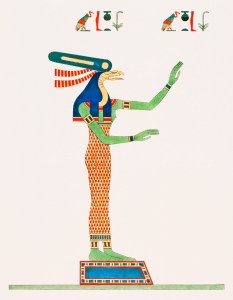
Wadjet
Wadjet (Wadjyt, Wadjit, Uto, Uatchet, Edjo, Buto) was one of the oldest Egyptian goddesses. Her worship was already established by the Predynastic Period, but did change somewhat as time progressed. She began as the local goddess of Per-Wadjet (Buto) but soon became a patron goddess of Lower Egypt.
By the end of the Predynastic Period, Wadjet was considered to be the personification of Lower Egypt rather than a distinct goddess and almost always appeared with her sister Nekhbet (who represented Upper Egypt). The two combined represented the country as a whole and were represented in the “nebty” (one of the pharaoh’s names, also known as “the two ladies”) which indicated that the king ruled over both parts of Egypt. The earliest recovered example of the nebty name is from the reign of Anedjib of the First Dynasty.
In the Pyramid Texts it is suggested that Wadjet created the first papyrus plant and primordial swamp. Her link to the papyrus is strengthened by the fact that her name was written using the glyph of a papyrus plant and the same plant was the heraldic plant of Lower Egypt.
According to another myth Wadjet was the daughter of Atum (or later Ra) who sent her as his “eye” to find Tefnut (moisture) and Shu (air) when they were lost in the waters of Nun. He was so happy when they returned that he cried and created the first human beings from his tears. To reward his daughter, he placed her upon his head in the form of a cobra so that she would always be close to him and could act as his protector.
Wadjet was one of the goddesses given the title “Eye of Ra” (connecting her to Bast, Hathor, Sekhmet, and Tefnut among others). In fact, the symbol of the “Eye of Ra” was often called “the Wedjat”.
In this form she was sent out to avenge her father and almost caused the destruction of mankind. Humanity was saved when she was tricked with some beer which had been dyed red with pomegranate juice to resemble blood.
There is also a suggestion that she was very closely linked to the principle of Ma’at (justice or balance). Before being crowned as king, Geb attacked and raped his mother Tefnut. When he went to take his place as pharaoh and put the Royal Ureas on his own forehead, the snake reared up and attacked the god and his followers. All of Geb’s retinue died and the god himself was badly injured. Clearly, his actions were against Ma’at and Wadjet was not prepared to allow him to go unpunished.
Wadjet is often described as an agressive deity while while her sister Nekhbet was thought of as a more matronly protector. However, she also had her gentler side. Wadjet was believed to have helped Isis nurse the young Horus and to help mother and baby hide from Set in the marshes of the delta. She was also considered to offer protection to all women during childbirth.
Wadjet and her sister also protected the adult Horus from the followers of Set. Horus pursued them in the form of a winged sun disc and Nekhbet and Wadjet flanked him in the form of crowned snakes. This protection was also extended towards the pharaoh who wore the “Royal Ureas” (serpent) on his (or her) forehead.
From the Eighteenth Dynasty the queens also added one or two snakes to their headdresses representing Wadjet and her sister.
Wadjet was associated with the fifth hour of the fifth day of the month and with “iput-hmt” (Epipi), the harvest month of the Egyptian calendar. Festivals were held in her honour on the 10th day of “rh-wr” (Mekhir) which was also called “the day of going forth of the Goddess”, the 7th day of “khnty-khty” (Payni), and the 8th day of “Wpt-rnpt” (Mesori). These latter two dates coincide roughly with the winter and spring solstices.
She was worshiped at the Temple of Wadjet, known as “Pe-Dep”. This temple was already long established by the Old Kingdom and is referred to in the Pyramid Texts. In this temple, Wadjet was linked with Horus.
Wadjet was thought to be the wife of Hapi in Lower Egypt and was linked to Set in his role as a representative of Lower Egypt. She was sometimes described as the wife of Ptah and the mother of Nefertem, probably because she occasionally took the form of a lion like Sekhmet.
Her sacred animal was the cobra, and Wadjet was often depicted as either a rearing cobra, a winged cobra, or a woman with the head of a cobra. She was also depicted as a woman wearing the red crown of Lower Egypt. She often appears with her sister Nekhbet who appeared as a snake or woman.
By the Late Period Wadjet was also associated with the ichneumon (a mongoose-like creature). This animal was known for its skill in killing snakes and was also sacred to Horus.The Egyptians placed mummified ichneumon and shrew (small mice) inside statuettes of Wadjet which were interred with the dead. The two animals represented day (ichneumon) and night (shrew). She was also worshipped as a vulture Goddess. In her form of the “eye of Ra” she was depicted as a lion-headed woman wearing a solar disc and the Uraeus (cobra).
Bibliography
- Bard, Kathryn (2008) An introduction to the Archaeology of Ancient Egypt
- Budge, E Wallis (1904) The Gods of the Egyptians
- Goodenough, Simon (1997) Egyptian Mythology
- Kemp, Barry J (1991) Ancient Egypt: Anatomy of a Civilisation
- Lehner, Mark (1997) The Complete Pyramids
- Pinch, Geraldine (2002) Handbook Egyptian Mythology
- Redford Donald B (2002) Ancient Gods Speak
- Watterson, Barbara (1996) Gods of Ancient Egypt
- Wilkinson, Richard H. (2003) The Complete Gods and Goddesses of Ancient Egypt
- Wilkinson, Richard H. (2000) The Complete Temples of Ancient Egypt


 Witches Of The Craft®
You must be logged in to post a comment.