The date for the Southern Hemispheric Beltane is October 31st and ‘May Day’ is November 1st. The climax of Spring!
Beltane is the peak of Spring, a celebration of fertility. In ancient times it was the Beltane Rites that recon- nected each year the King to the Goddess, the masculine to the feminine. It is a time for us to give thanks for our fertile lives, our creativity and our gender specific gifts and roles. Its a time to notice and honour the difference in the masculine and feminine. It is a time of increasing growth, building to almost full potential, of beauty and heightened passion.
Beltane Spiritual Practice
Your being, as part of the Earth, part of the cycle of the seasons, will be influenced by this energy whether you’re paying attention to it or not. If you pay some attention, you will feel it, and you can be in flow with it.
Think like the gardener, and align with the Earth energy of now, contemplate the growth that is peaking in your life, that is getting all the attention…
Discover the cosmos! Each day a different image or photograph of our fascinating universe is featured, along with a brief explanation written by a professional astronomer.
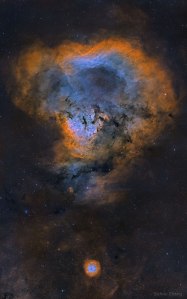
NGC 7822: Cosmic Question Mark
Image Credit & Copyright: Yizhou ZhangExplanation: It may look like a huge cosmic question mark, but the big question really is how does the bright gas and dark dust tell this nebula’s history of star formation. At the edge of a giant molecular cloud toward the northern constellation Cepheus, the glowing star forming region NGC 7822 lies about 3,000 light-years away. Within the nebula, bright edges and dark shapes stand out in this colorful and detailed skyscape. The 9-panel mosaic, taken over 28 nights with a small telescope in Texas, includes data from narrowband filters, mapping emission from atomic oxygen, hydrogen, and sulfur into blue, green, and red hues. The emission line and color combination has become well-known as the Hubble palette. The atomic emission is powered by energetic radiation from the central hot stars. Their powerful winds and radiation sculpt and erode the denser pillar shapes and clear out a characteristic cavity light-years across the center of the natal cloud. Stars could still be forming inside the pillars by gravitational collapse but as the pillars are eroded away, any forming stars will ultimately be cut off from their reservoir of star stuff. This field of view spans over 40 light-years across at the estimated distance of NGC 7822.
Herbs have many correspondences that can help you use them in spells, including astrological correspondences. For instance, an herb may correspond with one of the 4 elements (Earth, Air, Fire, or Water), one of the planets, or one of the astrological signs.
Knowing the correspondences of plants can tell you how and when to use them in a spell. For instance, an herb that corresponds to Sagittarius can help you bind the spell to a Sagittarius person you are trying to influence. Or, an Aries herb may help you to add a bit of enthusiasm and strength to a spell because that is what that sign represents.
Having the knowledge of herbal correspondences also helps you to wing it when making a spell. If you know instinctively that an herb has a specific association, you don’t have to check a book before completing a spell.
What Is Herbal Astrology?
When applying astrology to herbalism, we are usually looking at each astrological sign’s unique energies and powers.
These unique characteristics can be used with the…
The Moon’s current phase for today and tonight is a First Quarter phase. This phase occurs roughly 7 days after the New Moon when the moon is one quarter of the way through its orbit around the earth. Exactly half the moon will be illuminated and half dark. On the day of the First Quarter phase the moon is high overhead at sunset and is visible until mid-night when it sets in the west. The First Quarter phase is a one-day event and in the following days enters a Waxing Gibbous phase becoming more illuminated each day until the Full Moon.
The First Quarter on October 13 has an illumination of 54%. This is the percentage of the Moon illuminated by the Sun. The illumination is constantly changing and can vary up to 10% a day. On October 13 the Moon is 7.76 days old. This refers to how many days it has been since the last New Moon. It takes 29.53 days for the Moon to orbit the Earth and go through the lunar cycle of all 8 Moon phases.
The 8 Lunar Phases
There are 8 lunar phases the Moon goes through in its 29.53 days lunar cycle. The 4 major Moon phases are Full Moon, New Moon, First Quarter and Last Quarter. Between these major phases, there are 4 minor ones: the Waxing Crescent, Waxing Gibbous, Waning Gibbous and Waning Crescent. For more info on the Moon Cycle and on each phase check out Wikipedia Lunar Phase page.
Phase Details
Phase: First Quarter
Illumination: 54%
Moon Age: 7.76 days
Moon Angle: 0.54
Moon Distance: 369,063.85 km
Sun Angle: 0.53
Sun Distance: 149,218,784.35 km
Useful Moon Resources
Check the weather before a night of Moon gazing at weather.com
Join us on Saturday, October 9 to kick off the International Observe the Moon Night week of observing with a Global Moon Party. There will be live streams of the Moon and cultural lunar stories from around the world, NASA scientists, and amazing images, plus much more. 3-6pm PT/6-9pm ET
International Observe the Moon Night is a worldwide public engagement program that has been held annually since 2010. Every autumn, we ask people to observe the Moon in whatever way makes sense to them (via binoculars, telescopes, naked eye, images, artwork, songs, stories, etc.).
Phase: Waxing Crescent
Illumination: 13%
Moon Age: 3.40 days
Moon Angle: 0.55
Moon Distance: 363,679.30 km
Sun Angle: 0.53
Sun Distance: 149,389,987.53 km
Discover the cosmos! Each day a different image or photograph of our fascinating universe is featured, along with a brief explanation written by a professional astronomer.
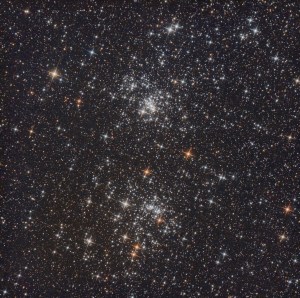
Explanation: This pretty starfield spans about three full moons (1.5 degrees) across the heroic northern constellation of Perseus. It holds the famous pair of open star clusters, h and Chi Persei. Also cataloged as NGC 869 (top) and NGC 884, both clusters are about 7,000 light-years away and contain stars much younger and hotter than the Sun. Separated by only a few hundred light-years, the clusters are both 13 million years young based on the ages of their individual stars, evidence that they were likely a product of the same star-forming region. Always a rewarding sight in binoculars, the Double Cluster is even visible to the unaided eye from dark locations. But a shroud of guitar strings was used to produce diffraction spikes on the colorful stars imaged in this
View our recorded Event Planning Webinar, and join the virtual Global Moon Party on October 9, for resources and activities that can take your International Observe the Moon Night to the next level.
Discover the cosmos! Each day a different image or photograph of our fascinating universe is featured, along with a brief explanation written by a professional astronomer.
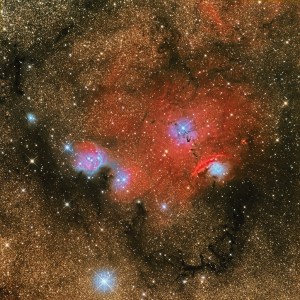
NGC 6559: East of the Lagoon
Image Credit & Copyright:Roberto SartoriExplanation: Slide your telescope just east of the Lagoon Nebula to find this alluring field of view in the rich starfields of the constellation Sagittarius toward the central Milky Way. Of course the Lagoon nebula is also known as M8, the eighth object listed in Charles Messier’s famous catalog of bright nebulae and star clusters. Close on the sky but slightly fainter than M8, this complex of nebulae was left out of Messier’s list though. It contains obscuring dust, striking red emission and blue reflection nebulae of star-forming region NGC 6559 at right. Like M8, NGC 6559 is located about 5,000 light-years away along the edge of a large molecular cloud. At that distance, this telescopic frame nearly 3 full moons wide would span about 130 light-years.
You can use this link to go forward or backward in time for Moon phase information. If you are curious you can even find out what phase the Moon was in when you or anyone else, you know was on the date the person was born.
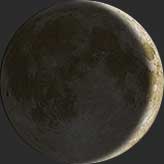
Today the Moon will be in a Waxing Crescent Phase. A Waxing Crescent is the first Phase after the New Moon and is a great time to see the features of the moon’s surface. During this phase the Moon can be seen in the wester sky after the sun dips below the horizon at sunset. The moon is close to the sun in the sky and mostly dark except for the right edge of the moon which becomes brighter as the days get closer to the next phase which is a First Quarter with a 50% illumination.
The Waxing Crescent on October 7 has an illumination of 1%. This is the percentage of the Moon illuminated by the Sun. The illumination is constantly changing and can vary up to 10% a day. On October 7 the Moon is 1.15 days old. This refers to how many days it has been since the last New Moon. It takes 29.53 days for the Moon to orbit the Earth and go through the lunar cycle of all 8 Moon phases.
Phase Details
Phase: Waxing Crescent
Illumination: 1%
Moon Age: 1.15 days
Moon Angle: 0.54
Moon Distance: 367,849.63 km
Sun Angle: 0.53
Sun Distance: 149,475,937.59 km
Useful Moon Resources
Check the weather before a night of Moon gazing at weather.com
Angel is Raphael, ruler of Mercury. Raphael is the patron of healers and travellers. He will keep you safe on all of life’s journeys and help you to communicate in a way that promotes healing and peace.
The colours are green and yellow. Yellow calcite and green agate are crystals that can help you connect with this gentle angel. Some scents used to invoke archangel Raphael are chamomile, lemongrass and sandalwood.
You can use this link to go forward or backward in time for Moon phase information. If you are curious you can even find out what phase the Moon was in when you or anyone else, you know was on the date the person was born.
The Moon’s current phase for today and tonight is a New Moon phase. During this phase the Moon is too close to the sun in the sky to be visible. The moon rises and sets with the sun and is not present in the night sky. Because of this the night sky is darker and an excellent time to view other celestial objects. Like the Full Moon, a New Moon happens at a very specific time when the sun and moon have the same ecliptic longitude and it can be measured down to the second it occurs.
The New Moon on October 6 has an illumination of 0%. This is the percentage of the Moon illuminated by the Sun. The illumination is constantly changing and can vary up to 10% a day. On October 6 the Moon is 0.03 days old. This refers to how many days it has been since the last New Moon. It takes 29.53 days for the Moon to orbit the Earth and go through the lunar cycle of all 8 Moon phases.
The 8 Lunar Phases
There are 8 lunar phases the Moon goes through in its 29.53 days lunar cycle. The 4 major Moon phases are Full Moon, New Moon, First Quarter and Last Quarter. Between these major phases, there are 4 minor ones: the Waxing Crescent, Waxing Gibbous, Waning Gibbous and Waning Crescent. For more info on the Moon Cycle and on each phase check out Wikipedia Lunar Phase page.
Phase Details
Phase: New Moon
Illumination: 0%
Moon Age: 0.03 days
Moon Angle: 0.54
Moon Distance: 371,419.45 km
Sun Angle: 0.53
Sun Distance: 149,518,954.95 km
Useful Moon Resources
Check the weather before a night of Moon gazing at weather.com
I am sorry a few posts are missing that I started doing daily but with my fibromyalgia flare it hurts to type or even copy and paste. See you again tomorrow.



 International Observe the Moon Night is a worldwide public engagement program that has been held annually since 2010. Every autumn, we ask people to observe the Moon in whatever way makes sense to them (via binoculars, telescopes, naked eye, images, artwork, songs, stories, etc.).


You must be logged in to post a comment.