Saint of the Day for July 24 is St. Michael, the Archangel

Saint of the Day

St. Michael, the Archangel

Patron of grocers, mariners, paratroopers, police, and sickness

St. Michael, the Archangel – Feast day – September 29th The name Michael signifies “Who is like to God?” and was the warcry of the good angels in the battle fought in heaven against satan and his followers. Holy Scripture describes St. Michael as “one of the chief princes,” and leader of the forces of heaven in their triumph over the powers of hell. He has been especially honored and invoked as patron and protector by the Church from the time of the Apostles.

Although he is always called “the Archangel,” the Greek Fathers and many others place him over all the angels – as Prince of the Seraphim. St. Michael is the patron of grocers, mariners, paratroopers, police and sickness.

Today’s I Ching Hexagram for July 24 is 9: Small Influences

9: Small Influences

Hexagram 9

General Meaning: A gentle wind gathers the clouds, but still, no rain. Softer influences predominate as the power of subtle forces grows. This is a time for smooth and friendly persuasion.

In the ebb and flow of events, there are always ‘low tides’ — times when sweeping action is impossible or inappropriate, but when small matters can be attended to profitably, leading to bigger and better things later on. When the tide is rolling in, by all means, ride the wave; but when it is receding like it is now, focus on little things.

When the times are such that you cannot do much to affect large matters, persuasion and subtle influence can prepare the way for strength in the future. Use your intuition to chart your long-term course, but avoid bold actions for the moment, for they are unlikely to work. This is an excellent time to refine existing abilities or develop new talents.

Be wary of others’ intentions if they hold the upper hand in a situation. Examine their sources of power, so as to discover subtle influences you may be able to exert upon them.

Spirit Water

A glass of pure spring water is typically maintained on an altar, to call in spirits and feed the ancestors. Many find Spirit Water a stronger substitute. This is a favorite of the Spiritualist, community and may be used to summon your own ancestral spirits, or in seances or other necromantic spells.

1.     Add one tablespoon of anisette to a glass of spring water.

2.     Place it on the altar instead of, or in addition to, the standard glass of plain spring water.

Your Daily Influences

Your Daily Influences
July 21, 2011

Tarot Influence

Rune Influence


Charm Influence
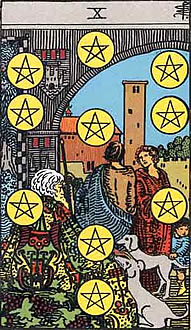
Ten of Pentacles Reversed
You and your family may suffer through some misfortune. Be wary of high risk ventures.
Tiwaz
You may be in a period of stagnation. Your goals may be unattainable or unrealistic at this time. Fortunately these times pass. Take stock of yourself and your goals. Do not fight battles you know you cannot win. Be patient.
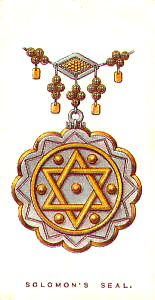
Solomons Seal
This aspect needs to be lightened up a bit, things are getting to serious. Some humor or even a bit of flirting could lighten the tone greatly.
Your Daily Influences represent events and challenges the current day will present for you. They may represent opportunities you should be ready to seize. Or they may forewarn you of problems you may be able to avoid or lessen. Generally it is best to use them as tips to help you manage your day and nothing more.

Your Deck of Ancient Symbols Card for July 21 is The Tree

Your Deck of Ancient Symbols Card for Today

The Tree

The Tree symbolizes spiritual health and growth. The healthy tree is rooted in a rich, nurturing medium, has a strong trunk from which leaf laden branches fan out to capture the sun’s energy. The Tree represents a healthy spirit entrenched in experience and strengthened by wisdom. It is a spirit that is happy with itself, but continues reaching to become even wiser, more complete, happier, stronger. While The Tree represents a strong and independent spirit, it is also a life-force that owes much of its strength and growth to being surrounded by other healthy spirits.

As a daily card, The Tree denotes a time when your spiritual self is especially powerful and open for further growth. Now is a time for you to seek out streams of wisdom and knowledge that you can not only draw from but contribute to as well. Don’t disregard sources that seem improbable, as they often produce the most profound revelations and spiritual expansion.

Today’s I Ching Hexagram for July 21 is 11: Harmony

11: Harmony

Hexagram 11

General Meaning: The trigram earth is above that of heaven, and heaven seems to be on earth. The gravity of matter merges with the upward radiation of light to merge in deep harmony. This juxtaposition denotes a time of peace and blessings for all living things. In the affairs of humans, tranquility comes when the good, strong and powerful show favor to those of lower status, and those of more modes means are well disposed towards those who are currently blessed. This condition marks an end to feuding. In such a state, it is best to let the energy ride high. The way is cleared, and the prospects for great success are outstanding.

Chaotic forces still abide in nature, but man, by carefully responding to the rhythms and cycles of the world around him, can find peace in the natural world. By planting the right crop in the right place in the right season, the farmer brings harmony to the cultivation of plants, and prosperity to his family. Similarly, any business must adjust to the natural cycles of the season; only through flexibility and adaptation can order and growth be maintained. Peaceful times produce a time of flowering and prosperity; the wise person channels positive energy to all quarters, to each in proper proportion, just as a farmer waters his field. But be vigilant. Otherwise, peaceful conditions will foster the growth of weeds as well as flowers.

Today’s Tarot Card for July 21 is The Magician

The Magician

This Tarot Deck: Cat People

General Meaning: Traditionally, the Magus is one who can demonstrate hands-on magic — as in healing, transformative rituals, alchemical transmutations, charging of talismans and the like. A modern Magus is any person who completes the circuit between heaven and Earth, one who seeks to bring forth the divine ‘gold’ within her or himself.

At the birth of Tarot, even a gifted healer who was not an ordained clergyman was considered to be in league with the Devil! For obvious reasons, the line between fooling the eye with sleight of hand, and charging the world with magical will was not clearly differentiated in the early Tarot cards.

Waite’s image of the Magus as the solitary ritualist communing with the spirits of the elements — with its formal arrangement of symbols and postures — is a token of the freedom we have in modern times to declare our spiritual politics without fear of reprisal. The older cards were never so explicit about what the Magus was doing. It’s best to keep your imagination open with this card. Visualize yourself manifesting something unique, guided by evolutionary forces that emerge spontaneously from within your soul.

Your Deck of Ancient Symbols Card for July 20th is The Believer

Your Deck of Ancient Symbols Card for Today

The Believer

The Believer represents Faith and the realization that you have an important place in the workings of the Universe. Although The Believer may not always understand why things are the way they are, they none-the-less feel an underlying cosmic rhythm which is moving events in a direction that is good. The Believer rejoices in their celestial role, because they realize their life has purpose on a grand scale.

As a daily card, The Believer denotes a time when you will benefit by embracing and exploring your place in the Universe. The Believer confirms that you have inherent value far beyond our secular existence; that you are an important part of the both the grandeur and the mystery of our Cosmos.

Today’s Runes for Wednesday, July 20th is Ehwaz

Today’s Runes

Jade Runes are most commonly used for questions about love, friendship, and relationships. Ehwaz is the rune of the eight-legged horse that the god Odin rode into battle. Horses are symbolic of a number of things. Firstly, horses may symbolize vehicles such as cars, motorcycles, planes, or boats. Secondly, horses may symbolize not wealth, but status. Thirdly, horses may symbolize motion towards an objective. As such, this rune suggests a journey or a quest to achieve a goal or improve one’s station in life. On a deeper level, the rune Ehwaz evokes the unique relationship of horse and rider as an inseparable team. To the modern eye this may be the relationship of master and underling, but to the Norse it was a total union. In fact, early representations of Odin are not of a man and a horse, but, of a centaur-like creature – the ultimate symbiosis of Man and Nature.

Today’s I Ching Hexagram for July 20th is 10: Treading Carefully

10: Treading Carefully

Hexagram 10
 
General Meaning: People of ability find their way and make progress even in difficult circumstances. Consider your steps carefully when you are surrounded by changing forces. Weak and strong forces (or people) can co-exist when the weaker element does not impose upon the stronger, when the weaker maintains good humor and avoids taking bold action. When treading among sleeping tigers — or slippery stones — step gingerly and don’t stumble.

In the company of strong, brash people, rushing wildly ahead brings misfortune. Now is not a good time for taking the initiative; rather, try getting by with a little grace and good humor. In the court of a powerful king, the jester often has more power than the prince.

Ceremonial Officiants

As in the olden days, a high priest or priestess usually performs the handfasting ceremony either outdoors or in a place of worship, such as a Christian church. Rings are exchanged to symbolize unbroken union and the eternal circle of life  It is interesting to note that the wedding ring, which is traditionally worn on the fourth finger of the left hand, came to be place there because our ancestors believed that it sat over an artery that ran directly from the hand to the heart.

The high priest or priestess is traditionally clothed in a gothic-style outfit, usually in green, gold or lavender. These outfits typically include ornate headdresses, and the priestess may wear a crown graced with a variety of crystals and feathers. These high-ranking clergy are mostly mature members of covens who have a wealth of knowledge about spell casting and all things magickal.

Today’s I Ching Hexagram for July 19th is 58:Joy

58: Joy

Hexagram 58

General Meaning: A joy that is shared is symbolized by a group of friends playing, or a carefree young girl singing to herself while engaged in her work. Happiness is rising within, and spreading out into the world.

Joy arises through gentle means, but springs from a solid inner base. The power of pure joy should not be underestimated. The enjoyment of learning and discovery, for example, has let to great innovation and much material progress. Accordingly, that which brings the most joy into the world — love — is the source of life itself.

If happiness is supported by personal stability, it will eventually wear down the stiffest barrier and win over the hardest heart. True joy is a beacon in the world, and though it is indeed rare, its presence is an indication of great good fortune, both now and in the future. How could it be otherwise?

Vision Quest: Seeking the Spirit the Old-Fashioned Way

Vision Quest: Seeking the Spirit the Old-Fashioned Way

Author: Sunny Dawn

A vision quest is a challenge. The verb in Lakota literally means, “to cry out for a vision”. This means you have to suffer in exchange for a gift. The words “cry out” may also refer to songs or chants sung by the person undertaking the suffering. In my first coven, it was highly desirable, if not precisely required, for third-degree initiation, although I did not attempt a vision quest or receive third-degree initiation from my first coven.

A vision quest has little to do with astral travel or guided “journeys”. Anyone who has ever perused the shelves of a pagan bookstore knows there are plenty of books available on astral travel. Any pagan who has ever attended a workshop, retreat, or festival has probably had an opportunity to participate in a guided “journey”.

Vision quests involve a little more advance planning, and a lot more sacrifice. They can also have a high rate of failure. Both are good reasons why the vision quest tends to scare folks away. But the most important reason why vision quests are no longer that popular in terms of pagan spiritual practice is that there isn’t a whole lot of sensible, contemporary advice on how to do one successfully. With this article, I hope to change this perception a little. A vision quest isn’t easy, but it is more accessible than most pagans think.

First, let’s start with the question of what a vision quest is, and what it probably isn’t. A “vision” is something more than a vivid dream that is easily remembered upon waking. It can be hard to describe to someone who hasn’t had one, but a “vision” is usually of profound personal significance to the person who receives it. It is more than a dream that rehashes the person’s recent experiences. It is almost always a foretelling of one’s personal future. It is often accompanied by some sort of supernatural event (however mild) that “marks” the vision as more than a dream.

If this describes the “vision”, then what is the “quest”? Traditionally, the “quest” involved a four-day fast done outdoors without food or water, and without drug use of any kind. Tobacco was offered, but not consumed [see note below]. Deloria uses the term “fast-vigil” as well as the more common “vision quest”. It was undertaken by young people (more often men than women) as a rite of passage, and not just by children or teen-agers who hoped to grow up and become medicine men someday, but by anyone who was serious about their spiritual path [see note below].

Most people who did a vision quest simply expected to live their lives to the fullest with some protection from the spirits. Others sought to obtain powers that would enhance their capabilities, but this imposed additional responsibilities on them. These responsibilities set them apart from the everyday life of their community, so it is probably fair to say that most hoped for the “vision” and not much more.

Deloria reports that the vision quest was nearly universal among Native American tribes. Because it was difficult to determine the validity of a vision, youths would discuss their vision with one or more elders who would help them decide if this vision was the primary one meant to shape some important part of their future [see note below]. Then they would get help “re-enacting” it down to the smallest detail, to demonstrate their intent to make the vision a reality. In the case of Black Elk, his vision involved the whole tribe, so the entire tribe participated in the reenactment (but this was the exception rather than the norm) .

What does a non-Native American “vision quest” look like today?

It is probably fair to say that the seeker is a “youth” on his or her spiritual path (my primary vision came accidentally during my first year on a pagan path) . Three or four days are still the goal, but the fast is from food only. It should be done outside, but it can even be done at a crowded campground if you have no other options, since your dreaming is most likely going to occur at night when things are quiet. Any vivid dreaming which occurs during this time may be considered sacred, but you will have a pretty strong “feeling” about a dream that is actually a vision.

Even a fast from food scares off a lot of folks. Assuming normal health, it shouldn’t. The fast is a very important part of what you’re doing the whole long day. It will get successively harder each day, and it will leave you pretty strung-out on the second and third day. There is often some loss of motor control on the fourth day, depending on the individual. Fasting only from food is popular because it allows the seeker to undertake the three or four day quest without being attended by someone else, assuming adequate advanced preparation.

There is no requirement that you be bored to tears during the long days. You can read, or play an instrument, or take long walks surrounding yourself by nature on the second or even on the third day, or sleep more than usual (a very common phenomenon on a fast) . None of this is “cheating”.

Fasting makes you more aware of your surroundings, particularly on the second day. In the morning, the smell of wood smoke from a neighbor’s tent site permeates everything. A birdcall really does sound as if it is trying to tell you something. You notice the fresh smell of the earth that comes up at the end of the day and washes out the fish odor next to a river. You are more aware of that honeysuckle scent in a shady alcove along the water, or the sudden splash of a fish that cannot be seen.

You will definitely want to set aside some time to observe the sky at night, to see if there is a prominent star whose god or goddess is “governing” your vigil (this can be meaningful even if you have dedicated your fast to deities that have nothing to do with the Greek or Roman gods normally associated with the night sky) . On the night I observed the sky, Mercury was strikingly close to the Earth, and it made everything else look as if it had lost its batteries. This meant that Hermes, the god of merchants and thieves, and the psychopomp who guides the dead to their just rewards, was guiding my fast. After it was over, I was to find out what this meant.

Choosing a tobacco offering is important. Whether or not you smoke is irrelevant, because the tobacco isn’t for you. I considered buying a pipe, but decided that a pipe is very closely associated with the Thunder Beings, the most powerful natural elements on the Plains, and that I did not know enough about these deities to call on them appropriately. So I spent seven bucks on a fancy cigar instead.

Each night I wrapped it up in the small bag that holds my extra tent stakes so it would stay dry, and the next morning I withdrew it, and lit it as the first offering of the morning. A sage bundle is probably an acceptable substitute for those who cannot tolerate tobacco. Those who are concerned about the purity of their tobacco offering will definitely want to stick with loose pipe tobacco.

Fasting without water is not something I can speak to personally. It will be A LOT more painful, both physically and psychologically, particularly if it is your first time going without water. It is also essential to have someone attend the seeker who abstains from water (this may mean arranging for someone to take off time from work and compensating them for lost earnings) . Your attendant doesn’t have to camp right on top of you but you will want them close enough to check on you frequently. This “someone” had better have competent first aid knowledge, as well as knowledge of the various phases of dehydration from the swelling of extremities like fingers or toes all the way up to hallucination, loss of consciousness, and death. It goes without saying that if you have an extensive background in meditation; you are going to be able to slow down the dehydration progression. If you don’t, you may want to rethink this one.

Say I’ve got a posse with enough time and dinero to make a field trip out of this. Any advice?

The Lakota considered the Black Hills the sacred center of their world, and Native Americans still use the Black Hills extensively when they want to do a vision quest. So do quite a few non-Native Americans as well. On the western end of South Dakota, just north of the motorcycle stomping ground of Sturgis, is a popular spot called Bear Butte (a.k.a. Bear Butt) . It won’t be private, and you will see tourists walking by you on most days, but folks tend to be respectful because this mountain does get a lot of spiritual use. It also has a nice campground adjacent to the mountain that your group can use as a set-up base.

I can’t speak for Harney’s Peak, although I suspect it will be crowded due to its proximity to Rapid City, SD. As the highest peak in the Black Hills, it is very important to Native American spirituality. “Women Killer” General Harney made a sport of killing non-combatants, so the reader may imagine what most Indians think of having their sacred peak named after this dude. “Would you name the highest peak in New York after Hitler or Goebbels? Didn’t think so, ” one remarked to me.

Just over the state line in eastern Wyoming, Inyan Kara Mtn. is said to be less accessible than the other two peaks and therefore more heavily associated with spiritual use.

What is an “accidental” vision?

According to Deloria, visions that simply “came” were a transition between relying on dreams and actively seeking a vision during a traditional experience of four or more days of ceremony. As a young pagan, this is actually what happened to me. With a minimum of fuss, I did a simple ritual, and asked for a “vision”. At the time, I wouldn’t have even known how to go about a traditional vision quest. A few nights later, I got my wish.

Marshall relates that the teen-age Crazy Horse at first did not trust his vision, which was also “accidental”, because he had not pursued it the traditional way (through pain) . Visions that came without sacrifice were distrusted. Still, with his father’s encouragement, his people accepted the first vision.

The vision I received was a “culminating” vision, a fairly common category among visions. It showed me an unavoidable personal disaster, dealt with events that happen to me in old age, and showed me my descendents who are not yet born. Within the vision, it seemed to me that there were also tantalizing glimpses of things that could not be seen. It is of little surprise to me that many people wish to undertake a second vision quest at some point in the future after their original one, in hopes of potentially exploring these tempting gaps.

It can take a very long time to get confirmation of the events one sees in a vision (the first of my descendents was born to a sibling six years later) . A “culminating” vision was considered a special gift because it showed the seeker that he or she would live into relative old age, a precious blessing among traditional communities with high adult mortality. The other side of this is waiting a long time without “knowing” if any part of it will come true. This is rather ironic considering that “knowing” is the whole point of seeking a vision.

Seekers who get a lucky “accident” sometimes wonder whether they should attempt a second vision under traditional circumstances. Unfortunately, I can’t answer this with certainty, since my second attempt failed. The literature relates that Black Elk would say that the biggest mistake he ever made was attempting a second vision in hopes of supplanting the meaning of his original one. Crazy Horse did attempt a second vision some twenty years or so after the first, but his descendents said that no vision came to him.

Seriously, what’s it like going three days without food?

Honestly, somewhere between “no big deal” and “WTF am I doing this, where am I, and why am I in this hand-basket?” You are feeling pretty hungry during the second day, but it still fits the “not that bad” category. If you get hunger headaches, you need to decide whether or not you will permit yourself aspirin (I decided to “work around” my headache, but I don’t see anything wrong with aspirin if it helps.)

You also need to wear more layers at night than you normally would if you were camping outdoors on a reasonably warm night, because your body will be more sensitive to cool temperatures while fasting (I found that I needed four layers on my chest to feel comfortable, in addition to the blankets I was sleeping under.)

It is also important to pay attention to signs in the environment at the beginning of your fast, because these will give you clues to the outcome. As I was setting up my campsite, a pair of scissors I was using broke. One of the handles simply cracked off. My experience has been that when something out of the ordinary like this occurs right at the beginning of spiritual work, it is usually a sign that nothing will come of it. Then it is up to you to decide whether or not to continue, or call it off.

Initially, I thought I would do a four day fast. After this happened, a three day fast seemed more appropriate, because I suspected this would be a purification rite, which is pretty much what you end up with when a “vision quest” fails.

The third day is tough, but the thought that there is only one day left keeps a lot of people going. On the morning of the fourth day, I had trouble buttoning my jeans, and quite a bit of trouble tying the laces on my hiking boots. Having someone attend me if I had wanted to do another full day would have been wise. I broke the fast early the fourth day. You get nearly instant strength from eating, enough to dissemble a campsite. It takes an hour or so to see an improvement in motor control, however, and a strung-out feeling may persist for several hours (although caffeine helps – stash a Coke for the end of your fast) .

Deloria has an interesting point about fasting. He feels that the four days of fasting was not a determining factor. He notes that many Indians had fasted far longer than four days when on a hunt, so four days was not a challenge. Also, some people received messages on the first or second day of their ritual, before any real physical deprivation of their body began to alter perceptions of the environment. It was the intent to do a four day fast that mattered (and still, many would simply report a bird or insect came before them, signaling that their efforts had not been wasted, but there would be no profound communication or interaction) .

What about “failure”?

It can be really disappointing if you have not experienced a vision, and have doubts that you ever will. The powers designate their recipients themselves. Your earnest effort may not move them.

On the other hand, no sincere effort is really a failure. If you successfully complete three days of fasting, and never thought you could do something like that, the sense of empowerment is palpable. Also, pay attention during the days after your fast is completed. The gods have their ways of acknowledging you privately even if they don’t “gift” you with a vision.

What are some other common types of visions?

Seeing an animal was fairly common. In one of Deloria’s examples, a man called Le Bornge saw a graceful peace spirit, the antelope. He did not see a war spirit, like a wolf or grizzly bear. This meant he was to guide his people by counsels, and protect them from the evil of their own feuds and dissensions. He would not gain renown by fighting.

Seeing an animal would be meaningless for a lot of modern folks today. A vision usually comes in a context that the recipient can at least partially understand. You may not feel the need to “reenact” it to demonstrate intent the way traditional practitioners did. But it is a good idea to talk the vision over with someone on your spiritual path whose experience and wisdom you respect, if you have access to such a person.

In my case, I was able to talk about it with the high priestess of my first coven. The first thing she told me was not to “read too much into it”. This was actually wise counsel. Feeling filled with certainty about something as exceptional as a vision is a swell recipe for a big head.

She also helped me distinguish what made the vision “real”. After I described it, she told me flat out it sounded like a dream, not a vision. I felt differently. So I described it again. This time I realized it was important to tell her how I came awake after the first part of the vision, and heard the sound of drumming that seemed as if it was right outside my house. I described how I badly wanted to go downstairs and find the source of that drumming, but ended up going back to sleep and having the final portion of my vision.

When I awoke again, I could see gray morning light coming through the skylight, and the sound of drumming was still there. By the time I got downstairs it was gone.

My priestess gave me an intent look, and said she felt I had in fact had “something more than a dream”. The whole process of defending it to her made me recall it from various angles so I could see myself if it really was valid.

Why do a vision quest at all?

There are a few different answers to this question. Some of them come straight from the journal I kept during my recent vision quest.

On the first day I wrote:

“When a vision comes to you without asking, as it did for me many years ago, you have no idea what it is like to actually ask for one. What will the boredom be like? What will be the hunger be like on the second or third day? Will I do it a fourth day? You come out here to ‘know’ into the future, but there is so much not ‘knowing’.”

On the second night I wrote:

“My stomach is hurting. So is my head. Best thing to do is to stay in the present. If it teaches you anything, a fast teaches you to stay only in the present moment. Don’t worry about the next day of the fast. Just deal with what you are dealing with right now.”

Others expressed different reasons. These range from the pragmatic, to a hard-wired yearning for the future, to a profound respect for the best that an “alien” culture had to offer.

Deloria excerpts the vision of a young man called Siya’ka:

“I was not exactly singing, but more nearly lamenting, like a child asking for something. In the crying or lamenting of a young man seeking a vision two things are especially desired: First, that he may have long life, and second, that he may succeed in taking horses from the enemy.”

The second reason he gives is interesting. It implies he was facing a problem of scarce resources. Some of the warrior chiefs were facing far worse than this.

Dee Brown writes of Crazy Horse:

“Since the time of his youth, Crazy Horse had known that the world men lived in was only a shadow of the real world. To get into the real world, he had to dream….In this real world his horse danced as if it were wild or crazy, and this was why he called himself Crazy Horse. He had learned that if he dreamed himself into the real world before going into a fight, he could endure anything [see note below].”

John Mason Brown writing in the Atlantic Monthly in 1886, observed:

“It cannot be denied that whites, who consort much with the ruder tribes of Indians, imbibe to a considerable degree, their veneration of medicine. The old trappers and voyageurs are, almost without exception, observers of omens and dreamers of dreams. They claim that medicine is a faculty which can in some degree be cultivated, and aspire to its possession as eagerly as do the Indians.”



Footnotes:
A Few Personal Observations

Quests involving peyote or other shamanic plants are a different animal from the vision quest that involves no drug use. The former is “easier” to do, and certainly more popular in certain quarters. But every account I have read suggests that the seeker is more likely to receive general wisdom than a specific vision of their personal future. This does not mean that drugs could not be used to obtain a personal vision of one’s future with the spirits’ blessings. But it is worth considering how much of the vision is actually yours when it comes from a drug, and ends as soon as the drug is metabolized. When seekers aren’t hallucinating from the drug (or from thirst) , they have little doubt where their vision is coming from.

Why the emphasis on determining the “primary” vision? It is important to remember that the average layperson (non-medicine man) relied on many different types of omens from the natural environment, or visions for their divination needs. This meant they would do more frequent vision quests for mundane needs, such as determining the best time and place for finding buffalo, or the best way to raid the neighbor’s horses without catching an arrow or losing their scalp. It was important to acknowledge the more sacred nature of a “primary” vision, as well as its longer lasting impact.

Physical toughness combined with meditation skills acquired through bow-and-arrow hunting may explain in part why Native American youth could successfully handle a four day fast without water. Marshall relates that Crazy Horse learned his bow-and-arrow skills by shooting grasshoppers in high grass before he was old enough to join real hunts. Think about this for a minute. It requires incredible precision to hit a creature as small and quick as a grasshopper. He would have had to slow his breathing, and achieve incredible stillness before and during each shot, and he would have had to practice this over and over again to get it right. Hand me a hand-made bow and arrow, and I’d be lucky to hit the broad side of my cat at fifteen yards, let alone a grasshopper at that distance. Today’s adults no longer possess the meditation skills that Native Americans used to learn as kids.

Dee Brown was trying to explain why Crazy Horse “dreamed”, and his words resonate on an intuitive level. But Marshall relates that Crazy Horse took the name from his father, who gave up his own name because he sensed that his son would need its power. The father of Crazy Horse was then called by a weaker name, so that all power would flow toward his warrior son.

Bibliography

Brown, Dee. Bury My Heart At Wounded Knee: An Indian History of the American West, Henry Holt and Co., New York, NY, 1970.

Only a couple of references are made regarding the vision quest, so I won’t describe this book in detail. This book is considered the primary 20th century history of the Native American struggle to survive a holocaust.

Deloria Jr., Vine. The World We Used to Live In: Remembering the Powers of the Medicine Men, Fulcrum Publishing, Golden, CO, 2006.

This fascinating survey should be mandatory reading for any pagan who has even attempted a sweat lodge, let alone a spiritual quest. In the first chapter titled, “Dreams – The Approach of the Sacred”, the author writes about visions, shared dreams, and sacred intrusions, including many examples of both men’s and women’s visions. Remaining chapters don’t deal specifically with the vision quest, but they all seem to relate some wisdom that someone seeking a vision may somehow find useful. The author was best known for his 1970’s tongue-in-cheek classic, Custer Died For Your Sins. This final work was published a year after his death in 2005.

Marshall, Joseph III. The Journey of Crazy Horse: A Lakota Story, Penguin (Non-classics) , 2004.

This biography of the Lakota leader who was murdered when he was 35 years old was written by a tribal member who interviewed the descendents of Crazy Horse’s relatives. The author’s view of the great warrior’s legacy, and what it means to his people, is different from the way Crazy Horse is remembered by most whites. Crazy Horse’s vision is central to this story; the author alternates the words used to describe his vision with impressionistic glimpses of Crazy Horse’s surrender right before he was killed. Don’t miss the final chapter called A Story: The Lightening Bow, a moving look at the gift of sacrifice that a leader makes on behalf of his tribe, and what happens when the people don’t even understand how much that is worth.

Neihardt, John G. Black Elk Speaks: New Edition, Bison Books, 2004.

It has been so long since I read this book that I hesitate to review it, but I do want to recommend it because Niehardt goes into elaborate detail on Black Elk’s original vision of the slaughter of his people, and his subsequent “false” vision of the Ghost Dance as a possible means of saving his tribe. Black Elk relates that his primary vision was so bitter that he could not bear it, but his subsequent vision was mere wishful thinking because he could not accept the truth. For anyone in search of a subsequent vision, this is wisdom worth pondering.

A Year and a Day – Origins and Applications

A Year and a Day – Origins and Applications

Author: del Luna la Madre’ Temple
I have seen the following in many, many posts. Competently trained Priests and Priestesses look at these words, and say to themselves – “Oh, You Truly Have No Idea”. The Phrase that I am referring to is:

“I have been studying for a Year and a Day and so I am now close to being ready for Initiation.” or “I am half way through my Year and a Day and so I now have questions about where do I find a group to Initiate into?”, There are other varying forms of this, and if you read through the many thousands of posts, you will surely come across that variety.

The Truth of the matter is that training in the Crafte does NOT take a Year and A Day. It sometimes takes much longer. Wikipedia lists the following information under a year and a day:

The year and a day rule was a principle of English law holding that a death was conclusively presumed not to be murder (or any other homicide) if it occurred more than a year and one day since the act (or omission) that was alleged to have been its cause. The rule also applied to the offence of assisting with a suicide.

• The period of a year and a day was a convenient period to represent a significant amount of time. Its use was generally as a jubilee or permanence.

• Historically (England) the period that a couple must be married for a spouse to have claim to a share of inheritable property.

• In mediaeval Europe, a runaway serf became free after a year and a day.

• When a judgment has been reversed a fresh action may be lodged within a year and a day, regardless of the statute of limitations. U.S.

• Note: a lunar year (13 lunar months of 28 days) plus a day is a solar year (365 days) . Also those 366 days would be a full year even if a leap day were included.

Magickally speaking- the Year and a Day rule is a hold over from the Masons. Their training period for an Apprentice was a year and a day of service and hard work. Gerald Gardner – the father of the modern day Crafte movement derived much of his early work on the Crafte from his Masonic roots, using the model of the Co-Masonic Lodge and its training as a basis for some of the early rules of the Crafte. It is known that in the early texts that Gardner wrote, that there were EXTREME similarities to Masonry, OTO and Golden Dawn.

As I stated before, A Year and A Day is quite misleading when it comes to serious study within the Crafte. It is a guide that is used by most of the Traditions to indicate that this is the MINIMUM amount of time that can be spent working toward a degree. In some cases, it is the minimum amount of time that one is allowed to spend working on one area of training within the Crafte itself.

So before you embark on telling the world that you have spent the last Year and a Day working on your studies of the Crafte, think, will those who I tell this to take me seriously. Can I really hold my own when questioned about what I have learned? Am I still unsure about the names and purposes of Deity within the Crafte? Do I understand that there is much more to learn and that I have only scratched the tip of the iceberg? Have I investigated books and other learning tools that are not just mainstream Crafte?

These are some serious questions that you need to ask yourself. Why? Because, if you do find others who are serious about their Crafte, be prepared to be asked some serious questions in conversation. Remember, they have studied long, and hard for the information they possess, their Oaths in many cases restrict them from passing on the intricacies of their Faith. Many of them feel that it is NOT their job to school the masses about the simplicities of the Crafte and its terminology.

If you want to be taken seriously, then learn the proper terminology, understand the terminology, and by all means – don’t act like a KNOW IT ALL. No One Knows It All. And a Good Teacher, High Priest or High Priestess will never be ashamed to tell you that they don’t know it all, but by their years of practice, not just studying or reading, have given them sufficient knowledge that they know that there is so much more out there to learn, that they will always be a student and practitioner.

So think before you infer that you have been studying for a year and a day, and that now you are properly prepared in the Crafte and therefore you should be granted all sorts of privileges, because of your studying for that year and a day. You now deserve to be taken as a serious authority on some level.

If you think this, say this, write this, be prepared for a good deal of laughter. But also be aware that there may also be some that are not laughing, and those are the ones that you need to be cautious of, for they are the ones that may see you as their next target of humiliation or degradation.

To ere on the side of humility in this case is a good thing…

Something to also consider is that even after you have studied long and hard, that is no guarantee that the information that you have studied is even correct and can withstand closer scrutiny, that, you are certain to receive if you spout off about ‘studying for a year and a day.’ You may have only read all the information published by one author or one publishing company. There is so much more to the Crafte that is not found in any book.

Nothing can replace pure and sincere experience and practice. So think about your Year and a Day, and ask: How far have I come and how far do I want to go? Have I experienced all that I can or do I need to experience more? Your answers might surprise you!

Wishing you Blessings Upon Your Path!

The Sacred Symbology of Trees

The Sacred Symbology of Trees

Author: Eldyohr

It is difficult to imagine a more perfect symbol than the tree. This may seem a bit odd at first glance, especially in comparison with other such powerful symbols as the pentacle, the cross, Thor’s hammer, etc. On both a physical and spiritual level, however, the tree provides a symbol that speaks to any and all earth-based religions in a powerful and meaningful way. The best way to begin is by noticing the appearance of the tree in various world religions and mythologies.

Trees have been sacred for as long as we have had the written word and probably long before that. The sorcerer of Trois Ferrois was depicted next to a tree and is one of the oldest known glyphs of in mythico-religious iconography.

The Hebrew Goddess, Asherah, who was later known as Ishtar, Astarte, or Inanna, had as her sacred symbol the tree groves. The druids long held trees, especially the oak, ash, and yew, to be sacred and divine symbols and their bardic schools were located within the heart of the forests.

In the dying/resurrecting God myths, the tree plays a prominent role. Christ was sacrificed on a cross made from a tree, Odin hung himself from Yggdrasil to gain the secret of the runes, and Osiris’ maimed body was recovered by Isis from the root of a tree and later resurrected. The most ancient cross-cultural symbolic representation of the universe’s construction is the world tree.

For instance, the Norse considered Yggdrasil, a giant Ash, to be the central structure of their various worlds and, in essence, it contained all of the worlds within it. Other examples of trees featured in mythology are the Bodhi tree in Buddhism and the tree of the knowledge of good and evil in Judaism.

In folk religion and folklore, trees are often said to be the homes of tree spirits. The tree plays a central role in world mythology and religious iconography, but why would its inclusion be of such importance to religions with such widely different belief systems?

The tree is powerful for human beings because it mirrors, symbolically, the way we should be living our own lives. First of all, the tree is rooted to the earth; it is grounded. Just as the Muladhara chakra at the base of the spine, grounds all of our spiritual energy, so the tree is grounded to the earth.

Grounding is as important as reach enlightenment. If we are always trying to spiritual and focused on the heavens, we will not be able to care for our physical needs. As pagans, we celebrate our physical life so grounding is especially important and almost sacred to us.

The tree is rooted in the earth, but it grows upward and its branches constantly stretch out and reach towards the heavens (for sunlight) . Just as it is important for us to be grounded, it is equally important to strive towards something greater than our physical selves, or at least to have recognition of it.

Pagans meditate, pray, celebrate the sabbats and commune with their Gods. All of these actions move away from the strictly physical and open us up to the spiritual. Thus the tree is grounded in the earth, but reaches towards heaven. Like the trees, we should be rooted in reality, but striving towards the spiritual until we unite the two in the dance of life, symbolically represented by Shiva’s dancing form.

The tree, like the pentacle, also represents the elements of the world in which we live. The pentacle has four points representing earth, air, fire, and water while the fifth point represents the spirit that binds them all. The tree also symbolizes these qualities. The roots of the tree draw up the water from the deep earth for nourishment. The tree is rooted in the earth and the soil provides nutrients for its continued development and growth.

The tree takes the carbon dioxide exhaled by humans and uses it to assist with its energy requirements. It is interesting to note that the tree exhales, as it were, oxygen. Thus we live with the trees in a symbiotic relationship proving the tree with the carbon dioxide it needs, while they provide us with the oxygen we need. Finally, the tree uses the sunlight for photosynthesis to create its own food via internal chemical reactions (fire) . As discusses earlier, the model of the tree being grounded, but reaching for the heavens is a symbol of spirit. Thus, the tree shares the major symbologies of the pentacle.

The tree is also symbolic of the cycle of death and rebirth. Some trees follow the natural cycles of the seasons. They blossom in spring and thrive in the summer. The light of the God brings them renewal and life. The leaves begin to change and the trees symbolically begin to die in the fall and meet their death in the winter when the light of the God resides in the womb of the mother. This cycle repeats itself every year and we can see in the trees the truth of our being. On the other hand, some trees are deciduous and thrive the entire year and this, too, is symbolic. Our true selves, the essence or soul, never dies, but lives on after death in a different form. So while certain trees provide a reminder of physical death and rebirth, other trees serve as a reminder of the eternity of our spirit. In many of the world mythologies, the tree is central to the dying/resurrecting myth of the Gods, such as Odin, Osiris, and Christ.

In summary, the tree provides a near perfect symbol for the pagan. It is a reminder to be both earthly and spiritual, it is reflective of the elements that created and sustain life, and it is a symbol of death and rebirth. While the pentacle and other such symbols may be as equally powerful in their own way, the tree is something we see every day and they as diverse as the people who see them. We have fat, skinny, tall, short, green, and variegated trees reflecting the diversity inherent in our world.

The next time you see a tree, stop and spend a moment with it. Look at its roots and its mighty branches. Sit beneath its canopy and listen to its story for it is a story of magick and hope.

Today’s Runes for July 18th is Hagalaz

Today’s Runes

Jade Runes are most commonly used for questions about love, friendship, and relationships. Hagalaz is the rune of hail. Hail is a destructive and elemental force, so one can expect this rune to represent the disruption of one’s life. In the harsh northern winter there is a halt to activity, and so delay or hindrance is frequently associated with this rune. The opposite of chaos is yet more chaos, as illustrated by the fact that this rune cannot be reversed.

Today’s I Ching Hexagram for July 18th is 38: Diverging Interests

38: Diverging Interests

Hexagram 38
 
General Meaning: An image of estrangement is indicated here. One example used in ancient Chinese texts is how when brothers and sisters marry, they grow apart, since their allegiances now lie with new family groups. Though they will remain close enough to successfully deal with problems and share minor interests, they will be unable to undertake anything big together. Simply put, when people grow apart — even for the most natural of reasons — their points of view, values and interests start to diverge.

Diverging interests bring opposition into the world of human affairs. And when differences morph into alienation and enmity, no good results. But when opposition takes the form of healthy competition, or when contrasting energies or positions are seen as part of the natural order of things, good fortune is still possible.

Even when diverging energies make a situation seem stagnant or futile, there are always creative possibilities inherent in polarities. One is reminded of the yin-yang interplay that is fundamental to the creation of life itself. But when opposition arises from issues of principle, you must hold to your integrity and individuality. And avoid becoming involved with vulgar or base people who do not share your values. With both people and companies, one measure of stature is the quality of the competition.

Your Daily Number for July 18th: 9

Today is about letting go, and there may be a restructuring or release of a friendship. Your priorities are changing, and today is about forgiveness, tolerance, and exercising compassion.

Fast Facts

About the Number 9

Theme: Encompassing a love for all, Compassion, Patience, Selfless
Astro Association: Virgo
Tarot Association: Hermit

Today’s Tarot Card for July 18th is Judgment

Judgment

This Tarot Deck: Medieval Cat

General Meaning: What has traditionally been known as the Judgement card, sometimes entitled Resurrection, represents the great reunion that the ancients believed would happen once in every age. This was the time when souls are harvested and taken Home to their place of origin, outside the solar system. Then the World is seeded with a batch of new souls and the process starts over.

From a modern point of view, this great reunion — which includes every personality that you have ever been and every soul that you have done deep work with — reunites to consciously complete the process. In a way, we symbolically celebrate this returning to center every year on our birthday.

In personal terms, the Judgment cards points to freedom from inner conflicts, and so clear a channel, that the buried talents and gifts of past incarnations can come through an individual in this lifetime. This card counsels you to trust the process of opening yourself, because what emerges is of consistently high quality. You can effortlessly manifest as a multi-dimensional being, and assist in evoking that response from others.

ACACIA

Folk names:  Cape Gum, Egyptian Thorn, Gum Arabic Tree, Kikwata, Mkwatia, Mgunga, Mokala

Gender: Masculine

Planet:  Sun

Element:  Air

Deities:  Osiris, Astarte, Ishtar, Diana, Ra

Powers:  Protection, Psychic Powers

Ritual Uses:  The wood is used as fuel in sacred fires in India, and is also used in building temples.

Magickal Uses: A sprig of the tree placed over the bed wards off evil, as it does when tucked into the turban in Eastern countries. When the wood is burned with sandalwood the psychic powers are stimulated. Acacia is also used in money and love spells, although in the latter case the outcome would be a platonic love.