



You can use this link to go forward or backward in time for Moon phase information. If you are curious, you can even find out what phase the Moon was in when you or anyone else, you know was on the date the person was born.
The Moon’s current phase for today and tonight is a Waning Crescent phase. In this phase the Moon’s illumination is growing smaller each day until the New Moon. During this part of the Moon cycle, the Moon is getting closer to the Sun as viewed from Earth and the night side of the Moon is facing the Earth with only a small edge of the Moon being illuminated. This phase is best viewed an hour or 2 before the sunrise and can be quite beautiful if you’re willing to get up early. It can also be a great time to see the features of the Moon’s surface. Along the edge where the illuminated portion meets the dark side, the craters and mountains cast long shadows making them easier to observe with a telescope or binoculars.
Visit the January 2022 Moon Phases Calendar to see all the daily moon phase for this month.
The Waning Crescent on January 29 has an illumination of 10%. This is the percentage of the Moon illuminated by the Sun. The illumination is constantly changing and can vary up to 10% a day. On January 29 the Moon is 26.44 days old. This refers to how many days it has been since the last New Moon. It takes 29.53 days for the Moon to orbit the Earth and go through the lunar cycle of all 8 Moon phases.
There are 8 lunar phases the Moon goes through in its 29.53 days lunar cycle. The 4 major Moon phases are Full Moon, New Moon, First Quarter and Last Quarter. Between these major phases, there are 4 minor ones: the Waxing Crescent, Waxing Gibbous, Waning Gibbous and Waning Crescent. For more info on the Moon Cycle and on each phase check out Wikipedia Lunar Phase page.
Check the weather before a night of Moon gazing at weather.com
For a list of all the current meteor showers visit American Meteor Society

If you need to calculate the planetary positions for a specific use and time, click on this link
To figure out GMT (Greenwich Mean Time) to your local time use this link
The time for this Custom Planetary Positions is from the local time in Los Angeles, California, USA
January 29, 2022
12:00 am GMT 4:00 PM PST
Zodiac: Tropical (Standard Western)

The time for this Custom Planetary Positions is from the local time in Chicago, Illinois, USA
January 29, 2022
10:00 pm GMT 4:00 PM CST
Zodiac: Tropical (Standard Western)
The time for this Custom Planetary Positions is from the local time in Frankfurt, Germany, Europe
29 January 2022
03:00 pm GMT 4:00 PM CEST
Zodiac: Tropical (Standard Western)
Discover the cosmos! Each day a different image or photograph of our fascinating universe is featured, along with a brief explanation written by a professional astronomer.
2022 January 29

Explanation: Named for the southern constellation toward which most of its galaxies can be found, the Fornax Cluster is one of the closest clusters of galaxies. About 62 million light-years away, it is almost 20 times more distant than our neighboring Andromeda Galaxy, and only about 10 percent farther than the better known and more populated Virgo Galaxy Cluster. Seen across this two degree wide field-of-view, almost every yellowish splotch on the image is an elliptical galaxy in the Fornax cluster. Elliptical galaxies NGC 1399 and NGC 1404 are the dominant, bright cluster members toward the upper left (but not the spiky foreground stars). A standout barred spiral galaxy NGC 1365 is visible on the lower right as a prominent Fornax cluster member.

Merry Meet and Merry Greet dear Sisters, Brothers, and Guests.
Merry Part and blessed be until we Merry Meet again



You can use this link to go forward or backward in time for Moon phase information. If you are curious, you can even find out what phase the Moon was in when you or anyone else, you know was on the date the person was born.
The Moon’s current phase for today and tonight is a Waning Crescent phase. In this phase the Moon’s illumination is growing smaller each day until the New Moon. During this part of the Moon cycle, the Moon is getting closer to the Sun as viewed from Earth and the night side of the Moon is facing the Earth with only a small edge of the Moon being illuminated. This phase is best viewed an hour or 2 before the sunrise and can be quite beautiful if you’re willing to get up early. It can also be a great time to see the features of the Moon’s surface. Along the edge where the illuminated portion meets the dark side, the craters and mountains cast long shadows making them easier to observe with a telescope or binoculars.
Visit the January 2022 Moon Phases Calendar to see all the daily moon phase for this month.
The Waning Crescent on January 29 has an illumination of 10%. This is the percentage of the Moon illuminated by the Sun. The illumination is constantly changing and can vary up to 10% a day. On January 29 the Moon is 26.44 days old. This refers to how many days it has been since the last New Moon. It takes 29.53 days for the Moon to orbit the Earth and go through the lunar cycle of all 8 Moon phases.
There are 8 lunar phases the Moon goes through in its 29.53 days lunar cycle. The 4 major Moon phases are Full Moon, New Moon, First Quarter and Last Quarter. Between these major phases, there are 4 minor ones: the Waxing Crescent, Waxing Gibbous, Waning Gibbous and Waning Crescent. For more info on the Moon Cycle and on each phase check out Wikipedia Lunar Phase page.
Check the weather before a night of Moon gazing at weather.com
For a list of all the current meteor showers visit American Meteor Society

If you need to calculate the planetary positions for a specific use and time, click on this link
To figure out GMT (Greenwich Mean Time) to your local time use this link
The time for this Custom Planetary Positions is from the local time in Sao Paulo, Brazil, South America
29 January 2022
08:00 pm GMT 5:00 PM BRT
Zodiac: Tropical (Standard Western)
Mean Lunar Node:28 Taurus 00 Rx
Lilith (Black Moon):21 Gemini 40
Chiron:09 Aries 11
Ceres:28 Taurus 42
Pallas:24 Pisces 47
Juno:28 Capricorn 45
Vesta:09 Capricorn 50
Eris:23 Aries 43

The time for this Custom Planetary Positions is from the local time in Cape Town, South Africa
29 January 2022
03:00 pm GMT 5:00 PM SAST
Zodiac: Tropical (Standard Western)
The time for this Custom Planetary Positions is from the local time in Melbourne, Victoria, Australia
29 January 2022
06:00 am GMT 5:00 PM AEDT
Zodiac: Tropical (Standard Western)
You can use this link to go forward or backward in time for Moon phase information. If you are curious, you can even find out what phase the Moon was in when you or anyone else, you know was on the date the person was born.
The Moon’s current phase for today and tonight is a Waning Crescent phase. In this phase the Moon’s illumination is growing smaller each day until the New Moon. During this part of the Moon cycle, the Moon is getting closer to the Sun as viewed from Earth and the night side of the Moon is facing the Earth with only a small edge of the Moon being illuminated. This phase is best viewed an hour or 2 before the sunrise and can be quite beautiful if you’re willing to get up early. It can also be a great time to see the features of the Moon’s surface. Along the edge where the illuminated portion meets the dark side, the craters and mountains cast long shadows making them easier to observe with a telescope or binoculars.
Visit the January 2022 Moon Phases Calendar to see all the daily moon phase for this month.
The Waning Crescent on January 28 has an illumination of 19%. This is the percentage of the Moon illuminated by the Sun. The illumination is constantly changing and can vary up to 10% a day. On January 28 the Moon is 25.32 days old. This refers to how many days it has been since the last New Moon. It takes 29.53 days for the Moon to orbit the Earth and go through the lunar cycle of all 8 Moon phases.
There are 8 lunar phases the Moon goes through in its 29.53 days lunar cycle. The 4 major Moon phases are Full Moon, New Moon, First Quarter and Last Quarter. Between these major phases, there are 4 minor ones: the Waxing Crescent, Waxing Gibbous, Waning Gibbous and Waning Crescent. For more info on the Moon Cycle and on each phase check out Wikipedia Lunar Phase page.
Check the weather before a night of Moon gazing at weather.com
For a list of all the current meteor showers visit American Meteor Society

If you need to calculate the planetary positions for a specific use and time, click on this link
To figure out GMT (Greenwich Mean Time) to your local time use this link
The time for this Custom Planetary Positions is from the local time in Los Angeles, California, USA
January 28, 2022
12:00 am GMT 4:00 PM PST
Zodiac: Tropical (Standard Western)
The time for this Custom Planetary Positions is from the local time in Chicago, Illinois, USA
January 28, 2022
10:00 pm GMT 4:00 PM CST
Zodiac: Tropical (Standard Western)
The time for this Custom Planetary Positions is from the local time in Frankfurt, Germany, Europe
28 January 2022
03:00 pm GMT 4:00 PM CEST
Zodiac: Tropical (Standard Western)
You can use this link to go forward or backward in time for Moon phase information. If you are curious, you can even find out what phase the Moon was in when you or anyone else, you know was on the date the person was born.
The Moon’s current phase for today and tonight is a Waning Crescent phase. In this phase the Moon’s illumination is growing smaller each day until the New Moon. During this part of the Moon cycle, the Moon is getting closer to the Sun as viewed from Earth and the night side of the Moon is facing the Earth with only a small edge of the Moon being illuminated. This phase is best viewed an hour or 2 before the sunrise and can be quite beautiful if you’re willing to get up early. It can also be a great time to see the features of the Moon’s surface. Along the edge where the illuminated portion meets the dark side, the craters and mountains cast long shadows making them easier to observe with a telescope or binoculars.
Visit the January 2022 Moon Phases Calendar to see all the daily moon phase for this month.
The Waning Crescent on January 28 has an illumination of 19%. This is the percentage of the Moon illuminated by the Sun. The illumination is constantly changing and can vary up to 10% a day. On January 28 the Moon is 25.32 days old. This refers to how many days it has been since the last New Moon. It takes 29.53 days for the Moon to orbit the Earth and go through the lunar cycle of all 8 Moon phases.
There are 8 lunar phases the Moon goes through in its 29.53 days lunar cycle. The 4 major Moon phases are Full Moon, New Moon, First Quarter and Last Quarter. Between these major phases, there are 4 minor ones: the Waxing Crescent, Waxing Gibbous, Waning Gibbous and Waning Crescent. For more info on the Moon Cycle and on each phase check out Wikipedia Lunar Phase page.
Check the weather before a night of Moon gazing at weather.com
For a list of all the current meteor showers visit American Meteor Society
If you need to calculate the planetary positions for a specific use and time, click on this link
To figure out GMT (Greenwich Mean Time) to your local time use this link
The time for this Custom Planetary Positions is from the local time in Sao Paulo, Brazil, South America
28 January 2022
08:00 pm GMT 5:00 PM BRT
Zodiac: Tropical (Standard Western)

The time for this Custom Planetary Positions is from the local time in Cape Town, South Africa
28 January 2022
03:00 pm GMT 5:00 PM SAST
Zodiac: Tropical (Standard Western)
The time for this Custom Planetary Positions is from the local time in Melbourne, Victoria, Australia
28 January 2022
06:00 am GMT 5:00 PM AEDT
Zodiac: Tropical (Standard Western)
Greetings Sisters, Brothers, and Honored Guests,
I am very sorry that the ‘ Daily Correspondence Digest for the Southern Hemisphere’s Moon Phase and Planetary Positions ‘ has been missing for some days in January. As you might have read in other posts, I have been having a lot of fibromyalgia problems along with arthritis ones this winter. Our winter where I live in the Midwestern United States has been going from below 0F up to in the 40’s F which is causing me multiple fibromyalgia flares. During fibromyalgia flares I get what is referred to as brain fog and since I have had problems with short term memory from the age of 2 years old after a major car accident, I was in. I think I have done all the major posts for both hemispheres only to come back the next day and find I have once again forgot to do the major post for your hemisphere. From today forward I am making myself a check list to make sure I do not forget to do the ‘ Daily Correspondence Digest for the Southern Hemisphere’s Moon Phase and Planetary Positions ‘. I will also make sure I do not forget to do Southern Hemisphere Sabbat posts at the appropriate time.
May you all be blessed with a beautiful spring and a summer that is not too hot and that both seasons bring you adequate amounts of rain.
Discover the cosmos! Each day a different image or photograph of our fascinating universe is featured, along with a brief explanation written by a professional astronomer.
2022 January 27
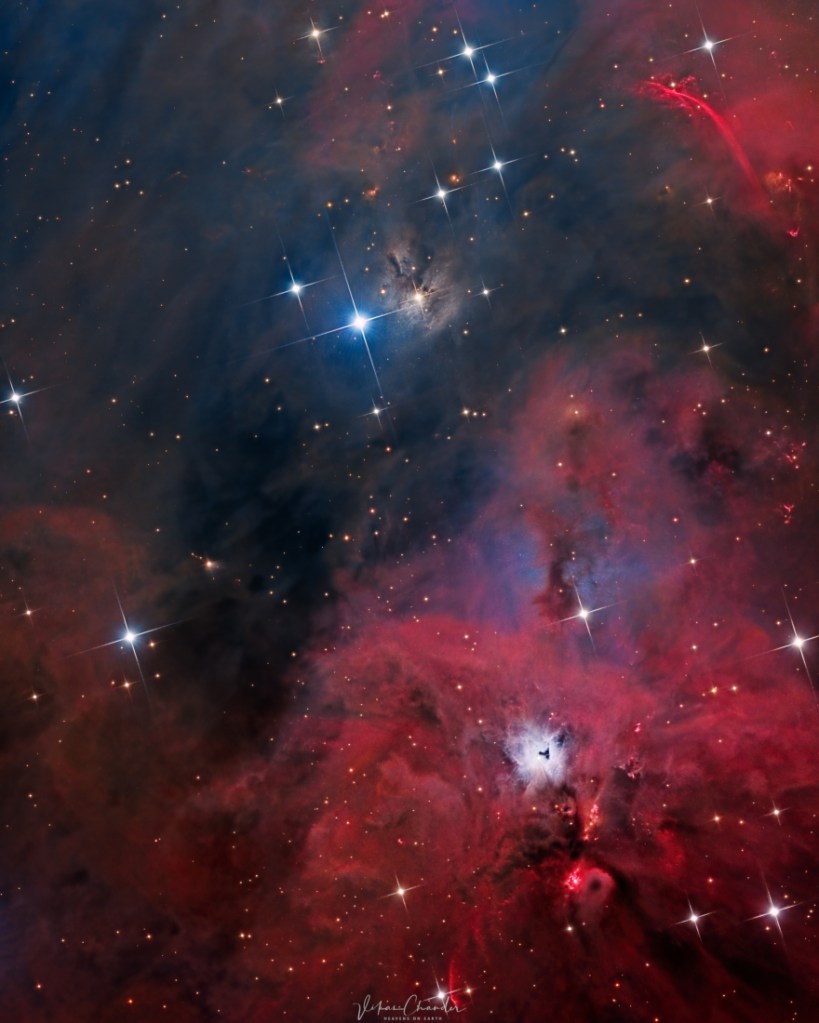
Explanation: South of the large star-forming region known as the Orion Nebula, lies bright blue reflection nebula NGC 1999. At the edge of the Orion molecular cloud complex some 1,500 light-years distant, NGC 1999’s illumination is provided by the embedded variable star V380 Orionis. The nebula is marked with a dark sideways T-shape at center right in this telescopic vista that spans about two full moons on the sky. Its dark shape was once assumed to be an obscuring dust cloud seen in silhouette. But infrared data suggest the shape is likely a hole blown through the nebula itself by energetic young stars. In fact, this region abounds with energetic young stars producing jets and outflows with luminous shock waves. Cataloged as Herbig-Haro (HH) objects, named for astronomers George Herbig and Guillermo Haro, the shocks have intense reddish hues. HH1 and HH2 are just below and right of NGC 1999. HH222, also known as the Waterfall nebula, looks like a red gash near top right in the frame. To create the shocks stellar jets push through the surrounding material at speeds of hundreds of kilometers per second.
You can use this link to go forward or backward in time for Moon phase information. If you are curious, you can even find out what phase the Moon was in when you or anyone else, you know was on the date the person was born.
The Moon’s current phase for today and tonight is a Waning Crescent phase. In this phase the Moon’s illumination is growing smaller each day until the New Moon. During this part of the Moon cycle, the Moon is getting closer to the Sun as viewed from Earth and the night side of the Moon is facing the Earth with only a small edge of the Moon being illuminated. This phase is best viewed an hour or 2 before the sunrise and can be quite beautiful if you’re willing to get up early. It can also be a great time to see the features of the Moon’s surface. Along the edge where the illuminated portion meets the dark side, the craters and mountains cast long shadows making them easier to observe with a telescope or binoculars.
Visit the January 2022 Moon Phases Calendar to see all the daily moon phase for this month.
The Waning Crescent on January 27 has an illumination of 29%. This is the percentage of the Moon illuminated by the Sun. The illumination is constantly changing and can vary up to 10% a day. On January 27 the Moon is 24.21 days old. This refers to how many days it has been since the last New Moon. It takes 29.53 days for the Moon to orbit the Earth and go through the lunar cycle of all 8 Moon phases.
There are 8 lunar phases the Moon goes through in its 29.53 days lunar cycle. The 4 major Moon phases are Full Moon, New Moon, First Quarter and Last Quarter. Between these major phases, there are 4 minor ones: the Waxing Crescent, Waxing Gibbous, Waning Gibbous and Waning Crescent. For more info on the Moon Cycle and on each phase check out Wikipedia Lunar Phase page.
Check the weather before a night of Moon gazing at weather.com
For a list of all the current meteor showers visit American Meteor Society

If you need to calculate the planetary positions for a specific use and time, click on this link
To figure out GMT (Greenwich Mean Time) to your local time use this link
The time for this Custom Planetary Positions is from the local time in Los Angeles, California, USA
January 27, 2022
12:00 am GMT 4:00 PM PST
Zodiac: Tropical (Standard Western)
The time for this Custom Planetary Positions is from the local time in Chicago, Illinois, USA
January 27, 2022
10:00 pm GMT 4:00 PM CST
Zodiac: Tropical (Standard Western)
The time for this Custom Planetary Positions is from the local time in Frankfurt, Germany, Europe
27 January 2022
03:00 pm GMT 4:00 PM CEST
Zodiac: Tropical (Standard Western)
You can use this link to go forward or backward in time for Moon phase information. If you are curious, you can even find out what phase the Moon was in when you or anyone else, you know was on the date the person was born.
The Moon’s current phase for today and tonight is a Waning Crescent phase. In this phase the Moon’s illumination is growing smaller each day until the New Moon. During this part of the Moon cycle, the Moon is getting closer to the Sun as viewed from Earth and the night side of the Moon is facing the Earth with only a small edge of the Moon being illuminated. This phase is best viewed an hour or 2 before the sunrise and can be quite beautiful if you’re willing to get up early. It can also be a great time to see the features of the Moon’s surface. Along the edge where the illuminated portion meets the dark side, the craters and mountains cast long shadows making them easier to observe with a telescope or binoculars.
Visit the January 2022 Moon Phases Calendar to see all the daily moon phase for this month.
The Waning Crescent on January 27 has an illumination of 29%. This is the percentage of the Moon illuminated by the Sun. The illumination is constantly changing and can vary up to 10% a day. On January 27 the Moon is 24.21 days old. This refers to how many days it has been since the last New Moon. It takes 29.53 days for the Moon to orbit the Earth and go through the lunar cycle of all 8 Moon phases.
There are 8 lunar phases the Moon goes through in its 29.53 days lunar cycle. The 4 major Moon phases are Full Moon, New Moon, First Quarter and Last Quarter. Between these major phases, there are 4 minor ones: the Waxing Crescent, Waxing Gibbous, Waning Gibbous and Waning Crescent. For more info on the Moon Cycle and on each phase check out Wikipedia Lunar Phase page.
Check the weather before a night of Moon gazing at weather.com
For a list of all the current meteor showers visit American Meteor Society
If you need to calculate the planetary positions for a specific use and time, click on this link
To figure out GMT (Greenwich Mean Time) to your local time use this link
The time for this Custom Planetary Positions is from the local time in Sao Paulo, Brazil, South America
27 January 2022
08:00 pm GMT 5:00 PM BRT
Zodiac: Tropical (Standard Western)
The time for this Custom Planetary Positions is from the local time in Cape Town, South Africa
27 January 2022
03:00 pm GMT 5:00 PM SAST
Zodiac: Tropical (Standard Western)
Mean Lunar Node:28 Taurus 07 Rx
Lilith (Black Moon):21 Gemini 25
Chiron:09 Aries 07
Ceres:28 Taurus 30
Pallas:24 Pisces 05
Juno:27 Capricorn 52
Vesta:08 Capricorn 41
Eris:23 Aries 43
The time for this Custom Planetary Positions is from the local time in Melbourne, Victoria, Australia
27 January 2022
06:00 am GMT 5:00 PM AEDT
Zodiac: Tropical (Standard Western)

I am not feeling any better than yesterday as it is still below 0F here and in the double digit below 0F with the wind chill factor. But I do not want to take off another day and you miss out on the daily posts I try to do every day. So even though all the extras’ posts are missing at least you are getting the regular everyday posts. It will probably be the same for the rest of this week. I hope you will bear with me while I am in this fibromyalgia super flare and the pain from arthritis and stick around until I can bring you extra posts about a wide range of pagan and some other topics.
Life in The Craft mini magazine will still be going out on January 30th, so you have the stuff it covers for Imbolc which falls on February 1st.
You can use this link to go forward or backward in time for Moon phase information. If you are curious, you can even find out what phase the Moon was in when you or anyone else, you know was on the date the person was born.
The Moon’s current phase for today and tonight is a Waning Crescent phase. In this phase the Moon’s illumination is growing smaller each day until the New Moon. During this part of the Moon cycle, the Moon is getting closer to the Sun as viewed from Earth and the night side of the Moon is facing the Earth with only a small edge of the Moon being illuminated. This phase is best viewed an hour or 2 before the sunrise and can be quite beautiful if you’re willing to get up early. It can also be a great time to see the features of the Moon’s surface. Along the edge where the illuminated portion meets the dark side, the craters and mountains cast long shadows making them easier to observe with a telescope or binoculars.
Visit the January 2022 Moon Phases Calendar to see all the daily moon phase for this month.
The Waning Crescent on January 26 has an illumination of 40%. This is the percentage of the Moon illuminated by the Sun. The illumination is constantly changing and can vary up to 10% a day. On January 26 the Moon is 23.13 days old. This refers to how many days it has been since the last New Moon. It takes 29.53 days for the Moon to orbit the Earth and go through the lunar cycle of all 8 Moon phases.
There are 8 lunar phases the Moon goes through in its 29.53 days lunar cycle. The 4 major Moon phases are Full Moon, New Moon, First Quarter and Last Quarter. Between these major phases, there are 4 minor ones: the Waxing Crescent, Waxing Gibbous, Waning Gibbous and Waning Crescent. For more info on the Moon Cycle and on each phase check out Wikipedia Lunar Phase page.
Check the weather before a night of Moon gazing at weather.com
For a list of all the current meteor showers visit American Meteor Society
If you need to calculate the planetary positions for a specific use and time, click on this link
To figure out GMT (Greenwich Mean Time) to your local time use this link
The time for this Custom Planetary Positions is from the local time in Los Angeles, California, USA
January 26, 2022
12:00 am GMT 4:00 PM PST
Zodiac: Tropical (Standard Western)
The time for this Custom Planetary Positions is from the local time in Chicago, Illinois, USA
January 26, 2022
10:00 pm GMT 4:00 PM CST
Zodiac: Tropical (Standard Western)
The time for this Custom Planetary Positions is from the local time in Frankfurt, Germany, Europe
26 January 2022
03:00 pm GMT 4:00 PM CEST
Zodiac: Tropical (Standard Western)
Items that you will need in order to perform this spell:
1 picture of the victim or there name on a peace of paper
1 white ribbon
Time: Any
Ritual: Take the white ribbon and wrap it around the picture over and over tighter and tighter until its at its end. While you are wrapping the picture say the following
” I bind you ______ from doing harm against others and harm against yourself””
Say until you have completely wrapped the ribbon around the picture.
The Modern Day Spellbook: A Collection of Spells for the Modern Day Witch
R. Marten,
Discover the cosmos! Each day a different image or photograph of our fascinating universe is featured, along with a brief explanation written by a professional astronomer.
2022 January 26
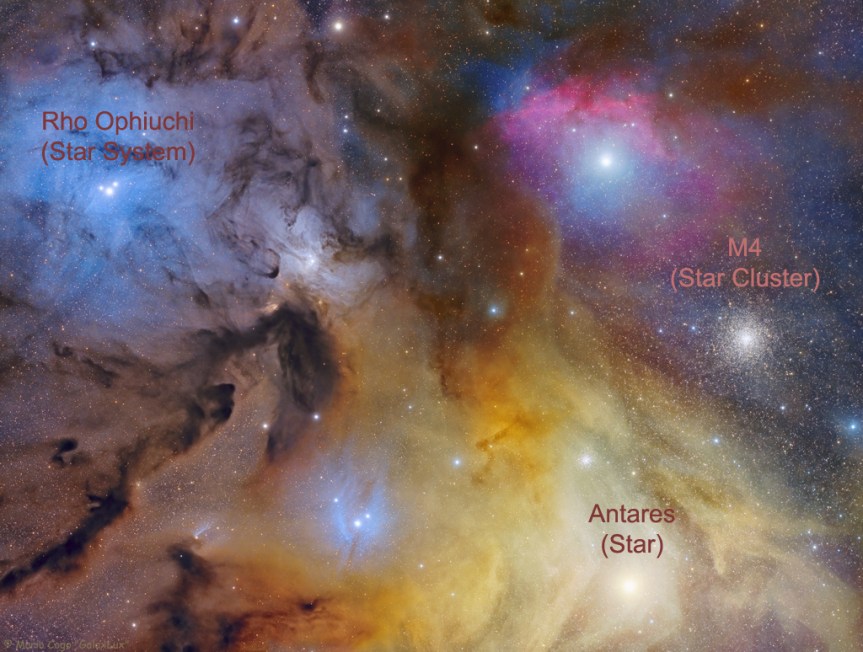
Explanation: Why is the sky near Antares and Rho Ophiuchi so dusty yet colorful? The colors result from a mixture of objects and processes. Fine dust — illuminated from the front by starlight — produces blue reflection nebulae. Gaseous clouds whose atoms are excited by ultraviolet starlight produce reddish emission nebulae. Backlit dust clouds block starlight and so appear dark. Antares, a red supergiant and one of the brighter stars in the night sky, lights up the yellow-red clouds on the lower right of the featured image. The Rho Ophiuchi star system lies at the center of the blue reflection nebula on the top left. The distant globular cluster of stars M4 is visible above and to the right of Antares. These star clouds are even more colorful than humans can see, emitting light across the electromagnetic spectrum.
Discover the cosmos! Each day a different image or photograph of our fascinating universe is featured, along with a brief explanation written by a professional astronomer.
2022 January 25
Video Credit & Copyright: Matipon Tangmatitham (NARIT); Text: Matipon TangmatithamExplanation: Which direction is this comet heading? Judging by the tail, one might imagine that Comet Leonard is traveling towards the bottom right, but a full 3D analysis shows it traveling almost directly away from the camera. With this perspective, the dust tail is trailed towards the camera and can only be seen as a short yellow-white glow near the head of the comet. The bluish ion tail, however, is made up of escaping ions that are forced directly away from the Sun by the solar wind — but channeled along the Sun’s magnetic field lines. The Sun’s magnetic field is quite complex, however, and occasionally solar magnetic reconnection will break the ion tail into knots that are pushed away from the Sun. One such knot is visible in the featured one-hour time-lapse video captured in late December from Thailand. Comet Leonard is now fading as it heads out of our Solar System.
Gallery: Notable images submitted to APOD of Comet Leonard in 2021
This contains a video as well as reading material on how to open your seven chakras.

Lady Beltane can open your chakras either through a full-length photograph of you or through a Skype video call, especially if they have never been done or are blocked. She does charge for cleaning them out, fills them with positive energy, get them connect to each other and will check back in a week to see if a minor tune up may be needed. Prices for this service can be found on the ‘Lady Beltane’s Readings and Abilities’ (page coming soon). Until the page is up you can contact Lady Beltane at ladybeltane@aol.com for more information. Please put the word “CHAKRAS” in the subject line. Thank you!
Discover the cosmos! Each day a different image or photograph of our fascinating universe is featured, along with a brief explanation written by a professional astronomer.
2022 January 24
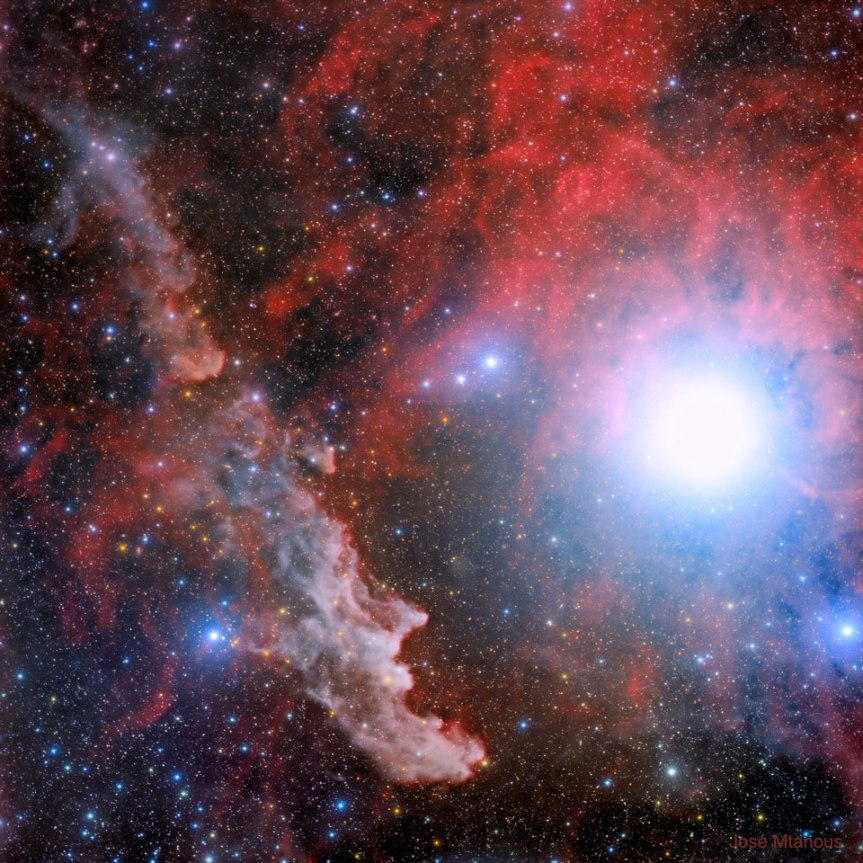
Explanation: By starlight this eerie visage shines in the dark, a crooked profile evoking its popular name, the Witch Head Nebula. In fact, this entrancing telescopic portrait gives the impression that the witch has fixed her gaze on Orion’s bright supergiant star Rigel. More formally known as IC 2118, the Witch Head Nebula spans about 50 light-years and is composed of interstellar dust grains reflecting Rigel’s starlight. The blue color of the Witch Head Nebula and of the dust surrounding Rigel is caused not only by Rigel‘s intense blue starlight but because the dust grains scatter blue light more efficiently than red. The same physical process causes Earth’s daytime sky to appear blue, although the scatterers in Earth’s atmosphere are molecules of nitrogen and oxygen. Rigel, the Witch Head Nebula, and gas and dust that surrounds them lie about 800 light-years away.
 Witches Of The Craft®
#/media/File:Animation_of_C%EF%BC%8F2021_A1's_orbit_around_Sun_-_2021_close_approach.gif)

You must be logged in to post a comment.