Litha/Summer Solstice Correspondences

From FlyingTheHedge.com – Litha Correspondences

Symbolism: life, fire, rebirth, transformation, power, purity

Symbols: sun flowers, leaves, sword, spear, sun, God’s eye, sun wheels, bonfire, balefires, fire, sun dials, bird feathers, seashells,

Colors: red, gold, orange, yellow, white, green, blue

Food and Drink: mead, ale, summer fruits and vegetables, strawberries, honey cakes, whipped cream, oranges, lemons, summer squash, honey

Herbs: Saint John’s Wortlavenderrose, peony, vervain, mugwortchamomile, chickweed, chicory, sun flower, lily, thyme, hemp, fennel, nettle, wisteria, rue, fern, heather, oakyarrowholly

Deities: Ra, Bast, Helios, Oak King, Fotuna, Arinna, and other sun god.

Crystals and Gemstones: Lapis, diamond, tiger’s eye, emerald, jade, and other green stones

Animals: butterflies, wren, horse, stag, robin, cattle, phoenix, dragon, faeries, satyrs

Magic: Litha is the time to celebrate the Sun and all that he provides for us. Protection spells and fire magic are great to perform on this night. Make protective amulets to be empowered in the balefire lit on Midsummer’s eve. Looking to promote a transformation, a new career, or create a new or strengthen an old relationship? Litha is a great night to perform such magic. Collect herbs, especially St. John’s Wort, on the eve of this sabbat to bring luck and enhance the herbs’ power. Renew your wedding vows or just enjoy the time with your friends and family. This is also a great time to communicate with faeries and seek their help if you so wish. Be careful though. Faeries can be tricky.

Please note this is not a complete list but a brief overview of symbols, colors, herbs, deities, and the like. If I have missed something that you feel should make the list, please feel free to contact me via the comments or through email. Willow

Spell for Today – Midsummer’s Day Herb Gathering Spell

Midsummer’s Day is a traditional time for Witches in all parts of the world to gather herbs from their gardens or from the wild to use in potions, dream pillows, and other forms of spellcraft.  They may be dried and burned on a charcoal disc during your magick spell or ritual.  All herbs collected at Litha are considered to have extra magickal and healing properties. 

To be recited on Midsummer’s Day, thrice before and thrice after gathering herbs for magickal workings:

“Herbs of magick, herbs of power,
Root and bark, leaf and flower,
Work for me when charms are spoken,
Potions brewed and curses broken!”

Happy Yule Blessings

Celebrating Litha: Traditions, Herbs, Symbols & More

Pagans who base their practices around western European pre-Christian traditions commonly observe a set of holidays. These are often grouped together as the Wheel of the Year, which is a way of visualizing the progression of seasons and sacred days as a cycle.

Litha is a solar festival that takes place on the longest day of the year — Midsummer.

About Litha

Litha is a name given to the summer solstice. In the northern hemisphere, this takes place around June 21st.

Because of the Earth’s axial tilt, this actually corresponds with the winter solstice in the southern hemisphere, so Pagans in the south typically celebrate Litha around December 21st. This is considered to be the time when the sun and solar deities are at the height of their power.

Origins & History

It’s hard to say when summer solstice celebrations really began. As long as humans have relied on plants and grazing animals for food, they’ve tracked the seasons.

The word “solstice” comes from Latin, and roughly translates to “sun stands still.” The solstice, then, is the point when the sun seems to stand still in the sky. In other words, it’s when the daylight hours are at their longest.

Nobody’s really certain where the name “Litha” comes from, either. One source cites a document called The Reckoning of Time (De temporum ratione) written by Saint Bede in 725 CE.

In it, he recorded a lot of Anglo-Saxon Pagan concepts, and the names of the months were among them. This time of year was allegedly named “Līða,” which translated to “gentle” or “easy to navigate.”

It was so named because this time of year marked the best weather for sailing, since the breezes were steady and not too powerful. June was Ǣrra-Līða, or “the first Litha,” while July was “the second Litha.”

Another source, Greer’s New Encyclopedia of the Occult, cites J.R.R. Tolkien’s Lord of the Rings trilogy as the actual origin. In it, the Hobbits’ called midsummer Lithe.

It’s possible that we may never find the true name of this holiday. Many of the cultures that inform modern-day European-based Paganism had strong oral traditions, and placed less emphasis on writing. As a result, the only written records left behind stem largely from invaders and other outside observers.

Traditions

Traditionally, Litha was a time to light bonfires, celebrate marriages, feast, sing, and dance. It’s a time when the weather is at its warmest, and all of the crops are at their most fruitful. This is a celebration of plenty, partnership, and community.

In Wicca, it’s customary to use this time to work solar magic, magic for men’s issues, and rituals for community stability, success, environmental healing, and strengthening relationships.

In ancient Rome, people celebrated Vestalia around midsummer. This was to honor Vesta, a virgin goddess of the hearth, home, and family. Under normal circumstances, only her devotees, the Vestal virgins, were allowed into the sacred inner areas of her temples.

During Vestalia, the inner sanctums of her temples would be opened for all women to come make offerings and request her aid and protection.

Folklore

In some forms of Wicca and …

Click here to read the rest of this article

A Very Happy and Blessed Beltane To All

For Your Viewing Pleasure – Beltane

Edinburgh’s Beltane Fire Festival celebrates the rebirth of summer with fire, dance and drumming c. 2017

Celtic festival of Beltane heats up in Scotland c. 2018

Printable Some Beltane Information

For Your Listening Pleasure – Beltane

A Pagan Love Song (Beltane)

For Your Listening PLeasure – Samhain

Samhain

Projects to Celebrate Samhain, the Witches’ New Year

As Samhain approaches, you can decorate your home with a number of easy craft projects. Start celebrating a bit early with these fun and simple ideas that honor the final harvest, and the cycle of life and death

01
of 10

Pagan Treat Bags for Samhain

Do you have Pagan kids coming over for a Samhain event? You can have a kid-friendly celebration by putting together a goodie bag that’s representative of your Pagan spirituality. The key here is to do some creative, outside the box thinking. Sure, there are a ton of Halloween decorations in the store at this time of year, but not all of those are really connected with Pagan religious belief systems. They’re really more about the secular celebration of Halloween, which is fine, unless you’re looking for kid-friendly stuff that honors Pagan spirituality.

Here are a few things to try:

  • Decorate the bags themselves with symbols that are meaningful to you – depending on the pantheon your group honors, you might include designs that are associated with Greek, Roman, Celtic, or Norse mythology.
  • Small herbal sachets: sew herbs into a fabric pouch. Use lavender to help with dreams, or other appropriate plants.
  • Crystals and gemstones: As long as the kids attending your event are beyond the put-everything-in-your-mouth stage, you could include rose quartz for love, hematite for protection, and more.
  • A Portable Altar Kit: Depending on how old the kids are, think about making an altar box that fits in a backpack or pocket. This might not be useful or safe for really young children, but older tweens and teens could use it responsibly.
  • Divination tools: make a simple pendulum with a stone wrapped in wire and attached to the end of a chain. Add a simple divination set by painting symbols on stones or wooden discs.
  • Wands: Make a simple wand with a stick and a crystal wrapped in wire.
  • Deity symbols: Does your tradition honor a particular god or goddess? Consider adding representative symbols – owls for Athenacats for Bastet, or an antler for Cernunnos. Try printing out a wallet-size image of the deity on heavy cardstock, add a prayer to your god/dess on the reverse side, and laminate it.

Finally, remember, Samhain is the same day as Halloween, so never underestimate the power of a few strategically placed pieces of delicious candy!

Click here for more craft ideas for Samhain from learnreligions.com

Wheel of the Year


The Wheel of the Year is a symbol of the eight Sabbats (religious festivals) of Neo-Paganism and the Wicca movement which includes four solar festivals (Winter Solstice, Spring Equinox, Summer Solstice, Fall Equinox) and four seasonal festivals (celebrating or marking a significant seasonal change). Contrary to modern-day Wiccan claims, there is no evidence of an ancient Wheel of the Year in its present form but it is clear that the Celts of thousands of years ago celebrated the festivals the wheel highlights, even if these celebrations were known by another name now long lost.

In the ancient Celtic culture, as in many of the past, time was seen as cyclical. The seasons changed, people died, but nothing was ever finally lost because everything returned again – in one way or another – in a repeating natural cycle. Although time in the modern world is usually regarded as linear, the cyclical nature of life continues to be recognized.

The modern-day Wheel of the Year was first suggested by the scholar and mythologist Jacob Grimm (1785-1863 CE) in his 1835 CE work, Teutonic Mythology, and fixed in its present form in the 1950s and early ’60s CE by the Wicca movement. The wheel includes the following holy days (most dates flexible year-to-year): …

Click here to read the rest of this article about the Wheel of the Year


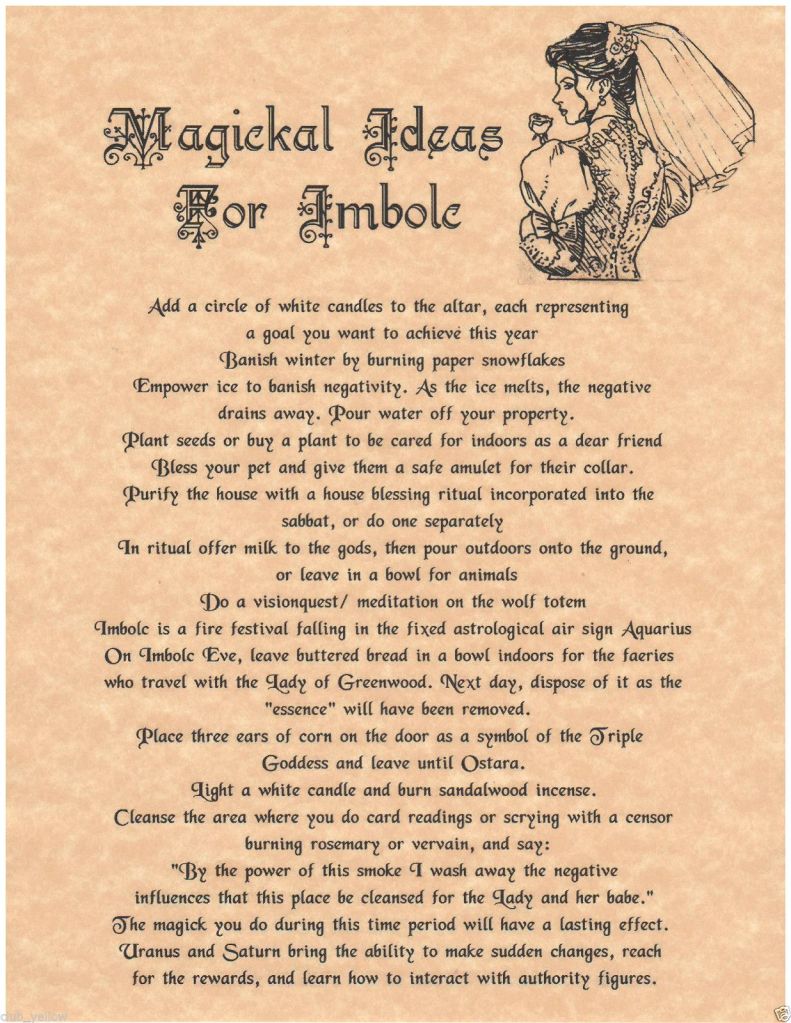
Magickal Ideas for Imbolc

Let’s Have Some Fun – Lammas


Let’s Have Some Fun – Imbolc


Flashback 2000 Imbolc

Daylight hours are gradually lengthening, and the Earth is beginning to stir. Although she is still in the middle of her winter’s rest, our planet subtly begins to plan. It’s appropriate that this period is represented by Aquarius, an air sign, since all change begins first in the mind. Every new thought or idea is full of raw potential as the Earth is now,nailing for the touch of fire to ignite her new growth period. Uranus is the ruler of Aquarius, and the planet best known for its jurisdiction over the future. This electric energy only looks forward, never back. It is during Imbolc, in fact, as the Sun is passing through Aquarius, that many ideas are born. As we prepare for the upcoming Equinox, then, it’s important to be sure that we’re looking ahead, as Uranus does, with all the electric enthusiasm and genius of Aquarius. Honor the potential of the coming spring by uncovering your gift of prophecy. Whether you use a crystal ball, a dream journal, or another type of predictive tool, prepare for the Equinox in your heart, by understanding how much is possible now.

©️ By Kim Rogers-Gallagher Llewellyn’s Witches’ Datebook 2000 Page 95

Flashback 2000 Lammas

At Lammas, the Sun is at the very peak of Leo, the sign this planet loves above all others. Our star’s warmth is at its most powerful now in the Northern Hemisphere, as it appears directly overhead. At this time, life too, ia at its peak—as are the crops. The ancients celebrated this festival by giving thanks for their first harvest, most especially the grain harvest, even as they accepted the beginning of the God’s descent into the underworld. The myth of the asteroid-Goddess Ceres (Demeter), giver of the grain, also relates to this season. It was now when she would bid her daughter Farwell, since Persephone was obligated to return to the Underworld to rejoin Hades (Pluto). So bereaved was Ceres to see her daughter leave her, she refused to all the Earth to produce grain until her return. At this time,nothing, modern practitioners should be remind of both astrological principles: the fullness of life the Sun brings, and the necessity for rest, as signified by the coming fall.

©️ By Kim Rogers-Gallagher Llewellyn’s Witches’ Datebook 2000 Page 95

Summer Solstice Printable Coloring Pages

Celebrate Summer Solstice and Connect With Nature Through These Rituals

After a long and seriously unforgiving winter, folks in the Northern Hemisphere are finally reaping the benefits of summer, as June 21 marks the official 2021 summer solstice. Many of us are already marking our calendars with beach days, hikes, and picnics galore — but if you’re looking to tap into the spiritual aspect of the seasonal shift, there are several solstice rituals you can do to welcome summer, in all its glory.

From gifting friends with sachets as a natural mosquito deterrent, to enjoying a seasonal feast of locally-grown goodies, there are so many fun ways to welcome and celebrate summer, sustainably.

Printable Games for Children – Summer

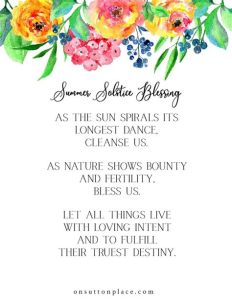
Happy and Blessed Summer Solstice