
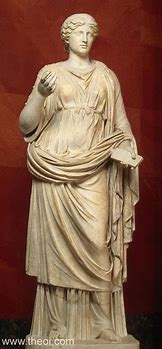
Goddess/Muse – Calliope

THE MUSE CALLIOPE IN GREEK MYTHOLOGY

THE MUSE CALLIOPE

Calliope is a famous name from Greek mythology, for Calliope was one of the Younger Muses, the beautiful goddesses who would inspire writers, artists and artisans.

Calliope the Muse of Epic Poetry, and hers was a name invoked by many writers and poets in antiquity; for they would give praise to the Muse for their ability to bring forth words of great eloquence.

CALLIOPE DAUGHTER OF ZEUS

As one of the Younger Muses, Calliope is the daughter of Zeus and the Titan goddess Mnemosyne; making her sister to Clio, Erato, Euterpe, Melpomene, Terpsichore, Thalia, Polyhmnia and Ourania.

Calliope was named as the eldest of the Younger Muses, conceived on the first night that Zeus lay with Mnemosyne.

CALLIOPE GODDESS OF MUSIC

Calliope was a Greek goddess of music, song and dance, and was specifically named as the Muse of Epic Poetry. In this role, Calliope was normally depicted with a writing tablet in her hand.

Calliope was also said to be the muse who bestowed the gift of eloquence about mortal kings, coming to them when they were a baby, and anointing their lips in honey.

​As a result of Calliope’s actions, when adults, the anointed ones would spout gracious words, and utter true judgements.

Calliope was also considered to be the leader of the Muses, the wisest of the sisters, and also the most assertive.

CALLIOPE MOTHER OF ORPHEUS

Stories from Greek mythology would tell of the marriage of Calliope to the Thracian king Oeagrus, with the wedding taking place at Pimpleia. The marriage of Calliope and Oeagrus was said to have brought forth two notable individuals Orpheus and Linus.  Orpheus was the great musical hero of Greek mythology, and Linus was the inventor of rhythm and melody; alternatively the father of Orpheus and Linus is named as the Olympian god Apollo.

Initially, Calliope and Orpheus were said to reside at Pimpleia, but later Calliope and her son were to be found with the other Younger Muses upon Mount Parnassus. For here Apollo visited to continue the musical training of Orpheus, which had been commenced by Calliope.

CALLIOPE IN GREEK MYTHOLOGY

Calliope was rarely spoken of as an individual but she is named as present, and spoken to by Thetis, when the Muses sang their dirges during the funeral rites of Achilles. Calliope was also certainly present when the Younger Muses were victorious in their contests with the Sirens and Pierides. Indeed, Calliope was said to be the Muse who caused the Pierides to be transformed into magpies after they had had the impudence to challenge Calliope and her sisters. 

Gemstone of the Day for August 31st is Opal

Gemstone of the Day

Opal

(Color: White, colorless, light yellow or red, or gray)

Hardness: 6
Specific Gravity: 2
Chemistry: SiO2∙n(H2O)
Class: Silicates
Crystallography: Amorphous
Cleavage: None
Fracture: Conchoidal
Streak: White
Luster: Vitreous – pearly

Healing: Opal is a stone of inspiration which enhances the imagination and creativity as well. It helps one release inhibitions and enhances the memory. Opal is said to be helpful for eyesight and Parkinson’s disease. Fire opals (ranging from orange to red) have also been associated with improving circulation. Green opals help give an energy boost.

Workings: Opal is also said to be a very spiritual stone, and can help one be “invisible” in situations where they don’t care to be noticed. It has been known to bring happy dreams, and also to ease the process of change. Opals are also helpful for enhancing dreamwork or assisting spiritual journeys.

Opal can be a very creative stone, especially for writers and those who need to get their thoughts down on paper.

Fire Opal is said to be energizing, giving strength and endurance in stressful times. It is also a great meditation stone.

Chakra Applications: Blue opals can help open up the third eye, soothe the throat chakra, and encourage telepathic communications. Pink opals address emotional issues, offering nourishment and support to the heart chakra.

Foot Notes: Opal is a gemstone and the birthstone for October. Opals can form anywhere but are mostly found in places where there are hot springs. Opal color depends on how pure the stone is. Most stones look white but have an iridescent shining of other colors, too. If they show colors, they are called precious opals.

Source:
Author: Crick
Website: The Whispering Woods