Poseidon (Earthshaker, Dark-haired one, Neptune) was Olympian god of sea, floods and earthquakes. In some cases, he is also referred to as a tamer of horses. He was known for his fast changing temperament and being easily offended. And because he was also dignified and competitive, it was very important not to offend him or argue his statements and acts. Those who angered him became the victims of his wrath. He was known for causing major catastrophic events, such as floods, earthquakes and sea storms, and even unleashed his sea monsters in order to get even. Poseidon was also very lustful and selfish when it came to women. He had numerous affairs with both goddesses and mortals, by either seducing them or tricking them by changing his form, not to mention abducting and violating them. However, Poseidon did have some positives and was always passionate in supporting his cause or the cause of his favourite characters, helping them in many different ways by giving them unique traits and special powers or granting them divine animals. He even changed gender of Caenis and Mestra on their own request.
Appearance in the works of art
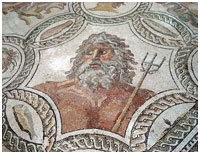
Poseidon is often depicted as a grown man with longer curly hair and long beard, wearing a crown and holding a magical trident. On more than few occasions, he is depicted in his domain of the sea and in company of his wife Amphitrite. Sometimes, he is depicted riding horses or a chariot drawn by horses.
Becoming the Ruler of the Sea
He was a descendant of Cronus and Rhea. With his brothers he fought bravely against the Titans. During the war he received the magical Trident, a weapon of great power made by the Cyclopes as a token of gratitude for helping them to escape from Tartarus. With their new weapons and help from enemies of Cronus, they were able to defeat and imprison the titans. After the victory, when the division of cosmos had to be decided between three brothers, they drew lots and he got the realm of Sea under his control. He also became second in command to Zeus. However, there is an alternative story how he became the ruler of the sea. According to Hyginus, it was Cronus himself who casted him under the sea when he was born, out of fear of dethroning him. Clement affirms this by saying that it was his destiny to become a sea ruler.
Love affairs and his descendants
Divine and semi-divine lovers
The god of the Sea is credited with having numerous love affairs with both goddesses and mortal women but in his honor he only had one wife, a sea-goddess called Amphitrite. With her he had a son Triton, who is also closely related to the sea, and Rhode, a water nymph closely related to Helios and island of Rhodes. Poseidon also had his eye set for Alcyone, one of the Pleiads, and soon he had an intercourse with her. She later gave birth to two sons, Hyrieus and Hyperenor and a daughter Atheusa. Plutarch also mentions Anippê, a daugher of Nile, who gave birth to Burisis by Poseidon. According to Hyginus, he made love with Antiopa, a daughter of Aeolus (supposedly son of Hippotes), who gave birth to two sons Boeotus and Hellen, and Arethusa, a daughter of Nereus, who gave him another son Abas. There was also Amymone, a daughter of Danaus, a mythical king of Egypt, who once called Poseidon to aid her when she was cornered in the woods by a satyr. So he came and drove the creature away and because of this courageous act she laid with him and from this embrace Nauplius was born. He also pursued Demeter who transformed herself into a mare to escape his lust but Poseidon tricked her with transforming himself into a stallion and mated with her. Demter then gave birth to goddess Desponia and variously to Arion, a horse with the ability to speak human language. Poseidon even had an intercourse with Medusa in the temple of Athena. Athena later cursed Medusa by changing her into a monster. It is also said by some authors that she was impregnated and when her head was chopped off by Perseus, Pegasus and Chrysaor arose from her blood and therefore they are giving credits to Poseidon as the father. He also fathered Polyphemus with the sea-nymph called Thoosa and Euphemus with Europe. It is said by Hyginus that Euphemus had the ability to walk on water.
Mortal lovers
One day, he tricked a mortal woman named Tyro by transforming himself in Enipeus, the river-god of her desire. She then gave birth to twin-boysPelias and Neleus who were known to be famous greek heroes. Aethra, the princess of Troezen is also said to had an intercourse with the god in the shrine of Athena and later gave birth to Theseus. Another famous hero by the name Orion was born to Poseidon and Euryale, a daughter of Minos, and it is said that he had been granted the ability to walk on water by his father. There was also Hippothous or Hippothoon who was begat by Alope after she was embraced by Poseidon. But, because Alope was uncertain who the father of her child was, unfortunate events followed for both of them. She was imprisoned and put to death and the child was exposed to danger twice but each time a mare came and furnished him milk. It was then when Sheperds had realized that it must be the will of the gods to spare him and gave him name Hippothous. It is also said that Alope was then turned, by the god, into a spring near Eleusis. Similar thing happened to Melanippe, a daughter of Desmontes, who was, after being impregnated by Poseidon, blinded and tossed in prison by her father Desmontes and the two sons Aeolus and Boeotus, that she had given birth to, thrown to wild beasts. But they managed to survive and eventually, led by their father, came back to Desmontes, killed him and freed their mother from prison whose sight was restored by Poseidon himself who is also credited as the father of Bellerophon by Eurynome. a daughter of Nysus. Another interesting tale comes from Apollodorus where it is said that Poseidon had a lover by the name Canace and she later gave birth to five sons, Aloeus, Epopeus, Hopleus, Nireus and Triops. Aloeus later married Iphimedia, a daughter of his brother Triops, but she fell in love with Poseidon and the god apparently couldn’t resist missing an opportunity like this because by him she later gave birth to two sons, Ephialtes and Otus. They were known as the Aloads or Aloadae giants.
Wraths of Poseidon
During his time, many vengeful acts were recorded. Most known are from the Odyssey where he chased Odysseus for eight years for blinding his son Polymphemus, the one-eyed cyclops. He was causing deadly storms and earthquakes, trying to drown the hero and prevent him from ever reaching Ithaca. It is also said that he punished Phoeacians by turning their ship into stone because they welcomed and helped the hero. Poseidon also became furious when he helped Laomedon, a king of Troy, with building the walls in exchange for a wealthy ransom. When the walls were built, the king refused to pay the god and therefore Poseidon flooded the region and sent an enormous sea-monster to ravage the lands of Troy.
The Trojan Cetus, as it was called, terrorized the whole country over and over again before the Trojans finally, after consultation with the Oracle, agreed to sacrifice King’s daughter Hesione in order to satisfy Poseidon enough to recall the monster. However, Laomedon had another option which was to promise a reward for Heracles who was just passing by from one of his quests. Heracles agreed, defeated the Cetus, and saved Hesione. In a similar story, where Cassiopeia, a mother of Andromeda, boasted that her daughter is more beautiful than the Nereids, relatives and employes of Poseidon. When they heard of this Cassiopeia’s pride, they complained to Poseidon who then released a Cetus to terrorise the lands of Ethiopia. They were, like the Trojans, advised by the oracle to sacrifice the princess to the monster. Thereafter they had chained Andromeda to the rock and left her to be devoured by the monster. Then Perseus came to rescue, but unlike Heracles, he defeated the Cetus and saved Andromeda because of love at first sight. Another one who offended the god was Inachus who, according to Apollodorus, testified that the land of Argos belonged to Hera after the gods were involved in a dispute. Poseidon was outraged and in revenge dried up all remaining springs, leaving the land completely waterless and useless to Hera.
There had also been a contest for the patronage of Athens between Athena and Poseidon. In order to win city’s deviotion, they had to produce a useful gift for its population. Poseidon was first to act and struck his trident hard in the earth, creating a well with streaming water. However, the water turned out to be salty and not so useful for the people. Athena was next and created the olive tree, by planting an olive branch into the hole that she made with a spear. Delighted with olives, oil and useful wood, people of Athens chose Athena over Poseidon. This angered the god who then, in his vengeful act, flooded the city and lands nearby with salt water. There is, however, an alternative explanation provided by Ovid where it is said nothing about revenge but that Poseidon, instead of giving fresh water to locals, presented a horse to men but the result was the same as they had picked Athena over him because of the olive tree. Then there were also two kings who paid their price for offending the god. First was Minos, a king of Crete, who tricked Poseidon with sacrificing an ordinary bull to him instead of the one given to him by the god as promised. The Earthshaker then had his revenge as he made the promised bull savage and casted a spell on his wife Pasiphae to fall in love with it. As a result of such action, the Minotaur was born which was a punishment enough for Minos. The other one was Erechtheus, a king of Athens, whose army killed Poseidon’s son Eumolpus in the battle for Athens. The god then demanded that one of his daughters should be sacrificed to him but because the daughters of Erechtheus had an agreement with each other that if one dies, the rest would commit suicide, the king of Athens lost all of his daughters. In the end Poseidon also requested from Zeus to struck Eechtheus with a thunderbolt which ended the king’s life and bloodline.
Helping others
Not all accounts are about revenge though. Poseidon could also be very passionate and understanding to those who he favoured and therefore gave good words or interviened himself on their behalf. One of such accounts is the myth of Ares and Aphrodite when they were trapped in the bed of Hephaestus. After all the gods have been summoned to see this adultery and having a laugh at it, it was Poseidon who convinced Hephaestus to let Ares go, in spite of what had been done. This was not the only god he helped. It is said, by Hyginus, that he also protected Leto from vengeful Hera and took her to Ortygia which later became known as Delos after Posedion had transformed it, and he also granted a wish of Aphrodite and accepted her descendants into his realm of Sea. It is worth mentioning that he also accepted a nypmh Leucothea into a divine company in deep waters with open arms and consequently did a great deed for mankind because ever since she supposedly helps seafares who lose their way. The god also once saved Ajax from the sea after previously cracking his boat in half due to hero’s boastful claim that he taught Antichlous everything about horses which of course was not true. Poseidon gave him a lesson but because he favoured the hero he spared his life. Poseidon was also very generous with gifts as he gave his son Peleus two magnificent horses, Balius and Xanthus, and also granted chariots to Idas and Pelops. He also blessed his son Neleus with boundless strength and ability to change shape whenever in a battle and other son Percilymenus the ability to change shape at will. To his grandson Pterelaus he granted immortality by implanting golden hair on his head. There had also been two accounts of sex-change recorded, both on own volition. There was a woman by the name Caenis whom the god once saw walking on the beach and ravished her. He felt bad about it so he offered to grant her any wish desired and she wanted to become a man so that such atrocity would never happen to her again. Poseidon granted her wish and made her a man named Caeneus but also made a new man invulnerable to any blow of sword or spear. Second was one the god’s lovers, named Mestra, who was only temporary changed to a man in order to conceal her from her father and master Erysichthon. He was looking for her and eventually, because he couldn’t find her, gave up and left. Poseidon then turned her back into original form.
Trojan war
Poseidon sided with the Greeks and was helping them all along but on one occasion he is said to had worked against them. It is said by Homer and Quintus Smyrnaeus that the god was jealous because of the impressive wall the Greeks have built around their ships. He was worried that its fame would overshadow his work on Trojan walls and, because of it, helped Trojans destroy it which left consequences on the morale of Greek soldiers. Thereafter, Poseidon had to interviene again and it is said that he encouraged troops indirectly ,because of the rules Zeus had set for immortals not to engage in battle, and fused both Ajaxes with power through his staff when being disguised in the shape of an old seer named Calchas. He is also said to had protected Idomeneus at all costs and even helped him kill Alcathos.
Later in war the god of the Sea became angered because Trojans killed his grandson Amphimachus and his indirect involvement was not helping much as Trojans were taking advantage over them. It was then when he agreed to take part in Hera’s plot to decieve Zeus. After the king of the gods had been put to sleep, Poseidon engaged in the battlefield to lead the Greek army and it is said that he roared so loud as if it were nine thousand men, all to raise morale and finally put an end to Trojans. And it had an effect until Zeus woke up and realised he had been tricked. Immediately he gave orders for all the immortals to withdraw from the battle but Poseidon opposed for a while until he realised that it is best to listen to his brother. He, then, finally withdrew himself from the battlefield and returned to the sea realm. Later, he was summoned to the assembly with the rest of the immortals where Zeus gave them a choice to pick a side and fight for them if they wish to do so. Poseidon is said to had intended to fight Apollo if provoked but the gods came to an agreement and let men decide their battle. When Greeks had finally taken the upper hand in war and when they were attacking Troy, Poseidon is mentioned to had shaken the walls and foundations of the city and driven back posts of Dardan or Dardanian gates. It is also said that after the war was won, he gave Trojans favourable winds which enabled them to escape and prevented further death casualties. According to Homer, he also previously saved Aeneas from a certain death in a battle with Achilles.
Poseidon’s sacred places







 Witches Of The Craft®
You must be logged in to post a comment.