FRIDAY – The Day of the Love, 
The Day of Venus

FRIDAY

The Day of the Love
The Day of Venus

frigedaeg or frige dag (Anglo-Saxon) freitag (Germanic) dies veneris (Latin) sukra-var (Hindu) juma (Islamic) vendredi (French) kin youbi (Japanese)

This is traditionally the sixth day of the week. The name given to this day in ancient Rome was ‘dies Veneris’ as is was a day dedicated to Venus. Later the French named the day ‘Vendredi’ believed to have derived from the same origin. In northern countries the closest equivalent to the Goddess Venus was ‘Frigg’ or ‘Freya’ with the day becoming known by the Anglo-Saxons as ‘Frige dag’, later to Friday. Traditionally associated in many parts of Europe with misfortune as this was believed to be the day when Christ was crucified at Calvary, and also that this was the day that Adam was tempted by Eve with the Forbidden Fruit. Within the Roman Catholic faith Friday was traditionally a day of abstinence. Today it is a still viewed as a day for some private act of self-denial. According to tradition there are some practices that should be avoided if possible on a Friday including, births, weddings, the sailing of a ship, cutting your nails or starting a new job. This is indicated in the following rhyme:

‘Whoever be born on Friday or it’s night, He shall be accursed of men, Silly and crafty and loathsome to all men, And shall ever be thinking evil in his heart, And shall be a thief and a great coward, And shall not live longer than to middle age.’

A contradiction is expressed if a child was born on this day in ‘Days of the Week’, which indicated a more favourable omen. And indeed it is said that in 1492 Columbus set sail and sighted land on a Friday. In Hungarian (Europe) folklore it was believed be an omen of bad luck to be born on a Friday although it was believed that the onset of misfortune could be avoided or removed by placing some of your own blood on some of your own old clothing and then burning it. The criminal underworld have an old belief that ‘a burglary committed on a Friday will probably result in arrest’ as perhaps a sign of divine intervention and retribution upon the criminal, and if you were bought to trial for any offence on a Friday it was thought to be a bad omen. In the British Isles and USA Friday was the customary day to carry-out hangings and so was sometimes referred to as ‘Hangman’s Day’ or ‘Hanging Day’. (This perhaps is connected to the Christian belief in a Friday being the worst day of the week, as this was the day identified with the Crucifixion and the death of Christ). If it rains on a Friday an old rural belief (UK) was that it indicated the forecast would be fine on the following Sunday. If you dreamt on a Friday night of an event or people and then told the content of the dream to someone in your family on the Saturday morning it was more likely to happen. In Scotland (UK) and Germany (Europe) according to an old belief Friday was thought to be a good day to go courting (dating). Norse men traditionally saw this as a positive day, the luckiest of the week. ‘Black Friday’ has been regularly used to label days of significance within the British culture. This was the name given to December 6 1745 in the British Isles. This was the day that information reached London (UK) that the Young Pretender had reached Derby (UK). The threatened General Strike was cancelled on 15 April 1921 affecting the stance of the British Labour Movement (UK). The Government (USA) flooded the open market with gold to bring down prices on 24 September 1869 ruining the livelihoods of many speculators in USA. Mohammedans believe that Adam was created on a Friday, and so the day is seen to be the Sabbath. It is also believed that Eve tempted Adam with the Forbidden Fruit on this day, and that later both died on a Friday. Friday is believed to be a day of misfortune too for Buddhists and Brahmins. ‘Long Friday’ was another name given to Good Friday (For further information see Mystical WWW Easter) by the Saxons. It is thought that the name derived from the fact that this was a day of abstinence. According to the English historian Richard Grafton certain dates of the month were unlucky as published in the ‘Manual’ in 1565. Days throughout the year were identified and of course could have related to any day of the week. The date was the most important point to consider. The work was reputed to have some credence with support given by astronomers of the day.

(For more information see Mystical WWW Mystical Time : Mystical Months).

Today’s Tarot for October 12th is The Emperor

The Emperor

Saturday, Oct 12th, 2013


In the most practical terms, what has traditionally been called the Emperor card represents the highest leadership, a head of state or the most exemplary and powerful person in the realm. This archetypal ruler is responsible for the positive working out of affairs of a society or community, which are directly proportional to his well being and happiness.

The more enlightenment and cosmic perspective this energy brings, the better life is for all. The Emperor archetype masters the world of matter and physical manifestation. When you apply this card to your situation, acknowledge your potentials for mastery. Reinforce a sense of sovereignty within yourself, despite any self-limiting beliefs, habits or appearances to the contrary.

Today's Tarot for September 2 is The Emperor

The Emperor

Monday, Sep 2nd, 2013


In the most practical terms, what has traditionally been called the Emperor card represents the highest leadership, a head of state or the most exemplary and powerful person in the realm. This archetypal ruler is responsible for the positive working out of affairs of a society or community, which are directly proportional to his well being and happiness.

The more enlightenment and cosmic perspective this energy brings, the better life is for all. The Emperor archetype masters the world of matter and physical manifestation. When you apply this card to your situation, acknowledge your potentials for mastery. Reinforce a sense of sovereignty within yourself, despite any self-limiting beliefs, habits or appearances to the contrary.

Calendar of the Sun for August 21

Calendar of the Sun

21 Weodmonath

Consualia: First Harvest of Rome

Color: Brown
Element: Earth
Altar: Upon a brown a cloth display the preserved fruits of the harvest thus far. There should be a pot of fruit that has been cooked to charring as a traditional offering, a wreath of flowers, and a chalice of wine. Outside, the underground stone altar of Consus is dug open and revealed.
Offering: Burned fruits.
Daily Meal: Food out of the garden.

Consualia Invocation

Hail, Consus, Lord of the Storehouse!
As our ancestors stored things deep underground,
So we have opened the earth
To give you what is your due.
For it is not enough to grow what must be grown.
Our sustenance must also be cultivated,
Plucked from vine and stem,
Cleaned and prepared,
And if necessary preserved.
You are the keeper of next year’s seeds
Which we must save as if our lives
Depended on those tiny cradles of life.
You are the keeper of next year’s grain,
And may we all come to love and understand
The cycle of seed and fruit on which
Our table, and our bellies, depend.
Hail Consus, keeper of the seeds,
May your blessing carry through
To next year’s garden, and each year forever.

(All go out to the garden, where the open hole reveals the carved stone of Consus’s altar. The burned fruits are laid in as an offering, and the wine poured in on top. Then the altar is covered again with earth, and the wreath of flowers is laid over it.)

[Pagan Book of Hours]

Your Charm for August 18 is The Bulla

Your Charm for Today

Today’s Meaning:   

You are distracted from this aspect by other areas of your life you feel are more pressing. This aspect is suffering from this lack of attention. You must ask yourself how much more you can let it suffer before you give it due attention.

General Description:   

From remote times the terrors of the arts of fascination have been dreaded, and by wearing this charm, which contained a written invocation to their gods, it was believed that full protection was obtained. The Bulla was popular in Rome from a very early period. It was worn on a necklace, or upon the girdle. The Gorgons head, with hair of writhing snakes, was believed to terrify and drive away the power of the bewitcher. Even today in many countries, the magic power of the evil eye is still believed in.

Your Tarot Card for August 16th isThe Chariot

The Chariot

Friday, Aug 16th, 2013


Traditionally, the card usually entitled the Chariot points to a triumphal feeling of freedom, as if the charioteer is being paraded through the streets as a hero (or heroine). The card reflects congratulations for high achievement, and serves as a sign of empowerment.

Huge wheels and frisky steeds speed the rate at which the driver’s willpower can be realized. This kind of charge makes more of the world accessible to anyone ambitious enough to seize the Chariot’s reins. But there is danger in this feeling of freedom, because of the increased rate of change and its power to magnify mistakes in judgment. As a seasoned warrior, the Charioteer is called upon to be extra attentive to the way ahead.

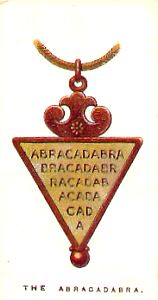
Your Charm for Tuesday, August 13th is Abracadabra

Your Charm for Today

Today’s Meaning:   

The most powerful of all talisman indicating you or someone close to you will recover from an infection.

General Description:   

One of the most famous of all talismans, and used as a magical formula by the Gnostics in Rome for invoking the aid of beneficient spirits against disease, misfortune and death. Sammonieus, the celebrated Gnostic physician; instructed that the letters of this magical triangle which he used for curing agues and fevers, were to be written on paper, folded into the shape of a cross, worn for nine days suspended from the neck, and, before sunrise, cast behind the patient into a stream running eastward. It was also a most popular charm in the middle ages. During the Great Plague, 1665, great numbers of these amulets were worn as supposed safeguards against infection.

Today's Tarot Card for August 13th is The Emperor)

The Emperor

Tuesday, Aug 13th, 2013

In the most practical terms, what has traditionally been called the Emperor card represents the highest leadership, a head of state or the most exemplary and powerful person in the realm. This archetypal ruler is responsible for the positive working out of affairs of a society or community, which are directly proportional to his well being and happiness.

The more enlightenment and cosmic perspective this energy brings, the better life is for all. The Emperor archetype masters the world of matter and physical manifestation. When you apply this card to your situation, acknowledge your potentials for mastery. Reinforce a sense of sovereignty within yourself, despite any self-limiting beliefs, habits or appearances to the contrary.

In the most practical terms, what has traditionally been called the Emperor card represents the highest leadership, a head of state or the most exemplary and powerful person in the realm. This archetypal ruler is responsible for the positive working out of affairs of a society or community, which are directly proportional to his well being and happiness.

The more enlightenment and cosmic perspective this energy brings, the better life is for all. The Emperor archetype masters the world of matter and physical manifestation. When you apply this card to your situation, acknowledge your potentials for mastery. Reinforce a sense of sovereignty within yourself, despite any self-limiting beliefs, habits or appearances to the contrary.

Celebrating Other Spirituality 365 Days A Year – Neptunalia

7rf%20W%2013

July 23

Neptunalia

The Neptunalia venerates the divine God of the sea, Neptune. Originally a freshwater God, Neptune acquired his maritime status when he was identified with the Greek Poseidon. At Rome, there was a temple dedicated to Neptune in the circus Flaminius within the Campus Martius where his festivals were held on July 23 and December 1.

Neptune was one of only three Gods to whom a bull might be sacrificed (the others were Mars and Apollo). According to legend, he has a wife whose name was Salacia, Goddess of the salty sea and inland guardian of springs. It is believed that the Goddess Sulis, who is still worshiped at the sacred hot springs at Bath, may have been an aspect of Salacia.

“Mighty Neptune, may it please,

Thee, the Rector of the Seas.

Through thy watrie-region;

And a Tunnie-fish shall be,

Offer’d up with thanks to thee.

—Robert Herrick, “To Neptune, Hesperides”

(1648)

Daily Horoscopes for Tuesday, July 23rd

We need to push past our personal desires today so we can focus on the realms of community and humanity. The greater good is of higher concern now that the Moon is visiting conceptual Aquarius. Although we’re comfortable in the world of thought, we might seem emotionally distant from others. Nevertheless, we must make choices about what we like and what we don’t like while resourceful Venus is moving through analytical Virgo until August 16.

Aries Horoscope

(Mar 21 – Apr 19)

You might be quite distracted from the emotional issues that have been building over the last few weeks. There is much to say, but you can’t bring yourself to say it. Lately, you are more concerned about what others think of you, so you often change the subject to something less threatening. Get together with trusted friends and share what’s weighing on your heart. Receiving their support will be well worth the risk of revealing your feelings. Nothing ventured; nothing gained.

Taurus Horoscope

(Apr 20 – May 20)

You want to be acknowledged for your unflappable behavior, but even if people say wonderful things about you now, you might not be open to what you are hearing. It’s important to be actively engaged with those around you; if praise comes your way, smile and say thank you. Don’t deflect the positive support because of your temporary insecurity or low self-esteem. On the other hand, don’t go fishing for compliments; they mean a lot more when they’re unsolicited. Be the friend you want to have and focus your attention on the happiness of others.

Gemini Horoscope

(May 21 – Jun 20)

New opportunities create alternatives today as you think about all the future possibilities waiting for you. Even if you’re still feeling stressed out, the potential for change is improving day by day. But don’t expect circumstances to suddenly transform. Rather, the dreams you hold on to now will begin to take shape gradually. Think big, but try not to be too disappointed if everything takes some time yet to manifest. Remember, Rome wasn’t built in a day.

Cancer Horoscope

(Jun 21 – Jul 22)

You may go through a weird phase this week as you attempt to distance yourself from your feelings in order to cope with what’s happening. Although this sounds difficult, gaining perspective can be quite helpful. Relationships might be easier than they have been for a while, since your current emotional detachment enables you to enjoy yourself without being overwhelmed. Be aware of your desires, but don’t spread them out on the table for others to see. Give yourself time to sort things out before you share them with anyone else.

Leo Horoscope

(Jul 23 – Aug 22)

You roar with all the intent of the Lion or Lioness, but others may react to you now in ways you don’t expect. The high tension between your will and the emotional response that you elicit today might anger you if you can’t have your way. But don’t follow your temptation to turn this into a full-blown argument. If you do, there won’t be a winner. Call on your inner patience today because you’ll most likely achieve your goals if you can wait long enough for others to come around to your point of view.

Virgo Horoscope

(Aug 23 – Sep 22)

Your ideas may be worth more than anyone perceives, but it’s difficult to get your concepts across at this time. If you are misinterpreted, your tendency now is to inflate your cleverness in an attempt to convince others of your intellectual merit. But the more you say, the less they understand. Loosening the reins of control prevents problems from developing later on. Your best tactic is to communicate as little as possible and let the day take its own course, without feeling the need to control where it leads.

Libra Horoscope

(Sep 23 – Oct 22)

You have lots of energy today to put toward creating enjoyment for you and those around you. You could choose to have a party since that would fulfill your need for spending time with your friends in a spontaneous manner. Also, your creative juices are flowing, so if there’s a project you’ve been putting off, today is the day to get it off the ground. He who hesitates is lost.

Scorpio Horoscope

(Oct 23 – Nov 21)

Processing your emotions may be tricky if it seems that you have nowhere to go with your feelings. If you express them honestly, you won’t improve your current situation. However, if you try to bury them, you’ll only make matters even worse. Thankfully, there’s an easy solution; simply steer clear of blame. Acknowledge what you’re feeling, but don’t attempt to describe the cause. If you stay in the present moment and remember to be kind, then a difficult situation can magically transform into a beautiful encounter.

Sagittarius Horoscope

(Nov 22 – Dec 21)

Today has all the earmarks of a highly busy day, complete with unusual social encounters. Although you may be looking for meaning as much as you are seeking a good time, the emphasis is on turning your day into an adventure. Of course, you’re nearly always up for a good adventure. However, problems arise if you make too much out of a minor event. If you’re going to the beach for a swim, don’t try to turn it into a Caribbean pleasure cruise.

Capricorn Horoscope

(Dec 22 – Jan 19)

Even if the emotional turmoil has started to calm down, you still might be embroiled in a bit of a power struggle that upsets you. Unfortunately, you can easily express your frustration at the wrong target, which doesn’t necessarily help you to regain your sense of balance. Instead of focusing on a current situation, look ahead to next week and do whatever you need in order to carry out your long-term commitments. Keeping your eyes on the future gives you the confidence motivation to successfully handle the current situation.

Aquarius Horoscope

(Jan 20 – Feb 18)

A close family member or a good friend may be the source of temporary trouble for you now. You feel like you haven’t done anything wrong, but someone still could get angry with you for no apparent reason. You might even see the black cloud coming and try to stop the oncoming storm, but to no avail. Don’t take it all too seriously, for the drama seems so much more important than it really is. Let the emotional barrage roll off you like water off a duck’s back. No worries; the sun will come out tomorrow.

Pisces Horoscope

(Feb 19 – Mar 20)

You can drift off into your own fantasy-land these days, but escape might not be such a bad thing now. Others get on your case and try to make you see the folly of your ways but you know there’s treasure to be discovered. Thankfully, there is no harm from taking your little mental holiday as long as you remember the difference between reality and your imagination. Embark on your journey, but make certain you’re back in time to do your chores.

Today’s Tarot Card for February 14th is The Emperor

The Emperor

Thursday, Feb 14th, 2013

In the most practical terms, what has traditionally been called the Emperor card represents the highest leadership, a head of state or the most exemplary and powerful person in the realm. This archetypal ruler is responsible for the positive working out of affairs of a society or community, which are directly proportional to his well being and happiness.

The more enlightenment and cosmic perspective this energy brings, the better life is for all. The Emperor archetype masters the world of matter and physical manifestation. When you apply this card to your situation, acknowledge your potentials for mastery. Reinforce a sense of sovereignty within yourself, despite any self-limiting beliefs, habits or appearances to the contrary.

Calendar of the Sun for February 14th

Calendar of the Sun

14 Solmonath

Lupercalia

Color: Black and red
Element: Earth
Altar: Drape with black and set with the figures of wolves and a straw goat. There should also be a shallow bowl filled with the blood of a recently slaughtered animal, and a knife in the blood, and a goatskin whip.
Offerings: Cakes baked of “mola salsa”, heavily salted meal from the first ears of  harvested during the last year. An agreement to  the predator and prey within you.
Daily Meal: Goat meat. Bread or cooked grains.

Lupercalia Invocation

Within us is the goat
Who is sacrificed
Who gives up its life
Who is torn apart
That others may live.
Within us is the wolf
That does the tearing,
Who is pitiless,
Who is implacable,
Who is the life for which
The prey lays it own down.
We are both wolf and goat
And to devalue one
Is to shame the other.

Call and Response:
Hail, Creature of Prey, Sacrificed One!
Hail, Predator who accepts the sacrifice!
Hail, Pan, Goat-God who runs on swift hooves!
Hail, Loba, Wolf-Goddess, who pursues him!
May we fear no pain!
May we fear no !

(Two who have been chosen to do the work of the ritual stand naked before the altar. One takes the whip and whips the open presented palms of each person, saying, “Let the spirit of the Goat come into you.” The other takes the bloody knife and carefully wipes it across the foreheads of everyone present, saying, “Let the spirit of the Wolf come into you.” All join in a group howl.)

[Pagan Book of Hours]

What Makes Runes Powerful?

What Makes Runes Powerful?

by: Donald Tyson
Runes are the manifest symbols through which rune magic is worked. They can be employed for all of the magical purposes that other magical systems serve, but  they possess unique aspects that make them superior for certain uses.
Because they were forged over the centuries in the same creative fire that shaped the pagan gods of the Teutonic peoples, runes are indispensable in magical  dealings that involve the northern hierarchy. They are a key that unlocks the powers of these gods, and they are a book that unfolds the secrets of their  personalities. Before the rediscovery of runes, the Aesir, lords of Asgard – who number among their ranks Odin, Thor, Tiw, Heimdall, Baldar, Loki, Frija and  Hel – were difficult to integrate into modern ceremonial magic. An elemental wildness distinguishes them from the more civilized gods of Greece and Rome and  the abstract, almost technical natures of the angels and spirits of Hebrew occultism. It would be absurd to invoke the Aesir with Hebrew numerology or Greek  words. Yet before the rebirth of runes, the magus had little option.
Because runes form the magical language of the northern gods and express the forces upon which those gods are framed, manipulating the runes gives direct  control over the actions- not just of the deities but also of the spirits and lesser entities of Norse mythology, which all arose out of the same primeval  crucible of mythic archetypes. They are more than just arbitrary symbols chosen to represent occult forces by the Germanic shamans; each rune contains in its  structure the same essence that is in the god, spirit, or magical potential to which it corresponds. It is the magical name of that god or natural power.     Anyone seeking to contact and communicate with the northern hierarchy – whether for purposes of worship, divination, or active magic – must use the runes. It  is possible to invoke the Aesir without runes, but this is akin to driving a nail with a rock when a hammer is sitting within easy reach. It makes no sense.  More and more, those with Teutonic roots are seeking to know the gods of their ancestors. Runes are indispensable in building this bridge to the past.
Perhaps because they rested forgotten for so many centuries, the runes remain undiluted by modem skepticism and rationalization. Of all the symbolic tools of  magic, they are the most powerful for causing material change in the world. Rune magic makes things happen – often violently, sometimes unpredictably. Most  potent physically, rune magic is also most dangerous to the unwary. The elemental powers contained and defined by the runes are not conscious in the human  sense, but they possess a type of animation and awareness not unlike the self-awareness of animals, plants, or embodied spirits – a watchful, quick,  sometimes malicious awareness that might almost be called mad in its unexpectedness. But madness is a human concept, and the runes are true to themselves and  terribly sane.
All types of occult work that seek material change – or transformations on the human level of emotions and urges that are linked to the body – can be  fulfilled with rune magic. Rune magic also embraces the spiritual level of the human soul, and great works of the spirit are possible using the runes. The  point that should be grasped here is that runes are weighted more toward the physical, tangible end of the scale than any other ancient magical system. It  may be that in their beginnings all magical systems were mainly concerned with material change, but it is only the runes that have descended through time in  their pristine, primitive state.
Another unique aspect of the runes has to do with their structure. Because they are simple letters that can be carried in the head and inscribed on any  surface as easily as the alphabet, they are the most compact and accessible of magical systems. Bulky temple instruments are not needed in rune magic. They  can be written anywhere on virtually anything in moments when an emergency arises. No one can ever take the runes away or destroy them; they live in the  mind.
In their portability runes resemble the Hebrew letters, which are combined into magical names and words of power based upon the numerical values of the  letters in the system of Jewish occultism known as the Kabbalah. At one time each letter of the Hebrew alphabet also had its elemental meaning, independent  of its numerical value. But in modern times, the natural powers embodied in the Hebrew letters have largely been forgotten, displaced by the number values.
As is true of the Hebrew letters, the runes can be combined both occultly in numerical and symbolic groupings and phonetically to form words and sentences.  The same runes can both embody a magical desire in their combination of elemental potentials and explicitly define that desire in words. These methods  complement and support each other, and are frequently encountered together on rune artifacts made for magical purposes. For example, the sixth-century  Lindholm amulet of Sweden bears the intelligible inscription of its magician maker: “I am an Herulian, I am called the Cunning One.” But it also  bears a string of runes that cannot be translated, because they convey only an occult, not a literal, meaning.

Your Tarot Card for December 10th is The Emperor

The Emperor

Monday, Dec 10th, 2012

In the most practical terms, what has traditionally been called the Emperor card represents the highest leadership, a head of state or the most exemplary and powerful person in the realm. This archetypal ruler is responsible for the positive working out of affairs of a society or community, which are directly proportional to his well being and happiness.

The more enlightenment and cosmic perspective this energy brings, the better life is for all. The Emperor archetype masters the world of matter and physical manifestation. When you apply this card to your situation, acknowledge your potentials for mastery. Reinforce a sense of sovereignty within yourself, despite any self-limiting beliefs, habits or appearances to the contrary.

Yuletide Herb – Frankincense

Frankincense

Botanical: Boswellia Thurifera Family:

N.O Burseraceae


—Synonym—Olibanum.

—Part Used—The gum resin.

—Habitat—Arabia, Somaliland.


—Description—Obtained from the leafy forest tree Boswellia Thurifera, with leaves deciduous, alternate towards the tops of branches, unequally pinnated; leaflets in about ten pairs with an odd one opposite, oblong, obtuse, serrated, pubescent, sometimes alternate; petioles short. Flowers, white or pale rose on short pedicels in single axillary racemes shorter than the leaves. Calyx, small five-toothed, persistent; corolla with five obovate-oblong, very patent petals, acute at the base, inserted under the margin of the disk, acstivation slightly imbricative. Stamens, ten, inserted under the disk, alternately shorter; filaments subulate, persistent. Anthers, caducous, oblong. Torus a cupshaped disk, fleshy, larger than calyx, crenulated margin. Ovary, oblong, sessile. Style, one caducous, the length of the stamens; stigma capitate, three-lobed. Fruit capsular, three-angled three-celled, three-valved, septicidal, valves hard. Seeds, solitary in each cell surrounded by a broad membranaceous wing. Cotyledons intricately folded multifid.

The trees on the Somali coast grow, without soil, out of polished marble rocks, to which they are attached by a thick oval mass of substances resembling a mixture of lime and mortar. The young trees furnish the most valuable gum, the older yielding merely a clear, glutinous fluid, resembling coral varnish.

To obtain the Frankincense, a deep, longitudinal incision is made in the trunk of the tree and below it a narrow strip of bark 5 inches in length is peeled off. When the milk-like juice which exudes has hardened by exposure to the air, the incision is deepened. In about three months the resin has attained the required degree of consistency, hardening into yellowish ‘tears.’ The large, clear globules are scraped off into baskets and the inferior quality that has run down the tree is collected separately. The season for gathering lasts from May till the middle of September, when the first shower of rain puts a close to the gathering for that year.

The coast of Southern Arabia is yearly visited by parties of Somalis, who pay the Arabs for the privilege of collecting Frankincense, and in the interior of the country, about the plain of Dhofar, during the southwest Monsoon, Frankincense and other gums are gathered by the Bedouins. (The incense of Dhofar is alluded to by the Portuguese poet, Camoens.)


—Constituents—Resins 65 per cent, volatile oil 6 per cent, water-soluble gum 20 per cent, bassorin 6 to 8 per cent, plant residue 2 to 4 per cent; the resins are composed of boswellic acid and alibanoresin.

—Medicinal Action and Uses—It is stimulant, but seldom used now internally, though formerly was in great repute . Pliny mentions it as an antidote to hemlock. Avicenna (tenth century) recommends it for tumours, ulcers, vomiting, dysentery and fevers. In China it is used for leprosy.

Its principal use now is in the manufacture of incense and pastilles. It is also used in plasters and might be substituted for Balsam of Peru or Balsam or Tolu. The inhalation of steam laden with the volatile portion of the drug is said to relieve bronchitis and laryngitis.

The ceremonial incense of the Jews was compounded of four ‘sweet scents,’ of which pure Frankincense was one, pounded together in equal proportion. It is frequently mentioned in the Pentateuch. Pure Frankincense formed part of the meet offering and was also presented with the shew-bread every Sabbath day. With other spices, it was stored in a great chamber of the House of God at Jerusalem.

According to Herodotus, Frankincense to the amount of 1,000 talents weight was offered every year, during the feast of Bel, on the great altar of his temple in Babylon. The religious use of incense was as common in ancient Persia as in Babylon and Assyria. Herodotus states that the Arabs brought every year to Darius as tribute 1,000 talents of Frankincense, and the modern Parsis of Western India still preserve the ritual of incense.

Frankincense, though the most common, never became the only kind of incense offered to the gods among the Greeks. According to Pliny, it was not sacrificially employed in Trojan times. Among the Romans, the use of Frankincense (alluded to as mascula thura by Virgil in the Eclogues) was not confined to religious ceremonials. It was also used on state occasions, and in domestic life.

The kohl, or black powder with which the Egyptian women paint their eyelids, is made of charred Frankincense, or other odoriferous resin mixed with Frankincense. Frankincense is also melted to make a depilatory, and it is made into a paste with other ingredients to perfume the hands. A similar practice is described by Herodotus as having been practiced by the women of Scythia and is alluded to in Judith x. 3 and 4. In cold weather, the Egyptians warm their rooms with a brazier whereon incense is burnt, Frankincense, Benzoin and Aloe wood being chiefly used for the purpose.

The word ‘incense,’ meaning originally the aroma given off with the smoke of any odoriferous substance when burnt, has been gradually restricted almost exclusively to Frankincense, which has always been obtainable in Europe in greater quantity than any other of the aromatics imported from the East.

There is no fixed formula for the incense now used in the Christian churches of Europe, but it is recommended that Frankincense should enter as largely as possible intoits composition. In Rome, Olibanum alone is employed: in the Russian church, Benzoin is chiefly employed.

The following is a formula for an incense used in the Roman Church: Olibanum, 10 OZ. Benzoin, 4 oz. Storax, 1 OZ. Break into small pieces and mix.

Today’s Tarot Card for November 20th is The Emperor

The Emperor

Tuesday, Nov 20th, 2012

In the most practical terms, what has traditionally been called the Emperor card represents the highest leadership, a head of state or the most exemplary and powerful person in the realm. This archetypal ruler is responsible for the positive working out of affairs of a society or community, which are directly proportional to his well being and happiness.

The more enlightenment and cosmic perspective this energy brings, the better life is for all. The Emperor archetype masters the world of matter and physical manifestation. When you apply this card to your situation, acknowledge your potentials for mastery. Reinforce a sense of sovereignty within yourself, despite any self-limiting beliefs, habits or appearances to the contrary.

Who Were The Celts?

Who Were The Celts?


The Celtic empire once ranged across Western Europe, and their armies eclipsed even those of Rome. Who were these mighty people, and what became of them?

The Celts (Kel’tz) were a diverse group of people whose empire once spanned the European continent.  Archeological digs from Halsted, Germany to the Orkney Isles of Scotland have uncovered evidence of Celtic settlements as far back as the late Bronze Age.  But where did  these brash, nomadic people come from, and what became of them?

Recent archeological digs in Eastern Europe and Asia Minor indicate the possibility that the Celts were not indigenous to Europe at all.  The fact that the original Celtic stock were primarily a dark haired people with swarthy complexions only verifies this new theory. This theory is the migratory theory;  when applied the Celtics sometime in the millennia of the Bronze Age entered Europe from somewhere in Asia Minor.  It wasn’t long before they settled in the region of the Danube River basin and soon began raiding and conquering their neighbors.  The Celtic conquest continued until their tribal lands covered most of Western Europe, from the Danube to Rome and westward as far as current-day Belgium.

Though their rise to power was quick, the Celtic domination of Europe was short, as empires go.  Over the centuries following the Celtic Golden Age seen at Halsted, the Celtic people were pushed farther west by new conquerors and empires, sprouting up in Athens, Macedonia, and, eventually, Rome.  To the North, the savage Goths pushed the Celts southward as well, condensing the majority of Celtic society into Gaul and Iberia, which today make up France and Spain.

If the origins of the Celts are historically dubious, the name they identified themselves with remains a mystery.  While historical accounts exist, as well as a few Celtic carvings referencing tribal names, Celtic writings don’t make any reference to a racial name.  The only surviving accounts to make reference to the Celtic people were written by Roman and Greek historians.  In fact, it is from Greek texts that the Celts received their ethnic name, Keltoi, a Greek word for “stranger” or “outsider.”  This identifier was altered by late Roman writers and eventually adopted by the Celts as a means of identification in trade and war.

Many historians and archeologists believe that the original people who entered European millennia before the birth of Christ had no name by which to identify themselves as a people.  They were nomadic, in many ways, and little more than a loose conglomeration of independent tribes and family groups.  If this theory is true, it adds a new dimension to the mystery of the Celts with a question that might never be truly answered: Who were the Celts?

Historical records and archeological evidence have much to say about Celtic culture and society.  Predominantly in Roman histories, reference is made to the deep racial pride of the Celts, and their stubborn refusal to be dominated or ruled.  According to Roman chroniclers, a Celt would choose suicide over surrender.  Nor was Celtic society a fluid structure like the Hellenic or Roman empires, but rather a loosely-linked group of autonomous tribes, each headed by a separate chieftain.  Within each tribe, the people were further divided into extended family units known as clans.  Each clan was subdivided into lineages, called “˜fine’, represented by the paternal kinship. Roman writers, examining this pastoral mind frame from their urban vantage point, no doubt found much to disdain as barbaric and primitive in Celtic society.

However, far from the barbarians with which they were often identified, the Celts had a highly developed society.  The basic structure of Celtic society divided the people into three classes:  the royal clans, the warrior aristocracy, and the common people, often referred to as Freemen.  And, though slaves did constitute a small percentage of the population, slavery was generally frowned upon in Celtic society. However, though Celtic social structure appeared loose and primitive to the Romans and Greeks, the Celts were by no means the “savage race” which the Roman scholars often slurred them by. Archeological evidence has shown the Celts to be an advanced race, for their era.  They made use of chain mail in battle and utilized machines for reaping grain.  There is also evidence that the Celts had begun extended roadways across Europe centuries prior to the Roman Empire’s much-lauded road system, and it is widely believed by historians that it was from the Celts that the Romans and Greeks first learned the use of soap.

However, regardless of their apparent advancements, the Celts were not an urbanized people, and their tastes ran to simple rather than extravagant.  Certain themes appear repetitively in reference to Celtic culture, including the predominance of rural settlements, the traditions governing hospitable feasts, and the evidence of fellowship drinking. Pork tended to be a primary item of diet, and clothing often followed a plaid design. However, though rural themes predominated their society and many settlements were merely farming communities, the Celts were far from uneducated. They placed high regard on thorough education and life-long study. The Druids, who are believed to be the Celtic scholars and priests, were required to undergo a period of training which lasted around twenty years. Also contrary to popular belief, historians have concluded that the Celts had a written language as early as the third century BCE, but made little use of it except on coinage and memorials, placing a higher value on the ability to remember vast quantities of information correctly.

Celtic society declined in the face of Rome’s advancing power, however.  As Roman culture stamped more of the face of world politics and trade, the Celts soon found themselves with no choice but to accept Roman rule. And, as Roman culture began dominating the Celtic tribes, the tribal culture was replaced by a racial identity.  By the withdrawal of Roman troops from Britain in approximately 340 CE, Celtic culture had waned nearly into oblivion.  It would enjoy a brief period of renewal with the fall of Rome, only to be quickly conquered by the Germanic culture advancing across Europe. And so, the proud people who had once dominated the European continent would be lost to myth and legend, leaving more unanswered questions than road signs to their once-golden culture.

//
//
//
//
//
//

Your Daily Cosmic Calendar for November 5th

There’s no sense dashing out of the starting gate this morning as the Moon in Cancer continues to be void until 11:40AM PST. Completing old projects with responsibility and self-reliance is the name of the game.  Key relationships remain a principal concern as Juno in Sagittarius opposes Jupiter in Gemini (6:52AM PST). When the two ancient ruling deities of Rome form challenging aspects, it is more likely that psychic storms may inundate partnership ties. Nevertheless, this alignment can be tweaked into providing enlightenment for lovers and thoughtful business associates.  Once the Moon abandons its void placement in Cancer for the warmhearted embrace of lion-ruling Leo (11:40AM PST), it becomes a great time to pursue favorite hobbies, arts and crafts, games and sports.  Even though Mercury is on the verge of stopping its direct motion tomorrow and beginning 20 days of being retrograde, there are golden opportunities for forward progress this evening as the Moon in Leo trines Mercury in Sagittarius (7:58PM PST) and Uranus in Aries (9:45PM PST). During this grand trine in fire signs, tune into your creative genius and learn more about advances on the cutting edge of science, metaphysics and astronomy.