Today’s Runes for July 15th is Gebo

Today’s Runes

Spirit Runes are most commonly used for questions about mysticism, spirituality, and religion. Gebo means gift, and like any gifts, the rune may be understood on many levels. Gifts are generally positive things, for both the giver and the recipient. In many cultures however, gifts and favors carry with them an obligation to respond in kind. It is for this reason that gifts, and hence the rune Gebo, are frequently symbolic of friendships, marriages, alliances, mergers, and other bonds between people or organizations. Gebo is a strong rune and the unions represented are strong as well. Moreover, Gebo is not reversible, as true friendships are not easily undone.

Today’s Tarot Card for July 15th is The Star

The Star

This Tarot Deck: Celestial

General Meaning: What has traditionally been known as the Star card is about reconnecting one’s Soul with the Divine — the transcending of personality, family, community and reputation. It has to do ultimately with the freedom to be one’s Self. The Soul is responding to celestial influences — forces that can provide the personality with a stronger sense of purpose. The Star card helps us to remember our exalted origins and our attraction to a Higher Union.

This card could also be called the “Celestial Mandate” — that which refers us back to our reason for being, our mission in this lifetime. The Star reminds us that, in a sense, we are agents of Divine Will in our day-to-day lives. If we let go of the idea that we are supposed to be in control, we can more easily notice and appreciate the synchronicities that are nudging us along. In this way, we become more conscious of the invisible Helping Hand, and we better understand our place within — and value to — the larger Cosmos

The Book Of Hours: Prayers to the Goddess

Lady,
Your chalice is full–
lucid, inviolate.
Your ancient eyes reflect eternity’s
blue roses and
mirror the mysteries
hidden within my heart–
like a song unremembered;
a breath of thought.
Head high You dance the circle;
dance and reawaken longing.
Satisfied, complete yet untouched,
Your smile proclaims the dawn.
 
Meditations
Smell the freshness of the morning. Now close your eyes and let it take you where it will.
 
Daily Affirmations
In the Name of the Maiden: I will remember harm none by thought, word, or deed.
 
Closing Prayer
Thanks to Thee Bright Maiden for Thy care,
for Thy green laughter and fire-edged dew and
for Thy blessing, a most precious jewel.
 
Blessed Be
 

Today’s I Ching Hexagram for July 14th is 41:Decrease

41: Decrease

Hexagram 41
 
General Meaning: Increase and decrease are part of the natural cycle of life. As spiritual author long ago put it, ‘To every thing there is a season, and a time for every purpose under heaven.’ Like a reservoir that is being used to irrigate the fields, learning to accept a decrease in position or material possessions is part of preparing for increase in the future.

We may live in materialistic times, but there is no disgrace in material decrease, particularly if it represents an investment in future gain — even if that gain be in the form of one’s education or the development of personal character. Likewise, the inner strength that comes from bearing loss can be balanced by a corresponding increase in inner strength and insight — as in the expression ‘what doesn’t kill you makes you stronger.’ When letting go of attachment and personal demands leads to a greater simplicity in daily life, good fortune often comes calling.

In nature, the lake evaporates to form the clouds that drop the rain that nurtures the surrounding forest. As the forest grows thick, more rain is captured for the lake. Similarly, an ‘evaporation’ or decrease in one area of your life, may give rise to an eventual increase in another. A loss of responsibility at work can mean more free time; more free time may generate more career options. A period of decrease is not necessarily a bad thing; in fact, it can free the spirit and fill the soul.

Be mindful of the lesson of young lovers: even with a minimum of possessions, feelings of the heart can bring an unsurpassed richness to life. The smallest of actions, if sincere, have value. So remain confident, for a time of decrease may actually bode good fortune, especially if you remain open to that possibility.

Let go of frustration, resistance and regret over whatever may be going down at this time. Accept the cycle, and remember what goes down must come up.

Today’s Tarot Card for July 14th is The Devil

The Devil

This Tarot Deck: Folklore

General Meaning: What has traditionally been known as the Devil card expresses the realm of the Taboo, the culturally rejected wildness and undigested shadow side that each of us carries in our subconscious. This shadow is actually at the core of our being, which we cannot get rid of and will never succeed in taming. From its earliest versions, which portrayed a vampire-demon, this card evoked the Church-fueled fear that a person could “lose their soul” to wild and passionate forces.

The image which emerged in the mid-1700’s gives us a more sophisticated rendition — that of the “scapegoated Goddess,” whose esoteric name is Baphomet. Volcanic reserves of passion and primal desire empower her efforts to overcome the pressure of stereotyped roles and experience true freedom of soul. Tavaglione’s highly evolved image (Stella deck) portrays the magical formula for harnessing and transmuting primal and obsessive emotions into transformative energies. As a part of the Gnostic message of Tarot, this fearsome passion and power must be reintegrated into the personality, to fuel the soul’s passage from mortal to immortal.

Today’s I Ching Hexagram for July 13 is 19: Approach of Spring

19: Approach of Spring

Hexagram 19

General Meaning: It is as if spring is approaching. Good times ahead feel inevitable; there is vitality in the air. This is a most auspicious time. Like a snake emerging from hibernation, negative forces are barely stirring and can be effectively controlled. This is a time of hopeful progress, and must be used to best advantage. When approaching good fortune, paying attention to what is happening now earns great dividends. All in all, a clear road lies ahead.

Take some action now, for at some point this ripe opportunity for advancement will be reversed. No spring lasts forever. It’s wise to stay alert and note the changing seasons and the energy they call for.

Spring is the season of new relationships. In the bounty of good times, new bonds form effortlessly. Relationships born in spring can serve well to warm the following autumn and winter.

Today’s Tarot Card for July 13th is Temperance

Temperance

This Tarot Deck: Golden Tarot

General Meaning: What is traditionally known as the Temperance card is a reference to the Soul. Classically female, she is mixing up a blend of subtle energies for the evolution of the personality. One key to interpreting this card can be found in its title, a play on the process of tempering metals in a forge.

Metals must undergo extremes of temperature, folding and pounding, but the end product is infinitely superior to impure ore mined from the earth. In this image, the soul volunteers the ego for a cleansing and healing experience which may turn the personality inside-out, but which brings out the gold hidden within the heart. (This card is entitled “Art” in the Crowley deck.)

Saint of the Day for July 12th is St. Francis of Assisi

Saint of the Day

St. Francis of Assisi

Founder of the Franciscan Order, born at Assisi in Umbria, in 1181.

In 1182, Pietro Bernardone returned from a trip to France to find out his wife had given birth to a son. Far from being excited or apologetic because he’d been gone, Pietro was furious because she’d had his new son baptized Giovanni after John the Baptist. The last thing Pietro wanted in his son was a man of God — he wanted a man of business, a cloth merchant like he was, and he especially wanted a son who would reflect his infatuation with France. So he renamed his son Francesco — which is the equivalent of calling him Frenchman.

Francis enjoyed a very rich easy life growing up because of his father’s wealth and the permissiveness of the times. From the beginning everyone — and I mean everyone — loved Francis. He was constantly happy, charming, and a born leader. If he was picky, people excused him. If he was ill, people took care of him. If he was so much of a dreamer he did poorly in school, no one minded. In many ways he was too easy to like for his own good. No one tried to control him or teach him.

As he grew up, Francis became the leader of a crowd of young people who spent their nights in wild parties. Thomas of Celano, his biographer who knew him well, said, “In other respects an exquisite youth, he attracted to himself a whole retinue of young people addicted to evil and accustomed to vice.” Francis himself said, “I lived in sin” during that time.

Francis fulfilled every hope of Pietro’s — even falling in love with France. He loved the songs of France, the romance of France, and especially the free adventurous troubadours of France who wandered through Europe. And despite his dreaming, Francis was also good at business. But Francis wanted more..more than wealth. But not holiness! Francis wanted to be a noble, a knight. Battle was the best place to win the glory and prestige he longed for. He got his first chance when Assisi declared war on their longtime enemy, the nearby town of Perugia.

Most of the troops from Assisi were butchered in the fight. Only those wealthy enough to expect to be ransomed were taken prisoner. At last Francis was among the nobility like he always wanted to be…but chained in a harsh, dark dungeon. All accounts say that he never lost his happy manner in that horrible place. Finally, after a year in the dungeon, he was ransomed. Strangely, the experience didn’t seem to change him. He gave himself to partying with as much joy and abandon as he had before the battle.

The experience didn’t change what he wanted from life either: Glory. Finally a call for knights for the Fourth Crusade gave him a chance for his dream. But before he left Francis had to have a suit of armor and a horse — no problem for the son of a wealthy father. And not just any suit of armor would do but one decorated with gold with a magnificent cloak. Any relief we feel in hearing that Francis gave the cloak to a poor knight will be destroyed by the boasts that Francis left behind that he would return a prince.

But Francis never got farther than one day’s ride from Assisi. There he had a dream in which God told him he had it all wrong and told him to return home. And return home he did. What must it have been like to return without ever making it to battle — the boy who wanted nothing more than to be liked was humiliated, laughed at, called a coward by the village and raged at by his father for the money wasted on armor.

Francis’ conversion did not happen over night. God had waited for him for twenty-five years and now it was Francis’ turn to wait. Francis started to spend more time in prayer. He went off to a cave and wept for his sins. Sometimes God’s grace overwhelmed him with joy. But life couldn’t just stop for God. There was a business to run, customers to wait on.

One day while riding through the countryside, Francis, the man who loved beauty, who was so picky about food, who hated deformity, came face to face with a leper. Repelled by the appearance and the smell of the leper, Francis nevertheless jumped down from his horse and kissed the hand of the leper. When his kiss of peace was returned, Francis was filled with joy. As he rode off, he turned around for a last wave, and saw that the leper had disappeared. He always looked upon it as a test from God…that he had passed.

His search for conversion led him to the ancient church at San Damiano. While he was praying there, he heard Christ on the crucifix speak to him, “Francis, repair my church.” Francis assumed this meant church with a small c — the crumbling building he was in. Acting again in his impetuous way, he took fabric from his father’s shop and sold it to get money to repair the church. His father saw this as an act of theft — and put together with Francis’ cowardice, waste of money, and his growing disinterest in money made Francis seem more like a madman than his son. Pietro dragged Francis before the bishop and in front of the whole town demanded that Francis return the money and renounce all rights as his heir.

The bishop was very kind to Francis; he told him to return the money and said God would provide. That was all Francis needed to hear. He not only gave back the money but stripped off all his clothes — the clothes his father had given him — until he was wearing only a hair shirt. In front of the crowd that had gathered he said, “Pietro Bernardone is no longer my father. From now on I can say with complete freedom, ‘Our Father who art in heaven.'” Wearing nothing but castoff rags, he went off into the freezing woods — singing. And when robbers beat him later and took his clothes, he climbed out of the ditch and went off singing again. From then on Francis had nothing…and everything.

Francis went back to what he considered God’s call. He begged for stones and rebuilt the San Damiano church with his own hands, not realizing that it was the Church with a capital C that God wanted repaired. Scandal and avarice were working on the Church from the inside while outside heresies flourished by appealing to those longing for something different or adventurous.

Soon Francis started to preach. (He was never a priest, though he was later ordained a deacon under his protest.) Francis was not a reformer; he preached about returning to God and obedience to the Church. Francis must have known about the decay in the Church, but he always showed the Church and its people his utmost respect. When someone told him of a priest living openly with a woman and asked him if that meant the Mass was polluted, Francis went to the priest, knelt before him, and kissed his hands — because those hands had held God.

Slowly companions came to Francis, people who wanted to follow his life of sleeping in the open, begging for garbage to eat…and loving God. With companions, Francis knew he now had to have some kind of direction to this life so he opened the Bible in three places. He read the command to the rich young man to sell all his good and give to the poor, the order to the apostles to take nothing on their journey, and the demand to take up the cross daily. “Here is our rule,” Francis said — as simple, and as seemingly impossible, as that. He was going to do what no one thought possible any more — live by the Gospel. Francis took these commands so literally that he made one brother run after the thief who stole his hood and offer him his robe!

Francis never wanted to found a religious order — this former knight thought that sounded too military. He thought of what he was doing as expressing God’s brotherhood. His companions came from all walks of life, from fields and towns, nobility and common people, universities, the Church, and the merchant class. Francis practiced true equality by showing honor, respect, and love to every person whether they were beggar or pope.

Francis’ brotherhood included all of God’s creation. Much has been written about Francis’ love of nature but his relationship was deeper than that. We call someone a lover of nature if they spend their free time in the woods or admire its beauty. But Francis really felt that nature, all God’s creations, were part of his brotherhood. The sparrow was as much his brother as the pope.

In one famous story, Francis preached to hundreds of birds about being thankful to God for their wonderful clothes, for their independence, and for God’s care. The story tells us the birds stood still as he walked among him, only flying off when he said they could leave.

Another famous story involves a wolf that had been eating human beings. Francis intervened when the town wanted to kill the wolf and talked the wolf into never killing again. The wolf became a pet of the townspeople who made sure that he always had plenty to eat.

Following the Gospel literally, Francis and his companions went out to preach two by two. At first, listeners were understandably hostile to these men in rags trying to talk about God’s love. People even ran from them for fear they’d catch this strange madness! And they were right. Because soon these same people noticed that these barefoot beggars wearing sacks seemed filled with constant joy. They celebrated life. And people had to ask themselves: Could one own nothing and be happy? Soon those who had met them with mud and rocks, greeted them with bells and smiles.

Francis did not try to abolish poverty, he tried to make it holy. When his friars met someone poorer than they, they would eagerly rip off the sleeve of their habit to give to the person. They worked for all necessities and only begged if they had to. But Francis would not let them accept any money. He told them to treat coins as if they were pebbles in the road. When the bishop showed horror at the friars’ hard life, Francis said, “If we had any possessions we should need weapons and laws to defend them.” Possessing something was the death of love for Francis. Also, Francis reasoned, what could you do to a man who owns nothing? You can’t starve a fasting man, you can’t steal from someone who has no money, you can’t ruin someone who hates prestige. They were truly free.

Francis was a man of action. His simplicity of life extended to ideas and deeds. If there was a simple way, no matter how impossible it seemed, Francis would take it. So when Francis wanted approval for his brotherhood, he went straight to Rome to see Pope Innocent III. You can imagine what the pope thought when this beggar approached him! As a matter of fact he threw Francis out. But when he had a dream that this tiny man in rags held up the tilting Lateran basilica, he quickly called Francis back and gave him permission to preach.

Sometimes this direct approach led to mistakes that he corrected with the same spontaneity that he made them. Once he ordered a brother who hesitated to speak because he stuttered to go preach half-naked. When Francis realized how he had hurt someone he loved he ran to town, stopped the brother, took off his own clothes, and preached instead.

Francis acted quickly because he acted from the heart; he didn’t have time to put on a role. Once he was so sick and exhausted, his companions borrowed a mule for him to ride. When the man who owned the mule recognized Francis he said, “Try to be as virtuous as everyone thinks you are because many have a lot of confidence in you.” Francis dropped off the mule and knelt before the man to thank him for his advice.

Another example of his directness came when he decided to go to Syria to convert the Moslems while the Fifth Crusade was being fought. In the middle of a battle, Francis decided to do the simplest thing and go straight to the sultan to make peace. When he and his companion were captured, the real miracle was that they weren’t killed. Instead Francis was taken to the sultan who was charmed by Francis and his preaching. He told Francis, “I would convert to your religion which is a beautiful one — but both of us would be murdered.”

Francis did find persecution and martyrdom of a kind — not among the Moslems, but among his own brothers. When he returned to Italy, he came back to a brotherhood that had grown to 5000 in ten years. Pressure came from outside to control this great movement, to make them conform to the standards of others. His dream of radical poverty was too harsh, people said. Francis responded, “Lord, didn’t I tell you they wouldn’t trust you?”

He finally gave up authority in his order — but he probably wasn’t too upset about it. Now he was just another brother, like he’d always wanted.

Francis’ final years were filled with suffering as well as humiliation. Praying to share in Christ’s passion he had a vision received the stigmata, the marks of the nails and the lance wound that Christ suffered, in his own body.

Years of poverty and wandering had made Francis ill. When he began to go blind, the pope ordered that his eyes be operated on. This meant cauterizing his face with a hot iron. Francis spoke to “Brother Fire”: “Brother Fire, the Most High has made you strong and beautiful and useful. Be courteous to me now in this hour, for I have always loved you, and temper your heat so that I can endure it.” And Francis reported that Brother Fire had been so kind that he felt nothing at all.

How did Francis respond to blindness and suffering? That was when he wrote his beautiful Canticle of the Sun that expresses his brotherhood with creation in praising God.

Francis never recovered from this illness. He died on October 4, 1226 at the age of 45. Francis is considered the founder of all Franciscan orders and the patron saint of ecologists and merchants.

Copyright 1996-2000 by Terry Matz. All Rights Reserved.

Your Daily Influences for July 12th

Your Daily Influences
July 12, 2011

Tarot Influence

Rune Influence


Charm Influence
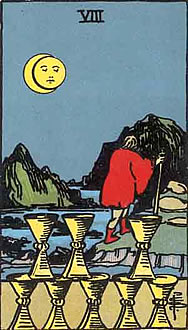
Eight of Cups
Roaming without a destination. Sadness with relationships. The abandonment of the material world.
Tiwaz
You may be in a period of stagnation. Your goals may be unattainable or unrealistic at this time. Fortunately these times pass. Take stock of yourself and your goals. Do not fight battles you know you cannot win. Be patient.
Cancer the Crab
This aspect of your life will be strongly influenced by a person who is emotional, loving, intuitive, imaginative, shrewd, cautious, protective and sympathetic. This could be an elder you look up too.
Your Daily Influences represent events and challenges the current day will present for you. They may represent opportunities you should be ready to seize. Or they may forewarn you of problems you may be able to avoid or lessen. Generally it is best to use them as tips to help you manage your day and nothing more.

Your Deck of Ancient Symbols Card for July 12th is The Hourglass

Your Deck of Ancient Symbols Card for Today

The Hourglass

The Hourglass is a gentle reminder that time passes and with it goes opportunity. Every moment is a moment we cannot retrieve or relive, and there are no guarantees that what we put off today really can be done tomorrow. The Hourglass urges us to make every second of our lives as rich and fulfilling as we possibly can.

As a daily card, The Hourglass suggest you may be allowing opportunities to pass you by. If you’ve been procrastinating or putting too much of your precious time into activities with no lasting value to you, now is the time for you redirect your energies into actions that will enrich your life.

Today’s Tarot Card for July 12th is The Hanged Man

The Hanged Man

This Tarot Deck: Lord of the Rings

General Meaning: Traditionally, the card known as the Hanged Man usually indicates a lack of ability to help oneself through independent action. This energy is arrested and awaiting judgment. With this card, there is no avenue for the will to regain control until the situation has passed.

This represents a good time to be philosophical, to study and meditate upon the position you find yourself in, and form resolutions for the moment you become free again. Only those who possess wisdom, patience and optimism will be able to see through limitations, including possible humiliation, to grasp the inspiring lesson one can gain from such an experience.

Saint of the Day for July 11th is St. Catherine of Siena

Saint of the Day

St. Catherine of Siena
Doctor of the Church

The 25th child of a wool dyer in northern Italy, St. Catherine started having mystical experiences when she was only 6, seeing guardian angels as clearly as the people they protected. She became a Dominican tertiary when she was 16, and continued to have visions of Christ, Mary, and the saints. St. Catherine was one of the most brilliant theological minds of her day, although she never had any formal education. She persuaded the Pope to go back to Rome from Avignon, in 1377, and when she died she was endeavoring to heal the Great Western Schism. In 1375 Our Lord give her the Stigmata, which was visible only after her death. Her spiritual director was Blessed Raymond of Capua. St, Catherine’s letters, and a treatise called “a dialogue” are considered among the most brilliant writings in the history of the Catholic Church. She died when she was only 33, and her body was found incorrupt in 1430.

Your Daily Influences for July 11th

Your Daily Influences
July 11, 2011

Tarot Influence

Rune Influence


Charm Influence
The Emperor Reversed
This card represents immaturity and loss of control.
Mannaz
Mannaz reversed may indicate you are in a period of depression. Be careful when making serious decisions at this time. Trust only those whom time has proven trustworthy.
Airies the Ram
This aspect of your life will be strongly influenced by a person who is selfish, quick-tempered, impulsive, impatient, foolhardy and a bit of a daredevil. Be careful this person keeps your best interest at heart and not their own. This person is probably somone you already know. Do not allow yourself to get caught up in their impulsiveness.
Your Daily Influences represent events and challenges the current day will present for you. They may represent opportunities you should be ready to seize. Or they may forewarn you of problems you may be able to avoid or lessen. Generally it is best to use them as tips to help you manage your day and nothing more.

Your Deck of Ancient Symbols Card for July 11th is The Dove

Your Deck of Ancient Symbols Card for Today

The Dove

Throughout history the Dove has symbolized peace and innocence in nearly all cultures. Dove’s soft cooing and gentle nature bring a calmness to any situation. The Dove appears where peace has been attained or there is a need to bring events to a peaceful ending. It denotes a time to let lose of grievances and settle conflicts in a way that benefits all parties equally.

As a daily card, Dove suggests the need to put an end to conflict in your present life. The conflict may be yours or may be that of people close to you. Regardless of the parties involved, you have been called upon to bring the discord to an impartial end.

Today’s Runes for July 11th is Ehwaz

Today’s Runes

Stone Runes are most commonly used for questions about the natural world and things beyond human control. Ehwaz is the rune of the eight-legged horse that the god Odin rode into battle. Horses are symbolic of a number of things. Firstly, horses may symbolize vehicles such as cars, motorcycles, planes, or boats. Secondly, horses may symbolize not wealth, but status. Thirdly, horses may symbolize motion towards an objective. As such, this rune suggests a journey or a quest to achieve a goal or improve one’s station in life. On a deeper level, the rune Ehwaz evokes the unique relationship of horse and rider as an inseparable team. To the modern eye this may be the relationship of master and underling, but to the Norse it was a total union. In fact, early representations of Odin are not of a man and a horse, but, of a centaur-like creature – the ultimate symbiosis of Man and Nature.

Today’s I Ching Hexagram for July 9th is 55: Great Abundance

55: Great Abundance

Hexagram 55

 General Meaning: A time of abundance comes into full flower when the powers of leadership and teamwork are at their peak. The situation is like that of the sun at midday — a high noon of clarity, insight and progress. Such peak periods can be brief. Whether this refers to a national cycle, a business boom or a period of abundance, it is important to bale your hay while the sun is shining.

During a period of abundance, it benefits one to show benevolence, to share the fruit of one’s good fortune. Think of good deeds now as a hedge against times of scarcity in the future. This reading bodes well for expansion in love, the raising of children and the nurturing of a healthy family or any close-knit group.

Today’s Tarot Card for July 9th is The Anchoret

The Anchoret

This Tarot Deck: Cagliostro

General Meaning: The challenge of what has traditionally been known as the Hermit card is to be able to recognize a teacher in a humble disguise. This font of mysterious knowledge will not make it easy for the student to acquire his wisdom, as it takes time and long contemplation to fathom what he knows. He often speaks wordlessly, or in ancient and barbaric tongues, communicating with the elements, animals and Nature herself.

While the hourglass was an identifying feature on the earliest Hermit cards, more modern ones have shifted the metaphor, showing more or less light released from his lantern. In either case, the Hermit card reminds us of the value of time away from the hubbub of civic life, to relax the ego in communion with Nature

Your Daily Number for July 8th: 7

Today has strong spiritual overtones for you. It’s a great day for communing with nature and acknowledging all things good in your world. A debt may be finally paid. Be aware of the possibility for mechanical breakdowns.


Fast Facts

About the Number 7

Theme: Quiet, Insightful, Analytical, Mystical, Intuitive
Astro Association: Cancer
Tarot Association: Chariot

Today’s Tarot Card for July 8th is Strength

Strength

This Tarot Deck: Angel Tarot

General Meaning: What has traditionally been known as the Strength card represents Nature which, however wild in its primal form, is tamed by our subtler, finer (feminine, interior) self. The will and passion of our instinctive nature does not need to be broken, but refined and brought to consciousness — so that all levels of Creation, inner and outer, may come into harmony.

The feminine soul-force contains a persuasive power that can nurture and induce cooperation from others, stilling disruptive energies by harmonizing differences in the spirit of collective good will.

Your Daily Number for July 7th: 5

An interesting new acquaintance may cross your path today. No matter how many times others change their mind, it’s best to go with the flow. The little voice in your head is often correct; don’t ignore it.

Fast Facts

About the Number 5

Theme: Resourceful, Adventure, Speculation, Travel
Astro Association: Taurus
Tarot Association: Hierophant