Category: The Sabbats
Calling Your Ancestors
I am blessed to work with to Archangel Suriel (a.k.a. Sariel), who helps people and other
living things that are stuck on this plain, for whatever reason, to accept their death and get
ready to cross to the Spirit Plane. I also work with Archangel Zlar, who crosses the Spirits from this plain to the
next The Spirit Plain is known by the name The Summerlands to many Witches and Wiccans.
In simpler terms, I am a medium an ability I was honored enough to be born with.I have to keep permanent protection shields up all the time so I can eat, sleep and live life without constantly hearing the voices of Spirits wanting to pass a message on to someone. While I am very grateful for the honor of the Archangels using me for this task; if I leave myself open all the time it can become unbearable to live with.
Many people are born with or are given this “gift” but do not know they have it or choose to ignore it. If someone ignores it just like any other talent not used it will wither and become dormant. If you may think you have this gift it can come to you in many ways. Some of which are: hearing voices, seeing someone/something out of the corner of your eye and when you turn your head no one is there, having consistent dreams of people who have crossed over (died) are the most common signs of this ability. One thing to always remember is if you have this ability that it is the Archangels mentioned above using you to help with their work and it is an honor to have this gift and yes, it can feel like a curse at times also..
This is spell can be used anytime you would like an Ancestor to visit or just on Samhain. I have written it two
different ways, one to invite them anytime you would like them near, and the other for on
Samhain (Pronounced Sow-en. Falls on October 31st when the veil between ours and the
Spirit plain is at its thinnest.).
Many covens set aside a portion of time during their Samhain celebration for members to call their ancestors into the circle to feast and celebrate with them. How this part of the Samhain celebration and ritual is done varies from coven to coven based on how the leader chooses to do it.
I found that I preferred even when I was with a coven that I liked talking and visiting with my ancestors alone. No special reason just personal preference.
What you need:
1 Birthday or short Candle for each Ancestor
A container with sand in it (I use an old metal pie plate)
Hot pad (to set container on to protect surface of what you set pie plate on)
Spell for any time use:
I invite _____ (fill in name of person you wish to contact) to come visit when I light this
candle one.
To visit and return to whence you came when your candle is done.
So mote it be.
Spell for Samhain:
I invite the Spirits I call upon to come to me one by one. (Light 1 candle each time you say
a name and place it in the sand)
Visit and return from whence you came when your candle is done.
So mote it be
After doing the spell spend some time just sitting quietly and thinking of the people you have summoned. They may just want to spend some time with you also and/or have a message for you or someone in your life. Ancestors are not just blood relatives that have crossed over they include anyone in your life that has had some type of impact on it. One of my favorite people to spend time with is an oil painting teacher I had when I was twelve years old. She was a very patient and sweet woman who help me through painting deal with my father’s crossing.
Copyright 2013 Lady Beltane
Sinister Solar System From NASA
Introduction
Our universe is full of mysterious sights, and spine-tingling sounds. Take a journey to the most frightful corners of the cosmos.
- Top 10 Sinister Solar System Facts
- Haunted Hayride through the Sinister Solar System
- Ghastly Images from the Stars
- Halloween at Home Activities
- Sinister Sounds of the Solar System
Click here for More interesting and fun information about our “Sinister Solar System”
A Bewitching History: Why Witches Ride Broomsticks
From LiveScience.com
By
Among the throngs of this year’s trick-or-treaters, hundreds of Americans will be dressed as Miley Cyrus or a minion from “Despicable Me,” but more will go with a fail-safe getup. “Witch” once again reigns as the No. 1 costume for adults, according to the National Retail Federation’s 2013 Halloween survey.
Many of the pointy-hatted sorcerers who roam the streets this Oct. 31 will be carrying broomsticks or besoms. But few likely know the murky tale of how witches came to be associated with those familiar household objects.
The story — full of sex, drugs and Christian inquisitors — starts with poisonous plants like black henbane (Hyoscyamus niger), sometimes called stinking nightshade.
Flying ointments
Ingesting henbane, which is rich in powerful alkaloids, can cause hallucinations (if it doesn’t kill you first). According to legend, witches used herbs with psychoactive properties like henbane in their potions, or “flying ointments.” Some historical accounts suggest witches applied these ointments to their nether regions. And what better applicator than a wooden staff?
Lady Alice Kyteler, Ireland’s earliest known accused witch, was condemned to death for using sorcery to kill her husband in 1324. (Kyteler escaped, and her maid was burned at the stake in her stead.)
The English historian Raphael Holinshed later recounted the case and described some of the supposedly damning evidence authorities found against Kyteler:…
A Version of the History of Beltane
History of Beltane from beltanefire.com.au
The Beltane fire festival welcomes the abundance of the fertile earth and is celebrated with bonfires, Maypoles, burning of the Wickerman, dancing, and a feast, with its roots in European traditions, Beltane is observed by many of today’s Pagans and others as a time for performing rituals
The Celts divided the year into two main seasons. Winter, the beginning of the year fell on November 1 (Irish: Samain) and midyear and summer on May 1 (Irish: Beltaine), opposite for us here in the Southern Hemisphere.
These two junctures were thought to be critical periods when the bonds between the human and supernatural worlds were temporarily erased; on May Eve (southern hemisphere)…
The Origins of Halloween by Silver RavenWolf
Harvest Moon, velvet sky, pumpkins glowing, children laughing, costumes, candy, scary stories—just where did this autumn gaiety begin? Let’s look through those cobwebby corridors of time to unearth the exciting genealogy of the American Celebration we call Halloween!
Nothing is ever as simple as it seems—especially when dealing with history. Too often events and circumstances of our past were written or re-written by people who, for whatever reason, operated under an agenda, or simply wanted history to reflect how it should have been, rather than how it was. How, then, do we determine what is fact and what is fiction? In some cases, we can’t. In other situations, we dig.
The Celts
Many historians feel that the greatest strength in the Celtic people lies in their collective mythos. Wading through the romanticism to find unmodified information can prove a tricky endeavor. The earliest archaeological evidence we have of the Celts rest in France and Western Germany. The Celtic people moved into Spain, Britain, and Switzerland between the fifth and first century BCE. They even ransacked Rome in 390 BCE.
The Celtic peoples celebrated four festivals called fire festivals–commonly know today as Samhain, Oimelc (Imbolc), Beltane, and Lughnasadh. Samhain (pronounced sow-in, sow rhymes with now) was the first and foremost a harvest festival relating to animal husbandry and preparations for the winter months. Fire is an element of cleaning, a vehicle of eradication, so it is not unlikely that fire would work itself into any type of religious celebration. Fire among the ancient peoples often represented an aspect of the divine.
What does the word Samhain mean? Well, we know what it doesn’t mean. There is no archeological or literary evidence of a Celtic god by the name of Samhain. This little slip of fact appears to have begum in the 1700s and continues in some misinformed publications today. The word Samhain actually means “summers end”.
So, where did this Lord of the Dead thing come in? Over time, Samhain took on a religious significance through ministrations of the Druids (the clergy of the Celt’s). Legends indicate that on Samhain all the hearth fires in Ireland were doused and then lit again from a central fire maintained by the Druids at Tlachtga. To the Celts, Samhain was a turning point from light into darkness, and it was thought that this break or fissure created easier access to their land of the dead, Tir nan Og.
The Druids
We need to know a little bit about the Druids to continue with our history of Halloween. The Druids were versed in all learning and were considered to have the gift of prophecy. They functioned as judge, ambassadors, healers, and religious leaders. The Druids first named the holiday Samhain.
Feast of the Dead
As the Celtic religious system solidified so did the beliefs of the Celts concerning the dead—as has occurred in all religions, before and after the Celts. Since the turning points of the year were considered fissures in time and space, the Celts believe that the dead they loved so dearly could travel through time and space and return from Tir nan Og to visit them. The custom of leaving food at the table (the birth part of the treat part of trick-or-treat) was a gesture of welcome to the departed. From these visits came the belief that those who had gone beyond the land of the living could provide information on past or future events. This is how divination became associated with Samhain.
The Celts did not believe in devils or demons, but they did believe in the Fairy Folk, whom they thought inhabited the land of the dead (the land in-between). Fairies were thought to be resentful of humankind for taking over their land. Because time and space could be conquered on Samhain, fairies were said to roam countryside creating mischief and kidnapping a human or two now and then—just for fun, you understand.—except the humans never came back. Here then is the root of the scary stuff associated with Halloween. The mischief, of course, was caused by living humans, and accepted by the Celts as a psychological release before the onset of winter gloom—though I doubt they would explain it in those terms.
Is it odd, gross, or unusual that a group of people should set aside a day for the dead? Nope. Different cultures and religions have followed such a practice for centuries. Let’s get on our broom again and check out Rome and its contributions to Halloween.
As the Celtic religious system solidified so did the beliefs of the Celts concerning the dead—as has occurred in all religions, before and after the Celts. Since the turning points of the year were considered fissures in time and space, the Celts believe that the dead they loved so dearly could travel through time and space and return from Tir nan Og to visit them. The custom of leaving food at the table (the birth part of the treat part of trick-or-treat) was a gesture of welcome to the departed. From these visits came the belief that those who had gone beyond the land of the living could provide information on past or future events. This is how divination became associated with Samhain.
The Celts did not believe in devils or demons, but they did believe in the Fairy Folk, whom they thought inhabited the land of the dead (the land in-between). Fairies were thought to be resentful of humankind for taking over their land. Because time and space could be conquered on Samhain, fairies were said to roam countryside creating mischief and kidnapping a human or two now and then—just for fun, you understand.—except the humans never came back. Here then is the root of the scary stuff associated with Halloween. The mischief, of course, was caused by living humans, and accepted by the Celts as a psychological release before the onset of winter gloom—though I doubt they would explain it in those terms.
Is it odd, gross, or unusual that a group of people should set aside a day for the dead? Nope. Different cultures and religions have followed such a practice for centuries. Let’s get on our broom again and check out Rome and its contributions to Halloween.
A Fly-BY of Ancient Rome
Rome had the habit of changing rulers as many times as you empty the lint trap in your dryer. Between 14 and 37 CE, Christianity had begun its rise in Rome. By 41 CE, Claudius had distinguished himself with the conquest of Britain. The Romans also had a harvest festival, so the Celts didn’t have much trouble blending the two holidays together after they came into contact with the Romans. It was around 314 CE when Constantine the Great declared the Roman Empire to be Christian, and the fate of Samhain and Druids was sealed.
The Advent of Christianity
By the fourth and fifth centuries , Celtic Christianity had oozed into Ireland. St. Patrick has his hands full, and here is where the kettle starts to boil. At, first, the Pagans openly welcomed Christianity, but as Christianity filtered into the Celtic system, church officials had a few problems—mainly the Celtics didn’t want up their holidays or folk practices. The people were not willing to throw out traditions that were ingrained into their social structure. If you can’t get someone to completely change, what do you do? Compromise. And that’s exactly what happened. Samhain was changed to All Hollow’s Eve. To make the Pagan peoples adhere more closely to this new religion of Christianity, the clergy of the day taught the peasants that fairies were really demons and devils (remember, a concept totally unknown to Celtic belief or history) and their beloved dead were horrid ghosts and ghouls. The early Christian erroneously associated the Celtic land of the dead with the Christian concept of Hell.
To help the belief in Christianity along, Druids priestess were systematically murdered. Early Christians also taught the area peasants that their Lord of the Underworld was in fact Satan, which is ridiculous, as the two mythos don’t have anything in common. It appears that Christians misunderstood what the word Samhain meant: because the peasants use this celebration to honor the dead, Christians assumed that Samhain was the incorrect pronunciation of a Pagan deity in the Bible, recorded as Samuel, from the Semitic Sammael, meaning God of the under world.
The Witches
So far, we’ve talked about the land of the dead, how the early Christians managed to superimpose Satan onto Samhain, and how fairies got zapped into demons, but there has been no mention of Witches, commonly associated in our time with Halloween. Where did Witches come from?
During the Dark Ages, the Church sought to eradicate the Pagans and wise women from the countryside so that the church could amass both power and property. First, they had to devalue women because women kept the holy days, trained the children, and provided the cohesive socialization of the culture, thus women held the power to shape society. The church taught, among other things, that women had no souls. Once this teaching had occurred, it was only a small step to make them inhuman, and the Church was able to incite the superstitious populace.
The Celtic women were the strong hold of the family environment, and although the Celts accepted Christianity at first, they did not want to give up their family traditions or their lifestyle. The Church was not into free thinking—therefore anything that did not follow the church dictates was evil. Hence, the Witches (really the women) became evil. Since Samhain was a primary festival of the Celts and the Church had already determined that Samhain was evil, the association between Witches and Halloween was born.
All Saints’ Day / All Hallow’s EVE / Halloween
All Saints’ Day and All Hallow’s Eve (Halloween) were first introduced in the seventh century CE. All Saints’ Day was originally celebrated in the spring. The date was changed to November 1 to supplant Pagan beliefs because those pesky Pagans just refused to cough up their original Samhain. The day was to honor God and all his saints, known and unknown. All Saints’ Day later became Hallowmass, a mass to honor the dead. The Eve of All Hallow’s Day, October 31, became All Hallow’s Eve, which evolved into the word Hallowe’en. Although the church wished this time to be one of somber prayer and quite custom, the Celtics continued their customary bonfires and fortune telling.
All Souls’ Day is a bit different. This festival falls on November 2, a day to offer prayers and alms to assist the souls of those departed that manage to get stuck in purgatory, an in-between place that is neither heaven nor hell. Over the succeeding centuries, Halloween, like Christmas, picked up various customs and discarded others, depending on the complex socialization of the times and religious dictates.
Halloween Comes to America
Our first inkling of Halloween coming to America revolves not around a specific set of people (many indicate the Irish) but with William Penn’s motley collection of refugees from Europe. In 1663, Penn wrote a promotional tract about the Americans. As a result, fifty ships dropped the anchors in the Delaware River. They discharged persecuted souls from England, Ireland, Wales, and the Rhineland (now Germany). Collectively, the Germans and Irish shared Celtic heritage. Therefore many of the folk customs resonated together—including Halloween.
From 1684 through 1930, Halloween was more a time for tricking rather than for treating. Many of the tricks the German and Irish communities became universal, such as overturning outhouses, dismantling a wagon and putting it back together on top of a house or barn, and tying cows to church bells. The tricks often served as social function, such as mildly chastising a neighbor who exhibited antisocial behavior.
By 1910, several American manufactures were making or importing party products just for the American holiday Halloween. From noisemakers to costumes, a new holiday meant new business and an opportunity to make money.
The drawback to the new holiday came in the form of the “declared” Mischief Night, Goblin Night, or Devil’s night on October 30. Minor offenses, such as trying several garbage cans together and hanging them from a light pole, soaping windows with lard, and later, bars of hand soap, abounded. As the pranks grew to vandalism shopkeepers would bribe youngsters to ward off destruction of their property.
In an effort to stop the criminal behavior, the Boy Scouts, in conjunction with local town councils, cities, boroughs, instituted the custom of Trick-or-Treat night to help keep youngsters from naughty practices. By the 1930s the custom of trick-or-treating was well entrenched in our American culture. Halloween, like Christmas, became a holiday for children, and parents strove to make the holiday as much fun as possible for the enjoyment of their youngsters.
During he 1950s. ’60s, and ’70s our American Halloween stayed primarily the same, but in the ’70s and ’80s, with a recession coupled by a candy scare, groups and organizations once again sought to find appropriate avenues to make Halloween safe for America’s children. Halloween practices extended through the entire month of October. Haunted houses, parties, hay rides, plays, story hours, and numerous other events were held throughout the month.
In the mid-to-late 1990s certain sects of the Protestant Christian church declared war on Halloween. using the same erroneous propaganda cultivated hundreds of years ago. Other groups size Halloween for their own political agendas—hosting haunted houses showing aborted babies, drug addicts, and other modern day violent situations. This did not go over well, as the holiday had become an event primarily for children, not adult political issues. Radical Christian groups said that the holiday was Satanic—which, as we’ve seen from our research, is a bizarre and fantastic claim, based on misinformation, politicking, personal agendas and fear. With America’s policy of separation of church and state the battle for destroying Halloween in the United States is an uphill battle.
The original Samhain marked the the close of the agriculture season and functional third harvest festival. In America, Halloween has become the first holiday in our end-of-year rush for partied gaiety. Our Halloween functions as the opening of the three-month-long celebratory fest that includes Thanksgiving, Christmas, Yule, Kwanzaa, and Chanukkah, and ends with the popular American New Year.
As our children crave pumpkins with delightful chatter, adults find solace in a night when they can be whatever they want to be. We have little doubt about the joy this holiday bring to the American people. I am sure we will forever love the haunted house, the harvest Moon, the thrills and chills of a well-wrought tale—and, of course, the deliciously scary things that go EEEEK! in the night.
Harvest Moon, velvet sky, pumpkins glowing, children laughing, costumes, candy, scary stories—just where did this autumn gaiety begin? Let’s look through those cobwebby corridors of time to unearth the exciting genealogy of the American Celebration we call Halloween!
Nothing is ever as simple as it seems—especially when dealing with history. Too often events and circumstances of our past were written or re-written by people who, for whatever reason, operated under an agenda, or simply wanted history to reflect how it should have been, rather than how it was. How, then, do we determine what is fact and what is fiction? In some cases, we can’t. In other situations, we dig.
Llewellyn’s Witches’ Datebook1999
Pages 24 to 29
Some Thoughts About Celebrating Samhain
Samhain is a day of reflection of the past year while celebrating the new. It is a day that whatever has not been harvested from gardens, fields, bushes, and trees get left for the wildlife and Fea Folk. It is also a day to communicate with those who have crossed the veil into the Summerlands. Many pagans and witches say it is the day and/or night to honor only those that have crossed in the last year but I do not go along with this way of thinking. While those who have passed since November 1, 2020 up to today do need more comforting and remembering them then those that have crossed over in other years past. The farther back in time you go to those who have crossed before the last year the more chance there is that they will be forgotten totally.
Hypothetically, if crossed the veil say 30 years ago or longer and each generation after you talk about you less and less as each year passes soon you will be forgotten completely. That one reason I have my Book of Shadows and Family Grimoire as one book that I hope keeps growing after I am gone. I have also placed pictures of ancestors at different ages as well as pictures of myself alone and with family members both ancestors and descents. In the section for ancestors I have included a picture of their headstone and where it can be found if I know.
So this Samhain when you are setting the extra place at the table, lighting a candle for each ancestors name, or however you choose to honor your ancestors (remember an ancestor does not have to be blood related they can be anyone in your life that help to mold you into the person you are today.) Set one more place, light one more candle, or whatever your tradition to remember your ancestors is for those who names have been forgotten since the first Homosapien of any branch of the human gene pool lived.
I implore you all to remember that we all can trace our lineage back to this mish mash of a gene pool and that the energy that runs through us connects us to every other living things and not just on Mother Earth. So the next time you have a negative thought about someone for any reason at all remember you are also having that negative thought about yourself.
I picked this song to be included in this post because for me it helps me to remember those, female or male or other, who otherwise might be forgotten
I wish all my family, which means everyone reading this post and by blood, a happy and blessed Samhain.
Lady Beltane 2018
Reed Moon: Celtic Tree Calendar
To read more about the Celtic Reed Month by Sarah Wayt
The celebration of Samhain, now known as Halloween, occurs during the Reed Moon. To the Celts this month hailed the end of the year, a time to cull the livestock and to connect with ancestors. All around the world festivals that honour the dead are celebrated. During the Reed Moon, light a candle for loved ones who have died and you may receive a message from the spirit world.
Releasing old energy
The Reed Moon is a good time to use divination to gain insights into the year that has passed. Perform energy work that will release old energy, burn symbols of illness on your bonfire on November the 5th during your Guy Fawkes celebrations. Remember the Celtic year does not begin until the Winter Solstice so use this interval to dream, not to make plans for the future.
The haunting sound of reed
In the past, the reed was used to make swift-flying arrow shafts that slew both enemies and game. In this way the plant was linked to the season of death and sacrifice, in which trees shed their leaves and the energy of nature became more introspective. Many early musical instruments also used the reed to create a haunting sound that has been connected to rites for the dead and the summoning of spirits.
Wind instruments
Modern day wind instruments have developed the same principle used by original reed instruments. Whereby a current of air is vibrated to produce a melodic sound.
Other traditional uses for reed include thatching. Rooftops were thatched with reeds, and as the Celts withdrew into their homes for the winter they honoured the plant that gave them shelter, making the reed a symbol of royalty and protection.
Reed Moon energy…
Beltane of the Southern Hemisphere
Today, in the Pagan calendar, the north celebrate the coming of winter at Samhainn. And all the while the sun is peaking up from behind the lush vernal trees and dancing for us once more in the southern hemisphere, as we welcome Beltane on October 31st. Or as I like to refer to it Beltane of the underworld.
A pagan spiral formation in Faerie Glenn where everything is miniature and enchanted. Copyright Content Catnip 2010
Beltane is the Gaelic seasonal festival historically held to mark the midpoint between the spring equinox & summer solstice (Là Bealltainn in Scottish Gaelic; Lá Bealtaine in Irish). Fire is the traditional means of marking this spring festival of optimism & return.
A famous Ossianic lament…
Click here to read more about Southern Hemisphere Beltane from ContentCatnip.com
BELTANE: SOUTHERN HEMISPHERE
Southern Hemisphere Beltane by Jane Hardwicke Collings
The date for the Southern Hemispheric Beltane is October 31st and ‘May Day’ is November 1st. The climax of Spring!
Beltane is the peak of Spring, a celebration of fertility. In ancient times it was the Beltane Rites that recon- nected each year the King to the Goddess, the masculine to the feminine. It is a time for us to give thanks for our fertile lives, our creativity and our gender specific gifts and roles. Its a time to notice and honour the difference in the masculine and feminine. It is a time of increasing growth, building to almost full potential, of beauty and heightened passion.
Beltane Spiritual Practice
Your being, as part of the Earth, part of the cycle of the seasons, will be influenced by this energy whether you’re paying attention to it or not. If you pay some attention, you will feel it, and you can be in flow with it.
Think like the gardener, and align with the Earth energy of now, contemplate the growth that is peaking in your life, that is getting all the attention…
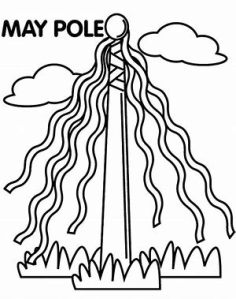
Beltane Printable Coloring Pages
I am not sure how large these will print out. I have found the easiest way to print them is to save them to my computer than print them out individually.


Samhain Printable Coloring Pages
I am not sure how large these will print out. I have found the easiest way to print them is to save them to my computer than print them out individually.


A Thought for Today
What is the Reason for Rain on Samhain?
[Revisions made September 25,2021 so a couple of dates might be wrong. The dates for my father’s and mother’s births and deaths are correct]
I have often wonder why it almost always rains and is cold on Samhain. Where I live, in the central United States, it usually nice the day before and the day after but rarely the day of.
This morning my Guides gave me an answer to this question that seems so right I have no idea why I never thought of it. It rains on Samhain because the veil between our world and the Summerlands is very thin allowing what the Spirits of our family and friends are feeling about residing in the Summerlands to come into our world and our feelings to go easier into their world. It also makes it easier to converse with them in many different ways (coming soon a post explaining this more)
Just as we weep for loved ones lost because we miss the person they were in this lifetime they weep because they miss us also so. The rain we experience is in reality their tears. The cold is because they do not need heat to keep a incarnated body warm like we do in this world.
When honoring your ancestors this Samhain remember to take into account their feelings and try to explain yours to them. Communication is not just important when we some someone face to face it is important when dealing with those who have crossed over too. Do not think the dialogue has to stop when Samhain is over, it may not be as easy to hear them but if they have something you really need to hear you will. Talk to them, ask them questions, tell them things. Just because they no longer have a physical body does not mean they are not interested in things going on in your life.
When helping those who passed away this past year cross into the Summerlands remind them of the happiness, rest, joy and love they will feel there instead of the cold uncertainty of roaming this world with no physical body. If you feel they are hanging on to something in this world or have unfinished business they want to take care before moving across the veil ask how you can help them let go or finish the unfinished business. It is important for us all to cross into the Summerlands after our physical bodies will no longer support life in this world, so we can rejuvenate and be reborn into our next life time.
Talking with my mom today and helping her to finish something she left undone (this I will not share as it was very personal between the two of us) after dreaming about her the other night (October 2015) for the first time since she passed (Born December 12, 1934 Died August 24, 2015) brought a calm to me I have not felt since the day before she passed. I knew the moment my mom passed as I felt a pull on both my heart and root charkas the two most connected thigs in our human body that connect us our to our parents and our children. She is happy and excited to be fully reunited with my dad, he refused rebirth until she and he could have some time together alone and with my eight siblings, who all passed away shortly before or after birth, in the Summerlands They both told me today that they will wait for me to join them in the future when it is my time to return to the Summerlands before they consider another lifetime in this world. Which made me feel very loved and special. It also makes me cry happy/sad tears every time I think about the sacrifice they choose to make for me. You see my dad (Born March 25, 1934) crossed over the veil exactly one month before my twelfth birthday on April 1, 1970. (Please NO April Fool’s jokes. Thank you)
I am sorry if this post seems to ramble some but I was typing as it came to me and had a couple of interruptions for trick-or-treater, all the kids in the neighborhood love to come to the Witch’s house because she gives out good treat if they do not trick her.
[Some of this paragraph maybe early while some of it could be what you needed to read today] May your Samhain be blessed,. May your time with your ancestors be joyful. My your New Year be filled with everything you need, a warm home, loving family and friends, enough food to keep hunger at bay, clothing to keep you comfortable and even bring you a way to get a couple of things you just want.
![]()
2015 Lady Beltane
Happy and Blessed Ostara Dear Sisters, Brothers, and Guests

Happy and Blessed Mabon Dear Sisters, Brothers, and Guests

Ostara – Sabbat Lore and Traditions
For more about Ostara
Date: September 20 – 23
Other Names: Spring Equinox, Lady Day, Alban Eiler (Druidic)
Pronunciations: uh-star-uh, oh-star-uh
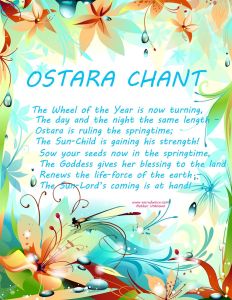
As Spring reaches its midpoint, night and day stand in perfect balance, with light on the increase. The young Sun God now celebrates a hierogamy (sacred marriage) with the young Maiden Goddess, who conceives. In nine months, she will again become the Great Mother. It is a time of great fertility, new growth, and newborn animals.
The next full moon (a time of increased births) is called the Ostara and is sacred to Eostre the Saxon Lunar Goddess of fertility (from whence we get the word estrogen, whose two symbols were the egg and the rabbit.
The Christian religion adopted these emblems for Easter which is celebrated on the first Sunday after the first full moon following the vernal equinox. The theme of the conception of the Goddess was adapted as the Feast of the Annunciation, occurring on the alternative fixed calendar date of March 25 Old Lady Day, the earlier date of the equinox. Lady Day may also refer to other goddesses (such as Venus and Aphrodite), many of whom have festivals celebrated at this time.
Herbs: Daffodil, Jonquils, Woodruff, Violet, Gorse, Olive, Peony, Iris, Narcissus and all spring flowers
Traditional Foods: Leafy green vegetables, Dairy foods, Nuts such as Pumpkin, Sunflower and Pine. Flower Dishes and Sprouts
Incense: Jasmine, Rose, Strawberry, Floral of any type
Stones: Jasper
Recipes
Ancient Celebrations for Today – OSTARA
For more about Ostara and the Wheel of The Year
Ostara marks the Spring Equinox, which happens between March 19 -23. Ostara is a pagan celebration of the German goddess Eostre and the origins of the Christian celebration of Easter. As the beginning of spring Ostara is a good time to literally and figuratively plant seeds for the future.
In modern day living Ostara is also good time to start taking action on the ideas and goals you started thinking about around Yule and Imbolc. What you plant during Ostara will be ready to be harvested during the coming summer months and the sabbats of Beltane, Litha and Lughnasadh.
Ostara is also a good time to freshen up your home and life. Take time to do some spring cleaning. Cleaning isn’t just limited to your home. Take some time to declutter and clean up areas where you spend a lot of time, like your car, your computer (delete those old emails!) or your work office.
Symbols Of Ostara
Colors: Green, pink, blue
Foods: Eggs, honey, sprouted greens, baked goods, asparagus
Stones: Aquamarine, amethyst, rose quartz
Symbols: Rabbits, eggs, spring flowers , lambs, clover, baskets
Flowers & Plants: clover, daffodils, crocus, tulips
Deities: Isis, Estotre, Adonis
Ways To Celebrate Ostara…
Ancient Celebrations for Today – MABON
For more about Mabon and the Wheel of The Year
Known as the pagan Thanksgiving, Mabon marks the Autumn Equinox, when day and night are equal, making it a time of balance, equality and harmony. In ancient times Mabon was a celebration of the second harvest (Lughnasadh was the first) when farmers gathered hearty foods like gourds, pumpkins, grapes and apples.
Modern Mabon celebrations are a time to give thanks for the abundance of Mother Earth – both literally and spiritually. It’s also a good time to reflect on the Wheel of the Year, recognizing your successes and letting go of the things that did not serve you during the past twelve months.
History Of Mabon
Modern Pagans began celebrating Mabon as the last of the eight Sabbats in the 1970s, but its roots as a harvest festival go back to ancient times.
Named after the ancient Welsh hero named Mabon ap Modron, which means Son of Mother, Mabon is the second of three harvest festivals that take place in the Wheel of the Year (Lughnasadh is the first and Samhain is the third). Similar to Apollo, the figure of Mabon was depicted as a handsome youth with a lyre. As a baby Mabon was said to have been held hostage as a baby in the underworld, similar to the story of Persephone and Demeter.
Indeed, the Greek goddess Demeter is much more closely associated with the Autumn harvest, as…
THE MONTH OF SEPTEMBER 2021: HOLIDAYS, FUN FACTS, FOLKLORE EVERYTHING YOU NEED TO KNOW ABOUT SEPTEMBER
From The Old Farmers Almanac
What happens in the month of September? It’s a little for everyone: the last days of summer and the first days of fall. See September holidays, advice, recipes, fun facts, and trivia below.
September, in Old England, was called Haervest-monath (Harvest Month). This is the time to gather up the rest of the harvest and prepare for the winter months.
There are flowers enough in the summertime,
More flowers than I can remember—
But none with the purple, gold, and red
That dye the flowers of September!
—Mary Howitt (1799-1888)
THE MONTH OF SEPTEMBER
September’s name comes from the Latin word septem, meaning “seven.” This month had originally been the seventh month of the early Roman calendar.
SEPTEMBER CALENDAR
- September 6—the first Monday in September—is Labor Day. Canadians also observe Labour Day.
- September 6 is also Rosh Hashanah, a Jewish holiday that marks the beginning of the new year.
- September 11 is Patriot Day, held in honor and remembrance of those who died in the September 11 attacks of 2001. This year marks the 20th anniversary of September 11.
- September 12 is Grandparents Day. Honor your grandparents today—and every day!
- September 15 is Yom Kippur, the holiest holiday in the Jewish calendar.
- September 17 is Constitution Day. This day celebrates the adoption of the U.S. Constitution, which occurred on September 17, 1787 (just five years prior to the founding of The Old Farmer’s Almanac, believe it or not!).
- September 21 is recognized as the annual International Day of Peace. Observances range from a moment of silence at noon to events such as peace walks, concerts, and volunteering in the community.
- September 22 marks the start of fall! This year’s Autumnal Equinox occurs at 3:20 P.M. EDT on Wednesday, September 22. At this time, there are approximately equal hours of daylight and darkness.
- September 29 is Michaelmas. Michaelmas is an ancient Celtic “Quarter Day” which marked the end of the harvesting season and was steeped in folklore.
“Just for Fun” Days
Have fun with these strange celebrations in September!
- September is National Happy Cat Month
- September 8: National Hug Your Hound Day
- September 13: Kids Take Over the Kitchen Day
- September 19: International Talk Like a Pirate Day
- September 24: National Punctuation Day
HOLIDAY TRADITIONS AROUND THE WORLD
Mid-Autumn Festival: September 20–21, 2021
Also known as the Moon Festival, this holiday has been celebrated for at least 3,000 years and is said to be the second largest festival in China after the Chinese New Year. Observed on the 15th day of the eighth month of the traditional Chinese lunar calendar, it can occur in either September or early October in the Gregorian calendar.
This autumn festival occurs during the full Moon nearest the fall equinox, which is traditionally said to be the brightest and roundest. Local festivities might involve brightly colored lanterns, dances, games, and other entertainments. Families and friends celebrate into the evening to give thanks for the harvest and for being together, offering each other wishes for happiness and long life and remembering loved ones who live far away.
Celebrants may make offerings to the Moon goddess Chang’e or share traditional mooncakes by moonlight. These round pastries, which symbolize the full Moon and reunion, are often filled with red bean or lotus seed paste surrounding a salted egg yolk in the center.
September Zodiac
September’s zodiac signs are Virgo (Aug. 23–Sept. 22) and Libra (Sept. 23–Oct. 22). Find out your zodiac profile!
See the Best Days to do things this month.
SEPTEMBER ASTRONOMY
Full Harvest Moon
September’s full moon, the Harvest Moon, reaches peak illumination on Monday, September 20, at 7:54 P.M. EDT. Read more about September’s Full Moon!
Moon Phases for September
New Moon: September 6, 8:52 P.M. EDT
First Quarter: September 13, 4:41 P.M. EDT
Full Moon: September 20, 7:54 P.M. EDT
Last Quarter: September 28, 9:58 P.M. EDT
See more about Moon Phases.
Check out our Sky Watch for the month’s best night sky events.
RECIPES FOR THE SEASON
We like to think of September as the month of apples, as apple-picking becomes a common weekend pastime. Here are a few recipes for this fruit of the season:
Wondering which kind of apples to use in your dish? See the Best Apples for Baking: Apple Pie, Applesauce, Cider & More to find out!
For more fall recipes, use our Recipe Search.
SEPTEMBER GARDENING
The garden may be winding down, but there’s still plenty left to do!
- See our list of gardening chores to be done around Labor Day: Labor Day Gardening Tips
- Correct any soil deficiencies you’ve noticed; healthy soil is crucial to healthy plants. See more on soil amendments and fixes.
- Compost should be watered during dry periods so that it remains active. Learn more about composting.
- Onions are nearly ripe when the tips of the leaves turn yellow. See our onion page for harvesting tips.
- Fall is the time to plant garlic. Got your cloves ready? Read more about planting garlic.
- Sunflower seeds are best dried while still in the plant. See more about how to harvest sunflower seeds.
- If you’re running out of ideas on where to store your crops, try using a root cellar.
See more gardening jobs for September.
EVERYDAY ADVICE
If you’re planning on baking some apple pies, try consulting our Best Apples for Baking article.
Do you still have herbs left over? If so, use them to make your own herbal remedies.
Try this fun fall craft using apples: Apple Heads.
Help out the birds this coming winter by preparing some bird food for them.
FOLKLORE FOR THE SEASON
- Heavy September rains bring drought.
- September dries up ditches or breaks down bridges.
- September blow soft, till the fruit’s in the loft.
- Married in September’s golden glow, smooth and serene your life will go.
- If the storms of September clear off warm, the storms of the following winter will be warm.
- Fair on September 1st, fair for the month.
SEPTEMBER BIRTH FLOWERS
September’s birth flowers are the aster and the morning glory. The aster signifies powerful love, and the China aster expresses variety or afterthought in the language of flowers. The morning glory symbolizes affection. It can also mean coquetry, affectation, or bonds in the language of flowers. Find out more about September’s birth flowers and the language of flowers.
SEPTEMBER BIRTHSTONE
The September birthstone is the sapphire, which was once thought to guard against evil and poisoning.
- Sapphire is a form of corundum that is typically blue, a color caused by tiny bits of iron and titanium; the vivid, medium blues are more valuable than lighter or darker forms. Due to various trace elements, sapphires also appear in other colors. Those with red colors are called rubies.
- Sapphires were thought to encourage divine wisdom and protection. They symbolized purity, truth, trust, and loyalty. Some believed that if they were placed in a jar with a snake, the snake would die.
- The sapphire, along with the related ruby, are the second-hardest natural gemstones, with only the diamond being harder.
Find out more about September’s birthstone.
THIS MONTH IN HISTORY
September 12: Choices
On this day in 1962, President John F. Kennedy went to Rice University in Houston, Texas, to make a speech justifying his proposed $5.4 billion space program. He had called on Congress in the previous year to fund a massive project to put a man on the Moon and bring him home safely before the end of the decade. Toward that end, he asked his vice president, Lyndon Johnson, to make it happen. Johnson, a Texan, was happy to oblige.
The plan was to establish a Manned Spacecraft Center in Houston, upon land that had been made available by Rice University (which had received it from Humble Oil and Refining Company). If that happened, federal money would flow to that city and to Rice, a university distinguished for its scholarship, if not for its football. In football, the University of Texas was king, although Rice gamely played Texas every year.
Kennedy challenged 35,000 listeners, sweltering in the Rice football stadium, to think big: “But why, some say, the Moon? Why choose this as our goal? And they may well ask, Why climb the highest mountain? Why, 35 years ago, fly the Atlantic?” he asked. Then he added another impossible goal, one he had jotted in the margin only minutes earlier: “Why does Rice play Texas?”
The line drew a huge laugh and added a touch of humor and humility to the soaring rhetoric. His speech continued, soon issuing the now famous lines, “We choose to go to the Moon in this decade and do the other things, not because they are easy, but because they are hard … .”
Kennedy eventually got his moonshot, although he did not live to see Neil Armstrong’s 1969 moonwalk. And, three years after the speech, in 1965, Rice beat Texas. It would be 28 years before that happened again.
Little Pagan Acorns – Website for Pagan Children
[Not just for Pagan children that are homeschooled but for any Pagan child)
WHY PAGAN?
The world of homeschooling is dominated by Christians, and the majority of online resources are Bible-based. For someone who is Pagan, it gets pretty frustrating to find great printables that aren’t filled with Bible scriptures or Christian phrasing. So I wanted to create a resource for all of us who are parents and/or homeschoolers who are following other spiritual paths.
My purpose is to create pages that can be mixed in with other resources to add some Pagan terminology, ideals and history so that people can teach their children something that is uniquely Pagan.
I also intend to have selections of nature-based and generically “spiritual” material that could be used by folks who aren’t really Pagan but want an option away from the Christian materials as well.
I know that the term “Pagan” covers a huge range of faiths and beliefs, and I hope that I can properly respect them all here. My own path is more Wiccan and you’ll tend to see more material along that slant (lots of altars, Sabbats and pentacles!). I’d welcome any comments or suggestions from other beliefs so that I can accurately cover them. I apologize in advance if I have included anything that is inaccurate about other religions. Feel free to let me know.
So, welcome to Little Pagan Acorns and I hope that there is something here to help with your Pagan homeschooling and parenting!
You must be logged in to post a comment.