Discover the cosmos! Each day a different image or photograph of our fascinating universe is featured, along with a brief explanation written by a professional astronomer.
Explanation: The spiky stars in the foreground of this backyard telescopic frame are well within our own Milky Way Galaxy. But the two eye-catching galaxies lie far beyond the Milky Way, at a distance of over 300 million light-years. Their distorted appearance is due to gravitational tides as the pair engage in close encounters. Cataloged as Arp 273 (also as UGC 1810), the galaxies do look peculiar, but interacting galaxies are now understood to be common in the universe. Nearby, the large spiral Andromeda Galaxy is known to be some 2 million light-years away and approaching the Milky Way. The peculiar galaxies of Arp 273 may offer an analog of their far future encounter. Repeated galaxy encounters on a cosmic timescale can ultimately result in a merger into a single galaxy of stars. From our perspective, the bright cores of the Arp 273 galaxies are separated by only a little over 100,000 light-years.
You can use this link to go forward or backward in time for Moon phase information. If you are curious, you can even find out what phase the Moon was in when you or anyone else was born.
The Moon’s current phase for today and tonight is a Waning Gibbous Phase. This is the first phase after the Full Moon occurs. It lasts roughly 7 days with the Moon’s illumination growing smaller each day until the Moon becomes a Last Quarter Moon with an illumination of 50%. The average Moon rise for this phase is between 9pm and Midnight depending on the age of the phase. The moon rises later and later each night setting after sunrise in the morning. During this phase the Moon can also be seen in the early morning daylight hours on the western horizon.
The Waning Gibbous on February 19 has an illumination of 92%. This is the percentage of the Moon illuminated by the Sun. The illumination is constantly changing and can vary up to 10% a day. On February 19 the Moon is 17.52 days old. This refers to how many days it has been since the last New Moon. It takes 29.53 days for the Moon to orbit the Earth and go through the lunar cycle of all 8 Moon phases.
The 8 Lunar Phases
There are 8 lunar phases the Moon goes through in its 29.53 days lunar cycle. The 4 major Moon phases are Full Moon, New Moon, First Quarter and Last Quarter. Between these major phases, there are 4 minor ones: the Waxing Crescent, Waxing Gibbous, Waning Gibbous and Waning Crescent. For more info on the Moon Cycle and on each phase check out Wikipedia Lunar Phase page.
Phase Details
Phase: Waning Gibbous
Illumination: 92%
Moon Age: 17.52 days
Moon Angle: 0.52
Moon Distance: 379,778.38 km
Sun Angle: 0.54
Sun Distance: 147,909,972.84 km
Useful Moon Resources
Check the weather before a night of Moon gazing at weather.com
Discover the cosmos! Each day a different image or photograph of our fascinating universe is featured, along with a brief explanation written by a professional astronomer.
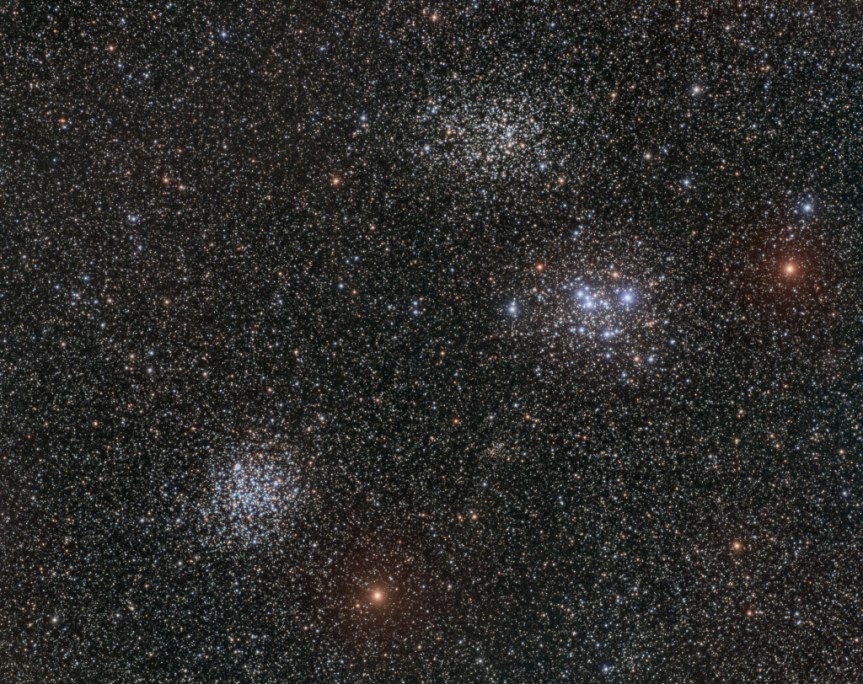
Explanation: Galactic or open star clusters are young. The swarms of stars are born together near the plane of the Milky Way, but their numbers steadily dwindle as cluster members are ejected by galactic tides and gravitational interactions. Caught in this telescopic frame over three degrees across are three good examples of galactic star clusters, seen toward the southern sky’s nautical constellation Puppis. Below and left, M46 is some 5,500 light-years in the distance. Right of center M47 is only 1,600 light-years away and NGC 2423 (top) is about 2500 light-years distant. Around 300 million years young M46 contains a few hundred stars in a region about 30 light-years across. Sharp eyes can spot a planetary nebula, NGC 2438, at about 11 o’clock against the M46 cluster stars. But that nebula’s central star is billions of years old, and NGC 2438 is likely a foreground object only by chance along the line of sight to youthful M46. Even younger, aged around 80 million years, M47 is a smaller and looser star cluster spanning about 10 light-years. Star cluster NGC 2423 is pushing about 750 million years in age though. NGC 2423 is known to harbor an extrasolar planet, detected orbiting one of its red giant stars.
You can use this link to go forward or backward in time for Moon phase information. If you are curious, you can even find out what phase the Moon was in when you or anyone else was born.
The Moon’s current phase for today and tonight is a Waning Gibbous Phase. This is the first phase after the Full Moon occurs. It lasts roughly 7 days with the Moon’s illumination growing smaller each day until the Moon becomes a Last Quarter Moon with an illumination of 50%. The average Moon rise for this phase is between 9pm and Midnight depending on the age of the phase. The moon rises later and later each night setting after sunrise in the morning. During this phase the Moon can also be seen in the early morning daylight hours on the western horizon.
The Waning Gibbous on February 18 has an illumination of 97%. This is the percentage of the Moon illuminated by the Sun. The illumination is constantly changing and can vary up to 10% a day. On February 18 the Moon is 16.51 days old. This refers to how many days it has been since the last New Moon. It takes 29.53 days for the Moon to orbit the Earth and go through the lunar cycle of all 8 Moon phases.
The 8 Lunar Phases
There are 8 lunar phases the Moon goes through in its 29.53 days lunar cycle. The 4 major Moon phases are Full Moon, New Moon, First Quarter and Last Quarter. Between these major phases, there are 4 minor ones: the Waxing Crescent, Waxing Gibbous, Waning Gibbous and Waning Crescent. For more info on the Moon Cycle and on each phase check out Wikipedia Lunar Phase page.
Phase Details
Phase: Waning Gibbous
Illumination: 97%
Moon Age: 16.51 days
Moon Angle: 0.52
Moon Distance: 384,535.53 km
Sun Angle: 0.54
Sun Distance: 147,878,126.13 km
Useful Moon Resources
Check the weather before a night of Moon gazing at weather.com
You can use this link to go forward or backward in time for Moon phase information. If you are curious, you can even find out what phase the Moon was in when you or anyone else was born.
Today and tonight the Moon will be in a Waning Gibbous Phase. This is the first phase after the Full Moon occurs. It lasts roughly 7 days with the Moon’s illumination growing smaller each day until the Moon becomes a Last Quarter Moon with an illumination of 50%. The average Moon rise for this phase is between 9pm and Midnight depending on the age of the phase. The moon rises later and later each night setting after sunrise in the morning. During this phase the Moon can also be seen in the early morning daylight hours on the western horizon.
The Waning Gibbous on February 18 has an illumination of 97%. This is the percentage of the Moon illuminated by the Sun. The illumination is constantly changing and can vary up to 10% a day. On February 18 the Moon is 16.51 days old. This refers to how many days it has been since the last New Moon. It takes 29.53 days for the Moon to orbit the Earth and go through the lunar cycle of all 8 Moon phases.
The 8 Lunar Phases
There are 8 lunar phases the Moon goes through in its 29.53 days lunar cycle. The 4 major Moon phases are Full Moon, New Moon, First Quarter and Last Quarter. Between these major phases, there are 4 minor ones: the Waxing Crescent, Waxing Gibbous, Waning Gibbous and Waning Crescent. For more info on the Moon Cycle and on each phase check out Wikipedia Lunar Phase page.
Phase Details
Phase: Waning Gibbous
Illumination: 97%
Moon Age: 16.51 days
Moon Angle: 0.52
Moon Distance: 384,535.53 km
Sun Angle: 0.54
Sun Distance: 147,878,126.13 km
Useful Moon Resources
Check the weather before a night of Moon gazing at weather.com
Discover the cosmos! Each day a different image or photograph of our fascinating universe is featured, along with a brief explanation written by a professional astronomer.
2022 February 17
Chamaeleon I Molecular Cloud
Image Credit & Copyright: Acquisition: Stas Volskiy (Chilescope.com), Processing: Robert Eder
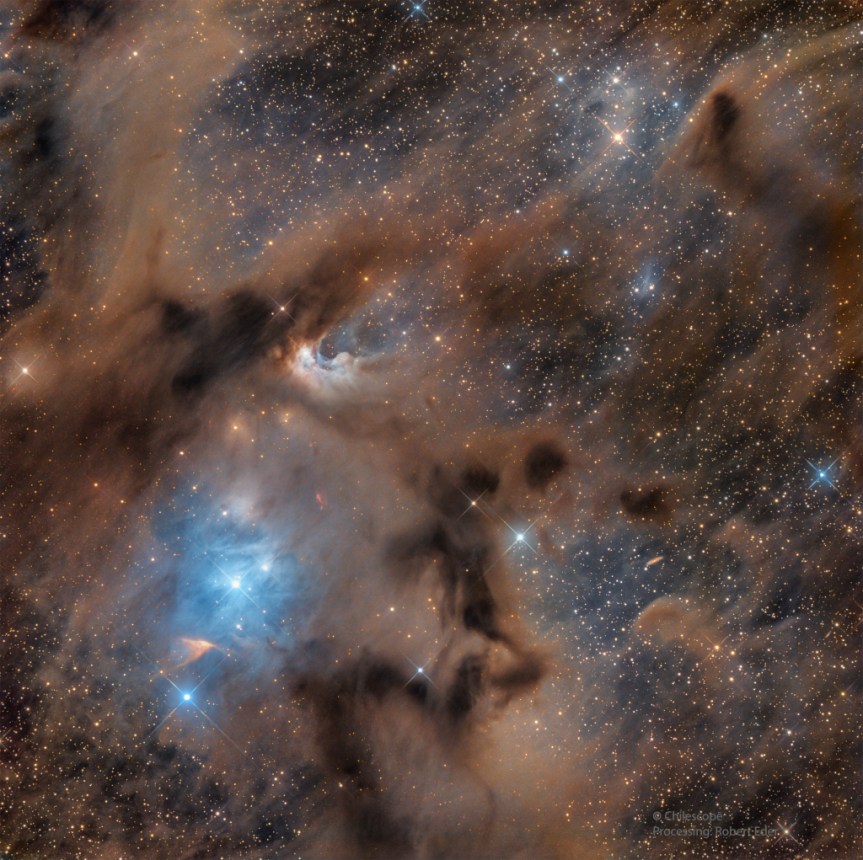
Explanation: Dark markings and bright nebulae in this telescopic southern sky view are telltale signs of young stars and activestar formation. They lie a mere 650 light-years away, at the boundary of the local bubble and the Chamaeleon molecular cloud complex. Regions with young stars identified as dusty reflection nebulae from the 1946 Cederblad catalog include the C-shaped Ced 110 just above and left of center, and bluish Ced 111 below it. Also a standout in the frame, the orange tinted V-shape of the Chamaeleon Infrared Nebula (Cha IRN) was carved by material streaming from a newly formed low-mass star. The well-composed image spans 1.5 degrees. That’s about 17 light-years at the estimated distance of the nearby Chamaeleon I molecular cloud.
You can use this link to go forward or backward in time for Moon phase information. If you are curious, you can even find out what phase the Moon was in when you or anyone else was born.
The Moon will be in a Waning Gibbous Phase today and tonight. This is the first phase after the Full Moon occurs. It lasts roughly 7 days with the Moon’s illumination growing smaller each day until the Moon becomes a Last Quarter Moon with an illumination of 50%. The average Moon rise for this phase is between 9pm and Midnight depending on the age of the phase. The moon rises later and later each night setting after sunrise in the morning. During this phase the Moon can also be seen in the early morning daylight hours on the western horizon.
The Waning Gibbous on February 17 has an illumination of 99%. This is the percentage of the Moon illuminated by the Sun. The illumination is constantly changing and can vary up to 10% a day. On February 17 the Moon is 15.52 days old. This refers to how many days it has been since the last New Moon. It takes 29.53 days for the Moon to orbit the Earth and go through the lunar cycle of all 8 Moon phases.
The 8 Lunar Phases
There are 8 lunar phases the Moon goes through in its 29.53 days lunar cycle. The 4 major Moon phases are Full Moon, New Moon, First Quarter and Last Quarter. Between these major phases, there are 4 minor ones: the Waxing Crescent, Waxing Gibbous, Waning Gibbous and Waning Crescent. For more info on the Moon Cycle and on each phase check out Wikipedia Lunar Phase page.
Phase Details
Phase: Waning Gibbous
Illumination: 99%
Moon Age: 15.52 days
Moon Angle: 0.51
Moon Distance: 389,241.12 km
Sun Angle: 0.54
Sun Distance: 147,846,793.70 km
Useful Moon Resources
Check the weather before a night of Moon gazing at weather.com
one Moon because by this point, the tribe’s winter food supplies had usually dwindled to the point where people had to gnaw on bones and cook bone marrow soup in order to survive. For the same reason, the Kalapuya tribe called this moon the Out of Food Moon. Appropriately, it’s also known as the Hunger Moon and the Little Famine Moon. Perhaps due to this month’s association with death, the Cherokee tribe would commune with their dead ancestors during the Bone Moon. A didanawiskawi, or a medicine person, would host a medicine dance for the community. Fasting and rituals for the dead were also common practices.
However, not all cultures associate February’s full moon with extreme cold and death. The Hopi tribe calls it the Moon of Purification and Renewal, which is very fitting because the Full Snow Moon is usually the very first full moon of the year according to the lunar calendar. Cultures that follow the lunar calendar, especially East Asian cultures, tend to associate the Full Snow Moon with new beginnings for this very reason. The ancient Chinese, for example, called it the Budding Moon.
As a matter of fact, celebrations of February’s full moon are the climax of Lunar New Year festivities in various East Asian countries. In China, the Full Snow Moon is celebrated during the Lantern Festival, also known as the Yuanxiao Festival, which is the 15th day of the Lunar New Year. During this festival, the Chinese release kongming lanterns into the sky as they admire the full moon and eat tangyuan, glutinous rice balls that are usually filled with sweet paste. The round shape of the balls symbolize family togetherness and bring good luck to the whole family.
Many East Asian cultures in general also light lanterns and bonfires to celebrate February’s full moon. According to an ancient Chinese legend, not long after Buddhism was brought into China, 17 deities were witnessed flying through the sky during the first full moon of the Lunar New Year. Shocked and excited, the populace lit fires and lanterns to see the godly beings better. They continued to do so year after year, but for more practical reasons – to chase away pests and to pray for a good crop in the upcoming spring.
In Korea, where February’s full moon is known as Daeboreum, these fiery structures are called “Houses of the Burning Moon”. During Daeboreum, Koreans hike mountains despite the freezing temperatures in order to catch a glimpse of the first rise of the first full moon of the Lunar New Year. According to legend, the very first person to accomplish this feat will have their dearest wish come true.
Local Date and Time for February 2022 Full Moon in major cities around the world:
Los Angeles,
San Francisco,
Vancouver
February 16, 2022
8:57am PST
Denver,
Salt Lake City,
Calgary
February 16, 2022
9:57am MST
Chicago,
Houston,
San Antonio
February 16, 2022
10:57am CST
New York,
Toronto,
Atlanta
February 16, 2022
11:57am EST
London,
Manchester,
Dublin
February 16, 2022
4:57pm GMT
Paris,
Rome,
Berlin
February 16, 2022
5:57pm CET
Athens,
Istanbul,
Helsinki
February 16, 2022
6:57pm EET
Dubai,
Abu Dhabi,
Muscat
February 16, 2022
8:57pm +04
Bangalore,
Mumbai,
New Delhi
February 16, 2022
10:27pm IST
Singapore,
Kuala Lumpur
February 17, 2022
12:57am +08
Perth,
Hong Kong,
Beijing
February 17, 2022
12:57am AWST
Sydney,
Brisbane,
Melbourne
February 17, 2022
3:57am AEDT
You can use this link to go forward or backward in time for Moon phase information. If you are curious, you can even find out what phase the Moon was in when you or anyone else was born.
The Moon will be in a Full Moon phase today and tonight. During a Full Moon the moon is 100% illuminated as seen from Earth and is on the opposite side of the Earth from the Sun. The Moon will be visible throughout the night sky rising at sunset in the east and setting with the sunrise the next morning. The point at which a Full Moon occurs can be measured down to a fraction of a second. The time it takes between full moons is known as a Synodic month and is 29.530587981 days long. Keep track of all the Full Moons throughout the year on the Full Moon Calendar >
The Full Moon on February 16 has an illumination of 100%. This is the percentage of the Moon illuminated by the Sun. The illumination is constantly changing and can vary up to 10% a day. On February 16 the Moon is 14.56 days old. This refers to how many days it has been since the last New Moon. It takes 29.53 days for the Moon to orbit the Earth and go through the lunar cycle of all 8 Moon phases.
The 8 Lunar Phases
There are 8 lunar phases the Moon goes through in its 29.53 days lunar cycle. The 4 major Moon phases are Full Moon, New Moon, First Quarter and Last Quarter. Between these major phases, there are 4 minor ones: the Waxing Crescent, Waxing Gibbous, Waning Gibbous and Waning Crescent. For more info on the Moon Cycle and on each phase check out Wikipedia Lunar Phase page.
Phase Details
Phase: Full Moon
Illumination: 100%
Moon Age: 14.56 days
Moon Angle: 0.51
Moon Distance: 393,660.25 km
Sun Angle: 0.54
Sun Distance: 147,815,985.47 km
Useful Moon Resources
Check the weather before a night of Moon gazing at weather.com
Discover the cosmos! Each day a different image or photograph of our fascinating universe is featured, along with a brief explanation written by a professional astronomer.
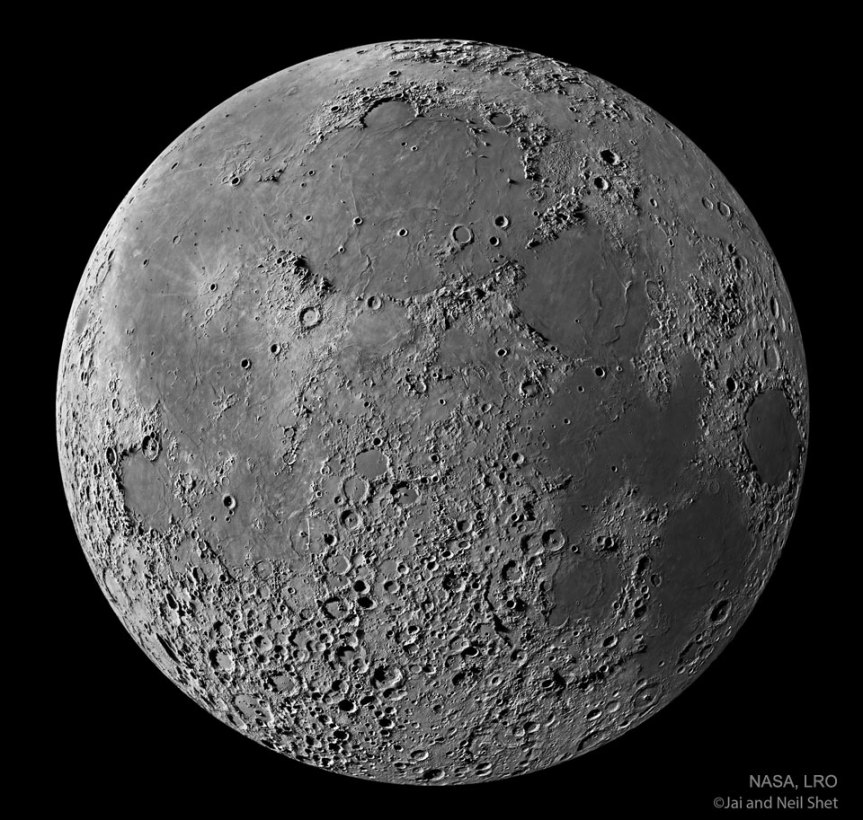
Explanation: What’s different about this Moon? It’s the terminators. In the featured image, you can’t directly see any terminator — the line that divides the light of day from the dark of night. That’s because the image is a digital composite of 29 near-terminator lunar strips. Terminator regions show the longest and most prominent shadows — shadows which, by their contrast and length, allow a flat photograph to appear three-dimensional. The original images and data were taken near the Moon by NASA’s Lunar Reconnaissance Orbiter. Many of the Moon’s craters stand out because of the shadows they all cast to the right. The image shows in graphic detail that the darker regions known as maria are not just darker than the rest of the Moon — they are flatter.
You can use this link to go forward or backward in time for Moon phase information. If you are curious, you can even find out what phase the Moon was in when you or anyone else was born.
The Moon’s current phase for today and tonight is a Waxing Gibbous phase. This phase is when the moon is more than 50% illuminated but not yet a Full Moon. The phase lasts about 7 days with the moon becoming more illuminated each day until the Full Moon. During a Waxing Gibbous the moon rises in the east in mid-afternoon and is high in the eastern sky at sunset. The moon is then visible through most of the night sky setting a few hours before sunrise. The word Gibbous first appeared in the 14th century and has its roots in the Latin word “gibbosus” meaning humpbacked.
The Waxing Gibbous on February 15 has an illumination of 98%. This is the percentage of the Moon illuminated by the Sun. The illumination is constantly changing and can vary up to 10% a day. On February 15 the Moon is 13.61 days old. This refers to how many days it has been since the last New Moon. It takes 29.53 days for the Moon to orbit the Earth and go through the lunar cycle of all 8 Moon phases.
The 8 Lunar Phases
There are 8 lunar phases the Moon goes through in its 29.53 days lunar cycle. The 4 major Moon phases are Full Moon, New Moon, First Quarter and Last Quarter. Between these major phases, there are 4 minor ones: the Waxing Crescent, Waxing Gibbous, Waning Gibbous and Waning Crescent. For more info on the Moon Cycle and on each phase check out Wikipedia Lunar Phase page.
Phase Details
Phase: Waxing Gibbous
Illumination: 98%
Moon Age: 13.61 days
Moon Angle: 0.50
Moon Distance: 397,586.10 km
Sun Angle: 0.54
Sun Distance: 147,785,711.24 km
Useful Moon Resources
Check the weather before a night of Moon gazing at weather.com
You can use this link to go forward or backward in time for Moon phase information. If you are curious, you can even find out what phase the Moon was in when you or anyone else, you know was on the date the person was born.
The Moon’s current phase for today and tonight is a Waxing Gibbous phase. This phase is when the moon is more than 50% illuminated but not yet a Full Moon. The phase lasts about 7 days with the moon becoming more illuminated each day until the Full Moon. During a Waxing Gibbous the moon rises in the east in mid-afternoon and is high in the eastern sky at sunset. The moon is then visible through most of the night sky setting a few hours before sunrise. The word Gibbous first appeared in the 14th century and has its roots in the Latin word “gibbosus” meaning humpbacked.
The Waxing Gibbous on February 14 has an illumination of 95%. This is the percentage of the Moon illuminated by the Sun. The illumination is constantly changing and can vary up to 10% a day. On February 14 the Moon is 12.68 days old. This refers to how many days it has been since the last New Moon. It takes 29.53 days for the Moon to orbit the Earth and go through the lunar cycle of all 8 Moon phases.
The 8 Lunar Phases
There are 8 lunar phases the Moon goes through in its 29.53 days lunar cycle. The 4 major Moon phases are Full Moon, New Moon, First Quarter and Last Quarter. Between these major phases, there are 4 minor ones: the Waxing Crescent, Waxing Gibbous, Waning Gibbous and Waning Crescent. For more info on the Moon Cycle and on each phase check out Wikipedia Lunar Phase page.
Phase Details
Phase: Waxing Gibbous
Illumination: 95%
Moon Age: 12.68 days
Moon Angle: 0.50
Moon Distance: 400,847.39 km
Sun Angle: 0.54
Sun Distance: 147,755,980.60 km
Useful Moon Resources
Check the weather before a night of Moon gazing at weather.com
I cast a circle
flowing out from deep within
circling me in pale blue flame
power
I see it stretching before me
growing out to spread for miles and miles hours
and days
I see the joined hands of my grandmothers my
mother my daughter
my systers
I see it encompassing all which I love all that is
will be
I see faces new and dear
long forgotten
smiling
Making it grow making it stretch
forming a perfect ring of light
and hope and love
protection
Illuminating the room the night
the house the sky
my soul
I see the circle going on and on
girdling the earth
embracing her
I feel it stretching out from my heart and soul
Flowering from my blood my womb my breath
Spinning stretching dancing out on and on unbreakable
and unbroken eternal.
Seasonally Defective: Poetry for Goddesses and Mortal Women
Aly Sebastian
Discover the cosmos! Each day a different image or photograph of our fascinating universe is featured, along with a brief explanation written by a professional astronomer.
2022 February 14
In the Heart of the Heart Nebula
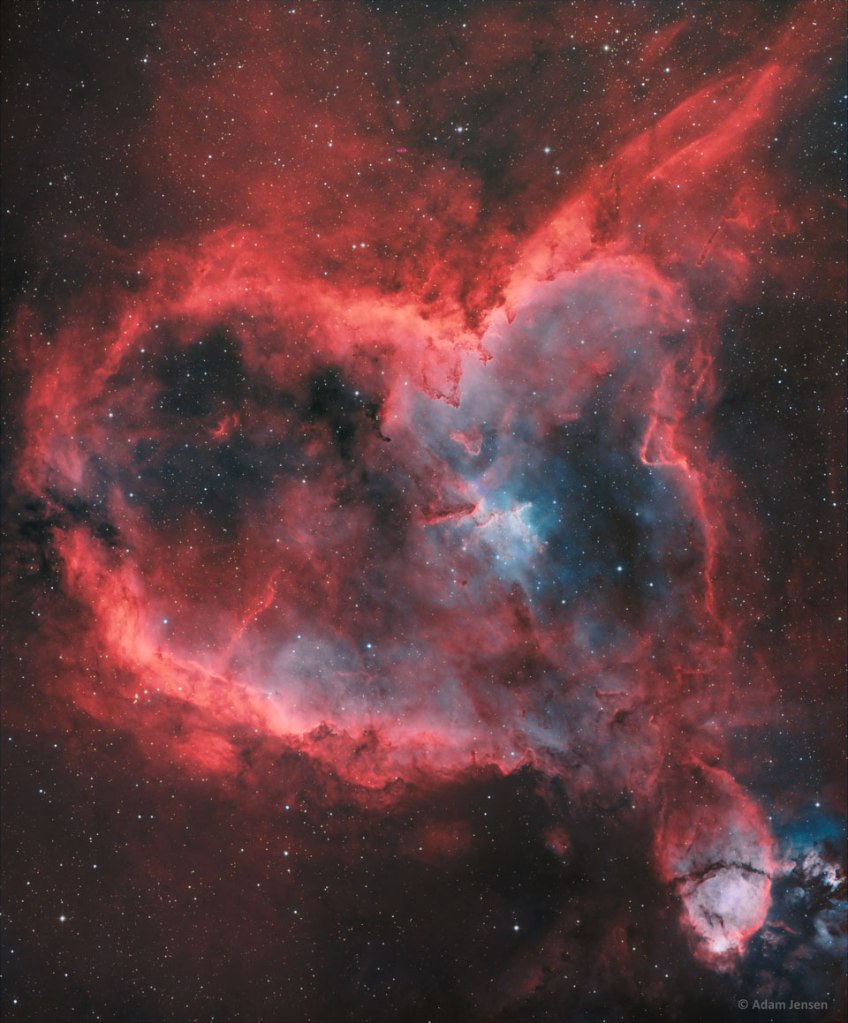
Image Credit & Copyright: Adam JensenExplanation: What excites the Heart Nebula? First, the large emission nebula dubbed IC 1805 looks, in whole, like a human heart. Its shape perhaps fitting of the Valentine’s Day, this heart glows brightly in red light emitted by its most prominent element: excitedhydrogen. The red glow and the larger shape are all created by a small group of stars near the nebula’s center. In the heart of the Heart Nebula are young stars from the open star cluster Melotte 15 that are eroding away several picturesque dust pillars with their energetic light and winds. The open cluster of stars contains a few bright stars nearly 50 times the mass of our Sun, many dim stars only a fraction of the mass of our Sun, and an absent microquasar that was expelled millions of years ago. The Heart Nebula is located about 7,500 light years away toward the constellation of the mythological Queen of Aethiopia (Cassiopeia).
















You must be logged in to post a comment.