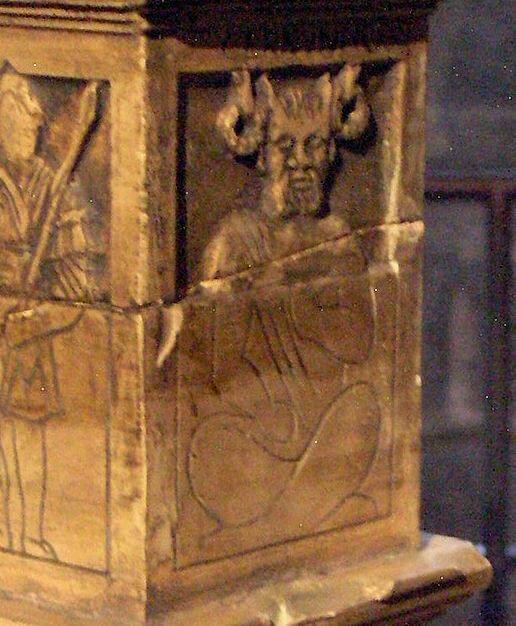
Cernunnos: Horned God of the Celts

Cernunnos is one of the most enigmatic and fascinating figures in Celtic mythology. Depicted as a horned god, he was worshipped by the ancient Celts throughout much of Europe.

Horned God | Protector | Fertility | Underworld |

In this article, we will explore the myths and legends associated with Cernunnos, and examine the many roles he played in Celtic religion and society.

Who was Cernunnos?

Cernunnos was a god of the Celts, who were an ancient people that inhabited much of Europe during the Iron Age. He is depicted as a horned figure, often holding a torque, or twisted metal necklace, and accompanied by various animals, such as stags, bulls, and serpents. Despite his popularity, little is known about Cernunnos and his exact role in Celtic religion and society remains a matter of debate among scholars.

The Horned God

The image of the horned god is one of the most distinctive and enduring symbols of the Celts. The horns are typically those of a stag, and they represent the god’s connection to … Click here to read the rest of this article Source: celticnative.com

Cernunnos – The Enigmatic Antlered God of the Ancient Celts

The Celts can rightfully be placed amongst the world’s most important ancient cultures and civilizations. Their far-reaching ancient origins are the irreplaceable part of every historical lesson, and their role in history was crucial in the development of the world as we know it today. Yet even so, many aspects of the Celtic culture and belief are a bit of an enigma – even today. Because they didn’t leave any considerable written records, the Celts are largely mysterious, and most of what we know of their early history comes from Roman or Greek historians. We do know, however, that Cernunnos was one of their foremost deities. A mystical antlered god, he was revered by the Celts across Europe.

Who was Cernunnos, the Antlered God of the Celts?

With the relatively recent discoveries of ancient Celtic core sites of La Tene and Hallstatt, in the mid-1800s, the world and the culture of these ancient Europeans came to the closer view of the general public and historians as well. Suddenly, there was so much more to learn about the Celts, about their art, their lifestyle, and their beliefs. Before the 1800s, the pantheon of the ancient Celts was largely enigmatic, but with new archeological material, typesites, and a closer glimpse into their religious rituals, we were finally able to paint a more detailed picture of the ancient Gods of the Celtic peoples.

Arguably the best-known deity in their pantheon is Cernunnos, the sylvan antlered god that likely has origins that far predate the emergence of the Celts. Sometimes also known as Carnonos, his name has firm Proto-Indo-European origins. It stems from the PIE word *k̑r̥no-, and is thus cognate to Germanic *hurnaz and Latin cornu, all meaning “horn”. In the Celtic Gaulish language, this word was karnon, and the connection with the name of Cernunnos is clear – it reflects the deity’s stag antlers, growing from his head. Thus, Cernunnos literally means “the horned one”.

This can also be deduced from the surviving imagery related to the god. In almost every surviving depiction, Cernunnos is presented as … Click here to read the rest of this article Source: .ancient-origins.net

Cernunnos Celtic God: Exploring the Ancient Deity’s Significance and Symbols

Cernunnos

Cernunnos Celtic god holds a significant place in ancient Celtic mythology. Represented as a horned deity, Cernunnos symbolizes nature, fertility, and the cycle of life. This ancient god intertwines with Celtic culture, rituals, and festivals.

Content of this Article

Spell For Tomorrow – Cernunnos’ Abundance Prayer

(YOU CAN COPY AND PASTE ANY SPELLS POSTED TO A DOCUMENT TO PRINT AND/OR SAVE ON YOUR COMPUTER FOR PERSONAL USE ONLY)

Cernunnos’ Abundance Prayer

Light a green candle during this prayer to Cernunnos

Incense for Cernunnos: Cedar, Musk, Pine, Sandalwood.

Offerings to Cernnunos: Bones, Fruit, Grains, Red meat, Wine, Milk, Water, Moss, Fresh soil.

The Celtic Forest God, Cernunnos, gets his name from a Latin word which means “the horned one”. His original name was lost but the name Cernunnos was inscribed in the Pilier des Nautes, a Gaelic-Roman monument found under the Notre Dame cathedral, in Paris, France in 1711.

As a Horned God, he can take the place of consort of the Goddess in the Wiccan Pantheon (God and Goddess). And as a primordial deity in Neopagan traditions, his male principality makes him often be merged with other gods such as Pan and the Green Man.

He is believed to be the god of abundance and ruler of wild animals. His nature is essentially earthly. He is usually depicted with the ears and horns of a deer and wearing a “torque”, the sacred neck ornament of Celtic gods and heroes.

Devotional text

Cernunnos, Guardian of the cauldron of plenty, I call to You.
Horned One, Dark One, Receiver of the Dead, Granter of Rest, I call to You.
God of freedom, God of sexuality, God of cleansing, God of rebirth, I call to You.
Mighty Lord of the Woods and Animals, Hunter and Hunted, I call to You.

I pray you to be present with me in this Sacred Space.
Let Your gaze fall upon this Sacred Ground.
In-dwell my rite and give me Your blessing.
Great Horned One, come into the Circle!

Pour over me the gift of your wealth, and place in my hands the spirit of fortune.
Let the gold and silver come from the four corners of the world and bless me.

Because you are a god that creates and multiplies,
From the top of my head to the soles of my feet,
Surround me with a stream of wealth.
Unleash your prosperity and let health and protection accompany me.

I hear your words, Cernunnos, the voice of the Horned One,  Whose names are uncountable:
You are the wild hunter of the forest deep,
You are the fire upon the hill, And the sower of the seed,

The wilderness is your shrine.
You wield the oaken staff, the elements at your call.
By day you are the sun, by night you ride upon the wild winds
For all things wild and free are in your keeping.

And all things of beauty and freedom and love delight you.
You are the Ancient One. Your faces outnumber the stars.
I am the Horned One of uncountable names, you are the gentle and the fierce
You are Cernunnos, the Ancient One, Lord and Sire of the Universe.

Some of the Witchcraft/Magickal Correspondence for Thursday

(YOU CAN COPY AND PASTE ANY COROSPONDENCES POSTED TO A DOCUMENT TO PRINT AND/OR SAVE ON YOUR COMPUTER)

Thursday Source: smudgemetaphysical.com

Planet: Jupiter

Colour: blue, purple, green

Plants: oak, wheat

Stone: Amethyst, Lepidolite, Sugilite, Tin

Herbs: Clove, Oakmoss, Cinnamon, Musk, Nutmeg, and Sage

Oils:manifest oil

Gods: Thor, Jupiter, Zeus, Taranis, Perun, and Perkunas.

Thursdays are ruled by the planet Jupiter. It is also associated with the Norse god Thor and the Roman God Jupiter. Jupiter is the largest planet and therefor the most powerful. 

Thursday is the best day to perform manifesting magic. Prepare that money magic, ask for that raise, have fun with friends and loved ones. 

Spells and rituals: luck, happiness, health, legal matters, male fertility, treasure, wealth, honour, riches, clothing, money, desires, business, group pursuits, joy, laughter, and expansion.

Thrifty Thursday spells:

Write what you want to manifest on a bay leaf and burn it.

Start your morning with a slice of whole wheat toast. Add butter or your choice of spread in the form of a dollar symbol ($) and feel the abundance and prosperity entering your life. 

Have a meal with a good friends or family. Laugh a lot and feel how abundant your life is with the love and friendships you have. 

Thursday Source: whitewitchgrimoire.com

Planet: Jupiter
Colors: Blue and Metallic

Ahhh Jupiter, you giant dick. While he is the go-to for power, money and good fortune, he’s about the long game. Fast money? Nope. He will give you more of what you have, so if you’re broke, you may be even more impoverished if you use any of his influence. Be careful with them herbs. Looking for justice? Thursday. Signing contracts or making big money moves? Thursday. Abundance looks different to everyone, but this is the day of plenty….sometimes that is just plenty of what you already have man. I’m serious here. My money spells done in the past before I got my shit together created lasting wounds. Expansion is painful when it comes from a space of lack. I said “I need money! I am broke” and he said “Hold my beer you desperate witch” and then I cried. Great money day if you are attracting what you are, but not what you want. I speak from my own experience and yours may differ, but if your money spells have backfired, look at the day and associations. If you see anything, take note. Everyone is different but I am not even ashamed to say that it took me years to figure this one out for my own magic. Good day for court and child support I must say.

June 19, 2025 Current Southern Hemisphere/Tomorrow’s Northern Hemisphere Moon Phase

Source: nineplanets.org

The current moon phase for June 19th, 2025 is the Waning Crescent phase.

On this day, the moon is 23.19 days old and 47.08% illuminated with a tilt of -71.105°. The approximate distance from Earth to the moon is 372,296.09 km and the moon sign is Aries.

The Moon phase for June 19th, 2025 is a Waning Crescent phase. This is the phase where the moon is less than 50% illuminated but has not yet reached 0% illumination (which would be a New Moon).

In this part of the moon cycle, it is getting closer and closer to the Sun as viewed from Earth and the night side of the Moon is facing earth with a decreasingly thin crescent being illuminated.

Solar-powered gadgets
Natural satellite photography books

The waning (shrinking) crescement Moon will rise at around midnight, transit the meridian after sunrise, before setting after noon. This phase is best viewed 1-2 hours before sunrise and is a great time to see the features of the Moon’s surface. Along the illuminated crescent you can see the craters and mountains of the moon casting long shadows.

The Waxing Gibbous phase, like all moon phases, will last for just over 7 days. The actual length will vary because of the elliptical shaped orbit of the moon. During this Waxing Gibbous phase the moon will rise in the east in the mid- to late-afternoon and will be high in the eastern sky at sunset.

Assuming it’s a clear night, the Waxing Gibbous moon will then be visible through most of the night before setting just before sunrise.

Fun fact: the illuminated side of a waning crescent moon is always pointed eastwards, towards the sunrise.

Phase Details

Phase: Waning Crescent

Moon age: 23.19 days

Moon illumination: 47.08%

Moon tilt: -71.105°

Moon angle: 0.53

Moon distance: 372,296.09 km

Moon sign: Aries

Source: MoonGiant.com

You can use this link to go forward or backward in time for Moon phase information. If you are curious, you can even find out what phase the Moon was in when you or anyone else was born.

The Moon’s current phase for today and tonight is a Waning Crescent phase. This phase is best viewed just before the sunrise in the western sky. In this phase the Moon’s illumination is growing smaller each day until the New Moon. During this part of the Moon cycle, the Moon is getting closer to the Sun as viewed from Earth and the night side of the Moon is facing the Earth with only a small edge of the Moon being illuminated. It can also be a great time to see the features of the Moon’s surface. Along the edge where the illuminated portion meets the dark side, the craters and mountains cast long shadows making them easier to observe with a telescope or binoculars.

Today’s Waning Crescent Phase

The Waning Crescent on June 19 has an illumination of 40%. This is the percentage of the Moon illuminated by the Sun. The illumination is constantly changing and can vary up to 10% a day. On June 19 the Moon is 23.11 days old. This refers to how many days it has been since the last New Moon. It takes 29.53 days for the Moon to orbit the Earth and go through the lunar cycle of all 8 Moon phases.

Phase Details

Phase: Waning Crescent
Illumination: 40%
Moon Age: 23.11 days
Moon Angle: 0.54
Moon Distance: 365,649.45 km
Sun Angle: 0.52
Sun Distance: 152,023,234.37 km

The 8 Lunar Phases

There are 8 lunar phases the Moon goes through in its 29.53 days lunar cycle. The 4 major Moon phases are Full Moon, New Moon, First Quarter and Last Quarter. Between these major phases, there are 4 minor ones: the Waxing Crescent, Waxing Gibbous, Waning Gibbous and Waning Crescent. For more info on the Moon Cycle and on each phase check out Wikipedia Lunar Phase page.

Useful Moon Resources

Check the weather before a night of Moon gazing at weather.com

For a list of all the current meteor showers visit American Meteor Society