Discover the cosmos! Each day a different image or photograph of our fascinating universe is featured, along with a brief explanation written by a professional astronomer.
2021 November 26
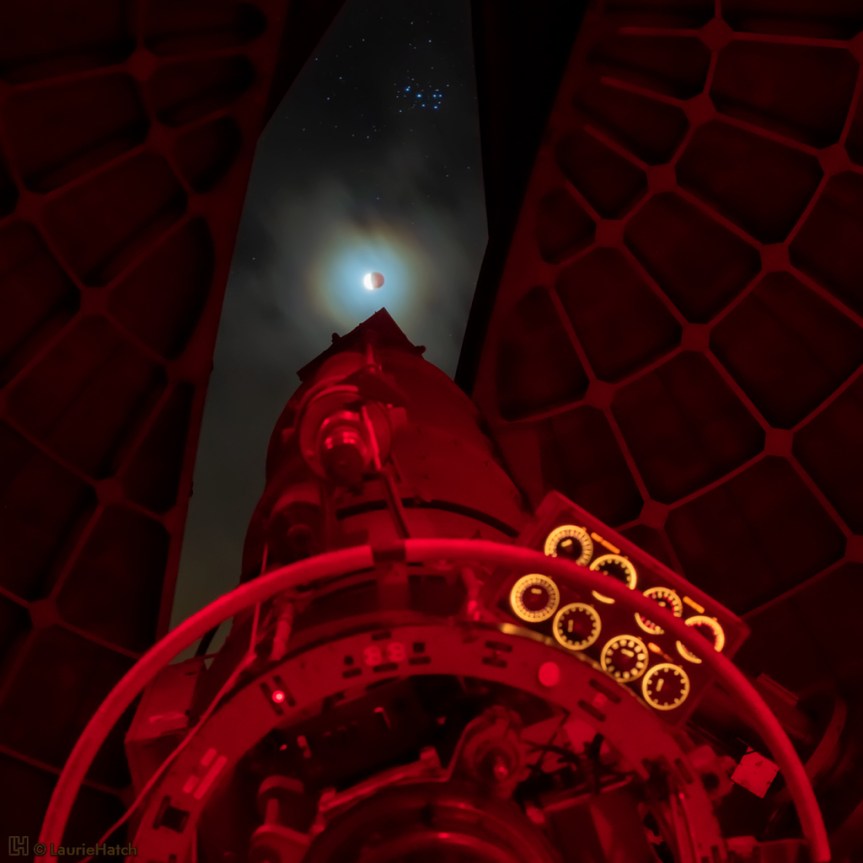
Notable APOD Submissions: Lunar Eclipse of 2021 November 19

Discover the cosmos! Each day a different image or photograph of our fascinating universe is featured, along with a brief explanation written by a professional astronomer.
2021 November 26

You can use this link to go forward or backward in time for Moon phase information. If you are curious you can even find out what phase the Moon was in when you or anyone else, you know was on the date the person was born.
Today the Moon will be in a Waning Gibbous Phase. This is the first phase after the Full Moon occurs. It lasts roughly 7 days with the Moon’s illumination growing smaller each day until the Moon becomes a Last Quarter Moon with an illumination of 50%. The average Moon rise for this phase is between 9pm and Midnight depending on the age of the phase. The moon rises later and later each night setting after sunrise in the morning. During this phase the Moon can also be seen in the early morning daylight hours on the western horizon.
Visit the November 2021 Moon Phases Calendar to see all the daily moon phase for this month.
The Waning Gibbous on November 26 has an illumination of 60%. This is the percentage of the Moon illuminated by the Sun. The illumination is constantly changing and can vary up to 10% a day. On November 26 the Moon is 21.18 days old. This refers to how many days it has been since the last New Moon. It takes 29.53 days for the Moon to orbit the Earth and go through the lunar cycle of all 8 Moon phases.

If you need to calculate the planetary positions for a specific use and time, click on this link
To figure out GMT (Greenwich Mean Time) to your local time use this link
The time for the Custom Planetary Positions is from the local time in Melbourne, Victoria, Australia
26 November 2021
06:00 am GMT 5:00 PM AEDT
Zodiac: Tropical (Standard Western)

The time for the Custom Planetary Positions is from the local time in Sao Paulo, Brazil, South America
26 November 2021
08:00 pm GMT 5:00 PM BRT
Zodiac: Tropical (Standard Western)
You can use this link to go forward or backward in time for Moon phase information. If you are curious you can even find out what phase the Moon was in when you or anyone else, you know was on the date the person was born.
Today the Moon will be in a Waning Gibbous Phase. This is the first phase after the Full Moon occurs. It lasts roughly 7 days with the Moon’s illumination growing smaller each day until the Moon becomes a Last Quarter Moon with an illumination of 50%. The average Moon rise for this phase is between 9pm and Midnight depending on the age of the phase. The moon rises later and later each night setting after sunrise in the morning. During this phase the Moon can also be seen in the early morning daylight hours on the western horizon.
Visit the November 2021 Moon Phases Calendar to see all the daily moon phase for this month.
The Waning Gibbous on November 25 has an illumination of 70%. This is the percentage of the Moon illuminated by the Sun. The illumination is constantly changing and can vary up to 10% a day. On November 25 the Moon is 20.25 days old. This refers to how many days it has been since the last New Moon. It takes 29.53 days for the Moon to orbit the Earth and go through the lunar cycle of all 8 Moon phases.
If you need to calculate the planetary positions for a specific use and time, click on this link
To figure out GMT (Greenwich Mean Time) to your local time use this link
The time for the Custom Planetary Positions is from the local time in Frankfurt, Germany, Europe
25 November 2021
04:00 pm GMT 5:00 PM CEST
Zodiac: Tropical (Standard Western)
The time for the Custom Planetary Positions is from the local time in Chicago, Illinois, USA
November 25, 2021
11:00 pm GMT 5:00 PM CST
Zodiac: Tropical (Standard Western)
Mean Lunar Node:01 Gemini 26 Rx
Lilith (Black Moon):14 Gemini 28
Chiron:08 Aries 41 Rx
Ceres:05 Gemini 23 Rx
Pallas:09 Pisces 57
Juno:03 Capricorn 53
Vesta:05 Sagittarius 04
Eris:23 Aries 52 Rx
Discover the cosmos! Each day a different image or photograph of our fascinating universe is featured, along with a brief explanation written by a professional astronomer.
2021 November 25
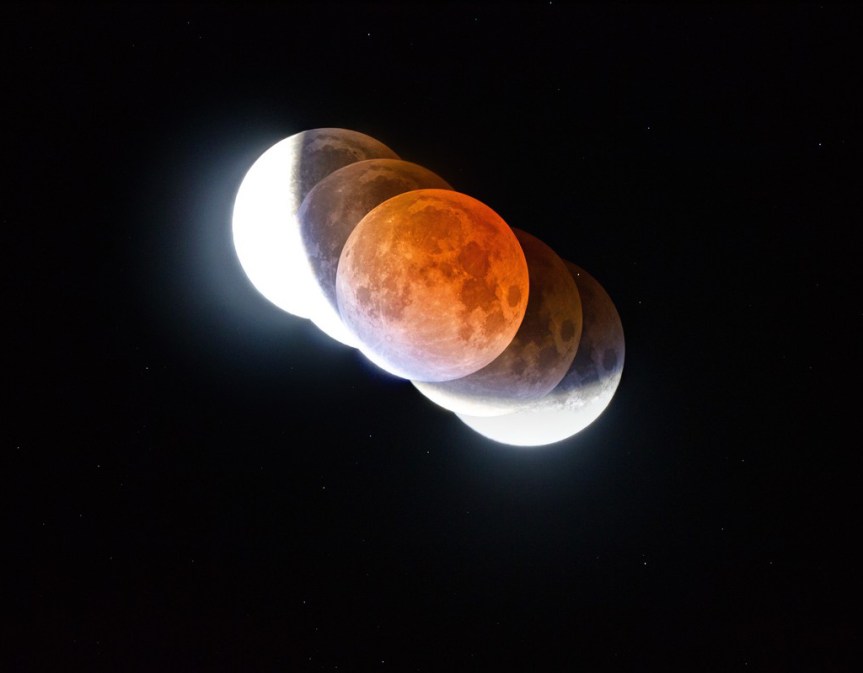
Explanation: Shaped like a cone tapering into space, the Earth’s dark central shadow or umbra has a circular cross-section. It’s wider than the Moon at the distance of the Moon’s orbit though. But during the lunar eclipse of November 18/19, part of the Moon remained just outside the umbral shadow. The successive pictures in this composite of 5 images from that almost total lunar eclipse were taken over a period of about 1.5 hours. The series is aligned to trace part of the cross-section’s circular arc, with the central image at maximum eclipse. It shows a bright, thin sliver of the lunar disk still beyond the shadow’s curved edge. Of course, even within the shadow the Moon’s surface is not completely dark, reflecting the reddish hues of filtered sunlight scattered into the shadow by Earth’s atmosphere.
Notable APOD Submissions: Lunar Eclipse of 2021 November 19
You can use this link to go forward or backward in time for Moon phase information. If you are curious you can even find out what phase the Moon was in when you or anyone else, you know was on the date the person was born.
The Moon’s current phase for today and tonight is a Waning Gibbous Phase. This is the first phase after the Full Moon occurs. It lasts roughly 7 days with the Moon’s illumination growing smaller each day until the Moon becomes a Last Quarter Moon with an illumination of 50%. The average Moon rise for this phase is between 9pm and Midnight depending on the age of the phase. The moon rises later and later each night setting after sunrise in the morning. During this phase the Moon can also be seen in the early morning daylight hours on the western horizon.
Visit the November 2021 Moon Phases Calendar to see all the daily moon phase for this month.
The Waning Gibbous on November 24 has an illumination of 78%. This is the percentage of the Moon illuminated by the Sun. The illumination is constantly changing and can vary up to 10% a day. On November 24 the Moon is 19.34 days old. This refers to how many days it has been since the last New Moon. It takes 29.53 days for the Moon to orbit the Earth and go through the lunar cycle of all 8 Moon phases.
There are 8 lunar phases the Moon goes through in its 29.53 days lunar cycle. The 4 major Moon phases are Full Moon, New Moon, First Quarter and Last Quarter. Between these major phases, there are 4 minor ones: the Waxing Crescent, Waxing Gibbous, Waning Gibbous and Waning Crescent. For more info on the Moon Cycle and on each phase check out Wikipedia Lunar Phase page.
Check the weather before a night of Moon gazing at weather.com
For a list of all the current meteor showers visit American Meteor Society
If you need to calculate the planetary positions for a specific use and time, click on this link
To figure out GMT (Greenwich Mean Time) to your local time use this link
The time for the Custom Planetary Positions is from the local time in Frankfurt, Germany, Europe
24 November 2021
04:00 pm GMT 5:00 PM CEST
Zodiac: Tropical (Standard Western)

The time for the Custom Planetary Positions is from the local time in Chicago, Illinois, USA
November 24, 2021
11:00 pm GMT 5:00 PM CST
Zodiac: Tropical (Standard Western)
Ancient Egyptian Goddess Isis and God Osiris
At the ancient Egyptian temples of Philae, Nubians gave new life to a vanishing religious tradition.
Hathor.When the Romans conquered Egypt in 30 B.C., the country’s system of temples, which had sustained religious traditions dating back more than 3,000 years, began to slowly wither away. Starved of the funds that pharaohs traditionally supplied to religious institutions, priests lost their vocation and temples fell into disuse throughout the country. The introduction of Christianity in the first century a.d. only hastened this process. But there was one exception to this trend: In the temples on the island of Philae in the Nile River, rites dedicated to the goddess Isis and the god Osiris continued to be celebrated in high style for some 500 years after the Roman conquest. This final flowering of ancient Egyptian religion was only possible because of the piety and support of Egypt’s neighbors to the south, the Nubians.
Philae lies just south of the Nile’s first cataract—one of six rapids along the river—which marked the historical border between ancient Egypt and Nubia, also known as Kush. In this region of Kush, called Lower Nubia, the temple complex at Philae was just one of many that were built on islands in the Nile and along its banks. Throughout the long history of Egypt and Nubia, Lower Nubia was a kind of buffer zone between these two lands and a place…
380 Theodosius I makes his adventus, or first formal entry, into Constantinople
1639 1st observation of transit of Venus by Jeremiah Horrocks and William Crabtree – helped establish size of the Solar System
1642 Dutch explorer Abel Tasman discovers Van Diemen’s Land (Tasmania)
1859 English naturalist Charles Darwin publishes “On the Origin of Species” radically changing the view of evolution and laying the foundation for evolutionary biology
1950 UN troops begin an assault intending to end Korean War by Christmas
1954 France sends 20,000 soldiers to Algeria
1974 Most complete early human skeleton (Lucy, Australopithecus) discovered by Donald Johanson, Maurice Taieb, Yves Coppens and Tim White in the Middle Awash of Ethiopia’s Afar Depression [1] [2]

380 Theodosius I makes his adventus, or first formal entry, into Constantinople
496 Anastasius II succeeds Gelasius I as Catholic Pope
642 Theodore I begins his reign as Catholic Pope
1105 Rabbi Nathan ben Yehiel of Rome completes Talmudic dictionary
1434 River Thames in London freezes over
1542 Battle of Solway Moss: English beat Scottish King James V
1587 Battle at Auneau: Henri de Guise wins
1601 Earl Mauritius ceases siege of De Bosch due to strict monarchy
1936 Noël Coward‘s anthology “Tonight at 8:30” premieres in NYC, runs for 118 performances
1947 The US House of Representatives Committee on Un-American Activities finds “Hollywood 10” in contempt because of their refusal to reveal whether they were communists
1948 WAVE TV channel 3 in Louisville, Kentucky (NBC) begins broadcasting
1948 “Bicycle Thieves”, Italian film directed by Vittorio De Sica, starring himself and Cesare Zavattini, is released (Honorary Academy Award 1950)
1966 The cult classic “One Million Years B.C.”, starring Raquel Welch, is released 1st in West Germany
1979 “Salem’s Lot”, American two-part miniseries based on the horror novel of the same name by Stephen King, concludes in the United States
1985 NBC miniseries “Mussolini: The Untold Story” starring George C. Scott premieres in the US
1991 CFL Grey Cup, Winnipeg Stadium: Toronto Argonauts defeat Calgary Stampeders, 36-21; Argos under new ownership of LA Kings owner Bruce McNall, hockey player Wayne Gretzky and actor John Candy
1800 Weber’s opera “Das Waldmadchen” premieres in Freiburg
1950 “Guys & Dolls” opens at 46th St Theater NYC for 1200 performances
1951 “17” closes at Broadhurst Theater NYC after 180 performances
1951 “Music in the Air” closes at Ziegfeld Theater NYC after 56 performances
1956 “Pajama Game” closes at St James Theater NYC after 1063 performances
1966 The Beatles began recording sessions for their album “Sgt.Pepper’s lonely hearts Club Band”
1975 “Boccaccio” opens at Edison Theater NYC for 7 performances
1986 “Smile” opens at Lunt-Fontanne Theater NYC for 48 performances
1897 Canadian Intercollegiate Rugby Football Union forms in Kingston
1934 CFL Grey Cup: Sarnia Imperials win their first Championship with a 20-12 win over Regina Roughriders
1938 National Semi-Pro Basketball Congress authorizes yellow basketball
1949 Syracuse Nationals beat Anderson Packers, 125-123 in 5 OTs
1951 CFL Grey Cup, Varsity Stadium, Toronto: Ottawa Rough Riders claim their 4th Championship with 21-14 win over Saskatchewan Roughriders
1953 Los Angeles Dodgers sign Walter Alston to a 1-year pact as manager for 1954; signs 23 one year agreements until 1976
1956 CFL Grey Cup, Varsity Stadium, Toronto: Edmonton Eskimos make it 3rd consecutive Championships; defeat Montreal Alouettes for 3rd straight year, 50-27
1956 Americans go 1-2 in the men’s 100m final at the Melbourne Olympics; Bobby Morrow and Thane Baker both record hand-timed 10.50s but automatic timing gives gold medal to Morrow
Discover the cosmos! Each day a different image or photograph of our fascinating universe is featured, along with a brief explanation written by a professional astronomer.
2021 November 24

Explanation: Have you ever seen the Pleiades star cluster? Even if you have, you probably have never seen it as large and clear as this. Perhaps the most famous star cluster on the sky, the bright stars of the Pleiades can be seen without binoculars from even the depths of a light-polluted city. With a long exposure from a dark location, though, the dust cloud surrounding the Pleiades star cluster becomes very evident. The featured exposure, taken from Florida, USA, covers a sky area several times the size of the full moon. Also known as the Seven Sisters and M45, the Pleiades lies about 400 light years away toward the constellation of the Bull (Taurus). A common legend with a modern twist is that one of the brighter stars faded since the cluster was named, leaving only six of the sister stars visible to the unaided eye. The actual number of Pleiades stars visible, however, may be more or less than seven, depending on the darkness of the surrounding sky and the clarity of the observer’s eyesight.
Volunteer Opportunity: Someone to Update APOD’s RSS Feed

You can use this link to go forward or backward in time for Moon phase information. If you are curious you can even find out what phase the Moon was in when you or anyone else, you know was on the date the person was born.
The Moon’s current phase for today and tonight is a Waning Gibbous Phase. This is the first phase after the Full Moon occurs. It lasts roughly 7 days with the Moon’s illumination growing smaller each day until the Moon becomes a Last Quarter Moon with an illumination of 50%. The average Moon rise for this phase is between 9pm and Midnight depending on the age of the phase. The moon rises later and later each night setting after sunrise in the morning. During this phase the Moon can also be seen in the early morning daylight hours on the western horizon.
Visit the November 2021 Moon Phases Calendar to see all the daily moon phase for this month.
The Waning Gibbous on November 24 has an illumination of 78%. This is the percentage of the Moon illuminated by the Sun. The illumination is constantly changing and can vary up to 10% a day. On November 24 the Moon is 19.34 days old. This refers to how many days it has been since the last New Moon. It takes 29.53 days for the Moon to orbit the Earth and go through the lunar cycle of all 8 Moon phases.
There are 8 lunar phases the Moon goes through in its 29.53 days lunar cycle. The 4 major Moon phases are Full Moon, New Moon, First Quarter and Last Quarter. Between these major phases, there are 4 minor ones: the Waxing Crescent, Waxing Gibbous, Waning Gibbous and Waning Crescent. For more info on the Moon Cycle and on each phase check out Wikipedia Lunar Phase page.
Check the weather before a night of Moon gazing at weather.com
For a list of all the current meteor showers visit American Meteor Society

If you need to calculate the planetary positions for a specific use and time, click on this link
To figure out GMT (Greenwich Mean Time) to your local time use this link
The time for the Custom Planetary Positions is from the local time in Melbourne, Victoria, Australia
24 November 2021
06:00 am GMT 5:00 PM AEDT
Zodiac: Tropical (Standard Western)
Chiron:08 Aries 44 Rx
Ceres:05 Gemini 47 Rx
Pallas:09 Pisces 48
Juno:03 Capricorn 17
Vesta:04 Sagittarius 08
Eris:23 Aries 53 Rx

The time for the Custom Planetary Positions is from the local time in Sao Paulo, Brazil, South America
24 November 2021
08:00 pm GMT 5:00 PM BRT
Zodiac: Tropical (Standard Western)

You can use this link to go forward or backward in time for Moon phase information. If you are curious you can even find out what phase the Moon was in when you or anyone else, you know was on the date the person was born.
The Moon’s current phase for today and tonight is a Waning Gibbous Phase. This is the first phase after the Full Moon occurs. It lasts roughly 7 days with the Moon’s illumination growing smaller each day until the Moon becomes a Last Quarter Moon with an illumination of 50%. The average Moon rise for this phase is between 9pm and Midnight depending on the age of the phase. The moon rises later and later each night setting after sunrise in the morning. During this phase the Moon can also be seen in the early morning daylight hours on the western horizon.
Visit the November 2021 Moon Phases Calendar to see all the daily moon phase for this month.
The Waning Gibbous on November 23 has an illumination of 85%. This is the percentage of the Moon illuminated by the Sun. The illumination is constantly changing and can vary up to 10% a day. On November 23 the Moon is 18.44 days old. This refers to how many days it has been since the last New Moon. It takes 29.53 days for the Moon to orbit the Earth and go through the lunar cycle of all 8 Moon phases.
There are 8 lunar phases the Moon goes through in its 29.53 days lunar cycle. The 4 major Moon phases are Full Moon, New Moon, First Quarter and Last Quarter. Between these major phases, there are 4 minor ones: the Waxing Crescent, Waxing Gibbous, Waning Gibbous and Waning Crescent. For more info on the Moon Cycle and on each phase check out Wikipedia Lunar Phase page.
Check the weather before a night of Moon gazing at weather.com
For a list of all the current meteor showers visit American Meteor Society

If you need to calculate the planetary positions for a specific use and time, click on this link
To figure out GMT (Greenwich Mean Time) to your local time use this link
The time for the Custom Planetary Positions is from the local time in Frankfurt, Germany, Europe
23 November 2021
04:00 pm GMT 5:00 PM CEST
Zodiac: Tropical (Standard Western)

The time for the Custom Planetary Positions is from the local time in Chicago, Illinois, USA
November 23, 2021
11:00 pm GMT 5:00 PM CST
Zodiac: Tropical (Standard Western)
A spirit animal is a healer, messenger, or teacher that has a special relationship with an individual. A spirit animal appears in the form of an animal that has a special appeal to the individual.
Spirit animals also go by the names animal helpers, powerful allies, spirit helpers, and animal guides. A spirit animal chooses you – you don’t choose your spirit ally.
Actually, if you feel a certain attachment to a spirit animal, it means that this animal has already chosen you.
This animal plays an important role in an individual’s life. It’s there to protect you, impart important lessons, and give you the guidance to make it in life.
It also provides you with power, wisdom, and immense knowledge.
Shamans and spiritual ministers from across the globe have relied on the wisdom and guidance of spirit animals since time immemorial.
Closely associated with spirit animals are animal totems. An animal totem is a symbol of your animal guide.
An animal totem is indicated by such symbols as jewelry, statue, crest, emblem, talisman, or a totem pole.
A totem can be used by a family lineage, a class of like-minded individuals, or an individual.
Your totem animal has the power to influence you throughout your life. This is because you feel a very strong affinity to the animal that has chosen you.
1248 Conquest of Seville by Christian troops under King Ferdinand III of Castile after the city capitulates
1644 “Areopagitica”, a pamphlet by John Milton decrying censorship, is published
1869 The clipper Cutty Sark is launched In Dumbarton, Scotland, one of the last clippers ever built and the only one still surviving
2018 US Federal Climate report finds climate change will reduce economy by 10% by 2100 with $141 billion cost from heat-related deaths, $118 billion from sea level rise
2019 Sumatran rhino officially declared extinct in Malaysia after last known specimen, 25-year-old Iman, dies of cancer in Sabah, Malaysian Borneo

800 Charlemagne arrives in Rome to investigate the alleged crimes of Pope Leo III
1165 Pope Alexander III returns from exile to Rome
1227 Polish Prince Leszek I the White is assassinated at an assembly of Polish dukes at Gąsawa
1248 Conquest of Seville by Christian troops under King Ferdinand III of Castile after the city capitulates
1334 St Clemens Flood: Dike breaks at Flemish/Zeeuwse/Dutch coast
1499 Flemish pretender to the English throne Perkin Warbeck hanged for reportedly attempting to escape from Tower of London. Invaded England in 1497, claiming to be the lost son of King Edward IV
1556 King Philip II confers with Dutch financial experts
1577 Water Geuzen under Captain Slope enters Amsterdam
1923 Cecil B. DeMille‘s first version of “The Ten Commandments” premieres in the USA
1926 Noël Coward‘s “This Was a Man” premieres in NYC
1953 KVFD (now KTIN) TV channel 21 in Ft Dodge, IA (NBC) 1st broadcast
1953 WJBF TV channel 6 in Augusta, GA (ABC) begins broadcasting
1960 Tinseltown dedicated its Walk of Fame at Hollywood Blvd & Vine St
1968 Noël Coward‘s “Sweet Potato” closes at Booth NYC after 36 performances
1970 KNCT TV channel 46 in Belton/Killeen, TX (PBS) begins broadcasting
1984 “A Christmas Carol” directed by Clive Donner starring George C. Scott premieres in the UK
1834 Hector Berlioz‘s symphony “Harold in Italy” premieres
1887 Opera “Trumpeter of Säckingen” 1st American production (NYC)
1903 Enrico Caruso makes his US debut at the Metropolitan Opera House, in New York in Verdi’s “Rigoletto”
1936 Legendary Delta blues musician Robert Johnson‘s first recording session with producer Don Law at the Gunter Hotel, San Antonio, Texas
1946 “Gypsy Lady” closes at Century Theater NYC after 79 performances
1950 Howard Swanson’s “Short Symphony” premieres
1959 “Fiorello!” opens at Broadhurst Theater NYC for 796 performances
1963 “Tambourines to Glory” closes at Little Theater NYC after 24 performances
1892 Pierre de Coubertin launches plan for modern Olympic Games at the Union des Sociétés Françaises de Sports Athlétiques AGM
1895 4th Iron Bowl: Auburn beats Alabama 48-0 in Tuscaloosa
1904 III Summer (Modern) Olympic Games close in St Louis
1943 Philadelphia Phillies owner William D Cox is permanently banned from baseball for having bet on his own team
1947 Washington Redskins quarterback Sammy Baugh passes for 6 touchdowns vs. Chicago Cardinals (45-21)
1956 Vladimir Kuts of the Soviet Union runs Olympic record 28:45.6 to win the 10,000m at the Melbourne Olympics; later also wins 5,000m gold
1960 Dodgers outfielder Frank Howard is voted NL Rookie of Year
1962 LA Dodgers shortstop Maury Wills is named National League MVP
Discover the cosmos! Each day a different image or photograph of our fascinating universe is featured, along with a brief explanation written by a professional astronomer.
2021 November 23

Explanation: Why are the regions above sunspots so hot? Sunspots themselves are a bit cooler than the surrounding solar surface because the magnetic fields that create them reduce convective heating. It is therefore unusual that regions overhead — even much higher up in the Sun’s corona — can be hundreds of times hotter. To help find the cause, NASA directed the Earth-orbiting Nuclear Spectroscopic Telescope Array (NuSTAR) satellite to point its very sensitive X-ray telescope at the Sun. Featured here is the Sun in ultraviolet light, shown in a red hue as taken by the orbiting Solar Dynamics Observatory (SDO). Superimposed in false-colored green and blue is emission above sunspots detected by NuSTAR in different bands of high-energy X-rays, highlighting regions of extremely high temperature. Clues about the Sun’s atmospheric heating mechanisms come from NuSTAR images like this and shed light on solar nanoflares and microflares as brief bursts of energy that may drive the unusual heating.
Color correspondence is the way that the use of color will affect your magickal workings. From the color of the candles that you use to the color of clothes that you wear
It should be noted that this type of correspondence is not just associated with pagan followings or metaphysics. There is scientific evidence about the relationship of color to mood, success and growth. In many penal systems, when an inmate acts out of line (eq. gets in a fight), they are put into a “pink room” for a short time. This, under short duration, is said to calm the suspect. But long time exposure to pinks or reds can have exactly the opposite effect.
You can use this link to go forward or backward in time for Moon phase information. If you are curious you can even find out what phase the Moon was in when you or anyone else, you know was on the date the person was born.
The Moon’s current phase for today and tonight is a Waning Gibbous Phase. This is the first phase after the Full Moon occurs. It lasts roughly 7 days with the Moon’s illumination growing smaller each day until the Moon becomes a Last Quarter Moon with an illumination of 50%. The average Moon rise for this phase is between 9pm and Midnight depending on the age of the phase. The moon rises later and later each night setting after sunrise in the morning. During this phase the Moon can also be seen in the early morning daylight hours on the western horizon.
Visit the November 2021 Moon Phases Calendar to see all the daily moon phase for this month.
The Waning Gibbous on November 23 has an illumination of 85%. This is the percentage of the Moon illuminated by the Sun. The illumination is constantly changing and can vary up to 10% a day. On November 23 the Moon is 18.44 days old. This refers to how many days it has been since the last New Moon. It takes 29.53 days for the Moon to orbit the Earth and go through the lunar cycle of all 8 Moon phases.
There are 8 lunar phases the Moon goes through in its 29.53 days lunar cycle. The 4 major Moon phases are Full Moon, New Moon, First Quarter and Last Quarter. Between these major phases, there are 4 minor ones: the Waxing Crescent, Waxing Gibbous, Waning Gibbous and Waning Crescent. For more info on the Moon Cycle and on each phase check out Wikipedia Lunar Phase page.
Check the weather before a night of Moon gazing at weather.com
For a list of all the current meteor showers visit American Meteor Society

If you need to calculate the planetary positions for a specific use and time, click on this link
To figure out GMT (Greenwich Mean Time) to your local time use this link
The time for the Custom Planetary Positions is from the local time in Melbourne, Victoria, Australia
23 November 2021
06:00 am GMT 5:00 PM AEDT
Zodiac: Tropical (Standard Western)
Chiron:08 Aries 45 Rx
Ceres:06 Gemini 01 Rx
Pallas:09 Pisces 42
Juno:02 Capricorn 55
Vesta:03 Sagittarius 36
Eris:23 Aries 54 Rx

The time for the Custom Planetary Positions is from the local time in Sao Paulo, Brazil, South America
23 November 2021
08:00 pm GMT 5:00 PM BRT
Zodiac: Tropical (Standard Western)
Chiron:08 Aries 44 Rx
Ceres:05 Gemini 53 Rx
Pallas:09 Pisces 45
Juno:03 Capricorn 08
Vesta:03 Sagittarius 55
Eris:23 Aries 53 Rx
You can use this link to go forward or backward in time for Moon phase information. If you are curious you can even find out what phase the Moon was in when you or anyone else, you know was on the date the person was born.
From Moongiant.com
The Moon’s current phase for today and tonight is a Waning Gibbous Phase. This is the first phase after the Full Moon occurs. It lasts roughly 7 days with the Moon’s illumination growing smaller each day until the Moon becomes a Last Quarter Moon with an illumination of 50%. The average Moon rise for this phase is between 9pm and Midnight depending on the age of the phase. The moon rises later and later each night setting after sunrise in the morning. During this phase the Moon can also be seen in the early morning daylight hours on the western horizon.
Visit the November 2021 Moon Phases Calendar to see all the daily moon phase for this month.
The Waning Gibbous on November 22 has an illumination of 92%. This is the percentage of the Moon illuminated by the Sun. The illumination is constantly changing and can vary up to 10% a day. On November 22 the Moon is 17.55 days old. This refers to how many days it has been since the last New Moon. It takes 29.53 days for the Moon to orbit the Earth and go through the lunar cycle of all 8 Moon phases.
There are 8 lunar phases the Moon goes through in its 29.53 days lunar cycle. The 4 major Moon phases are Full Moon, New Moon, First Quarter and Last Quarter. Between these major phases, there are 4 minor ones: the Waxing Crescent, Waxing Gibbous, Waning Gibbous and Waning Crescent. For more info on the Moon Cycle and on each phase check out Wikipedia Lunar Phase page.
Check the weather before a night of Moon gazing at weather.com
For a list of all the current meteor showers visit American Meteor Society

If you need to calculate the planetary positions for a specific use and time, click on this link
To figure out GMT (Greenwich Mean Time) to your local time use this link
The time for the Custom Planetary Positions is from the local time in Frankfurt, Germany, Europe
22 November 2021
04:00 pm GMT 5:00 PM CEST
Zodiac: Tropical (Standard Western)

The time for the Custom Planetary Positions is from the local time in Chicago, Illinois, USA
November 22, 2021
11:00 pm GMT 5:00 PM CST
Zodiac: Tropical (Standard Western)

Discover the cosmos! Each day a different image or photograph of our fascinating universe is featured, along with a brief explanation written by a professional astronomer.
2021 November 22
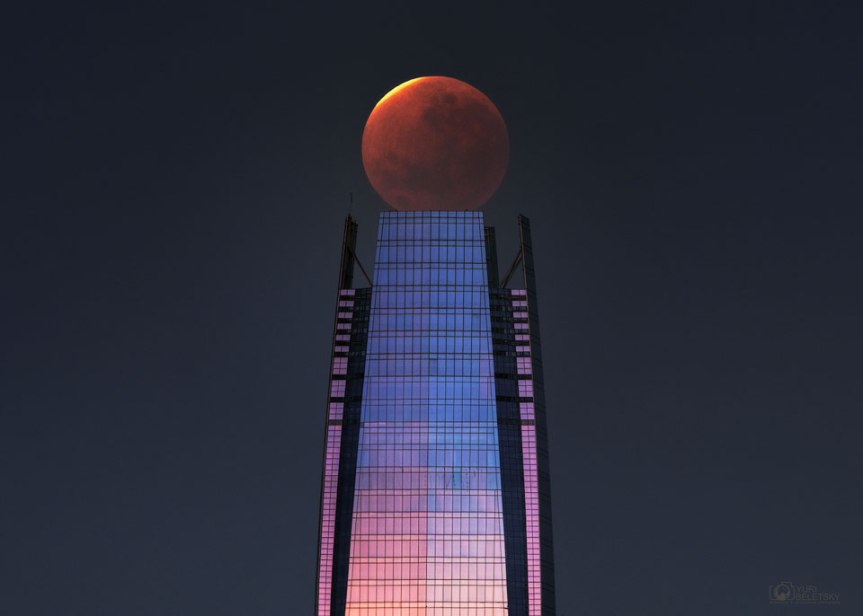
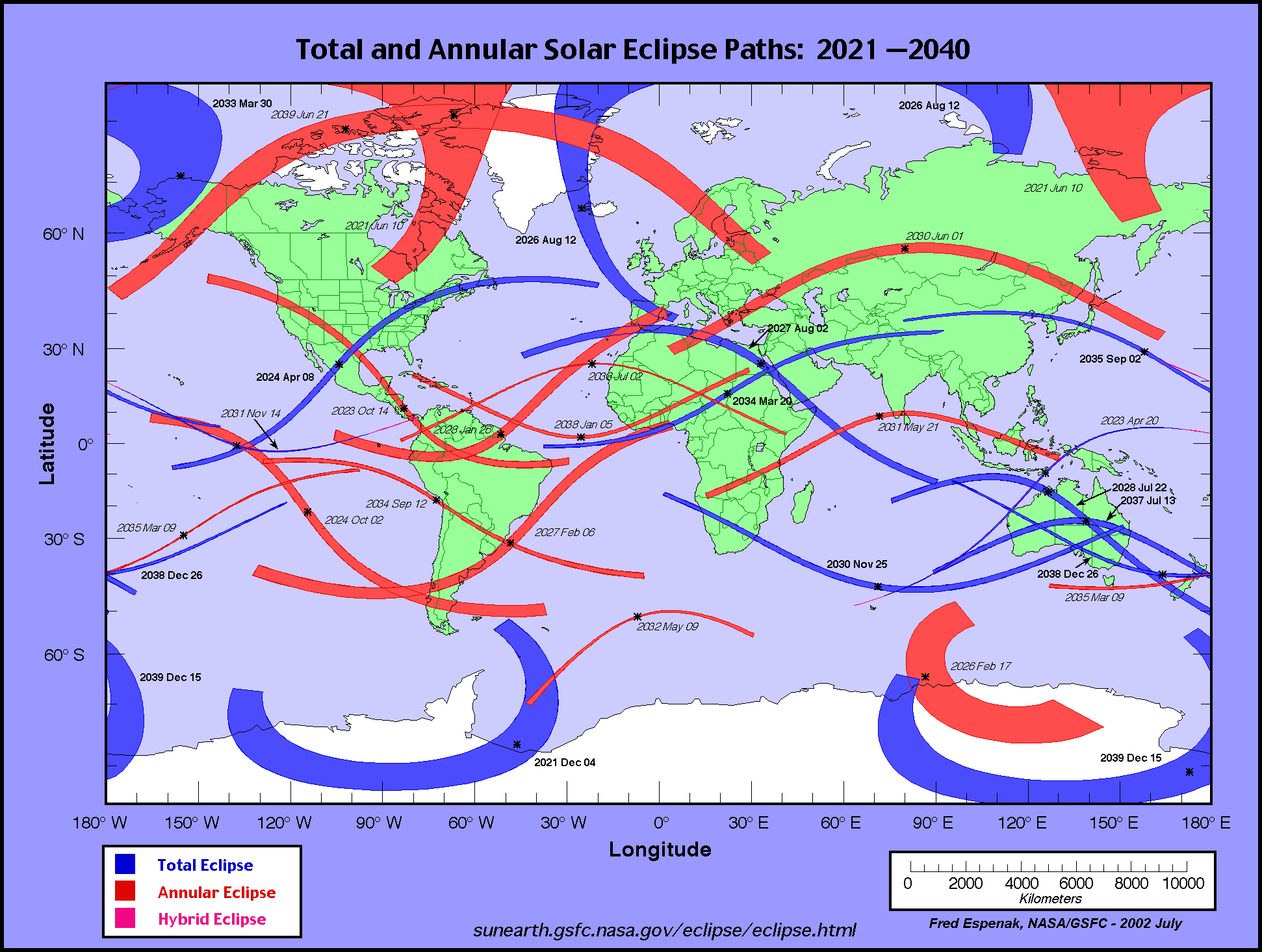
Explanation: Why is the Moon on top of this building? Planning. It took the astrophotographer careful planning — including figuring out exactly where to place the camera and exactly when to take the shot — to create this striking superposition. The single image featured was taken in the early morning hours of November 19, near the peak of the partial lunar eclipse that was occurring as the Moon passed through the Earth’s shadow. At this time, almost the entire Moon — 99.1 percent of its area — was in the darkest part of the Earth’s shadow. The building is the Gran Torre Santiago building in Chile, the tallest building in South America. Although the entire eclipse lasted an impressive six hours, this image had to be taken within just a few seconds to get the alignment right — the Earth’s rotation soon moved the building out of alignment. The next Earth-Moon eclipse will be a total eclipse of the Sun that will occur on December 4 — but only be visible from the bottom of our world.
APOD Editor (RJN) Online Monday: NASA’s Best Space Images (& Videos)
Notable APOD Submissions: Lunar Eclipse of 2021 November 19




You must be logged in to post a comment.