

Tag: Lughnasadh
Flashback 2004 Lammas
(This is written for the Northern Hemisphere in 2004. The date of August 7th is wrong for 2022 the Southern or Northern Hemisphere)
Lammas
Lammas is the first of the harvest festivals, a celebration of ripening grains and grapes. If you celebrate traditionally on the second, the planetary energies offer a for great creative energy, drama, and joy. If you celebrate on the astrologically on August 7 at 15 degrees of Leo, the Moon will aid a ceremony with great magic and mystery.
The Sun is wanning, but still holding sway in the sky. A day of circle dances and foot races will honor the Sun; be certain the music encourages exuberant joy. If you planted wheat in a pot or plot, this is the day to ritually harvest it. Use some to make a Brigid’s cross; save a few stalks to return to the earth as compost next spring and lend continuity from harvest to sowing to harvest.
If corn is your grain of choice, bring ripe ears to the altar and use the husks to make corn dollies for use at Imbolc. Indian corn can be dried, ground, and used in corn bread. Make a fiery incense with dragon’s blood and hot herbs like ginger or galangal. Do a ritual at a sacred spot — a well or tree or sacred hill. Use the colors of green and gold and orange for your altar, and encourage everyone to wear them. The harvest has just begun.
Copyright By K. D. Spitzer in Llewellyn’s Witches’ Datebook 2004 Page 89
Flashback 2000 Imbolc
Daylight hours are gradually lengthening, and the Earth is beginning to stir. Although she is still in the middle of her winter’s rest, our planet subtly begins to plan. It’s appropriate that this period is represented by Aquarius, an air sign, since all change begins first in the mind. Every new thought or idea is full of raw potential as the Earth is now,nailing for the touch of fire to ignite her new growth period. Uranus is the ruler of Aquarius, and the planet best known for its jurisdiction over the future. This electric energy only looks forward, never back. It is during Imbolc, in fact, as the Sun is passing through Aquarius, that many ideas are born. As we prepare for the upcoming Equinox, then, it’s important to be sure that we’re looking ahead, as Uranus does, with all the electric enthusiasm and genius of Aquarius. Honor the potential of the coming spring by uncovering your gift of prophecy. Whether you use a crystal ball, a dream journal, or another type of predictive tool, prepare for the Equinox in your heart, by understanding how much is possible now.
©️ By Kim Rogers-Gallagher Llewellyn’s Witches’ Datebook 2000 Page 95
Flashback 2000 Lammas
At Lammas, the Sun is at the very peak of Leo, the sign this planet loves above all others. Our star’s warmth is at its most powerful now in the Northern Hemisphere, as it appears directly overhead. At this time, life too, ia at its peak—as are the crops. The ancients celebrated this festival by giving thanks for their first harvest, most especially the grain harvest, even as they accepted the beginning of the God’s descent into the underworld. The myth of the asteroid-Goddess Ceres (Demeter), giver of the grain, also relates to this season. It was now when she would bid her daughter Farwell, since Persephone was obligated to return to the Underworld to rejoin Hades (Pluto). So bereaved was Ceres to see her daughter leave her, she refused to all the Earth to produce grain until her return. At this time,nothing, modern practitioners should be remind of both astrological principles: the fullness of life the Sun brings, and the necessity for rest, as signified by the coming fall.
©️ By Kim Rogers-Gallagher Llewellyn’s Witches’ Datebook 2000 Page 95
Summer Solstice Printable Coloring Pages

For Your Viewing Pleasure – Winter Solstice
For Your Listening PLeasure

Category Samhain/Deep Autumn
WE ARE THE ANCESTORS: MAY WE BE INTERESTING FOOD
May 9, 2020 · by Glenys D. Livingstone · in Samhain/Deep Autumn · Leave a comment Our present lives are formed by all who came before us. We are in-formed by them, whether conscious or not. In PaGaian Samhain ceremony as it has been done traditionally, participants are invited to remember the ancestors in this way: Let us remember our ancestors, those who have gone before, whose lives have been harvested, […]THREADS OF GOLD IN THE COMPOST
April 20, 2020 · by Glenys D. Livingstone · in Samhain/Deep Autumn · 2 Comments There are threads of gold in the compost, if one has the vision for it. And we may take the golden thread, exclaim the strongest natural fibre known – our creative selves, our imaginations – for the building of a new world made sacred, of our conceiving: yet beyond our knowings, across the vast Darkness between […] For more interesting article about Southern Hemisphere Samhain click hereLammas/Lughnasadh Blessings Sisters, Brothers, and Guests

May your harvest be plentiful growing from what you sowed on Imbolc.
Blessed be dear ones.
Imbolc Blessing

Celtic Tree Month – Coll – Hazel Moon August 5 – September 1
About the Celtic Tree Month – Coll (Hazel Moon): August 5 – September 1
“The lunar tree calendar of the Celts has long been a source of controversy among Celtic scholars. Some even claim it was never a part of the old Celtic world, but was an invention of author/researcher Robert Graves. The Druids are generally given credit by other researchers for creating this system. There seems to be no scholarly evidence to prove otherwise, yet many Celtic Pagans feel that the system pre-dates the time of Druidic influence over Celtic religious matters. It is probably reasonable to believe that the truth lies somewhere in between these three extremes. It is most likely that the tree system was in place, with minor regional variations before the time of the Druids who experimented with it, discovered the magical properties of each tree, and codified all the information into the system we have today.”
The Hazel Moon was known to the Celts as Coll, which translates to “the life force inside you.” This is the time of year when Hazelnuts are appearing on the trees, and are an early part of the harvest. Hazelnuts are also associated with wisdom and protection. Hazel is often associated in Celtic lore with sacred wells and magical springs containing the salmon of knowledge. This is a good month to do workings related to wisdom and knowledge, dowsing and divination, and dream journeys. If you’re a creative type, such as an artist, writer, or musician, this is a good month to get your muse back, and find inspiration for your talents. Even if you normally don’t do so, write a poem or song this month.
Source
Patti Wigington, Author
Published on ThoughtCo
Lughnasadh

Lughnasadh
The Celtic harvest festival on August 1st takes its name from the Irish god Lugh, one of the chief gods of the Tuatha De Danann, giving us Lughnasadh in Ireland, Lunasdál in Scotland, and Laa Luanys in the Isle of Man. (In Wales, this time is known simply as Gwl Awst, the August Feast.)
Lugh dedicated this festival to his foster-mother, Tailtiu, the last queen of the Fir Bolg, who died from exhaustion after clearing a great forest so that the land could be cultivated. When the men of Ireland gathered at her death-bed, she told them to hold funeral games in her honor. As long as they were held, she prophesied Ireland would not be without song. Tailtiu’s name is from Old Celtic Talantiu, “The Great One of the Earth,” suggesting she may originally have been a personification of the land itself, like so many Irish goddesses. In fact, Lughnasadh has an older name, Brón Trogain, which refers to the painful labor of childbirth. For at this time of year, the earth gives birth to her first fruits so that her children might live.
Tailtiu gives her name to Teltown in County Meath, where the festival was traditionally held in early Ireland. It evolved into a great tribal assembly, attended by the High King, where legal agreements were made, political problems discussed, and huge sporting contests were held on the scale of an early Olympic Games. Artists and entertainers displayed their talents, traders came from far and wide to sell food, farm animals, fine crafts and clothing, and there was much storytelling, music, and high-spirited revelry, according to a medieval eye-witness account:
“Trumpets, harps, hollow-throated horns, pipers, timpanists, unwearied…fiddlers, gleemen, bone-players and bag-pipers, a rude crowd, noisy, profane, roaring and shouting.”
This was also an occasion for handfasting, or trial marriages. Young men and women lined up on either side of a wooden gate in a high wall, in which a hole was carved, large enough for a hand. One by one, girl and boy would grasp a hand in the hole, without being able to see who was on the other side. They were now married, and could live together for year and day to see if it worked out. If not, the couple returned to next year’s gathering and officially separated by standing back to back and walking away from each other.
Throughout the centuries, the grandeur of Teltown dwindled away, but all over Ireland, right up to the middle of this century, country-people have celebrated the harvest at revels, wakes, and fairs – and some still continue today in the liveliest manner. It was usually celebrated on the nearest Sunday to August 1st, so that a whole day could be set aside from work. In later times, the festival of Lughnasadh was christianized as Lammas, from the Anglo-Saxon, hlaf-mas, “Loaf-Mass,” but in rural areas, it was often remembered as “Bilberry Sunday,” for this was the day to climb the nearest “Lughnasadh Hill” and gather the earth’s freely-given gifts of the little black berries, which they might wear as special garlands or gather in baskets to take home for jam.
As of old, people sang and danced jigs and reels to the music of melodeons, fiddles and flutes, and held uproarious sporting contests and races. In some places, a woman-or an effigy of one-was crowned with summer flowers and seated on a throne, with garlands strewn at her feet. Dancers whirled around her, touching her garlands or pulling off a ribbon for good luck. In this way, perhaps, the ancient goddess of the harvest was still remembered with honor.
Lammas, Lughnasadh, Summer Feast, First Harvest Celebration

Lammas, Lughnasadh, Summer Feast, First Harvest Celebration
1. Collect corn husks, dry and store in shade. “Corn” was a generic term for cereal crops (i.e., wheat, barley, oats), and New World corn was added after 1520. Our non-irrigated winter wheat is harvested in June and July where I live. We can collect wild wheat stalks and seeds, tie, and hang in shade. Make a corn dolly and keep until the Yule Celebration. We can pick fruit (apricots, berries, figs and plums) and dry them. Many kinds for fruit are ripe in late July, so place some of these on your home altar. Many garden herbs are at their peak and ready for harvesting to make herbal remedies, air fresheners, use in herbal magic, and for decoration. There are hundreds of good books and websites on the magical, sacramental, and health uses of herbs.
2. Read about and make a loaf of bread. Loaves of bread are a traditional part of the First Harvest Feast. Break bread into four pieces and place at each of the Four Corners altars. Lammas means “Loaf Mass” in the Welsh language. Sharing bread is a common feature of a Lammas celebration. What is the role of baking bread in human culture? Find a really good bakery in your area.
3. This is a good month for celebrating. We, in America, celebrate the Fourth of July, and many counties have their annual Fairs. Be try to be very thankful for our peaceful and bountiful life in America. We are thankful for our religious freedom and the 1st Amendment. Americanism and patriotism are forms of a popular religion – we should reflect on our symbols and heritage. Take a look at Ceisiwr Serith’s website and links on Americanism. Hang up the flags, sing, play, smile, celebrate. Remember our fallen heroes, brave soldiers, and hardworking Ancestors.
4. Prepare for the “Games” of the First Harvest Feast. The Greek Olympics and Roman Heracleia games were held at this time. What games might you play? Horseshoes, boche ball, races, swimmng races, croquet, volleyball, badminton, frisbee, baseball, wrestling, spear throwing, arrow shooting, weight tossing …. Get your equipment and playing court ready, and practice.
5. Renew supplies of your favorite ritual-recreational drug: coffee, tobacco, alcohol (whiskey, beer, wine), fuzzy herbs, etc.. Beer and whiskey, made from barley, are often part of joyful summer harvest feast celebrations. Read about the song John Barleycorn.
6. Think about the power of the sun. How can we use solar power? Dry your clothes in the sun. Build a simple box with screen so you can use the power of the summer sun to dry your fresh fruit.
7. Do some thinking, reflection, or discursive meditation on various themes. Here are some themes to reflect upon: What are the relations between Chaos, Gaia, and Eros? What role does more sunlight play in bringing forth the bountiful harvest? What does summertime mean to you?
8. Implement new ways to stay cool that use less electrical energy. Switch to an evaporative cooler in areas with low humidity. Keep all windows covered. Carefully place fans to circulate air indoors. Work early in the morning and rest in the hot afternoon. Drink plenty of water. If your nights are cooler, under 80, draw the cool air indoors at night. A gable fan can really help reduce heat indoors.
9. Check out astronomical details about the rising of the Dog Star, Sirius, in late July, and the beginning of the “Dog Days of Summer.”
10. The Celtic God, Luga (Lugh, Long Hand), is noted for his high level skills in many arts and crafts: smith, carpenter, bard, healer, herbalist, magician, gamesman, spear throwing, military leadership, etc. Get out your paintbrush. Fix something in the yard or garden or home. Tidy up the garden. Create something, make something. Start learning a new practical skill or craft. Clean your weapons and practice with the weapons.
11. Working and meditating in the garden is an important facet of my spiritual path. I need to regularly reconnect with the earth and the autumn season outdoors. I live in Red Bluff, California, USDA Zone 9, Northern Hemisphere. My late September gardening chores might be quite different from yours, depending upon where you live. Tend your garden daily. Water your garden each day. Weed your vegetable garden. Harvest squash, tomatoes, peppers and other vegetables from your garden each day. Review your own lists of chores for July and August, and act accordingly.
12. Read about Lammas, Lughnasadh, and summer festivals around the world. Add notes and links to books, magazines, and webpages on the subject. See my bibliography and links above. Visit your local public library or college library to obtain access to books, media and magazines on the subject. Study about ancient Indo-European religions. I update my Months webpages on July and September.
13. Add some appropriate Lammas, Lughnasadh, or Mid-Summer songs, chants, prayers, reflections, invocations, or poems to your Neo-Pagan Craft Journal, Book of Shadows, blog, website, or Ritual Handbook. Write in your personal journal. Most spiritual seekers keep a notebook, journal or log as part of their experimental, creative, magical and experiential work.
14. Stay at home. Improve your home, backyard, or garden. Eliminate long driving trips. Do you really need to “Go” anywhere? Do you really need to fly by airplane to another country? Explore your backyard, neighborhood, local community, nearby city, county wide area, regional area within 100 miles. Visit a local “sacred site.” For us, for example, this could be Mt. Shasta, the headwaters spring of the Sacramento River in Mt. Shasta City, the Sacramento River at Woodson Bridge Park, a long walk in the forest below nearby Mt. Lassen, sitting on the shore of Whiskeytown Lake, sitting in my backyard in the moonlight, or visiting a beautiful church or college or park that is nearby. Watch a DVD on a spiritual subject, sacred place, or inspirational topic. Learn more about your local environment.
15. Read solitary or group rites for Lughnasadh available in books and webpages (see above). Create your own ritual for Lughnasadh. Practice the ritual. Conduct the ritual at a convenient time for you, or your family and/or friends, as close to the day of the autumnal equinox as possible. Attend a public Mabon ritual of a local NeoPagan group.
16. A large fire is often lit in your safe outdoor fireplace as part of celebrating Lughnasadh. Take special care because many areas are quite dry in early August. Maybe use a few fireworks left over from the Fourth of July in America.
17. Thoroughly clean, dust, tidy up, refreshen, improve, and add appropriate seasonal decorations to your home altar. This should normally be clean and tidy, however an extra cleaning before the Lughnasadh celebration is a way to express your reverence, create a visible reminder of your thoughts and devotional practices, and to offer hospitality to the nature spirits, ancestors, and Shining Ones. If you don’t have a home altar, read some books and webpages about setting one up in your home or garden, and then establish one this holiday season.
Lughnasadh Celebrations
Legends and Lore of Lammas (Lughnasadh)

Legends and Lore of Lammas
(Lughnasadh)
In many cultures, there are different legends and lore surrounding Lammas (Lughnasadh). Here are a few of the stories about this magical harvest celebration from around the world.
In Israel, the festival of Shavout commemorates the beginning of the harvest, as well as honoring the date that Moses received the Torah on Mt. Sinai. The final sheaf of wheat is brought to the rabbi for a blessing, synagogues and homes are decorated with flower, and a great feast is prepared for all to enjoy.
The festival of Onam is celebrated in India, and people dress up in their finest clothes and give food to the poor. Onam is celebrated in honor of King Mahabali, who was a ruler of Kerala. In one story, the god Vishnu approached Mahabali dressed as a beggar, and asked for land, which Mahabali gave him. Mahabli ended up buried under the earth by Vishnu, but was allowed to return once a year, symbolizing the planting of the seed and the subsequent harvest.
Thor’s wife, Sif, had beautiful golden hair, until Loki the prankster cut it off. Thor was so upset he wanted to kill Loki, but some dwarves spun new hair for Sif, which grew magically as soon as it touched her head. The hair of Sif is associated with the harvest, and the golden grain that grows every year.
In the Shetland Islands, farmers believed that grain harvesting should only take place during a waning moon. They also believed this about the fall potato crop, and the cutting of peat.
At Lughnasadh, calves are weaned, and the first fruits are ripe, such as apples and grapes. In some Irish counties, it was believed farmers had to wait until Lughnasadh to start picking these fruits, or bad luck would befall the community.
In some countries, Lammas is a time for warrior games and mock battles. This may hearken back to the days when a harvest festival was held, and people would come from miles around to get together. What better way for young men to show off their strength and impress the girls than by whacking away at all the competition? Games and contests are also held in honor of Lugh, the mighty Celtic craftsman god, in which artisans offer up their finest work.
It’s become a custom to give people the gift of a pair of gloves at Lammastide. In part, it’s because winter is just around the corner, but it’s also related to an old tradition in which landowners gave their tenants a pair of gloves after the harvest. The glove is a symbol of authority and benevolence.
Source:
By Patti Wigington, Pagan and Wicca Expert
Article found on & owned by About.com
Lammas/Lughnasadh Ritual for Online Coven Gathering
Anyone attending our online coven gathering on Saturday, August 1, 2015 this will be the ritual we are following. Nothing is needed to participate in this ritual. For more information on where and when the gathering will take place please scroll down and click on the banner for Coven Life’s “Home” page. Any questions please email me at ladybeltane@aol.com
LAMMAS GATHERING
I will be closing the circle around us:
With my Sword pointed at the ground: I call upon Fire to guard this circle from all things negative outside of it.
With my Sword pointed at shoulder level: I call upon Water to keep this circle safe from all things negative.
With my Sword above head: I call upon Air to keep this circle safe from all things negative.
We enter this circle in perfect love and perfect trust. We stand in a place that is not a place. In a time that is not a time.
Calling the Watchtowers:
Lay sword on altar.
Facing East: Power of ancient dreams, ancestors of the mighty east
Come forth, O guardians of Air.
Let your wings of intelligence my protection be
Hear this call, let my words draw you near.
Lock the gate that none may pass unless
They come in love and trust. Blessed Be!
Facing South: Power of ancient dreams, ancestors of the mighty south
Come forth, O guardians of Fire.
May your firey breath cleanse my work.
Hear this call, let my words draw you near.
Lock the gate that none may pass unless
They come in love and trust. Blessed Be!
Facing West: Power of ancient dreams, ancestors of the mighty west
Come forth, O guardians of Water.
May your sweeping waters bring protection all around.
Hear this call, let my words draw you near.
Lock the gate that none may pass unless
They come in love and trust. Blessed Be!
Facing North: Power of ancient dreams, ancestors of the mighty north
Come forth, O guardians of Earth.
Let the North Star crown your brow.
Hear this call, let my words draw you near.
Lock the gate that none may pass unless
They come in love and trust. Blessed Be!
This circle is now closed around us and I say: We stand in a place that is not a place, in a time that is outside of time. I welcome you in perfect love and perfect trust. Merry Meet and Merry greet.
I invoke Mother Earth, her of bounty and beauty to come into our circle. I invoke the Lugh, he of craftsmanship in beauty and toil to come into our circle.
Waiting for the power to rise and the deities to enter.
Sitting before me is a loaf of bread made in the shape of a sickle. With it cradled in my hands:
“We thank Mother Earth, Air, Water, Fire and Earth for the grain and other things that made it possible to make this loaf.” (I tear a bite off to save for an offering, that I will place outside for all attending after we are through. Then put the loaf down)
I pick up my chalice: “Lugh we thank you for all the know how you have given us to make instruments for many purposes in our lives.” (I set the chalice back down so the first sip maybe poured on the ground as an offering to Lugh for all attending after we are done.)
Before dismissing the Watchtowers and opening the circle I say: May no harm come to those within or without as we honor this goddess, god, and the elements of Air, Water, Fire and Earth.
I dismiss the Watchtowers starting in the North and walking counter clockwise/witthershins.
Earth I now send you back for where you came with thanks for your protection and power you have given this circle.
Water I now send you back for where you came with thanks for your protection and power you have given this circle.
Fire I now send you back for where you came with thanks for your protection and power you have given this circle.
Air I now send you back for where you came with thanks for your protection and power you have given this circle.
Walking counter clockwise/witthershins
Holding my sword above my head Air I send you back from where you came with heartfelt thanks for your protection.
Holding my sword at should height Water I send you back from where you came with heartfelt thanks for your protection
Holding my sword towards the ground Fire I send you back from where you came with heartfelt thanks for your protection
The circle is now closed. May you go from it with peace and love. Merry part until we Merry meet again.
All About Lammas (Lughnasadh)
- It’s the dog days of summer, the gardens are full of goodies, the fields are full of grain, and the harvest is approaching. Take a moment to relax in the heat, and reflect on the upcoming abundance of the fall months. At Lammas, sometimes called Lughnasadh, it’s time to begin reaping what we have sown throughout the past few months, and recognize that the bright summer days will soon come to an end.
-
Lammas History: Welcoming the Harvest
The Beginning of the Harvest:
At Lammas, also called Lughnasadh, the hot days of August are upon us, much of the earth is dry and parched, but we still know that the bright reds and yellows of the harvest season are just around the corner. Apples are beginning to ripen in the trees, our summer vegetables have been picked, corn is tall and green, waiting for us to come gather the bounty of the crop fields.
Now is the time to begin reaping what we have sown, and gathering up the first harvests of grain, wheat, oats, and more.
This holiday can be celebrated either as a way to honor the god Lugh, or as a celebration of the harvest.
Celebrating Grain in Ancient Cultures:
Grain has held a place of importance in civilization back nearly to the beginning of time. Grain became associated with the cycle of death and rebirth. The Sumerian god Tammuz was slain and his lover Ishtar grieved so heartily that nature stopped producing. Ishtar mourned Tammuz, and followed him to the Underworld to bring him back, similar to the story of Demeter and Persephone.
In Greek legend, the grain god was Adonis. Twogoddesses, Aphrodite and Persephone, battled for his love. To end the fighting, Zeus ordered Adonis to spend six months with Persephone in the Underworld, and the rest with Aphrodite.
A Feast of Bread:
In early Ireland, it was a bad idea to harvest your grain any time before Lammas — it meant that the previous year’s harvest had run out early, and that was a serious failing in agricultural communities.
However, on August 1, the first sheaves of grain were cut by the farmer, and by nightfall his wife had made the first loaves of bread of the season.
The word Lammas derives from the Old English phrase hlaf-maesse, which translates to loaf mass. In early Christian times, the first loaves of the season were blessed by the Church.
Honoring Lugh, the Skillful God:
In some Wiccan and modern Pagan traditions, Lammas is also a day of honoring Lugh, the Celtic craftsman god. He is a god of many skills, and was honored in various aspects by societies both in the British Isles and in Europe. Lughnasadh (pronounced Loo-NAS-ah) is still celebrated in many parts of the world today. Lugh’s influence appears in the names of several European towns.
Honoring the Past:
In our modern world, it’s often easy to forget the trials and tribulations our ancestors had to endure. For us, if we need a loaf of bread, we simply drive over to the local grocery store and buy a few bags of prepackaged bread. If we run out, it’s no big deal, we just go and get more. When our ancestors lived, hundreds and thousands of years ago, the harvesting and processing of grain was crucial. If crops were left in the fields too long, or the bread not baked in time, families could starve. Taking care of one’s crops meant the difference between life and death.
By celebrating Lammas as a harvest holiday, we honor our ancestors and the hard work they must have had to do in order to survive. This is a good time to give thanks for the abundance we have in our lives, and to be grateful for the food on our tables. Lammas is a time of transformation, of rebirth and new beginnings.
Symbols of the Season
The Wheel of the Year has turned once more, and you may feel like decorating your house accordingly. While you probably can’t find too many items marked as “Lammas decor” in your local discount store, there are a number of items you can use as decoration for this harvest holiday.
Crafts, Song and Celebration
Because of its association with Lugh, the skilled god, Lammas (Lughnasadh) is also a time to celebrate talents and craftsmanship. It’s a traditional time of year for craft festivals, and for skilled artisans to peddle their wares. In medieval Europe, guilds would arrange for their members to set up booths around a village green, festooned with bright ribbons and fall colors. Perhaps this is why so many modern Renaissance Festivals begin around this time of year!
- Sickles and scythes, as well as other symbols of harvesting
- Grapes and vines
- Dried grains — sheafs of wheat, bowls of oats, etc.
- Corn dolls — you can make these easily using dried husks
- Early fall vegetables, such as squashes and pumpkins
- Late summer fruits, like apples, plums and peaches
Lugh is also known in some traditions as the patron of bards and magicians. Now is a great time of year to work on honing your own talents. Learn a new craft, or get better at an old one. Put on a play, write a story or poem, take up a musical instrument, or sing a song. Whatever you choose to do, this is the right season for rebirth and renewal, so set August 1 as the day to share your new skill with your friends and family.
By: Patti Wigington
-
Gods – OgmaCeltic God c.2015
Ogma
Celtic God
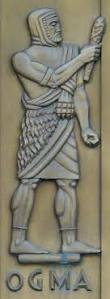
In Irish-Celtic myth, Ogma is the god of eloquence and learning. He is the son of the goddess Danu and the god Dagda, and one of the foremost members of the Tuatha Dé Danann. He is the reputed inventor of the ancient Ogham alphabet which is used in the earliest Irish writings.
In the final battle at Mag Tuireadh he managed to take away the sword of the king of the Fomorians, but had to pay with his life for this feat. His Celtic equivalent is Ogmios.
Ogma or Oghma is a character from Irish mythology. A member of the Tuatha Dé Danann, he is often considered a deity and may be related to the Gaulish god Ogmios.
He fights in the first battle of Mag Tuired, when the Tuatha Dé take Ireland from the Fir Bolg. Under the reign of Bres, when the Tuatha Dé are reduced to servitude, Ogma is forced to carry firewood, but nonetheless is the only one of the Tuatha Dé who proves his athletic and martial prowess in contests before the king. When Bres is overthrown and Nuadu restored, Ogma is his champion. His position is threatened by the arrival of Lugh at the court, so Ogma challenges him by lifting and hurling a great flagstone, which normally required eighty oxen to move it, out of Tara, but Lugh answers the challenge by hurling it back. When Nuadu hands command of the Battle of Mag Tuired to Lugh, Ogma becomes Lugh’s champion, and promises to repel the Fomorian king, Indech, and his bodyguard, and to defeat a third of the enemy. During the battle he finds Orna, the sword of the Fomorian king Tethra, which recounts the deeds done with it when unsheathed. During the battle Ogma and Indech fall in single combat, although there is some confusion in the texts as in Cath Maige Tuired Ogma, Lugh and the Dagda pursue the Fomorians after the battle to recover the harp of Uaitne, the Dagda’s harper.
He often appears as a triad with Lugh and the Dagda, who are sometimes collectively known as the trí dée dána or three gods of skill, although that designation is elsewhere applied to other groups of characters. His father is Elatha and his mother is usually given as Ethliu, sometimes as Étaín. His sons include Delbaeth and Tuireann. He is said to have invented the Ogham alphabet, which is named after him.
Scholars of Celtic mythology have proposed that Ogma represents the vestiges of an ancient Celtic god. By virtue of his battle prowess and invention of Ogham, he is compared with Ogmios, a Gaulish deity associated with eloquence and equated with Herakles. J. A. MacCulloch compares Ogma’s epithet grianainech (sun-face) with Lucian’s description of the “smiling face” of Ogmios, and suggests Ogma’s position as champion of the Tuatha Dé Danann may derive “from the primitive custom of rousing the warriors’ emotions by eloquent speeches before a battle”, although this is hardly supported by the texts. Scholars such Rudolf Thurneysen and Anton van Hamel dispute any link between Ogma and Ogmios.
*
A Proto-Indo-European root *og-mo– ‘furrow, track, incised line’ may be the origin of the stem of the name. In addition, Proto-Celtic had a causative verbal suffix *-ej– ~ *-īj-. A hypothetical Proto-Celtic *Ogm-īj-o-sogm-. This agent noun would therefore mean ‘furrow-maker, incisor’ and may have had a metaphorical sense of ‘impresser.’ therefore looks very much like an agent noun derived from a verb formed by the addition of this causative suffix to the stem *
The Irish god of writing, eloquence and poetry. Ogma was credited of being inventor of the Celtic writing systems that the Druids used for their magic. These scripts were known as Ogham.
Ogma was the son of Dagda and the goddess Danu. Some other writers say that Ogma and Dagda were brothers; in this version they were the sons of Eithne. Ogma had also being called the son of Elatha, the king of the Fomorians.
Ogma was one the seven champions in the First Battle of Moytura (Mag Tuired), but when Bres became the king of Tuatha dé Danann, Ogma was degraded into working on humiliating manual job of gathering firewood.
When Lugh went to Nuada, asking for a place to serve the king, Ogma seemed to be Nuada’s foremost fighter. During the second battle of Moytura, Ogma had killed one of the Fomorian leaders, named Indech, the son of Domnu.
Ogma had married Etain, the daughter of Dian Cécht. Ogma had a son named Caipre. Some say that he was the father of MacCuill, MacCecht and MacGrené (MacGrene), the three Danann kings who ruled Ireland, during the Milesian invasion, though other say that Neit was their father.
To the Celtic Gauls he was called Ogmios. According to both Gallic and Irish myths Ogma was a warrior god, depicted as a wrinkled old man, wearing lion’s skin cloak, carrying a bow and club. The Romans considered Ogmios as the Celtic equivalent of Hercules (Greek Heracles). They also depicting Ogimos as holding people chained to his tongue by their ears, to indicate he was the god of eloquence and poetry.
Author: Agaliha
Website: Deity of the Week
Instant Witch
Instant Witch

Author: Stephanie Arwen
Gotcha! Now you know there is no $19.95 wayof being a Witch, don’t you? Sit down; take a breath…now that you havefound something you want you want it yesterday! I understand. I can rememberwhen I started. I remember that sense of urgency I got. That “I have toget there right now” I have to be just like Z. Budapest, Starhawk, Margo!I wanted to meet them. I wanted to talk to them yesterday! But most ofall and worst of all, I wanted to be them. Put pushing the river isn’tgoing to get you there any faster. And where is there anyway?
Seventeen years down the road now and I cansay to you that you will NEVER be a Z a Starhawk a Margot a Silver Ravenwolf, a D.J. Conway, a Scott Cunningham. Oh no, you can’t be them. You can onlybe you. And that you is going to be a beautiful thing!
So I was 20 and I finally knew what I wantedto be when I grew up, but no one could give me enough information. I wasneither as fortunate nor as cursed as you are in today’s world of a dozenbooks per subject. Fortunate because you can go into almost any Barnesand Noble, Waldenbooks, or even Amazon.com and just pick up a book. Doyou have any idea how hard that was in 1981? Finding a copy of ZsuzsannaBudapest’s The Holy Book of Women’s Mysteries, pt 1 was an experience.I was living in Louisiana at the time and a friend had introduced me toStarhawk’s The Spiral Dance. I was hooked. I am also a bibliography reader.If an author I like mentions a book, then I want to get my hands on thatbook and see what it is about!
But you are cursed as well because thereis so much witchcrap out there. So many people who have written books thatare a total waste of paper. But the books that I think are a waste of papermay be the ones that speak best to you. That is a clue, my new Witch friend.Never let me or anyone else tell you that a book is useless. Learn to readfor yourself and think critically while you read. Does the author makesense or is there a nagging feeling you have that this person is a completeflake? If there is, then do yourself a favor and research the subject.You don’t think that author woke up one morning and knew everything therewas to know about their subject do you? Patricia Telesco, one of my favoriteauthors, has a page on her website that tells new authors to plan for 800hours per book. And that 800 hours includes research as part of it! Soif Ms. Telesco must research, why shouldn’t you?
The web has wonderful places for that kindof research, but don’t forget your local library! Find authors you admire.Then try to discover why you like them. Is it because they have writtenbooks period? Or is it in the way that they deliver their information?Dorothy Morrison has a style that I adore! She is personable and approachablein her books as well as accurate and knowledgeable. Or you might preferFrancesca De Grandis style that has the feel of teacher walking with herstudent and talking.
And don’t just read websites! A website ownercan be someone with less knowledge than you but has the ability and know-howto scan books and copy things wholesale without credit. Don’t be takenin. Go to your local library (you remember, that large brick building onthe corner?) and check out books on anthropology, archaeology, history, etc. Learn where our roots come from. And please, don’t let someone tellyou Wicca is an ages-old religion! It is not. It is a new religion. I liketo say Wicca is a new dress on a very old set of bones. We do have someancient roots, but the branches we have today are new. But you have tolearn to let the urgency not rule you. Do read everything you can get yourhands on. Read “Witch” books. Read all the books! But don’t forget to takeyour salt cellar with you.
Huh? Arwen? What the heck are you talkingabout and what is a salt cellar?
Your Salt Cellar is that thing you carrysalt in so you will always have a grain of salt to take things with. Don’taccept something simply because it is published in a book or on the web.Learn to believe in yourself. Learn to listen to your inner voice. Theone telling you that maybe what you just read is a load of manure …ormaybe it is saying that there is a pearl in that load of manure. Trustin the reality of self. I can’t stress this enough. If you will give yourselfthe tools of knowledge and discernment, then you can begin to hear thetruth in things as well as the lies and mistakes. Do listen to what otherssay about books, but don’t take their word for it. Figure it out for yourself.
The sense of urgency you feel now may makeyou too intent on getting there. But, here is the question. Where is there?Are you so focused on your race to the finish that you are not enjoyingthe journey? Be too intent on getting there wherever there is and not intentupon enjoying the journey and the journey will pass you by! I don’t knowif this message will reach you, but I am 38 (b. 1961). I began my journeyon the path to Wicca in 1981 (or 2). That was 17 years ago. I am stillon the journey of getting there. I will always be on that journey. Learnto enjoy the Trip. There is no there. When you get there, you will havereached the end and that means starting again.
Once you learn that the journey is the meansand the end, then you realize how much more you have to learn.
I wish you good fortune on your travels.A part of me wishes I was at the beginning again, but most of me is quitecontent to be where I am. I am still experiencing new thoughts, new thingsand new people on a daily basis. Remember to enjoy the trip. Oh, and don’tforget to send a postcard from some of those exotic places you visit.
Ok, for those of you who still want all theanswers.
All The Answers ™
Red, blue, green, yellow, white, Hallows, Samhain, Winter Solstice, Yule, Candlemas, Brigidmas, Imbolg, Vernal Equinox, Spring Equinox, Ostara, Beltain, Mayday, Lady’s Day, Beltaine, Litha, Midsummer, Summer Solstice, Longest Day of the Year, Lammas, Lugh’s Feast, Lughnassadh, Autumnal Equinox, Mabon, cakes and wine, Heiros Gamos, 42, North, East, South, West, Water, Fire, Air, Earth, Center, Above, Below, salamander, dragonfly, snake, dolphin, Raven, Morgan, WildHawk, Hawkdatter, OakStandingTall, cat, dog, frog, toad, A, B, C, D, All Of The Above, True, False, myrrh, frankincense, pine, oak, holly, Cerridwen, Cernnunos, Herne, Hecate, Isis, Tammuz.
Now…you have to supply the questions.
Arwen NightstarThe Instant Witch Graphic was done by Andra (webmistress for http://www.spiritonline.com) This graphic is one she made in response to a flurry of “insta-witch” questions she received on her discussion board Spirit Online, an interactive resource for those interested in understanding and discussing religion and metaphysics.

A Little Rhyme That Ties Candlemas/Imbolc to Groundhog’s Day

“If Candlemas Day be fair and bright,
Winter will have another flight;
If on Candlemas Day be shower and rain,
Winter is gone, and will not come again.”
Alternately…
“If the sun shines bright on Candlemas Day,
The half of the winter’s not yet away.”
**Author Unknown**
Imbolc: Traditional Celebrations for a Modern Time
Imbolc: Traditional Celebrations for a Modern Time
Author: Morgan
This holiday is called many names including Imbolc, Oímealg, Lá Fhéile Bríde, Laa’l Breeshey, and Gwyl Mair Dechrau’r Gwanwyn and was originally celebrated when the ewes first began to lactate. Some older sources mention Imbolc being celebrated on February 13th, although now the date is fixed on February 2nd. This holiday is a celebration of the loosening of winters hold on the land and the first signs of spring’s immanent arrival. Three main types of ceremonies could be undertaken – purification with water, blessing with fire, and consecration of talismans or charms. In addition, the main ritual theme centered on inviting the goddess Brighid into the home, either in effigy or in the form of a person acting the part.
The fire represents the growing light of the sun. Candles are lit to celebrate the increased daylight, and often candles were blessed for use in the year to come; this connection to candles offers another alternate name for the holiday, Candlemas. In my personal practice I light special “sun” candles, and bless my candleholders for the year to come.
Ritual washing was done to cleanse and prepare the people for the agricultural work of the coming seasons. Water was blessed and then used to ceremonially wash the head, hands, and feet. Each year when I do this, I dip my fingers in the blessed water and run them over the body parts in question, asking that I be cleansed of winter’s cold and filled with summer’s warmth to work towards a new season. Then I pour the remaining water out onto the earth thanking Brighid for her blessing.
The main charms and talismans of Imbolc are related to Brighid. First there is the Brighid’s cross, a woven sun wheel shape which represented the cycle of the year and the four main holy days, according to the book Apple Branch. On Imbolc, you can weave new Brighid’s crosses, or bless ones you already have, although it may be better to burn the old and weave new each year when possible. A Brighid’s cross is protective and healing to have in the home.
A second talisman is the brídeóg, or “little Brighid” a small cloth or straw doll wearing white clothes which is an effigy of the goddess. In some cases, the brídeóg would be made from straw saved from the previous Lughnasadh. This doll played a role in ritual after being brought outside, usually carried by the eldest daughter, then invited to enter the home where it was led with all ceremony to a specially prepared little bed. The doll was left in the bed over night and its presence was believed to bless all those in the household.
Another talisman connected to Imbolc is Brigid’s mantle, or an brat Bríd, a length of cloth left out on the window sill over the course of the holy day and night. It is believed that this cloth absorbs the energy of the goddess during the ritual, and can be used for healing and protection throughout the year. This talisman would be kept and recharged every year, attaining full power after seven years.
The ritual for Brighid on Imbolc centers on inviting the goddess in and offering her hospitality. In some cases a woman was chosen to play the part of the goddess, in other cases the brídeóg was used. The door would be opened to her and she would loudly be invited in, shown to her “bed” and offered specially baked bread. Candles would be lit at the windows and next to her “bed”, songs would be sung and prayers said calling on Brighid to bless all present in the coming seasons, and grant health and protection to the household.
A small broom or white wand would be placed next to the “bed”, and the ashes from the fire would be smoothed down in the hopes that the morning would reveal the marks of the wand, or better yet, the footprints of the goddess herself, either of which would be a sign of blessing. Placing the doll in her bed at night would be followed by a large family meal.
In Scotland a hundred years ago when entire communities still celebrated Imbolc in the old way, a sheaf of corn would be dressed as Brighid and taken from house to house by the young girls. The girls would carry the doll from home to home where the “goddess” would be greeted and offered food and gifts. After visiting each home, the girls would return to the house they started from where a party would be held with music, dancing, and feasting until dawn; all the leftover food would be handed out to the poor the next day.
Other rituals involve blessing the forge fires for blacksmiths and Otherworld divinations. In some Scottish mythologies, it is believed that Brighid is held by the Cailleach Bhur during the winter months but escapes, or is rescued by her brother Aonghus mac óg, on Imbolc. In others, it is said the Cailleach drinks from a hidden spring and transforms into Brighid on this day.
For modern people seeking to celebrate Imbolc in a traditional way, there are many options. Rituals can be adapted to feature the brídeóg. If you celebrate in a group, you could have one person wait outside with the doll while the other members prepare her bed, and then the group leader could go to the doorway and invite the goddess in. This could even be modified for use in an urban setting with the brídeóg “waiting” out in a hallway or separate room to be invited in.
Once invited in the goddess can be offered food and gifts as was done in Scotland and stories about Brighid from mythology could be told. Water can be used for purification; blessing with fire or of candles can be done, as well as making and consecrating the charms associated with Brighid. After ritual, the doll could be left in the bed while the group celebrates with a party; to keep the spirit of the way this was done for a modern time all members should bring food to donate to a local food pantry. A solitary celebration could still include inviting the goddess in, placing the brídeóg in her bed, making offerings to her, and a private celebration and food donations.
Imbolc is a powerful holy day with many beautiful traditions. By understanding how this day was celebrated in the past, we can find ways to incorporate those methods into modern practice and preserve the traditions that have surrounded Brighid’s day for so many generations
____________________________
Footnotes:
Carmichael, A. (1900) . Carmina Gadelica. Floris books. ISBN-10 0-86315-520-0
Evert Hopman, E. (1995) . A Druid’s Herbal of the Sacred Earth Year. Destiny Books ISBN 0-89281-501-9
Kondrariev. K. (1998) . The Apple Branch: A Path to Celtic Ritual. Citadel Press ISBN 0-8065-2502-9
McNeill, F. (1959) . The Silver Bough, volume 2. McLellan and Co.


You must be logged in to post a comment.